I
Species Profile

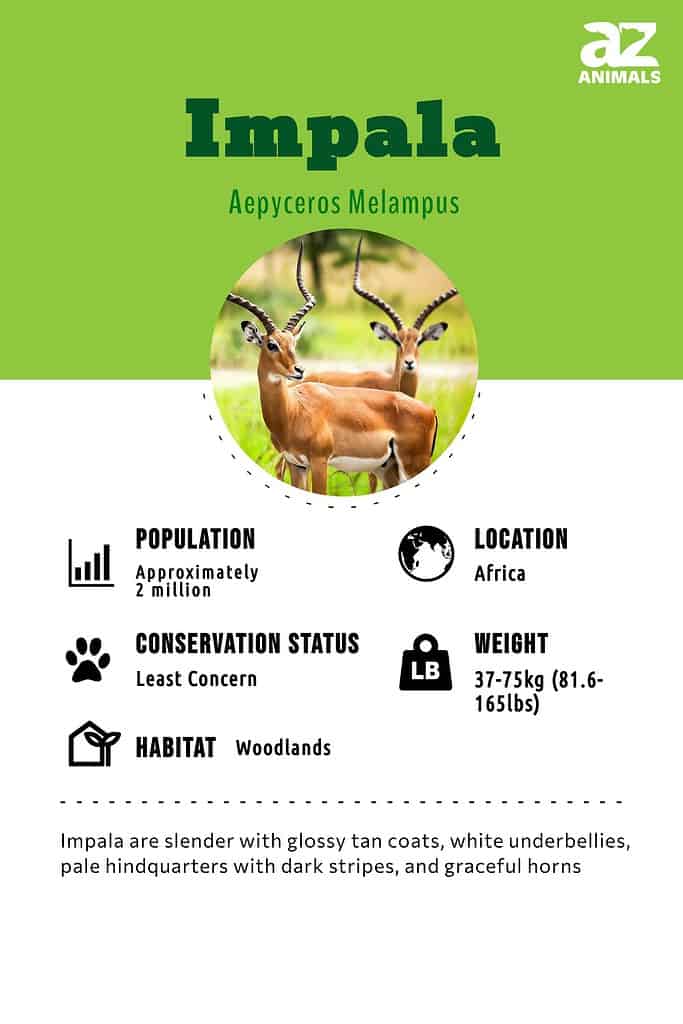
Impala

Aepyceros melampus

Built for speed-born to bound.
Svdmolen / Creative Commons

Impala Distribution

Click a location to explore more animals from that region

Loading map...

Size Comparison

Human 5'8"
Impala 2 ft 7 in

Impala stands at 46% of average human height.

At a Glance

Wild Species
Diet Herbivore
Activity Diurnal+
Lifespan 12 years
Weight 76 lbs
Status Least Concern
Did You Know?

Only males carry horns-lyre-shaped, heavily ringed, typically ~45-92 cm long.

Scientific Classification

The impala is a medium-sized African antelope known for its agility and fast, bounding leaps. It is a common savanna and woodland ungulate and a key prey species for many African predators.

Kingdom
Animalia
Phylum
Chordata
Class
Mammalia
Order
Artiodactyla
Family
Bovidae
Genus
Aepyceros
Species
Aepyceros melampus

Distinguishing Features

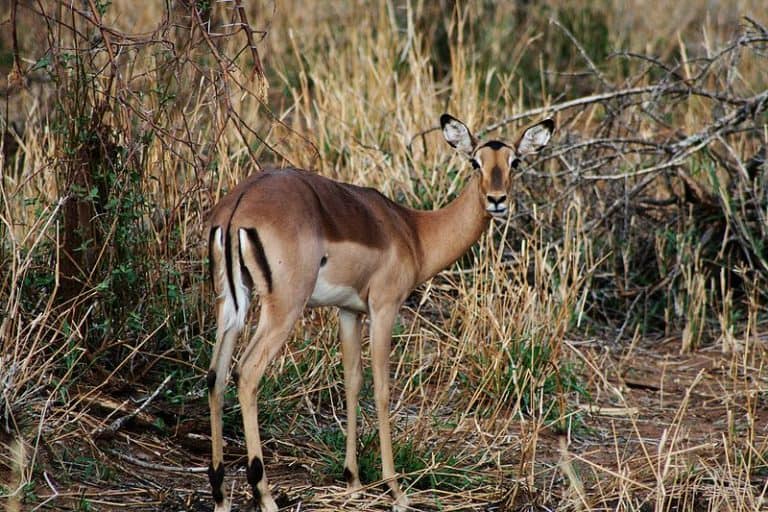
  • Reddish-tan coat with pale underside and contrasting black markings (including a black tail stripe)
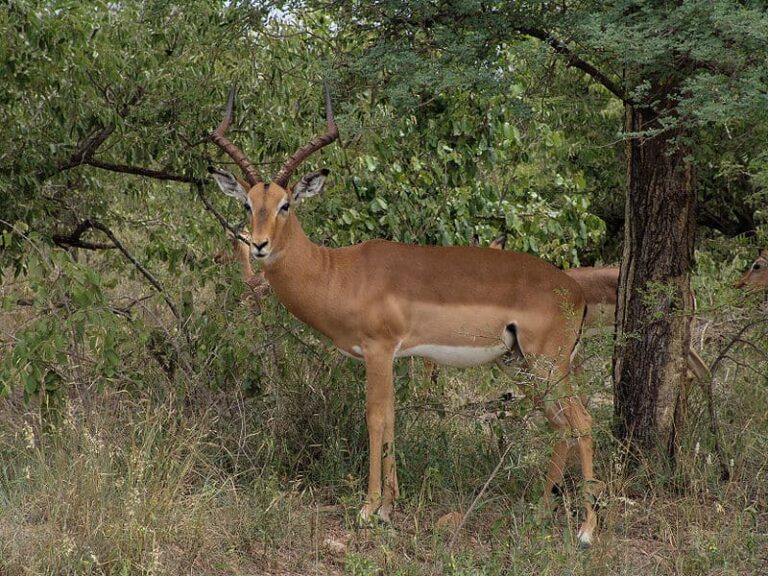
  • Long, ringed, lyre-shaped horns in males (females typically hornless)
  • Notable for high-speed running and characteristic pronking/leaping behavior
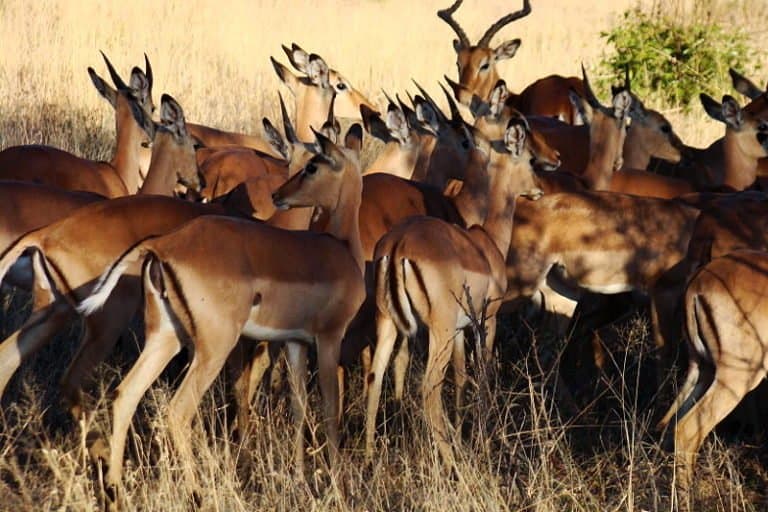
  • Often seen in mixed-sex herds; males may form bachelor groups or defend territories in breeding season

Physical Measurements

Males and females differ in size

Height
2 ft 9 in (2 ft 6 in – 3 ft)
2 ft 7 in (2 ft 6 in – 2 ft 9 in)
Length
5 ft 10 in (4 ft 11 in – 6 ft 9 in)
5 ft 5 in (4 ft 11 in – 5 ft 9 in)
Weight
142 lbs (117 lbs – 168 lbs)
104 lbs (88 lbs – 117 lbs)
Tail Length
1 ft 3 in (12 in – 1 ft 6 in)
12 in (10 in – 1 ft 2 in)
Top Speed
50 mph
Impala top speed ~80 km/h

Appearance

Primary Colors
Tan
Secondary Colors
Skin Type Mammalian skin with short, sleek guard hair and dense underfur (a smooth, close coat rather than shaggy), typical of a medium-sized African bovine antelope; hair lies flat and emphasizes the animal's streamlined running profile.
Distinctive Features
  • Impala (Aepyceros melampus) is a medium-sized African antelope of savanna and open woodland. It often forms herds and is a main prey for lions, leopards, cheetahs, African wild dogs, and hyenas.
  • Shoulder height: adult males ~75-92 cm; adult females ~70-85 cm (commonly reported ranges in standard field references) (Estes, 2012; Kingdon, 2015).
  • Body mass: adult males ~40-76 kg; adult females ~30-53 kg (Estes, 2012; Kingdon, 2015).
  • Characteristic head and rump markings: white underparts and rump patch contrasted by black rump lines and a black-tipped tail tuft; ear tips are black, aiding visual signaling within herds.
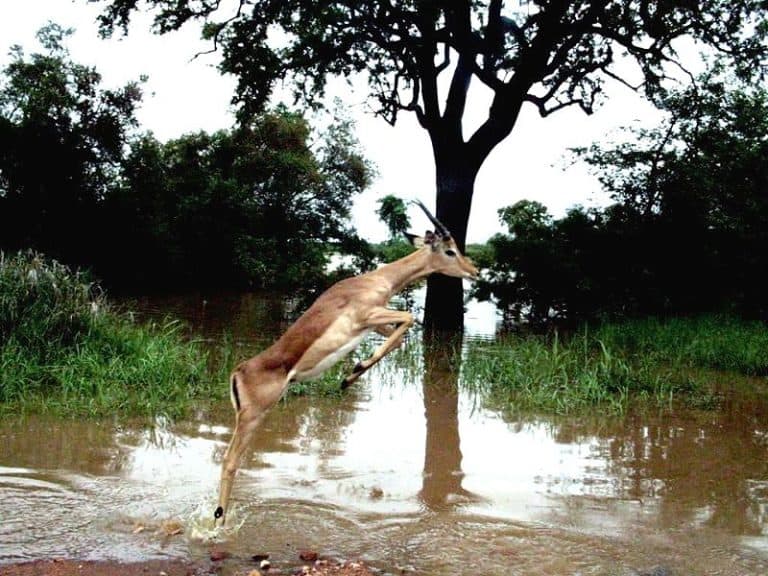
  • Escape/locomotion behavior strongly tied to appearance: famous for agile, stiff-legged bounding ('pronking') and long leaps; frequently reported capable of leaps ~3 m high and ~10 m long during alarmed flight (Estes, 2012).
  • Speed and evasive running: frequently cited sprint capacity up to ~80-90 km/h during predator evasion, with rapid directional changes facilitated by long, slender limbs (Estes, 2012; Kingdon, 2015).
  • Typical longevity: commonly cited ~13 years in the wild; up to ~17 years in captivity (values reported in major mammal reference works/field guides) (Estes, 2012; Kingdon, 2015).

Sexual Dimorphism

Marked sexual dimorphism: males are generally larger and bear horns; females are hornless. Male horns are distinctive-lyre-shaped, strongly ridged/ringed, and swept back then forward, used in rutting displays and combat (Estes, 2012; Kingdon, 2015).

  • Horns present (female hornless); horns lyre-shaped with prominent transverse rings (annulations), typically ~45-92 cm in length in adult males (reported ranges vary by population) (Estes, 2012; Kingdon, 2015).
  • On average larger/heavier than females (adult males commonly ~40-76 kg vs females ~30-53 kg) (Estes, 2012).
  • Often shows slightly thicker neck and more pronounced dark facial/neck accents, especially in dominant/rutting males (field-observed trait noted in standard references).
  • Rutting behavior: males establish and defend territories or temporary rutting stands; horn use and visual displays (head high, lateral postures) are prominent and rely on the species' high-contrast markings for signaling (Estes, 2012).
  • No horns; slimmer head profile and generally smaller body size (adult females commonly ~70-85 cm shoulder height and ~30-53 kg) (Estes, 2012; Kingdon, 2015).
  • Typically forms and remains in female/juvenile herds; visual cohesion aided by uniform tan/white coloration and rump patch patterns during coordinated flight responses.

Did You Know?

Only males carry horns-lyre-shaped, heavily ringed, typically ~45-92 cm long.

Can sprint about 80-90 km/h and change direction quickly to evade predators.

Famous for "pronking/stotting": stiff-legged bounding that can reach ~3 m high and ~10 m long.

A "mixed feeder": shifts from grazing to browsing seasonally as grass quality drops.

Gestation is ~194-200 days (about 6.5 months), usually producing a single fawn.

Social system cycles through female herds, bachelor groups, and rut-season territorial males.

Unique Adaptations

  • Extreme escape biomechanics: light build and elastic tendons support rapid acceleration, sharp turning, and long, high bounds (up to ~3 m high, ~10 m long).
  • Sexual dimorphism in weaponry: male-only horns used for sparring and dominance; the lyre shape helps absorb impact and lock during contests.
  • Scent communication: males use scent glands (including on the forehead and legs) to mark territories and signal status to rivals and females.
  • Dietary flexibility: can switch between grasses and browse (leaves, forbs) across seasons-key for thriving in savanna-woodland mosaics.
  • Group living as anti-predator strategy: large herds increase vigilance and dilute individual risk; rapid follow-the-leader flight improves escape success.

Interesting Behaviors

  • Pronking/stotting during alarm: repeated high, stiff-legged leaps that advertise fitness and confuse predators during chases.
  • Rut territoriality (seasonal): mature males defend territories and attempt to "hold" passing female groups; non-territorial males form bachelor herds.
  • Allomothering and crèches: females may cluster fawns, and newborns often "hide" for days to weeks, relying on camouflage and stillness.
  • Alarm communication: loud snorts and coordinated flight; herds often follow the first animals to break away, producing rapid group-level escape waves.
  • Flexible daily activity: typically crepuscular (dawn/dusk), but adjusts with temperature, water availability, and predation pressure.
  • Seasonal breeding synchronization: births often peak to align with periods of higher forage quality, boosting fawn survival.

Cultural Significance

Across eastern and southern Africa, the impala (Aepyceros melampus) is a famous safari animal, shown in art and tourism, important for local food and legal sport hunting, and named in global culture (e.g., Chevrolet Impala) for its speed and grace.

Myths & Legends

Name-origin tradition: "impala" is widely traced to Nguni languages (often cited from Zulu usage), becoming the common English name as colonial-era natural history adopted local terms.

Southern African storytelling and proverb themes often use swift antelope as stock symbols of agility, alertness, and narrow escape-traits strongly associated with the impala in modern regional lore and safari narrative.

Modern cultural legend (popular naming): the Chevrolet "Impala" was branded to evoke the antelope's speed and sleek athleticism, turning the animal into a global symbol of motion and power.

Conservation Status

LC Least Concern

Widespread and abundant in the wild.

Population Stable

Protected Under

  • Not listed on the CITES Appendices (no international CITES trade listing).
  • Occurs in numerous state-protected areas (national parks, reserves, conservancies) across southern and eastern Africa; populations in protected areas are an important component of overall security (IUCN Red List: Aepyceros melampus; assessed 2016).
  • National hunting/wildlife laws commonly regulate offtake as a game species (e.g., permit/quota systems in several range states), with protection levels varying by country and province/state.

Life Cycle

Birth 1 calf
Lifespan 12 years

Lifespan

In the Wild
8–15 years
In Captivity
12–20 years

Reproduction

Mating System Polygyny
Social Structure Harem Based
Breeding Pattern Seasonal
Fertilization Internal Fertilization
Birth Type Internal_fertilization

Behavior & Ecology

Social Herd Group: 15
Activity Diurnal, Crepuscular
Diet Herbivore Fresh, short green grasses (post-rain flush; frequently reported as the preferred forage when available)

Temperament

Highly vigilant and predator-responsive; alarm contagion is strong (rapid group flight following a single alarm response) (Estes 1991).
Gregarious and generally tolerant within herds, but adult males show marked seasonal aggression associated with territorial defense and rutting competition (Estes 1991).
Flight strategy emphasizes speed and erratic, high bounding leaps ('pronking/stotting' and directional zig-zags) that function as both escape behavior and a visual signal to herd-mates/predators (Estes 1991).

Communication

Explosive alarm snorts given on detecting predators; often triggers immediate group flight Estes 1991
Male rut vocalizations Deep grunts/roars) associated with advertisement, herding attempts, and escalated contests during the breeding season (Estes 1991
Contact grunts/low calls used at close range within herds, especially between females and young Reported in behavioral syntheses; Estes 1991
Visual signals: tail flagging, head-up alert postures, and synchronized flight; bounding/pronking acts as a conspicuous signal during alarm/escape Estes 1991
Olfactory signaling by males: scent marking and odor advertisement associated with territoriality and rut E.g., urination/defecation patterns and rubbing/marking behaviors used in territory maintenance) (Estes 1991
Tactile/agonistic displays: ritualized horn presentation and sparring in males Especially in bachelor groups and territorial disputes), typically escalating from parallel displays to brief clashes (Estes 1991

Habitat

Biomes:
Savanna Tropical Dry Forest Wetland
Terrain:
Plains Plateau Hilly Valley Riverine
Elevation: Up to 6561 ft 8 in

Ecological Role

Abundant savanna/woodland primary consumer and key prey base species; mixed grazer-browser linking grass and woody plant energy pathways.

Regulates grass and browse biomass through selective grazing/browsing (influences plant community composition and post-rain sward structure) Transfers energy to higher trophic levels as a principal prey species for large African carnivores Nutrient redistribution and cycling via dung/urine inputs and localized grazing lawns Seed dispersal for some plants via ingestion of fallen fruits and endozoochory (opportunistic, secondary contribution)

Diet Details

Other Foods:
Grasses C4 savanna grasses Herbaceous forbs and herbs Browse Tree and shrub flowers and pods Fallen fruit

Human Interaction

Domestication Status

Wild

Impala (Aepyceros melampus) are not domesticated. They live wild but are managed on fenced game ranches and in zoos. People move, control, treat, and fence them; uses include trophy hunting, meat, and wildlife tourism. Adults ~70–92 cm shoulder, ~37–76 kg, live ~13–17 years; they run, leap, group, and males hold territories.

Danger Level

Low
  • Physical injury when cornered/handled: powerful kicks and collisions; adult males can gore with horns, especially during rut or in captivity/restraint situations.
  • Vehicle collisions in and around protected areas and rural roads (risk to motorists).
  • Zoonotic/ectoparasite interface typical of African ungulates (e.g., tick exposure) for handlers and people in close contact; risk is context-dependent and generally low for casual observers.

As a Pet

Not Suitable as Pet

Legality: Impala (Aepyceros melampus) — wild/exotic hoofed animals. Laws vary by country and state; often banned as pets or allowed only with strict permits, show or breeder licenses, and vet/transport rules. In southern Africa, wildlife-ranch permits are required.

Care Level: Expert Only

Purchase Cost: $3,000 - $12,000
Lifetime Cost: $30,000 - $100,000

Economic Value

Uses:
Ecotourism and wildlife viewing Trophy hunting (regulated) Meat/venison production (game meat) Live animal sales and translocation (game ranching) Zoo exhibition and conservation education Research (ecology, behavior, disease ecology)
Products:
  • tourism revenue from safaris and protected areas
  • hunting permits/fees and trophies (notably male horns)
  • game meat (venison) and byproducts (e.g., hides/leather in some markets)
  • live-sale value for stocking private reserves and conservancies

Relationships

Related Species 5

Black-faced impala Aepyceros petersi Shared Genus
Springbok
Springbok Antidorcas marsupialis Shared Family
Thomson's gazelle Eudorcas thomsonii Shared Family
Grant's gazelle Nanger granti Shared Family
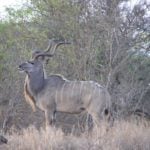
Greater kudu
Greater kudu Tragelaphus strepsiceros Shared Family

Ecological Equivalents 5

Animals that fill a similar ecological role in their ecosystem

Springbok
Springbok Antidorcas marsupialis Ecological analog as a medium-sized, fast, open-habitat antelope subject to similar predator suites; both show bounding/"pronking" displays and rely on high-speed escape. Springbok speeds are commonly reported at ~80-90 km/h with stiff-legged bounding leaps (behavior synthesized in Estes 1991; Kingdon).
Thomson's gazelle Eudorcas thomsonii Similar niche as a predator-focused grazer/mixed feeder in savannas. Forms herds and relies on vigilance and rapid acceleration. Occupies short-grass to mixed savanna mosaics and is a major prey species for cheetahs and other carnivores in overlapping ranges (Estes 1991).
Grant's gazelle Nanger granti Overlaps in savanna use and mixed feeding, especially in East Africa; both exploit seasonal shifts between grazing and browsing and rely on open sightlines and sprinting to evade predators (Kingdon; Estes 1991).
Bushbuck Tragelaphus scriptus Shares edge/woodland–savanna ecotone feeding (browsing plus forbs) and uses cover for predator avoidance. Contrasts with impala's more open-area, group-living behavior, but both are key meso-herbivores in African woodland systems (Estes 1991).
Common wildebeest Connochaetes taurinus Co-occurs in many savanna systems and participates in similar grazing-driven predator-prey dynamics. Impala are smaller and more mixed-feeding, but both function as high-biomass ungulate prey sustaining large carnivore populations (Estes 1991).

When startled, an impala animal can jump up to 10 feet high.

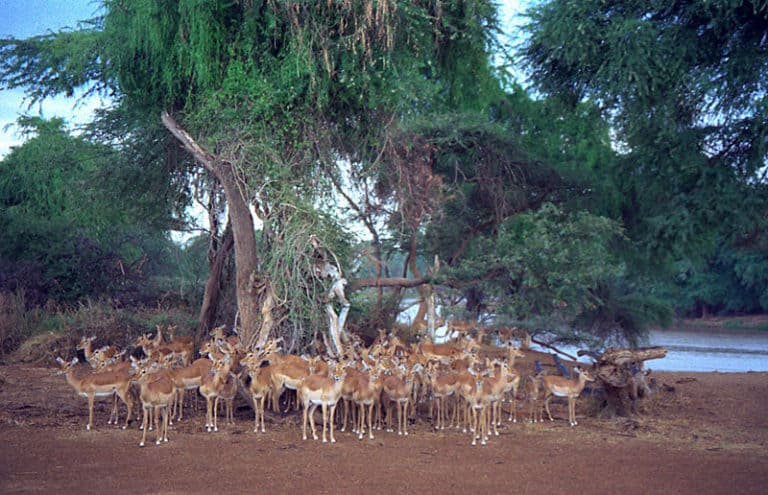
Impala are animals that live in the light woodlands and savannahs of southern and eastern Africa. These medium-sized antelopes travel and gather in herds of hundreds during the rainy season. The rains bring an abundance of grasses, shoots, herbs, bushes, and shrubs for their grazing. In the dry season, these herds work together to find food in a process called “browsing,” as part of which they eat leaves, twigs, and higher-growing vegetation.

Impala animals have an innate sensibility when it comes to avoiding predators. For example, they tend to drink in the hottest part of the day from rivers or other sources of water, aware that their enemies tend to be sluggish or sleep during that time. Also, pregnant female impalas give birth around midday for the same reason–there will be a lower risk of a predator laying in wait to attack. If a herd encounters a lion, leopard, cheetah, or other predators, they will scatter in many directions to confuse the attacker, while kicking their hind legs to release a scent from glands in the feet to help them stay together or regroup.

Impala animals are truly fascinating creatures! Read on to learn more about their characteristics, behavior, habitat, and more.
 

Top Facts

  • At up to 39 inches tall, impala are about the size of a large dog
  • Male impala horns can grow to the same length as their body height
  • Impala are herbivores

Scientific Name
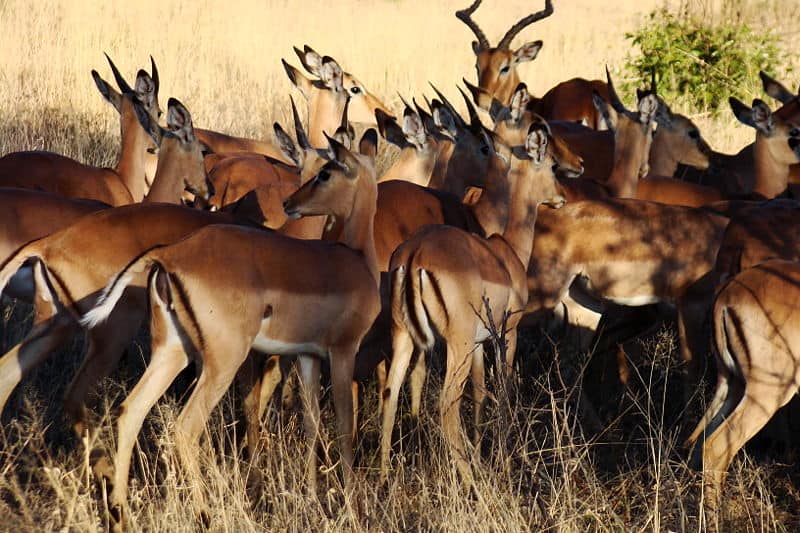
Impala are related to antelopes, bison, buffalo, goats, and sheep

Impala have the scientific name Aepyceros melampus. This name comes from Ancient Greek, with Aepyceros meaning “high horned” and melampus meaning “black foot.” The common name impala is from the Zulu language.

Impala belong to the kingdom Animalia, phylum Chordata, and class Mammalia. Along with cattle, antelopes, sheep, goats, buffalo, and bison, they belong to the family Bovidae. All of these bovidae have hooves and horns. The horns differ from deer, however, in that they grow from the front of the animal’s skull and do not shed or branch.
 

Appearance & Behavior
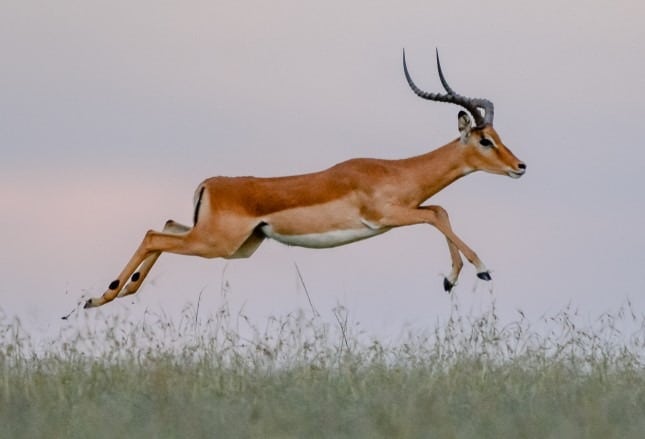
jumping animals - impala

Impala are renowned for being impressively athletic

Impala have mostly red-brown fur that helps them hide among the brush. But they feature white on their bellies, chins, lips, inner ears, eyebrows, and tails. The tail and backside of the animal also feature a set of black stripes that form the letter “M.” Otherwise, they have more black across their foreheads, thighs, and ear tips.

Female impala, called ewes, have no horns. But males, the rams, grow curved horns with a notable twisted appearance due to ridges. These horns are black and grow as long as 36 inches.

Males measure between 30 and 36 inches tall from their hooves to their shoulders. Females grow to a smaller span of 28 to 33 inches. Their length from their head to the base of their tail is between 47 and 63 inches, for both genders. An impala tail adds between 12 and 18 inches more to their length. They usually weigh 88 to 99 pounds (for females) and 132 to 143 pounds (for males).

Impala limbs are lengthy, slender, and graceful with scent glands at the ankles. These legs help them leap up to 30 feet in length or up to 10 feet high. Learn more about the highest jumping animals on earth here.

Impala typically stick together in herds of 100 to 200 animals. During the dry season, these herds include both males and females working together to find food. When the wet season begins, the herd separates into a male herd and a female herd. These new groups graze on the plentiful grasses and other vegetation.

Evolution
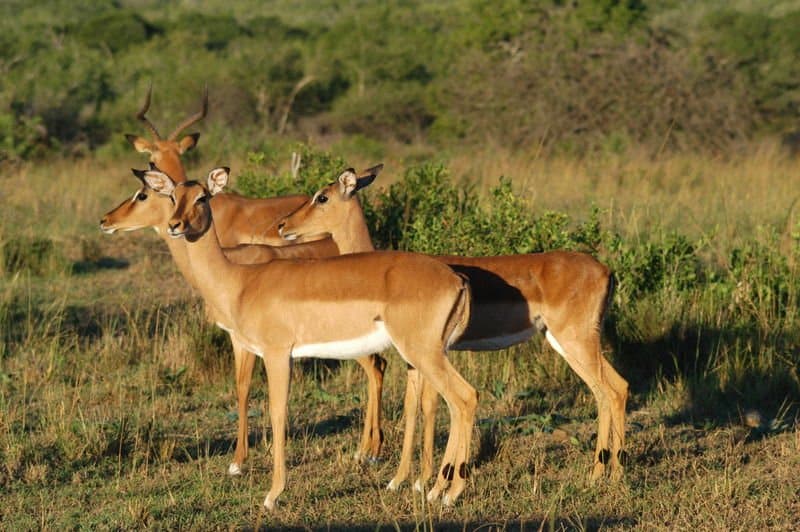
Scientists believe that the ancestors of the impala were pretty similar to their descendants although they were somewhat smaller in size

Paleontologists have discovered a wide range of fossils relating to this slender antelope such as  A. datoadeni dating back to the Pliocene Era in Ethiopia.

They also believe according to evidence obtained from the oldest fossil that the ancestors of the impala were pretty similar to their modern descendants although somewhat smaller in size. A sign that the herbivore has done rather well for itself in handling the challenges presented by its habitat from the distant past until the present.

Habitat

Impala are animals that prefer to live near a water source in woodland, grassland, and savannah of Africa. In Africa, these animals still live throughout Kenya, Botswana, Angola, Malawi, Zimbabwe, Zambia, Mozambique, Namibia, Rwanda, South Africa, Swaziland, Uganda, Zaire, and Tanzania. Herds recently began living in Gabon. But in Burundi, local impala are extinct.

Diet

Impala animals prove highly adaptable herbivores. They change their diet according to what vegetation is available around them. They prefer to eat fresh grass. But they will then rely on many types of foliage, including herbs and shoots, when there is no grass. Other foods they eat include shrubs, bushes, fruits, and acacia pods.

Much like your pet house cat, impala are picky about the water they drink. They prefer lake or river water, over murky ponds or puddles. But they can also eat enough green vegetation to keep themselves hydrated.
 

Predators & Threats
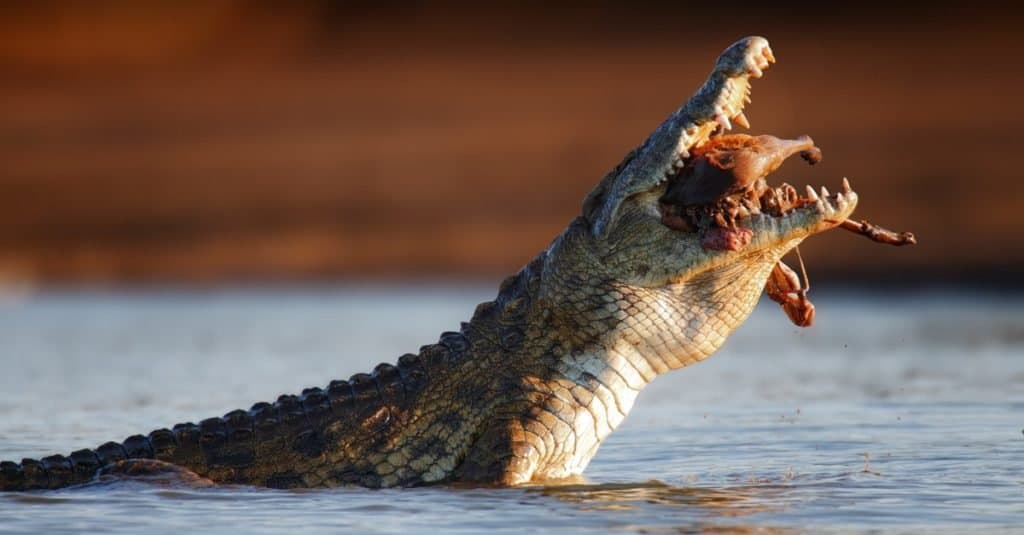
World's Scariest Animal: Nile Crocodile

Crocodiles are one the main predators of impala

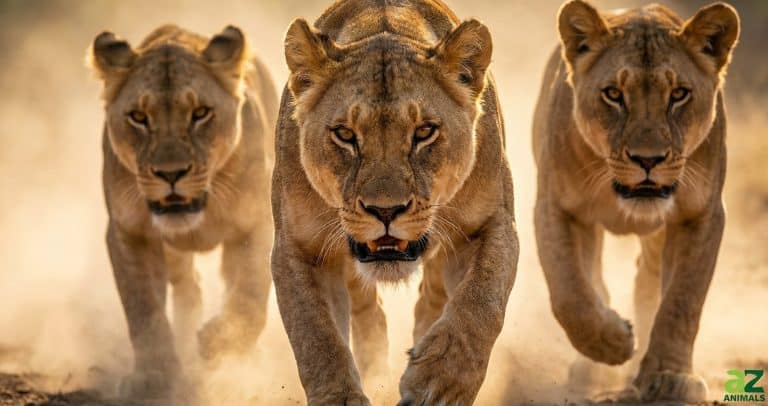
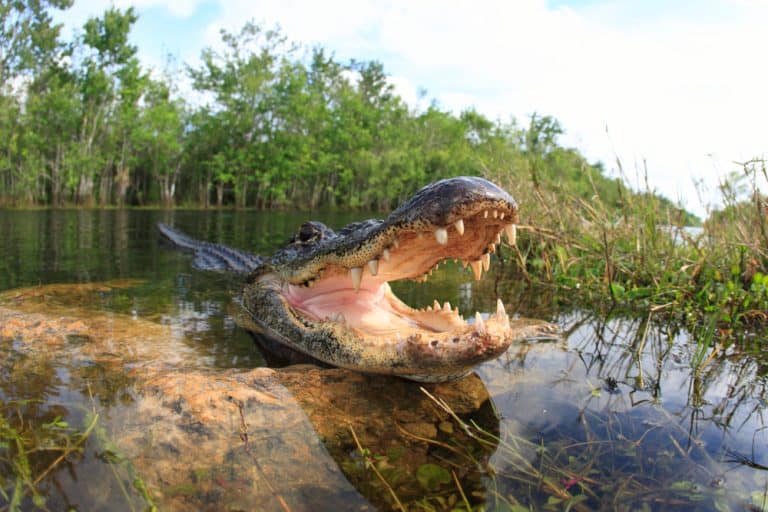
The primary predators of impala include stalking animals like lions, leopards, cheetahs, hyenas, and wild dogs. But many also lose their lives to jackals, humans, eagles, hunting dogs, and caracal. When the animal attempts to drink water from a river or they fail to pay attention, an impala can become a meal for a hungry Nile crocodile.

The captured impala is usually one that was absorbed by its own thoughts while grazing. They tend to stop paying attention to their surroundings when they are in low-lying brush, where many predators stalk and surprise them. When out in the open, they stay aware and act quickly to get away from danger.

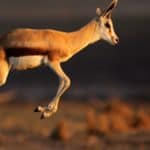
Leaping upward is “pronking,” a behavior that confuses impala animal predators. It can work on human hunters who then struggle to line up a shot on the fast and high jumper. When a predator comes near, all of the impala in the herd start pronking to create a confusing scene. If pronking fails to send the predators away, the impala scatter in all directions and hide in low brush and bushes. Besides this vertical leap of up to 10 feet in the air, impala can leap up to 30 feet outward and over bushes and other hurdles.
 

Reproduction, Babies, and Lifespan
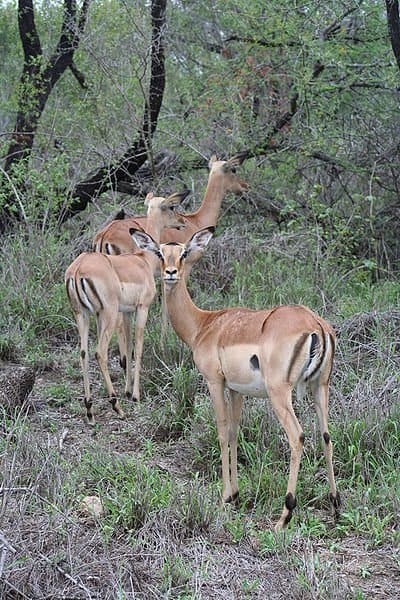
Male impalas stick out their tongues to attract females

Besides signalling growth of abundant food for impala, the rainy season also signals time for males to compete for territory dominance. The single herd of the dry season separates into two herds, one male and one female group.

After separation, the most dominant males spray urine and feces to make their presence known and mark their land. Using their long, slender horns, the males challenge each other to prove their strength. Some of the males find a territory and herd as many females as they can onto that territory. Once on their territory with a group of lured females, the dominant males mate while using their horns to threaten incoming rivals.

To attract females, dominant males engage in tongue flashing. This means they flash their tongues at the females who group together to walk through the male herd. Non-dominant males in the territory show their defiance of this scene by running away or flashing their own tongues stubbornly.

Males not succeeding in achieving herd dominance retreat to a bachelor herd. They can challenge rivals throughout the season. Of course, the younger, older, and weaker males typically find themselves staying with the bachelors for grazing until the herd comes back together as one unit for the dry season.

After successful mating, females give birth to an approximately 11-pound fawn after about seven months of gestation. They can put birth off until month eight if conditions are not right for the fawn’s safety.

Most births are for only one baby. The mother and newborn fawn stay together in an isolated area for several days. The mother then leaves each day to be with the herd, returning to the fawn’s den to nurse. Eventually, they both join the female herd and other offspring where the fawn nurses for four to six months before weaning.

Like humans going off to nursery school at a young age, weaned fawns live in a sub-group of the herd called a nursery group. When they mature at about one year of age, females from this group stay with the herd. But males must join a bachelor group.

Impala live for 12 to 15 years in the wild. But in captivity and without predators, drought or disease to contend with, many live beyond age 20.
 

Population
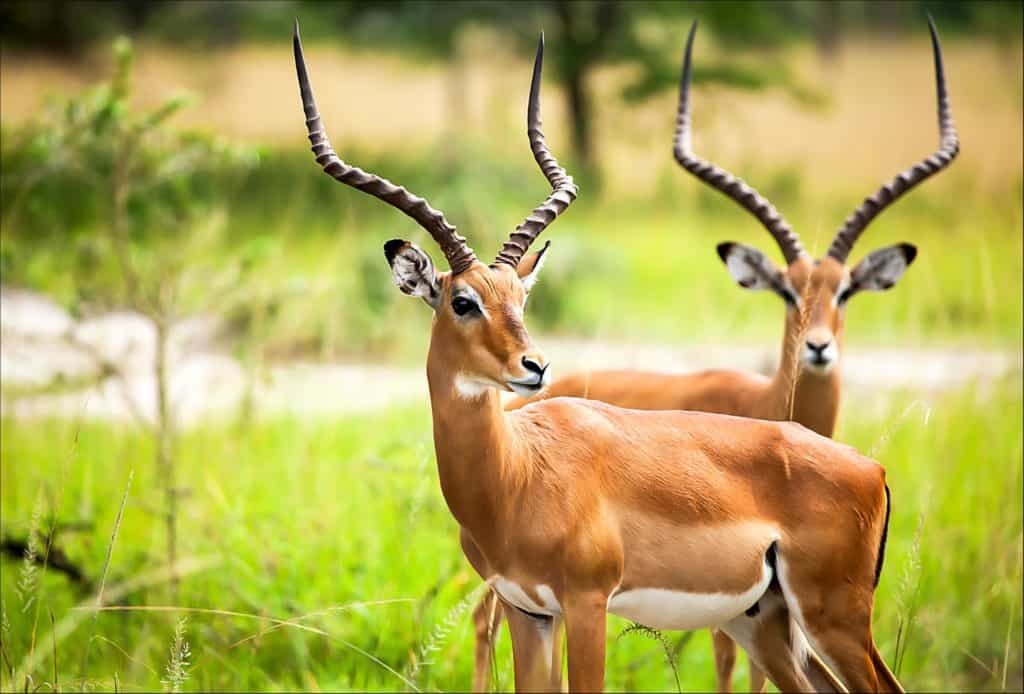
About 2 million impala live in the world today

The International Union for Conservation of Nature (IUCN) lists the impala as of the least concern, in regard to conservation. This means they are at low risk for extinction at this time.

About two million impala live in the wild or on private land today. About one quarter of these live in protected areas in Botswana, Kenya, South Africa, Tanzania, Zambia, and Zimbabwe. The population remains stable with the exception of a black-faced subspecies of southwestern Angola and Kaokoland in northwestern Namibia, that currently includes only 1000 animals. To help that subspecies with black faces restore its population, some are being protected on private farms in Namibia and the Etosha National Park.
 

View all 59 animals that start with I

Sources

  1. David Burnie, Dorling Kindersley (2011) Animal, The Definitive Visual Guide To The World's Wildlife / Accessed March 10, 2009
  2. Tom Jackson, Lorenz Books (2007) The World Encyclopedia Of Animals / Accessed March 10, 2009
  3. David Burnie, Kingfisher (2011) The Kingfisher Animal Encyclopedia / Accessed March 10, 2009
  4. Richard Mackay, University of California Press (2009) The Atlas Of Endangered Species / Accessed March 10, 2009
  5. David Burnie, Dorling Kindersley (2008) Illustrated Encyclopedia Of Animals / Accessed March 10, 2009
  6. Dorling Kindersley (2006) Dorling Kindersley Encyclopedia Of Animals / Accessed March 10, 2009
  7. David W. Macdonald, Oxford University Press (2010) The Encyclopedia Of Mammals / Accessed March 10, 2009
Dana Mayor

About the Author

Dana Mayor

I love good books and the occasional cartoon. I am also endlessly intrigued with the beauty of nature and find hummingbirds, puppies, and marine wildlife to be the most magical creatures of all.
Connect:

Thank you for reading! Have some feedback for us?


Impala FAQs (Frequently Asked Questions)

Impala are herbivores with the ability to adapt their diet to their surroundings. They prefer soft, short grasses of the rainy season. They also eat leaves, bushes, fruit, acacia pods, herbs and succulents. But during the difficult times of the dry season, they browse. This means they change their diet to fit available plant life. If the impala cannot access a river or lake as a preferred drinking source, they often rely on succulent vegetation for its high water content. This keeps them hydrated until water becomes available.