






I
Species Profile

Indochinese Tiger

Panthera tigris corbetti

Ghost of the Southeast Asian forests
Ltshears / Creative Commons

Indochinese Tiger Distribution

Click a location to explore more animals from that region

Loading map...

Size Comparison

Human 5'8"
Indochinese Tiger 3 ft 1 in

Indochinese Tiger stands at 55% of average human height.

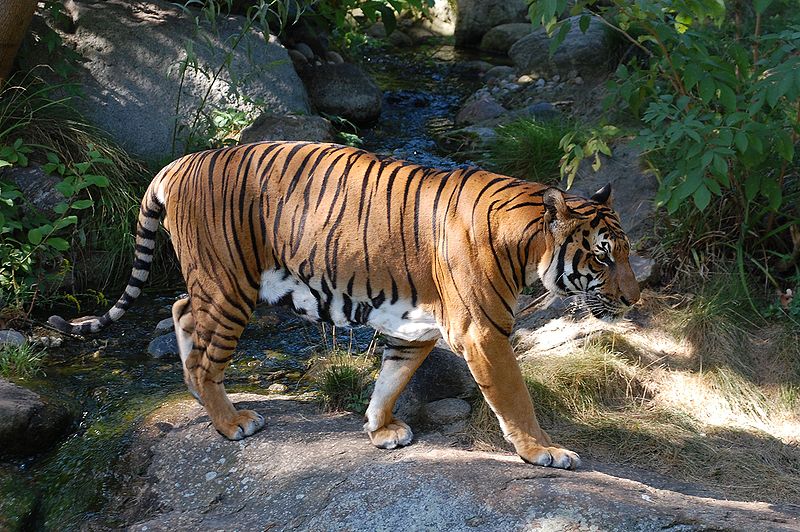
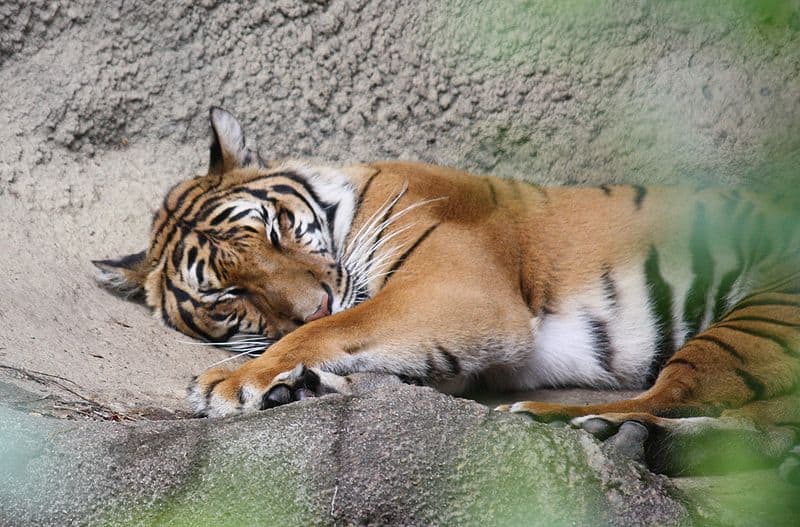
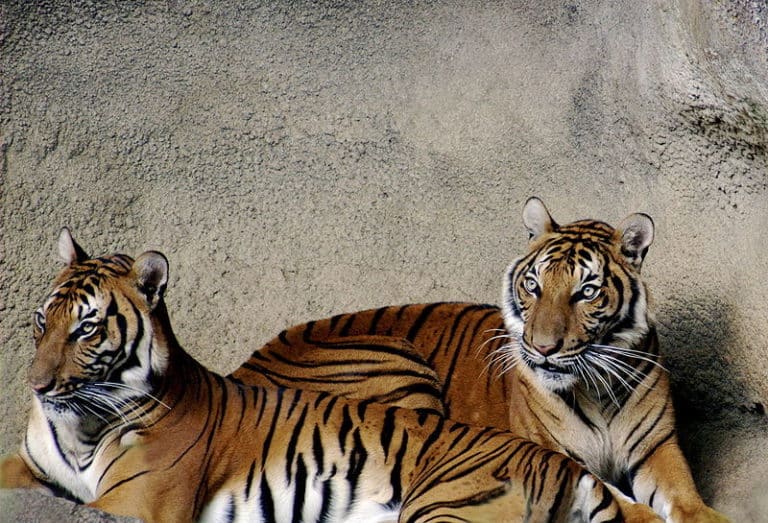
Indo-chinese Tiger (Panthera tigris corbetti) at Cincinnati Zoo

At a Glance

Wild Species
Also Known As Siamese tiger, Southeast Asian tiger, Thai tiger
Diet Carnivore
Activity Nocturnal+
Lifespan 12 years
Weight 195 lbs
Status Not Evaluated
Did You Know?

The subspecies name corbetti honors Jim Corbett, a famed naturalist and tiger conservation advocate (formalized in 1968 by Mazák).

Scientific Classification

The Indochinese tiger (Panthera tigris corbetti) is a mainland Southeast Asian subspecies of tiger, historically distributed across parts of Myanmar, Thailand, Laos, Cambodia, Vietnam, and adjacent regions. It is a large apex predator adapted to forested and rugged landscapes.

Kingdom
Animalia
Phylum
Chordata
Class
Mammalia
Order
Carnivora
Family
Felidae
Genus
Panthera
Species
Panthera tigris

Distinguishing Features

  • Tiger subspecies from mainland Southeast Asia (Indochina region)
  • Generally smaller on average than some other tiger subspecies (e.g., Siberian), with regional variation
  • Striping pattern can be relatively narrow and numerous compared with some populations (not diagnostic alone)

Physical Measurements

Males and females differ in size

Height
0 in (0 in – 0 in)
2 ft 11 in (2 ft 9 in – 3 ft 1 in)
Length
1 in (1 in – 1 in)
7 ft 12 in (7 ft 7 in – 8 ft 4 in)
Weight
381 lbs (331 lbs – 430 lbs)
243 lbs (198 lbs – 287 lbs)
Tail Length
0 in (0 in – 0 in)
3 ft 1 in (2 ft 9 in – 3 ft 3 in)
Top Speed
37 mph
About 60 km/h (species)

Appearance

Primary Colors
Secondary Colors
Skin Type Fur (short-to-moderately long, dense mammalian coat; thicker in cooler seasons/at higher elevations; robust vibrissae/whiskers and paw pads adapted for silent stalking)
Distinctive Features
  • Large, muscular forest-associated tiger of mainland Southeast Asia (Myanmar-Thailand-Laos-Cambodia-Vietnam historically), typically recorded in evergreen/deciduous forests and rugged landscapes (IUCN/Goodrich et al. 2015).
  • Adult body mass (reported ranges): males ~150-195 kg; females ~100-130 kg (commonly cited for P. t. corbetti in field and reference syntheses; Nowell & Jackson 1996; Mazák 1981).
  • Linear size (commonly cited ranges): total length (head-body + tail) males ~255-285 cm; females ~230-255 cm; tail length commonly ~85-110 cm; shoulder height often cited ~90-100 cm (Mazák 1981; Nowell & Jackson 1996).
  • Craniofacial appearance: broad head with pronounced zygomatic arches, pale 'eyespots'/ocelli on backs of ears, and heavy whisker pads; canine teeth and forelimb musculature visually prominent (general Panthera tigris morphology).
  • Behavioral appearance cues: typically solitary; moves with low, stealth posture; uses scent-marking (spraying/scraping) and vocalizations (roars) for spacing/territoriality; activity often crepuscular/nocturnal in human-pressured landscapes (IUCN/Goodrich et al. 2015).
  • Many Indochinese tigers now survive mainly in a few strongholds (Thailand's Western Forest Complex and Dong Phayayen-Khao Yai), facing poaching, prey loss, and habitat breakup, making them more cautious and in poorer condition.

Sexual Dimorphism

Sexual dimorphism is pronounced, primarily in overall size and head/neck robustness (typical of tigers; reported size ranges for P. t. corbetti show males consistently larger than females).

  • Heavier and longer-bodied on average (commonly cited ~150-195 kg; total length ~255-285 cm) (Mazák 1981; Nowell & Jackson 1996).
  • Broader head with thicker neck/shoulder musculature; facial ruff/cheek fur may appear fuller in some individuals.
  • Smaller, more gracile build on average (commonly cited ~100-130 kg; total length ~230-255 cm) (Mazák 1981; Nowell & Jackson 1996).
  • Proportionally narrower head/neck; overall silhouette typically more streamlined.

Did You Know?

The subspecies name corbetti honors Jim Corbett, a famed naturalist and tiger conservation advocate (formalized in 1968 by Mazák).

Reported adult mass: males ~150-195 kg; females ~100-130 kg (compiled in classic references such as Mazák 1981; Nowell & Jackson 1996).

Typical total length (nose-to-tail tip) is reported around ~255-285 cm for males and ~230-255 cm for females; tail ~85-100 cm (Mazák 1981, range-style measurements).

Gestation is about 93-112 days, with litters commonly 2-4 cubs-timing and litter size consistent across tiger subspecies (widely reported in field and zoo records).

Indochinese tigers are strongly associated with rugged, forested landscapes and tend to rely on ambush from cover rather than long chases.

The Western Forest Complex of Thailand (including Huai Kha Khaeng-Thung Yai) is one of the best-known remaining strongholds where breeding populations persist.

A tiger's stripe pattern is individually unique, functioning like a "fingerprint" and enabling identification via camera-trap surveys (standard practice in tiger monitoring).

Unique Adaptations

  • Striped camouflage optimized for broken light in forests and bamboo/secondary growth-effective concealment at surprisingly short distances.
  • Large forelimb musculature and retractile claws for grappling large ungulates (e.g., sambar, wild boar) and securing a suffocating bite.
  • Highly developed night vision and low-light hunting performance typical of big cats (retinal adaptations and large pupils).
  • Soft paw pads and controlled, "silent step" gait for stealth stalking on leaf litter and along streambeds.
  • Powerful canines and carnassial teeth for puncturing, holding, and shearing meat; rough tongue (papillae) for stripping flesh from bone.
  • Wide-ranging physiology: capable of moving efficiently through steep, forested terrain and swimming across rivers when necessary.

Interesting Behaviors

  • Solitary, territorial lifestyle: adults usually travel alone, maintaining exclusive core areas via scent-marking (urine spray), scrapes, and claw marks on trees.
  • Crepuscular-to-nocturnal activity: often most active at dusk/night in human-pressured landscapes, reducing daytime encounters.
  • Ambush hunting from dense cover: stalk-freeze-rush strategy, typically aiming for a throat bite (suffocation) or nape bite (especially on smaller prey).
  • Kill-and-cache behavior: may drag carcasses into cover and return to feed over multiple days when undisturbed.
  • Long-distance patrolling: males particularly make wide circuits along ridgelines, streambeds, and game trails to monitor boundaries and locate females.
  • Maternal rearing: females hide cubs in dense vegetation/rocky cover; cubs are moved between dens to reduce detection risk.
  • Rich vocal and scent communication: roars for long-range signaling; chuffing (friendly greeting); flehmen response to assess reproductive cues.

Cultural Significance

Indochinese Tiger (Panthera tigris corbetti) is a strong sign of power and forest danger. In Thailand it is on amulets and sacred tattoos for strength and courage. In Vietnam it is a respected guardian spirit shaping rules and warnings about the forest.

Myths & Legends

Thailand's were-tiger tradition tells of a tiger spirit or a person who becomes a tiger-often a feared forest being that deceives travelers and embodies the peril of the wild.

In Vietnamese folk naming, the tiger is sometimes addressed as "Grandfather Thirty," a respectful euphemism linked in popular retellings to historical-era taboos and penalties associated with killing tigers, reflecting fear and reverence.

Vietnamese folk religion includes the cult of the Five Tiger Gods, in which differently colored tigers serve as spirit-generals and guardians tied to directions and protective power; devotees make offerings for safety and fortune.

Khmer and broader regional storytelling often frames the tiger as a formidable forest lord-an enforcer of boundaries between village and wilderness-appearing in cautionary tales about arrogance, broken taboos, or disrespect toward the forest.

Lao and Thai animist-leaning traditions in some areas describe powerful forest spirits associated with big cats; tigers may appear as manifestations or companions of guardian beings that test human conduct in the deep forest.

Buddhist-influenced folktales across the region sometimes portray encounters with tigers as moral trials-where compassion, restraint, or wisdom determines whether a person survives an encounter with the forest's most feared predator.

Conservation Status

NE Not Evaluated (no current, standalone IUCN Red List assessment for the subspecies; the species Panthera tigris is assessed as Endangered on the IUCN Red List)

Has not yet been evaluated against the criteria.

Population Unknown

Protected Under

  • CITES Appendix I (international commercial trade prohibited for wild specimens).
  • National legal protection across range states (e.g., full protection/prohibition on hunting and trade, with penalties for possession/trafficking), implemented through country-specific wildlife protection laws and protected-area regulations in Myanmar, Thailand, Lao PDR, Cambodia, and Viet Nam.
  • Key conservation delivery mechanism: protected areas/tiger source sites (notably Thailand's Western Forest Complex) with intensive anti-poaching, snare removal, prey recovery, and monitoring.
  • Notes (subspecies biology context-ranges commonly reported in the scientific literature; values vary by site/sex): adult males typically ~150-195 kg and adult females ~100-130 kg; wild longevity commonly ~10-15 years (longer in captivity). Solitary, territorial apex predator using forested and rugged landscapes; home-range size and density are strongly prey- and protection-dependent. (General tiger biology sources used by IUCN and standard references include Mazák; Sunquist & Sunquist; Karanth & Nichols; and IUCN/SSC Cat Specialist Group accounts.)
  • HUBS (tiger subspecies/group conservation landscape): Across tiger lineages, conservation status ranges from Extinct in the Wild/Extinct (historic forms) to Endangered for the species overall; the main modern subspecies groups persist as small, fragmented populations. Common threats are illegal killing for trade, snaring-driven prey depletion, and habitat fragmentation via roads/agriculture/logging. Notable highest-risk regional forms include the Sumatran tiger (critically imperiled), while the strongest recoveries are in a few well-protected source sites (e.g., parts of India/Nepal and Thailand), highlighting enforcement and prey recovery as decisive factors.

Life Cycle

Birth 3 cubs
Lifespan 12 years

Lifespan

In the Wild
8–15 years
In Captivity
16–26 years

Reproduction

Mating System Polygynandry
Social Structure Solitary
Breeding Pattern Transient
Fertilization Internal Fertilization
Birth Type Internal_fertilization

Indochinese Tiger (Panthera tigris corbetti) are solitary and do not form lasting pairs. Mating is brief partnerships during female estrus; males overlap several females' ranges. Both sexes may have multiple mates. Females care for cubs; males usually do not.

Behavior & Ecology

Social Solitary (no stable group name); temporary pair; mother-and-cubs family Group: 1
Activity Nocturnal, Crepuscular, Cathemeral
Diet Carnivore Sambar deer (Rusa unicolor)

Temperament

Strongly territorial and primarily avoidant of conspecifics; most interactions are mediated through scent marks and vocal signals rather than direct contact (Sunquist & Sunquist 2002).
Secretive/cryptic in forested and rugged habitats; tends to shift activity toward night and crepuscular hours in areas with high human disturbance (pattern commonly reported for mainland SE Asian tigers; Goodrich et al. 2015).
High defensive aggression when cornered or when females are with cubs; otherwise typically minimizes conflict through spacing and signaling (Sunquist & Sunquist 2002).
Across Panthera tigris subspecies the usual social system is solitary, with females holding space. Differences are in night activity, meeting rates, and tolerance at food, driven by prey, habitat openness, and humans.

Communication

Roar Long-distance advertisement; used in territorial and mating contexts) (Sunquist & Sunquist 2002
Moans/growls/hisses Close-range agonistic signals) (Nowell & Jackson 1996
Chuffing/prusten Non-aggressive close-range signal, e.g., between familiar individuals such as mother-cubs) (Sunquist & Sunquist 2002
Mews/whines Mother-cub contact calls) (Sunquist & Sunquist 2002
Scent marking: urine spraying on vegetation, ground-scrapes with interdigital gland secretions, and fecal marking to advertise territory and reproductive state Sunquist & Sunquist 2002; Nowell & Jackson 1996
Visual signaling: scratch marks on trees, scrape lines, and conspicuous marking on trails/ridges used as communication hubs Tiger-wide; Sunquist & Sunquist 2002
Tactile: rubbing/cheek marking and close-contact behaviors mainly during courtship and within mother-cub bonds Sunquist & Sunquist 2002
Acoustic-olfactory 'HUBS': repeated use of trails, saddles, and junctions for marking/vocalizing creates predictable communication nodes; frequency and visibility of these hubs increase where terrain channels movement Reported widely for forest tigers, including Indochinese tiger study landscapes in Thailand; Sunquist & Sunquist 2002; Simcharoen et al.

Habitat

Biomes:
Tropical Rainforest Tropical Dry Forest Savanna Temperate Forest Freshwater Wetland
Terrain:
Mountainous Hilly Plateau Valley Riverine Plains Karst Rocky +2
Elevation: Up to 8202 ft 1 in

Ecological Role

Apex predator (top carnivore) in mainland Southeast Asian forest ecosystems.

Regulates ungulate and wild pig populations (top-down control), helping limit overbrowsing and maintain vegetation structure. Shapes prey behavior and space use (risk effects), influencing habitat use patterns and community dynamics. Provides carrion resources for scavengers (e.g., vultures where present, bears, jackals, smaller carnivores) through partially consumed kills. Contributes to nutrient redistribution by concentrating organic matter at kill/feeding sites.

Diet Details

Main Prey:
Sambar deer Wild boar Banteng Gaur Mainland serow Muntjac Eld's deer Porcupines and other medium mammals +2

Human Interaction

Domestication Status

Wild

Indochinese tiger (Panthera tigris corbetti) has no history of domestication. Humans have hunted and trapped it, cleared its forest homes, poached it for illegal trade, and sometimes killed it after livestock losses. Conservation, captive care, parks, and ecotourism now also shape human-tiger interactions across forest and rugged habitats.

Danger Level

High
  • Potentially fatal attacks if surprised at close range, if a tiger is wounded/trapped, or if people approach cubs or a kill (all tiger subspecies share this risk)
  • Livestock depredation leading to dangerous encounters during guarding/retaliation attempts
  • Risk escalation in degraded habitats where prey is depleted and tigers range closer to settlements
  • Handling/captivity risk: severe injury or death to keepers/owners due to strength, predatory behavior, and unpredictable stress responses
  • Zoonotic/disease considerations in captivity (e.g., exposure risks from large carnivore handling; not unique to this subspecies)

As a Pet

Not Suitable as Pet

Legality: Indochinese Tiger (Panthera tigris corbetti) is not legal as a pet in most places. International trade is banned under CITES Appendix I. Range countries and the U.S. ban or require permits, licenses and secure facilities; illegal trade is a crime.

Care Level: Expert Only

Purchase Cost: $5,000 - $50,000
Lifetime Cost: $250,000 - $1,000,000

Economic Value

Uses:
Ecotourism and wildlife viewing (where populations are secure enough) Research and conservation funding (camera-trap monitoring, anti-poaching, prey recovery) Captive display value (zoos/sanctuaries; regulated facilities) Costs from human-tiger conflict (livestock losses, compensation, guarding time) Illegal wildlife trade (highly harmful to conservation)
Products:
  • Non-consumptive tourism services (guided wildlife tourism, park fees; indirect local income)
  • Conservation jobs/services (rangers, monitoring teams, local conservation programs)
  • Illicit products targeted by poachers/traffickers (skins, bones, teeth/claws marketed for decoration/traditional medicine) - illegal

Relationships

Ecological Equivalents 5

Animals that fill a similar ecological role in their ecosystem

“Every Indochinese tiger has its own pattern of stripes, so no two tigers are exactly the same”

Indochinese tigers live in the southeastern part of Asia. They have a coat of orange or gold featuring a pattern of black stripes. This tiger lives alone and stays hidden most of the time. They can live to be 15 to 26 years old in the wild.

5 Indochinese Tiger Facts

• Indochinese tigers are carnivores
• They are nocturnal and hunt at night
• These tigers live in tropical rainforests as well as in grasslands and the mountains
• One of the 6 species of big cats that are on the endangered species list
• A male Indochinese tiger can weigh up to 430 pounds!
Evolution And Origin

The oldest ancestor of all modern-day carnivores, which included cats, dogs, mongooses, skunks, and bears, was the Miacid, an extinct group that lived about 50 million years ago, during the Eocene era. Then came Pseudaelurus, which was the direct ancestor of the 40 species of cats found on earth today. The earliest tiger fossil found was in South Asia and dated back to about 2 million years ago.

Scientific Name

The Indochinese tiger is this animal’s common name while its scientific name is Panthera Tigris Corbetti. The word Panthera means leopard and the word Tigris is Latin for tiger. In addition, the word Corbetti refers to a British man named Jim Corbett who was a hunter turned conservationist of Indochinese tigers. This tiger belongs to the family Felidae and class Mammalia.

As a quick comparison, these tigers are smaller than a Bengal tiger but larger than a Malayan tiger. The Indochinese tiger and the Malayan tiger were once thought of as the same subspecies. But, in 2004, it was officially stated that these two tigers are different subspecies.

Types Of

There are currently six subspecies of tigers, of which one is the Indochinese tiger. The remaining five are:

The following 3 tigers are now extinct:

  • Bali Tiger
  • Javan Tiger
  • Caspian Tiger

Appearance And Behavior

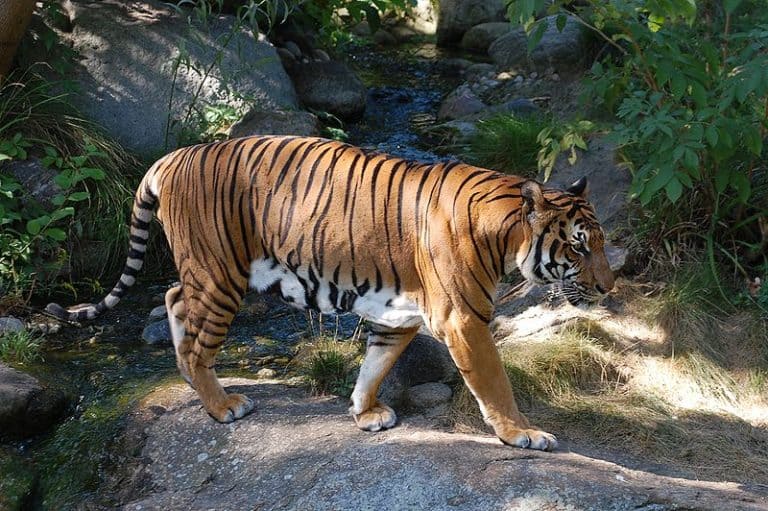
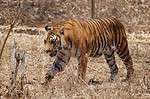
Side view of an indochinese tiger walking

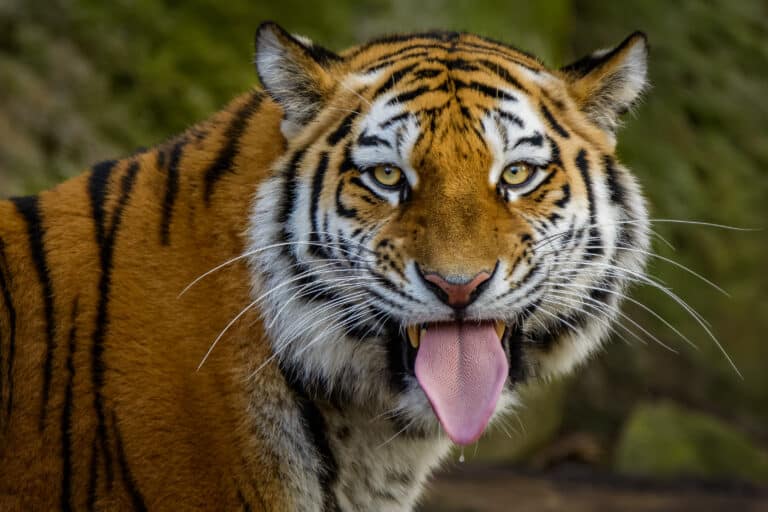
These tigers have a coat of orange or gold with black stripes. Their fur color helps to keep them hidden in the forest when hunting for food. The stripes on a tiger blend in with the shadows in a rainforest making it hard to see these big cats. This tiger also has white fur on its stomach, and face and a ruff of white hair on its neck.

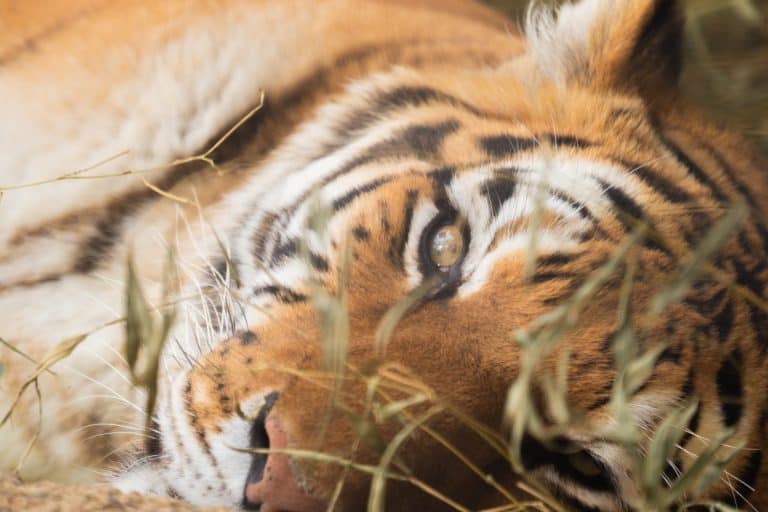
This big cat has powerful yellow or light-colored eyes that allow it to see perfectly in the dark as they hunt at nighttime. Plus, they have excellent hearing which also helps them to detect prey such as deer, wild boar, and even monkeys.

These tigers have long claws that are retractable. This means the tiger can pull its claws back into its paws when it doesn’t need them. These claws allow a tiger to hold onto the bark while safely climbing a tree.

The strong back legs of this tiger allow it to easily jump onto high tree branches, swim, and chase prey. This tiger can run at speeds up to 60 miles per hour. So, the running speed of this tiger is almost as fast as a baseball pitcher’s curveball.

A male tiger grows to be 8 and a half to 9 and a half feet long. They can weigh from 330 to 430 pounds. A 9-and-a-half-foot male tiger is as long as a line of 7 bowling pins. A 430-pound male tiger is half as heavy as a full-grown horse. Female tigers can be 7 and a half to 8 and a half feet long and weigh between 220 and 290 pounds. An 8-and-a-half-foot-long tiger is equal to half the height of a giraffe. A 290-pound tiger is as heavy as 3 toilets.

These tigers are solitary animals. The only time you’ll see a few of these tigers together is when mothers are taking care of cubs and during mating season.

These tigers are shy and like to stay hidden from sight. But, a male will become aggressive to another male tiger entering its territory, especially during mating season. Have you ever seen a cat in your neighborhood scratching the bark of a tree? This is one of the ways a cat (including these tigers) marks its territory as a signal to other cats to stay away.

Habitat
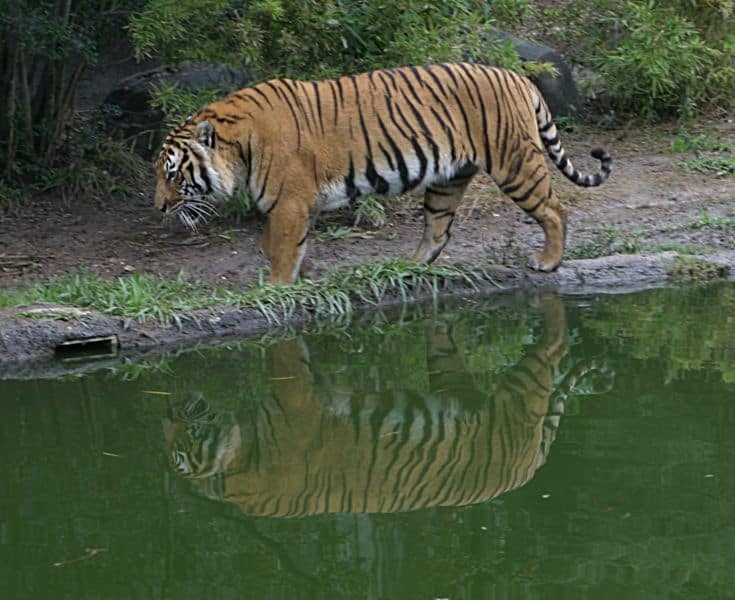
Indochinese Tiger at the Houston Zoo

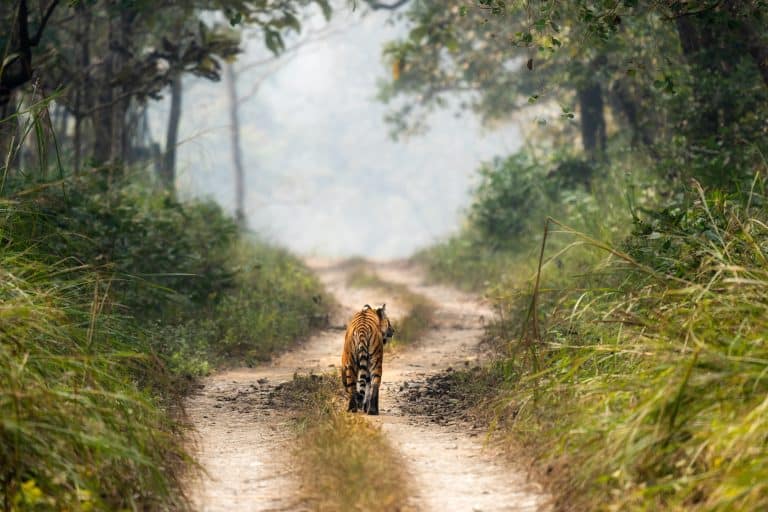
Indochinese Tigers live in rainforests and grasslands in southeast Asia.

Indochinese tigers live in the southeast area of Asia. Specifically, they live in Cambodia, Laos, Thailand, Vietnam, and Myanmar. They live in a tropical climate in rainforests as well as in grasslands and in the mountains.

These tigers migrate to areas located higher in the mountains to find food if the prey is scarce in their current territory.

Diet
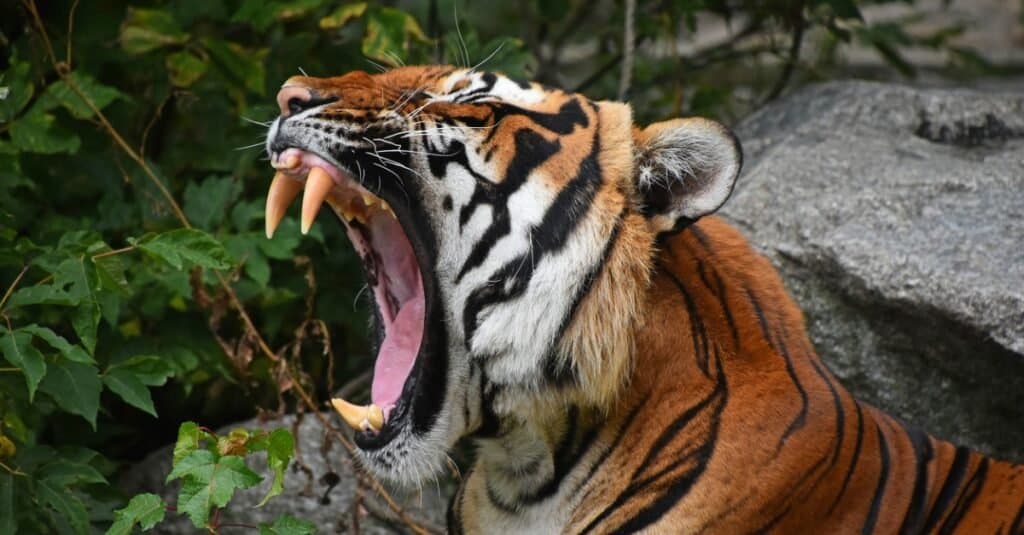
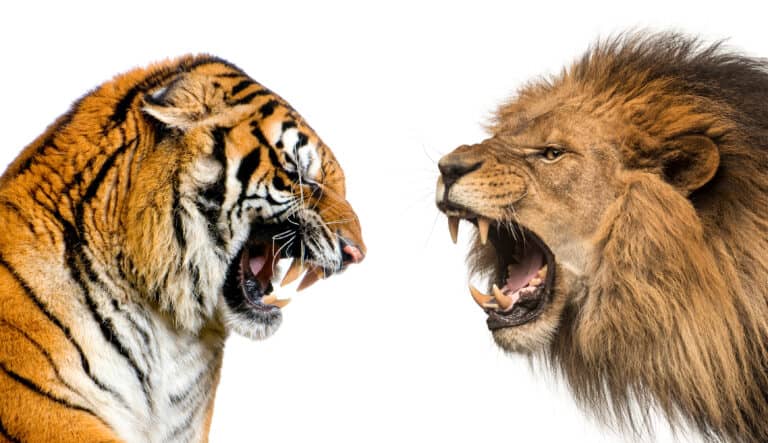
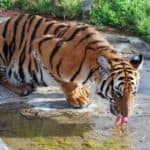
Tiger Teeth - Tiger with open mouth

These tigers are carnivores and will eat what is in their territory.

What do Indochinese tigers eat? These tigers are carnivores. The type of meat they eat depends on what’s available in their territory. Sambar deer, serow (a goat-like mammal), wild boars, and banteng (wild cattle) are all common prey for this tiger. However, if there is a shortage of these animals, an Indochinese tiger’s diet can include monkeys, hog badgers, and even porcupines!

These tigers can eat up to 88 pounds of meat in one meal. 88 pounds of meat is equal in weight to 6 bowling balls!

An Indochinese tiger’s tongue has papillae on it. When you think of papillae imagine tiny spikes on a tiger’s tongue. These help an Indochinese tiger to remove feathers or meat from their dead prey without hurting its tongue. If you have a house cat, it has papillae on its tongue, too! But, a house cat’s papillae are much softer than the papillae of an Indochinese tiger that has to chase down large prey in the wild.

Predators And Threats

Indochinese tigers don’t have any animal predators. Humans are their only predators. Some people hunt these tigers for sport or for their fur, claws, or meat. Some types of ancient medicines are made using parts of this tiger.

Habitat loss is another threat to Indochinese tigers. Areas of the forests they live in are being cut down and cleared. This area is being devoted to extending roadways and creating more farmlands.

The conservation status of this tiger is Endangered. To help protect this tiger, there are laws against hunting it. The punishment for poaching Indochinese tigers can be years in prison. Also, over 60 of these tigers are being kept in zoos to protect them and increase their population.

Reproduction, Babies, And Lifespan
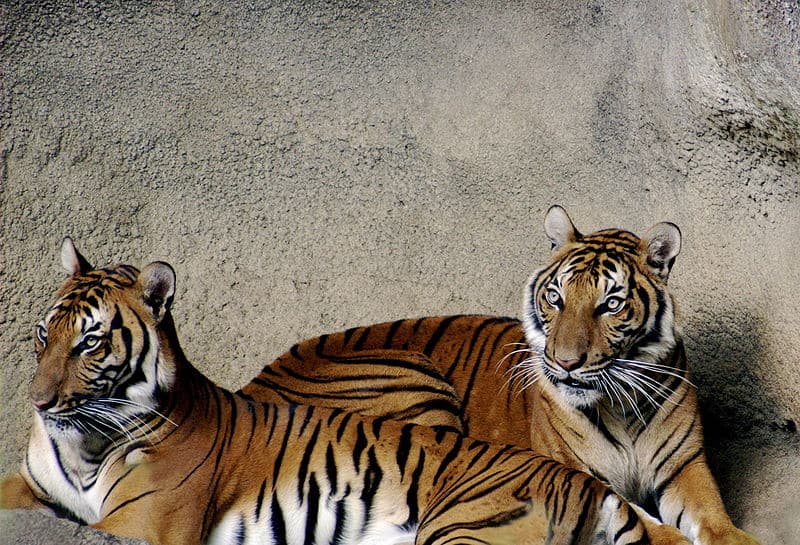
The mating season of Indochinese tigers falls between November and April. When female tigers are ready to mate they release a scent to alert male tigers. Also, females make growling or purring noises as a way to attract males. It’s not uncommon for two males to fight over one female. The strongest one will win and mate with the female.

A female Indochinese tiger is pregnant for about 16 weeks. She gives live birth to between 2 to 6 cubs. Each cub weighs around 2 pounds. Once the female is pregnant, the male tiger leaves the expectant mother.

Baby Indochinese tigers are known as cubs. They are born blind and helpless in a den. A cub’s eyes don’t open for about 6 to 12 days after it’s born. The mother tiger nurses her cubs until they are about 6 months old. After that, she teaches her cubs how to hunt for food and brings them some of the prey she captures. A mother tiger is very sensitive to the safety of her cubs. If she senses that her cubs are in danger, she will move them to another den or area to keep them away from predators.

At about 18 or 24 months, the cubs are old enough to leave their mother’s den and go out on their own. In 2 or 3 years, they will begin having their own cubs.

Indochinese tigers live from 15 to 26 years. A Sumatran tiger (similar to an Indochinese tiger) that made its home in San Diego Zoo lived to be 25 years old. That Sumatran tiger is the oldest on record.

As Indochinese tigers age they can experience vision problems which can lead to a lack of nourishment because they aren’t able to catch their prey. Plus, if an older tiger fall sick or is injured, it is vulnerable to attacks from other tigers in the area.

Population

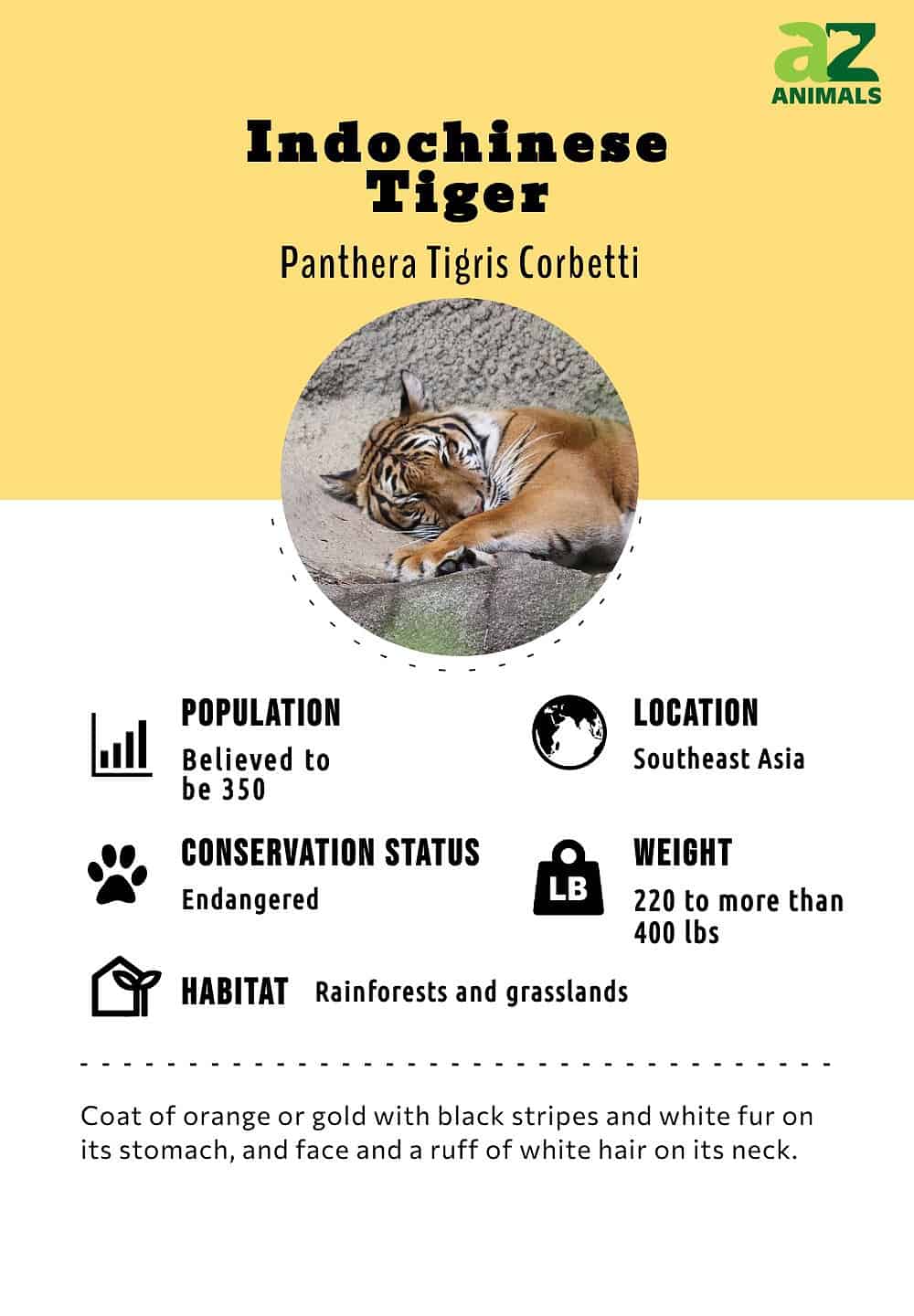
The conservation status of the Indochinese tiger is Endangered. The population is decreasing due to habitat loss and poaching.

The total population of Indochinese tigers is difficult to estimate because these big cats are so good at staying hidden. However, there are believed to be approximately 350 left in existence. The largest concentration of Indochinese tigers is in Thailand.

View all 59 animals that start with I
How to say Indochinese Tiger in ...
Bulgarian
Индокитайски тигър
Danish
Indokinesisk tiger
German
Indochinesischer Tiger
English
Indochinese tiger, Corbett's tiger
Spanish
Panthera tigris corbetti
Finnish
Indokiinantiikeri
French
Tigre d'Indochine
Croatian
Indokineski tigar
Hungarian
Indokínai tigris
Italian
Panthera tigris corbetti
Dutch
Chinese tijger
English
Indokinatiger
Polish
Tygrys indochiński
Portuguese
Tigre-da-indochina
Turkish
Çinhindi kaplanı
Vietnamese
Hổ Đông Dương
Chinese
印度支那虎

Sources

  1. David Burnie, Dorling Kindersley (2011) Animal, The Definitive Visual Guide To The World's Wildlife / Accessed May 27, 2010
  2. Tom Jackson, Lorenz Books (2007) The World Encyclopedia Of Animals / Accessed May 27, 2010
  3. David Burnie, Kingfisher (2011) The Kingfisher Animal Encyclopedia / Accessed May 27, 2010
  4. Richard Mackay, University of California Press (2009) The Atlas Of Endangered Species / Accessed May 27, 2010
  5. David Burnie, Dorling Kindersley (2008) Illustrated Encyclopedia Of Animals / Accessed May 27, 2010
  6. Dorling Kindersley (2006) Dorling Kindersley Encyclopedia Of Animals / Accessed May 27, 2010
  7. David W. Macdonald, Oxford University Press (2010) The Encyclopedia Of Mammals / Accessed May 27, 2010
Melissa Bauernfeind

About the Author

Melissa Bauernfeind

Melissa Bauernfeind was born in NYC and got her degree in Journalism from Boston University. She lived in San Diego for 10 years and is now back in NYC. She loves adventure and traveling the world with her husband but always misses her favorite little man, "P", half Chihuahua/half Jack Russell, all trouble. She got dive-certified so she could dive with the Great White Sharks someday and is hoping to swim with the Orcas as well.
Connect:

Thank you for reading! Have some feedback for us?


Indochinese Tiger FAQs (Frequently Asked Questions)

These big cats are carnivores. They eat deer, wild boars, wild cattle, monkeys and porcupines. Indochinese tigers hunt for prey at night. So, it makes sense that most of the animals these tigers eat are also active at night.