

K
Species Profile

King Crab

Lithodidae

Cold-water royalty of the seafloor
Stan Shebs, CC BY-SA 3.0, via Wikimedia Commons

King Crab Distribution

Click a location to explore more animals from that region

Invasive Species

This map shows coastal regions where King Crab are found.

Loading map...
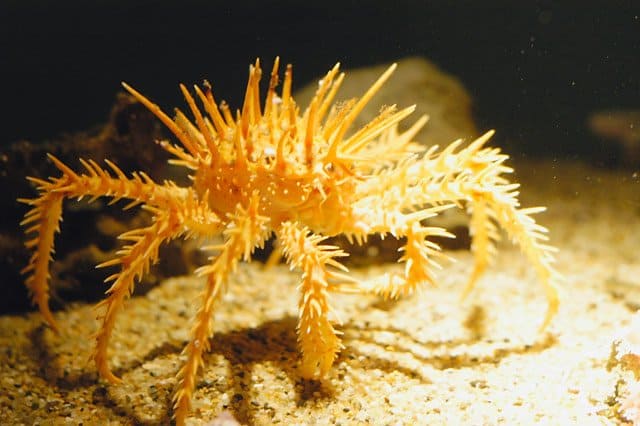
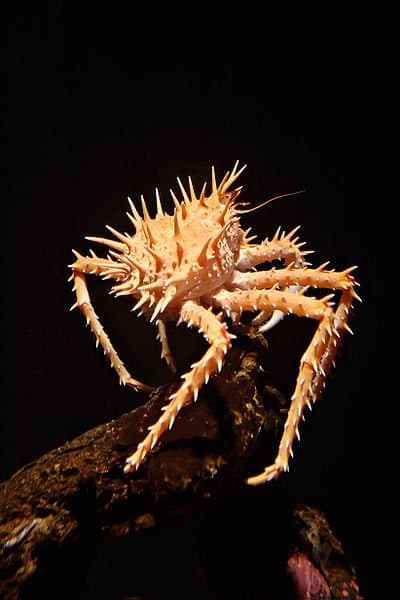
Photo of Paralithodes californiensis (king crab) at the Birch Aquarium in San Diego

At a Glance

Family Overview This page covers the King Crab family as a group. Stats below are general traits shared across the family.
Diet Omnivore
Activity Nocturnal+
Lifespan 15 years
Weight 12 lbs
Status Not Evaluated
Did You Know?

"King crab" is a family-level common name (Lithodidae), not a single species-red, golden, and blue king crabs are just a few well-known examples.

Scientific Classification

Family Overview "King Crab" is not a single species but represents an entire family containing multiple species.

King crabs are large, often spiny, bottom-dwelling decapod crustaceans in the family Lithodidae. Despite their crab-like form, they are anomuran crustaceans (closer to hermit crabs than to true crabs) and many lineages show strong “carcinization” (evolution toward a crab-like body plan). Several species are major seafood resources in cold-temperate to subpolar seas.

Kingdom
Animalia
Phylum
Arthropoda
Class
Malacostraca
Order
Decapoda
Family
Lithodidae

Distinguishing Features

  • Robust, heavily calcified carapace often bearing prominent spines/tubercles
  • Long, powerful walking legs; large chelae (claws) in many species
  • Anomuran body plan (lithodids are not “true crabs” despite appearance)
  • Cold-water distribution is common; many species are commercially fished

Physical Measurements

Males and females differ in size

Length
5 in (1 in – 12 in)
2 ft 7 in (5 in – 4 ft 11 in)
Weight
6 lbs (0 lbs – 26 lbs)
6 lbs (0 lbs – 18 lbs)
Top Speed
2 mph
walking

Appearance

Primary Colors
Secondary Colors
Skin Type Hard, calcified chitinous exoskeleton (carcinized anomuran body plan) with prominent spines/tubercles in many species; surface may be rough and setose, with stout articulated walking legs and large chelae (claws).
Distinctive Features
  • Family-level group ("king crabs" = Lithodidae), not a single species; includes red, golden, and blue king crab examples.
  • Anomuran affinity (closer to hermit crabs than true crabs); strong carcinization produces crab-like form.
  • Size range across family: small species ~2-5 cm carapace width; largest ~20-25+ cm, leg spans up to ~1.5-1.8 m.
  • Mass range broad: from <0.5 kg in small species to ~8-12+ kg in the largest individuals.
  • Typically robust, triangular-to-oval carapace with conspicuous spines, tubercles, and armored limb segments; degree of spination varies widely by genus/species.
  • Large, powerful chelae (often asymmetrical); walking legs long and stout; hind legs reduced/modified (anomuran trait).
  • Cold-temperate to subpolar benthic ecology is common; many occur on continental shelves and slopes, from shallow subtidal to >1000 m depending on species.
  • Generalist feeding is typical: scavenging and omnivory/predation on benthic invertebrates; diet varies with habitat and life stage.
  • Behavior varies by species: seasonal movements and aggregations (including fishery-relevant concentrations) occur in some; others are more solitary in deeper water.
  • Lifespan varies widely across the family: roughly ~5-30+ years depending on species, temperature, and growth rate.
  • Economically important in multiple regions; several species support major cold-water fisheries, but not all Lithodidae are harvested.

Sexual Dimorphism

Sexual dimorphism is common but variable: males typically grow larger with more robust chelae and longer legs. Females usually have a broader abdomen for brooding eggs and may show different spine robustness or body proportions.

  • Often larger overall body size and heavier mass at maturity.
  • Chelae commonly larger and more robust; sometimes stronger asymmetry.
  • Relatively narrower abdomen compared with females.
  • Legs may appear longer/thicker, enhancing reach and combat ability.
  • Broader, more rounded abdomen adapted for carrying egg masses.
  • Brooding behavior (egg carriage under abdomen) influences body profile.
  • Often smaller maximum size than males in heavily dimorphic species.
  • Mature females may appear fuller-bodied during reproductive periods.

Did You Know?

"King crab" is a family-level common name (Lithodidae), not a single species-red, golden, and blue king crabs are just a few well-known examples.

They're anomurans (closer to hermit crabs than "true crabs"), and many lineages independently evolved a crab-like body plan (carcinization).

Size varies enormously across the family: from small species only a few cm across to giants with ~25-30 cm carapaces and leg spans that can approach ~1.5-1.8 m.

Some species live from shallow coastal zones to very deep slopes-lithodids include both shelf-dwelling and deep-sea forms (down to well over 1000 m in some records).

Females brood eggs on their abdomen for many months (often close to a year in cold waters), carrying large egg masses until hatching.

Several species underpin major cold-region fisheries (notably in the North Pacific), shaping coastal economies, regulations, and seafood culture.

Unique Adaptations

  • Carcinization (crab-like evolution): many lithodids have a broad, armored carapace and a reduced abdomen tucked beneath-an evolutionary pathway shared with other anomurans but repeated strongly in this family.
  • Heavy armor and spines: robust calcified exoskeletons and prominent spines can deter predators and may help in rough, cold-water benthic habitats.
  • Reduced last walking legs: the rearmost pair is typically small and partly hidden, used for grooming and, in females, helping manage/clean the egg mass beneath the body.
  • Cold-water reproduction strategy: extended brooding and relatively large, yolky eggs are common in colder environments where development is slow and seasonal windows are tight.
  • Strong, multi-jointed walking legs: long legs increase reach over uneven seafloor and help these crabs traverse soft sediments and complex terrain.

Interesting Behaviors

  • Seasonal movements are common in many fished species: adults may shift between deeper and shallower areas tied to temperature, reproduction, and feeding-yet some lithodids remain largely deep-water year-round.
  • Reproductive aggregations: in several species, adults concentrate during mating and egg extrusion periods; timing can differ by region and species.
  • Brooding and guarding: females carry eggs under the tucked abdomen, aerating and cleaning them with specialized limbs; brooding duration is typically long in cold seas.
  • Opportunistic feeding: across the family, diets often include a mix of benthic invertebrates and carrion; some species are more predatory while others scavenge heavily depending on habitat and availability.
  • Shelter use and ontogenetic shifts: juveniles commonly use complex habitat (rocks, algae, sponges, or structured bottom) for protection, while larger adults roam more openly on soft or mixed sediments.
  • Activity patterns vary: some species are more active foragers, while others conserve energy in very cold/deep environments, moving less and relying more on opportunistic feeding.

Cultural Significance

Lithodidae king crabs are a famous seafood in cold‑temperate and subpolar areas, especially the North Pacific (Alaska, Russian Far East). They support valuable fisheries with rules, holiday and restaurant markets, local subsistence, and became a symbol after 20th‑century moves to the Barents Sea.

Myths & Legends

Name-origin lore in fishing cultures: "king crab" entered common use as a marketing-style name emphasizing exceptional size and value-an anecdotal tradition that helped cement their "royal" reputation in seafood markets.

Japanese naming association: the Japanese common name for red king crab is often explained as meaning "cod crab," reflecting frequent capture in cod fisheries-an enduring linguistic association rather than a biological trait.

Barents Sea tale: along northern Norway and Russia, king crabs (Lithodidae) came after Soviet-era introductions, becoming a modern coastal story — a 'newcomer from the east' that changed fishing and local identity.

Conservation Status

NE Not Evaluated (family-level). Across Lithodidae, most species have not been assessed globally; where assessed, statuses span Least Concern through Near Threatened/Vulnerable in some cases, with many taxa effectively Data Deficient due to deep-water distributions and limited monitoring.

Has not yet been evaluated against the criteria.

Population Unknown

Protected Under

  • Widely managed under national/regional fisheries frameworks (e.g., total allowable catch, size limits, sex restrictions, seasonal closures, limited entry).
  • Area-based protections apply in some jurisdictions via marine protected areas and fishery closures on sensitive benthic habitats.
  • Bycatch and gear regulations in some trawl and pot fisheries may indirectly reduce mortality for non-target lithodid species.

You might be looking for:

Red king crab

50%

Paralithodes camtschaticus

Large, commercially important North Pacific king crab; famously introduced to the Barents Sea.

Golden (brown) king crab

15%

Lithodes aequispinus

Deep-water North Pacific king crab, smaller than red king crab, important in some fisheries.

Blue king crab

12%

Paralithodes platypus

Cold-water Bering Sea/North Pacific species known for bluish coloration.

Southern king crab

8%

Lithodes santolla

South American/Patagonian king crab harvested in southern South America.

Japanese king crab

7%

Paralithodes japonicus

Northwest Pacific species occurring around Japan and adjacent waters.

Life Cycle

Birth 50000 larvas
Lifespan 15 years

Lifespan

In the Wild
5–30 years
In Captivity
1–15 years

Reproduction

Mating System Polygynandry
Social Structure Transient
Breeding Pattern Seasonal
Fertilization Internal Fertilization
Birth Type Internal_fertilization

Across Lithodidae, adults are mostly solitary but form brief mating pairs during seasonal breeding. Males compete and often guard females around molting, transferring spermatophores for internal fertilization; females brood eggs on pleopods, with no parental help.

Behavior & Ecology

Social Aggregation Group: 10
Activity Nocturnal, Crepuscular, Cathemeral
Diet Omnivore Varies across Lithodidae; commonly energy-rich benthic invertebrates (especially bivalves and echinoderms) and carrion when available.
Seasonal Migratory 124 mi

Temperament

Generally non-territorial and tolerant at moderate densities; aggression increases around food, mates, and during crowding
Opportunistic benthic foragers; many species scavenge readily but also prey actively on invertebrates
Risk-averse: many individuals shelter or reduce movement after molting; juveniles especially cryptic
Behavior varies widely by habitat depth, fishing pressure, and local predation regimes

Communication

Chemical cues in water (pheromones) for mate finding, readiness to spawn, and species recognition
Tactile signaling via antennal contact and leg probing during courtship and assessment
Hydrodynamic/mechanosensory cues detected by setae for nearby movement, predators, and conspecifics
Visual/body-posture displays at close range (raised claws, pushing) during contests or mating
Substrate-borne vibrations from walking/stridulation-like movements may aid short-range signaling

Habitat

Coastal Rocky Shore Kelp Forest Seabed/Benthic Deep Sea Open Ocean
Terrain:
Coastal Rocky Sandy Muddy
Elevation: -118110 in

Ecological Role

Benthic mesopredators and scavengers that can strongly influence seafloor community structure; effects range from localized predation on shellfish/echinoderms to broader opportunistic consumption across benthic food webs, with substantial variation among species and habitats (shelf vs. deep sea, high-latitude vs. temperate).

Regulation of benthic invertebrate populations (e.g., bivalves, echinoderms, worms) Carrion removal and recycling of organic matter (scavenging) Bioturbation and sediment reworking while foraging Nutrient cycling and energy transfer from benthos to higher trophic levels (as prey for fishes, octopuses, marine mammals, and humans in fished systems)

Diet Details

Main Prey:
Benthic bivalves Gastropods Polychaete worms Echinoderms Crustaceans Fish eggs and small benthic fishes Carrion +1
Other Foods:
Macroalgae Drift algae and kelp detritus Seagrass and algal detritus biofilm and organic-rich sediments

Human Interaction

Domestication Status

Wild

King crabs (Lithodidae) are wild; none are truly domesticated. Humans mainly catch them in fisheries and manage stocks with quotas, size/sex rules, and seasonal closures. There is limited hatchery or aquaculture research and rare short-term holding or fattening, but no breeding across many generations in captivity.

Danger Level

Moderate
  • Painful pinches/crush injuries from large chelae (highest risk to fishers/handlers)
  • Puncture/scrape injuries from spines and sharp carapace edges
  • Slips/strains during handling of heavy animals/gear in fisheries
  • Allergic reactions in sensitized individuals (shellfish allergy)
  • Foodborne illness risk if improperly handled/stored/cooked (applies to seafood consumption generally, not unique to Lithodidae)

As a Pet

Not Suitable as Pet

Legality: King crabs (Lithodidae) are not usually pets, but local fishing laws often control taking, keeping, or transport (permits, size and sex limits, seasons, bag limits). Import/export may need biosecurity or wildlife permits. Check laws first.

Care Level: Expert Only

Purchase Cost: Up to $300
Lifetime Cost: $2,000 - $15,000

Economic Value

Uses:
Commercial and subsistence fisheries (major for some species, negligible for others) Seafood processing and trade (live, fresh, frozen) Bycatch considerations and ecosystem management Aquaculture/hatchery research (limited; experimental in parts of the range) Invasive-species management impacts (region-dependent; e.g., where introduced populations occur)
Products:
  • Crab meat (legs/claws/body; fresh, frozen, canned, prepared meals)
  • Live seafood market product (where legally traded)
  • Shell byproducts (chitin/chitosan and meal; limited and variable by region)
  • Fishery-related employment and export revenue (highly variable across species and countries)

Relationships

Predators 7

Related Species 8

Spiny king crabs Lithodes Shared Family
Red/blue king crabs Paralithodes Shared Family
Stone king crabs Lopholithodes Shared Family
Deep-sea king crabs Neolithodes Shared Family
Lithodid king crabs Paralomis Shared Family
Prickly king crabs Echidnocerus Shared Family
False king crabs Cryptolithodes Shared Order
Hapalogastrine king crabs Hapalogaster Shared Family

Types of King Crab

18

Explore 18 recognized types of king crab

Red king crab Paralithodes camtschaticus
Blue king crab Paralithodes platypus
Golden king crab Lithodes aequispinus
Southern king crab Lithodes santolla
Japanese king crab Paralithodes japonicus
Stone king crab Lopholithodes mandtii
Prickly king crab Lopholithodes foraminatus
California king crab Paralithodes californiensis
Brown king crab Lithodes antarcticus
Antarctic stone crab Paralomis birsteini
Southern king crab (Lithodes santolla) Paralomis granulosa
False king crab Cryptolithodes typicus
Butterfly crab (a false king crab) Cryptolithodes sitchensis
Deep-sea king crab Neolithodes grimaldii
Deep-sea king crab Neolithodes brodiei
Deep-sea king crab Lithodes murrayi
Hapalogaster king crab Hapalogaster dentata
Hapalogaster king crab Hapalogaster grebnitzkii

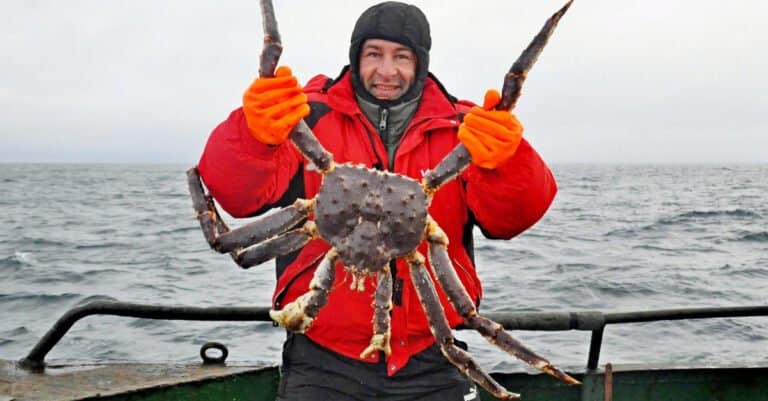
The king crab is one of the largest crab species known to man. It can weigh more than 11 pounds, which is heavier than a house cat, and has a total leg span of over 5 feet, which means that it can be as long as a human is tall.

Some of the most popular King crabs are Alaskan king crabs, red king crabs, or Japanese crabs. They can only grow larger through a process called molting, in which they shed their old shells and grow newer, larger ones.

In general, king crabs can be found along the Alaskan coast, in the Bering Sea, and in the shallow waters surrounding the coast of Japan. They are the most popular crab to eat, and their meat is considered a delicacy in most parts of the world.
While they may look inedible, king crab meat is considered a delicacy.

Types of King Crab

There are over 120 different species of king crabs across the Earth.

Alaskan King Crab

Some of the most well-known king crabs originate near the Alaskan coast. These are the four main types:

  • Red King Crab (Paralithodes camtschaticus): The Red King Crab is also known as the Japanese crab or the Kamchatka crab. Red king crab is the most expensive type of crab and is very desirable. They can be caught near Bristol Bay.
  • Blue King Crab: The Blue King Crab is named for the touches of blue on their otherwise brown exoskeleton. The meat from the blue king crab is sometimes mistaken for red king crab meat because of its red and orange coloration. These crabs can be caught in the areas near St. Matthew Island and the Pribilof Islands.
  • Brown “Golden” King Crab: The Brown “Golden” King Crab is named for its gold and brown shell. These smaller crabs can be harvested close to the Aleutian Islands; however, they deliver less meat than their larger cousins.
  • Scarlet King Crab: The Scarlet King Crab is known for its bright red shell. These crabs are not hunted in the same numbers as the other Alaskan king crabs, due to their smaller population.

Other King Crab

There are many other types of king crabs found around the world’s oceans.

  • Southern King Crab: The Southern King Crab is another king crab that lives far to the south, close to Chile and Argentina. These crabs are sometimes known as Chilean king crabs and also centolla. They grow to be just over half a foot long.
  • Norway King Crab: The Norway King Crab is found off the coast of Northern Europe and Norway, and it’s also called the deep-sea crab. They can be recognized by their spiky carapace, which has a brown and orange hue.
  • Puget Sound King Crab: The Puget Sound King Crab is a larger cousin of the other king crabs that grow almost a foot long. It is one of the more colorful king crabs with their hues of purple, red, and orange.
  • Brown Box Crab: The Brown Box Crab can be caught along the Pacific Coast of Canada and America, including Alaska. These crabs are a little duller than other king crabs and not quite as large, yet much of their total mass is edible.
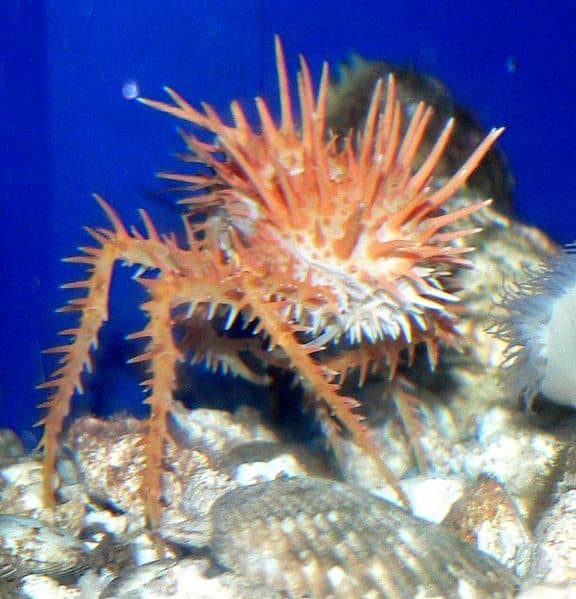
King crabs cannot swim as adults.

Appearance and Behavior

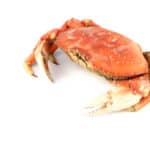
Despite its name, the red king crab is typically not red. Live ones tend to have a more orange or burgundy hue. Some can even be a brownish-blue color. The name actually comes from the fact that they turn bright red when cooked.

Like most crab species, king crabs are covered in a thick and heavy shell, which is usually called a carapace. In addition, their entire bodies are covered in large, sharp spines for additional protection.

Outside of the mating season, king crabs are solitary creatures. However, they have been known to group together in the face of large predators. They will stack on top of each other in what is known as a “pod” in order to appear larger and more menacing. These pods can be dozens of feet high and contain stacks of hundreds of crabs.

Male king crabs usually grow to be larger than females, and they can be easily identified by their different body shapes. Female king crabs have a wide, fan-shaped abdomen, and males have a narrow, triangle-shaped abdomen.

King crabs have five pairs of legs. The first pair of legs actually functions more like arms, and each has a sharp pincer attached to the end. The right claw is larger and thicker, and it is designed for crushing. The left claw is smaller, and it is designed to tear apart food.

The fifth set of legs is also different from the rest. These legs are smaller and specialized in aiding the crabs in egg fertilization during mating and cleaning fertilized eggs after they have been laid.
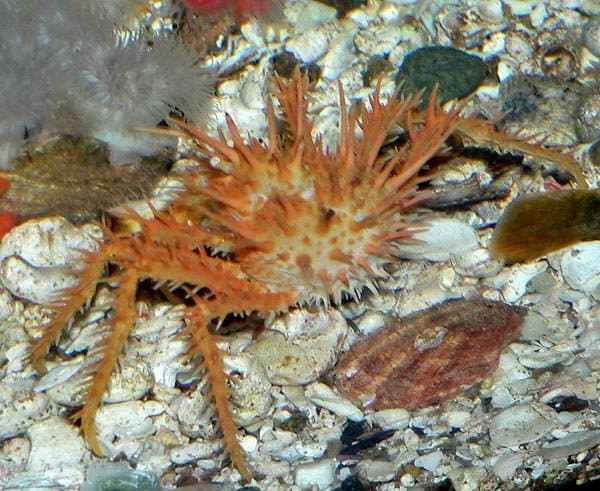
King crabs are covered in a thick and heavy shell, called a carapace.

History and Evolution

King crabs are some of the largest arthropods on Earth. Evidence points to king crabs descending from the same tree as hermit crabs, despite them having weak exoskeletons and spiraling abdomens. Somewhere along the line, the king crab ancestors evolved away from living within a shell and adapted a much stronger exoskeleton for protection to replace the exterior shell. Making this adaptation allowed the king crab to grow larger than hermit crabs. This roughly took place around 20 million years ago, and the hermit crabs themselves have a long history dating back 150 million years.

There also happens to be a line of thought that sees other crustaceans evolving to take a form similar to that of a crab. There must be some advantage to the evolution that a lot of these animal types are trending towards over time.

Habitat

Most species of king crabs prefer to live in relatively shallow and muddy coastal waters that are less than 200 feet deep. However, they can also live in waters that are as deep as 650 feet.

Adult king crabs generally prefer cold water that is between 2 to 4 degrees Celsius or 35 to 40 degrees Fahrenheit.
 

Crab Diet
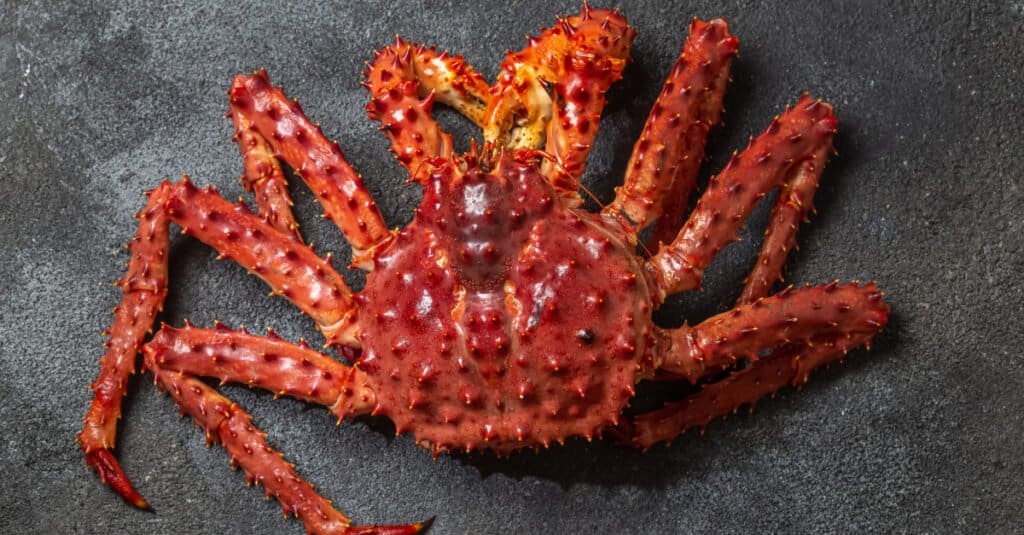
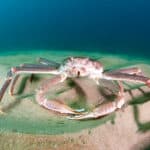
Top 10 Animals That Have Shells - king crab

King crabs eat mussels, barnacles, sea urchins, clams, fish, and even smaller crab species.

King crabs are carnivores, and they are known for eating smaller ocean creatures such as worms, snails, mussels, barnacles, sea urchins, clams, and fish. They will even eat smaller crab species.

They are also considered opportunistic feeders, which means that they are not picky eaters. They will eat whichever invertebrates are easiest to find and crush with their pincers in the nearby surroundings.

Predators and Threats

The natural predators of king crabs include large fish like cod, halibut, and other similar species, as well as skates and sculpins. They are also in danger from octopuses and even other king crabs.

The largest king crabs have very few natural predators due to their sheer size and the fact that they are only vulnerable right after molting.

Human harvesting of king crabs is another threat to wild populations. However, a number of man-made fisheries have been established, and strict harvesting regulations are in place, so they are not considered to be endangered.
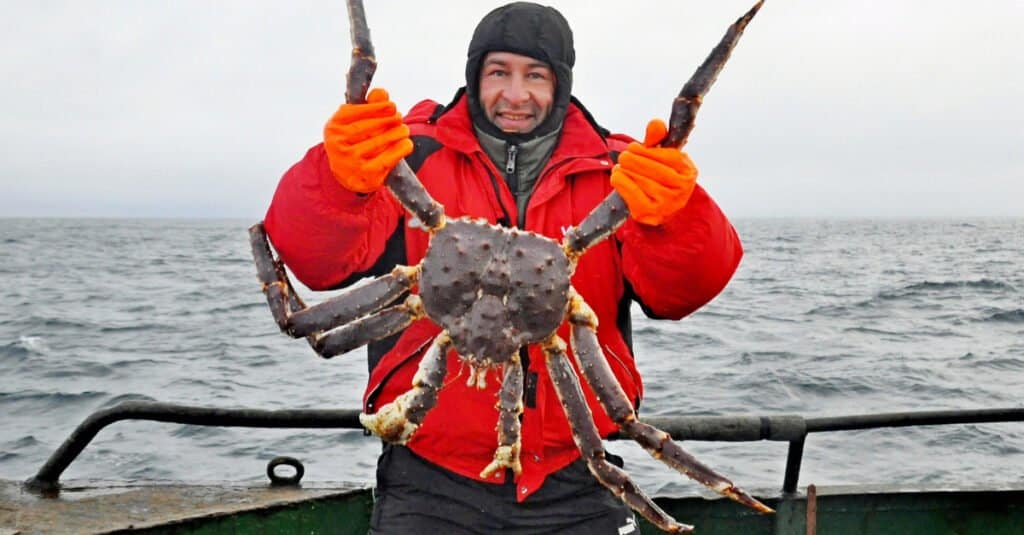
Largest King Crab - Red King Crab

Harvesting king crabs is a heavily restricted industry.

Reproduction, Babies, and Lifespan

In the wild, king crabs can live up to 30 years. Most do not live this long, but it is normal for a king crab to live at least 20 years when there is minimal threat of human harvesting.

King crabs reach sexual maturity after about five years, and their reproduction cycle begins in the spring.

In mid-spring, usually around May, mature female king crabs will migrate to warmer, shallower waters to ensure that they can safely spawn their eggs. They can spawn anywhere from 50,000 to 500,000 eggs at once.

Male king crabs will join the females later in the season to fertilize the eggs, and females will then carry these eggs in their abdominal flaps for up to 12 months before they hatch. After hatching, king crab larvae resemble tiny shrimp. These larvae are called zoea, and unlike their adult counterparts, they are able to swim. They do not spend any time with the mother crab.

King crab larvae will molt up to five times in the first few months of their lives, and they then metamorphose into what is called a “glaucothoe.” This is a sort of in-between stage of growth for king crabs, which is similar to how many insects have a juvenile stage that essentially looks like a less-developed adult version of the creature.

These juvenile king crabs settle onto the ocean floor when they reach this stage of growth, and as they continue to grow, they will remain on the ocean floor and begin to move around and behave like adult king crabs. During this phase, they will continue to molt regularly as they grow larger, and they also lose their ability to swim.
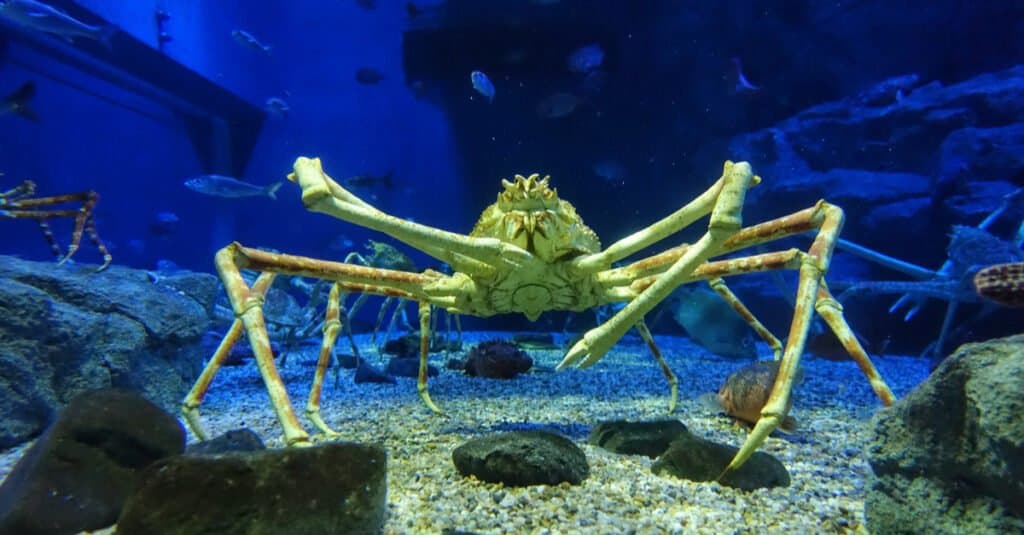
japanese spider crab deep sea creatures

King crabs can live up to around 30 years in the wild.

Population

King crab populations are closely monitored to avoid overfishing. Because king crab population fluctuations are cyclical, fisheries maintain guidelines regarding how and when these crabs can be harvested to maximize their chances of reproducing and keeping population numbers high.

As an example, fisheries follow the “three S” rule: size, sex, and season. Only male crabs may be harvested, and they must be above a certain size threshold. Additionally, they are only allowed to be harvested outside of the mating and molting season. This helps to ensure that the species is able to replenish itself.

Populations in the Barents Sea are estimated to be around 20 million, and the numbers in the Bering Sea are slightly lower.
 

View all 103 animals that start with K

Sources

  1. David Burnie, Dorling Kindersley (2011) Animal, The Definitive Visual Guide To The World's Wildlife / Accessed November 10, 2008
  2. Tom Jackson, Lorenz Books (2007) The World Encyclopedia Of Animals / Accessed November 10, 2008
  3. David Burnie, Kingfisher (2011) The Kingfisher Animal Encyclopedia / Accessed November 10, 2008
  4. Richard Mackay, University of California Press (2009) The Atlas Of Endangered Species / Accessed November 10, 2008
  5. David Burnie, Dorling Kindersley (2008) Illustrated Encyclopedia Of Animals / Accessed November 10, 2008
  6. Dorling Kindersley (2006) Dorling Kindersley Encyclopedia Of Animals / Accessed November 10, 2008
Heather Ross

About the Author

Heather Ross

Heather Ross is a secondary English teacher and mother of 2 humans, 2 tuxedo cats, and a golden doodle. In between taking the kids to soccer practice and grading papers, she enjoys reading and writing about all the animals!

Thank you for reading! Have some feedback for us?


King Crab FAQs (Frequently Asked Questions)

King crabs are larger than snow crabs. In addition, they have spines across their bodies and are thicker than snow crabs.