K
Species Profile

King Penguin

Aptenodytes patagonicus

Royal diver of the Southern Ocean
Jeff Kubina from Columbia, Maryland, CC BY-SA 2.0, via Wikimedia Commons

King Penguin Distribution

Click a location to explore more animals from that region

This map shows coastal regions where King Penguin are found.

Loading map...

Size Comparison

Human 5'8"
King Penguin 2 ft 11 in

King Penguin stands at 52% of average human height.

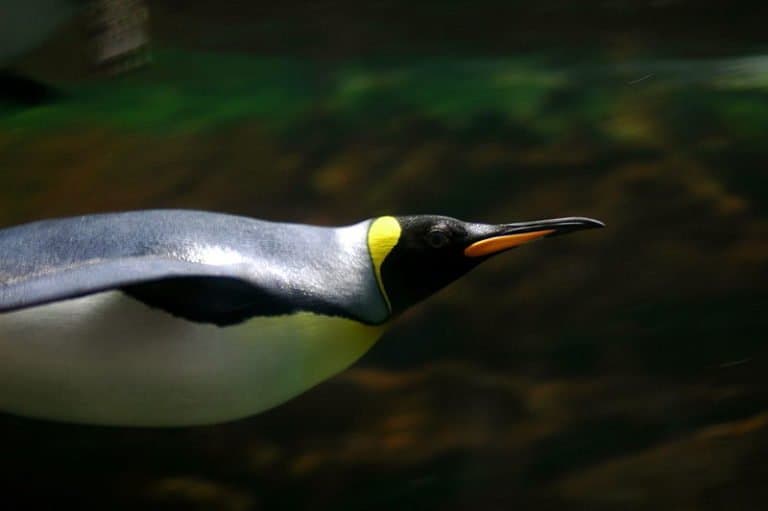
King penguin swimming under water

At a Glance

Wild Species
Also Known As Pingüino rey, Manchot royal, Königspinguin, Pinguim-rei, Pinguino reale, Koningspinguïn, королевский пингвин
Diet Piscivore
Activity Cathemeral
Lifespan 20 years
Weight 17.3 lbs
Status Least Concern
Did You Know?

Size: ~85-95 cm tall; adults typically ~9-18 kg depending on season and molt (field measurements reported across colonies).

Scientific Classification

A large, flightless seabird of the Southern Ocean, notable for its sleek gray back, white belly, and bright orange-yellow patches on the neck and upper chest; the second-largest penguin species after the Emperor Penguin.

Kingdom
Animalia
Phylum
Chordata
Class
Aves
Order
Sphenisciformes
Family
Spheniscidae
Genus
Aptenodytes
Species
Aptenodytes patagonicus

Distinguishing Features

  • Second-largest penguin; tall, upright posture
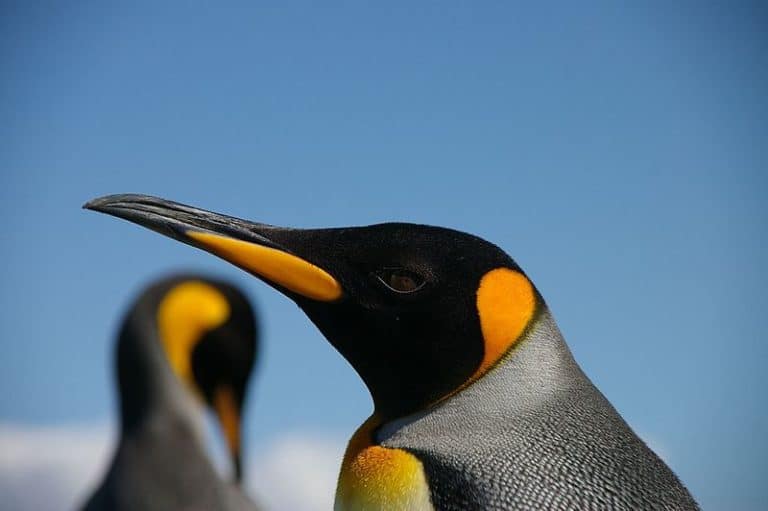
  • Orange-yellow ear/neck patches and upper breast wash
  • Longer, slimmer bill than many penguins; black head with sharp color boundaries
  • Breeds on land in subantarctic regions (not primarily on sea ice)
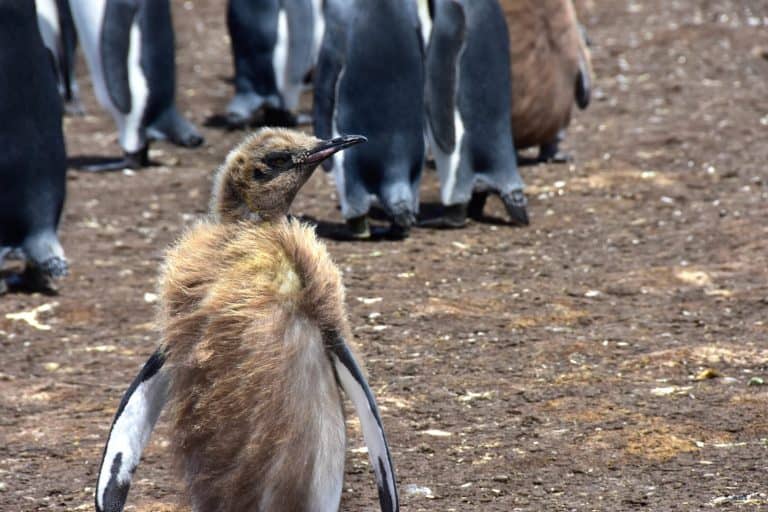
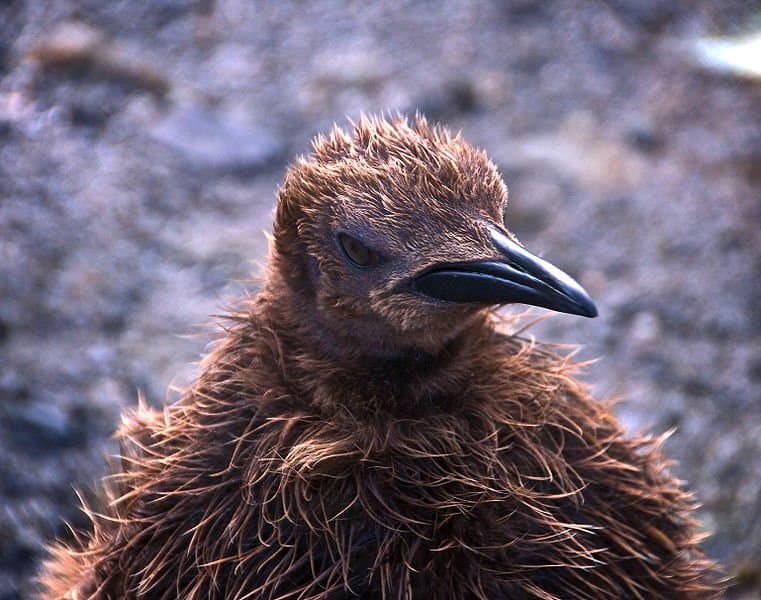
  • Chick stage features distinctive brown, downy plumage (often called ‘oakum’ chicks)

Physical Measurements

Height
2 ft 11 in (2 ft 9 in – 3 ft 1 in)
Length
2 ft 11 in (2 ft 9 in – 3 ft)
Weight
26 lbs (20 lbs – 33 lbs)
Tail Length
5 in (4 in – 6 in)
Top Speed
7 mph
swimming

Appearance

Primary Colors
Secondary Colors
Skin Type Dense waterproof feathers; bare black skin on the bill and feet.
Distinctive Features
  • Second-largest penguin: adult height typically ~85-95 cm (Birds of the World; HBW Alive).
  • Adult mass commonly ~11-16 kg; can exceed ~18 kg pre-molt in some colonies (Birds of the World).
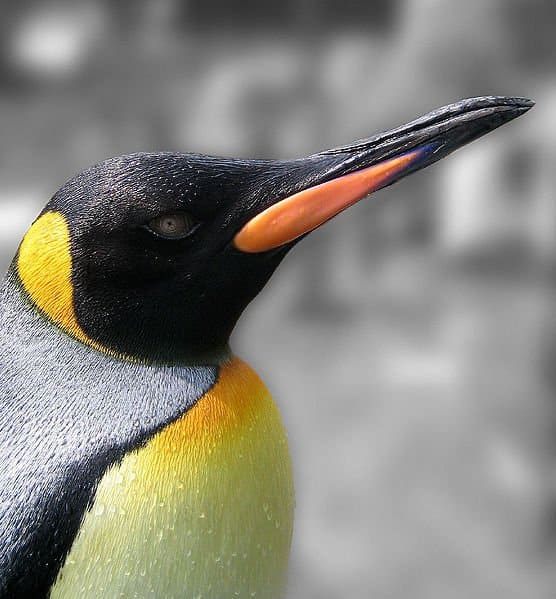
  • Oval orange ear/neck patches ("auricular" patches) and golden upper-breast grading into white belly.
  • Long, narrow black bill with orange mandibular plate; head sleek without crests (diagnostic vs. Eudyptes penguins).
  • Flippers stiff and dark dorsally; feet black and robust for upright posture on land.
  • Chicks are conspicuously large and covered in thick brown woolly down before molting to juvenile plumage.
  • Subantarctic land-based breeder in dense colonies (e.g., South Georgia, Crozet, Kerguelen), not typically on Antarctic sea ice.
  • Deep-diving forager: maximum recorded dive depth ~343 m; dives commonly several minutes (e.g., Kooyman et al.; Pütz et al.).

Sexual Dimorphism

Sexual dimorphism is slight: males average marginally larger and heavier, but plumage pattern and coloration are essentially identical, so sex is unreliable to determine visually without measurements or vocal/behavioral cues.

  • Slightly greater average mass and linear measurements (bill/flipper length) on population averages.
  • May appear marginally bulkier through chest/neck when paired side-by-side.
  • Slightly smaller average mass and linear measurements; overlaps strongly with males.
  • No consistent plumage-color differences from males.

Did You Know?

Size: ~85-95 cm tall; adults typically ~9-18 kg depending on season and molt (field measurements reported across colonies).

Dive performance: commonly ~100-300 m; recorded maxima around ~300+ m with dives lasting up to ~9 minutes (instrumented dive studies on king penguins).

Breeding is unusually long: a single chick takes ~10-13 months to fledge, so the full breeding cycle lasts ~13-16 months, not a simple annual schedule.

Incubation is "on the feet": the single egg is carried on the parents' feet under a warm brood pouch; incubation lasts ~54-55 days (colony observations).

Chicks form large crèches (groups) while both parents forage, reducing predation risk and improving thermoregulation in dense colonies.

Diet is dominated by lanternfish (myctophids) and other mesopelagic prey captured during deep, repeated dives along oceanic fronts (Southern Ocean foraging studies).

Unique Adaptations

  • Countershading and signaling: sleek gray back and white belly for camouflage at sea, plus orange-yellow ear/neck and upper-chest patches used in social signaling and mate assessment.
  • Exceptional oxygen management for diving: high myoglobin in muscles, strong bradycardia (slowed heart rate) during dives, and preferential oxygen allocation to brain/heart enable long deep dives (documented in diving physiology studies of Aptenodytes).
  • Dense, overlapping feathers and subcutaneous fat provide insulation; waterproofing plus trapped air layers reduce heat loss in near-freezing waters.
  • Large body size (second only to emperor penguin) lowers surface-area-to-volume ratio, improving thermal efficiency in cold seas.
  • Brood-pouch incubation on feet prevents egg contact with ice/cold ground and allows prolonged fasting while maintaining incubation temperature.
  • Specialized bill and tongue: backward-facing spines (papillae) and a strong bill help grip slippery fish and squid in water.

Interesting Behaviors

  • Dense land-based breeding: adults pack tightly in huge subantarctic colonies (often on beaches/flat ground), using vocal calls and visual cues to relocate mates and chicks among thousands.
  • Two-parent incubation and chick-rearing: both sexes alternate long fasting shifts on land with multi-day foraging trips at sea; shift length changes with food availability and chick stage.
  • Crèche formation: after early brooding, chicks aggregate into crèches while adults forage, and parents later find their own chick primarily by its distinctive call (acoustic recognition documented in penguins, including king penguins).
  • Long-distance foraging tied to ocean fronts: adults commute to productive waters (e.g., Polar Front/Subantarctic Front regions near colonies) and often target the deep scattering layer at night/day depending on prey depth.
  • Thermoregulatory postures: "huddling," minimizing exposed surface area, and tucking flippers reduce heat loss during cold, windy subantarctic weather.
  • Molt fasting: adults undergo a catastrophic annual molt (replacing all feathers), remaining ashore and fasting while they become temporarily non-waterproof.

Cultural Significance

King penguins are iconic wildlife of subantarctic islands (e.g., South Georgia, Crozet, Kerguelen, Marion/Prince Edward, Heard, Macquarie), featured in expedition journals, nature documentaries, and conservation messaging about Southern Ocean food webs and climate-linked shifts in ocean fronts that affect foraging distances and breeding success.

Myths & Legends

Early European explorers and sailors called the King Penguin (Aptenodytes patagonicus) "King" because of its large size and upright stance. The name stuck in natural history after 18th-century Southern Ocean voyages.

Sailors in the Subantarctic told stories about king penguin (Aptenodytes patagonicus) rookeries as noisy 'cities.' Their marching and order made sailors imagine penguin armies and royal gatherings.

On remote islands with no known local myths, King Penguin (Aptenodytes patagonicus) entered human stories through explorers' journals, shown as brave, curious 'locals' that approach visitors, recurring in expedition tales.

Conservation Status

LC Least Concern

Widespread and abundant in the wild.

Population Increasing

Protected Under

  • Many major breeding sites occur within nationally protected areas (e.g., nature reserves and protected islands in subantarctic territories), with regulated access and biosecurity measures.
  • CCAMLR (Commission for the Conservation of Antarctic Marine Living Resources) provides ecosystem-based management of Southern Ocean fisheries in large parts of the species' foraging range.

Life Cycle

Birth 1 chick
Lifespan 20 years

Lifespan

In the Wild
15–26 years
In Captivity
20–30 years

Reproduction

Mating System Monogamy
Social Structure Socially Monogamous
Breeding Pattern Long Term
Fertilization Internal Fertilization
Birth Type Internal_fertilization

King penguins are socially monogamous within dense colonies, forming a pair bond for a prolonged breeding attempt (~14-16 months). They typically lay one egg; both parents alternate incubation on their feet and later share chick provisioning.

Behavior & Ecology

Social Colony Group: 50000
Activity Cathemeral
Diet Piscivore Lanternfish (Myctophidae)-particularly Electrona carlsbergi in many Subantarctic foraging systems (reported as the principal prey by mass/frequency in multiple colony-based diet studies).

Temperament

Highly gregarious; breed in very dense colonies with close neighbor tolerance.
Locally territorial only at immediate standing/egg space; disputes involve pecking and bill-fencing.
Strong mate and chick fidelity/recognition; parents reunite with chick after long foraging trips.
Chicks are social in creches; adults remain vigilant but generally non-cooperative beyond parenting.

Communication

Mutual display/trumpet calls used in mate reunions and pair maintenance.
Individually distinctive parent-chick contact calls enable recognition in dense colonies Aubin & Jouventin 1998
Agonistic calls during close-range conflicts over space E.g., bill-fencing encounters; Stonehouse 1960
Chick begging calls that escalate with hunger and stimulate provisioning.
Visual displays: head-swinging, bill pointing, flipper spreading, and body postures during courtship and aggression.
Tactile signals: pecking, jabbing, and body pushing in spacing disputes.
Spatial cues: maintaining a small personal zone around feet/egg/chick within tight colony structure.

Habitat

Coastal Beach Rocky Shore Open Ocean Deep Sea
Biomes:
Terrain:
Coastal Island Rocky Sandy Muddy
Elevation: Up to 656 ft 2 in

Ecological Role

Mid-upper trophic-level marine predator specializing on mesopelagic fish; key conduit of energy from offshore mesopelagic food webs to breeding colonies.

Top-down predation on mesopelagic forage fish (especially myctophids), influencing prey population dynamics and community structure Biological transport of marine-derived nutrients to land via guano, carcasses, and food remains at colonies (nutrient subsidy that can alter soil chemistry and nearshore productivity) Prey base support for higher predators (e.g., leopard seals and killer whales) by contributing to local food-web biomass and energy flow

Diet Details

Main Prey:
Lanternfish Small pelagic fishes Cephalopods Krill

Human Interaction

Domestication Status

Wild

The king penguin (Aptenodytes patagonicus) is wild and has never been domesticated. People keep them only in zoos and aquariums for display, research, and education. Historic hunting on subantarctic islands for oil or meat was limited and not domestication. Adults are about 90–100 cm tall, 11–16 kg, lay one egg, and live ~15–20 years.

Danger Level

Low
  • Bites and pecks: strong bill can cause puncture wounds, especially during handling or at nest/chick defense
  • Flipper strikes and scratches during restraint/handling
  • Zoonotic and hygiene risks typical of seabirds in close contact (e.g., Salmonella spp.; ectoparasites; and general avian disease precautions). Human risk is mainly for handlers rather than observers under normal ecotourism distances
  • Slip/fall hazards for humans approaching colonies in wet/icy terrain; also biosecurity risk of humans introducing pathogens to penguins

As a Pet

Not Suitable as Pet

Legality: King Penguin (Aptenodytes patagonicus) cannot be kept as a private pet in most places. They are protected by national laws and CITES; only licensed zoos, aquariums, or research and conservation centers with permits can keep them.

Care Level: Expert Only

Purchase Cost:
Lifetime Cost: $1,000,000 - $5,000,000

Economic Value

Uses:
Ecotourism (subantarctic wildlife tourism; colony viewing from regulated sites) Conservation flagship value (fundraising/awareness for Southern Ocean protection) Scientific research value (climate, oceanography, foraging ecology, bio-logging) Education/exhibition value (public aquaria and zoos; high infrastructure needs) Historical subsistence/industrial exploitation (limited; penguin oil/meat historically across regions)
Products:
  • Non-consumptive services: guided wildlife viewing and associated local tourism revenue
  • Research outputs (datasets/monitoring programs relevant to fisheries and climate impacts)
  • Educational programming and conservation outreach (institutional/NGO value)

Relationships

Predators 5

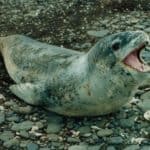
Leopard Seal
Leopard Seal Hydrurga leptonyx
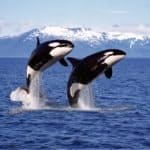
Killer Whale
Killer Whale Orcinus orca
Southern Giant Petrel Macronectes giganteus
Brown Skua Stercorarius antarcticus
Subantarctic Skua Stercorarius lonnbergi

“The king penguin is second in size only to the emperor penguin.”

Standing as tall as the average toddler, the king penguin is large for its species. Only the emperor penguin is larger. Taxonomy places both the king and emperor penguins in the Aptenodytes genus. Both are experts in the water and can dive to great depths. King penguins are animals that hunt for lanternfish, krill, and crustaceans for themselves and to feed to their young. King penguin chicks look very different from the adults, with their brown downy feathers. The babies can take more than a year to become independent.
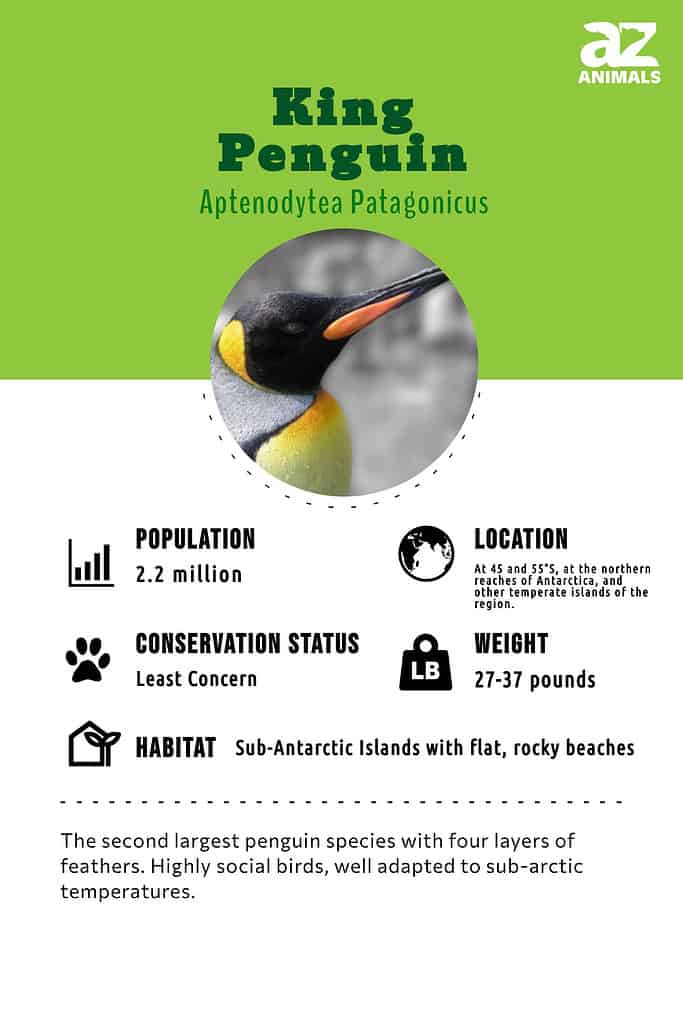
King penguin infographic

Incredible King Penguin Facts

  • When hunting prey, king penguins can reach depths of 300 meters, stay underwater for almost 10 minutes, and travel 1,200 miles.
  • King Harald V of Norway crowned one penguin at the Edinburgh Zoo a knight in 2008. His official name is Sir Nils Olav.
  • King penguin colonies can be as large as 200,000 birds, but family members can recognize and find each other by unique vocalizations.
  • The king penguin is the second largest penguin species in the world, trailing only the emperor penguin in size.

You can check out more incredible facts about king penguins.

Scientific Name
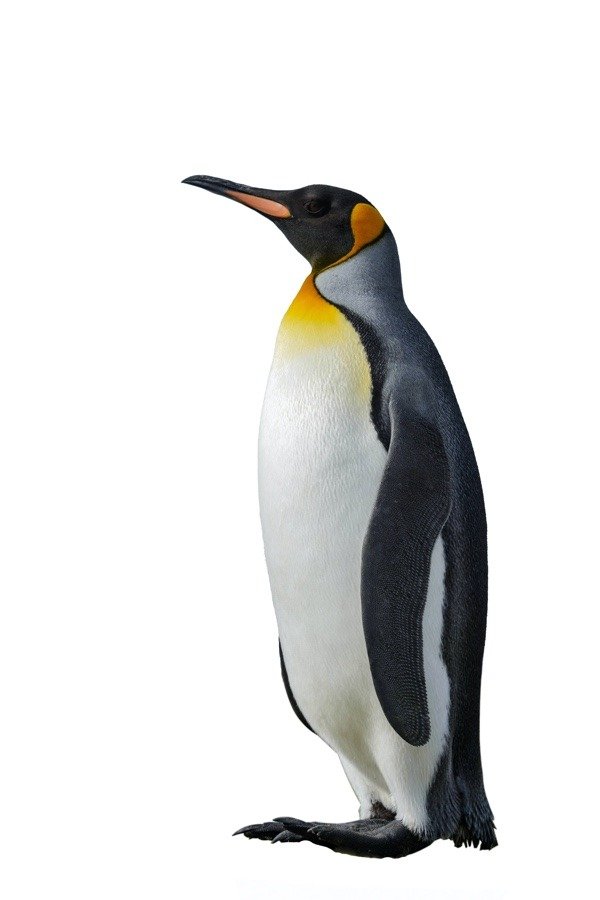
An isolated full-body profile view of a king penguin

King penguin’s scientific name is Aptenodytes Patagonicus

Taxonomy places the king penguin into the Spheniscidae family with all other penguins, but just emperor and king penguins have a separate genus: Aptenodytes, which is Greek for “featherless diver.” These two birds are bigger than all other penguins; have a long, thin bill and bright colors; dive deeper and longer than others; and are the only two who lay one egg and use their feet in place of a nest for that egg. The scientific name for the king penguin is Aptenodytes Patagonicus. While most of these creatures live in sub-arctic regions, fossils place them in the Patagonia region at least 6,000 years ago, hence the second part of their scientific name.

This animal’s common name came from European explorers at the beginning of the 18th century, who thought that they were the biggest penguins. It was not until Captain Cook’s second voyage that the explorers found the larger emperor penguin.

Evolution and Origins
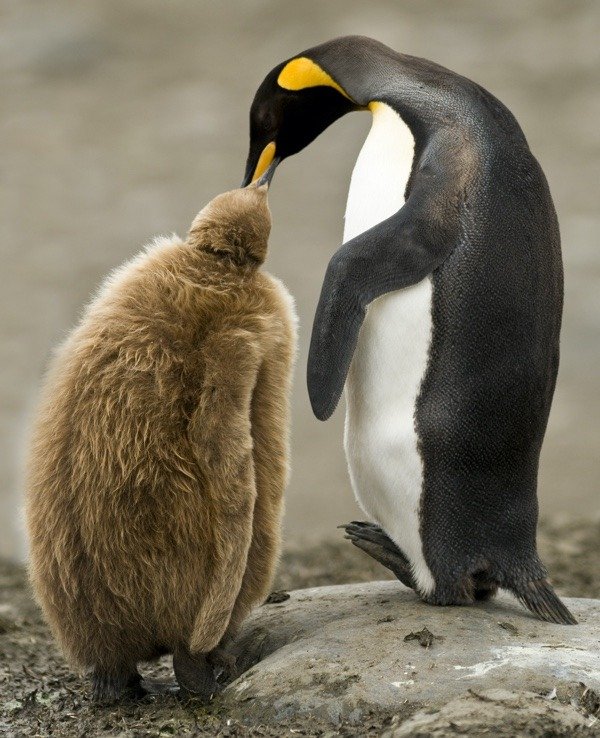
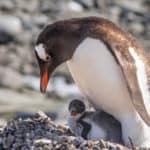
A baby king penguin being fed by an adult

King penguins have adapted four layers of fur to survive harsh climates.

The King Penguin (Aptenodytea patagonicus) is a fascinating species that has captured the attention of scientists and nature enthusiasts alike. While much remains unknown about their evolutionary history, researchers have made some significant discoveries in recent years.

Studies of genetic markers suggest that the King Penguin diverged from its closest living relative, the Adelie Penguin (Pygoscelis adeliae), around 11 million years ago. This divergence occurred during a period of global cooling, which led to the formation of permanent ice sheets near Antarctica.

The earliest known fossils of King Penguins date back to around 1 million years ago, during the Pleistocene epoch. These fossils indicate that early populations were smaller than modern ones and had slightly different morphological features.

One particularly interesting aspect of King Penguin’s evolution is its remarkable ability to adapt to changing environmental conditions. For example, recent research has shown that they can adjust their breeding behavior in response to changes in sea ice cover and ocean temperatures.

Overall, while we still have much to learn about the origins and evolution of this majestic bird species, ongoing research promises exciting new insights into their past and present adaptations for survival in one of Earth’s harshest environments.

Appearance
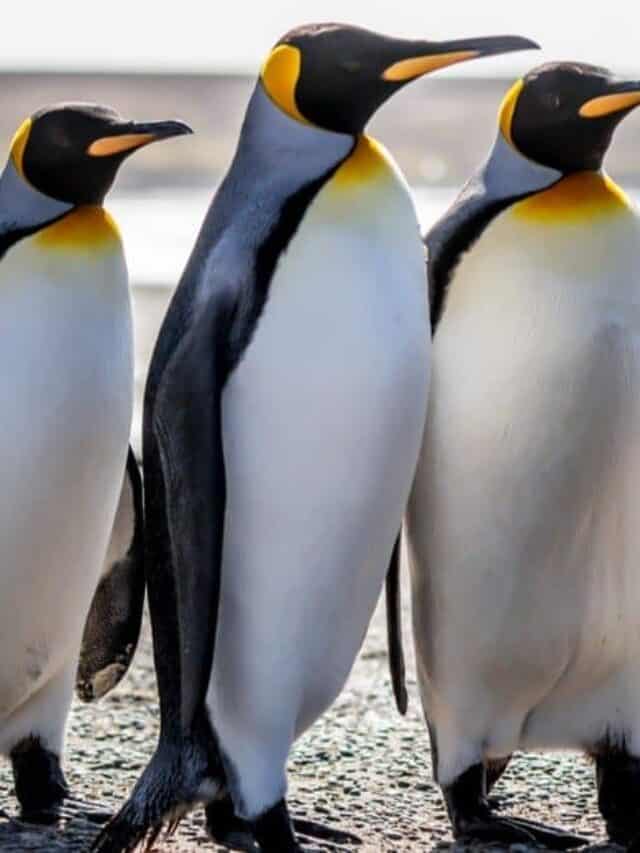
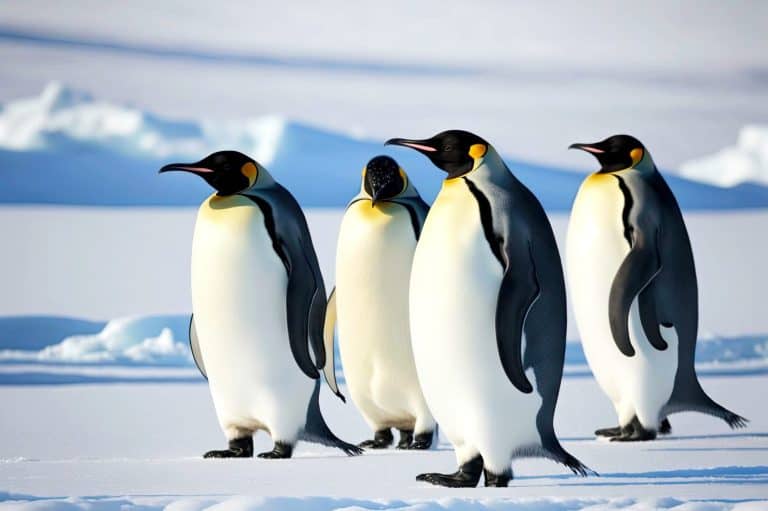
4 mostly black and white king penguins walk side-by-side along a beach.
King penguins live at Volunteer Point in the Falkland Islands.

The king penguin is the second largest penguin. The average adult is 35 pounds, with males being slightly heavier than females. They are, on average, 3.1 feet tall or about the size of a typical human toddler.

King penguins are animals that are adapted for arctic climates, keeping warm with four layers of feathers — 70 are in just a square inch of skin! The three layers closest to the body are down feathers, while the layer on the outside is oiled for waterproofing. A baby, however, is not waterproof. Therefore, they do not enter the water until their downy brown feathers turn to the adult black and white ones.

Black Head and Orange Plumage

King penguins have black heads with distinguishing orange plumage at the ear and throat. The plumage fades to yellow as it nears the chest, which is white. This two-toned coloration camouflages them from both predators and prey in the water. White bellies blend with the sunny surface when a creature views the penguin from below. From above, the black helps the penguin blend with the dark sea bottom. They have thick, black legs to hold their eggs and young chicks, and their beak, which has orange on each side, is longer than any other penguin species.

Behavior
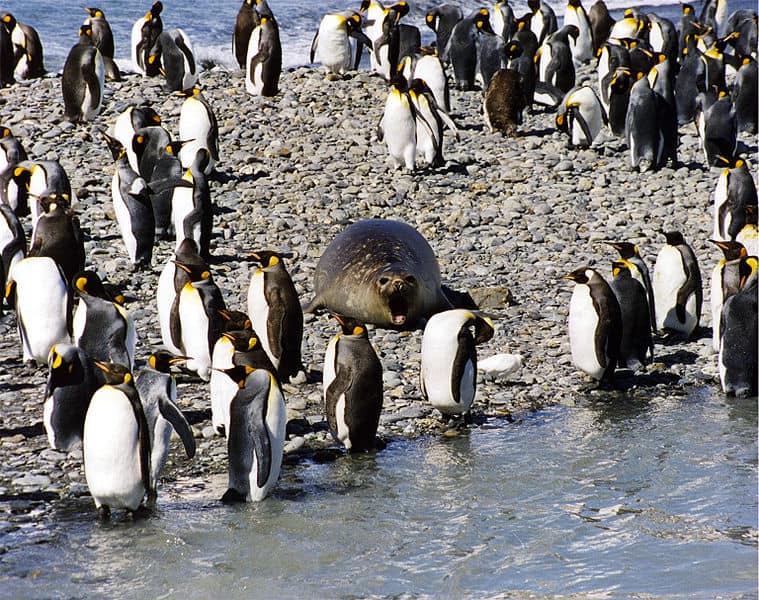
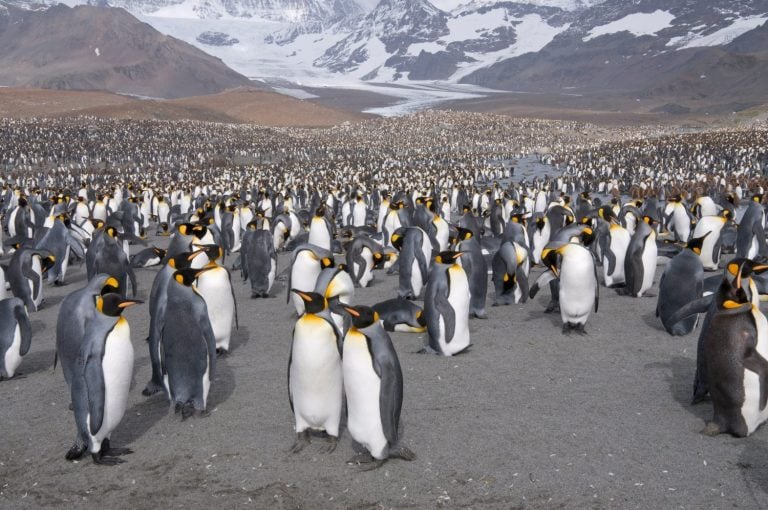
A colony of king penguins

King Penguins are very social animals that are curious and intelligent.

These birds are highly social creatures. Although they share space with penguin species such as the Gentoo, Magellan, and Royal, they do not interact with them. Adults often fight with each other, the most dominant of which make their way to the center of their huddles. They are extremely curious about humans, and they will come up to visitors to investigate. Their colonies can have tens or even hundreds of thousands of breeding pairs. The size of the colonies helps them huddle for warmth. Chicks also form groups called communal crèches. While adults leave to forage, when mates or parents return, these creatures recognize one another through unique vocalizations.

King penguins prefer to walk or toboggan versus hop. They are expert swimmers and cruise at speeds between 3 and 6 miles per hour. Records have found them as far as 1,200 miles away and 1,000 feet deep when hunting food.

Habitat
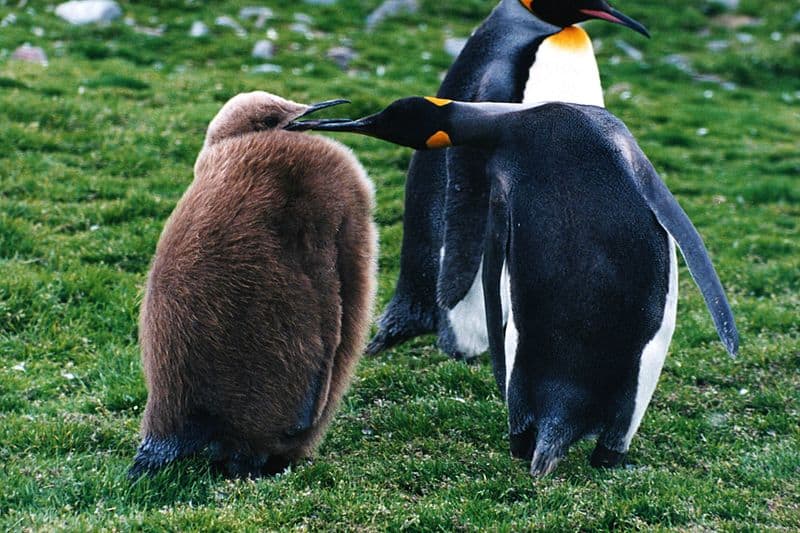
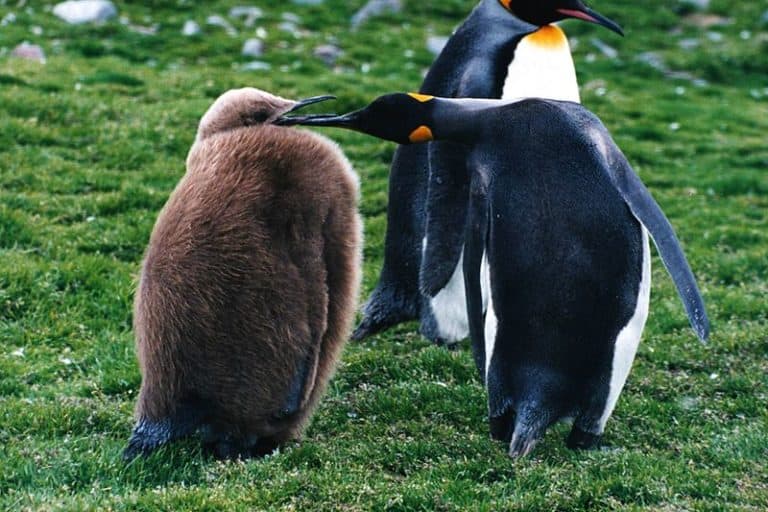
A king penguin chick with its parent

King Penguins live on sub-antarctic islands.

These creatures thrive in sub-antarctic islands. Although they had almost disappeared from the area, they are now increasing in the Patagonia region. Scientists have also spotted them in South Africa and even Staten Island in New York! A. patagonicus is the subspecies that inhabit South Georgia, the Falkland Islands, and southern Chile. A. patagonia halli is the subspecies that live in the Kerguelen Islands, Prince Edward Island, Crozet Islands, McDonald Islands, Heard Island, and Macquarie Island.

Unlike emperor penguins, king penguins remain farther north in less hostile climates. Temperatures can reach 50 degrees Fahrenheit during warmer months. They tend to choose flat green or rocky beaches that are not covered with snow and ice. Optimal locations offer wind protection through the surrounding snowy mountains. They dive to great depths to hunt during the day but stay in the shallow waters in the dark. The birds will move inland during mating season.

Population

This species faced threats to its population in the 19th and 20th centuries. As seals were hunted for fur, the possibility of exploiting penguins for oil was realized, and some populations were almost wiped out. Today, however, the king penguin population is in the Least Concern category. Current estimates show there are 2.23 million breeding pairs, and this number is increasing.

Diet
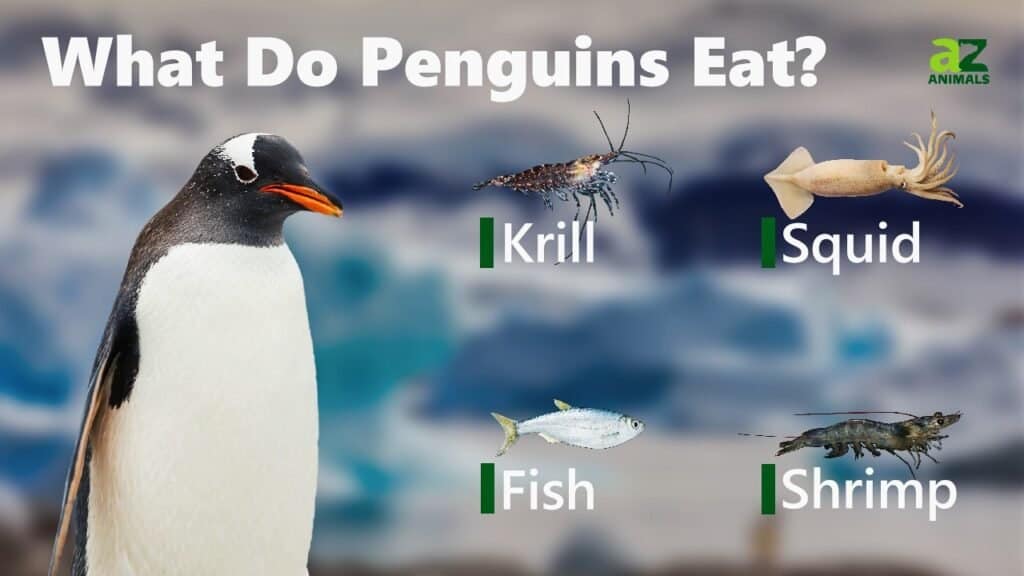
What Do Penguins Eat
Penguins primarily eat fish, with other seafood like crustaceans and krill added to the mix.

These birds hunt in colonies. Their high energy usage requires large amounts of food for their size as they routinely dive to the ocean floor as many as 100 times in a single day! That is where they find lanternfish as well as other kinds of fish, squid, small crustaceans, and krill. Adults will consume as many as 450 fish in a day, and they feed their young by regurgitating their food. During these periods, an adult will eat 8 pounds of food a day! That’s equivalent to the average grown man eating 25 large pizzas! Chicks are born with reserves of body fat that help them to endure up to a 70% weight loss, allowing them to survive for at least three months while waiting for adults to find and deliver food.

The king penguin reaches depths of about 54-110 yards when hunting its prey, but they have been known to go as deep as 328 yards. They can stay underwater for almost 10 minutes. A capillary gland above their eyes filters out salt, which allows them to be able to consume ocean water. This is useful since freshwater sources can be frozen.

Predators and Threats
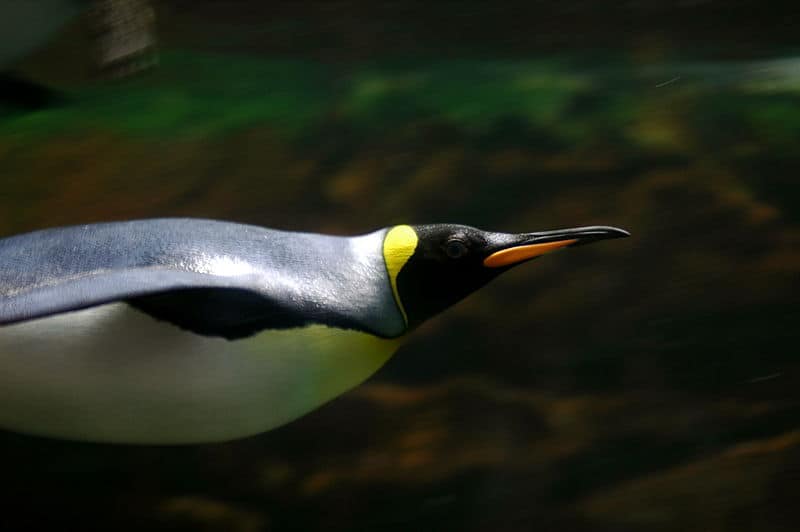
King penguin swimming under water

King penguins are excellent swimmers.

King penguins are in the category of Least Concerned. Their habitats are cold enough to be sparsely populated, which means there is little human impact on their population. They have a varied diet, so overfishing of things like krill and climate change will not be detrimental to their diet. Global warming, however, does appear to affect successful breeding. In spite of global warming, though, king penguin populations are increasing.

These creatures are not the main food source for any animal, but they do have some predators. Adult threats are marine animals since the penguin habitat is harsh for land animals. Leopard seals and orcas are the biggest threats to adults as they prey in the water.

Birds such as skuas, sheathbills, southern black-backed gulls, and giant petrels are strong enough to grasp eggs and young penguins on land who are left unattended by adults.

Reproduction, Babies, and Lifespan
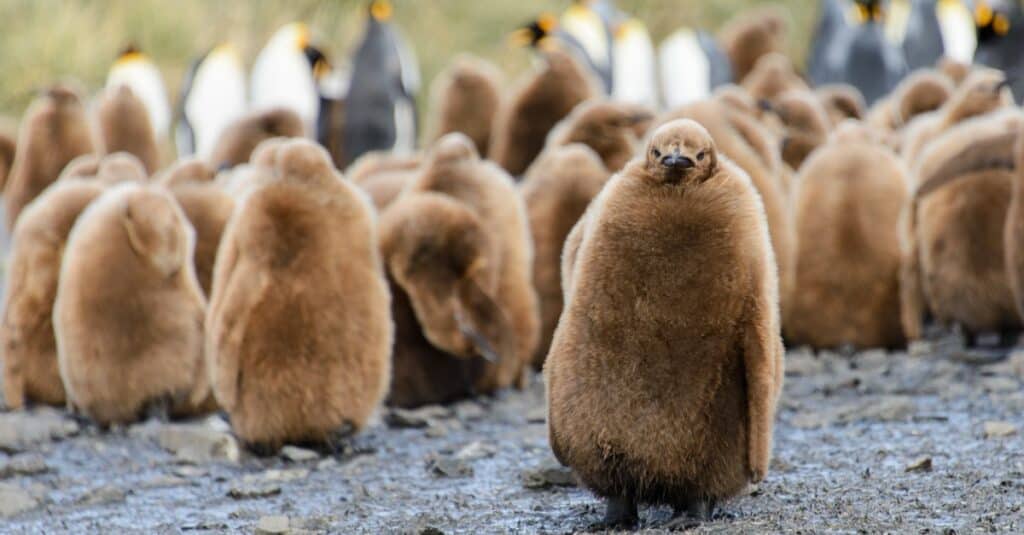
Baby penguins rely on regurgitated food from both parents.

King penguins become sexually mature around the age of three years, but they likely will wait until six years to begin breeding. Mating season is marked by a molt during September, October, or November. Those who are molting or roosting instead of breeding are segregated from others who are breeding. Molting king penguins move inland and stay out of the water until new waterproof feathers grow. This lasts approximately three weeks, during which they survive on stored body fat. When ready to mate, male king penguins spend anywhere from a few hours to a few days lifting their heads high, calling, and holding their flippers out to attract a mate. A match is successful when both birds shake their heads at the same time.

King penguins only breed twice within three years. King penguins and emperor penguins are the only penguins that do not nest. Rather, king penguins lay one pale green egg between November and April and incubate it with a warm fold of skin that hangs over their webbed feet on which the egg rests. The egg hatches after approximately 54 days. The baby is naked at birth and must remain under a parent’s warm skin for another 39 days. Males and females take turns protecting the baby and hunting. Chicks gather in a group called a crèche for another nine months, making it harder for predators to single out one baby. The chick relies on regurgitated food from adults.

While other penguin babies go from egg to swimming in one summer and hunt regardless of food availability, king penguin newborns require a plentiful hunting season. Since this takes over a year, that leaves king penguin colonies inhabited year-round.

On average, king penguins can live up to 25 years in the wild and 30 years in captivity. Some ages of those in zoos are unknown because they were born elsewhere, but zookeepers estimate some to be at least in their mid-30s.

King Penguins In the Zoo
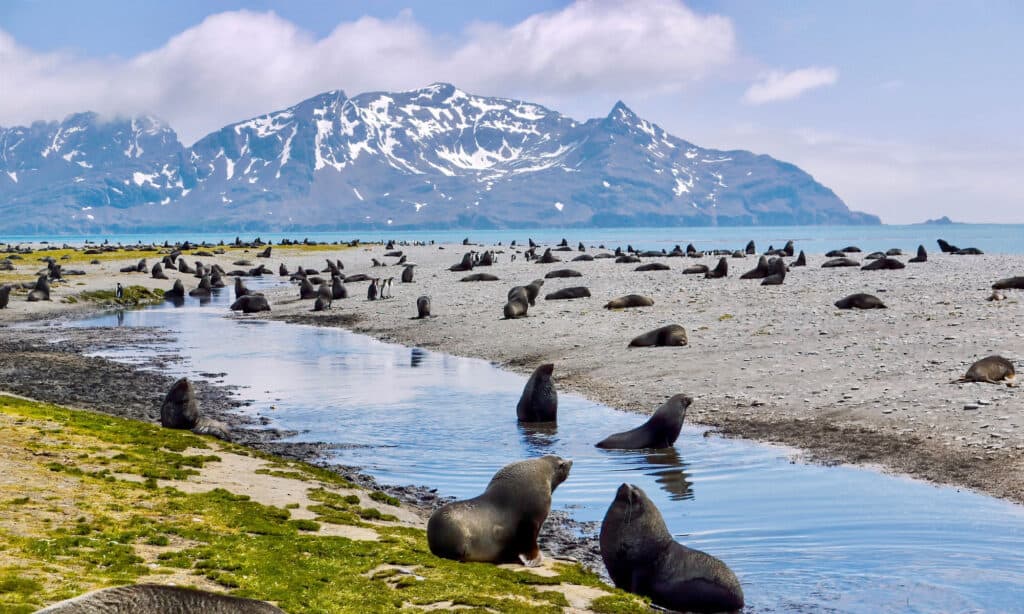
South Georgia and the South Sandwich Islands

The South Georgia Islands is one of the habitats of King Penguins

Visitors can view king penguins at a few zoos in the United States, Australia, and the United Kingdom. These include:

View all 103 animals that start with K

Sources

  1. New Zealand Birds Online
  2. Penguins World
  3. Australian Antarctic Program
Heather Hall

About the Author

Heather Hall

Heather Hall is a writer at A-Z Animals, where her primary focus is on plants and animals. Heather has been writing and editing since 2012 and holds a Bachelor of Science in Horticulture. As a resident of the Pacific Northwest, Heather enjoys hiking, gardening, and trail running through the mountains with her dogs.

Thank you for reading! Have some feedback for us?


King Penguin FAQs (Frequently Asked Questions)

Although both are the largest penguins, the king penguin is smaller than the emperor penguin. The colors are similar, but rather than closed orange patches, the emperor penguin has open yellow patches. King penguin beaks are longer, but emperor penguin beaks are more curved. Finally, they live in different locations. Emperor penguins will be found in Antarctica. King penguins are on subantarctic islands.