K
Species Profile

Kudu

Tragelaphus strepsiceros

Spiral horns, striped stealth.
KlausF / Creative Commons

Kudu Distribution

Click a location to explore more animals from that region

Loading map...

Size Comparison

Human 5'8"
Kudu 4 ft 9 in

Kudu stands at 84% of average human height.

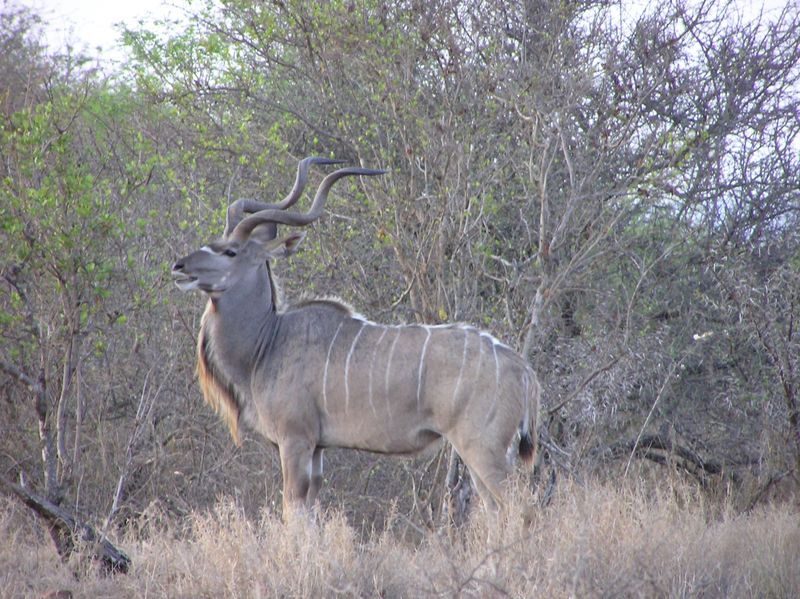
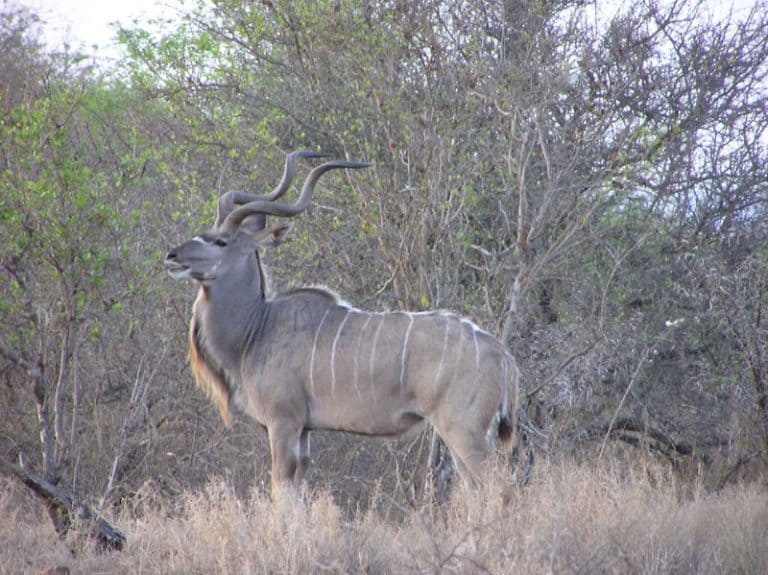
Greater Kudu in Kruger Park

At a Glance

Wild Species
Also Known As kudu, koodoo, koudou, koedoe
Diet Herbivore
Activity Crepuscular+
Lifespan 10 years
Weight 270 lbs
Status Least Concern
Did You Know?

Adult males commonly stand ~140-160 cm at the shoulder; females ~120-150 cm.

Scientific Classification

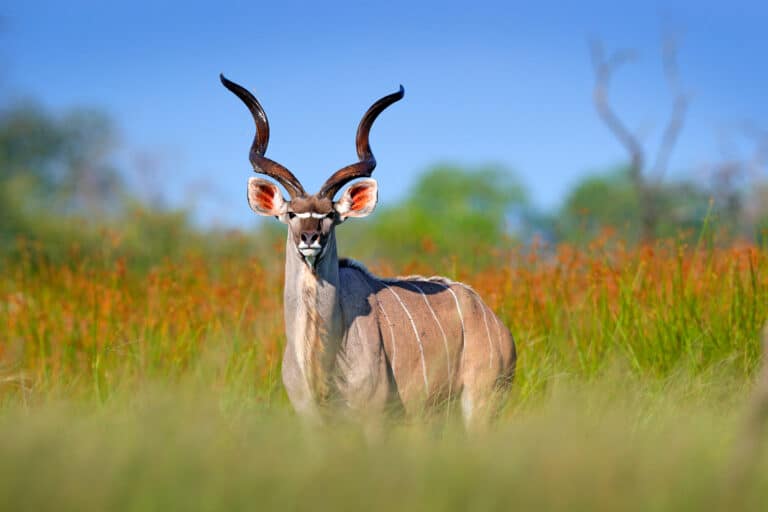
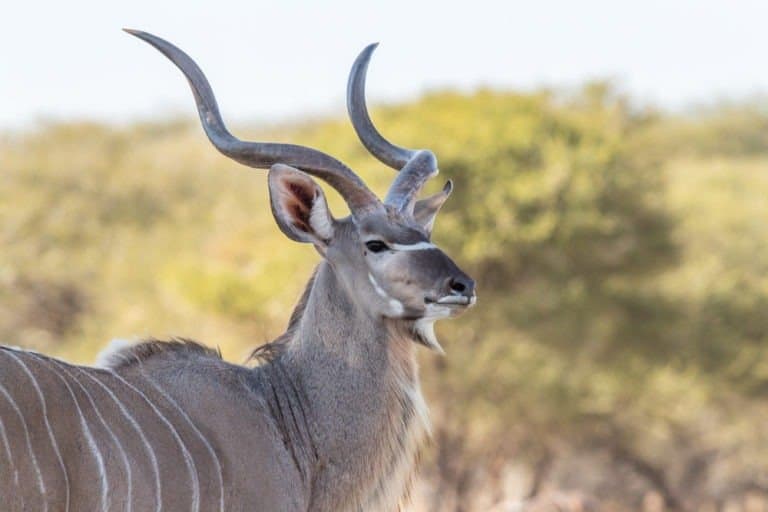
The greater kudu is a large African antelope (a spiral-horned bovine) known for males’ long, corkscrew horns and a gray-brown coat with vertical white stripes. It is one of the most iconic antelopes of eastern and southern Africa.

Kingdom
Animalia
Phylum
Chordata
Class
Mammalia
Order
Artiodactyla
Family
Bovidae
Genus
Tragelaphus
Species
strepsiceros

Distinguishing Features

  • Large antelope; males with very long spiral (corkscrew) horns
  • Vertical white body stripes; subdued gray-brown coloration
  • Prominent ears and a throat dewlap; males often darker than females
  • Primarily a browser, favoring leaves, shoots, and pods; often elusive and uses cover

Physical Measurements

Males and females differ in size

Height
♂ 492 ft 2 in (426 ft 6 in – 524 ft 11 in)
♀ 3 ft 9 in (3 ft 3 in – 4 ft 3 in)
Length
♂ 8 ft 5 in (7 ft 1 in – 9 ft 10 in)
Weight
♂ 529 lbs (419 lbs – 595 lbs)
♀ 353 lbs (265 lbs – 463 lbs)
Tail Length
♂ 1 ft 6 in (12 in – 1 ft 10 in)
♀ 1 ft 5 in (12 in – 1 ft 10 in)
Top Speed
43 mph
running

Appearance

Primary Colors
Secondary Colors
Skin Type Short, coarse hair over thick ungulate hide; slight mane along neck and back.
Distinctive Features
  • Adult male horn length typically ~120-180 cm; record ~188 cm; 2-2.5 tight corkscrew turns.
  • Prominent white chevron between eyes; pale muzzle and chin, aiding field identification.
  • Large ears and long legs adapted for browsing and moving through woodland thickets.
  • Loose throat skin (dewlap) more evident in older males; neck/back crest may darken.
  • Adults: head-body length ~185-245 cm; shoulder height ~125-160 cm; tail ~30-55 cm.
  • Mass: males ~190-270 kg; females ~120-210 kg (regional variation documented).
  • Behavior: primarily browsing (leaves, shoots, forbs); relies on woodland cover; mostly crepuscular/nocturnal in disturbed areas.
  • Greater vs lesser kudu: greater is larger, with fewer but broader vertical stripes and heavier, longer horns; lesser is smaller, more finely striped, and occurs mainly in the Horn of Africa.

Sexual Dimorphism

Marked sexual dimorphism: males are larger and carry long spiral horns (usually 2-2.5 turns), with darker gray-brown coloration and more pronounced dewlap/crest. Females are smaller, typically hornless, and generally lighter with clearer striping.

♂
  • Long spiral horns (typically ~120-180 cm; up to ~188 cm)
  • Larger body and heavier neck musculature
  • Darker gray-brown coat; often reduced stripe contrast with age
  • More pronounced dewlap and dorsal/neck crest
♀
  • Typically hornless
  • Smaller body mass and shoulder height than males
  • Lighter brownish-gray coat with clearer stripe contrast
  • Less developed dewlap and crest

Did You Know?

Adult males commonly stand ~140-160 cm at the shoulder; females ~120-150 cm.

Mass ranges widely: males ~190-270 kg (occasionally heavier), females ~120-210 kg.

A mature bull's horns usually make 2-3 twists; measured along the curve, exceptional horns can exceed ~150 cm.

Coats show bold camouflage: typically ~6-10 vertical white body stripes plus a white chevron between the eyes.

Gestation is about ~240 days, and females usually give birth to a single calf that hides in cover for its first weeks.

Greater kudu can clear high obstacles when alarmed-jumps around ~2.5 m have been reported in field accounts.

Compared with the lesser kudu, greater kudu are larger and more widespread farther south, and adult bulls carry thicker, longer horns with broader spirals.

Unique Adaptations

  • Corkscrew horns (males): 2-3 helical twists create a large visual signal for mate competition and allow controlled horn-locking during fights.
  • Disruptive stripe pattern: high-contrast vertical stripes break up the body outline in dappled woodland light-especially effective in thickets.
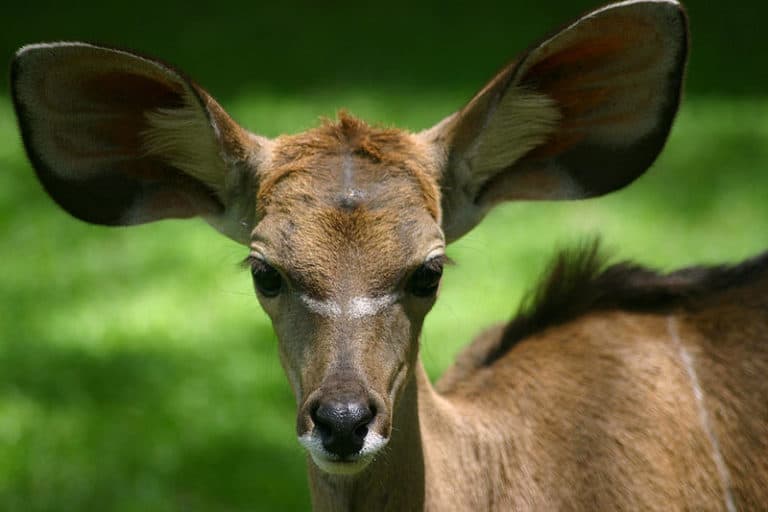
  • Large ears and acute hearing: well-suited to detecting predators in dense bush where sightlines are short.
  • Water-flexible browsing: like many tragelaphines, greater kudu can meet much of its water needs from browse when free water is scarce, aiding survival in dry seasons.
  • Dewlap and large body surface features: the throat dewlap may aid visual signaling and potentially heat exchange in hot environments.

Interesting Behaviors

  • Crepuscular browsing: most feeding peaks at dawn/dusk; diet is mainly leaves, shoots, pods, flowers, and some fruit-typical of a woodland browser rather than a grazer.
  • Cover-first anti-predator strategy: freezes and relies on stripes for concealment; if pressed, breaks into powerful bounds and can leap fences/brush to escape.
  • Sexual dimorphism in social life: females and calves form small groups; adult bulls are often solitary or in loose bachelor groups except during breeding.
  • Rutting contests: bulls perform parallel walks and horn-wrestling; the long spirals help lock and push without immediately stabbing.
  • Seasonal movements on a small scale: individuals shift locally to track fresh browse and water availability, often using thickets and rocky ridges as refuges.
  • Calf "hider" behavior: newborns are concealed in dense cover while the mother forages nearby, reducing detection by predators.

Cultural Significance

Across eastern and southern Africa, the greater kudu (Tragelaphus strepsiceros) is a famous spiral-horned antelope. It is popular in wildlife tourism, is hunted for food and sport, its hide is used for leather, and its long horn is used as an ornament and as a ritual trumpet in some Jewish communities.

Myths & Legends

Southern African folktales about the greater kudu (Tragelaphus strepsiceros) say its white bands came as a gift or mark earned by being smart, staying strong, or after meeting a powerful bush spirit.

In some regional story cycles about trickster animals (often featuring Hare), the kudu appears as the swift, watchful forest antelope-sometimes outwitted, sometimes respected for escaping danger through alertness and sudden leaps.

Hunters in parts of southern Africa call the Greater kudu (Tragelaphus strepsiceros) bull a 'ghost of the thicket' in campfire stories, creating modern folklore about its ability to disappear into dense brush.

Naming traditions preserve older cultural links: the widely used name "kudu" is commonly traced to southern African Indigenous language usage, and stories about the animal are often tied to local language heritage and place-based identity.

Conservation Status

LC Least Concern

Widespread and abundant in the wild.

Population Decreasing

Protected Under

  • Occurs in numerous protected areas across eastern and southern Africa (e.g., national parks and game reserves)
  • Subject to national wildlife legislation and regulated hunting frameworks in several range states (quotas/permit systems vary by country and province/state)

Life Cycle

Birth 1 calf
Lifespan 10 years

Lifespan

In the Wild
8–15 years
In Captivity
15–20 years

Reproduction

Mating System Polygyny
Social Structure Solitary
Breeding Pattern Transient
Fertilization Internal Fertilization
Birth Type Internal_fertilization

Greater kudu are polygynous: adult bulls (often solitary or in bachelor groups) roam and compete via displays and horn-sparring for estrous cows. Copulation is internal; a bull may guard a receptive female for ~1-3 days. Gestation ~240-245 days; no male care.

Behavior & Ecology

Social Herd Group: 6
Activity Crepuscular, Nocturnal
Diet Herbivore Fresh woody browse-especially young leaves and shoots (and seasonally fallen acacia pods).

Temperament

Vigilant, shy, and cover-dependent; typically freeze then bound away when threatened (Estes 1991).
Fission-fusion tendency: groups split/merge with forage, water availability, and disturbance (Estes 1991; Kingdon 2015).
Adult males less gregarious; social tolerance increases during rut around receptive females (Estes 1991).
Dominance interactions in males rely on parallel walking, horn/neck displays; fights can occur but are usually ritualized (Estes 1991).

Communication

Loud alarm bark used when detecting predators or sudden disturbance Estes 1991
Low grunts/moans during rut and close-range social interactions Estes 1991
Soft contact bleats between females and calves at close range Kingdon 2015
Olfactory assessment Sniffing/urine cues) during courtship; flehmen-like investigation reported in males (Estes 1991
Visual alarm signaling via tail-flagging White underside) and bounding 'stotting' escape displays (Estes 1991
Ritualized visual displays in males: lateral presentation, horn posturing, and parallel-walk assessment Estes 1991

Habitat

Biomes:
Savanna Tropical Dry Forest
Terrain:
Mountainous Hilly Plateau Plains Valley Riverine Rocky +1
Elevation: Up to 8202 ft 1 in

Ecological Role

Large-bodied browser in African savanna-woodland systems; shapes woody-plant community structure and functions as an important prey species for large carnivores.

Regulates shrub and young-tree growth through sustained browsing pressure (influencing vegetation structure and plant community composition) Seed dispersal via endozoochory for some fleshy-fruited species and movement of seeds across the landscape Nutrient cycling through dung deposition and localized fertilization Supports predator populations as prey for lions, leopards, spotted hyenas, and African wild dogs (especially calves/juveniles)

Diet Details

Other Foods:
Woody browse Herbaceous dicots, forbs and climbers Legume pods and seeds Fruits and berries from savanna shrubs and trees Flowers and new growth Grasses

Human Interaction

Domestication Status

Wild

Greater kudu (Tragelaphus strepsiceros) is a wild African bovid with no true domestication. It is kept in zoos, game ranches and private wildlife collections, but not selectively bred like cattle. Lives about 15 years in the wild and 20+ years in captivity. Active at dawn and dusk, strong flight response, good jumper; males spar when breeding.

Danger Level

Moderate
  • Injury from horns (adult males) during handling, restraint, or rut-related aggression; risk increases in confined spaces (bomas, trailers, small pens).
  • High-speed collision risk with vehicles in range areas (a common human-wildlife conflict for large antelopes).
  • Zoonotic/livestock disease interface risk typical of wild bovids (e.g., acting as hosts in multi-species disease systems), relevant to ranching and livestock-adjacent landscapes.
  • Fence-jumping/escape from inadequate enclosures leading to road hazards and property damage.

As a Pet

Not Suitable as Pet

Legality: Greater kudu (Tragelaphus strepsiceros) are generally not suitable or legal as household pets. They are seen as exotic/ungulate wildlife: permits or licenses (USDA in U.S. for commercial use) often required; many places ban private ownership. Check local and international rules.

Care Level: Expert Only

Purchase Cost: $3,000 - $12,000
Lifetime Cost: $60,000 - $250,000

Economic Value

Uses:
Wildlife-based tourism (safari viewing/photography) Sustainable-use hunting (where legal and managed) Meat production from game ranching (venison) Hide/leather and horns (trophies/curios, regulated) Conservation breeding and zoo exhibition
Products:
  • Tourism services (safari/park revenue tied to iconic antelope viewing)
  • Game meat (kudu venison) from regulated harvest/ranches
  • Hides (leather)
  • Horns and skulls (trophies/ornamental items, jurisdiction-dependent)
  • Live animal sales/translocations for game ranch stocking (where permitted)

Relationships

Related Species 13

Lesser kudu Tragelaphus imberbis Shared Genus
Nyala
Nyala Tragelaphus angasii Shared Genus
Common eland
Common eland Taurotragus oryx Shared Genus
Bushbuck Tragelaphus scriptus Shared Genus
Sitatunga Tragelaphus spekii Shared Genus
Bongo
Bongo Tragelaphus eurycerus Shared Genus
Mountain nyala Tragelaphus buxtoni Shared Genus
Greater kudu
Greater kudu Tragelaphus strepsiceros Shared Species
Giant eland Taurotragus derbianus derbianus Shared Genus
Giant eland Taurotragus derbianus gigas Shared Genus
Sable antelope Hippotragus niger Shared Family
Roan antelope Hippotragus equinus Shared Family
Impala
Impala Aepyceros melampus Shared Family

Ecological Equivalents 5

Animals that fill a similar ecological role in their ecosystem

Giraffe
Giraffe Giraffa camelopardalis Large savanna and woodland browsers that eat leaves, shoots, and pods; often use Acacia/Vachellia; rely on patchy woody cover; and are active at dawn, dusk, and night, causing niche overlap.
Common eland
Common eland Taurotragus oryx Often found with eland in miombo, mopane, and mixed savannas; both are large, spiral-horned bovids that browse heavily, can obtain seasonal moisture from browse, and use woodland edges and rough terrain for food and cover.
Sable antelope Hippotragus niger Sable and kudu share woodland–savanna mosaics, including miombo, mopane, and nearby grass openings, and exhibit similar predator-avoidance behaviors: using cover and edges, staying alert, and grouping. Sables feed more on grass while kudus feed more on leaves; they overlap at water and mineral licks during dry seasons.
Impala
Impala Aepyceros melampus At woodland-savanna edges and river thickets, impala eat grasses and leaves and follow seasonal food changes (green flush, pod drop) that also affect kudu movements. Both are main prey for large predators.
Bushbuck Tragelaphus scriptus Both are browsers that use dense cover (thickets, drainage lines). Bushbuck are smaller and generally more solitary but overlap with kudu where woody browse and shelter are available; both use cover to avoid predators.

“Fast, powerful, and peaceful members of the African ecosystem.”

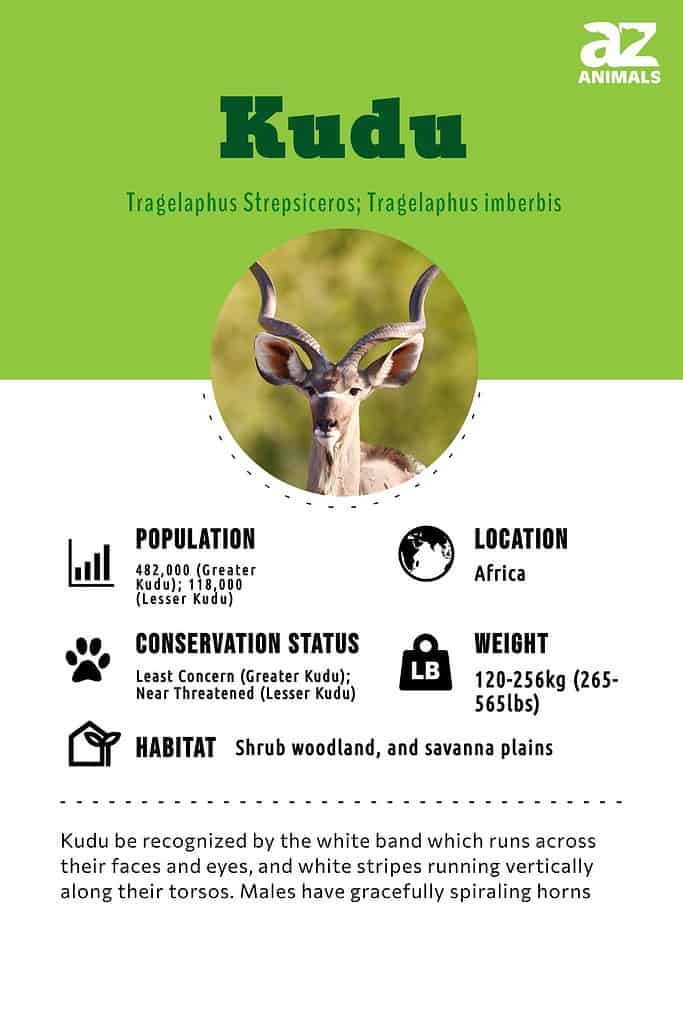
The name kudu describes two different antelope species, called greater kudu and lesser kudu, that are found in the southern and eastern regions of Africa. Both kinds are characterized by the long, twisted horns that grow on the heads of mature males. They also share similar habitats, body structure, and coloration, although there are notable differences in size between the greater and lesser species. The kudu is an animal with passive grazing habits and natural camouflage to help them avoid being easily spotted by the many predators in their native habitat.

An Incredible Animal: 3 Kudu Facts!

  • High speeds: The kudu animal can reach speeds of over 60mph when attempting to escape from a predator.
  • Ceremonial horns: The animal’s spiraled horns are prized in local religious practices and are also made into musical instruments.
  • Polite competition: Even though males sometimes engage in rutting, they are generally not very violent when competing for mates.
Scientific Name

Kudu, alternatively spelled koodoo, is derived from the name given to the animal by the local, nomadic Khoikhoi, who are indigenous to southwestern Africa. The greater kudu is classified as Tragelaphus strepsiceros and the lesser kudu is Tragelaphus imberbis. The genus Tragelaphus shares its name with a word originally put forth by the ancient Greek philosopher Aristotle in his oral depiction of an imagined animal that was half goat and half deer.

Evolution

The earliest bovid, Eotragus, emerged during the early Miocene as a result of divergence from the ancestors of deer and giraffes. According to experts, it was a small mammal and rather similar to a Thompson’s gazelle.

The Boodontia and Aegodontia subfamilies soon diverged from each other shortly after this event owing to the division of the continent. However, that division was temporary and both subfamilies soon had the opportunity to wander into each others’ ranges when the continent came together once more.

Boodontia also known as Bovinae includes not only Bovini (bison, buffaloes, and cows) but also Tragelaphini (kudu and nyala). Hence the status of kudu as Bovinae makes them closer to bison, buffaloes, and cows, than other antelopes, which belong to the subfamily Aegodontia.

Types

There are three subspecies of greater kudu:

  • Tragelaphus strepsiceros chora – This subspecies is mostly found in Eastern Africa including Eastern Sudan, the Horn (Ethiopia, Eritrea, and Somalia) and northern Kenya.
  • Tragelaphus strepsiceros cottoni – This subspecies can be found in Chad and Sudan.
  • Tragelaphus strepsiceros strepsiceros – The range of this subspecies extends from the south of Kenya down to the southern parts of the continent including Botswana, Namibia, and South Africa

Appearance
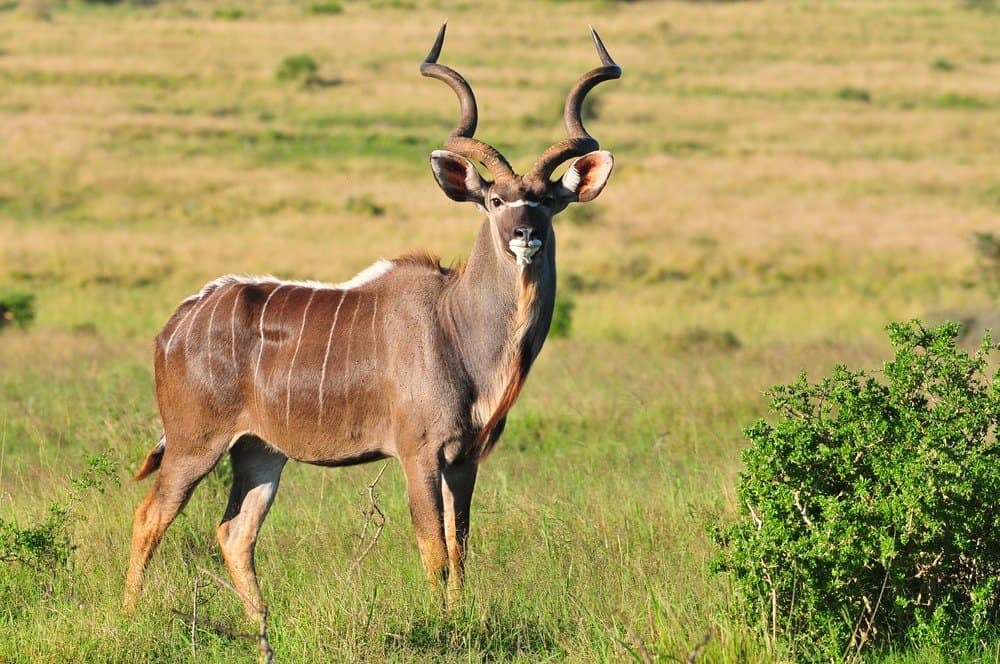
Kudu

Greater kudu are capable of reaching 690 lbs and of having horns as long as 6 feet

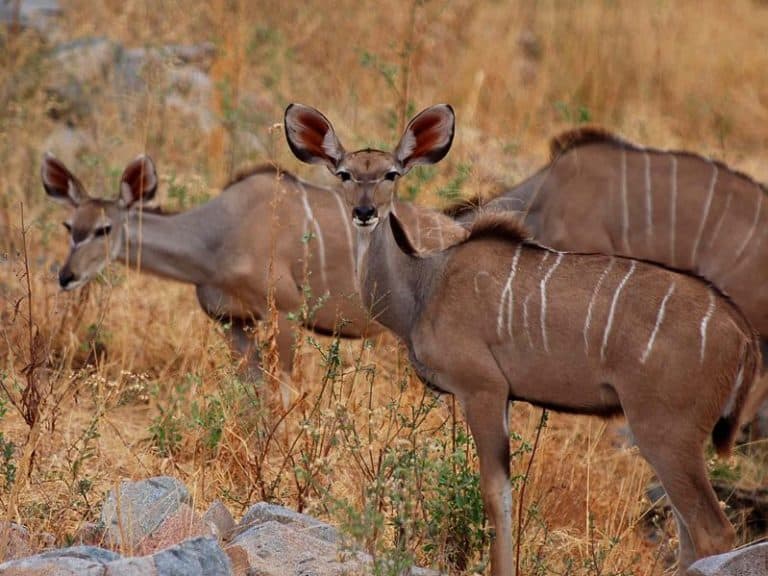
Both species of kudu animals have similar body structure and proportions, although there are a few notable differences in their external characteristics. Both have grey to brown fur that is broken by a series of white stripes and other markings, often including a chevron visible on their nose. The lesser species typically has between 11 and 15 white stripes on their body, while the greater species usually has between 6 and 10.

Body size is one of the key differences between the two species. The lesser species is generally 3 to 3.5 feet tall and weighs between 130 and 230 pounds. Greater kudu can reach much greater size, with a potential shoulder height of up to 5 feet and total weight of mature adults ranging between 260 and 600 pounds. The largest bull male on record weighed in at over 690 pounds.

All male kudu animals have the potential to grow spiraled horns that can be quite long relevant to their body size. Lesser kudu males can grow horns that are up to 3.5 feet long, while some greater kudu have been reported sporting horns as long as 6 feet. These horns tend to make 2 to 3 large twists as they slope backwards from the head toward the terminal point, which sets them apart from the tightly wound horns seen on other antelopes.

Behavior
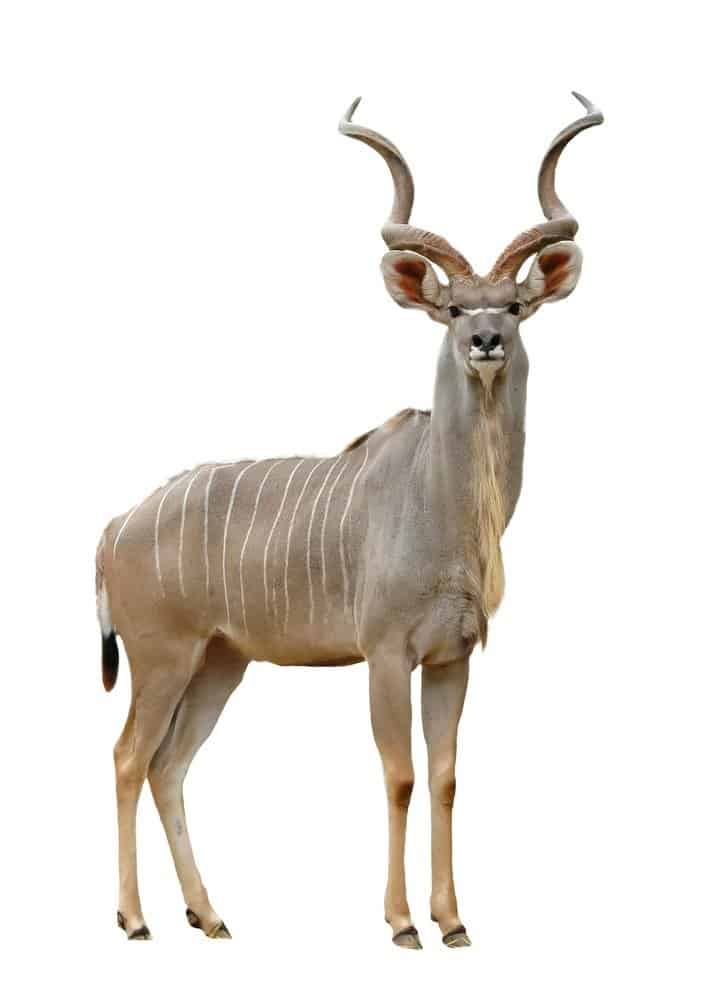
Kudu isolated on white background

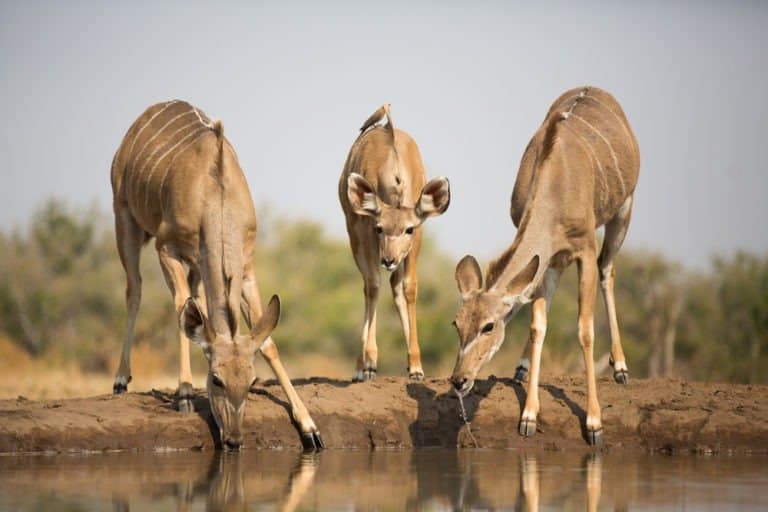
The kudu’s coloration and fur pattern makes for an effective camouflage when feeding

As herbivores, most of the kudu’s biology and behavior is geared toward surviving in a potentially harsh native habitat and avoiding dangerous predators. They tend to stay very still as they graze, which allows their coloration to provide effective camouflage. They are most active during the night or morning hours and seek shelter in dense brush during the daytime. Kudu often travel in small packs or herds, but they are also frequently seen alone. Much like other kinds of antelope, these animals have a strong flight reflex and can move very quickly when confronted with an immediate threat.

Habitat
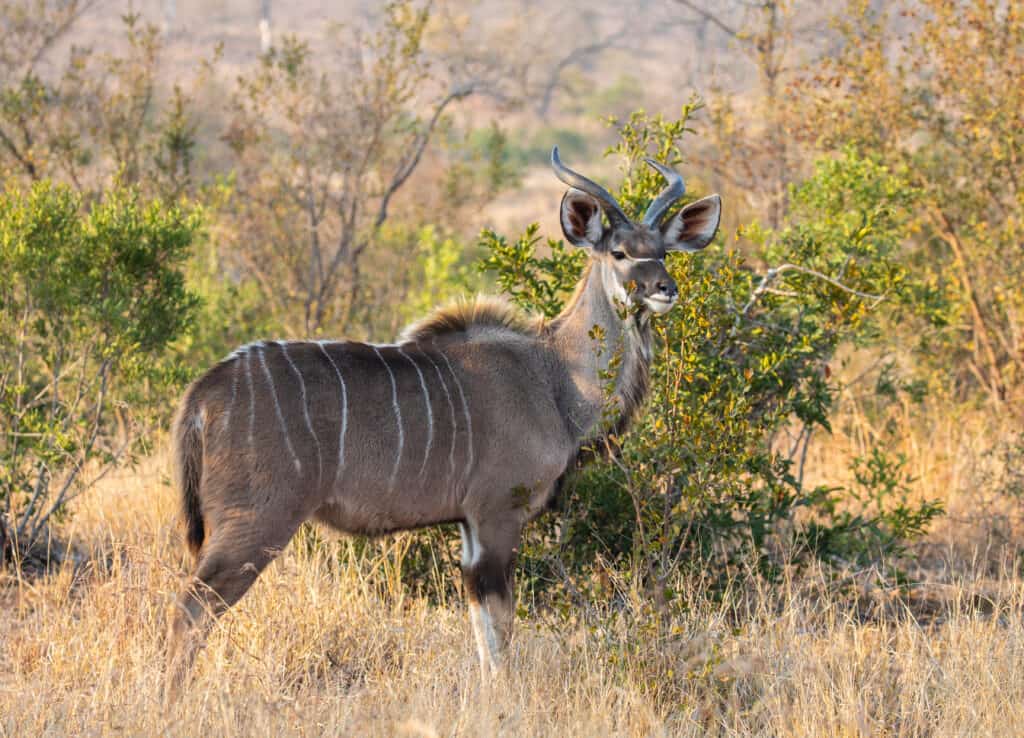
Unlike greater kudu which can be found in both Southern and Eastern Africa, lesser kudu are only found in Eastern Africa

Both kudu animal species are native to southern and eastern portions of Africa. Greater kudu have a much greater geographic distribution that includes parts of Ethiopia, Tanzania, Kenya and as far south as South Africa. There are also some isolated populations of the cottoni subspecies found in central Africa. Lesser kudu have a much smaller distribution and are only found in eastern regions near the Horn of Africa, including Ethiopia and Kenya.

These animals have strong jumping and bulldozing potential, which helps them navigate rugged terrain around hills or mountains and forge boldly through dense brush and growth in wooded regions. They tend to inhabit woodland and forested areas, particularly along water sources. Lesser kudu are a bit less water-dependent than their greater cousins. Both species can satisfy some of their water needs by seeking out certain types of plants as they graze.

Diet
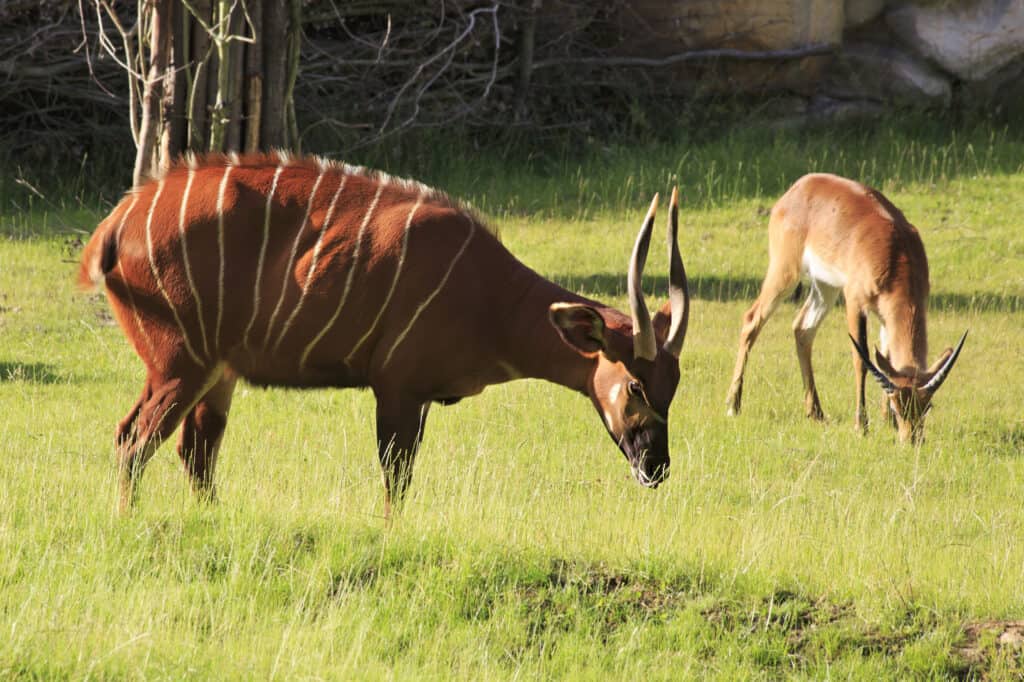
Kudu are known to eat shoots, roots, and even fruit

Kudu are flexible foragers that consume a wide range of plant materials in woodlands, thickets, and open fields. Lesser kudu are known to have a diet that is mostly foliage from trees and shrubs, with most of the remaining being from vines and similar plants. However, kudu can also eat tender young shoots, plant roots, and may even target some types of fruit when they can find them. Succulent plants that store water are also a prime target during the dry season. Kudu in captivity are typically fed grass or alfalfa hay alongside some natural forage and enriched pellets or biscuits.

Predators and Threats
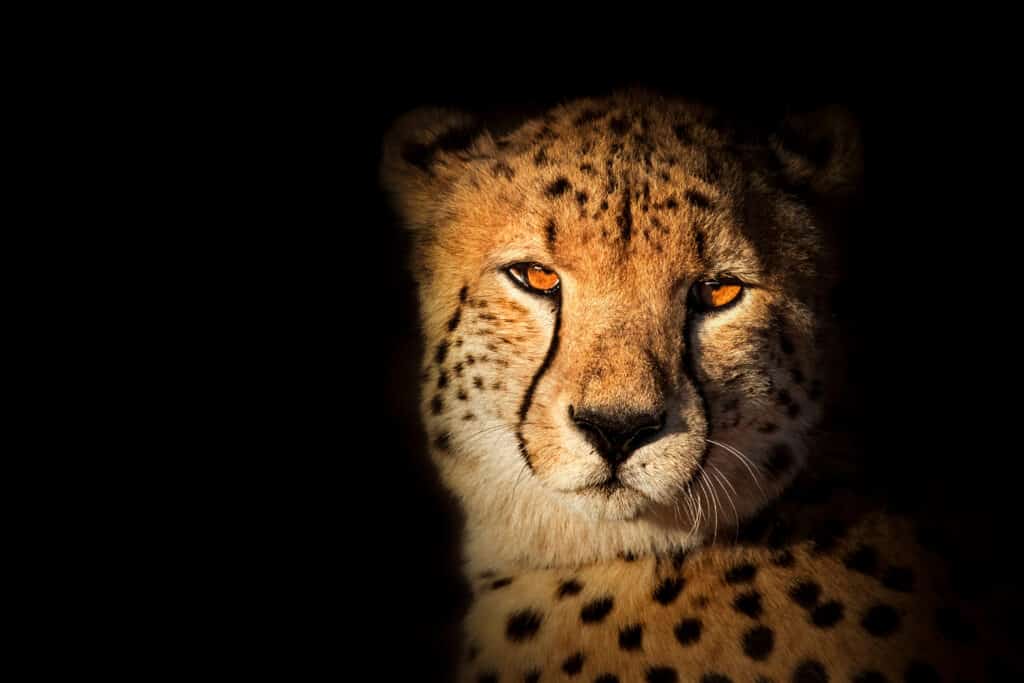
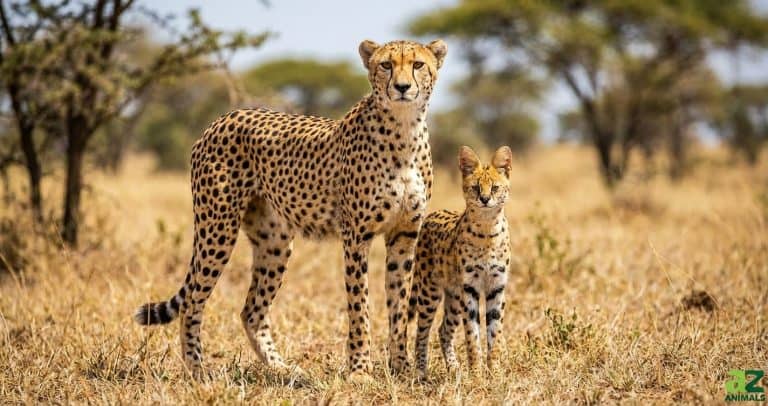
cheetah

Cheetahs as well as other big cats are known to hunt kudu

The kudu share their native range with many solitary and pack predators that pose a significant threat to their survival. Perhaps the most dangerous predators are big cat species, including lions, cheetahs, and leopards. Felines tend to use a combination of stealth, patience, and speed to ambush the fast-acting kudu while they graze. Packs of spotted hyenas and African hunting dogs are also known to trap or track down kudu as prey.

Humans are both predator and serious environmental threat to the long-term viability of kudu populations. People hunt the animals for their meat, large hides, and distinguished horns, which are traditionally used to make musical, ornamental, and various household objects. Native habitats, especially of lesser kudu, are also threatened by the continued growth of human settlements and expansion of commercial farming enterprises throughout the region.

Lesser kudu are particularly vulnerable to habitat fragmentation and hunting due to their small geographic distribution, which has prompted their classification as near threatened. They can also suffer significant population losses from contagious diseases like rinderpest, which has decimated numbers in the past. Greater kudu have a much bigger native range and are considered a species of least concern by conservationists.

The Animal’s Reproduction, Babies, and Lifespan

Some herbivores can get pretty violent during mating season, but kudu are among the more peaceful species on the continent. Males often compete by showing off their size in profile until one withdraws. However, they may physically struggle by locking horns if one of the competitors doesn’t back down. Victorious ales often wrestle with females initially then follow them for a while before actually mating.

Females remain pregnant for about 240 days before giving birth to a single calf, which typically weighs around 10 to 15 pounds. Mothers separate from their group before they deliver their baby. They leave the calf carefully hidden in the brush while they forage during the first 4 or 5 weeks after birth. At this point, calves accompany the mother on foraging expeditions until it is about 6 months old.

Despite the care and attention that mother kudu show their young, roughly half of calves die before the 6-month mark. Researchers estimate that only about 1 in 4 individuals make it to 3 years old. Kudu reach sexual maturity within a few years, but males are rarely successful at mating until they are about 4 or 5 years old. Aside from high death rates during youth, the animals often live to be 10 to 15 years old in the wild and up to 20 in captivity.

Population
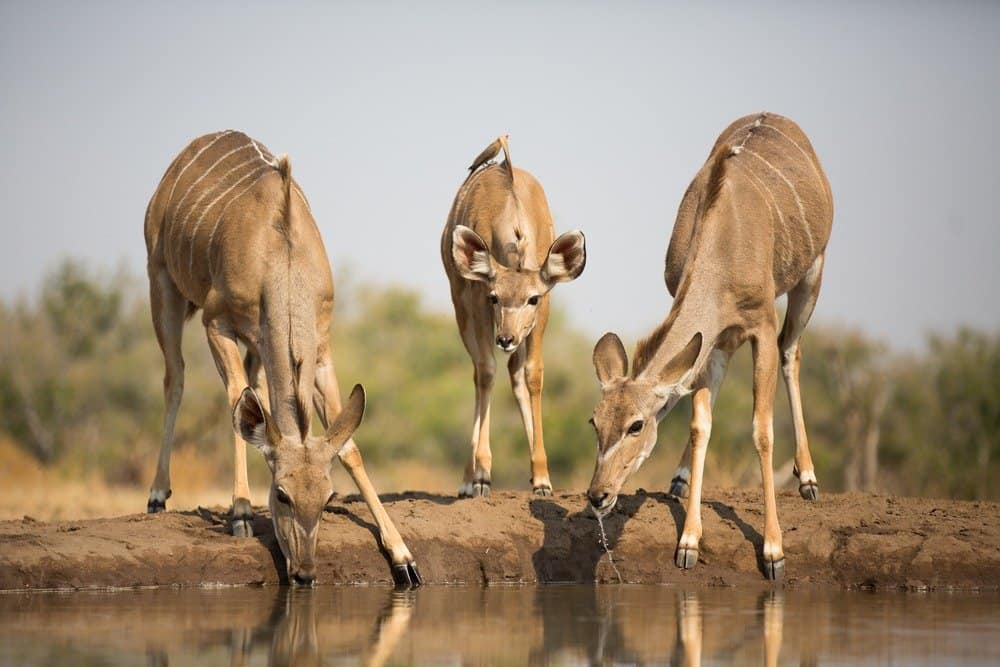
Two adults and one baby kudu

Lesser kudu are presently facing issues with habitat disruption

Researchers estimate there are about 118,000 lesser kudu remaining in Africa. Their limited native range combined with significant habitat disruption by humans is a serious cause for concern. About a third of them currently live in National Parks and other protected areas.

Greater kudu are believed to number about 482,000, although the extremely limited range of the cottoni subspecies, found only in Chad and Sudan, means it could be a candidate for endangerment.

Animals in the Zoo: Where to find the Kudu

The Smithsonian’s National Zoo has a small population of kudu available for visitors to observe. They reported the birth of a male kudu calf in 2019. Over a dozen other city and state zoos across the country, including the Maryland Zoo, also have lesser kudu on display for interested viewers.

View all 103 animals that start with K

Sources

  1. Britannica
  2. African Wildlife Foundation
  3. National Zoo
  4. Fossil Rim Wildlife Center
  5. Wikipedia
  6. Wikipedia
Dana Mayor

About the Author

Dana Mayor

I love good books and the occasional cartoon. I am also endlessly intrigued with the beauty of nature and find hummingbirds, puppies, and marine wildlife to be the most magical creatures of all.
Connect:

Thank you for reading! Have some feedback for us?


Kudu FAQs (Frequently Asked Questions)

Kudu are two species of forest antelopes found in various countries throughout southern and eastern Africa. They are camouflaged herbivores that tend to hunt in the hours between dusk and dawn.