
“The Smallest Penguin Species”
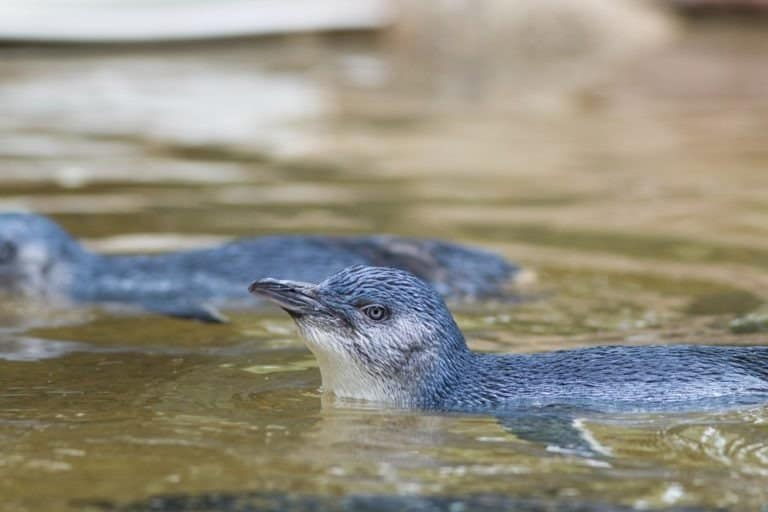
Small fries of the Spheniscidae family, little penguins are native to Australia and New Zealand. Standouts in the penguin-sphere, they sport bright blue feathers and sometimes go by “fairy penguins.” Little penguins forage and frolic in ocean waters 80 percent of the time and can lay more than one clutch of eggs per breeding season.
Though these animals aren’t Endangered by IUCN Red List standards, their numbers are plummeting, and researchers are ringing alarm bells. Thankfully, conservation efforts are underway, and advocates of flightless birds have successfully lobbied for little penguin protection laws.
Nine Fascinating Little Penguin Facts
- Johann Reinhold Forster first described these animals in 1871.
- The little penguins around Summerland Beach on Phillip Island do nightly parades, and tourists come to watch.
- The University of Tasmania devotes considerable resources to little penguin fact-finding projects.
- Hunters valued fairy penguins for their skins and feathers in the 1800s and early 1900s.
- In days of old, shipwrecked sailors in the Antipodes ate these animals to survive.
- The eggs of these animals were once considered a delicacy, especially among Aboriginal Australians.
- The Linux penguin mascot was inspired by a little penguin who pecked the operating system’s creator during an Australian vacation.
- Scientists believe that some fairy penguin populations may occasionally share nesting colonies with seabirds, like prions and short-tailed shearwaters.
- Fishers once used fairy penguins to catch southern rock lobsters.
Scientific Name And Other Monikers
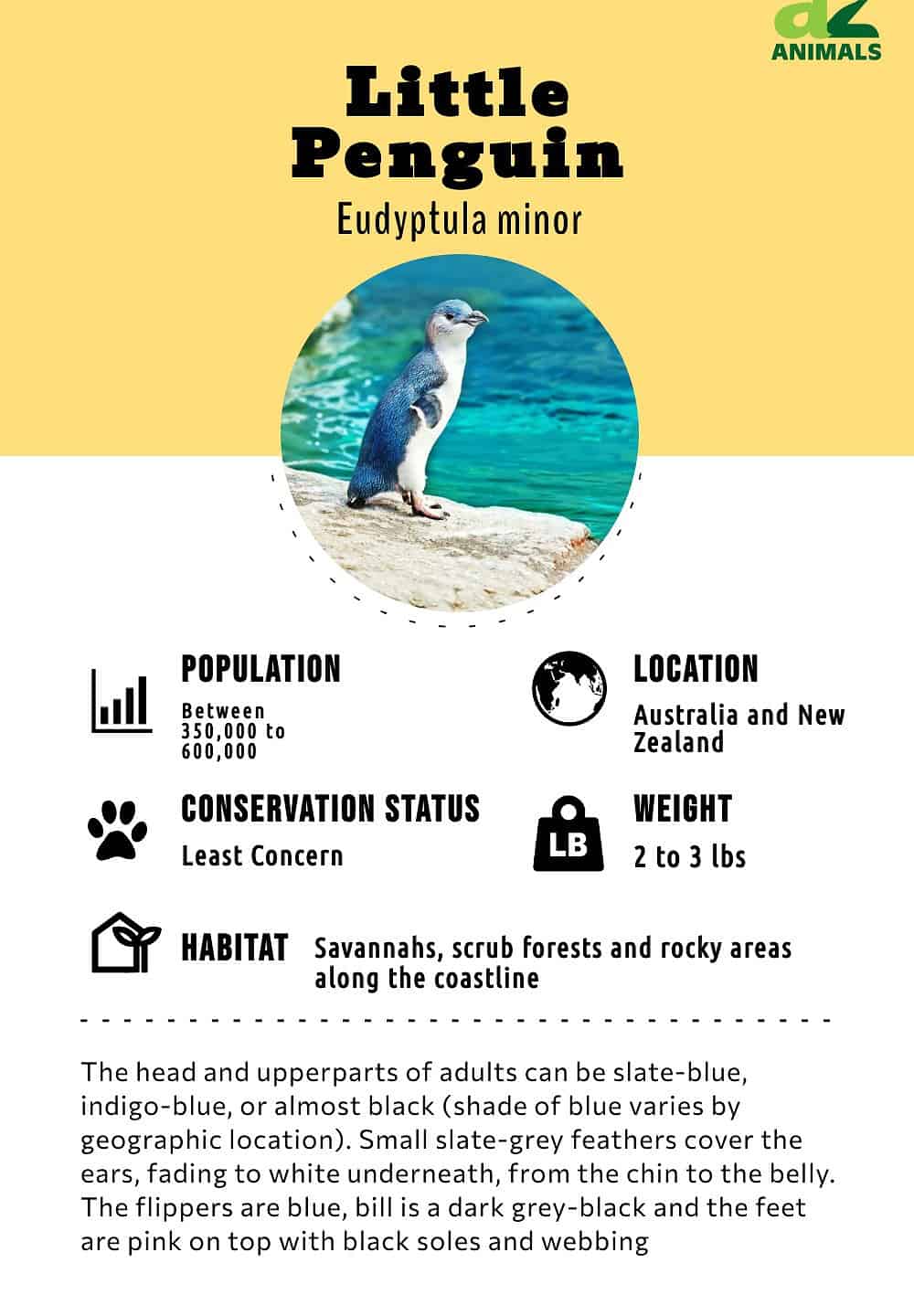
The scientific name for these animals is Eudyptula minor. Eudyptula derives from Greek and means “good little diver.” Minor refers to the animal’s petite stature.
Some folks in Australia call them “fairy penguins,” whereas many Kiwis use “little blue penguins.” The native Māori word for little penguin is “kororā.”
Evolution And Origin
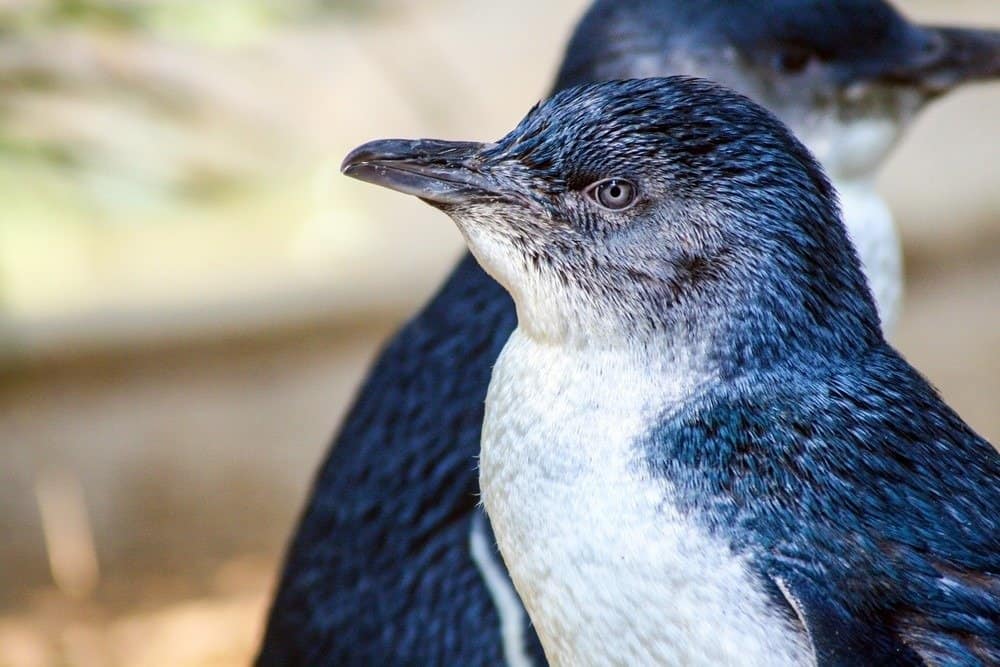
The penguin is believed to share an ancestor with the albatross and the petrel.
©berm_teerawat/Shutterstock.com
It has been said by researchers that the penguin evolved from one common ancestor that is shared with the albatross and the petrel and the Waimanu penguin species is currently considered the earliest common ancestor of all penguins. It lived over 66 million years ago, in New Zealand waters.
As the penguin evolved, and gained its ability to dive, it eventually lost its ability to fly, as they become more adapted to a water environment. The little penguin is believed to have gotten its start in New Zealand and eventually spread further out to Australia.
Types Of
Subspecies
Marine biologists clash over little penguin taxonomy. Some scientists believe white-flippered penguins are a subspecies of these animals, others think it’s a different species altogether, and a third group insists they’re color-morphed little penguins.
Similar questions linger about the eastern rockhopper penguin.
Although there is a small group of subspecies for the little penguin that may be somewhat questionable, this little bird belongs to a family of penguins that includes around 18 species. A few of those are:
- King Penguin (Aptenodytes patagonicus)
- Macaroni Penguin Eudyptes chrysolophus
- Emperor Penguin Aptenodytes forsteri
- Galapagos Penguin Spheniscus mendiculus
- Humboldt Penguin Spheniscus humboldti
Appearance And Behavior
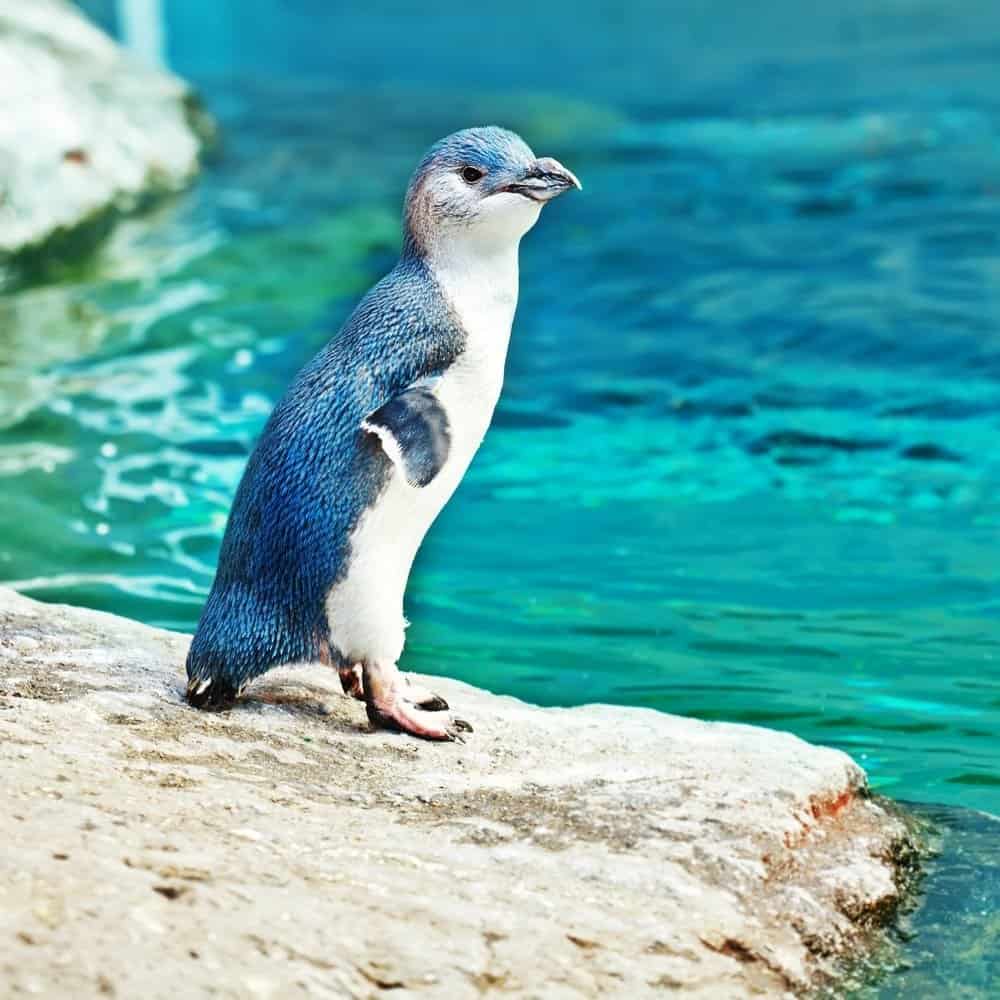
Little blue penguins are tiny, weighing on average 3.3 pounds.
©Khoroshunova Olga/Shutterstock.com
Appearance
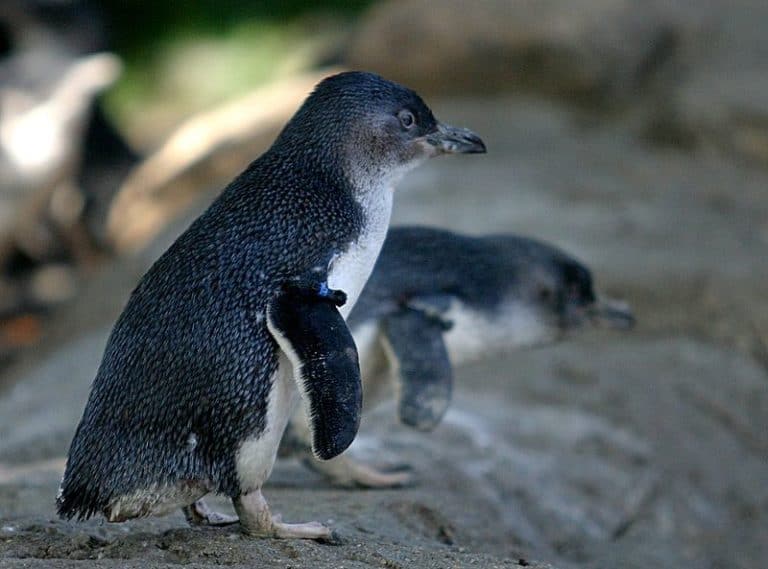
As you may have guessed, in comparison to other Spheniscidae species, these animals are tiny. Exact measurements vary by subspecies and population, but generally speaking, their average height is 13 inches, and they weigh about 3.3 pounds — the same as a two-slice toaster.
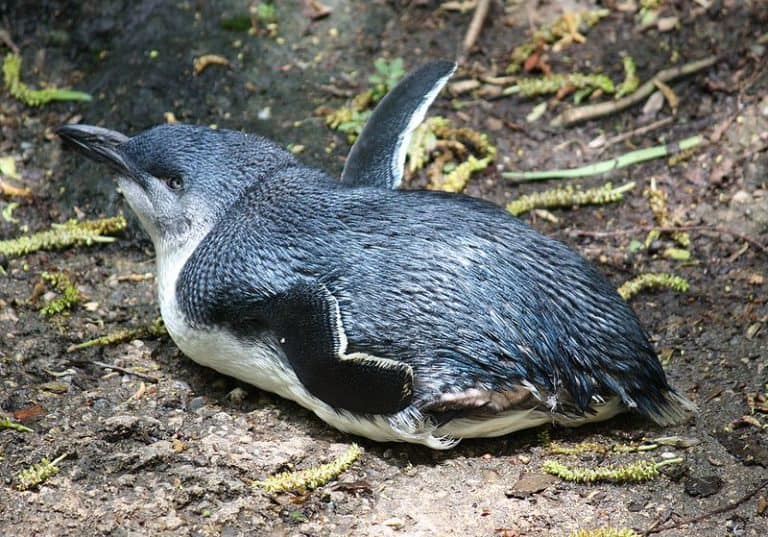
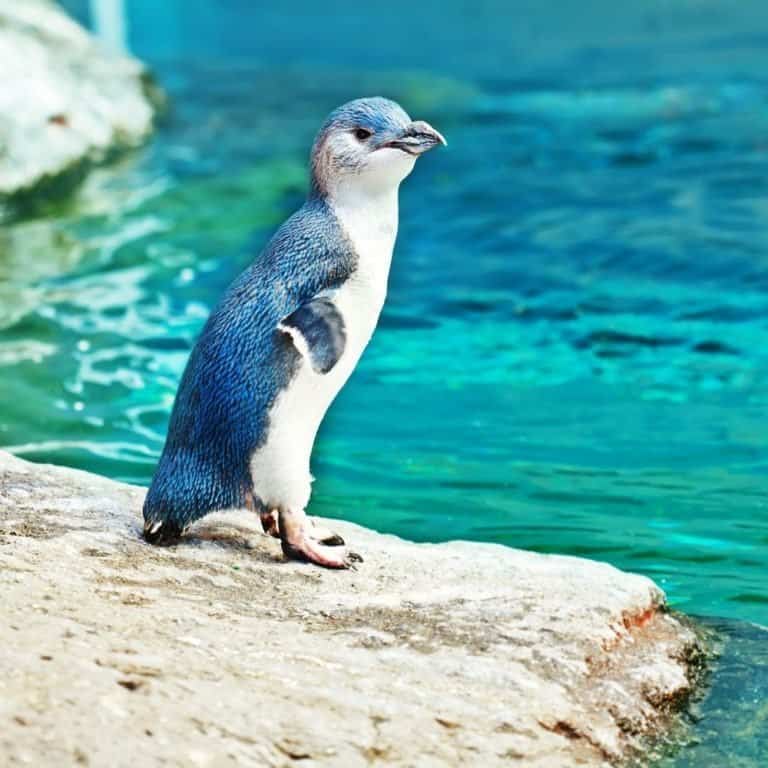
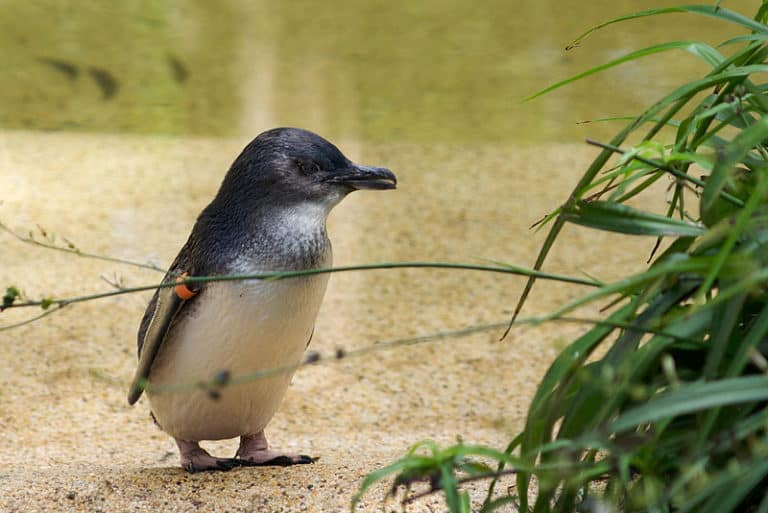
Little penguin feathers are a vibrant cerulean blue. Slate-grey plumage covers their ears, and their undersides are white. Beaks typically reach between three and four centimeters long, and their black-soled feet are webbed.
How can you distinguish between females and males on sight? Notice the beak size: females have thinner ones.
As is the case with all species in the family, these animals are flightless birds — and their “wings” function as flippers.
Behavior
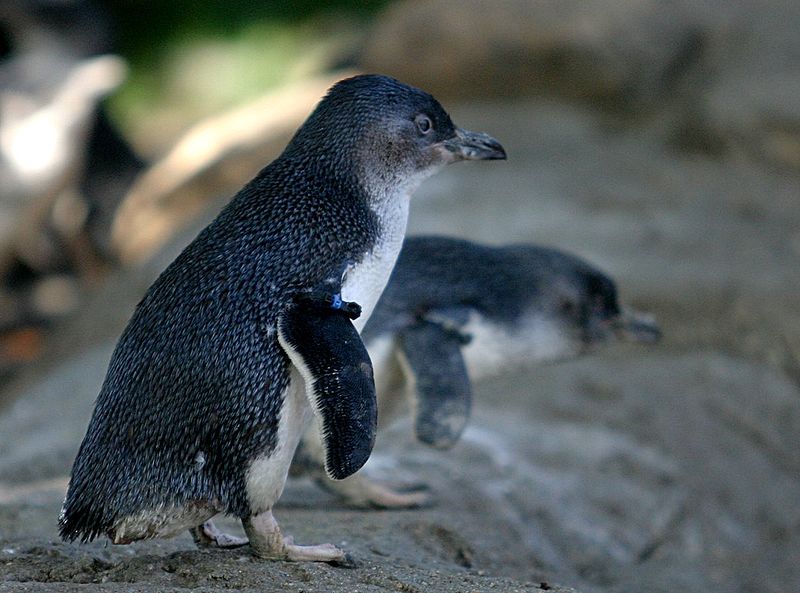
Little Penguins are most active during the day and return home at night to feed their chicks and sleep.
©Cburnett, CC BY-SA 3.0, via Wikimedia Commons – Original / License
Like humans, these animals are diurnal, meaning they’re most active during the day. They rise with the sun and immediately head out for a day of swimming and food foraging. At dusk, they return home to feed the chicks and sleep.
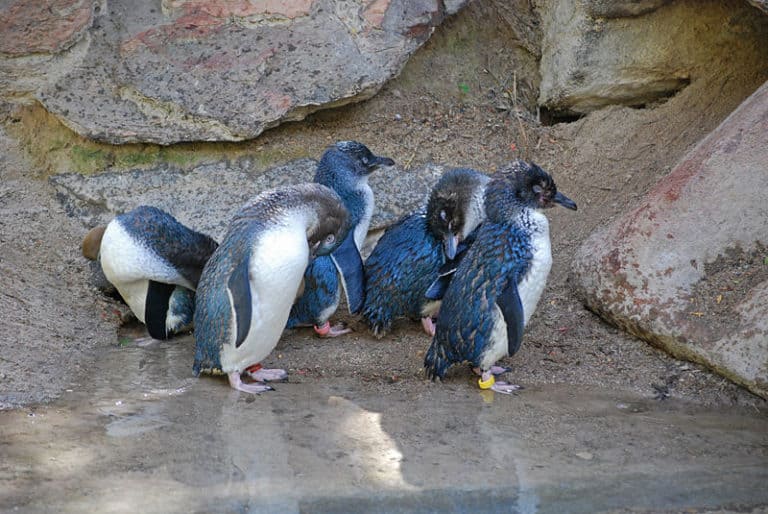
Little penguins are cooperative animals that groom each other. Specifically, they remove parasites from each other’s hard-to-reach places. As both hosts and predators of these minuscule critters, these animals play a vital role in their ecosystems.
Speaking of grooming, they spend lots of time preening their feathers with oils produced in a gland above their tails. The process helps keep their plumage waterproof. Additionally, once a year, colonies land themselves for about 17 days of molting. During this period, their old feathers fall off, and new ones emerge. The annual shedding is a critical part of their waterproofing physiology.
Little penguins also have glands above their eyes that filter salt from the sea.
When coming ashore, they work in groups. As a defensive strategy, they move from the water to land in ranks — like an army — and communicate with squeals and trills.
As their scientific name suggests, these animals are super divers and swimmers who spend 80 percent of their time doing both. On average, they swim two to four kilometers per hour, but researchers have clocked individuals speeding along at 6.4 kilometers per hour. Diving-wise, they can reach the seafloor, and the average plunge lasts 21 seconds. To date, the longest recorded little penguin dive was 90 seconds.
Not only are these animals great divers and swimmers, but they’re also impressive travelers who can migrate to far-off places. In 1984, researchers tracked one from Gabo Island to Victoria Harbor — a distance of 4,739 miles (7,628 kilometers)!
Habitat
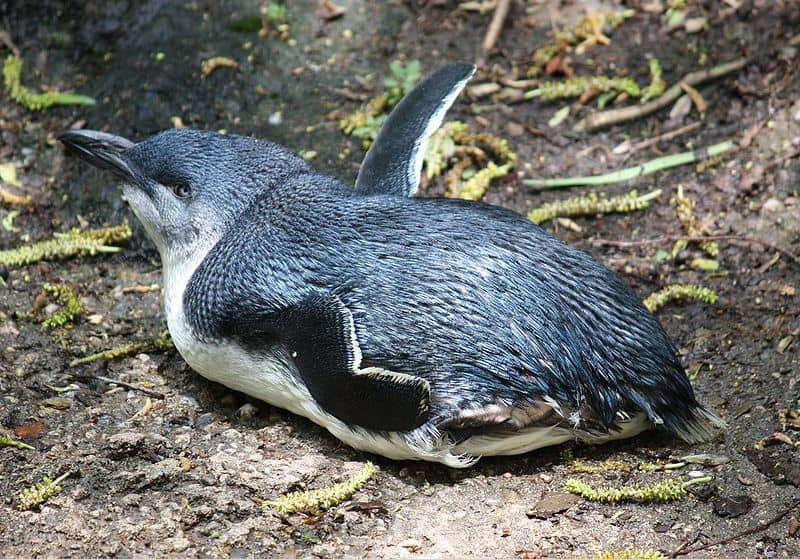
Little Penguins mainly live in New Zealand and southern Australia, although people claim to have seen them in Chile and South Africa.
©Ltshears / Creative Commons – Original
Little penguins primarily live in coastal New Zealand and island-studded southern Australia. People have claimed to see the species in Chile and South Africa, but experts are divided on the topic. Some believe the witnesses misidentified another animal; others think they may be vagrant populations introduced by humans. The debate is ongoing.
When they’re not in the water, fairy penguins live in coastal burrows. They’re always in sandy and rocky areas, and they make good use of caves, rock crevices, logs, and even man-made structures to build their homes.
Some breeding colonies are managed by conservation groups and operate as tourist destinations. If you go, though, stash your camera! Visitors can’t take pictures or videos of the little penguins because it stuns the animals and can even blind them.
Diet
These animals dine on a smorgasbord of small fish, including:
- ahuru
- anchovies
- cod
- crayfish
- cuttlefish
- crab larvae
- herring
- jellyfish
- octopus
- prawns
- sardines
- seahorses
- shads
- shrimp
- squid
Since little penguins are petite, they typically hunt younger, smaller prey.
Predators And Threats

Little Penguins face challenges to their populations due to climate change and pollution.
©Sklmsta / Creative Commons – Original
As a species, these animals are not endangered. However, individual populations face challenging obstacles. Due to climate change, human population growth, and pollution, experts are sounding alarms early and urging communities to support conservation efforts.
Natural Predators Of Little Penguins
The natural predators of these animals include:
- currawongs
- Pacific gulls
- kelp gulls
- white-bellied sea eagles
- sharks
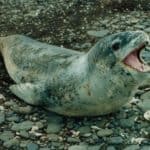
- sea lions
- long-nosed fur seals
- blue-tongued lizard
- Rosenberg’s monitor
- tiger snakes
Unnatural Threats To Little Penguins
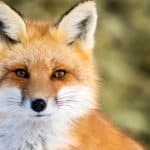
Cats, rats, and foxes aren’t natural penguin predators — nor are they endemic to the Antipodes. But since being introduced by humans, the three “intruders” have decimated regional penguin populations.
But there’s good news! And it’s all thanks to a chicken farmer named Swampy Marsh who suggested using sheepdogs to protect penguin colonies. At first, people ignored his idea. But when only six penguins remained near his home, the powers that be gave in and employed Mr. Marsh’s pups to scare away the foxes. It worked! Today, the sheepdog method is being used where non-native predators pose a threat to indigenous species.
Humans are also a huge hazard to these animals. For starters, the human population is skyrocketing. To frame the situation, approximately one billion people occupied the planet in 1800. In 2020, 7.8 billion of us walked the Earth.
Our growth, unfortunately, is demolishing hundreds of habitats. After all, people take up room! In Australia, new housing developments are encroaching on wildlife, and the whizzing of Skidoos and powerboats is driving penguin populations from their historical homes. Vehicle strikes, bycatch, plastic pollution, and land-management fires also pose big problems for the little penguins.
Reproduction, Babies, And Lifespan
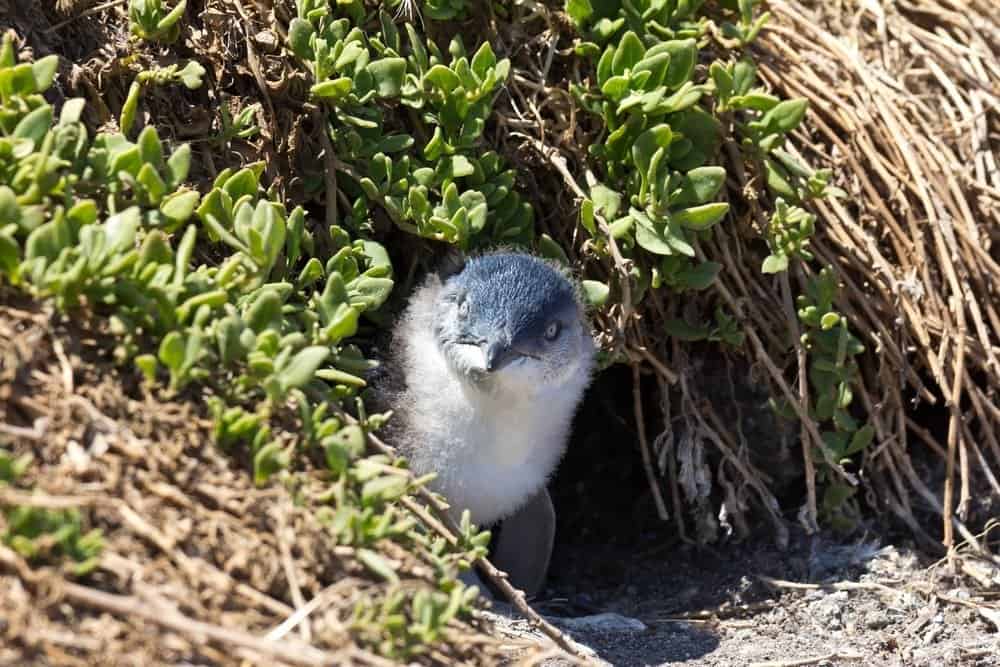
Little Penguins become juveniles at 8 weeks of age and are the same size as their parents.
©Eugene Sim/Shutterstock.com
Reproduction
The breeding season is mainly dependent on location and ocean temperatures. Generally speaking, males start building and renovating burrows sometime between May and September for mating season. Their goal is to create the best nest to attract the top females.
Except in rare circumstances, partners remain monogamous for the breeding season. To mate, pairs typically isolate themselves or form small colony offshoots from the larger group.
The standard clutch consists of one to four eggs laid one to four days apart. At first, they weigh about .12 pounds (55 grams) — the same as four jellybeans — and grow larger over a 36-day incubation period. Female fairy penguins are capable of laying more than one clutch per season, but few do.
These animals return to the same breeding spots year after year — changing only occasionally.
Babies
Both parents help incubate and rear chicks. Once born, mom and dad work overtime to keep the nestlings warm and comfortable for 18 to 38 days. When a baby reaches 7 or 8 weeks old, their feathers grow in and fledge out on their own!
Males reach sexual maturity at three years old, whereas females develop by two years old.
Lifespan
The average lifespan of these animals in the wild is about 6.5 years. Individuals living in captivity can make it to 20.
Population
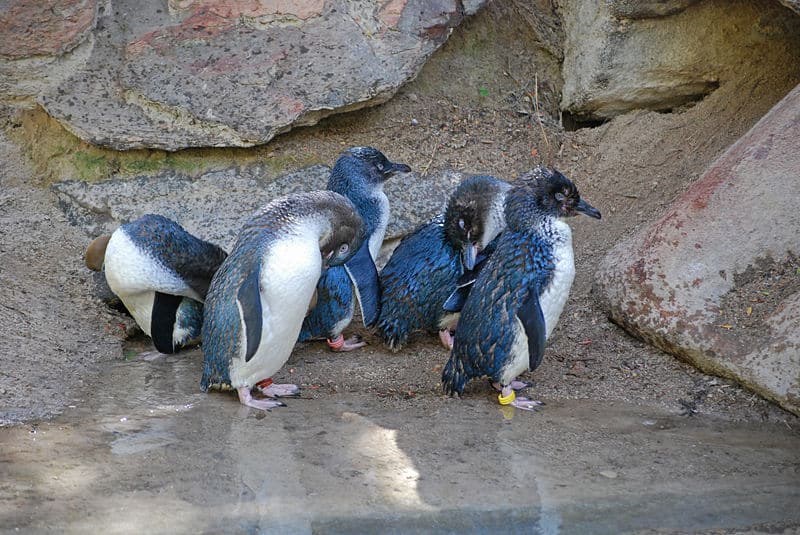
Colonies of Little Penguins have been steadily declining since the 1960s, although they are still listed as an animal of least concern.
©Tanya Dropbear / Creative Commons – Original
Experts place the worldwide population of these animals between 350,000 and 600,000. Some estimates go as high as 1,000,000. Resultantly, the International Union for the Conservation of Nature considers them an animal of Least Concern.
But that doesn’t tell the whole story.
Colonies in New Zealand have been steadily declining since the 1960s. Conservationists estimate a 70 percent downtown. Southern Australia and mainland Tasmanian populations are also struggling under the weight of human encroachment.
Thankfully, despite the absence of an IUCN alarm, both Australia and New Zealand have instituted laws addressing potential problems before it’s too late.
White-flippered penguins, which some scientists consider a little penguin subspecies, are considered endangered in New Zealand.
In U.S. Zoos
Many U.S. zoos care for these animals, including:
This list isn’t exhaustive. To find a zoo near you with a little penguin enclosure, head to Google!
Little Penguin Pictures
View all of our Little Penguin pictures in the gallery.

Sources
- David Burnie, Dorling Kindersley (2011) Animal, The Definitive Visual Guide To The World's Wildlife / Accessed August 3, 2010
- Tom Jackson, Lorenz Books (2007) The World Encyclopedia Of Animals / Accessed August 3, 2010
- David Burnie, Kingfisher (2011) The Kingfisher Animal Encyclopedia / Accessed August 3, 2010
- Richard Mackay, University of California Press (2009) The Atlas Of Endangered Species / Accessed August 3, 2010
- David Burnie, Dorling Kindersley (2008) Illustrated Encyclopedia Of Animals / Accessed August 3, 2010
- Dorling Kindersley (2006) Dorling Kindersley Encyclopedia Of Animals / Accessed August 3, 2010
- Christopher Perrins, Oxford University Press (2009) The Encyclopedia Of Birds / Accessed August 3, 2010
- Penguin Foundation / Accessed November 1, 2020
- Aquarium of the Pacific / Accessed November 1, 2020
- The New York Times / Accessed November 1, 2020