




L
Species Profile

Long-Eared Owl

Asio otus

Tufts up, talons down.
Paul A Carpenter/Shutterstock.com

Long-Eared Owl Distribution

Click a location to explore more animals from that region

Loading map...

Found in 74 locations

long-eared owl, Asio otus

At a Glance

Wild Species
Also Known As Common long-eared owl, Eared owl, Hibou moyen-duc, Waldohreule, Búho de orejas largas
Diet Carnivore
Activity Nocturnal+
Lifespan 4 years
Weight 0.435 lbs
Status Least Concern
Did You Know?

Size: 31-40 cm long; wingspan 86-102 cm.

Scientific Classification

A medium-sized nocturnal owl widely distributed across the Northern Hemisphere, recognized by its prominent ear tufts (feather tufts) and streaked plumage; often roosts communally in dense vegetation outside the breeding season.

Kingdom
Animalia
Phylum
Chordata
Class
Aves
Order
Strigiformes
Family
Strigidae
Genus
Asio
Species
Asio otus

Distinguishing Features

  • Prominent, long ear tufts (not actual ears) held upright when alert
  • Orange to amber facial disk with dark rim; pale buffy underparts with heavy vertical streaking
  • Slender build and relatively long wings for a forest-edge owl
  • Often roosts in dense cover during day; may form winter roost groups
  • Calls include low, repeated hoots (male) and various barks/squeals in breeding context

Physical Measurements

Males and females differ in size

Length
♂ 1 ft 2 in (1 ft 2 in – 1 ft 3 in)
♀ 1 ft 3 in (1 ft 2 in – 1 ft 4 in)
Weight
♂ 1 lbs (0 lbs – 1 lbs)
♀ 1 lbs (1 lbs – 1 lbs)
Tail Length
♂ 6 in (5 in – 6 in)
♀ 6 in (6 in – 7 in)
Top Speed
31 mph
flying

Appearance

Primary Colors
Secondary Colors
Skin Type Feathered body and facial disc; scaly feet/toes with sharp black talons.
Distinctive Features
  • Medium-sized owl: total length 35-37 cm; wingspan 84-95 cm (Birds of the World/Cornell Lab; HBW Alive).
  • Mass typically 0.21-0.435 kg, with females averaging heavier than males (Birds of the World).
  • Prominent "ear tufts" are feather tufts (not external ears), usually held upright when alert.
  • Facial disc is well-defined with dark rim; orange eyes; short hooked bill mostly hidden by facial feathers.
  • Nocturnal/crepuscular woodland-edge hunter; low, silent flight; prey mainly small mammals (voles, mice) (Birds of the World).
  • Often roosts communally in dense vegetation in winter/nonbreeding season; daytime roosts can include many individuals together.
  • Northern Hemisphere distribution across much of Eurasia and North America; typically in coniferous/mixed woodland edges and wooded riparian areas.
  • Longevity: EURING record 27 years 9 months (ringing recovery longevity record); wild average lifespan is much shorter due to mortality.

Sexual Dimorphism

Sexes look very similar in plumage and ear-tuft appearance, but females are measurably larger and heavier on average. Females may appear slightly darker/warmer-toned, while males often look a bit paler overall.

♂
  • Smaller average body mass than females (within reported 0.21-0.435 kg range).
  • Often slightly paler or less heavily marked underparts, though overlap is extensive.
♀
  • Larger average mass and size; typically the heavier end of 0.21-0.435 kg range (Birds of the World).
  • May show slightly darker or richer-toned plumage; overlap with males is substantial.

Did You Know?

Size: 31-40 cm long; wingspan 86-102 cm.

Mass: males ~0.178-0.281 kg; females ~0.192-0.435 kg (females average heavier).

Uses old nests (often corvid or squirrel dreys); typically does not build its own nest.

Breeding: usually 4-6 eggs (recorded range ~2-10); incubation ~25-30 days.

Young leave the nest before they can fly ("branching") at ~20-24 days, but are fed for weeks after.

Winter roosts can be communal-often dozens of birds packed into dense conifers/hedges.

Maximum recorded longevity in the wild is about 27 years (banding/recovery records); most live far less due to predation and starvation risk.

Unique Adaptations

  • Ear tufts are feather tufts (not ears): likely aid camouflage and visual communication; actual ear openings are on the sides of the head.
  • Silent-flight plumage: serrated leading edges on primary feathers plus downy, velvety feather surfaces reduce turbulence noise-improving stealth and prey detection.
  • Facial disc sound-funneling: a pronounced facial disc helps focus sound to the ears for pinpointing prey in low light.
  • Low-light vision: large eyes and retina adapted for nocturnal hunting; relies on combined vision + hearing to strike through grass cover.
  • Cryptic streaked plumage: vertical streaking and warm buff tones mimic branches and bark, especially when the bird adopts an elongated roosting posture.
  • Wide Northern Hemisphere plasticity: breeds across temperate to boreal regions and uses varied roost sites (conifers, shrubs, reedbeds), enabling success in patchy woodland-edge mosaics.

Interesting Behaviors

  • Communal winter roosting: outside the breeding season, individuals may gather daily in dense vegetation (often conifers, thorny hedges, or shelterbelts), relying on camouflage and group vigilance.
  • Woodland-edge hunting: typically hunts over grasslands, pastures, field margins, and clearcuts near trees-flying low with buoyant wingbeats and frequent pauses to listen.
  • Prey specialization: many populations focus heavily on small mammals, especially voles (Microtus spp.), switching prey when vole numbers crash.
  • "Branching" juveniles: chicks often climb out of the nest onto nearby branches well before true flight; adults continue provisioning scattered young by voice contact.
  • Nest usurpation: regularly occupies abandoned stick nests of corvids (crows, magpies, jays) or raptors; will also use artificial platforms in some areas.
  • Vocal and visual signaling: uses low, rhythmic hoots in breeding season; ear-tuft postures and body elongation ("stick pose") are used in display and concealment.

Cultural Significance

The Long-eared Owl (Asio otus) is a night watch bird linked to secrecy, forest- and field-edges, and seen as wise or an omen. It roosts in dense trees near farms, often in groups, and has noticeable feather tufts.

Myths & Legends

Long-eared Owl (Asio otus): A European folktale, 'The Owl and the Baker's Daughter,' says a girl was turned into an owl as a warning; tale spread in Britain and tied owls near villages to omens.

In Ancient Rome, people saw owls as bad omens; writers said an owl's call or presence could mean trouble. The tufted eared look fits species like Asio (Long-eared Owl), not the Little Owl.

Hopi tradition in the U.S. Southwest: Mongwu (Great Horned Owl) is an owl kachina that means night power and discipline. "Eared" owls are also seen as powerful night watchers in Puebloan belief.

Navajo (Diné) belief: owls are cautiously regarded as night messengers linked to harmful witchcraft narratives; this applies to any tufted owl seen near homes or camps, not just one species.

Slavic/Eastern European rural folklore: owls calling near a settlement were traditionally taken as warnings or signs connected to illness or death; tufted "eared" owls roosting near farms could readily be interpreted through this lens.

Northern Eurasian naming lore: vernacular names in multiple languages emphasize the "horns/ears" (feather tufts), and traditional hunters' and herders' stories often treat tufted owls as disguised forest spirits watching from conifers at dusk.

Conservation Status

LC Least Concern

Widespread and abundant in the wild.

Population Decreasing

Protected Under

  • CITES Appendix II (international trade regulated)
  • EU Birds Directive (all wild birds protected in the EU; hunting/trade controls and habitat measures apply)
  • U.S. Migratory Bird Treaty Act (where occurring; prohibits take/possession without permit)
  • Bern Convention on the Conservation of European Wildlife and Natural Habitats (general protection framework in Europe)

Life Cycle

Birth 5 chicks
Lifespan 4 years

Lifespan

In the Wild
0.5–28 years
In Captivity
1–30 years

Reproduction

Mating System Monogamy
Social Structure Socially Monogamous
Breeding Pattern Seasonal
Fertilization Internal Fertilization
Birth Type Internal_fertilization

Seasonally socially monogamous; males defend nesting territory, court with flight displays, and provision females. Female lays typically 4-6 (2-10) eggs; incubates ~25-30 days while male hunts; young leave nest ~21-26 days, fly ~35-40 days.

Behavior & Ecology

Social Flock Group: 15
Activity Nocturnal, Crepuscular
Diet Carnivore Voles (Microtus spp.; commonly reported as the primary prey, often comprising the majority of prey items/biomass in pellet analyses across much of the range).
Seasonal Migratory 932 mi

Temperament

Breeding season: strongly territorial around nest/roost area; aggressive chases and threat postures toward conspecifics and raptors (Marks et al. 1999).
Non-breeding season: notably tolerant at communal roosts; individuals maintain small spacing but rarely fight (Cramp 1985).
Predator-avoidant and cryptic; relies on camouflage and immobility at day roosts, flushing only when approached closely (Marks et al. 1999).

Communication

Male territorial song: low, evenly spaced single hoots "hoo") repeated at intervals; primary long-range signal (Marks et al. 1999
Contact calls at roost/nest: short barks and chuckling notes; increased during pair interactions Marks et al. 1999
Alarm/defense: harsh screams and hissing; young give begging squeals/whines Cramp 1985; Marks et al. 1999
Visual threat displays: erect ear tufts, upright posture, feather sleeking; sometimes bill-snapping when handled Marks et al. 1999
Acoustic non-vocal: wing-clapping during aerial interactions has been reported in Asio species, including long-eared owl Cramp 1985
Spatial signaling: repeated use of traditional roost trees; site fidelity concentrates individuals and facilitates social tolerance in winter Cramp 1985

Habitat

Biomes:
Temperate Forest Boreal Forest (Taiga) Temperate Grassland Mediterranean Desert Cold
Terrain:
Mountainous Hilly Plateau Plains Valley Coastal Riverine +1
Elevation: Up to 9842 ft 6 in

Ecological Role

Nocturnal mesopredator specializing on small mammals (notably voles), linking open-field small-mammal populations to higher trophic levels and stabilizing prey cycles via density-dependent predation.

Biological control of rodent populations in agricultural and pastoral landscapes (reducing vole/mouse outbreak impacts) Transfers energy/nutrients across habitats (foraging in open areas, roosting in dense cover; pellet deposition subsidizes decomposer/scavenger communities) Indicator of small-mammal abundance and habitat structure in monitoring programs (diet/pellets reflect local prey communities)

Diet Details

Main Prey:
Vole Field vole Common vole Meadow vole Mice Shrews Young rats Small passerine birds Bat Large insects +4

Human Interaction

Domestication Status

Wild

The Long-eared Owl (Asio otus) is a wild raptor species with no domestication history. It has not been selectively bred into a domestic form; human interaction is primarily through observation in the wild and, where legally permitted, short-term captivity for rehabilitation, education, research, or licensed wildlife handling.

Danger Level

Low
  • Defensive strikes near nest or when handled can cause puncture/laceration from talons; beak can pinch
  • Low but nonzero zoonotic risk typical of wild birds (e.g., Salmonella/Campylobacter exposure from feces; ectoparasites) if handled without hygiene
  • Indirect risk: secondary exposure concerns in rehabilitation settings (handling animals with rodenticide burdens)

As a Pet

Not Suitable as Pet

Legality: Keeping a Long-eared Owl (Asio otus) as a pet is generally illegal in most places. In the U.S. the MBTA bans possession without permits; EU/UK laws also require licenses for rehab, education, or falconry.

Care Level: Expert Only

Purchase Cost: Up to $2,000
Lifetime Cost: $15,000 - $60,000

Economic Value

Uses:
Ecosystem services (rodent predation) Ecotourism/birdwatching value Education and outreach (licensed programs) Research/monitoring (raptor ecology, contaminants as bioindicators)
Products:
  • Non-market service: suppression of small-mammal pest populations in farmland/grassland mosaics
  • Non-consumptive recreation: winter roost viewing and general birding interest
  • Scientific value: indicator data via pellets (diet), banding/telemetry, contaminant monitoring

The long-eared owl makes its home in North America, Europe, and parts of Asia, as well as in northern and eastern parts of Africa, including Madagascar. It nests in forests where the trees grow close together. Long-eared owls hunt at night, looking for mice, bats, and other small animals.

The wingspan of these owls can measure up to 39 inches wide, and they can live to be almost 30 years old. The male and female long-eared owls differ in several ways, one of which is in the distinct sounds they make in their mating calls.

Incredible Long-Eared Owl Facts
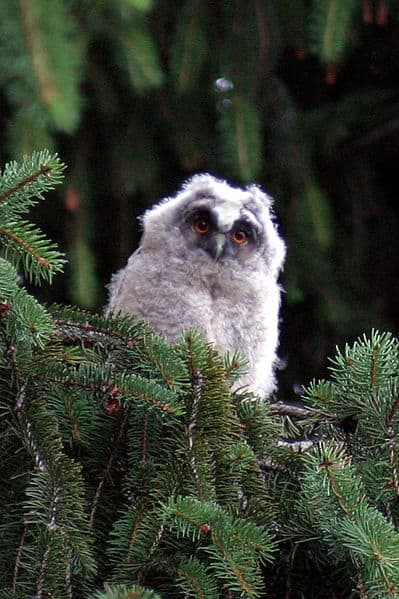
Long-shot of a white long-eared owl in a pine tree

Baby long-eared owls can’t fly until they’re 35 days old.

  • Making dense forests their home, these owls have babies in nests that are abandoned by other birds.
  • They use their excellent sense of hearing to hunt for prey at night, often hunting in open country.
  • Baby long-eared owls can’t fly until they’re 35 days old.

Classification and Scientific Name
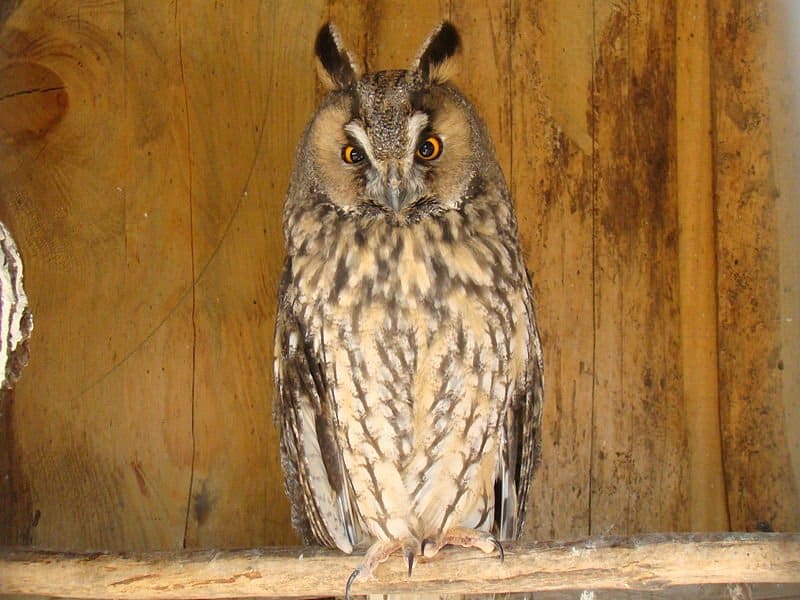
Long-eared owl with a brown background

The Long-Eared Owl’s scientific name is Asio otus.

The long-eared owl, sometimes called the common or Northern long-eared owl, has the scientific name of Asio otus, which is Latin in origin. Its class is Aves, and it belongs to the Strigidae family.

Subspecies include:

  • A. o. otus
  • A. o. canariensis 
  • A. o. wilsonianus 
  • A. o. tuftsi 

Evolution and Origins

Although there are fossil records of the Asio owl species in places like Kansas, Idaho (Asio brevipes), and California (Asio priscus) from prehistoric times, we don’t know for sure where exactly the long-eared owl first evolved. It’s unlikely that we’ll ever discover that information. While we can’t pinpoint the exact origins of the Long-Eared Owl, the first known ancestor of owls or birds is the Archaeopteryx.

Similar to other owls, the Long-eared Owl has a body designed for quiet flight and accurate hunting. Its flight feathers have fringed edges and soft surfaces that reduce the noise of flying. In fact, these owls also have excellent hearing due to their ears being placed unevenly and their big, sound-trapping face disks.

Appearance
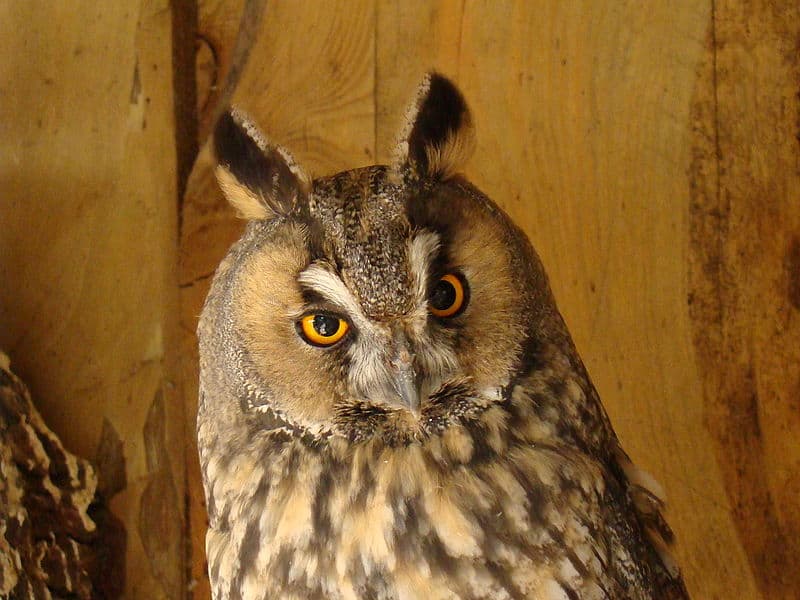
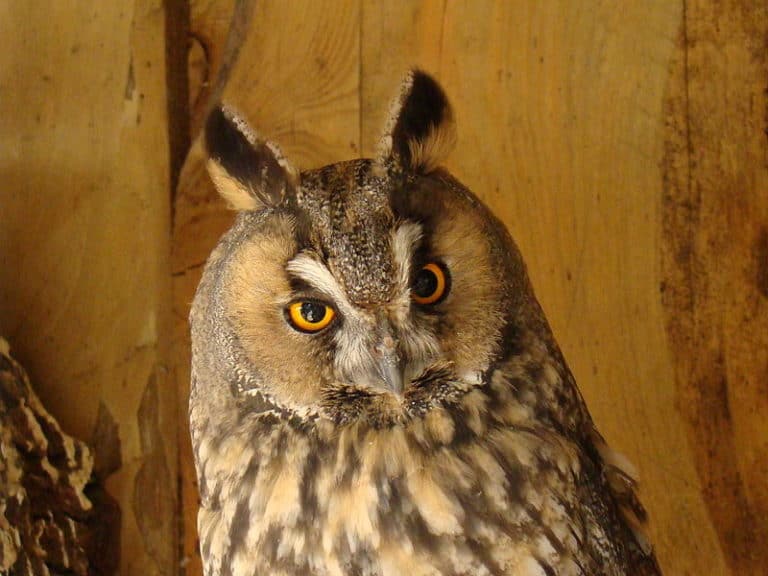
Close-up photo of a long-eared owl with brown and yellow features

The long-eared owl has a mixture of brown and gray feathers

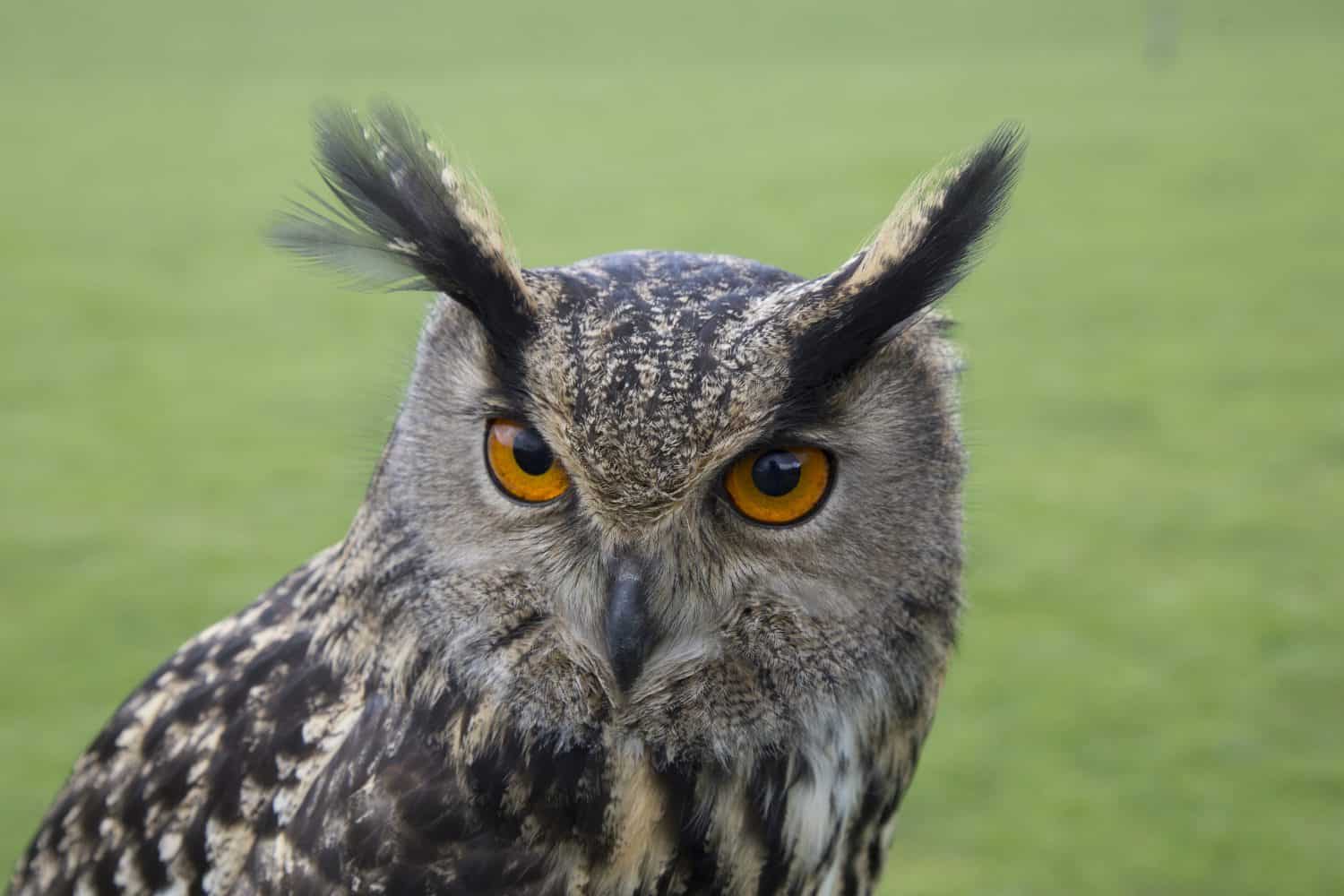
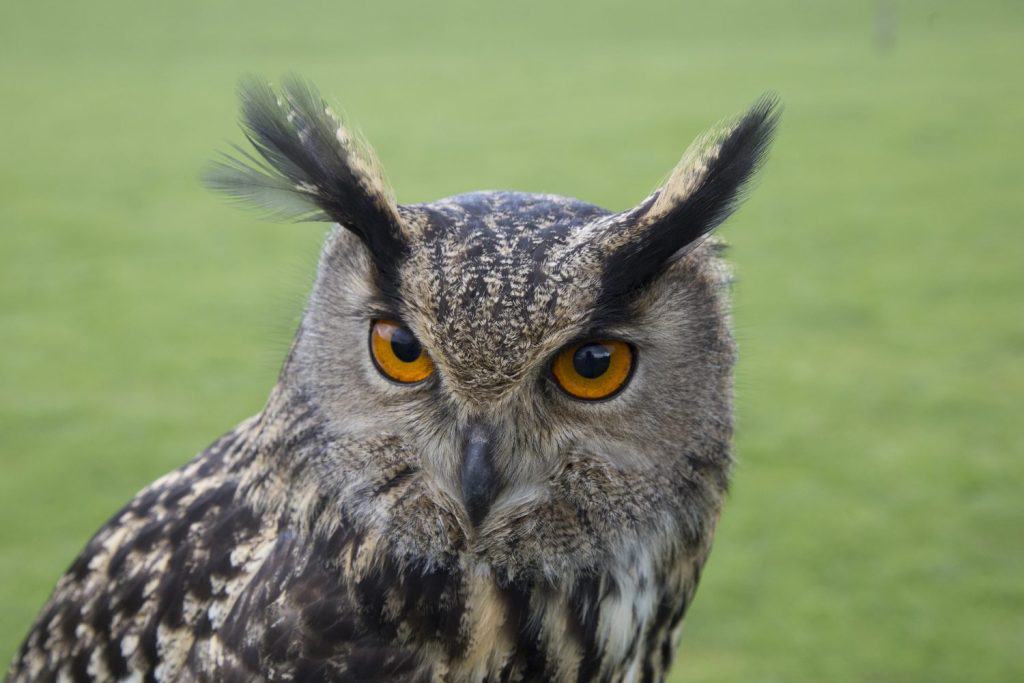
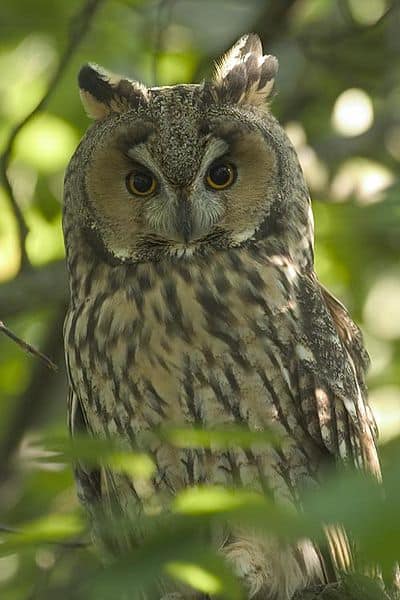
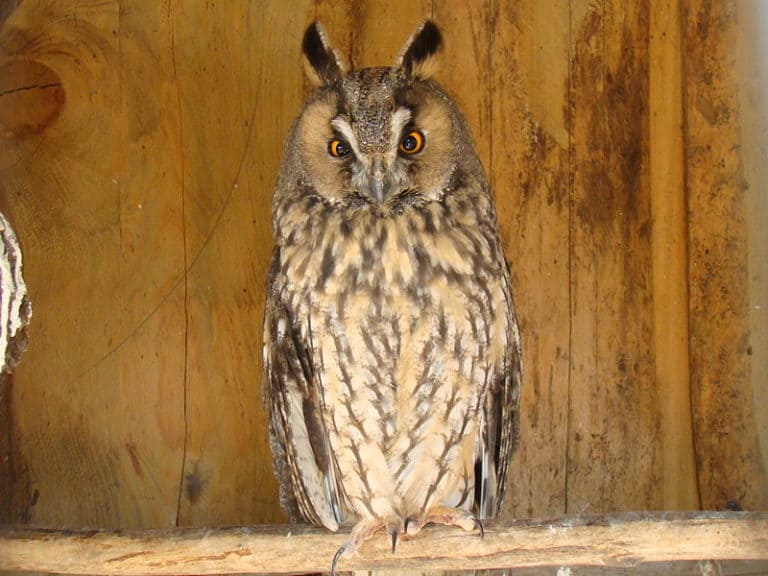
The long-eared owl has a mixture of brown and gray feathers, which flow in a vertical design, with two ear tufts standing up on its head. But, despite the name, these ear tufts aren’t the owl’s ears; they are simply tufts of black feathers. Its ears are located on the sides of its head.

A long-eared owl’s eyes are either orange or yellow, and it has a black beak. Its feet are covered with a thin layer of light-colored feathers.

This owl is categorized as medium-sized due to its slender body, which can range in length from 13 to 16 inches, which is slightly taller than a bowling pin. Normally, female long-eared owls are larger than males, weighing an average of 10 ounces (the weight of two baseballs) to the male’s average of 8.75 ounces (slightly less than a can of soup).

The wingspan of this owl can be as wide as 39 inches. So, if you set 18 golf tees on the ground end to end, you’d be looking at the approximate width of this owl’s wings when they’re spread. Its wings are so wide that this owl has to cross them over one another on its back when perched on a branch. It’s no wonder they can fly as fast as 31 miles per hour!

Behavior
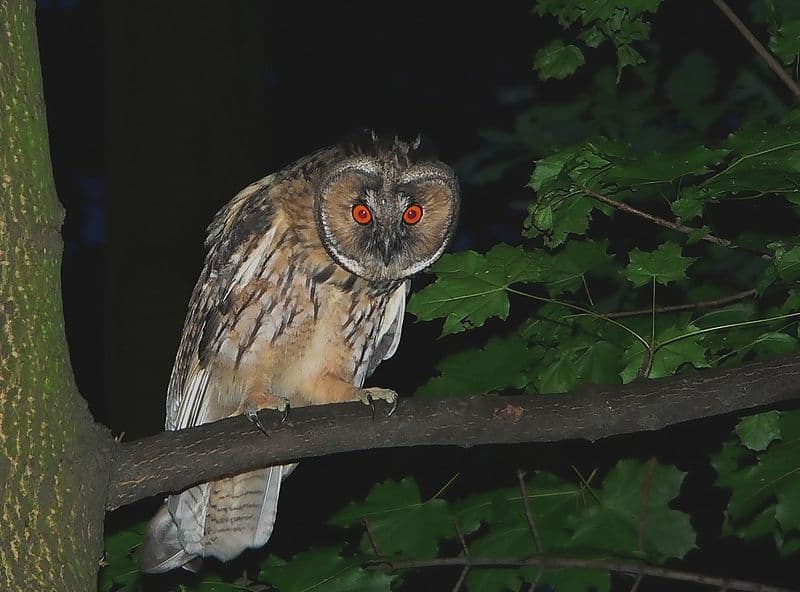
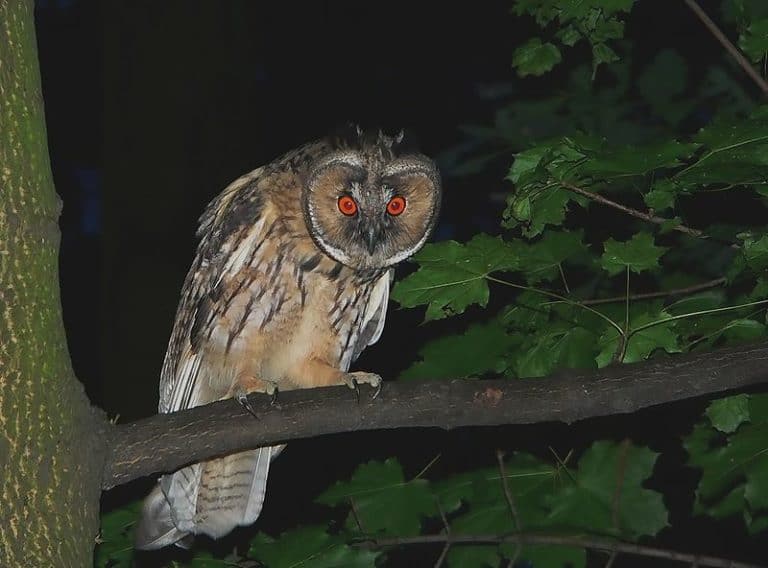
Long-eared owl perched in a tree at night

Males make more than 200 primarily low-pitched sounds.

Long-eared owls are quiet most of the year, except during mating season when they make a lot of hooting sounds. Males make more than 200 primarily low-pitched sounds, while a female’s call comes out as a much higher sound.

A male’s sounds range from a short whine or whistle to a deep moaning sound. A call of this owl can sound like a squeak, a cat’s meow, a squeal, or even a bark. Just like human speech, every owl call has its meaning.

The slender body of this owl helps to protect it against predators. While sitting in a tree, a long-eared owl pulls in its feathers so they’re flat against its body and stretches out to its full length. In this position and with its dark coloration, it can be mistaken for a large tree branch by predators.

Owls are known to be solitary animals. But when they do gather together, the group is called a parliament. These birds are shy and like to stay hidden if at all possible.

Habitat
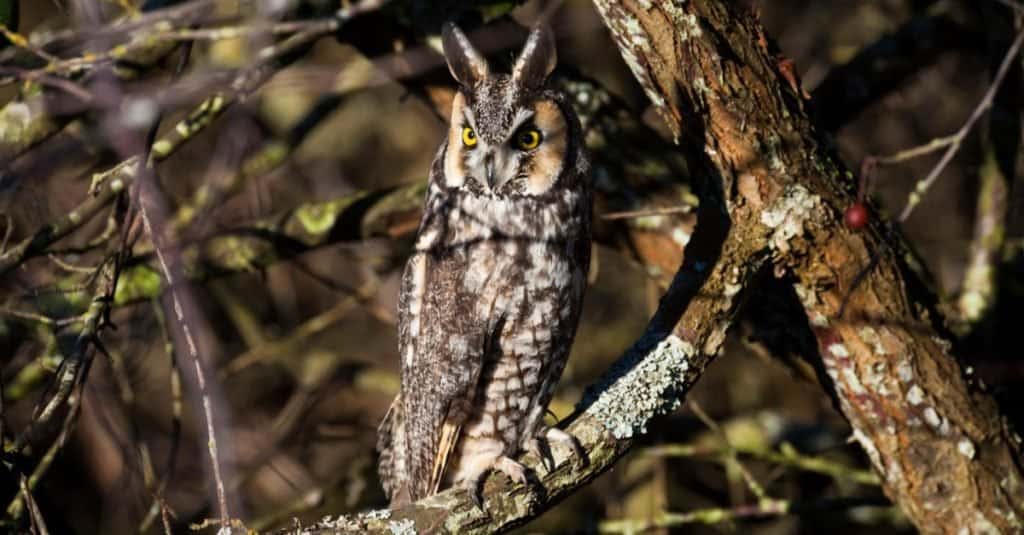
Animals With Camouflage: Long-eared Owl

Some long-eared owls migrate south for the cold months.

Long-eared owls live in areas throughout the world, including North America, Europe, and parts of Asia, as well as in northern and eastern parts of Africa. Additionally, some subspecies of these owls live in Madagascar. The long-eared owl needs a temperate climate to survive.

Specifically, these owls live in large forests, smaller groves of trees, thickets around wetlands and marshes, and in grasslands. They prefer to nest in areas where the trees are packed closely together to give them protection from predators. But when these owls hunt, they fly around open grassy areas in search of prey.

Some long-eared owls migrate south for the cold weather season. For instance, owls that live in the southern part of Canada or the northern United States fly south as far as Mexico before the cold weather arrives in the autumn. Scientists know these facts because they’ve tracked populations of these owls and their movements throughout the years.

Population
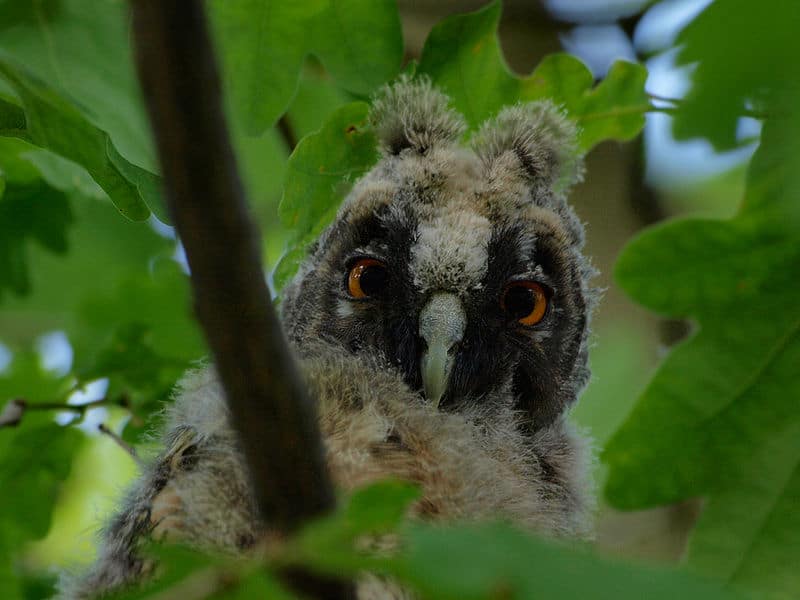
Long-eared owl with red eyes in a tree

Long-Eared Owl is of least concern.

The official conservation status of the long-eared owl is Least Concern. While its population has been affected by the loss of habitat due to land clearing and construction, it remains stable. It’s been estimated that there are around 2,200,000 to 3,700,000 mature individuals.

Diet

The long-eared owl has excellent hearing and vision, and it uses these senses to hunt in the dark. They fly low to the ground and listen for rodent activity so they can quickly capture any small prey they find. The tips of their wings are shaped like the teeth of a comb which helps them to move without making any noise. They are true birds of prey.

Long-eared owls hunt for mice, voles, shrews, small birds, small snakes, bats, and sometimes insects. They are carnivores like most other owls and swallow their prey whole. It’s unclear how these owls take in water, but they may get enough from the fluids inside the animals they eat.

Predators and Threats

Several of the predators of the long-eared owl are larger owls, including the great horned owl, barred owls, and eagle owls. Other predators include red-tailed hawks, golden eagles, northern goshawks, and peregrine falcons.

The babies of long-eared owls sometimes fall prey to raccoons, bull snakes, American crows, and porcupines.

Fully-grown long-eared owls can be chased into trees and attacked by the predators mentioned above. They’re smaller and thinner than many of their predators, making it easier to subdue them.

Baby long-eared owls are sometimes threatened while they are still in the nest. A raccoon or bull snake may approach the nest to grab a baby owl, and the mother and father owl will flap their wings at a predator or fly down to snap at it to protect their owl babies.

In some cases, other owls with nests nearby will join in the fight to drive a predator away from the area. When a predator sees it’s outnumbered, it is likely to give up and go away.

Reproduction

The mating season of this owl goes from February to July. The male long-eared owl flies over the nesting area and makes a variety of calls and sounds to attract a female. It may also perform some interesting flying routines to grab the attention of other males looking for a mate.

These owls are monogamous and have babies once per year. If you ever hear an owl’s call coming from one area and a second owl’s call coming from another direction, they are likely a monogamous male and female pair that’s communicating with one another.

One of the most interesting facts about long-eared owls is that they don’t build their nests. Instead, they occupy nests abandoned by owls and other birds. Sometimes they settle down in an old nest abandoned by squirrels, which is called a drey.

Babies

Females can lay from 2 to 10 eggs in the nest, but the group, also known as a clutch, usually contains 5 or 6 eggs. Instead of laying all of her eggs at once, a female lays a new egg every two days or so. Each egg is a little over 1 inch in length and is bright white with a glossy shell. The female owl sits on the eggs nonstop during the day while taking a little time away to hunt at night.

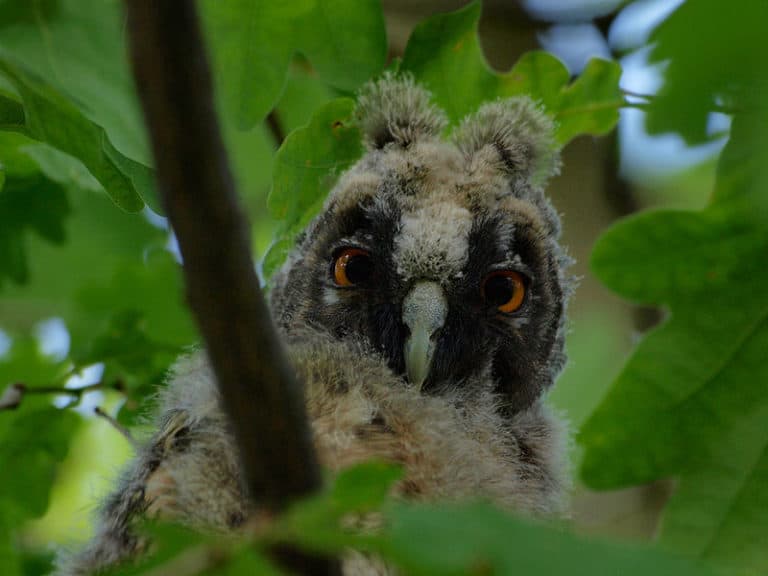
The eggs hatch in 25 to 30 days. A newly hatched baby owl is covered with white feathers, called down, and its eyes are closed. This is when they are most vulnerable to predators. The mother owl is the main caretaker for about two weeks, and then the father owl takes over. He brings food to the mother and her babies, also known as chicks or owlets. The chicks eat small things like worms and insects, then eat larger prey as they get bigger.

When the chicks are 21 days old, they leave the nest but are not able to fly. At this stage, they are called branching because they perch on branches around the nest while still getting food from the father owl. When they reach 35 days old, the babies can fly for short distances. They practice hunting and capturing small prey to prepare to care for themselves. At around 11 weeks, the baby owls can live independently.

Lifespan

The lifespan of a long-eared owl can range from 10 to 27 years, depending on its strength and health, but the average lifespan is about 4 years. The oldest long-eared owl made it to 27 years, 9 months old in the wild.

Owls can develop some of the same respiratory ailments as many other types of birds. Trichomoniasis and aspergillosis are two examples.

View all 131 animals that start with L

Sources

  1. David Burnie, Dorling Kindersley Animal, The Definitive Visual Guide To The World's Wildlife / Accessed August 2, 2010
  2. Tom Jackson, Lorenz Books The World Encyclopedia Of Animals / Accessed August 2, 2010
  3. David Burnie, Kingfisher The Kingfisher Animal Encyclopedia / Accessed August 2, 2010
  4. Richard Mackay, University of California Press The Atlas Of Endangered Species / Accessed August 2, 2010
  5. David Burnie, Dorling Kindersley Illustrated Encyclopedia Of Animals / Accessed August 2, 2010
  6. Dorling Kindersley Dorling Kindersley Encyclopedia Of Animals / Accessed August 2, 2010
  7. Christopher Perrins, Oxford University Press The Encyclopedia Of Birds / Accessed August 2, 2010
Ashley Haugen

About the Author

Ashley Haugen

Ashley Haugen is the editor of A-Z Animals. She's a lifelong animal lover with an affinity for dogs, cows and chickens. When she's not immersed in A-Z-Animals.com (her favorite editorial job of her 25-year career), she can be found on the hiking trails of Middle Tennessee or hanging out with her family, both human and furry.
Connect:

Thank you for reading! Have some feedback for us?


Long-Eared Owl FAQs (Frequently Asked Questions)

A long-eared owl can lay from 2 to 10 eggs. But they usually lay about 5 or 6.