








L
Species Profile

Lynx

Lynx

Tufted ears. Silent steps. Northern hunters.
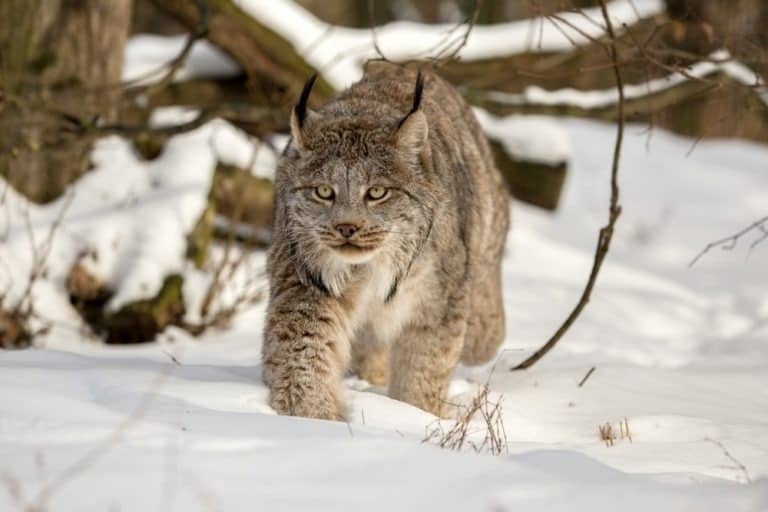
Cris Canton/Shutterstock.com

Size Comparison

Human 5'8"
Lynx 1 ft 12 in

Lynx stands at 35% of average human height.

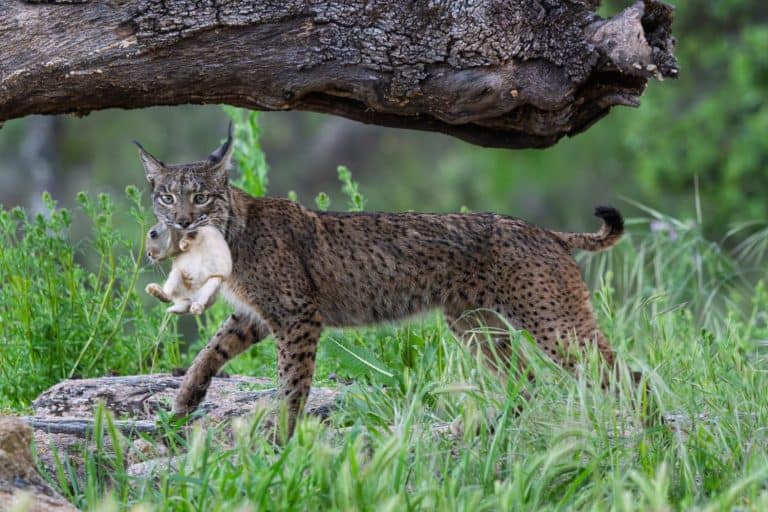
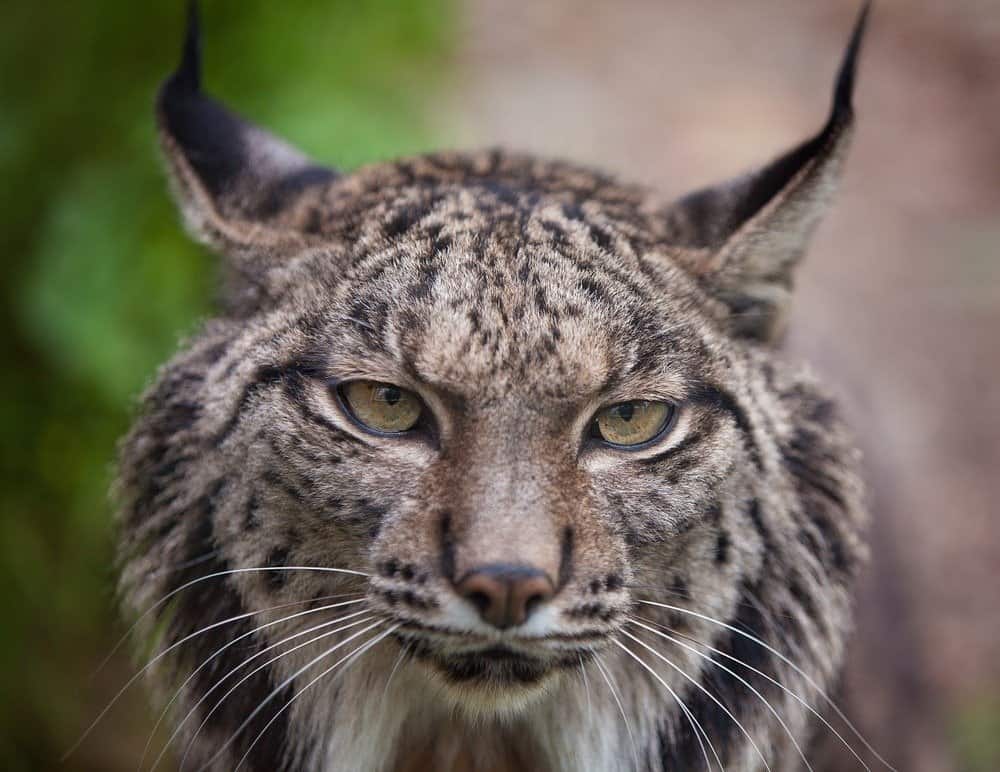
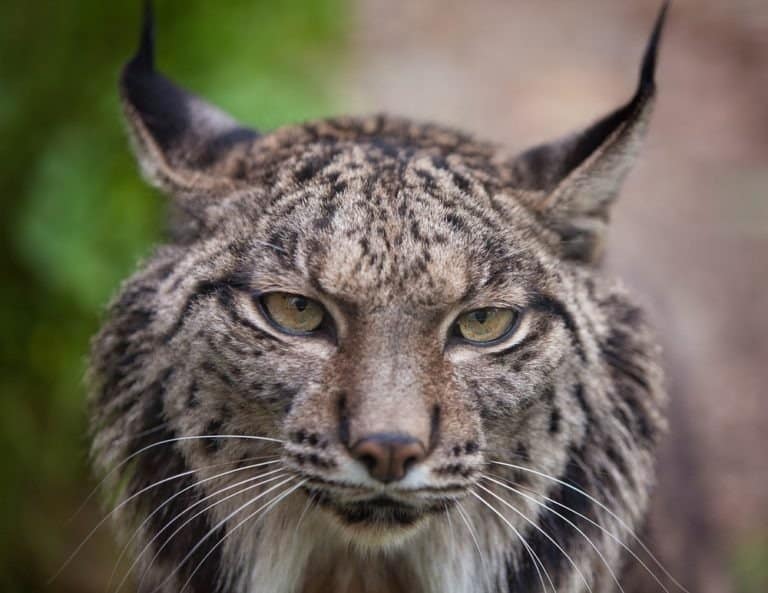
Iberian Lynx looking at camera

At a Glance

Genus Overview This page covers the Lynx genus as a group. Stats below are general traits shared across the genus.
Diet Carnivore
Activity Crepuscular+
Lifespan 11 years
Weight 38 lbs
Status Not Evaluated
Did You Know?

Genus-wide size range: ~65-130 cm head-body length and ~5-38 kg in weight (smallest bobcats/Canada lynx to largest Eurasian lynx).

Scientific Classification

Genus Overview "Lynx" is not a single species but represents an entire genus containing multiple species.

Lynxes are medium-sized wild cats characterized by tufted ears, a short “bobbed” tail, broad furry paws (often aiding travel over snow), and a facial ruff. They are solitary predators, primarily hunting small to medium prey (notably lagomorphs such as hares and rabbits), and inhabit forests, scrub, and mountainous regions across the Northern Hemisphere.

Kingdom
Animalia
Phylum
Chordata
Class
Mammalia
Order
Carnivora
Family
Felidae
Genus
Lynx

Distinguishing Features

  • Black ear tufts and triangular ears
  • Short tail with dark tip
  • Facial ruff (“sideburns”)
  • Large, furred paws (especially in snow-adapted species)
  • Spotted or mottled coat pattern varying by species and region

Physical Measurements

Males and females differ in size

Height
1 ft 12 in (1 ft 7 in – 2 ft 6 in)
1 ft 10 in (1 ft 6 in – 2 ft 6 in)
Length
3 ft 9 in (2 ft 5 in – 5 ft 1 in)
3 ft 5 in (2 ft 4 in – 4 ft 7 in)
Weight
37 lbs (13 lbs – 84 lbs)
22 lbs (9 lbs – 55 lbs)
Tail Length
6 in (2 in – 10 in)
6 in (2 in – 9 in)
Top Speed
43 mph
running

Appearance

Primary Colors
Secondary Colors
Skin Type Dense double-layered fur with pronounced seasonal molt; broad, heavily furred paws and a short tail with dark tip.
Distinctive Features
  • Tufted ears with black tips, aiding silhouette recognition and signaling
  • Short "bobbed" tail, typically ending in a black tip or band
  • Facial ruff/cheek fringes creating a broad, framed face
  • Long legs and compact, muscular body built for pouncing and climbing
  • Broad, furred paws; especially snow-adapted in Canada and Eurasian lynx
  • Coat pattern highly variable: from faint mottling to bold spots
  • Genus-wide Northern Hemisphere distribution: North America and Eurasia, including Iberia
  • Size range across genus: head-body ~65-130 cm; tail ~5-25 cm; shoulder height ~45-75 cm; mass ~6-35 kg
  • Lifespan range across genus: typically ~7-17 years in the wild; up to ~20-25 years in captivity
  • Ecology: solitary, territorial ambush predators; prey focus varies from hare/rabbit specialists to broader generalists

Sexual Dimorphism

Males are generally larger and heavier than females across all Lynx species, with broader heads and more robust neck/shoulder build. Coat colors and patterns largely overlap, so size and proportions are the most consistent differences.

  • Greater average body mass and shoulder height
  • Broader head and heavier neck/forequarters
  • Larger overall paw and limb proportions on average
  • Smaller, lighter build with more gracile proportions
  • More pronounced abdominal changes during pregnancy and nursing
  • Nipples more evident during lactation

Did You Know?

Genus-wide size range: ~65-130 cm head-body length and ~5-38 kg in weight (smallest bobcats/Canada lynx to largest Eurasian lynx).

Lifespan across the genus is commonly ~7-17 years in the wild; individuals in human care can reach ~20-25 years.

All four species share the classic "lynx look": ear tufts, a facial ruff, and a short tail with a dark tip-but coat spotting and color vary widely by species and region.

Prey focus differs strongly: Canada lynx tracks snowshoe hare cycles; Iberian lynx is tightly linked to European rabbits; bobcats are generalists; Eurasian lynx often takes larger prey (including roe deer) where available.

Feet are famously furred and broad-especially in Canada lynx-helping distribute weight on snow like natural snowshoes (less pronounced in bobcats from milder regions).

Despite being secretive, lynxes communicate intensely through scent marking (urine sprays, scrapes) that map territory boundaries over large areas.

Their ranges barely overlap in many places: bobcat is widespread in North America; Canada lynx is mainly boreal North America; Eurasian lynx spans parts of Europe and Asia; Iberian lynx is restricted to the Iberian Peninsula.

Unique Adaptations

  • Ear tufts and large, sensitive ears aid sound localization-useful for detecting prey under cover or snow; tuft size varies among species and individuals.
  • Broad, furred paws increase traction and reduce sinking in snow (most developed in Canada lynx; generally smaller-feet/greater versatility in bobcats).
  • Thick seasonal coats and cryptic patterns provide insulation and camouflage; coats tend to be denser and paler in colder, snowier regions.
  • Facial ruff ("sideburns") may help channel sound toward the ears and breaks up the head outline in cover.
  • Powerful hind limbs and flexible spine support sudden pounces and rapid acceleration during short chases.
  • Exceptional low-light vision supports twilight and night hunting, though reliance on vision vs. hearing can vary with habitat structure.

Interesting Behaviors

  • Solitary living is the norm: adults typically hunt alone and avoid each other outside the breeding season; the main regular social unit is a mother with kittens.
  • Crepuscular-to-nocturnal activity is common, but timing varies with prey and human disturbance (bobcats often shift more nocturnal near people).
  • Territorial spacing is maintained by scent marking and scrapes; home-range size and overlap vary greatly with prey density and habitat quality.
  • Ambush hunting dominates: slow stalking followed by a short burst; tactics and typical prey size range from rabbits/hares to larger ungulates (most notably in Eurasian lynx).
  • Strong prey-linked population dynamics: Canada lynx numbers can rise and fall with snowshoe hare cycles; Iberian lynx density closely tracks rabbit availability.
  • Denning and kitten-rearing rely on hidden sites (rock crevices, dense thickets, downed logs); timing of births varies by latitude and climate.

Cultural Significance

Across Europe and North America, lynxes are symbols of wilderness, stealth, and keen sight ('lynx-eyed'). The Accademia dei Lincei used the lynx to mean sharp sight in science. Iberian lynx marks conservation success; Eurasian lynx appears in folklore, art, and heraldry.

Myths & Legends

In Greek myth, Lynceus (one of the Argonauts) was famed for extraordinary sight-so sharp he could see through obstacles-helping cement the long-standing association between "lynx" and uncanny vision.

Medieval and Renaissance bestiaries repeated the tale that the lynx could see through walls and that a precious "lynx stone" (lapis lynxurius) formed from its urine-an influential legend in European natural lore.

European literary tradition used the lynx as an emblem of penetrating observation; this symbolism carried into early modern culture, including the naming of the Accademia dei Lincei ("Academy of the Lynxes") to celebrate sharp-eyed inquiry.

In parts of Europe, the lynx's secret life in deep woods made it a symbol of secrecy and watchfulness. People thought it saw what others missed; it appears in art and coats of arms.

Conservation Status

NE Not Evaluated at genus level (IUCN assesses species); Lynx species span LC-VU, with Iberian lynx (Lynx pardinus) currently Vulnerable while bobcat, Canada lynx, and Eurasian lynx are Least Concern

Has not yet been evaluated against the criteria.

Population Unknown

Protected Under

  • CITES: most Lynx species listed in Appendix II; Iberian lynx (Lynx pardinus) listed in Appendix I
  • European Union: Habitats Directive (strict protection/Annex listings apply to Iberian lynx and parts of Eurasian lynx range)
  • United States: Canada lynx listed under the Endangered Species Act as Threatened in the contiguous U.S.; harvest regulated elsewhere
  • Widespread national/subnational protections and hunting regulations vary by country/state/province; many populations occur in protected areas

You might be looking for:

Eurasian lynx

30%

Lynx lynx

Largest lynx species; widespread across boreal and temperate forests of Europe and Asia.

View Profile

Canada lynx

25%

Lynx canadensis

North American boreal-forest lynx strongly associated with snowshoe hare cycles.

View Profile

Bobcat

25%

Lynx rufus

Smaller, adaptable North American lynx; often called lynx regionally.

View Profile

Iberian lynx

20%

Lynx pardinus

Highly endangered Mediterranean species; historically restricted to the Iberian Peninsula.

Life Cycle

Birth 3 kittens
Lifespan 11 years

Lifespan

In the Wild
7–18 years
In Captivity
15–32 years

Reproduction

Mating System Polygyny
Social Structure Solitary
Breeding Pattern Transient
Fertilization Internal Fertilization
Birth Type Internal_fertilization

Across Lynx, adults are largely solitary; during a seasonal rut, males range widely and may mate with multiple females whose home ranges they overlap. Pair associations are brief, and females typically rear kittens alone; occasional multiple mating occurs.

Behavior & Ecology

Social Family Group: 1
Activity Crepuscular, Nocturnal, Cathemeral, Diurnal
Diet Carnivore Lagomorphs (hares and rabbits)

Temperament

Solitary and territorial
Elusive and wary of humans
Opportunistic hunter; prey-driven behavior
Intraspecific tolerance generally low outside breeding
Maternal and protective when rearing kittens

Communication

mews and soft calls Close-range contact
growls and hisses Aggression/defense
yowls/wails and screams Breeding season
spits and snarls Escalated conflict
scent marking via urine spraying and feces deposition
scratching and claw marks on trees/ground
anal/facial gland rubbing on objects
visual postures Arched back, ear position, tail movements
trail use and repeated marking at prominent landscape features

Habitat

Biomes:
Boreal Forest (Taiga) Temperate Forest Mediterranean Temperate Grassland Tundra Alpine Desert Hot Wetland +2
Terrain:
Mountainous Hilly Plateau Plains Valley Rocky
Elevation: Up to 18044 ft 8 in

Ecological Role

Mid-to-upper trophic-level predator (mesopredator to regional apex predator depending on ecosystem and competitor presence) that strongly links small-medium prey populations to forest/scrub food webs.

Regulates lagomorph and small-mammal populations, reducing overbrowsing pressure indirectly in some systems Influences prey behavior and distribution (landscape-of-fear effects) Provides carrion and leftover kills that subsidize scavengers (foxes, raptors, corvids, mustelids) Can suppress or compete with smaller predators in some regions, reshaping community structure Acts as an indicator of habitat integrity and prey-base stability in forested and montane ecosystems

Diet Details

Main Prey:
Hares and rabbits Small mammals Birds Medium mammals Ungulates Reptiles and amphibians Carrion +1

Human Interaction

Domestication Status

Wild

Lynx (genus) are not domesticated. They are sometimes bred in captivity or kept in zoos, but stay wild and rarely form feral groups from pets. People have hunted and trapped them for pelts. They can kill poultry and cause conflict. Conservation uses legal protection, habitat and prey recovery, and reintroduction. Main threats: cars, illegal killing, traps, habitat loss, and disease.

Danger Level

Low
  • Attacks on humans are rare; most incidents involve cornered, trapped, injured, or habituated individuals, or defensive reactions when approached.
  • Bites/scratches can cause serious lacerations and infection risk (cat-associated bacteria).
  • Disease exposure risk is low but includes rabies or other zoonoses in rare cases, especially when handling wild or sick animals.
  • Higher risk occurs during capture/rehabilitation/illegal keeping due to close contact and stress-related aggression.

As a Pet

Not Suitable as Pet

Legality: Rules for keeping a Lynx as a pet vary by country and state. Often illegal or allowed only with strict permits, secure cages, no public contact or sale, and paperwork like CITES or national laws. Check local rules.

Care Level: Expert Only

Purchase Cost: $2,000 - $15,000
Lifetime Cost: $20,000 - $100,000

Economic Value

Uses:
Fur/pelt trade (historical to present, varying by region and regulation) Ecotourism and wildlife viewing (regionally important) Cultural significance (folklore, symbolism, Indigenous/local traditions) Ecosystem services (mesopredator/top-predator roles influencing prey populations) Scientific research and conservation employment (monitoring, reintroductions, veterinary care)
Products:
  • Pelts/furs (where legal/regulated)
  • Tourism revenue (guiding, park visitation)
  • Conservation program funding/roles (tracking, telemetry, restoration projects)

Types of Lynx

4

Explore 4 recognized types of lynx

As solitary and stealthy predators, the lynx is rarely seen by humans.

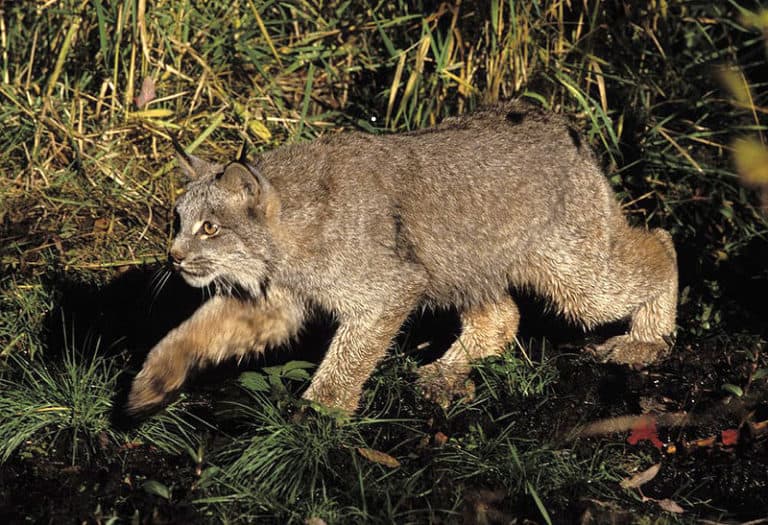
The Canada lynx is one of the biggest wild cats in North America, but other species of these cats also inhabit Europe and Asia. The lynx is easy to spot with its huge furry paws, stubby tail, and long ear tufts. The huge paws serve as natural snowshoes to help them navigate the snowy, cold forests and mountains it calls home.
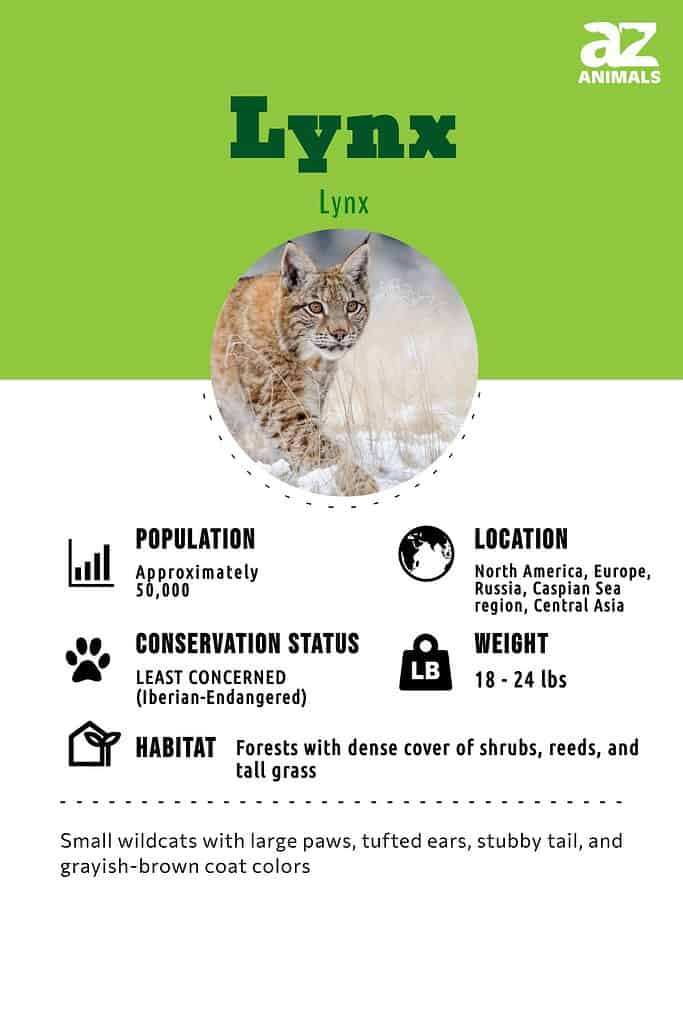
An Incredible Animal: 4 Lynx facts!

  • Lynx are solitary animals that typically only come together for mating
  • Four species of these cats are found in many places around the world, including North America, Russia, Europe, and Asia
  • The lynx is an opportunistic predator that will generally eat any prey that it is capable of killing
  • Lynx are animals that are easily recognizable by their large paws, tufted ears, stubby tail, and grayish-brown coat colors

You can check out more incredible facts about lynxes.
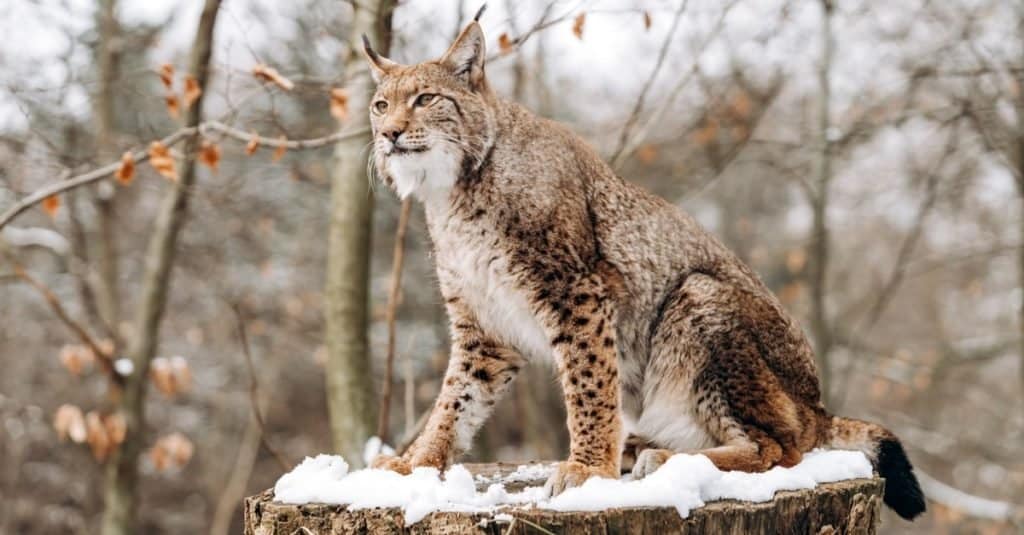
Canada Lynx sitting in a tree on a sunny day

Canada Lynx sitting in a tree on a sunny day.

Scientific name

Lynx refers to four species of stubby-tailed wild cats that live in the cold forests of North America, Europe, and Asia. All of these animals belong to the class Mammalia, the order Carnivora, the suborder Feliformia, the family Felidae, and the subfamily Felinae. The name lynx is part of the scientific name of each of the four species. It originates from an old Greek word that meant light or brightness. The term is thought to refer to the lynx’s bright, reflective eyes.

The four species of these animals are as follows:

  • Canada lynx (L canadensis) This wildcat has broad, horse-shoe like paws and dense fur for living in a snowy Canadian climate. Prefered prey is snowshoe hare.
  • Bobcat (L rufus) Native to North America and adapted to living in the warmer climates of the United States, the Bobcat lacks the tufted ears and broad paws of its Canadian cousins.
  • Eurasian lynx (Lynx) This solitary cat is nocturnal and spends the day sleeping in dense thickets. Their superior eyesight enables them to spot a mouse 250 feet away. They can be found all over Europe, Russia and into Asis.
  • Iberian lynx (L pardinus) This endanger cat once enjoyed a wider range but can only be found in Spain.

Evolution

The first mammals are believed to have lived 208 million years ago – after the extinction of dinosaurs. The first carnivores came from animals known as miacoids about 60 million years ago. These tree dwellers were about the size of a domestic cat and had developed sharp crushing teeth. Miacoids are the oldest relative to the modern-day lynx.

Carnivores split into two groups – Carniformia and Feliformia – around 40 million years ago. The Carniformia group was more bear-like and evolved into bears, dogs, weasels, raccoons, skunks, badgers, sea lions, walruses, and seals. Feliformia was more cat-like and evolved into cats, hyenas, and mongooses.
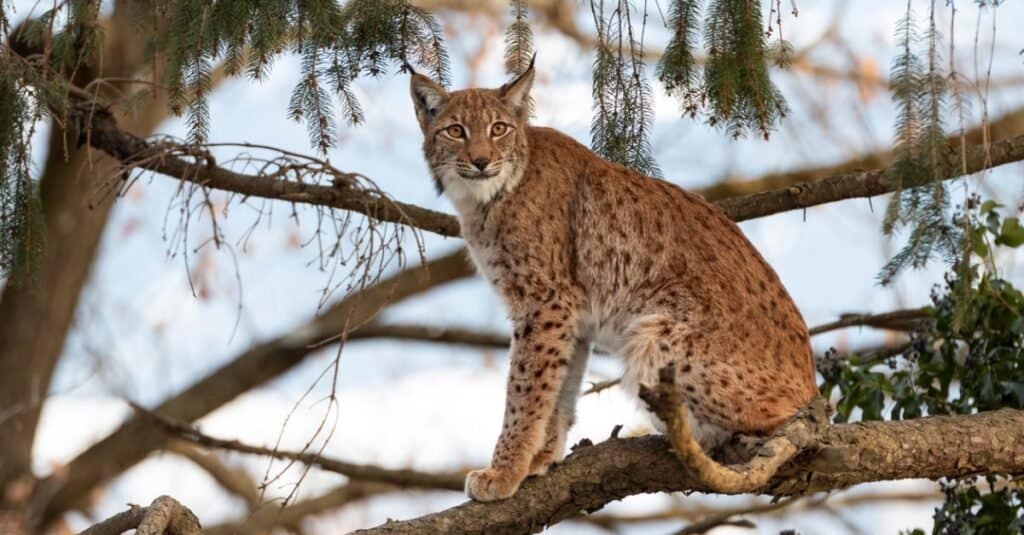
eurasian lynx sitting in tree

The Eurasian Lynx entered North America across the Bering Strait Land Bridge about 2.5 million years ago.

Proailurus, the oldest cat, appeared in France 30 million years ago. This aboreal creature weighed around 25 pounds and had eight more teeth than modern cats. 20 Million years ago, the direct ancestor of modern cats, Pseudaelurines, was found in the fossil record. Around 1.6 million years ago, the saber-tooth tiger, Smilodon, was found in fossil records discovered in the La Brea tar pits in California. These big cats became extinct around 10,000 years ago.

The oldest lynx remains, approximately four million years old, were found in Africa. The ancestor of the four lynx species is believed to be Lynx issiodorensis, which was distributed all over the northern hemisphere. The Eurasian Lynx entered North America across the Bering Strait Land Bridge about 2.5 million years ago. The different lynx species evolved to suite their environments – resulting in the four species that exist today.
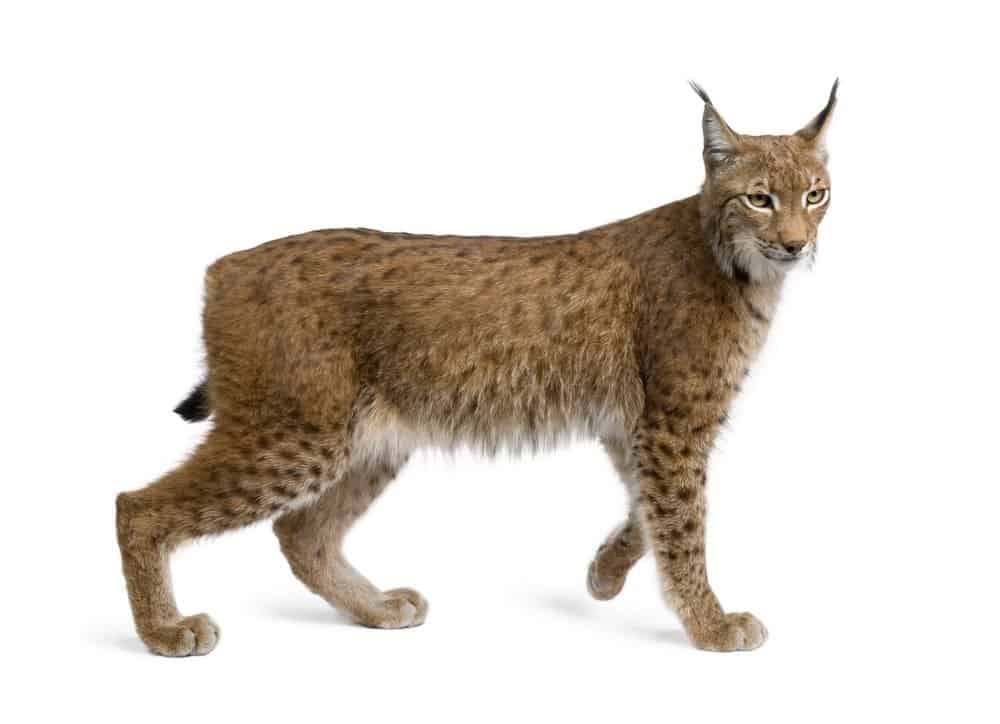
Eurasian Lynx, lynx lynx, 5 years old, standing in front of white background, studio shot

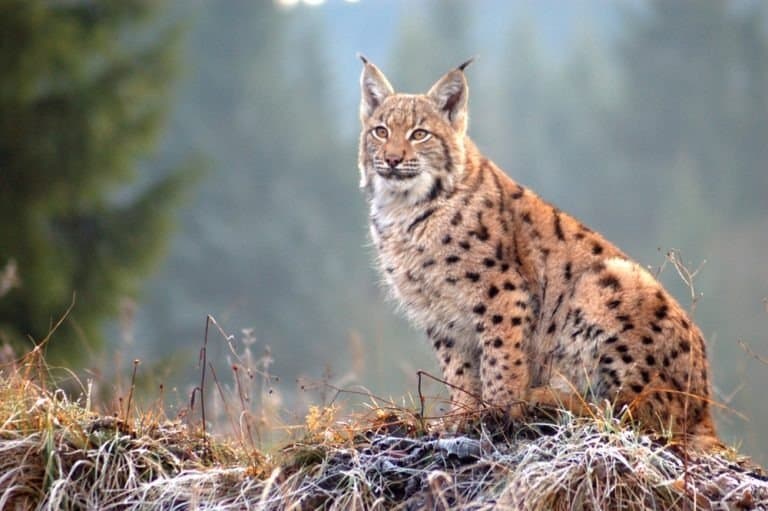
The most notable features of lynx are their huge paws, tufted ears, and stubby tail.

Appearance

The most notable features of these cats are their huge paws, tufted ears, and stubby tail. The color of the animal varies depending on the species. The body color follows a gradient of medium brown to golden brown to as light as grayish-white. A furry ruff is found in all species. It’s usually marked with black bars that look like a bowtie, but it’s not always visible. All species have white fur on the undersides of their bodies.

The size and weight of the animal depend on the species. The Eurasian lynx is the largest with males weighing between 40 and 66 pounds. It stands roughly 27 inches at the shoulder. The Canada lynx weighs between 18 and 31 pounds and stands between 19 and 22 inches at the shoulder. The Iberian lynx weighs 28 pounds for males and 20 pounds for females. Height varies between 23 and 27 inches at the shoulder. The bobcat weighs between 16 and 30 pounds and stands between 20 and 24 inches at the shoulder.

Bobcats are technically part of the lynx species, but they look a bit different compared to the other three species. They typically do not have long ear tufts, and their paws aren’t as obviously large and padded due to their common habitat in warmer climes. The bobcat’s scientific name, rufus, alludes to its reddish-brown coloring, and it often has prominent black spots as well.
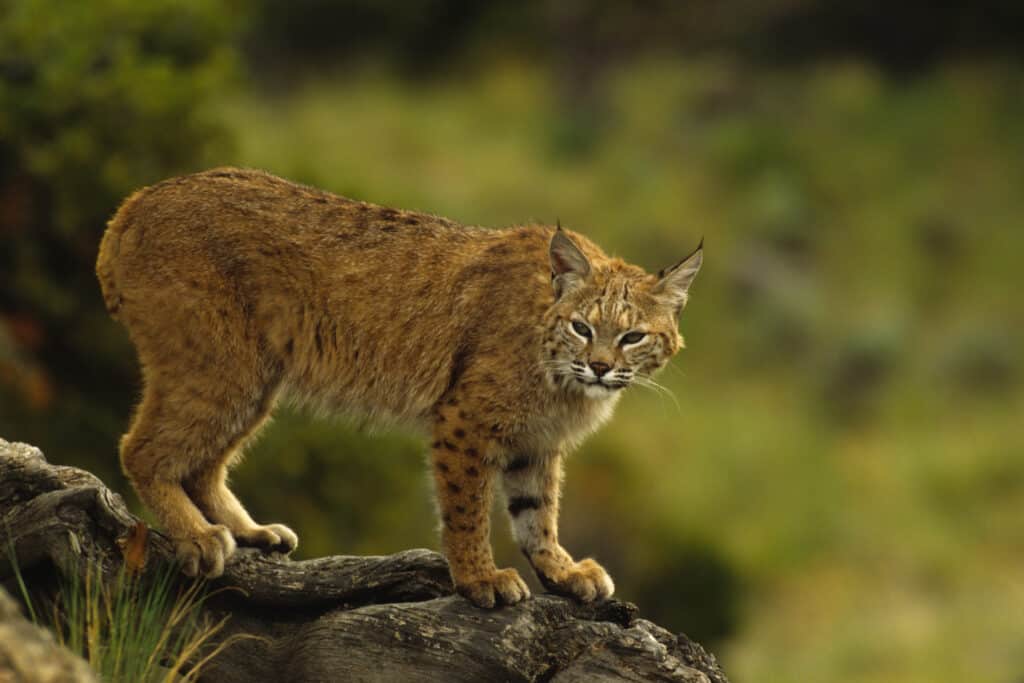
bobcat

Bobcats typically do not have long ear tufts, and their paws aren’t as obviously large and padded due to their habitat in warmer climes.

Behavior

These cats are typically solitary animals. Rarely, small groups of these cats will travel together and hunt prey. They usually live in dens burrowed into ledges or rocky crevices. This is where they raise their kittens as well. A lynx won’t usually take its food back to its den unless it is a mother that needs to feed her kittens. These animals are very stealthy and good at avoiding human settlements, which is why they’re rarely seen.

Habitat

Most species roam high-altitude forests that offer plenty of protection with dense shrubs, trees, and tall grass. Even though this wild cat generally hunts on the ground, it’s fully capable of climbing trees and swimming. The Eurasian lynx lives in central and northern Europe and over to India, northern Pakistan, and Iran near Mount Damavand. This species is most commonly found in northern European countries like Norway, Finland, and Sweden as well as most of Russia.

The Iberian lynx is far rarer and lives only in the southern parts of Spain. It used to live in eastern Portugal as well but became extinct there.

The Canada lynx mainly lives in Canada and Alaska but is also found in some northern US states like Washington, Montana, and Maine. Its habitat is primarily boreal forests, which are also known as snow forests and consist largely of coniferous trees.

The bobcat ranges further than the Canada lynx. It is found in southern Canada, most of the continental United States, and as far south as northern Mexico. It lives in both forests and grasslands.
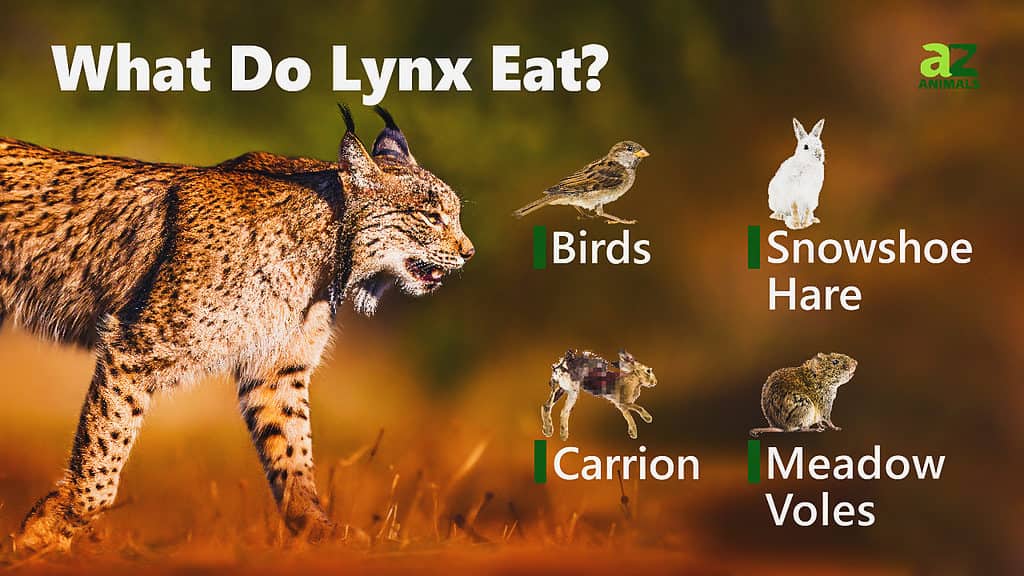
Diet

This animal is an opportunistic predator and can hunt a wide range of animals. It is a strict carnivore. The Canada lynx strongly prefers the snowshoe hare, and its population numbers fluctuate with the availability of the hare. However, it will also hunt fish, squirrels, rabbits, birds, grouse, turkey, and more. The larger Eurasian lynx often hunts larger animals such as deer, reindeer, and even elk.
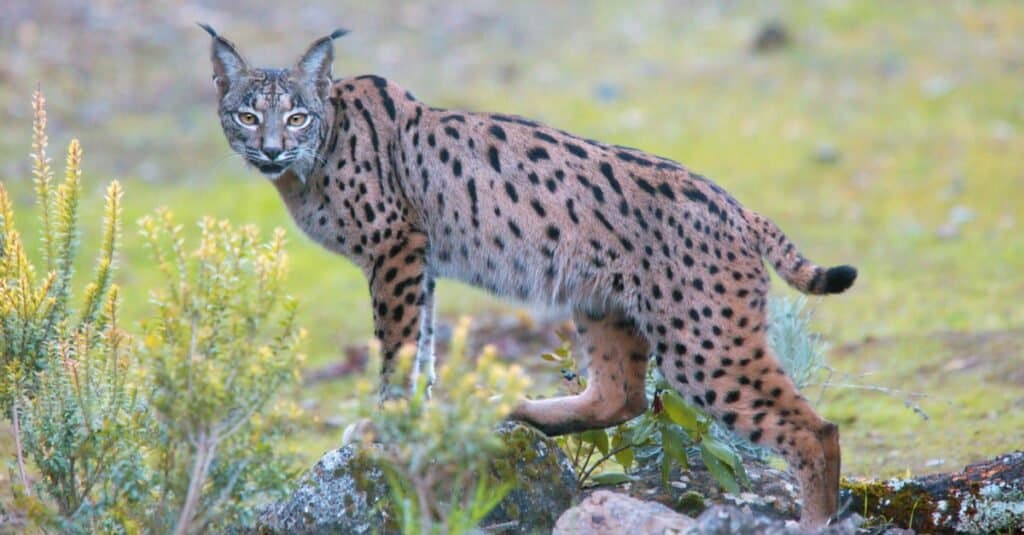
Types of wild cats - Iberian Lynx

The Iberian Lynx is the most threatened of these cat species. In 2004, only 100 animals lived in southern Spain.

Predators and threats

These animals are primarily threatened by other predators larger than it as well as humans. The Eurasian lynx is one of the largest predators in Europe, with only the gray wolf and brown bear being larger. In North America, the cougar, gray wolf, and coyote pose threats to the lynx. Humans have often hunted lynx for their fur, but some species are now protected, depending on the region. The Eurasian and Canadian lynx are most vulnerable to loss of habitat. Both are also dependent on prey numbers remaining healthy. The bobcat is the least endangered of all lynx species, and its numbers remain well into the hundreds of thousands despite being actively hunted by humans.

The Iberian lynx is the most threatened of these cat species. In 2004, only 100 animals lived in southern Spain. Thanks to conservation efforts by the Spanish government, they have somewhat recovered. As of 2014, over 300 animals were found in the same area.
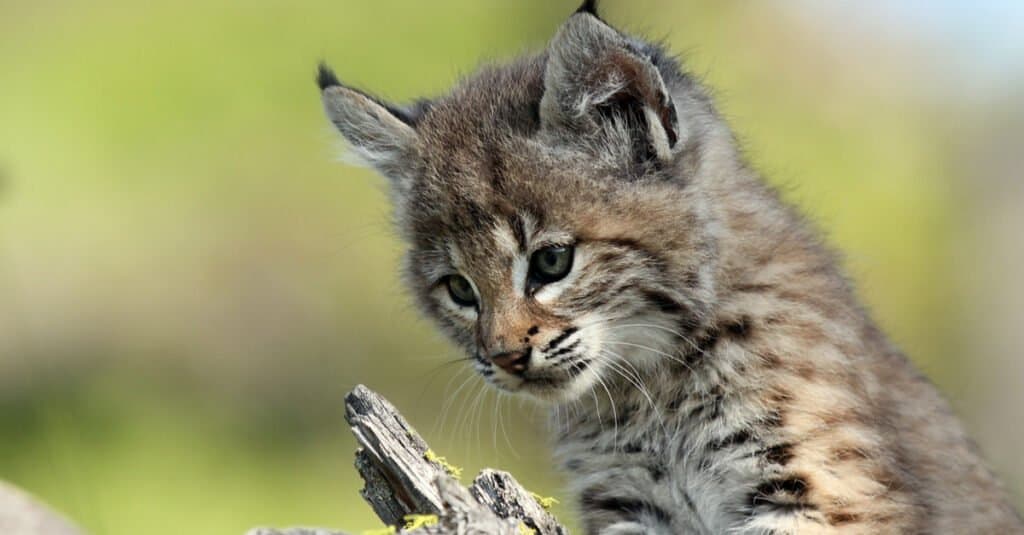
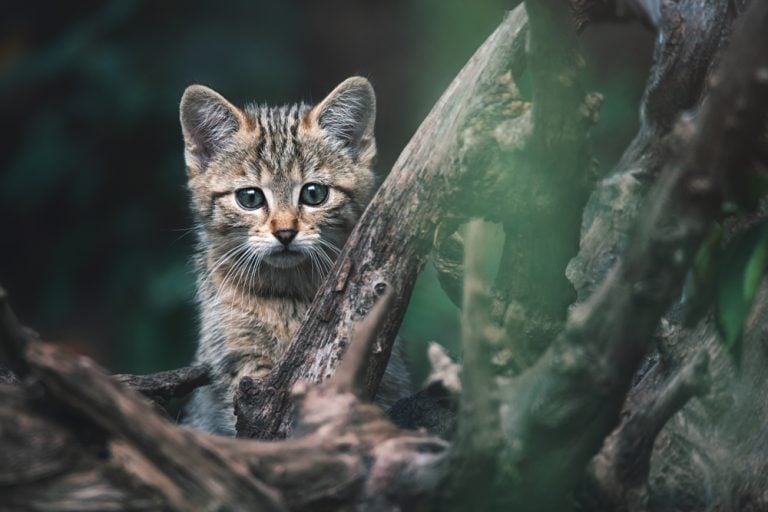
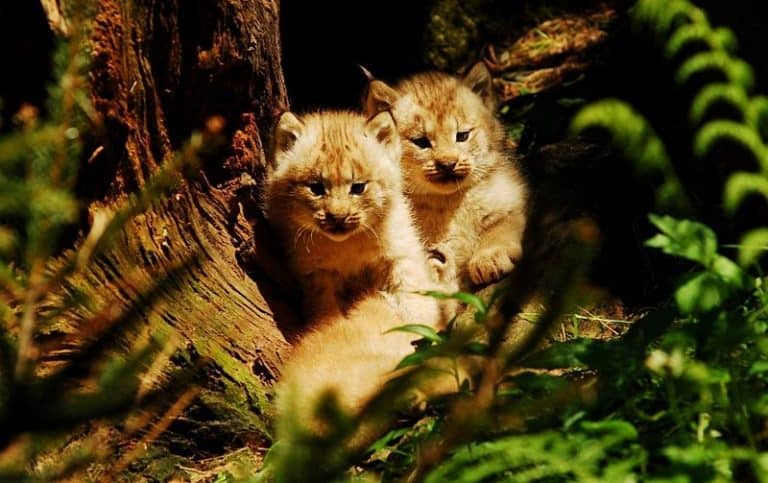
baby lynx closeup

Lynx kittens weigh between 6.2 and 8.3 ounces at birth and do not open their eyes for 14 days.

Reproduction, Babies, and Lifespan

The Eurasian lynx mates between January and April with the female having one oestrus period for four to seven days during this time. Males make deep growls to alert potential mates to their presence, while females make softer meow sounds. Pregnant females looking for secret locations to build their nests, which are often in caves or dens. Gestation lasts between 67 and 74 days and usually results in two kittens. Three or more lynx in a litter are rare. These baby lynxes -or kittens -are between 8.5 and 15.2 ounces. They are covered in grayish-brown fur and gain full adult color by 11 weeks. Their eyes open after about 10 days. They can eat solid food at around six weeks but are not fully weaned until at least five months. The mother lynx leaves the den at two or three months after birth, and the kittens accompany her until they reach 10 months.

The Canada lynx has a one-month mating season between March and April. Mating calls and marking with urine are typical matings behaviors. Gestation is between two and three months and the resulting litter can be one kitten or as many as eight. Litter sizes appear to vary depending on the availability of prey. The kittens weigh between 6.2 and 8.3 ounces and do not open their eyes for 14 days. These kittens also leave their mothers around 10 months.
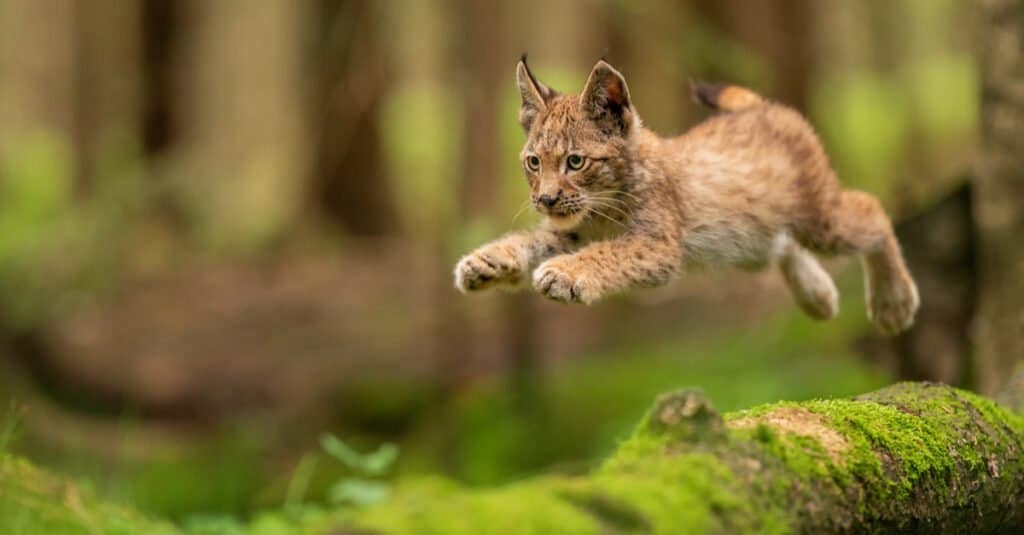
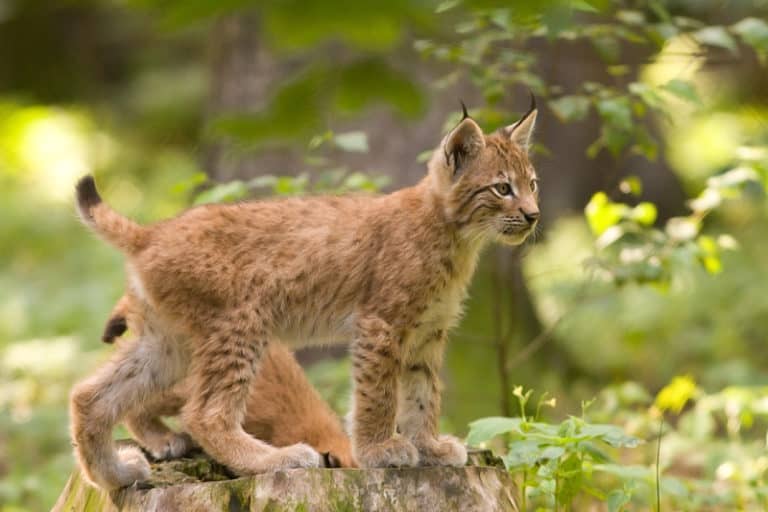
baby lynx pouncing

This baby lynx is learning to pounce.

The Iberian lynx litter is born between March and September after a two-month gestation period. The majority of births are in March and April. These kittens weigh between 7 and 8.8 ounces. By 10 months, the kittens are mostly independent, but many remain with the mother until about 20 months of age. They are known to get into violent fights with each other, which often leads to death. This starts to happen between 30 and 60 days of age.

Bobcats usually mate between February and March. A male bobcat will travel with one female and mate with her several times. The female bobcat will raise the kittens alone after birth. Bobcat litters generally consist of two to four kittens but can be as many as six. Gestation lasts 60 to 70 days, and usually results in an April or May birth. Bobcat kittens open their eyes around nine days and are weaned by two months. Between three and five months of age, they begin to leave the den and travel with the mother bobcat.

The Eurasian lynx has lived up to 21 years in captivity. The Canada lynx is known to live up to 27 years in captivity and between 10 and 16 years in the wild. The bobcat lives between 7 and 10 years in the wild, with one notable exception being 16 years. In captivity, the oldest bobcat lived 32 years. Iberian lynx have a maximum wild lifespan of 13 years.
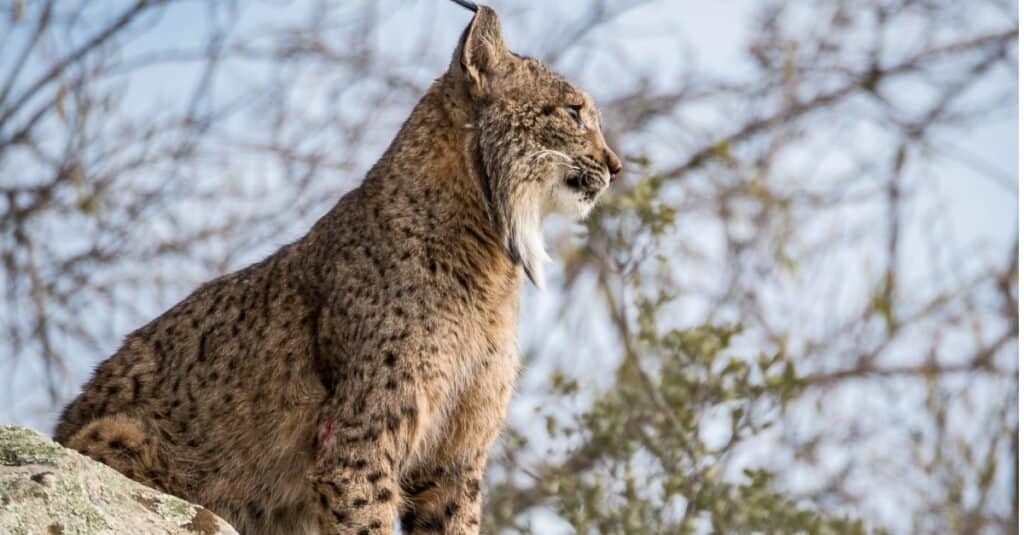
Iberian lynx looking out sitting on rock

The Iberian lynx has an endangered conservation status.

Population

The Canada and Eurasian lynx and bobcat have a conservation status of least concern. The Iberian lynx is considered endangered. As of 2015, 400 Iberian lynx live on the Iberian peninsula. The United States population of bobcats is estimated to be several hundred thousand. The Eurasian lynx population is thought to be around 45,000 and is considered generally stable. The Canada lynx population is also stable and is thought to be in the tens of thousands.

In the Zoo – Where to Find the Lynx

The Canada lynx and the bobcat are the most common of these cats in United States zoos. They are easily found in zoos all over the country, including the following:
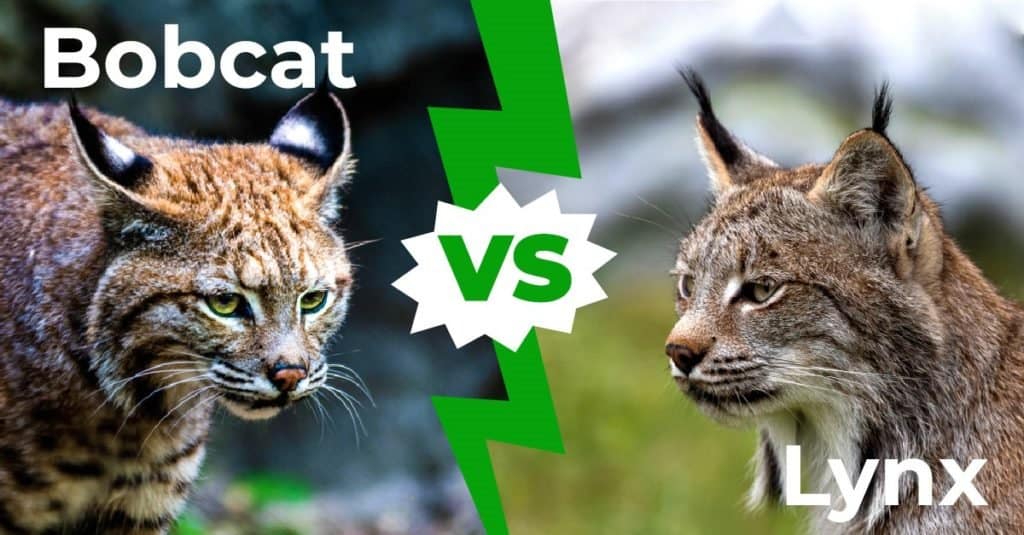
bobcat vs lynx
The bobcat doesn’t have huge paws or long ear tufts like the lynx.

Lynx vs. Bobcat

The bobcat is a species of lynx, but its appearance is easily distinguishable from the Canada lynx, with which it shares some range. The bobcat typically has prominent black spots and tawny fur. Its fur is also less thick, and it doesn’t have long ear tufts or the huge paws of a Canada lynx. The bobcat is found in nearly any type of habitat and ranges over the entire United States and southern parts of Canada. The Canada lynx is mostly found in snow forests in Canada and parts of the northern U.S.

View all 131 animals that start with L
How to say Lynx in ...
Bulgarian
Рис
Catalan
Linx nòrdic
Czech
Rys ostrovid
German
Eurasischer Luchs
English
Eurasian Lynx
Esperanto
Linko
Spanish
Lince europeo
Estonian
Ilves
Finnish
Ilves
French
Lynx d'Eurasie, Lynx commun
Croatian
Obični ris
Italian
Lince europea
Hebrew
שונר צפוני
Japanese
ヨーロッパオオヤマネコ
Latin
Lynx lynx
Hungarian
Eurázsiai hiúz
English
Eurasisk gaupe
Dutch
Euraziatische lynx, Los
Polish
Ryś
Portuguese
Lince-da-Eurásia
English
Râs
Slovenian
Evrazijski ris
Swedish
Europeiskt lodjur
Turkish
Bayağı vaşak
Chinese
猞猁屬

Sources

  1. David Burnie, Dorling Kindersley (2011) Animal, The Definitive Visual Guide To The World's Wildlife / Accessed November 10, 2008
  2. Tom Jackson, Lorenz Books (2007) The World Encyclopedia Of Animals / Accessed November 10, 2008
  3. David Burnie, Kingfisher (2011) The Kingfisher Animal Encyclopedia / Accessed November 10, 2008
  4. Richard Mackay, University of California Press (2009) The Atlas Of Endangered Species / Accessed November 10, 2008
  5. David Burnie, Dorling Kindersley (2008) Illustrated Encyclopedia Of Animals / Accessed November 10, 2008
  6. Dorling Kindersley (2006) Dorling Kindersley Encyclopedia Of Animals / Accessed November 10, 2008
  7. David W. Macdonald, Oxford University Press (2010) The Encyclopedia Of Mammals / Accessed November 10, 2008
  8. National Geographic / Accessed November 18, 2020
  9. The Nature Conservancy / Accessed November 18, 2020
  10. Britannica / Accessed November 18, 2020
  11. Wikipedia / Accessed November 18, 2020
  12. Find an Answer / Accessed November 18, 2020
Lisha Pace

About the Author

Lisha Pace

After a career of working to provide opportunities for local communities to experience and create art, I am enjoying having time to write about two of my favorite things - nature and animals. Half of my life is spent outdoors, usually with my husband and sweet little fourteen year old dog. We love to take walks by the lake and take photos of the animals we meet including: otters, ospreys, Canadian geese, ducks and nesting bald eagles. I also enjoy reading, discovering books to add to my library, collecting and playing vinyl, and listening to my son's music.

Thank you for reading! Have some feedback for us?


Lynx FAQs (Frequently Asked Questions)

A lynx is a medium-sized wild cat that lives in North America, Russia, parts of Europe, and parts of Asia.