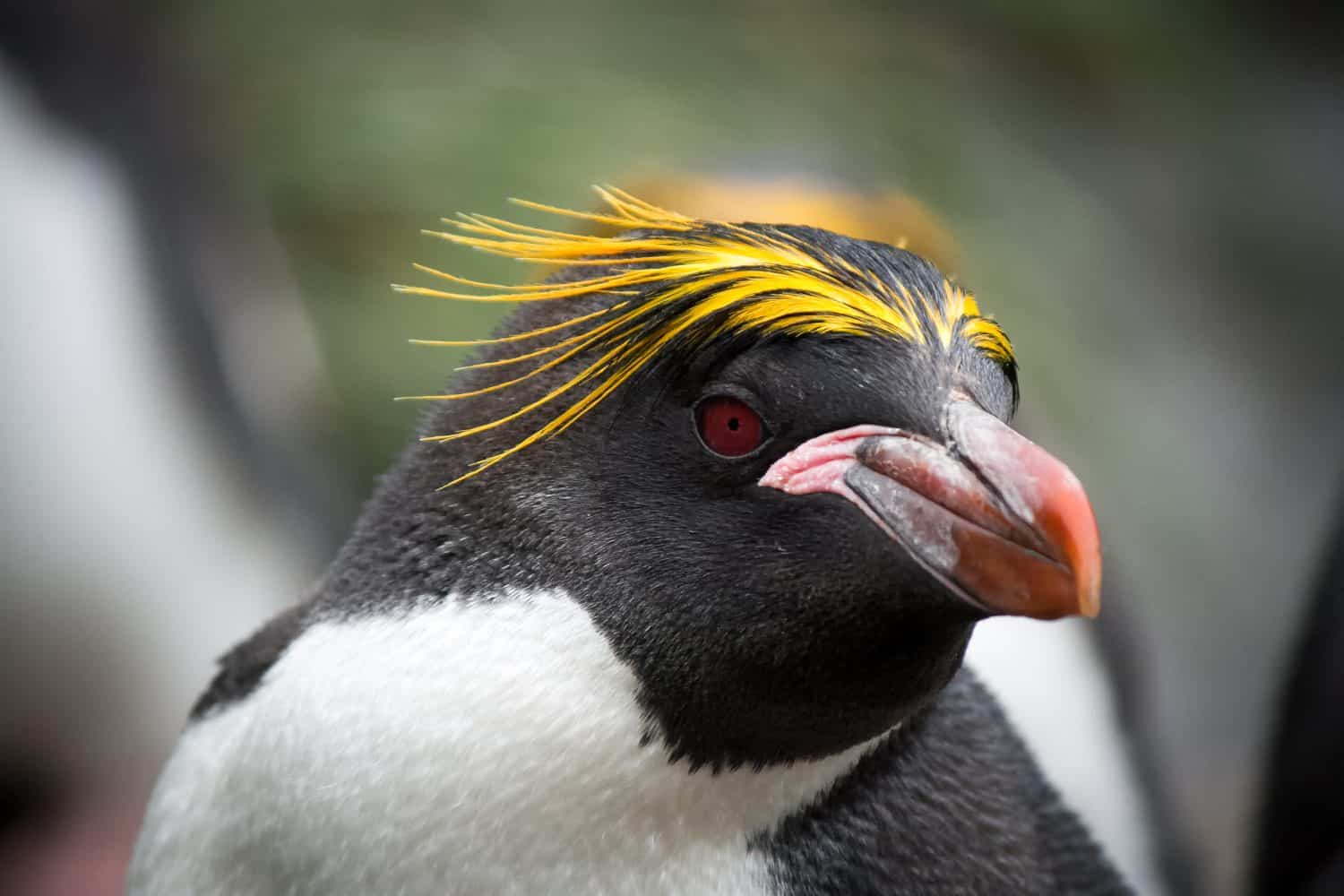
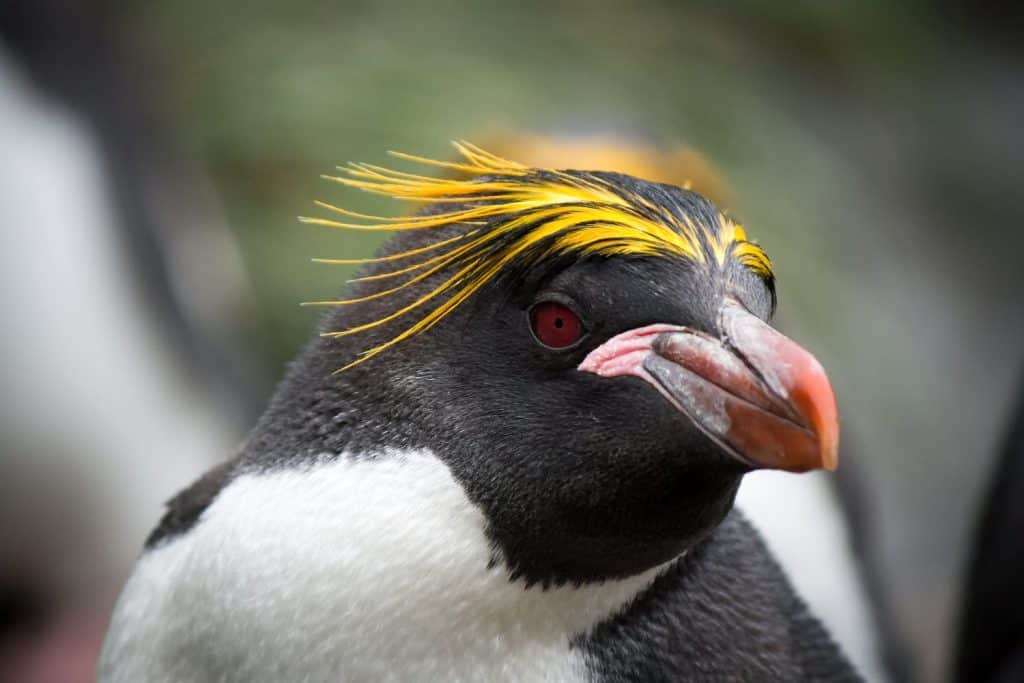
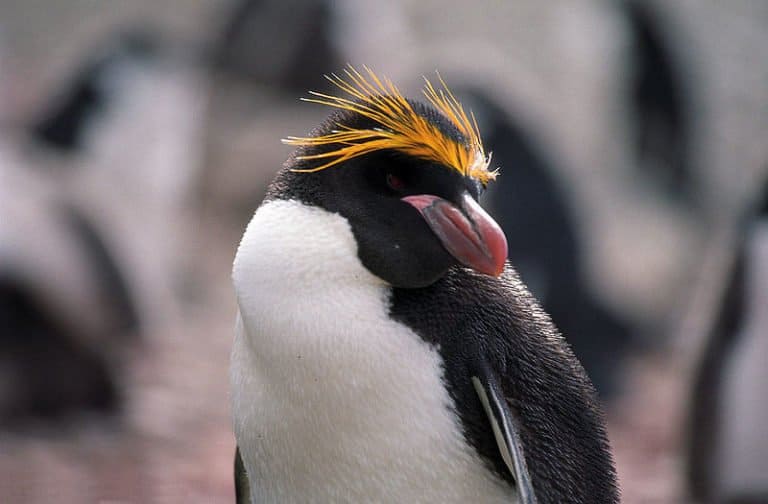
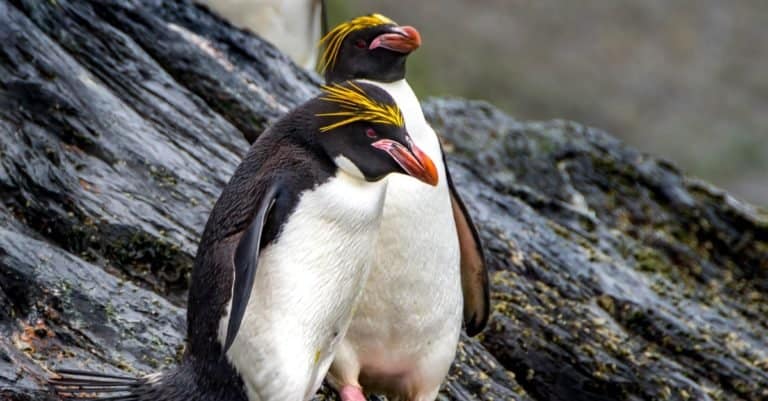
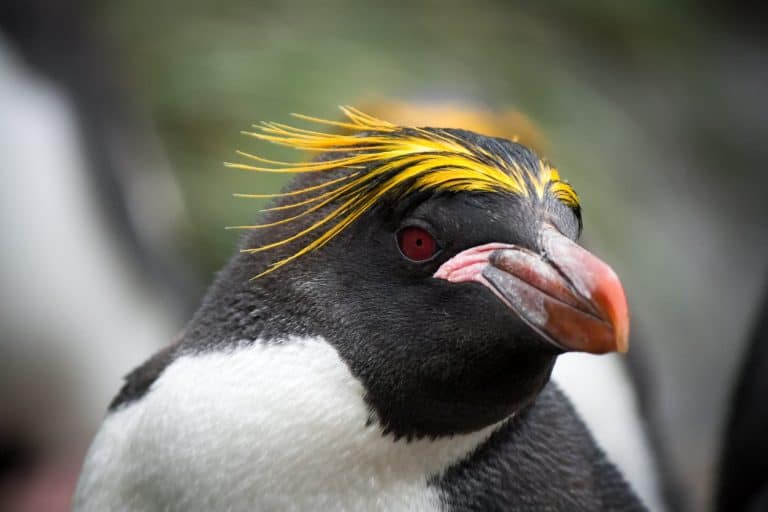

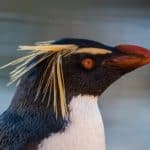
Macaroni penguins are found in the sub-Antarctic and on the Antarctic Peninsula. They eat krill, fish, squid, and some crustaceans. These birds live in huge groups that include hundreds of thousands of penguins. They are black and white with a bright orange crest, or tuft of feathers, on their head. The official conservation status of macaroni penguins is vulnerable.
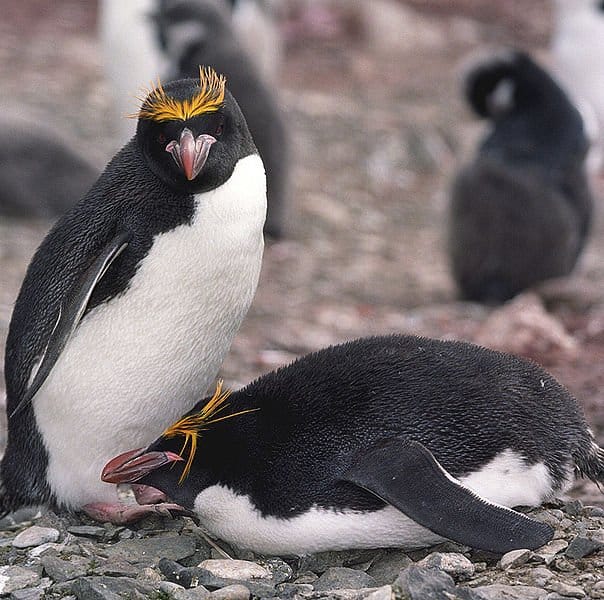
Macaroni penguins swallow tiny stones to aid in the digestion of shellfish.
Evolution
Fossil records indicate that macaroni penguins’ common ancestors lived as long as 40 million years ago and were around five feet tall. They are believed to have originated in Antarctica, which was covered in forests at that time and connected to what would become New Zealand, Australia, South America, and the surrounding islands. These ancient ancestors of penguins had diverged from the ancestors of petrels and albatrosses around 71 million years ago.
The ancestors of the macaroni penguin swam to newly formed islands around Antarctica after the continents formed.
The arrival of the ice age 35 million years ago brought brutal changes to the ancient ancestors of the penguin. The continents of Australia and South America drifted away from Antarctica while ocean currents encircled it.
While most of the ancient penguins became extinct, others, like the macaroni penguin, swam to warmer waters to found new lineages. Species like the emperor penguin stayed in Antarctica and evolved adaptations suited to live in the cold environment.
Scientific Name
The scientific name of the macaroni penguin is Eudyptes chrysolophus. The word eudyptes is Greek, meaning ‘good diver,’ and chrysolophus means ‘golden’ and ‘crest.’ This bird belongs to the Spheniscidae family and the class of Aves.
Its common name came about because of its colorful crest. In the 18th century, sailors who saw this unique penguin started to refer to it as a macaroni. Macaroni was a slang word used for someone who dressed in a flashy, colorful way. Also, the bird reminded them of the man in the song “Yankee Doodle” who “…stuck a feather in his cap and called it macaroni…”
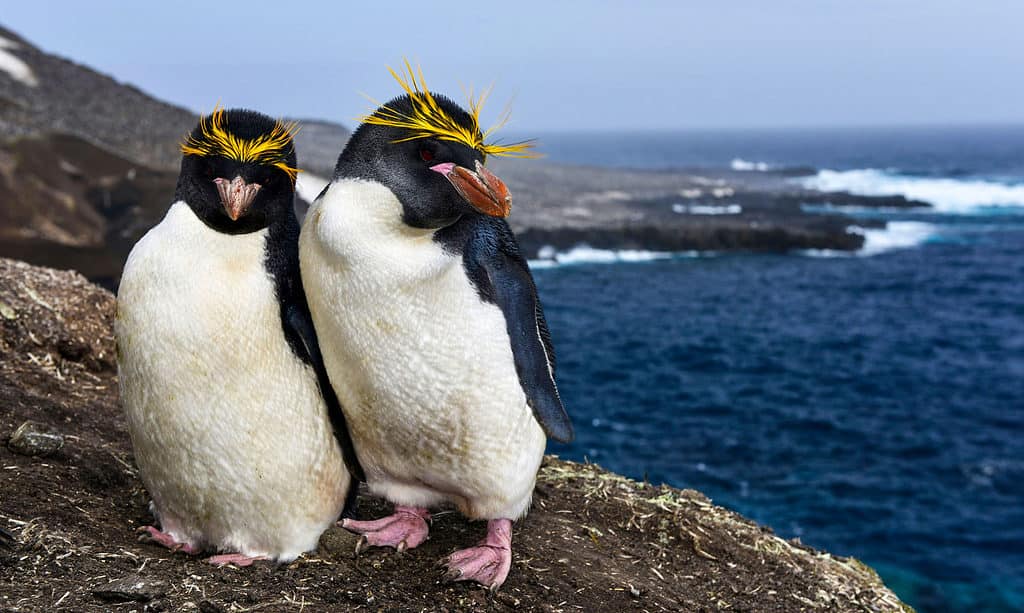
Macaroni penguins were named for a line from the song, “Yankee Doodle.”
©Vladimir Strnad/Shutterstock.com
Appearance
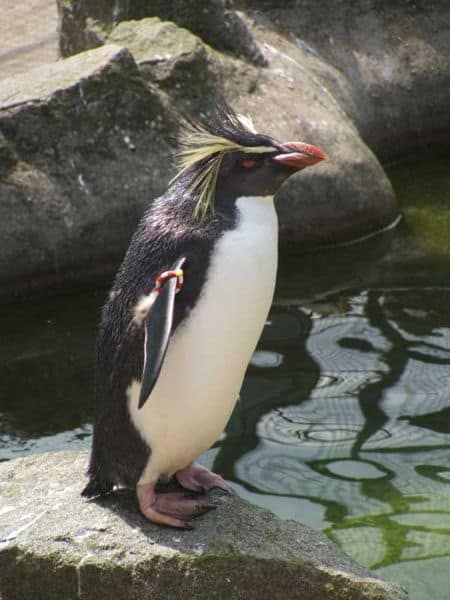
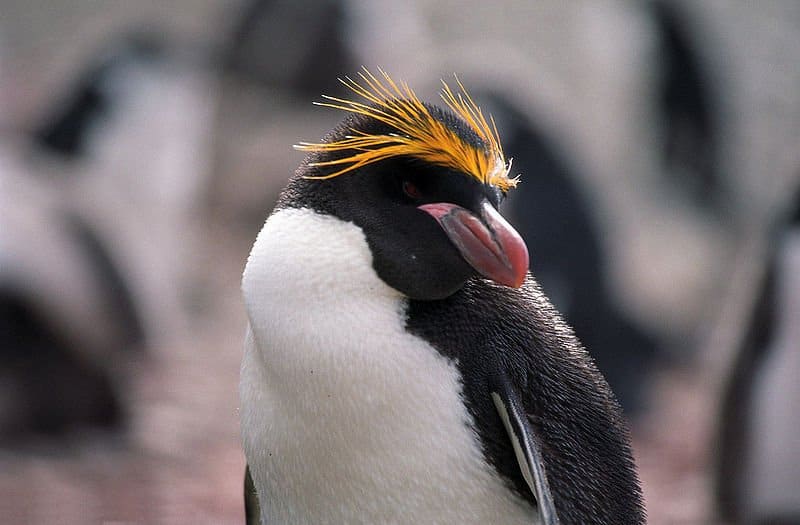
These penguins have the traditional penguin tuxedo look of white feathers on their chest as well as black feathers on their back, neck, and head. In addition, it has a red bill and a crest of orange feathers on its head. This penguin is very similar in appearance to the royal penguin. The macaroni penguin is one of a group of six penguins with a crest, including the Fiordland crested penguin, the southern rockhopper penguin, the Snares penguin, the Erect-crested penguin, and the northern rockhopper penguin.
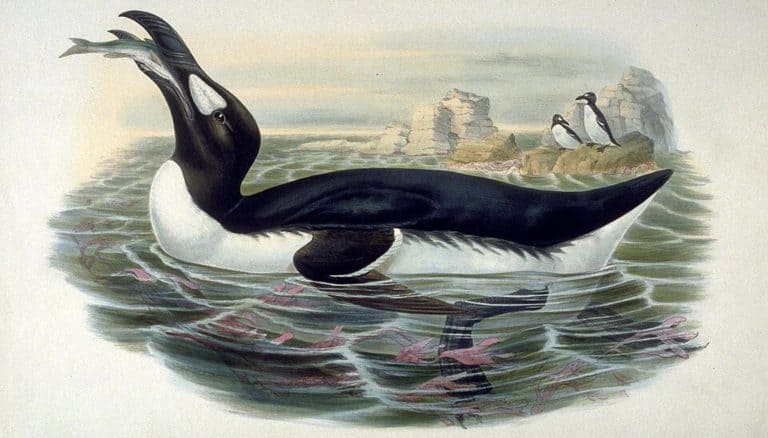
Puffins, auks, and murres are very similar to macaroni penguins in appearance. Plus, all of these birds can swim and dive. However, puffins, auks, and murres can fly, whereas macaroni penguins cannot.
These medium-sized penguins grow to be 20 to 28 inches tall and weigh an average of 12 pounds. For reference, a 20-inch-tall penguin is just a few inches taller than a bowling pin, and a 12-pound penguin weighs the same as a gallon can of paint.
These penguins spend part of their time in the ocean. They have webbed feet that help them swim as well as a tail that serves as a rudder, steering them in the direction they want to go. When macaroni penguins are on land, they have to navigate rocky terrain, sandy areas, and cliffs. Their webbed feet also give them the ability to hop or walk over slippery rocks.
A macaroni penguin’s vision isn’t very good on land, although these birds can see very well while swimming in the ocean. In fact, they use their excellent underwater vision to spot and avoid predators like leopard seals and killer whales. They can also dive deep into the ocean to escape some predators.
The bones of macaroni penguins are solid instead of hollow, allowing them to dive deep into the ocean when it needs to. Furthermore, these birds can stay underwater for 2 or 3 minutes before having to resurface to take a breath. They have a layer of fat that keeps them warm in the Antarctic climate, and their feathers are designed to allow water to pour off them when they get out of the frigid water instead of absorbing the moisture. Penguins can puff up their feathers, allowing air under them to circulate and create more warmth.
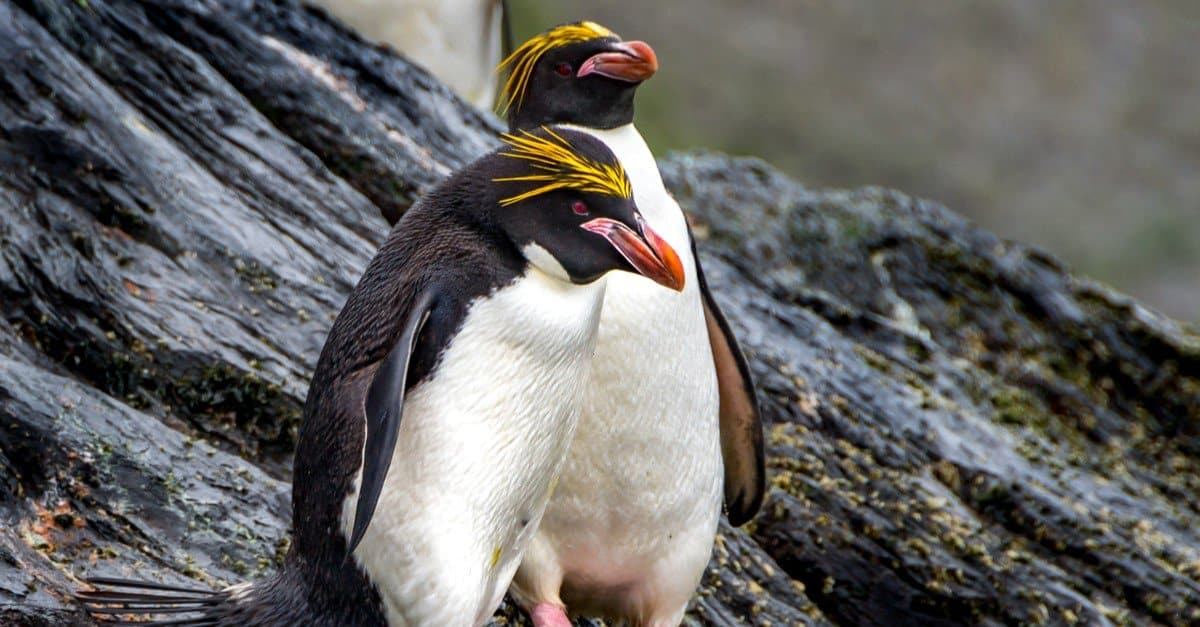
Macaroni penguins can often be seen bonding by grooming each other.
©Tetyana Dotsenko/Shutterstock.com
Behavior
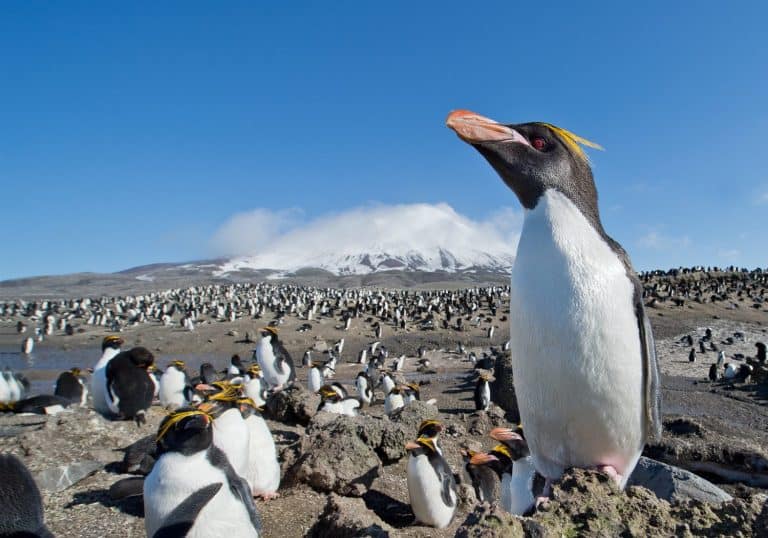
Macaroni penguins live in groups called colonies. Some colonies contain more than 100,000 penguins. Living in large groups is another way these birds are protected from predators. If a seal invades the colony, most of the penguins will be able to escape it.
These penguins are also aggressive and loud. They communicate in barks, chirps, yelps, and brays. Oftentimes, male penguins fight with one another by locking beaks and flapping their wings as they move through each other’s territory. They don’t treat strange penguins in a friendly way. So, it’s not uncommon to see a penguin moving through a colony with its head tucked into its chest. This pose delivers the message that the penguin doesn’t want to interact or fight with any others around it.
You’d think it would be challenging for a penguin to find its family in a colony containing thousands of penguins that are moving around and making noise. But, it turns out, it’s not a challenge at all. In order to find family members in a large colony, penguins listen to the unique sounds made by their relatives.
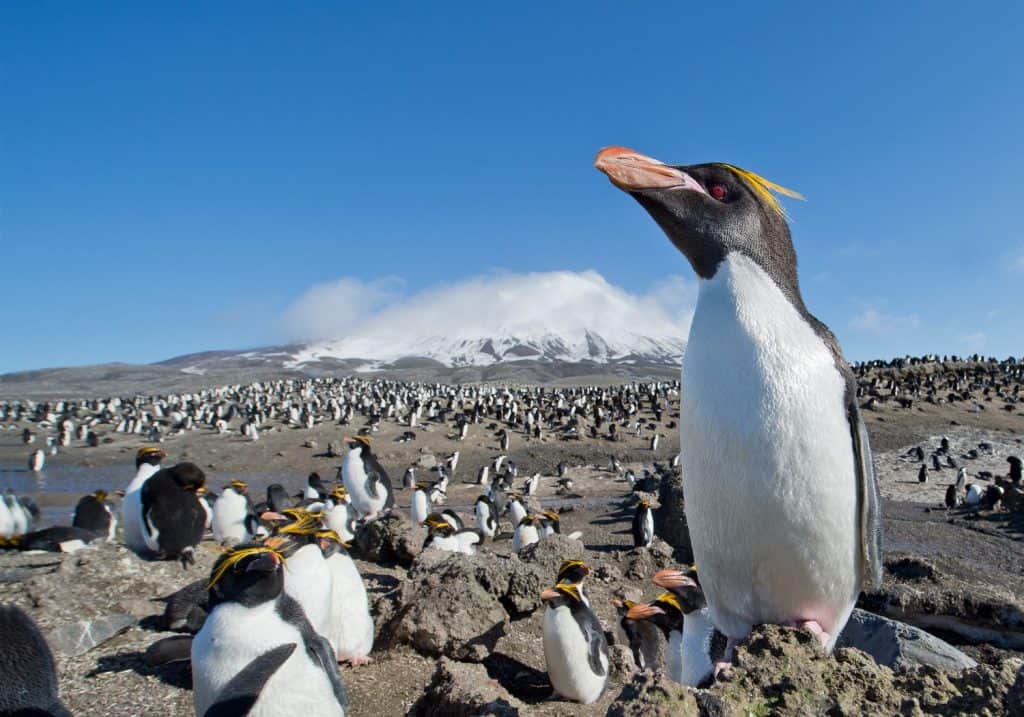
Macaroni penguins live in the sub-Antarctic and on the Antarctic Peninsula.
©MZPHOTO.CZ/Shutterstock.com
Habitat
The macaroni penguin habitat consists of the sub-Antarctic and the Antarctic Peninsula. Specifically, many are found in the South Shetland Islands, the Falkland Islands, the Crozet Islands, and the South Sandwich Islands.
Macaroni penguins migrate to land during the breeding season, starting the month of October, to join a large colony of breeding pairs of penguins. After laying eggs in November, a male and female pair stay on land with their babies until April or May. Afterward, they return to the ocean until it’s breeding time again.
Diet
What do macaroni penguins eat? These penguins are carnivores, so they eat marine animals such as krill, small fish, squid, and crustaceans. To eat krill and other sea life with a hard outer shell, macaroni penguins swallow tiny stones to help them grind up the shells to digest them. Other penguins do this as well.
Though macaroni penguins eat a variety of prey, krill is the main item in their diet. In fact, scientists believe that out of all the types of sea birds, macaroni penguins eat the largest amount of krill. They eat tons of these small creatures each year. For reference, a car weighs two tons, so just imagine how much krill that would be!
Predators and Threats
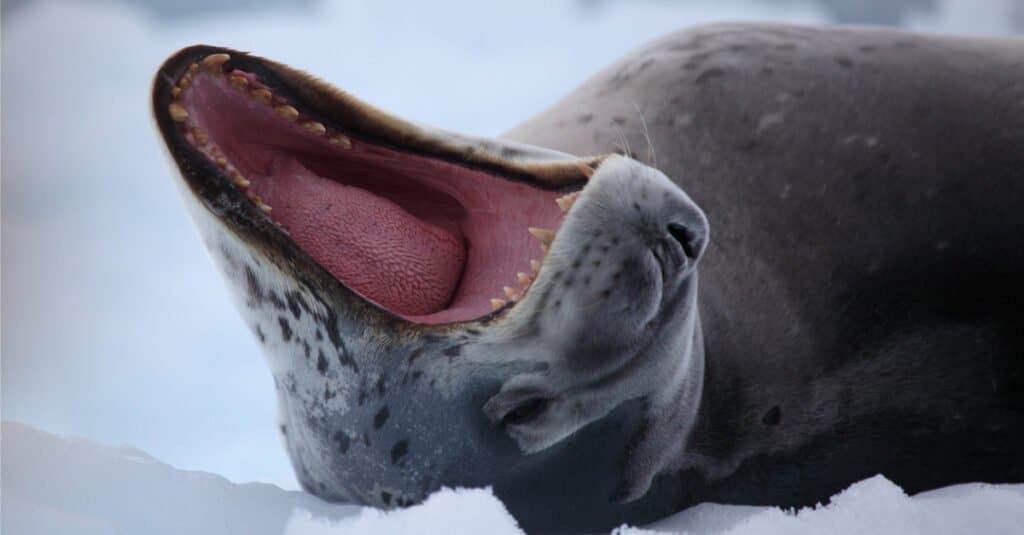
Leopard seals prey on macaroni penguins.
©iStock.com/MogensTrolle
Leopard seals and other types of seals, as well as killer whales, are predators of macaroni penguins. These creatures have enough speed and strength to capture macaroni penguins while they’re swimming in the ocean or trying to get from the ocean up onto the rocky beach.
The eggs laid by macaroni penguins are also vulnerable to sea birds, such as petrels and skuas. This penguin’s nest is very shallow, so the eggs are especially visible to these and other birds as they fly over.
Humans are a danger to these penguins as well. They can become entangled in the nets of fishermen who are out to capture other types of wildlife. Oil pollution in the ocean waters is another threat to the health and population of macaroni penguins.
The official conservation status of these penguins is Vulnerable. Scientists believe they’re decreasing in number due to environmental pollution.
Reproduction, Babies, and Lifespan
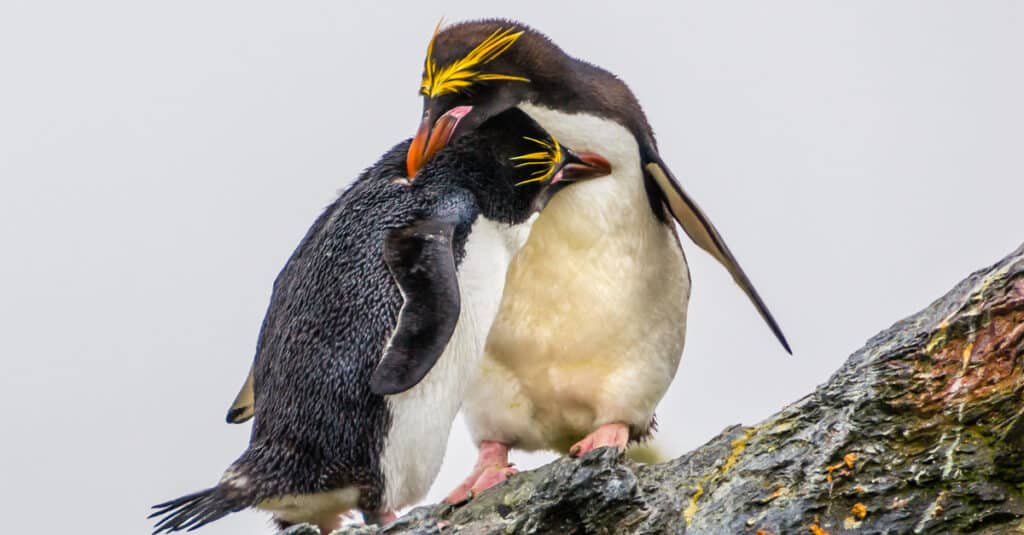
Males engage in courtship rituals to woo female macaroni penguins.
©Tetyana Dotsenko/Shutterstock.com
At about age five or six years of age, male and female penguins gather onshore in a colony to breed. This usually happens in October, which is summer in the Antarctic. Male penguins bow their heads, move from side to side, and bark to capture the attention of females. If a male and female have been to the breeding ground before, they will look for the same partner the next time.
The female lays two eggs in early November. Both the male and female watch over the eggs until they hatch 33 to 37 days later. The newborn babies weigh just a few ounces.
Baby penguins are known as chicks or nestlings. They don’t have all of their feathers when they are born, so the penguin parents have to work hard to keep the babies warm until their feathers grow. They move very little until they are older, but can see around them. These penguins aren’t born with their orange/yellow crest. Their crest doesn’t fully develop until a penguin is 3 or 4 years old.
The male penguin continues to protect the babies from sea birds and other predators while the mother penguin feeds them. The mother penguin feeds the babies fish she’s chewed up, so they can easily digest the meal. After 25 days, a baby macaroni penguin goes to stay with other babies in the colony to continue to grow for another 60 to 70 days. They keep each other warm and protected while away from the nest. At that time, they’re ready to go out into the ocean and hunt for food.
Most macaroni penguins don’t live to be more than 20 years old in the wild. However, Mickey, a macaroni penguin at the Pittsburgh Zoo, celebrated her 40th birthday in November 2024, making her one of the oldest known macaroni penguins in North America.
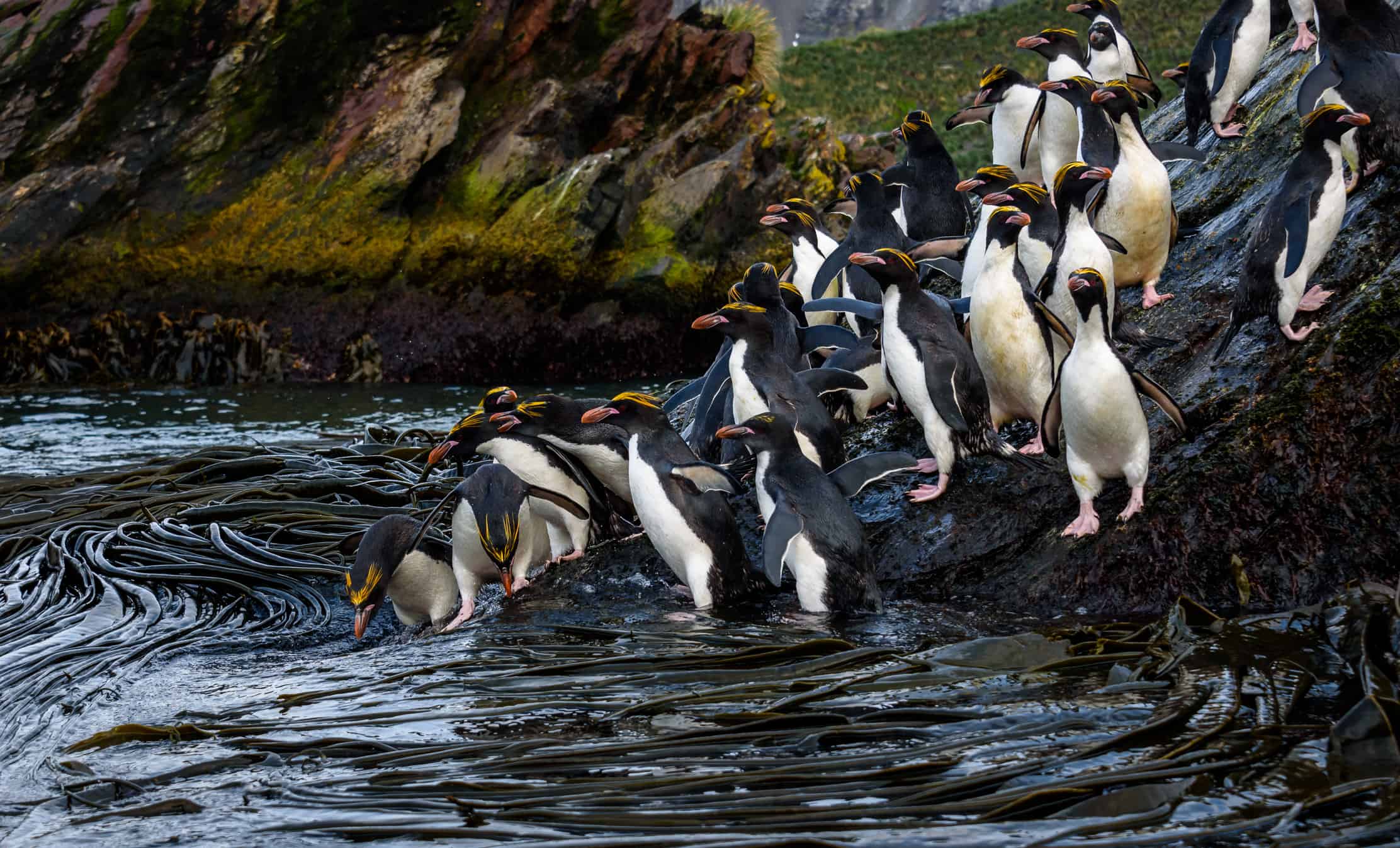
A raft of Macaroni Penguins hopping down a large rock to the seaweed and ocean for morning feeding, Coopers Bay, South Georgia.
©N8tureGrl/ via Getty Images
Population
There are estimated to be 6.3 million breeding pairs of macaroni penguins living in the world. Unfortunately, their population is decreasing due to water pollution and a decrease in their food source. Their conservation status, according to the International Union for the Conservation of Nature (IUCN), is Vulnerable. There is currently monitoring and protection in place to help the macaroni penguins, but more could be done.
Macaroni Penguin Pictures
View all of our Macaroni Penguin pictures in the gallery.

Sources
- David Burnie, Dorling Kindersley Animal, The Definitive Visual Guide To The World's Wildlife / Accessed January 18, 2010
- Tom Jackson, Lorenz Books The World Encyclopedia Of Animals / Accessed January 18, 2010
- David Burnie, Kingfisher The Kingfisher Animal Encyclopedia / Accessed January 18, 2010
- Richard Mackay, University of California Press The Atlas Of Endangered Species / Accessed January 18, 2010
- David Burnie, Dorling Kindersley Illustrated Encyclopedia Of Animals / Accessed January 18, 2010
- Dorling Kindersley Dorling Kindersley Encyclopedia Of Animals / Accessed January 18, 2010
- Christopher Perrins, Oxford University Press The Encyclopedia Of Birds / Accessed January 18, 2010