M
Species Profile

Markhor

Capra falconeri

Corkscrew kings of the cliffs
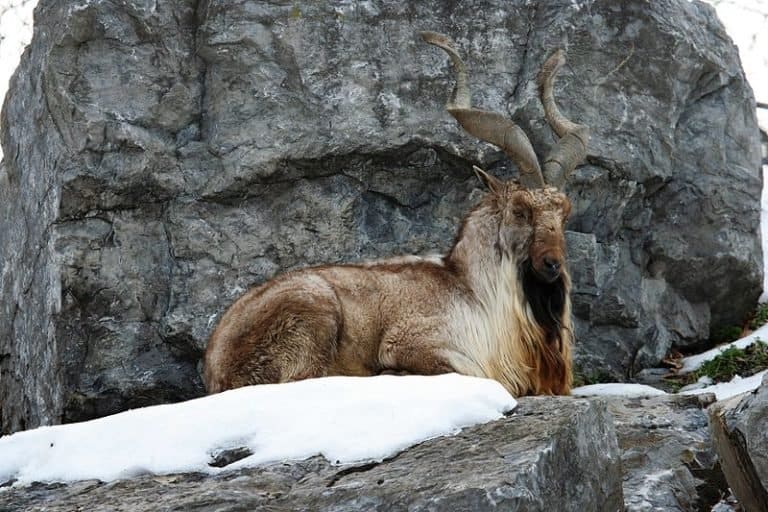
Armensl/Shutterstock.com

Markhor Distribution

Click a location to explore more animals from that region

Loading map...

Size Comparison

Human 5'8"
Markhor 3 ft 1 in

Markhor stands at 55% of average human height.

Markhor

At a Glance

Wild Species
Also Known As Screw-horned goat, Spiral-horned goat
Diet Herbivore
Activity Diurnal+
Lifespan 11 years
Weight 110 lbs
Did You Know?

A male markhor's horns can reach ~160 cm along the curve, while females' are typically ~20-30 cm (IUCN; HMW).

Scientific Classification

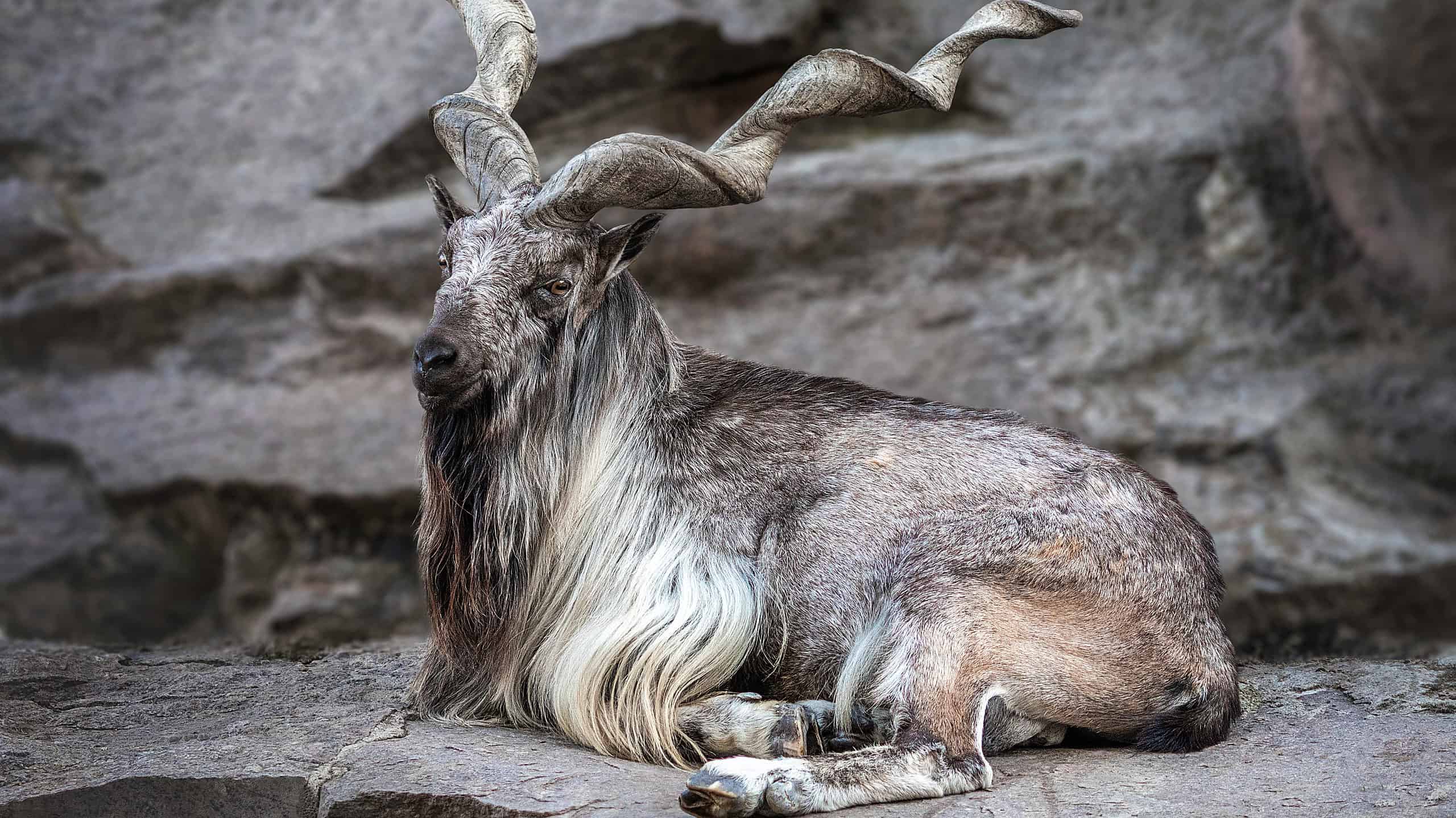
The markhor is a large wild goat native to rugged mountains of Central and South Asia, notable for its dramatic corkscrew-shaped horns (especially in males).

Kingdom
Animalia
Phylum
Chordata
Class
Mammalia
Order
Artiodactyla
Family
Bovidae
Genus
Capra
Species
Capra falconeri

Distinguishing Features

  • Very large, corkscrew-twisted horns (males especially)
  • Shaggy coat with seasonal variation; males often with a pronounced beard and longer mane
  • Goat-like build adapted for steep, rocky terrain

Physical Measurements

Males and females differ in size

Height
3 ft 3 in (2 ft 7 in – 3 ft 9 in)
2 ft 7 in (2 ft 2 in – 2 ft 11 in)
Length
5 ft 9 in (4 ft 7 in – 6 ft 9 in)
Weight
209 lbs (176 lbs – 243 lbs)
90 lbs (71 lbs – 110 lbs)
Tail Length
6 in (4 in – 8 in)
6 in (3 in – 8 in)
Top Speed
31 mph
running

Appearance

Primary Colors
Secondary Colors
Skin Type Dense mammalian fur over skin; permanent keratin horns (corkscrew spirals) present in both sexes.
Distinctive Features
  • Signature corkscrew (spiral) horns: males typically ~80-160 cm; females ~25-45 cm (length).
  • Adult male body mass commonly ~70-110 kg; females ~32-50 kg.
  • Head-body length typically ~132-186 cm; shoulder height ~80-110 cm (adult males).
  • Coat is seasonally variable: shorter/lighter in summer, longer/shaggier in winter.
  • Prominent beard in both sexes; males develop a longer throat beard and shaggy neck/chest "mane."
  • Adapted to steep, rocky mountain terrain: cloven hooves and strong limbs support agile cliff climbing.
  • Ears relatively long; tail short with darker terminal hair in many individuals.

Sexual Dimorphism

Males are markedly larger and carry much longer, heavier corkscrew horns plus a pronounced mane and beard. Females are smaller, lighter-built, with shorter, slimmer horns and reduced shaggy neck/chest hair.

  • Body mass commonly ~70-110 kg; larger frame and deeper chest.
  • Horn length usually ~80-160 cm, thick and strongly spiral/corkscrew-shaped.
  • More developed shaggy mane over neck/shoulders and longer throat beard.
  • Darker, more contrasting leg and facial markings are common.
  • Body mass commonly ~32-50 kg; smaller, lighter build.
  • Horn length usually ~25-45 cm, slimmer and less massively spiraled.
  • Shorter, less developed mane; beard present but typically reduced.
  • Overall coat often appears more uniform and less contrasting.

Did You Know?

A male markhor's horns can reach ~160 cm along the curve, while females' are typically ~20-30 cm (IUCN; HMW).

Adult males commonly weigh ~60-110 kg; females ~32-50 kg (IUCN; HMW).

Shoulder height is about ~80-110 cm in males and ~70-90 cm in females (HMW).

Gestation is roughly ~155-170 days, with 1 (sometimes 2) kids born in spring (HMW; caprine reproduction studies).

Markhor are listed on CITES Appendix I; the species is assessed as Near Threatened on the IUCN Red List (IUCN).

Pakistan's national animal is the markhor-its image appears widely in state symbolism and conservation messaging.

Unique Adaptations

  • Corkscrew horns (especially in males): long, spiraled horns used for dominance contests and visual signaling in open mountain habitats; the extreme sexual dimorphism reflects strong sexual selection (HMW; IUCN).
  • Specialized hooves: hard outer hoof rim with a softer, grippier center helps traction on rock-key for steep, broken terrain typical of the species' range (caprine functional morphology summaries).
  • Rugged-terrain body plan: strong shoulders, short lower legs, and powerful hindquarters support jumping and scrambling on cliffs (HMW).
  • Seasonal coat and mane: males develop a pronounced beard and chest/neck "ruff," increasing apparent size during the rut and providing insulation at high elevations (HMW).
  • Efficient ruminant digestion: a multi-chambered stomach allows extraction of nutrients from fibrous mountain plants that are seasonally sparse and low in quality (bovid physiology references).

Interesting Behaviors

  • Cliff agility: moves confidently on near-vertical rocky slopes, using narrow ledges to escape predators such as snow leopards and wolves (IUCN range accounts).
  • Seasonal altitude shifts: often uses higher, cooler slopes in summer and descends to lower, more vegetated areas in winter, tracking forage and snow cover (IUCN/HMW ecology summaries).
  • Sex-segregated living: outside the rut, adult males are frequently solitary or in small bachelor groups, while females form nursery groups with young (HMW).
  • Rut displays and combat: during the breeding season (often late autumn-winter), males perform lateral displays and engage in horn wrestling and pushing contests to access females (HMW; caprine behavioral literature).
  • Crepuscular feeding: commonly most active at dawn and dusk, balancing forage intake with predator avoidance in open mountain terrain (HMW).
  • Mixed feeding strategy: grazes grasses and forbs when available, but shifts to browsing shrubs/trees (e.g., leaves and shoots) when grasses are scarce, especially in winter (HMW).

Cultural Significance

The markhor (Capra falconeri) is Pakistan's national animal and a key species for mountain conservation in the Hindu Kush–Karakoram–western Himalaya. Regulated community trophy hunting has helped fund local protection. Its spiral horns and beard make it a regional symbol.

Myths & Legends

Stories in northern Pakistan and nearby areas say the markhor (Capra falconeri) name comes from Persian/Indic mar 'snake' + khor 'eater' because people believe it kills or eats snakes in the mountains.

Serpent-slayer tales: in Chitral, Gilgit-Baltistan, and Kashmir-area oral traditions, markhor are sometimes portrayed as fearless cliff spirits/guardians that confront venomous serpents-an idea echoed in local explanations of their formidable, twisting horns.

Bezoar lore: In South and Central Asia, people valued bezoar stones from wild goats like the markhor (Capra falconeri) as remedies for poison, especially snakebite, and as protective charms for rulers and homes.

In some mountain communities, Markhor (Capra falconeri) horns or horn designs are shown in homes or shrines as signs of strength and protection, because the animal is known for surviving cliffs and beating rivals.

Conservation Status

NT Near Threatened

Likely to qualify for a threatened category in the near future.

Population Increasing

Protected Under

  • CITES Appendix I (Pakistan population in Appendix II with export quotas for hunting trophies)
  • India: Wildlife (Protection) Act, 1972 - Schedule I (highest protection)
  • Pakistan: protected under provincial wildlife legislation; occurs in multiple protected areas (e.g., Chitral Gol National Park)
  • Occurs in a network of protected areas and community-managed conservancies across parts of its range; regulated trophy hunting programs exist in some jurisdictions as conservation incentives

Life Cycle

Birth 1 kid
Lifespan 11 years

Lifespan

In the Wild
7–13 years
In Captivity
12–20 years

Reproduction

Mating System Polygyny
Social Structure Harem Based
Breeding Season Rut typically November-January; most births occur April-June (after ~150-170 days gestation).
Breeding Pattern Seasonal
Fertilization Internal Fertilization
Birth Type Internal_fertilization

During the rut (typically Nov-Jan), dominant males fight and guard small female groups, achieving most matings; subordinate males get few. Copulation is internal; no pair bonds persist beyond the breeding season and females rear 1 (rarely 2) kids.

Behavior & Ecology

Social Herd Group: 8
Activity Diurnal, Crepuscular, Matutinal, Vespertine
Diet Herbivore Tender grass shoots in spring/summer; oak (Quercus spp.) leaves/twigs as key winter browse.

Temperament

HUBS (Capra): seasonal sexual segregation; dominance hierarchies; rut-driven male aggression; group-size varies with predation/snow.
Highly vigilant and wary; strong flight response in disturbed or hunted populations (Schaller 1977; Shackleton 1997).
Adult males become markedly aggressive in rut; frequent threats, chases, and horn clashes.
Females show protective behavior toward kids; juveniles engage in play-fighting and climbing practice.

Communication

Bleats Contact calls between females/kids
Grunts during close-range interactions
Snorts or explosive exhalations as alarm signals
Low moans/roars associated with rutting males Reported in Capra spp.
Scent marking via preorbital glands and urine; increased marking during rut Capra spp.
Flehmen response to assess female estrus and scent marks
Visual displays: lateral presentations, head tossing, horn posturing, and erect stance
Tactile signals: horn sparring/clashes, nudging, and pushing during dominance contests
Foot stamping and abrupt body orientation to signal alarm and initiate group flight

Habitat

Mountain Cliff/Rocky Outcrop Shrubland Woodland Coniferous Forest Alpine Meadow Grassland +1
Biomes:
Temperate Forest Temperate Grassland Alpine
Terrain:
Mountainous Rocky Hilly
Elevation: 1968 ft 6 in – 11811 ft

Ecological Role

Large-bodied mountain herbivore (mixed grazer-browser) and key prey-base species in Central/South Asian montane ecosystems.

Vegetation regulation via browsing/grazing (influences shrub-grass balance and plant community structure) Nutrient cycling and soil enrichment through dung/urine deposition on cliffs, ledges, and seasonal ranges Seed dispersal of some ingested plants (endozoochory) and seed movement via fur/dung Supports higher trophic levels as prey for large carnivores (e.g., snow leopard, wolf) and scavengers through carcasses

Diet Details

Other Foods:
Grasses Herbaceous forbs Shrubs Oak leaves and twigs Juniper foliage/twigs Pistachio and other woody browse Ephedra shoots Conifer needles and twigs +2

Human Interaction

Domestication Status

Wild

Markhor (Capra falconeri) is a wild mountain goat with no domestication history. It is flighty and very aggressive in rut, so it is unsuitable for farming. People interact by hunting (subsistence and trophy), sharing pasture and diseases with livestock, tourism, poaching, and community conservation. Domestication came from bezoar goat, not markhor.

Danger Level

Moderate
  • Normally shy/avoidant, but males can be dangerous at close range during the rut; goring injuries are possible due to large, rigid, spiraled horns.
  • Handling/transport risks in captivity (stress, flight, jumping/climbing leading to injury of handlers).
  • Zoonotic and livestock-shared pathogens possible at the wild-domestic interface (e.g., respiratory and parasitic diseases typical of caprids), posing occupational risk to herders/wildlife staff.
  • Vehicle/trekking encounter risk in steep terrain is generally indirect (falls/terrain hazards while pursuing/photographing), more than direct aggression.

As a Pet

Not Suitable as Pet

Legality: Markhor (Capra falconeri) are usually not legal pets. International trade is tightly controlled (CITES). Keeping them is allowed only in zoos, research centers, or permitted ranches with permits; U.S. ESA and state laws often ban private ownership.

Care Level: Expert Only

Purchase Cost: $5,000 - $25,000
Lifetime Cost: $50,000 - $200,000

Economic Value

Uses:
Conservation-linked trophy hunting (regulated, program-dependent) Ecotourism/wildlife viewing Subsistence meat use (illegal in many contexts) Hides/horns trade (generally illegal; enforcement-dependent) Livestock-wildlife interface costs (forage competition; disease management)
Products:
  • Trophy hunting permits/fees (where legal and scientifically quota-managed)
  • Tourism services (guiding, lodging, park fees)
  • Meat (local consumption; often illegal/controlled)
  • Hides/horns (trade typically prohibited)

Relationships

Related Species 11

Alpine ibex Capra ibex Shared Genus
Siberian ibex
Siberian ibex Capra sibirica Shared Genus
Bezoar ibex Capra aegagrus Shared Genus
Nubian ibex Capra nubiana Shared Genus
West Caucasian tur Capra caucasica Shared Genus
East Caucasian tur Capra cylindricornis Shared Genus
Spanish ibex Capra pyrenaica Shared Genus
Domestic goat
Domestic goat Capra hircus Shared Genus
Argali Ovis ammon Shared Family
Urial
Urial Ovis vignei Shared Family
Mouflon Ovis gmelini Shared Family

Ecological Equivalents 5

Animals that fill a similar ecological role in their ecosystem

Himalayan tahr Hemitragus jemlahicus Mountain-dwelling caprine browser/grazer that uses steep, rocky terrain as an anti-predator refuge; exhibits similar seasonal altitudinal movements and sexually segregated herds outside the rut.
Bharal Pseudois nayaur High-elevation, cliff- and steep-slope-dwelling ungulate sharing a predator guild (snow leopard, wolf), relying on sparse alpine forage in winter, and exhibiting similar grouping behavior and terrain-based escape strategies.
Argali Ovis ammon Large-bodied mountain ungulate in Central and South Asian ranges; overlaps in rangeland use and predator community, with seasonal movements that track forage availability and snow depth.
Goral
Goral Naemorhedus goral Rugged-slope specialist in the western Himalaya and Hindu Kush region; occupies a similar mixed browsing-grazing niche and uses broken terrain and forest-edge mosaics for cover and forage.
Chamois
Chamois Rupicapra rupicapra Ecological analog in other mountain systems: a medium-to-large mountain bovid that uses cliffs and rocky outcrops, feeds crepuscularly, and undergoes seasonal shifts between alpine meadows and lower-elevation browse.

The markhor is the national animal of Pakistan.

The markhor, a species of large, wild goat, is native to western and central Asia’s mountains and high-altitude monsoon forests. Also called the screw-horned goat or Shakhawat, it was considered to be the most challenging animal to hunt in British India due to the danger that pursuing them at high altitudes brought.
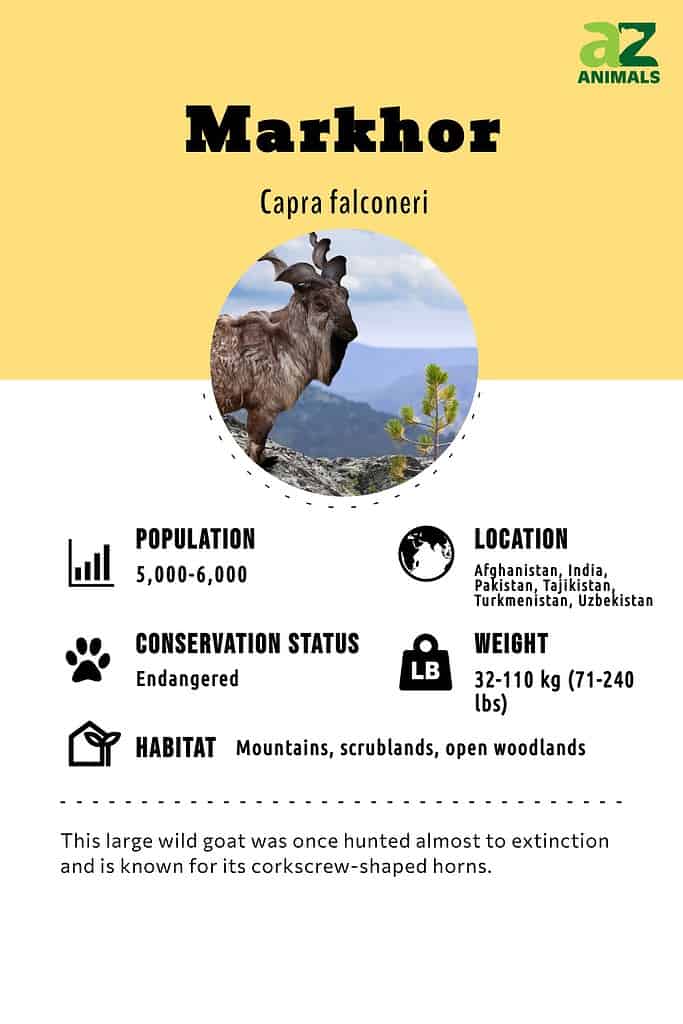
5 Fascinating Facts About the Markhor!

  • The markhor is Pakistan’s national animal.
  • It was featured in the World Wide Fund for Nature Conservation Coin Collection in 1976, along with 72 other animals.
  • Afghan puppet shows known as buz-baz use markhor marionettes.
  • It has been on the livery of Pakistan’s flag carrier, Pakistan International Airlines, since 2018.
  • Allahyar and the Legend of Markhor, a Pakistani computer-animated film, mentions the markhor.
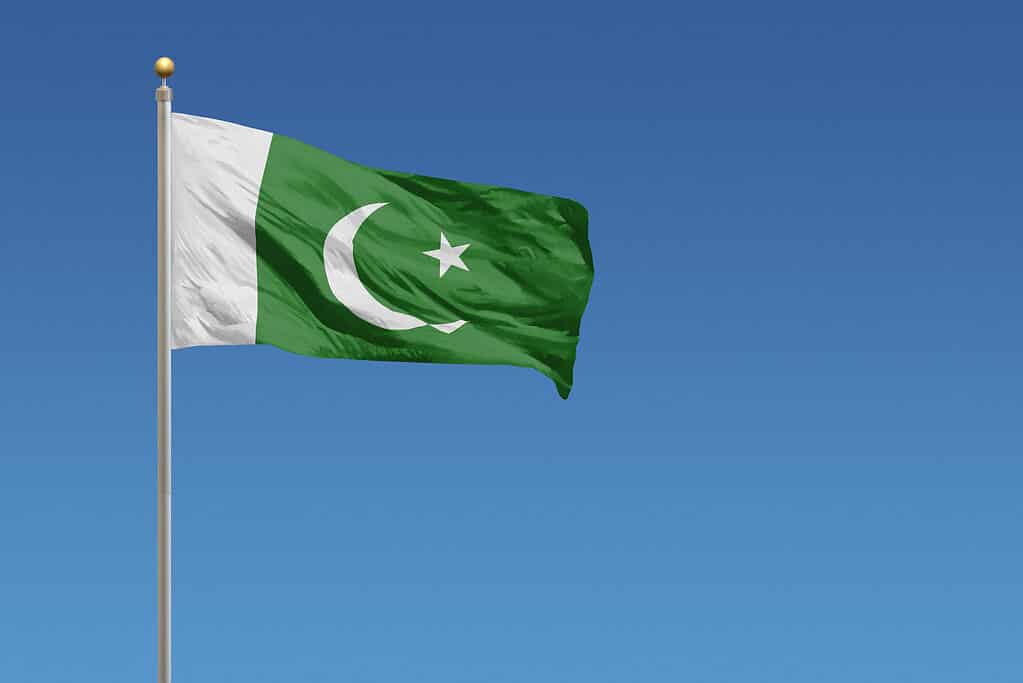
The markhor is the national animal of Pakistan.

Scientific Name

Capra falconeri is the scientific name of the markhor. Capra refers to a genus of mammals, specifically the genus of goats, and includes wild goats and ibexes. Falconeri refers to the species.

Markhor is a combination of Persian and Pashto words: “Mar” translates as snake and “khor” means eater. According to the region’s folklore, the markhor’s horns give it special abilities including being an eater or killer of snakes. The local population uses the foamy substance that results from the markhor chewing its cud to extract snake poison.
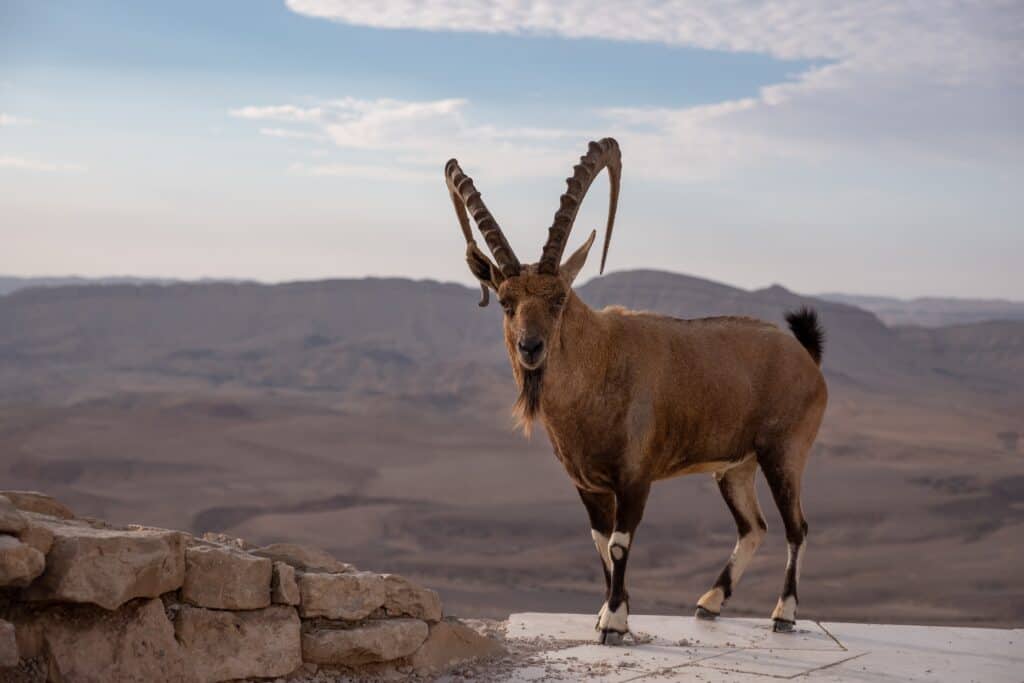
Adult ibex on rock

The ibex belongs to the same genus, Capra, as the markhor.

Types of Markhor

Due to the corkscrew shape of its horns, the markhor is known as a screw horn or screw-horned goat in Pakistan. All varieties of markhor goats have horns that are long, flaring, typically curled, and appear snake-like. However, it is possible for their horns to differ even within the same herd on a particular mountain range.

There are a few subspecies of markhor goats that are recognized by the IUCN and can be identified by the shape of their horns:

  • Astor (Capra falconeri falconeri): Also known as Pir Panjal, this subspecies has large, flat and wide-branching horns that flare in different directions. It is found in Afghanistan, Pakistan, and India.
  • Bukharan (Capra falconeri heptneri): Their twisted horns have three half-turns, and they have habitats in Afghanistan, Tajikistan, Turkmenistan, and Uzbekistan. Other common names for this subspecies are Tajik, Turkmenian, or Heptner’s markhor.
  • Kabul (Capra falconeri megaceros): Also called the straight-horned markhor, as its spiral-shaped horns stand up straight, this subspecies is present in Afghanistan and Pakistan.

Some believe there are two other possible subspecies, but these are disputed:

  • Kashmir (Capra falconeri cashmiriensis): This markhor has heavy, flat horns with flaring, loose corkscrew-style twisting, showing two half-turns. Astor is often synonymous with Kashmir.
  • Suleiman (Capra falconeri jerdoni): They have horns with tight corkscrew-style twisting resulting in four half-turns.
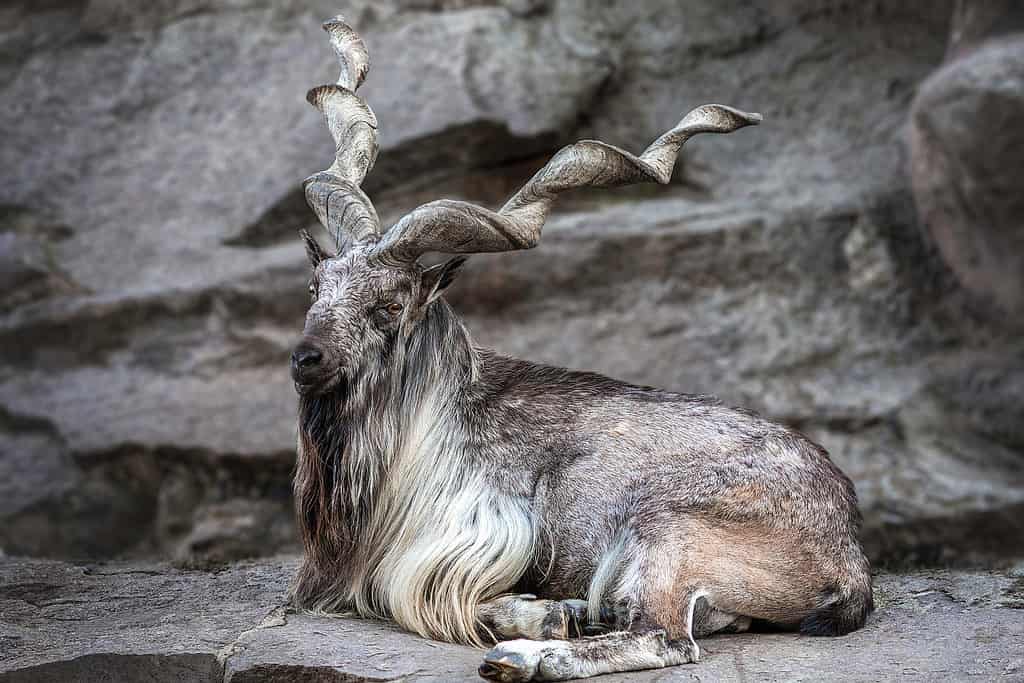
Markhor

All varieties of markhor goats have long, curled horns.

Evolution and History

In the 19th century, naturalist Charles Darwin theorized that it was through crossbreeding the markhor with wild goats that the modern goat was developed. Scientists have continued to conduct research into the relationship between the markhor and other goats, with some believing the markhor could be the ancestor of many different domesticated goats such as the Angora goat, Ladakh and Tibet’s Changthangi goat, Sicily’s Girgentana goat, and Ireland’s Bilberry goat.

The markhor is the largest goat in its family and the only one that has adapted to living at altitudes of 4,000–12,000 feet in northern Pakistan’s mountains. The genetic adaptation of wider hooves assists the markhor to keep its balance climbing and navigating uneven and steep terrain.

During the time of the British Raj’s reign in Pakistan, from 1858 to 1947, and for decades after, markhor were popular targets for hunters, especially those who sought the challenge of capturing high-altitude game. Overhunting led to the species nearly becoming extinct by 1990. In an effort to prevent extinction, Pakistan’s government banned hunting markhors in 1991. In Kashmir, trophy hunting has been organized yearly since 2000, with the highest bidder receiving the license to hunt a markhor and proceeds going toward conservation and local communities.

Appearance

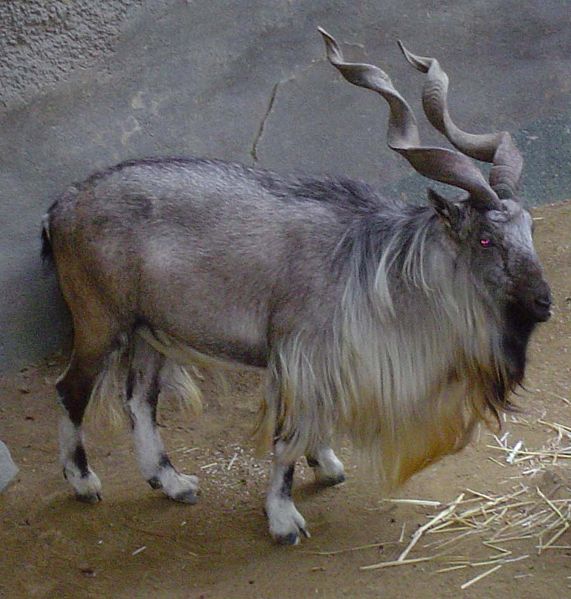
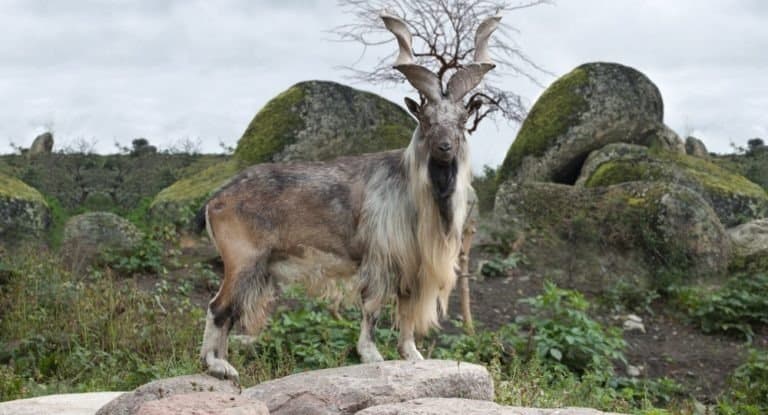
Markhors are animals that have grizzled, long hair which may come in brown, grey-black, white, tan, or any combination thereof. It is short and smooth in summer and longer and thicker in winter. Most notable however are its unique horns which usually grow up to 5 feet long in mature males. Their lower legs are usually black and white. They are 65-115 cm (26-45 in) in height at the shoulder, 132-186 cm (52-73 in) in length, and 32-110 kg (71-243 lbs). Only the Siberian ibex exceeds its weight and length, but they have the highest shoulder length in the Capra genus.

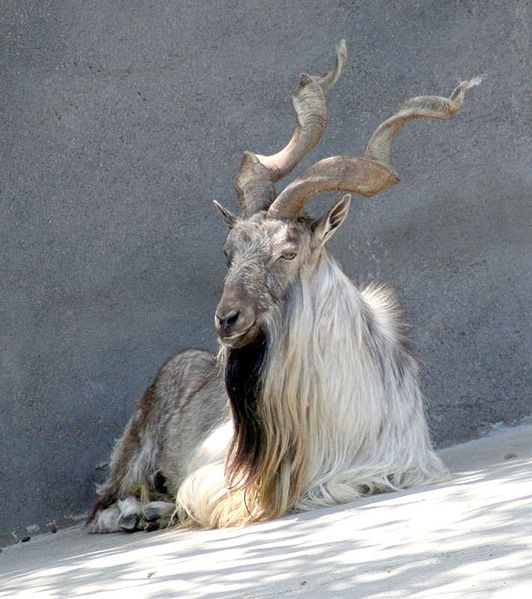
The species is sexually dimorphic, meaning the males and females do not look the same. Males have longer hair on the chin, throat, chest, and shanks, while females have shorter, redder hair, a short black beard, and no mane. Both have horns, but while the males’ can grow up to 160cm (63 in), the females’ only grow up to 25 cm (10 in). The males also have a strong odor which is stronger than that of the domestic goat.
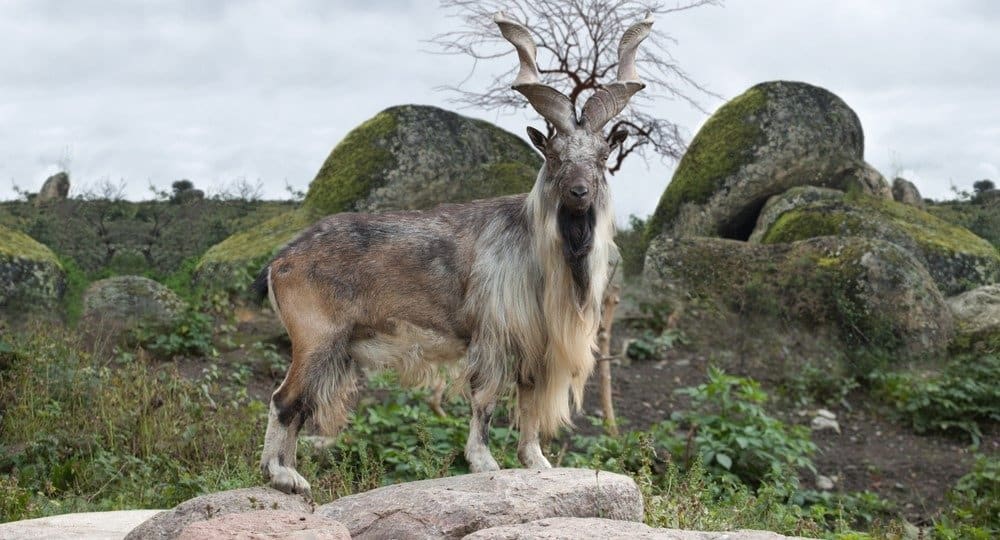
Male Turkmenian Markhor stand on rocks

The markhor has grizzled, long hair in different shades.

Behavior

The males are loners and females gather into herds of nine. As a crepuscular diurnal species, they are active during the day and mostly in the early morning and late afternoon. They are excellent at climbing and jumping on rocky, high altitudes. When threatened, they have an alarm call that sounds like a domestic goat’s bleating. The males remain in the woods during the summer, while the females climb the highest terrain. They descend to lower altitudes in the winter to avoid extreme cold. They forage 8-12 hours a day except for the middle of the day when they stop to rest and chew their cud.
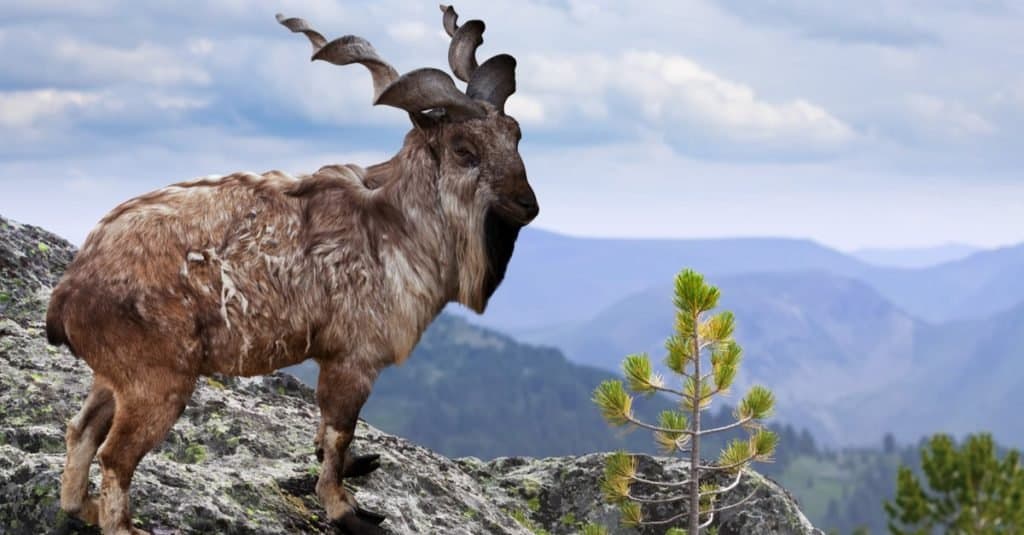
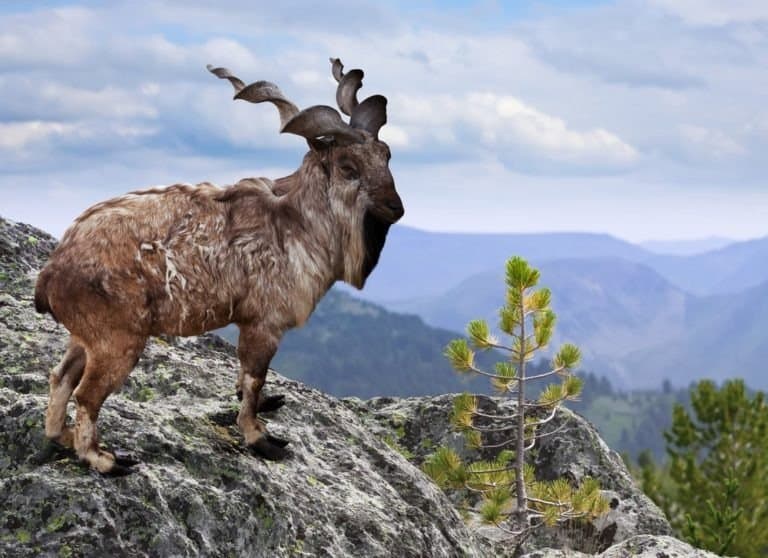
Weirdest Animal: Markhor

The markhor is excellent at climbing and jumping on rocky, high altitudes.

Habitat

The markhor’s habitat varies depending on its subspecies, but they generally live in the scrublands, open woodlands, and mountains of central Asia, Karkoram, and the Himalayas. Their range of scattered herds includes Turkmenistan, Uzbekistan, Tajikistan, Afghanistan, Pakistan, and northern India.

Astor or Pir Panjal lives in the Indian region of Kashmir, northern Pakistan, and eastern Afghanistan at altitudes of up to 3,600 m (11,800 ft). Bukharan, Tajik, Turkmenian, or Heptner’s markhor live in Tajikistan, Pakistan, Turkmenistan, and Uzbekistan, and possibly parts of Afghanistan, up to 13,000 feet above sea level. Kabul and Suleiman live in Afghanistan and Pakistan, and Kashmir live in Afghanistan.
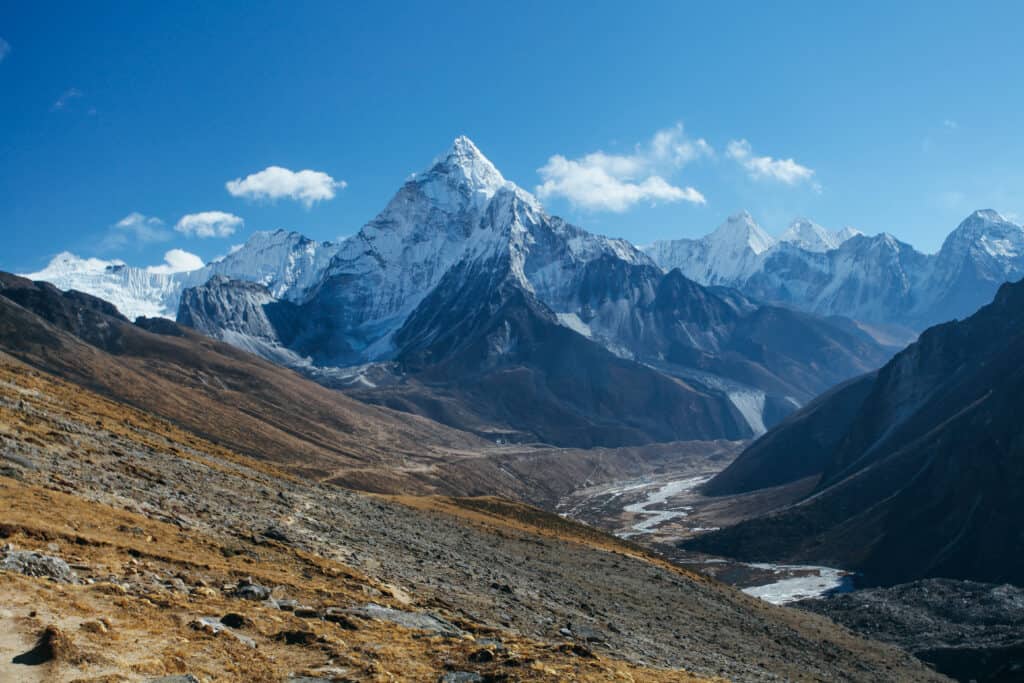
Himalayan mountains

The markhor’s habitat includes the Himalayas.

Diet

It competes with domestic goats over food. This is due to the greater numbers of herds of domestic goats, which drive the wild goats away from food sources. Their typical diet is grass, leaves, and shoots. During spring and summer, they graze and during winter they browse trees.

Predators and Threats

Snow leopards, Himalayan wolves, Eurasian lynx, and brown bears are predators of the markhor. The golden eagle also preys on juvenile markhor. Feral dogs were reported in 2022 to have been behind the deaths of 392 markhors over the past 15 years in the Chitral Gol National Park.

Hunters and poachers are also a threat to markhor, pursuing them in India for both food and due to the desire for their unique horns, which they value as trophies. They are commonly hunted along with the Himalayan ibex and in Afghanistan, it is traditional to hunt them in Nuristan and Laghman. Foreign trophy hunters and powerful Pakistanis overhunted and poached markhor so much that by the 1960-70s they were endangered. It was in the 1970s that Pakistan passed conservation legislation. However, hunting still goes on in spite of its being illegal in all three countries.
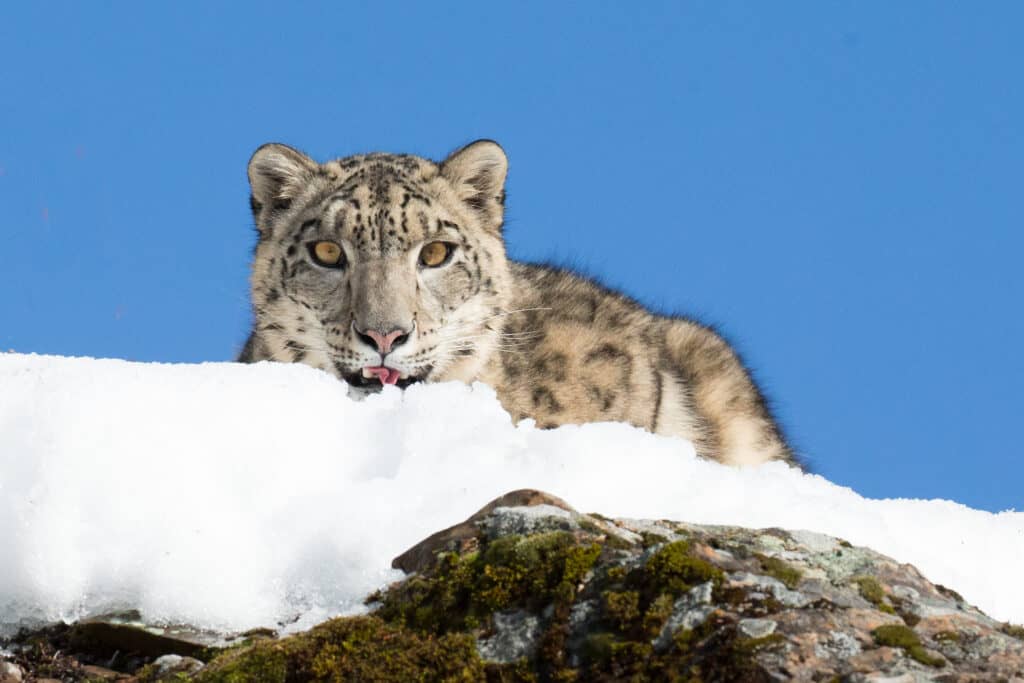
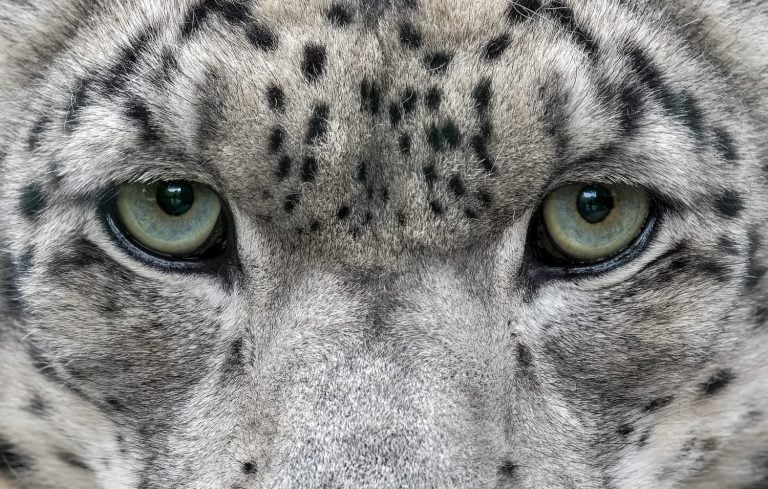
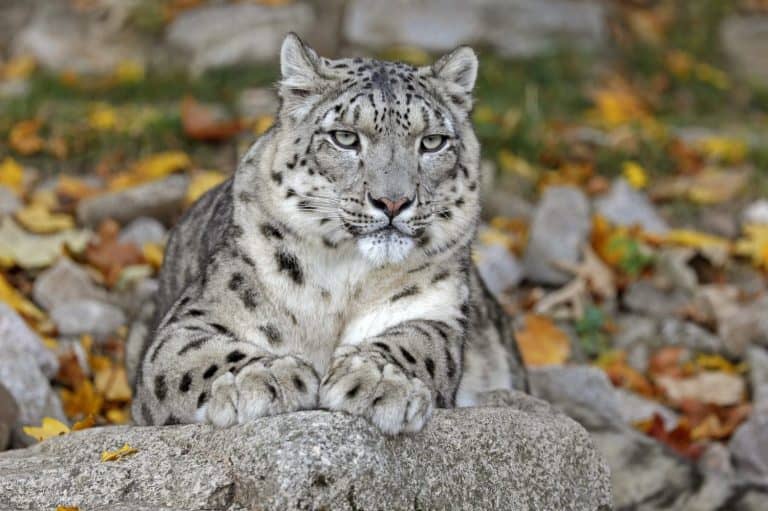
snow leopard

The snow leopard is one of the markhor’s natural predators.

Reproduction, Babies, and Lifespan

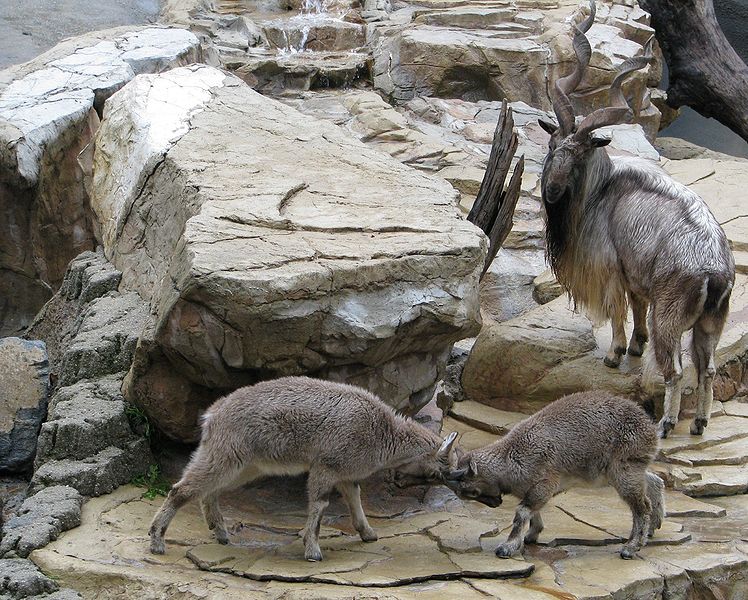
Male markhors fight for the attention of females by locking horns and then twisting and pushing against the other male. Mating season is in the winter when males start rutting, and both sexes reach maturity at 18-30 months.

As a mammal, markhor mothers give birth to live young. After a gestation period of 135-170 days, they give birth to 1-2 kids. The kids are weaned at 5-6 months. Markhor can be expected to live around 10-13 years in the wild and up to 19 years in captivity. A markhor’s age can be determined by counting the rings on its horns.
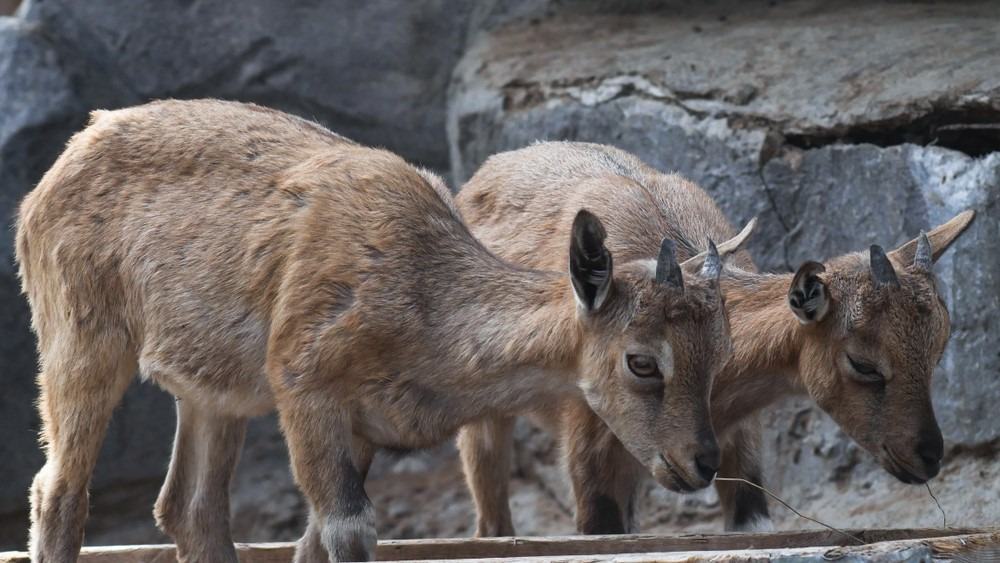
Pair of young cubs of markhors searching for the food. Two little goats

Markhor kids are weaned around 5-6 months.

Population

The largest population of Astor or Kashmir markhor is currently found in Chitral National Park in Pakistan, where they now exceed 1,000 in number. The population increased by about 20% during the past decade. Data from 2022 estimates the number of markhors at 5,000-6,000. Its conservation status is Near Threatened since 2015 according to the IUCN Red List.

IUCN

The IUCN’s Red List classifies the markhor as Near Threatened.

Markhor in Zoos

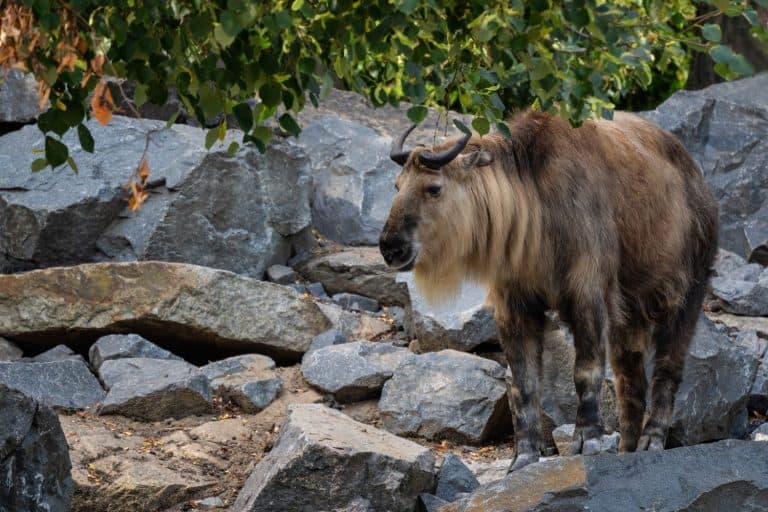
These animals are commonly housed with other wild goats. For example, in the Bronx Zoo, they live with a herd of Himalayan Tahr. Zoos in several countries are common international conservation sites for markhor, while parks serve the same purpose on the local level.
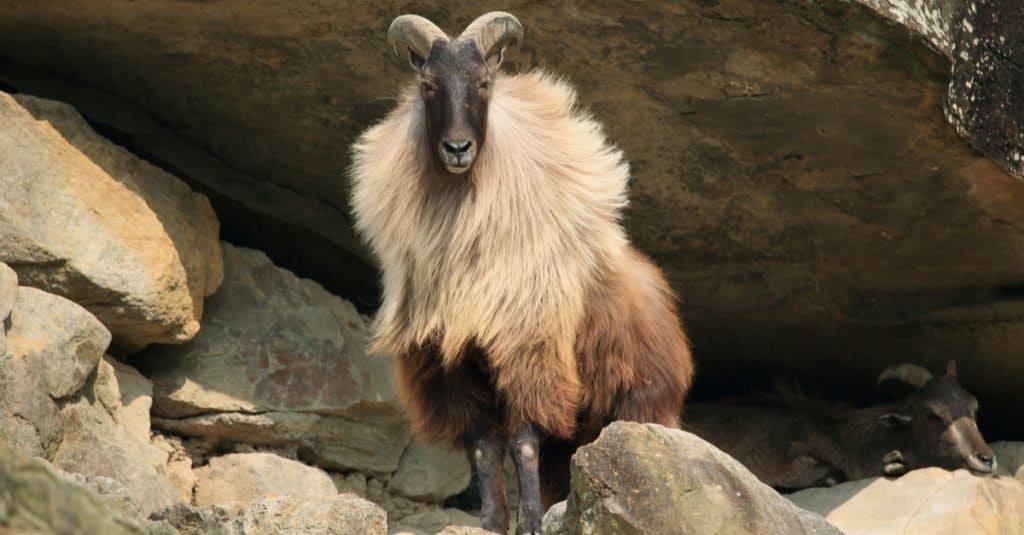
Amazing Mountain Animal: Himalayan Tahr

The markhor is housed with the Himalayan Tahr at the Bronx Zoo.

View all 330 animals that start with M

Sources

  1. David Burnie, Dorling Kindersley (2011) Animal, The Definitive Visual Guide To The World's Wildlife / Accessed July 26, 2010
  2. Tom Jackson, Lorenz Books (2007) The World Encyclopedia Of Animals / Accessed July 26, 2010
  3. David Burnie, Kingfisher (2011) The Kingfisher Animal Encyclopedia / Accessed July 26, 2010
  4. Richard Mackay, University of California Press (2009) The Atlas Of Endangered Species / Accessed July 26, 2010
  5. David Burnie, Dorling Kindersley (2008) Illustrated Encyclopedia Of Animals / Accessed July 26, 2010
  6. Dorling Kindersley (2006) Dorling Kindersley Encyclopedia Of Animals / Accessed July 26, 2010
  7. David W. Macdonald, Oxford University Press (2010) The Encyclopedia Of Mammals / Accessed July 26, 2010
  8. Wikipedia / Accessed November 1, 2020
  9. Facts and Details / Accessed November 1, 2020
  10. WCS Pakistan / Accessed November 1, 2020
  11. Animal Corner / Accessed November 1, 2020
  12. Los Angeles Zoo & Botanical Gardens / Accessed November 1, 2020
  13. New England Zoo / Accessed November 1, 2020
Catherine Gin

About the Author

Catherine Gin

Catherine Gin has more than 15 years of experience working as an editor for digital, print and social media. She grew up in Australia with an alphabet of interesting animals, from echidnas and funnel-web spiders to kookaburras and quokkas, as well as beautiful native plants including bottlebrushes and gum trees. Being based in the U.S. for a decade has expanded Catherine's knowledge of flora and fauna, and she and her husband hope to have a hobby farm and vegetable garden in future.

Thank you for reading! Have some feedback for us?


Markhor FAQs (Frequently Asked Questions)

A markhor is a species of large, wild goat in central and western Asia.