






M
Species Profile

Moorhen

Gallinula chloropus

The reed-bed runner on lily pads
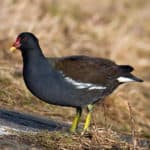
Andreas Trepte, www.photo-natur.de / Creative Commons

Moorhen Distribution

Click a location to explore more animals from that region

Loading map...

Found in 120 countries

At a Glance

Wild Species
Also Known As Moorhen, Common Gallinule, Gallinule, Waterhen, Swamp hen, Marsh hen
Diet Omnivore
Activity Diurnal+
Lifespan 3 years
Weight 0.5 lbs
Status Least Concern
Did You Know?

Size: 30-38 cm long; wingspan 50-55 cm; mass typically ~250-500 g (varies by sex/season).

Scientific Classification

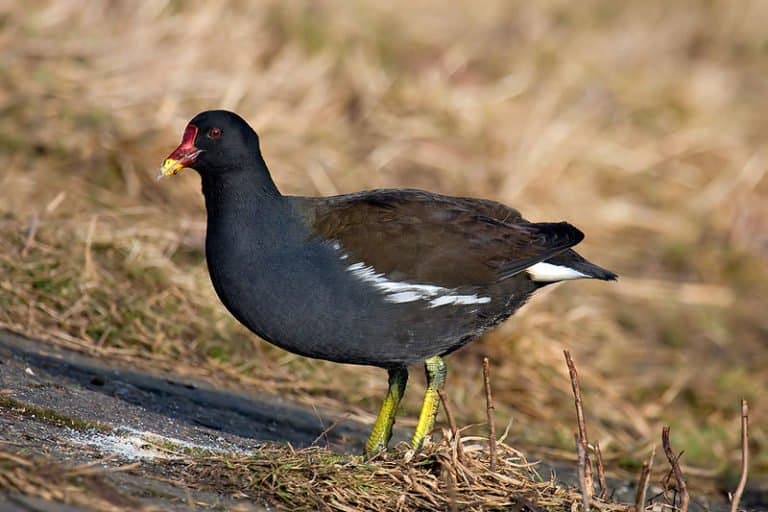
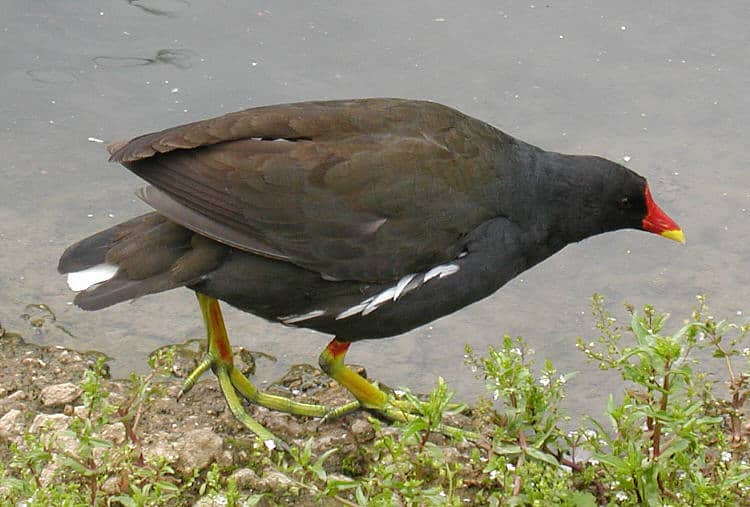
A medium-sized rail (family Rallidae) associated with freshwater wetlands; typically dark-plumaged with a red frontal shield and bill tipped yellow, and white flank markings. Often seen walking on floating vegetation and swimming with head-bobbing movements.

Kingdom
Animalia
Phylum
Chordata
Class
Aves
Order
Gruiformes
Family
Rallidae
Genus
Gallinula
Species
chloropus

Distinguishing Features

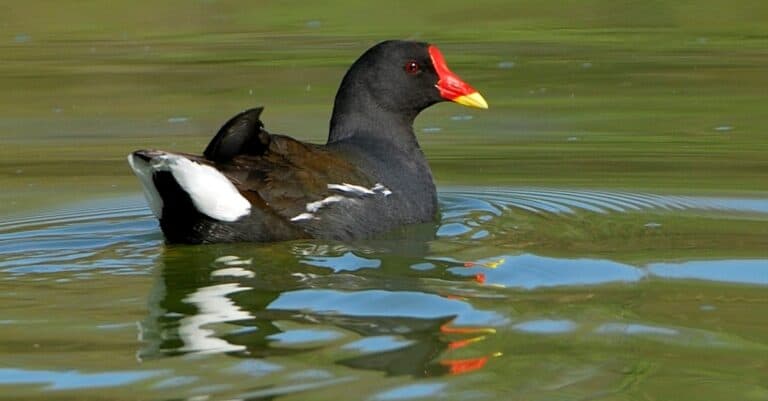
  • Dark slate-brown/blackish body with contrasting white flank stripes
  • Red bill and frontal shield with yellow tip to bill
  • Long toes adapted for walking on floating vegetation
  • Often flicks tail showing white undertail

Physical Measurements

Length
1 ft 1 in (12 in – 1 ft 3 in)
Weight
1 lbs (1 lbs – 1 lbs)
Tail Length
3 in (2 in – 3 in)
Top Speed
25 mph
flying

Appearance

Primary Colors
Secondary Colors
Skin Type Feathered body; bare keratin bill and frontal shield; scaly legs and feet with very long toes.
Distinctive Features
  • Adult size: total length 32-35 cm; wingspan 50-55 cm; mass typically 0.25-0.50 kg (handbook/BirdLife accounts).
  • Diagnostic vs Eurasian Coot (Fulica atra): moorhen has red shield and red bill with yellow tip; coot has white bill/shield.
  • White flank stripe and white undertail/vent are key field marks; often shown with frequent tail-flicking.
  • Greenish legs with exceptionally long toes; routinely walks on floating vegetation (e.g., lily pads) and swims readily.
  • Swimming gait often includes head-bobbing; typically skulking in emergent vegetation but can be bold in urban wetlands and parks.
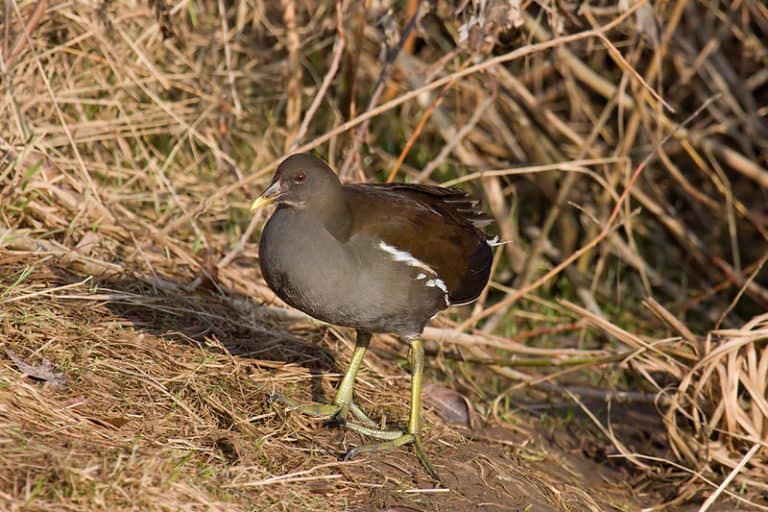
  • Age/season differences: juveniles are browner with dull bill and reduced/no red frontal shield; adults show brightest red shield in breeding season.

Sexual Dimorphism

Sexes are very similar in plumage; males average slightly larger and may show a marginally larger frontal shield and bill. In the field, sex is usually not separable without size comparison or handling.

  • Slightly larger average body size and heavier build.
  • On average, slightly larger red frontal shield and bill base.
  • Slightly smaller average body size.
  • On average, slightly smaller frontal shield; overall appearance typically identical to males.

Did You Know?

Size: 30-38 cm long; wingspan 50-55 cm; mass typically ~250-500 g (varies by sex/season).

Longevity: most live only a few years, but the oldest ringed individual recorded reached 18 years 3 months (UK ringing record).

Unlike Eurasian coots, which have white bills and lobed toes, moorhens have a red frontal shield and bill with a yellow tip and unlobed toes.

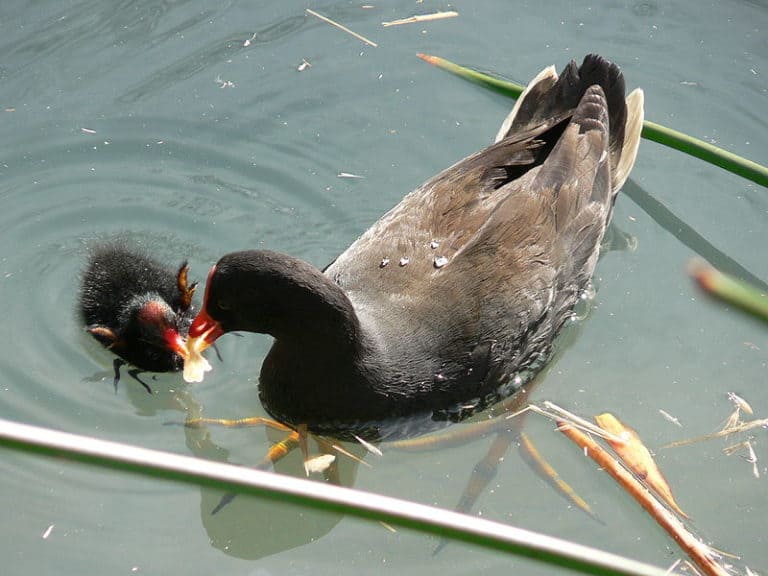
Chicks hatch covered in black down with a brightly colored head/bill area, and can swim soon after hatching.

Breeding is flexible: typical clutches are 5-9 eggs (but can range wider), and pairs may attempt multiple broods in a season when conditions are good.

They often become surprisingly bold in city parks and urban wetlands, approaching people for food while still retreating instantly into cover when alarmed.

Unique Adaptations

  • Very long toes spread body weight, allowing it to walk on floating vegetation (lily pads, mats of weeds) and soft mud without sinking.
  • Laterally compressed body and short, rounded wings help it thread through reeds and rushes-classic rail family "marsh-skirting" design.
  • Bright red frontal shield and bill act as close-range signals in dense vegetation for mate choice and territorial displays.
  • Strong legs with greenish-yellow coloration (reflected in the species name) support both swimming and agile running across wet ground.
  • Flexible diet and habitat use (from reedbeds to ornamental ponds) supports survival in fragmented, human-made wetlands.

Interesting Behaviors

  • Skulking-to-bold switch: in natural marshes they keep to dense cover, but in urban ponds they may feed openly on lawns and paths.
  • Characteristic swimming style with rhythmic head-bobbing; when walking, they frequently flick the tail to show the white undertail.
  • Territorial defense in breeding season: chasing, threat postures, and sometimes grappling fights with feet and wings.
  • Foraging is highly opportunistic (omnivorous): grazing on land, picking seeds/plant shoots, and taking invertebrates (e.g., insects, snails) at the water's edge.
  • Nest building includes a bulky platform of reeds and other vegetation, often anchored to emergent plants; pairs may add material throughout incubation.
  • Anti-predator tactics include freezing in cover, slipping through vegetation, and diving/swimming underwater for short escapes when threatened.

Cultural Significance

The Common Moorhen (Gallinula chloropus) is a familiar park wetland bird in Europe, Africa, and Asia. Used in public nature education for urban freshwater habitats. Also called moorhen, waterhen, or gallinule; American relatives are often treated as the common gallinule. Its presence usually means vegetated, intact emergent shore margins.

Myths & Legends

Name lore (etymology): the genus name means "little hen," referencing its chicken-like shape and gait; the species name means "green-footed," echoing its leg and foot tones.

Traditional naming associations: across parts of Britain and Ireland, "waterhen" and "moorhen" are long-standing folk names that tie the bird to everyday marshland life-an example of how wetlands shaped local vocabulary and place-based identity.

Historical note: the Common Moorhen (Gallinula chloropus) is common and visible at managed waters, so older European nature writers used it as a sign of reed-fringed ponds, often compared with the coot.

Conservation Status

LC Least Concern

Widespread and abundant in the wild.

Population Decreasing

Protected Under

  • EU Birds Directive (2009/147/EC) - protected as a naturally occurring wild bird in the EU; hunting allowed/regulated in some member states where listed as huntable.
  • AEWA (Agreement on the Conservation of African-Eurasian Migratory Waterbirds) - covered as a migratory waterbird within the Agreement area, promoting coordinated habitat conservation and management.
  • Ramsar Convention - not species-specific, but protection/management of key wetland sites benefits Gallinula chloropus populations across its range.
  • National wildlife legislation in many range states provides protections for wild birds and regulates hunting seasons, methods, and wetland management.

Life Cycle

Birth 7 chicks
Lifespan 3 years

Lifespan

In the Wild
0–18.3 years
In Captivity
0–20 years

Reproduction

Mating System Monogamy
Social Structure Socially Monogamous
Breeding Pattern Seasonal
Fertilization Internal Fertilization
Birth Type Internal_fertilization

Typically forms territorial male-female pairs; both sexes build nest, incubate, and care for chicks, often raising 2-3 broods per season. Polygyny, polyandry, and extra-pair copulations occur but are uncommon.

Behavior & Ecology

Social Flock Group: 8
Activity Diurnal, Crepuscular, Nocturnal
Diet Omnivore Tender aquatic vegetation-especially duckweed (Lemna spp.) where abundant
Seasonal Migratory 1,243 mi

Temperament

Strongly territorial in breeding season; frequent chases and threat postures (Cramp & Simmons, BWP).
Generally wary but can habituate in urban wetlands; tolerance increases with stable food supply (Birds of the World).
Aggressive at nest/young; uses bill-jabs and pursuit to expel intruders (Taylor & van Perlo 1998).
Pair territoriality is widespread; winter flocking varies with food availability, ice, and disturbance.
Body size context often reported: length 30-38 cm; mass ~0.25-0.50 kg (Birds of the Western Palearctic; Birds of the World).
Longevity: most adults live only a few years; ring-recovery maxima reported up to ~18 years (EURING/BTO summaries).

Communication

Loud, repeated advertising call often rendered "kurrk/kurruk" or "kruk-kruk".
Sharp alarm notes ("kik/kek-kek") during predator approach or territorial disputes.
Low contact clucks/chuckles between mates and family members in cover.
Chick begging and contact peeps maintaining cohesion within broods.
Visual displays: tail-flicking exposes white undertail; head-bobbing while walking/swimming.
Frontal shield and bill used in close-range threats; bill-pointing and lunging precede fights.
Posture signals: raised wings, lowered head, and forward body-lean during escalation.
Pursuit/chase behavior communicates dominance and reinforces territory boundaries.

Habitat

Biomes:
Freshwater Wetland Temperate Forest Temperate Grassland Mediterranean Tropical Rainforest Tropical Dry Forest Savanna +2
Terrain:
Riverine Coastal Island Plains Valley Muddy
Elevation: Up to 6561 ft 8 in

Ecological Role

Generalist wetland consumer (omnivorous mesopredator and primary consumer) that links aquatic vegetation/seed resources and invertebrate production to higher trophic levels.

Regulation of aquatic and shoreline invertebrate populations via predation Grazing on aquatic macrophytes and algae, influencing wetland plant community structure Seed dispersal (especially of aquatic plants) through ingestion and movement among wetlands Nutrient cycling and redistribution via foraging and defecation between shoreline and open-water microhabitats Prey base support for wetland predators (raptors, mammals), transferring energy up the food web

Diet Details

Main Prey:
Aquatic and terrestrial insects Insect larvae Earthworms Snails and other mollusks Small crustaceans Tadpoles and small amphibians Small fish Bird eggs and nestlings +2
Other Foods:
Aquatic macrophytes Floating vegetation Algae and biofilm Seeds and grains Berries and soft fruits Plant roots and rhizomes

Human Interaction

Domestication Status

Wild

The Common Moorhen (Gallinula chloropus) is a wild bird with no domesticated lineage. It is sometimes kept in zoos or by licensed bird keepers and can become used to people in parks when fed. This is habituation (getting used to people), not domestication. Adults are about 30–38 cm long, wingspan ~50–55 cm, weight ~0.19–0.49 kg.

Danger Level

Low
  • Defensive aggression near nests (pecking/scratching) if approached closely; risk increases during breeding season when adults actively defend territories and chicks.
  • Zoonotic pathogen exposure typical of wild waterbirds (e.g., Salmonella spp., Campylobacter spp.) via handling feces/soiled water; low risk with normal hygiene.
  • Potential involvement in avian influenza ecology as a wild waterbird (risk primarily to poultry/animal health; human risk is low and context-dependent).
  • Slips/falls or minor injuries during attempts to capture/handle injured birds without training.

As a Pet

Not Suitable as Pet

Legality: Common Moorhen (Gallinula chloropus) is usually not kept as a pet. Many places protect it by law, so capture, sale, or keeping needs permits. Rules vary and captive-bred birds often need permits too.

Care Level: Expert Only

Purchase Cost: Up to $500
Lifetime Cost: $3,000 - $12,000

Economic Value

Uses:
Wildlife tourism (birdwatching) Wetland education/interpretation in parks and nature reserves Scientific research/monitoring (wetland indicator species; ecotoxicology/urban ecology) Limited subsistence/recreational hunting in some jurisdictions (local/regional regulations vary)
Products:
  • non-consumptive value (viewing/photography)
  • occasional regulated game meat in limited areas (where legal)
  • educational display value (licensed institutions)

Relationships

Related Species 8

Common Gallinule
Common Gallinule Gallinula galeata Shared Genus
Dusky Moorhen Gallinula tenebrosa Shared Genus
Lesser Moorhen Gallinula angulata Shared Genus
Gough Moorhen Gallinula comeri Shared Genus
Eurasian Coot Fulica atra Shared Family
American Coot Fulica americana Shared Family
Purple Swamphen Porphyrio porphyrio species complex Shared Family
Water Rail Rallus aquaticus Shared Family

Ecological Equivalents 4

Animals that fill a similar ecological role in their ecosystem

Eurasian Coot Fulica atra They occupy very similar freshwater-wetland niches: both swim well, feed on aquatic vegetation and invertebrates, and build floating or shoreline nests in emergent vegetation. Coots tend to be more specialized on submerged plants, while moorhens are more edge- and cover-oriented and more omnivorous.
Purple Swamphen Occupies reedbeds and marshes and forages by walking on floating vegetation and pulling plant material. Overlaps strongly in habitat structure and diet (plant matter plus invertebrates), though swamphens are generally larger and more robust grazers.
Water Rail Rallus aquaticus Shares dense emergent-vegetation wetlands and secretive rail behaviors; both feed on aquatic invertebrates and small vertebrates. Water rails are more skulking and less oriented toward open-water swimming than moorhens.
Little Grebe Tachybaptus ruficollis Often co-occurs on small ponds and lakes; both use similar freshwater bodies and can nest in floating vegetation, but grebes are diving specialists while moorhens are surface foragers and walkers.

Types of Moorhen

5

Explore 5 recognized types of moorhen

Common Moorhen
Common Moorhen Gallinula chloropus
Common Gallinule
Common Gallinule Gallinula galeata
Dusky Moorhen Gallinula tenebrosa
Lesser Moorhen Gallinula angulata
Gough Moorhen Gallinula comeri

Moorhens can walk on top of water plants in ponds and lakes.


The common moorhen, also called the common gallinule, are birds that are found around the world, just about every place except for the polar regions and tropical jungles. These birds are black with distinctive yellow legs and a red beak with a shield that extends from their beaks up between their eyes and onto their foreheads. Unlike most water birds, moorhens don’t have webbed feet to help them swim. They will hiss if they feel threatened, but otherwise have a distinctive, gargly-sounding call they use to communicate with one another. Moorhens are members of the rail family, which includes many different species of marsh birds.

5 Moorhen Facts

• Moorhens are birds that often nest in places that people frequent, such as parks.

• Juvenile moorhens don’t have the bright red shields on their faces.

• Moorhens can fly, but they aren’t very good at it and will only go short distances at any one time.

• Moorhens will eat other birds’ eggs if they can get to them.

• Young moorhens from previous hatchings often help to care for their parents’ new babies.
 

Moorhen Scientific Name

The scientific name of the common moorhen is Gallinula chloropus. This name comes from the Latin word Gallinula, meaning a small chicken or hen, and the Greek word chloropus, which means green or yellow (khloros) foot (pous).

Multiple moorhen subspecies exist. Because they can be hard to identify based on the often-subtle physical differences, they are generally described by where they can be found.

  • Eurasian Moorhen, G. C. Chloropus, found in Northwest Europe to North Africa and Central Siberia, also in the humid areas of Southern Asia, Japan, and Central Malaysia, Sri Lanka, the Canary Islands, the Azores, Madeira, and the Cape Verde Islands.
  • North American Moorhen, G. C. Cachinnans, found in Southeast Canada south into the USA, but not in the Great Plains Region, also in West Panama, the Galápagos, and Bermuda.
  • Southern American Moorhen, G. C. Galeata, found in the Guyanas, Trinidad, and parts of Brazil, Argentina, and Uruguay.
  • Indo-Pacific Moorhen G. C. Orientalis, found in the Andaman Islands, the Seychelles, Southern Malaysia, Indonesia, the Philippines, and Palau.
  • Barbados Moorhen, G. C. Barbadensis, found only in Barbados.
  • African Moorhen, G. C. Meridionalis, found in Sub-Saharan Africa.
  • Madagascan Moorhen, G. C. Pyrrhorrhoa, found on the islands of Madagascar, Réunion, and Mauritius.
  • Andean Moorhen, G. C. Garmani, found in the Andes from Peru to Northwest Argentina.
  • Hawaiian Moorhen, G. C. Sandvicensis, found only in Hawaii.
  • Antillean Moorhen, G. C. Cerceris, found in the Antilles (not Trinidad or Barbados) and South Florida.
  • Subandean Moorhen, G. C. Pauxilla, found in East Panama down to Northwest Peru.
  • Mariana Moorhen, G. C. Guami, found in the Northern Mariana Islands.
     

Moorhen Appearance and Behavior

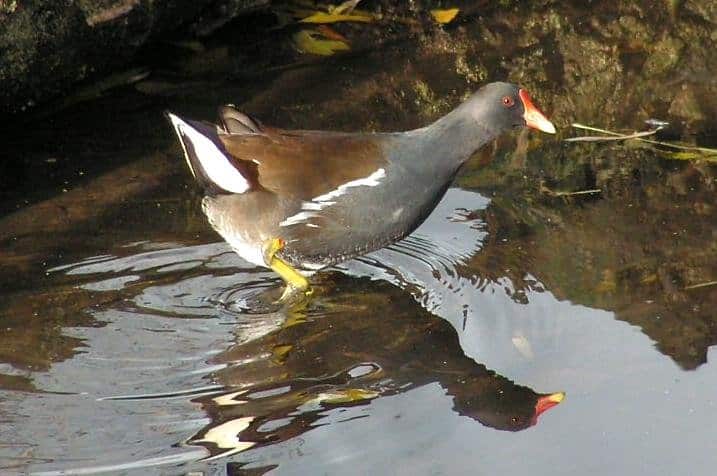
The moorhen is mainly charcoal gray to black bird, but its wing feathers tend to have a brownish appearance to them. Along the rear edges of each wing is a strip of white, and it may have small white patches towards its rear as well. The adult birds have a bright red beak that extends upward between its eyes to create a shield. The point of the beak is yellow. Its legs are mostly bright yellow, and it has long, pointed toes with no webbing.

This bird grows to be about 10 to 15 inches (25 to 38 cm) long and weighs from 2.5 ounces to 14 ounces (70 to 400 g), about the same weight as a can of soup. Moorhens have a wingspan of 20 to 31 inches (50 to 80 cm), a bit more than the height of two bowling pins stacked one on top of the other. They’re about the same size as a crow. They’ve been known to fly as fast as 22 mph (35 km/h), but they can’t keep up this speed for very long.

Moorhens live in groups, called flocks, most of the time. While these flocks can be large, moorhens often live in small groups of just a few birds. During the breeding season, they live around others of their kind but will separate somewhat from the others to claim a nesting territory.

Although they can be easy to spot when they are swimming, moorhens tend to be rather shy and will avoid people whenever they can. They are not aggressive except during breeding season, and then they will squabble with one another over nests as well as fiercely protecting their babies. They avoid contact with people whenever possible.
Moorhen standing in the water

Moorhen Habitat

Moorhens can be found in most parts of the world, with the exception of jungles and the polar regions. They must have water, so they are only found in areas with enough water for the moorhens to survive. Usually, they need water that is deep enough for them to swim in, which also provides them with a place to nest and a way to escape their enemies.

In colder regions, moorhens will migrate to more temperate areas before breeding season. They can typically be found either swimming boldly on areas of open water or hiding in the weeds at the edge of ponds and creeks. They build their nests along the edges of the water, in dense vegetation that offers them good shelter.
 

Moorhen Diet

Moorhens are omnivorous and eat a range of plant and animal matter. They eat many different small aquatic creatures, such as snails, small frogs, and fish, as well as land animals including rodents and lizards. They also eat insects and worms and have been known to eat the eggs of other birds. In addition, moorhens eat many of the plants that grow in or near the water, including fruit, berries, and seeds.

Moorhen Predators and Threats

The moorhen faces many environmental challenges brought about by humans, including pollution and loss of habitat. Despite this, the common moorhen has proven to be highly adaptable and continues to thrive in many different environments, even parks and other locations frequented by humans. This bird is listed as being of least concern by the International Union for the Conservation of Nature (IUCN), which means that they exist in adequate numbers to sustain their population and face no significant environmental threats.

Not all species of moorhens are thriving, however. The status of the Hawaiian moorhen is uncertain due to its being preyed upon by the mongoose. Another species of concern is the Mariana moorhen. It is listed as endangered by the IUCN as well as other conservation organizations, due to loss of habitat. The Indo-Pacific moorhen is also considered endangered, most likely because the local people hunt this bird for food.

In most places, the moorhen is a popular prey item for a variety of predators. Some of the animals that prey on moorhens are foxes, coyotes, raccoons, dingos, and dogs.
 

Moorhen Reproduction, Babies, and Lifespan

In spring, anywhere from mid-March to mid-May, depending on the climate, moorhens begin to breed. At this time a male moorhen will swim towards the female with his beak dipped into the water. If she accepts him, they will go on to nibble each other’s feathers before working together to build a large nest in a hidden location in the weeds or brush. They will both defend the nest fiercely from any threats, including other birds who might want to steal their spot.

The female usually lays seven or eight eggs, and the male and female take turns incubating the eggs until they hatch, which takes about three weeks. When the babies hatch, both parents share the task of caring for them, taking turns feeding and protecting them. It takes the babies about 40 to 50 days to fledge out fully and be able to fly.

If the babies are threatened in any way, they may cling to the body of one of their parents for safety. The adult will then fly away from the area where the threat exists, carrying the babies to safety.

The young birds will often stay near their parents for some time, even helping to care for the next group of babies once they hatch. Once the birds are sexually mature, usually by the time they’re a year old, they will pair up and start families of their own.

Moorhens don’t have a very long lifespan. They typically live between one and three years, but they can live longer. The oldest moorhen on record was part of a banding study in Louisiana in 1940. He was known to be almost 10 years old at the time he was recaptured and his band was checked.
 

Moorhen Population

The overall population of moorhens is stable and is believed to be in the millions. Overall moorhens are thriving and their numbers are steady. They are listed as a species of least concern by the IUCN. However, this isn’t true for all of the subspecies of moorhens.

Some of the subspecies, such as the Hawaiian moorhen, the Mariana moorhen, and the Indo-Pacific moorhen, number far fewer. Each of these smaller groups of birds contains no more than a few hundred individuals, despite efforts to protect them. All three of these types are listed as endangered, and these species may not survive because their numbers are so small.
 

View all 330 animals that start with M

Sources

  1. David Burnie, Dorling Kindersley (2011) Animal, The Definitive Visual Guide To The World's Wildlife / Accessed January 11, 2010
  2. Tom Jackson, Lorenz Books (2007) The World Encyclopedia Of Animals / Accessed January 11, 2010
  3. David Burnie, Kingfisher (2011) The Kingfisher Animal Encyclopedia / Accessed January 11, 2010
  4. Richard Mackay, University of California Press (2009) The Atlas Of Endangered Species / Accessed January 11, 2010
  5. David Burnie, Dorling Kindersley (2008) Illustrated Encyclopedia Of Animals / Accessed January 11, 2010
  6. Dorling Kindersley (2006) Dorling Kindersley Encyclopedia Of Animals / Accessed January 11, 2010
  7. Christopher Perrins, Oxford University Press (2009) The Encyclopedia Of Birds / Accessed January 11, 2010
A-Z Animals Staff

About the Author

A-Z Animals Staff

AZ Animals is a growing team of animals experts, researchers, farmers, conservationists, writers, editors, and -- of course -- pet owners who have come together to help you better understand the animal kingdom and how we interact.
Connect:

Thank you for reading! Have some feedback for us?


Moorhen FAQs (Frequently Asked Questions)

The name “moorhen” refers to both male and female birds, just like the name “ladybug” describes both males and females of that species. The term “hen” in this case refers to the bird in general and not specifically a female bird.