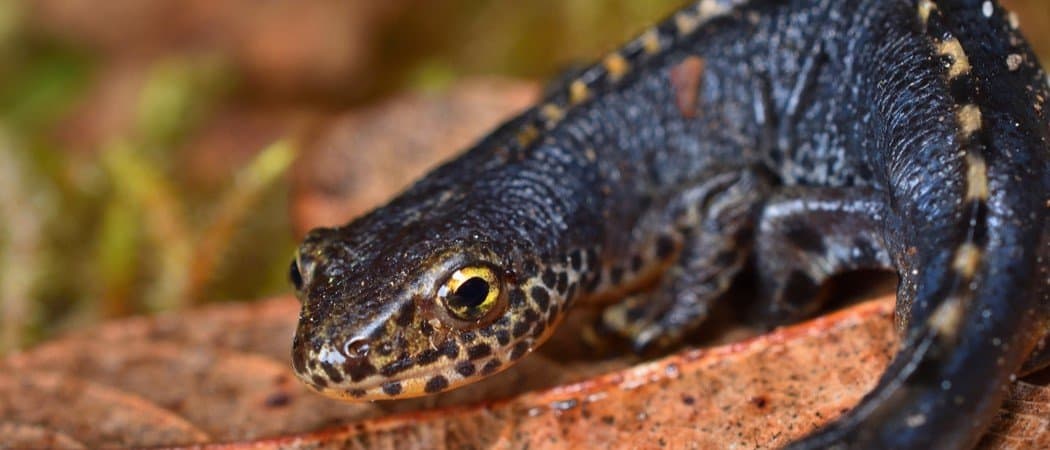
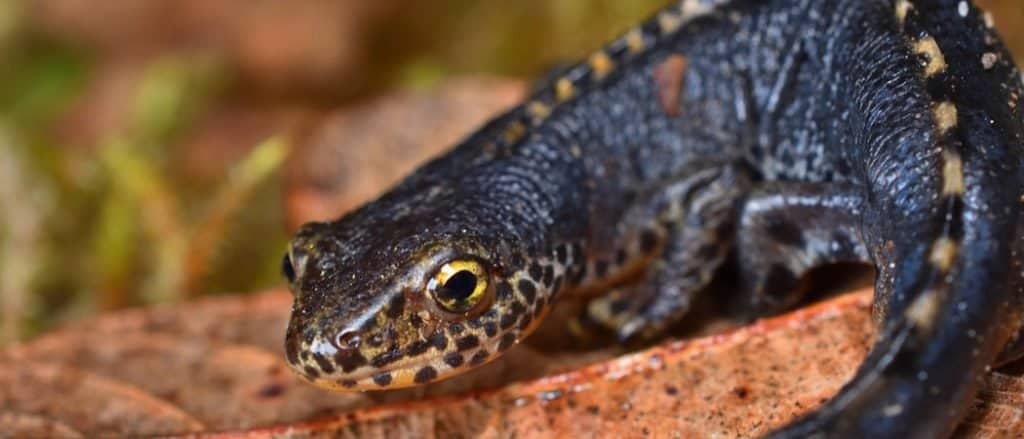







“Newts are able to regrow legs, eyes, intestines and other organs”
Newts are found in Asia, northern Africa, North America, and Europe. They are carnivores eating frogs’ eggs, tadpoles, slugs, worms, and other insects. Some types of newts display yellow, orange, and other bright color combinations. A female can have as many as 400 eggs. The lifespan of a newt is 2 to 15 years.
5 Incredible Facts About Newt!
- They can breathe underwater
- They release neurotoxin from their skin as protection against predators
- A newt is a type of salamander
- There are over 100 species
- They live on land and in the water
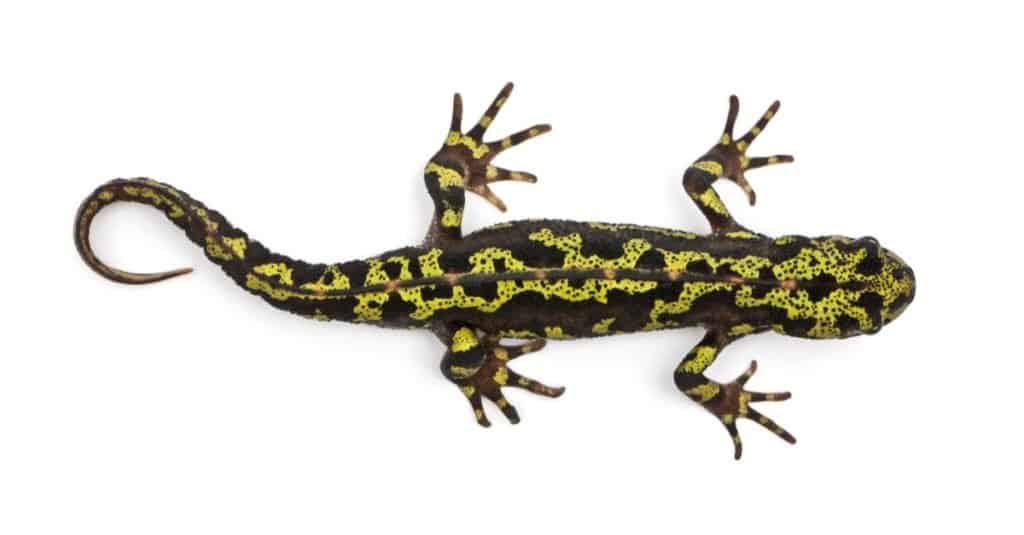
The unique color of the Newt skin, which is highly toxic, and precautions should be taken while handling one.
©Eric Isselee/Shutterstock.com
Scientific Name
Lissotriton vulgaris is the scientific name for one of these animals, the smooth newt. The Greek word Lissotriton translates to smooth (lisse) and triton (Triton, Greek god of the sea). The Latin word vulgaris means common. A young newt is known as an eft.
These slippery creatures belong to the Salamandridae family and the class of Amphibia.
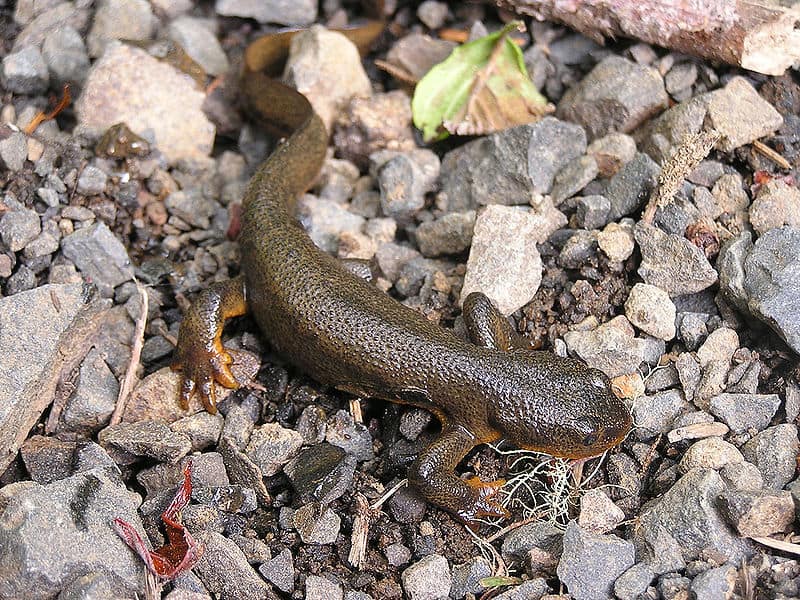
Red bellied newt common sight in Northern California
©Pete / Creative Commons – Original
Appearance & Behavior
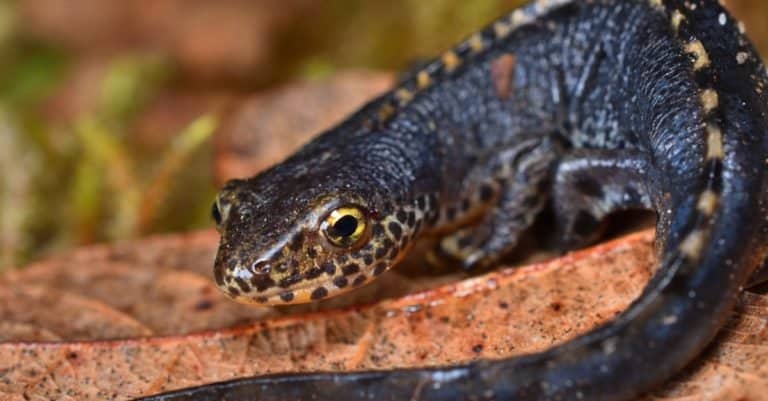
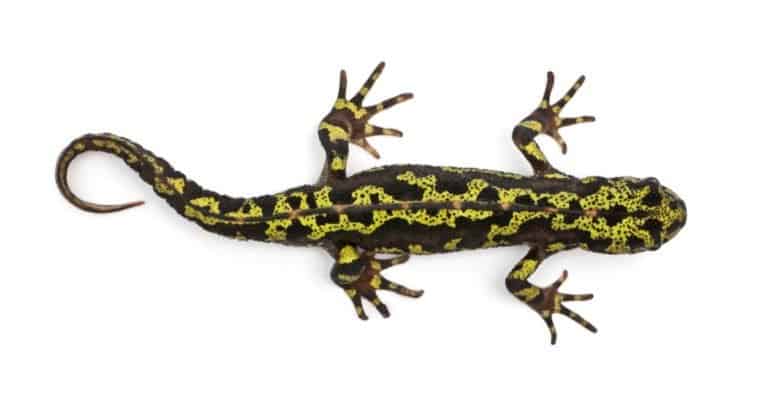
These animals have a long body and tail as well as four short legs with four toes. Their features make it look like a cross between a frog and a lizard.
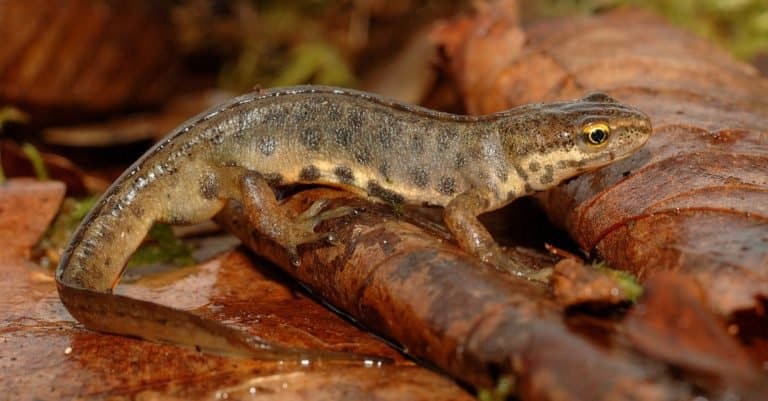
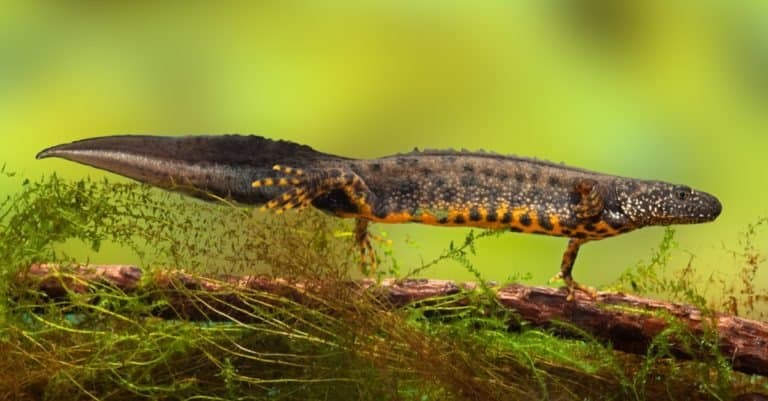
Different types of these animals display different color patterns. A Northern crested newt has a brown body with a yellow/orange belly. Adult red-spotted newts have yellow/green skin featuring red spots. The Palmate newt has brown skin with dark spots paired with a yellow or orange belly.
The size of the animal depends on its type. Generally, they are 3 to 4 inches in length. A 4-inch newt is about half the length of an unsharpened pencil. There are some species that are longer than 4 inches. One of the largest is the Great crested newt. It can grow to be 7 inches long!
Most of them weigh less than an ounce. An animal weighing half an ounce is approximately the same weight as a AAA battery.
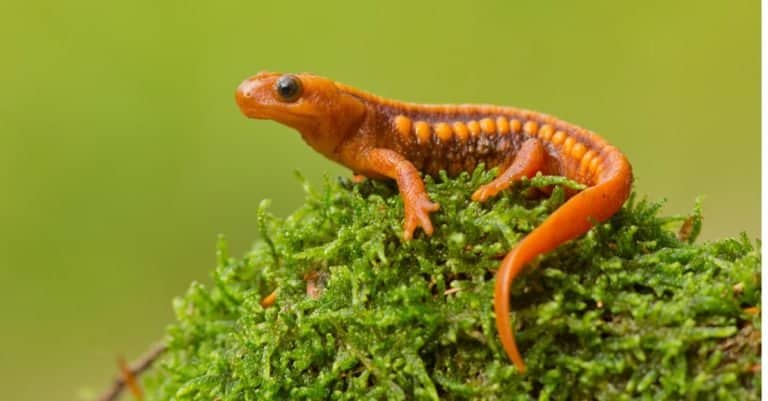
An animal with a green or brown body can blend in with its muddy environment as a defense against predators. In addition, the brightly colored belly serves as a warning that this amphibian is poisonous. This warning discourages some predators (but not all) from trying to capture them.
They are solitary animals except during the breeding season. They are shy and prefer to stay out of sight.
Newt vs Salamander
Checkout the similarities and differences that separate newts vs salamanders.
Similarities
First, both of these animals can release poison from their skin. Secondly, both are carnivores eating a variety of insects. Larger types of salamanders and newts can eat larger prey. In addition, both can have very colorful skin.
Differences
One of the major differences between these two animals is newts spend much of their life in the water while salamanders stay on land most of the time. Another difference is, generally speaking, newts have rougher skin than salamanders. All types of newts are categorized as salamanders, but not all salamanders are newts.
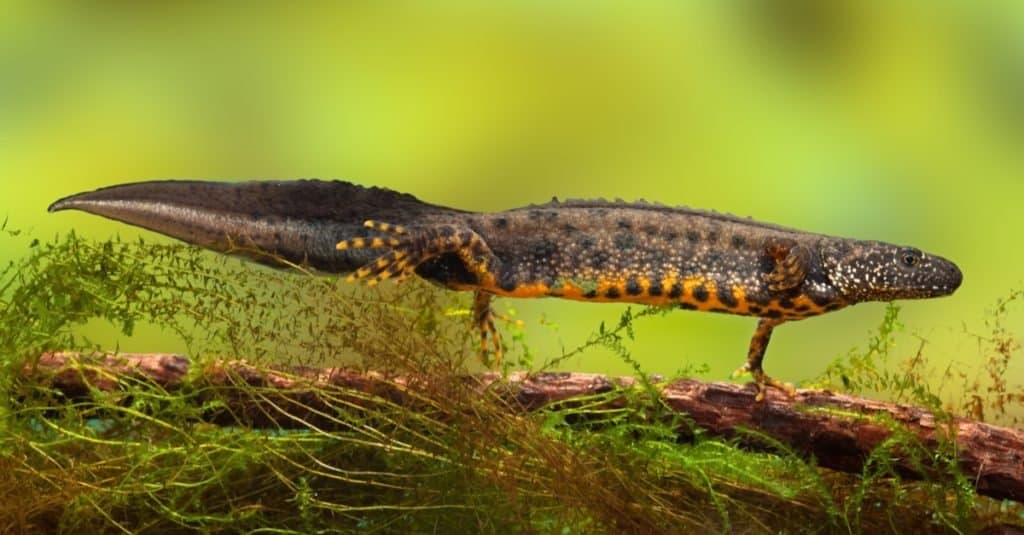
The body of the Newt resembles most amphibians and Salamanders.
©Dirk Ercken/Shutterstock.com
Habitat
These animals live in Europe, Asia, northern Africa, and North America. There are groups of them that live in specific regions. For instance, eastern newts live in the eastern part of North America. These animals include the red-spotted, the broken striped, the central, and the Peninsula newt. The Peninsula newt only lives on the Florida peninsula.
Different types of these animals have different habitats. Some spend more time on land than others. Eastern newts live in marshes, lakes, creeks, and ponds. Others like the Alligator newt that lives in Japan, lives in swamps, grasslands, and forests.
The animal’s webbed feet and paddle-like tail help it to swim around in its watery habitat.
These animals hibernate in the wintertime. They usually choose a spot beneath a log or under dense vegetation located near a body of water. In March or April, these amphibians migrate to the water for the breeding season. The female lays her eggs on vegetation growing in a stream, creek, pond, or lake.

Newts are mostly land dwellers and enter the water to breed.
©Tarquin / Creative Commons – Original
Diet
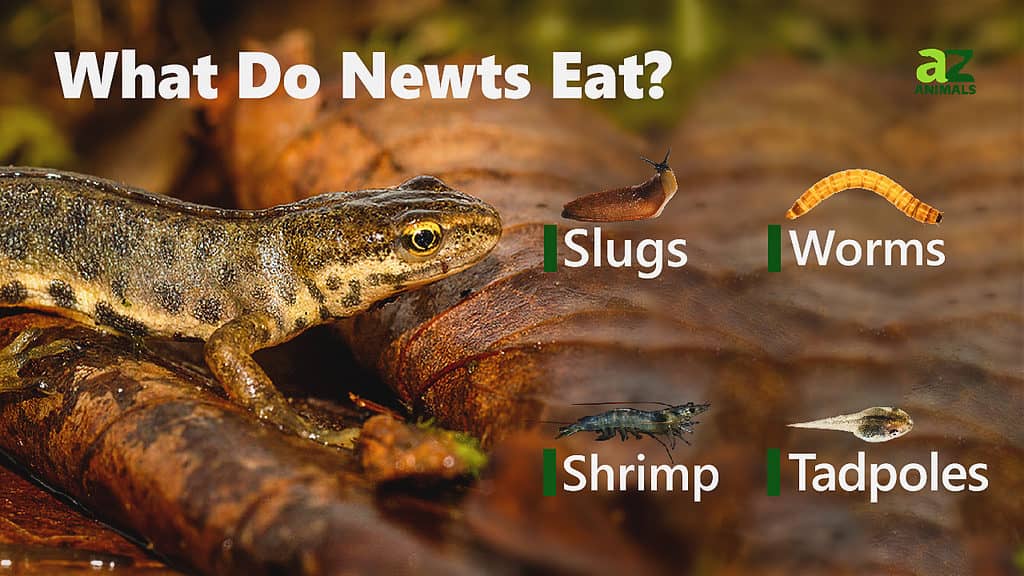
These animals are carnivores eating a variety of insects. An animal that is larger in size can eat larger insects.
Their usual diet includes insects, worms, tadpoles, slugs, frogs’ eggs, and beetles. They come out at night to search for food and are able to swallow their prey whole!
Salamanders are carnivores as well. They eat many of the same types of insects eaten by adult newts. However, some of the larger types of salamanders eat frogs and even mice.
Predators and Threats
Predators of these animals include foxes, snakes, birds, fish, and larger amphibians. These predators are more likely to eat the eggs or young larva, instead of full-grown adults.
A bird like a Blue heron may walk through a creek or pond and scoop their eggs out of the water to eat. Fish have easy access to their eggs and larvae because they share the same habitat.
Some snakes, such as the garter snake, have evolved and become resistant to the poison released by these animals. So, they are able to eat adults without an issue.
In some regions, water pollution is a threat to these animals. In Turkey, construction and deforestation are threats to their population in the Black Sea.
The official conservation status of the species Lissotriton vulgaris is Least Concern. Their population is categorized as stable.
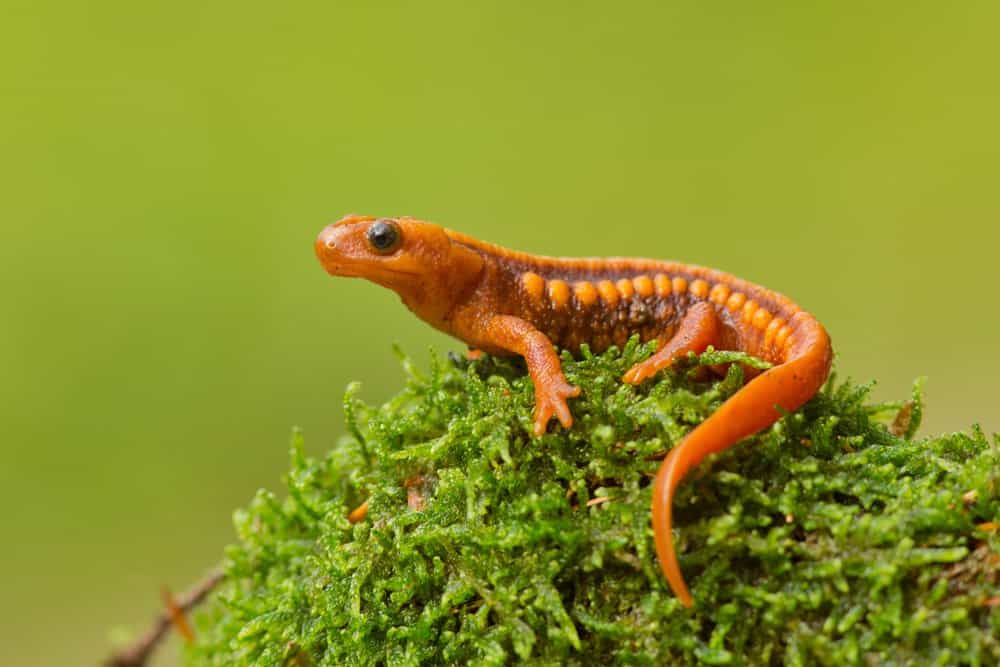
The bright colors of the newt serve as a warning to predators of their toxicity.
©Milan Zygmunt/Shutterstock.com
Reproduction, Babies and Lifespan
The breeding season of these animals starts in early spring. When looking for a mate, a male swims in front of a female and vibrates his tail. When a female and male pair up, a male releases sperm, and a female swims over it. The eggs are fertilized inside the female. A female lays up to 400 eggs on the leaves of plants growing in the water. Each egg is a little less than 2 millimeters in diameter. After laying the eggs, neither parent has anything to do with the young.
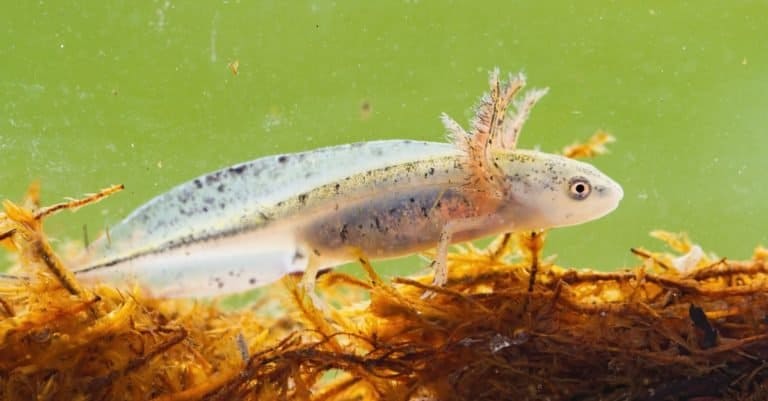
In 10 to 20 days, the eggs hatch into larvae also called tadpoles. The larvae survive on algae and small insects. Not surprisingly, the larvae are vulnerable to many predators including fish and birds. In 3 months, they become juveniles also called efts. Efts live on land for 2 to 3 years. After that, an eft goes back into a creek, pond, or stream to become a fully-grown adult that stays in the water most of the time.
Interestingly, the animal has the ability to breathe on land as well as underwater. While the animal is in the tadpole stage, it has gills to breathe underwater. An adult has lungs that allow it to breathe on land. Plus, an adult can take in oxygen through its skin while underwater. However, it does have to come up for air every few minutes!
The lifespan of these animals is 2 to 15 years. Some of them in captivity can live as long as 20 years. These amphibians are prone to developing skin fungus.
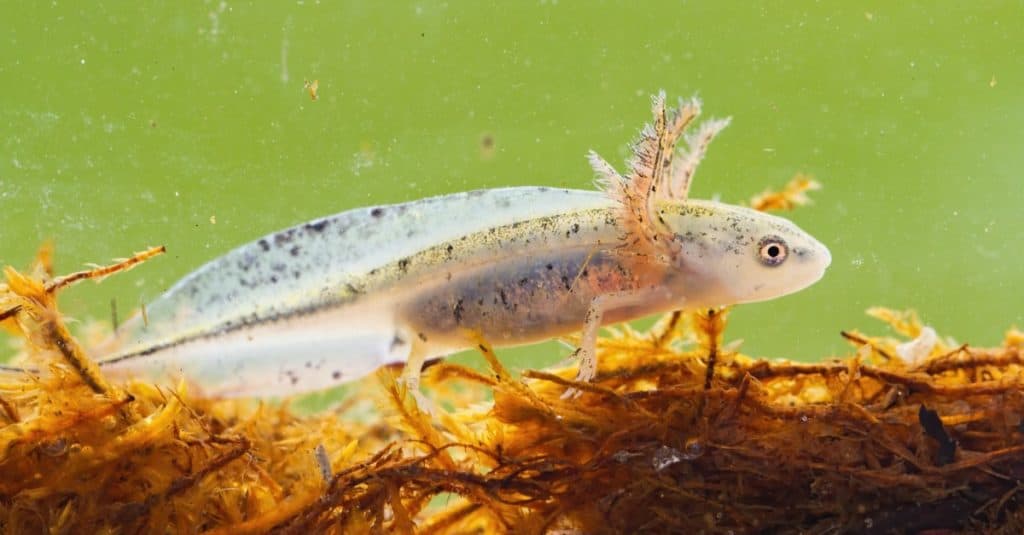
Newt larvae live in water until they are evolved enough to go on land.
©WildMedia/Shutterstock.com
Population
Though the exact population is unknown, its official conservation status is Least Concern. Their population is stable.
Evolution of Newts
Newts are a group of aquatic salamanders that have undergone a fascinating evolution over time. They are believed to have originated around 180 million years ago during the Jurassic period. While the exact lineage of newts is not entirely clear, scientists believe that they are most closely related to other salamander groups such as mud puppies and sirens. The process of newts evolving from terrestrial salamanders to aquatic ones is believed to have occurred over millions of years, as the climate and environment on Earth changed. This transition likely involved the development of adaptations such as webbed feet, fins, and gills, which allowed newts to live and thrive in water.
It’s also important to note that the term “newt” is often used to refer to members of the genus Triturus, which consists of several different species of aquatic salamanders found in Europe, Asia, and North America. The genus Triturus is the most known and studied among newts, but other genera such as Pachytriton, Cynops and Echinotriton are also considered newts.
Over the course of millions of years, newts evolved a number of unique characteristics that allowed them to thrive in aquatic environments. For example:
- Webbed feet and fins that helped them swim more efficiently
- Gills, which allowed them to breathe underwater
- The ability to regenerate lost body parts
As newts continued to evolve, they split into several different species. The most common species of newts include the European newt, the American newt, and the Chinese newt. Each of these species has its own unique characteristics, such as different color patterns and variations in size.
In recent times, the newt species have been facing the threat of habitat loss and pollution, which have led to their population decline. Conservation efforts are in place to protect these species and their habitats, but much more needs to be done to ensure their survival in the wild.
Types and Sub-Species
Eastern Newt – Eastern Newt are native to North America, commonly found in the Eastern parts of the country, spreading from New York State in the east to the Mississippi River in the west and the Gulf of Mexico in the south till Canada in the north. The Eastern Newt and its subspecies are known for having bright colors that warn predators of their toxicity. They are known for eating the larvae of mosquitoes and reducing the population of mosquitoes in the eastern part of the country.
Smooth Newt – Smooth Newt, also known as European Newt or Common Newt is widely found in Europe, and in parts of Asia. They are known for the changing nature of their skin. The adult Smooth Newt has a velvety-dry skin while they are on land, however, when they enter the water it becomes smooth. The color of their skin is brown with spots on the underside that ranges from orange to white depending on their habitat. The males are larger than females and they develop vivid skin color and a crest on their back during mating. Although they live on land, this species of newt enters the water to mate. They have been introduced in Australia, which did not have any native salamander species, as pets and have been found in the wild as well.
Yunnan Lake Newt – Once native to the Yunnan region of China, this species of newt, also known as Wolterstorff’s Newts are now considered extinct. These species was known for living in shallow water and lakes. They have distinct coloring, black body with bright orange-red ridge on the vertebrae, from top of the nose till the end of the tail, with bright spots lining the sides. During mating season the tail of the male newt turned blue. They are also known for having strong tendencies of neoteny. This species is considered to be extinct as none have been spotted since 1979.
Northern Crested Newt – Native to Europe, including UK and the central continental Europe, spreading all the way through parts of Russia to Spain. These species of newt are rather large and has distinct characteristics. Their color, a dark brown on the back and sides, and yellow or white on the belly with splotches of dark skin. During mating season the males develop jagged crest on the back and tail, they also attract female with a ritualistic display before depositing their spermatophore on the ground. The female then picks it up with their cloaca. Although this species of newt mainly live in wooded land, they move to aquatic environment during mating season.
California Newt – California Newt are endemic to the region of California and southern parts of the Sierra Nevada. They look quiet unique with a warty-slate colored skin on the back and a bright red skin underneath it, they are distinguishable from the Rough Skinned Newt by the color of the skin underneath their eye. The skin contains glands that secrete tetrodotoxin, a neurotoxin more potent that cyanide. The adult male and female enter the water where they had initially hatched, where after performing the ‘mating dance’, the male newt mounts the female newt, rubs the chin to her nose and drops a spermatophore to the substrate which is retrieved by the female later by her cloaca. Some males have been known to remain in the water post mating and some even cannibalize the eggs after they have been laid by the female.
Rough Skinned Newt – Native to North America, this species of newt are rather heavyset, known for radiating a bitter smell that warns other animals to stay away. Just like others of its species, the rough skin newt has highly toxic skin that can harm even a human if ingested. They have a rounded snout, a coarse-grainy skin of dark brown, olive or dark brown color, and the underside of the belly, head, legs and tail are orange to yellow. They look similar to the California Newt, all except the eyes when seen from above the head. The California Newt has eyes positioned in a way that makes them seem protruding, whereas the rough skinned newt has symmetrically placed eyes.
Red-bellied Newt – Red-bellied Newts are native to woodlands of California, they are comparatively smaller than the other Newts found in the region. They have similar grainy-coarse skin, dark brown body on the upper part and bright red under-side. The lack of yellow color in their eyes distinguish them from other Newts of the region. Red bellied newt are known for their remarkable homing abilities, which some suspect is due to their superior sense of smell. The male Newt develops smooth skin and flat tail during mating season. When faced by threat, these newts lift up their head and tail to display their red coloring, which serves as a warning to predators. Their skin is also highly toxic and potent enough to kill an adult human if ingested. Even their embryos and eggs are lethal to humans. Unlike the males, the female red bellied newt does not breed every year.
Texas Newt – Notophthalmus meridionalis, also known as the Texas newt or the black-spotted newt is native to the area between southern part of Texas and northern Mexico. The female of this species grows larger than the male species, they are olive green in color with black spots, the underside of their body ranges from yellow to orange. The prefer to live in habitat thick with vegetation and submerged in shallow-water. They have currently been declared Vulnerable by IUCN.
Alpine Newt – Native to continent of Europe, the Alpine Newt has been divided in to two distinct populations of four subspecies. The adult newts grow up to approximately 5 inch and develop a grey to blue color on the back and sides, a orange hue on the underside. The female skin is usually dull compared to adult males, who become more vibrant during mating seasons. These newts can survive in both high altitude and low or flatlands, they are land-dwellers but seek out water bodies for mating. Their eggs are usually laid and hidden among aquatic plants and leaves to keep them safe. The Alpine Newts that are divided into two classifications and 4 subspecies; the eastern and western alpine newts; Apennine Alpine Newts, Cantabrian Alpine Newts, and Greek Alpine Newts. These Newts have been introduced to New Zealand and Great Britain, where they have been marked as threat to the native population of frogs and other amphibians and spread disease. Although these Newts are in the Least Concern category in the IUCN’s Red List, the Alpine Newt population is definitely on the decline and has completely disappeared from certain areas.
Palmate Newt – Native to the Western Europe, namely the Iberian peninsula to Britain, the Palmate Newt are similar in appearance to the Smooth Newt. The adult of this species can grow up to almost 4 inches and have brown or olive skin with dark spots on their back, stretching from nose to tail tip as well as the sides. The underside is usually the shades of yellow to orange and the throat remains unspotted, unlike smooth newt. The Palmate species is usually nocturnal and inhabit gardens, marshes, forests and pastures alike. They breed in water and are on the Least Concern category in IUCN’S Red List.
Iberian Ribbed Newt: Native to the South-Western part of Europe known as the Iberian peninsula and the country of Morocco. They usually inhabit shallow ponds and streams, and can survive in temporary wetlands, such as flooded meadows, but prefer permanent water sources. They are light grey to dark brown in color, and have a distinctive pattern of bold yellow stripes running down the back and sides. They have the ability to change coloration to blend in with its environment. Its skin is covered in small, sharp barbs on the side, which are used to deter predators. They are highly toxic and can secrete a poisonous skin secretion to ward off predators. The Iberian ribbed newt also has the . During the day they tend to be darker in color to help absorb heat, and at night they are paler to help reflect the moonlight. The Iberian ribbed newt is listed as Near Threatened on the IUCN Red List due to habitat loss and degradation.
Italian Crested Newt: The Italian crested newt is found in parts of the Balkans and Italy and prefers living in deep, fish-free water bodies with plentiful aquatic plants. The adult newt measures up to 7 inches. It is a nektonic species, meaning that it swims freely and is independent of currents. It is typically found in ponds in northern Europe. They have yellowish-brown skin, with a black stripe along the back and yellow edges. It is relatively sensitive to pollutants and toxins, and releases noxious substance from its skin to deter predators. It is classified as Least Concern on the IUCN Red List.
Italian Newt: The Italian newt is found in parts of the Balkans, particularly Italy and Albania. They prefer living in shallow, fish-free bodies of water with plentiful aquatic plants and can grow up to 6 inches. It is a benthic, meaning that it spends most of its time in the bottom part of a body of water. It has yellowish-brown skin, with a black stripe along the back and yellow edges. The Italian newt is on Least Concern in the IUCN Red list, and is protected by various laws in Europe.
Southern Banded Newt: The Southern Banded Newt is a small amphibian native to the southeastern United States. They typically inhabit swamps, marshes, and other wetland areas, as well as slow-moving streams and rivers. They are semi-aquatic and spend most of their time in the water, but can also be found on land during the breeding season. Their skin color is typically brown or gray with darker spots or bands, which helps them blend in with their surroundings. They are not poisonous, but they do have a gland that secretes a mild toxin which they use as a defense mechanism against predators. They are not considered endangered, but their populations can be affected by habitat destruction and pollution. Overall, Southern Banded Newt is an important species for the ecosystem, playing a role in the food chain and helping to control the population of insects and other invertebrates.
Southern Crested Newt: Southern Crested Newts are found in the southern regions of Europe, including Spain, Italy, and Greece. They typically inhabit freshwater habitats such as ponds, lakes, and streams, and can also be found in damp terrestrial environments like wet meadows and woodlands. These newts are semi-aquatic, spending most of their time in the water but also coming on land to forage for food and mate. They have a distinct, rough skin that can vary in color from brown to green, and they have a crest of spiky skin on their backs, which gives them their name. Southern Crested Newts are toxic and use this as a defense mechanism against predators. The conservation status of Southern Crested Newts is considered to be vulnerable. Efforts are being made to protect their habitats and increase their populations.
Danube Crested Newt: As the name suggests the Danube Crested Newt is found in the Danube River Basin of Central and Eastern Europe. They are found in a wide variety of freshwater habitats, including rivers, streams, ponds, and wetlands. Their skin is rough and can vary in color from brown to green. They have a crest of spiky skin on their backs, and toxins to deter predators. Danube Crested Newt is considered to be endangered due to habitat loss and degradation, pollution, and over-exploitation.
Chinese Warty Newt: The Chinese Warty Newt is native to China and can be found in a variety of freshwater habitats, such as ponds, streams, and marshes. They have a unique, warty skin that can vary in color from brown to green and they have a crest of spiky skin on their backs. They are toxic and use this as a defense mechanism against predators. The Chinese Warty Newt has been listed as vulnerable by the IUCN.
Chinese Fire Belly Newt: The Chinese Fire Belly Newt is native to China and can be found in a variety of freshwater habitats such as ponds, streams, and marshes. They have a distinct, smooth skin that is usually brown or black, with vibrant red or orange underbellies, which gives them their name “Fire Belly”. They are not toxic, but they do use their bright colors as a defense mechanism to warn predators of their poor taste. Chinese Fire Belly Newt has been listed as Least Concern by the IUCN.
Carpathian Newt: The Carpathian Newt are found in the mountain ranges of Central Europe, particularly the Carpathian Mountains. They inhabit cold, fast-flowing streams and rivers in deciduous or mixed forest habitats. They are semi-aquatic and their skin color can vary from black to brown, with yellow or orange spots. These newts are highly toxic, producing a potent neurotoxin to deter predators. They also have a defense mechanism of puffing up their bodies to appear larger and more intimidating. The Carpathian Newt is considered to be a species of Least Concern by the IUCN.
Emperor Newt: Emperor newts are native to Japan and the Ryukyu Islands, typically found in damp, wooded areas such as forests and swamps. In the wild, they dwell in leaf litter, under rocks, and in burrows that they dig themselves. Emperor newts are active during the day and are known to be slow-moving creatures. Their skin color varies depending on the location, but they are generally brown or black with spots or stripes of orange or yellow. The skin of the emperor newt contains a toxin that acts as a defense mechanism against predators. They are considered to be a species of least concern by the IUCN. They are still often collected for the pet trade.
Japanese Fire Bellied Newt: Japanese Fire Bellied Newt are native to Japan and Korea. They typically inhabit slow-moving streams, ponds, and marshlands with a muddy bottom and plenty of vegetation. In the wild, they dwell in the aquatic environment and come to land only during the breeding season. They are known for their bright, orange-red belly, which is used as a warning coloration to predators. Their skin also secretes a toxic substance, which makes them unpalatable to many predators. As a defense mechanism, they can puff up their bodies to appear larger and more intimidating to potential threats. The Japanese Fire Bellied Newt is not currently considered endangered, but their populations have been declining due to habitat loss and pollution. It is considered as least concern by IUCN.
Black Knobby Newt: The Black Knobby Newt, or the Californian black salamander, is native to California, USA. These newts typically inhabit coastal streams and rivers, as well as nearby grasslands and woodlands. They are primarily active at night and spend most of their time in or near water. Their skin is dark black or brown in color and covered in small, raised bumps, giving it a distinctive, knobby appearance. These newts are also known to be toxic, producing a potent venom that is used as a defense mechanism. Despite this, their conservation status is currently listed as least concern by IUCN.
Sardinian Mountain Newt: The Sardinian Mountain Newt are native to the mountainous regions of Sardinia, Italy. They are rock dwellers in the alpine habitats and are typically found near streams or other bodies of water. They are active during the night and are known to be terrestrial, spending most of their time on land. The Sardinian Mountain Newt’s skin color can vary from dark brown to black, with a distinctive orange or red belly. These newts are toxic and use this as a defense mechanism against predators. The Sardinian Mountain Newt has been listed as a vulnerable species by the IUCN due to habitat loss and degradation caused by human activities.
Corsican Mountain Newt: The Corsican Mountain Newt, also known as the Euproctus montanus, is native to the mountainous regions of Corsica, France. They like rocky, high altitude habitats such as alpine meadows, shrublands and forests. These newts are known for their distinctive skin coloration, which ranges from dark brown to black with yellow or orange spots. They have a toxic skin secretions and are active during the day. Their conservation status is considered “Least concern” by the IUCN Red List.
Yellow-Spotted Newt: The Yellow-spotted Newt (Taricha granulosa) is native to western United States and Mexico. They are found in forests, meadows, and streams, where they can be found hiding under rocks and logs. They are known for their bright yellow spots, which are a warning to predators of their toxic skin. They are also active during the day and night, which is unusual for newts. They have a defense mechanism which is a toxic skin to protect them from predators. As per conservation status, they are considered as a species of least concern by the IUCN.
Edough Ribbed Newt: The Edough Ribbed Newt are native to Europe and Asia. These small sized newts typically inhabit wetlands, such as marshes, ponds, and slow-moving streams. They spend most of their time on land, but return to the water to breed. They are nocturnal animals and are most active at night. Their skin is smooth and slimy, and they can change color depending on their environment, with shades of brown, green and black. These newts are not toxic, but they do have a defense mechanism in the form of a gland that secretes a bitter-tasting liquid to deter predators. They are considered least concern by the IUCN.
Himalayan/Crocodile Newt: The Himalayan/Crocodile Newt (Tylototriton verrucosus) is found in the Himalayan region of India, Bhutan, and Nepal. They dwell in freshwater streams and rivers, and can also be found in nearby terrestrial habitats such as forests and grasslands. They spend most of their time on land, and only return to water for breeding. Their skin color ranges from dark brown to black with orange or yellow spots, which serves as a warning to potential predators of their toxicity. The Himalayan/Crocodile Newt is considered as near threatened species by IUCN.
In the Zoo
- Visit the many types of these animals on display at the San Diego Zoo
- Discover the Peninsula newt at the Jacksonville Zoo and Gardens
- The Detroit Zoo has an exhibit of these animals that’s not to be missed!
Newt Pictures
View all of our Newt pictures in the gallery.

Tobias Hauke/Shutterstock.com
Sources
- Wikipedia / Accessed February 10, 2021
- Young People's Trust for the Environment / Accessed February 10, 2021