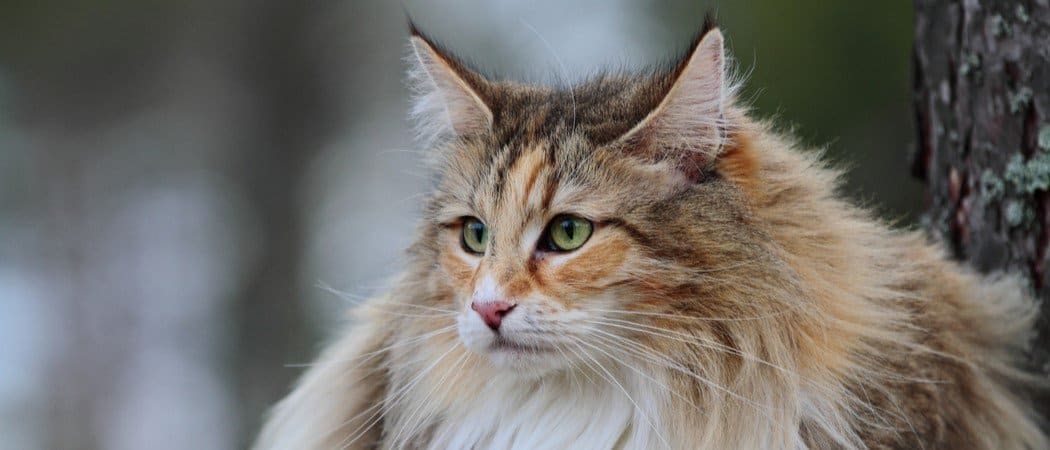
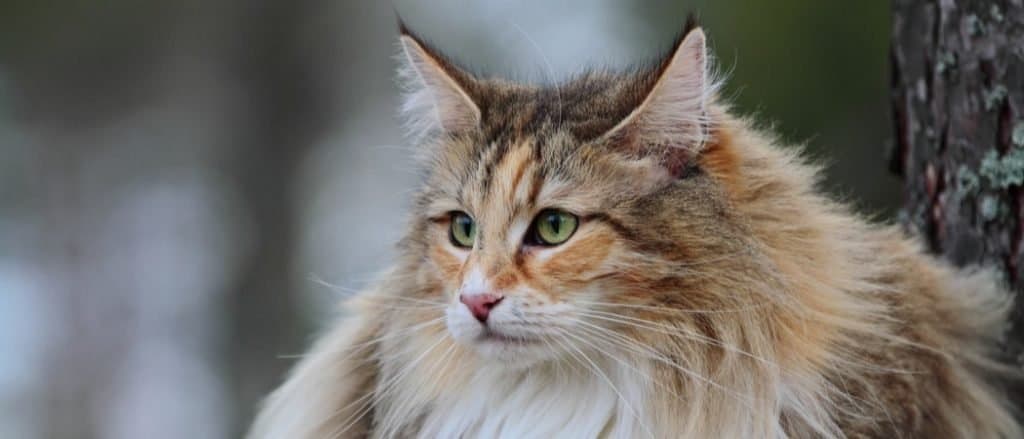
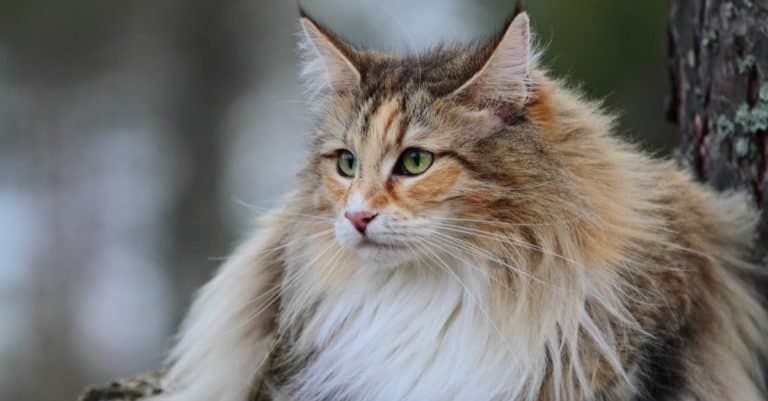




The big-boned and heavily furred Norwegian Forest cat is often mistaken for the similarly built Maine Coon, but it has a big personality all its own. These cats get along well with just about everyone, but they’re also protective of their territory and endlessly inquisitive.
Breed History
There are a couple of theories as to the origins of the Norwegian Forest cat. One is that it’s descended from black and white British Shorthair cats that were brought by Vikings to Norway from Great Britain after 1000 A.D. Or they could have come from long-haired cats brought to Norway by Crusaders in the 1300s. Other ancestors could be the Turkish Angora or the Siberian, both long-haired breeds. The Norwegian Forest cat does appear in Norse mythology, called “skogkatt,” a beloved animal of the Norse goddess Freyja.
These cats were likely used as work cats by Scandinavians, especially to keep down rodent populations on farms or even on ships. It wasn’t until the 20th century that the breed gained recognition from organizations such as the Norwegian Forest Cat Club formed in its honor in 1938. This club sought to protect the breed from near extinction after having been cross-bred with free-ranging domestic cats during WWII. Norwegian Forest cats were also dubbed the official cats of Norway by King Olav V in the 1950s. By the 1970s, the breed was registered in Europe, and in America in 1994.
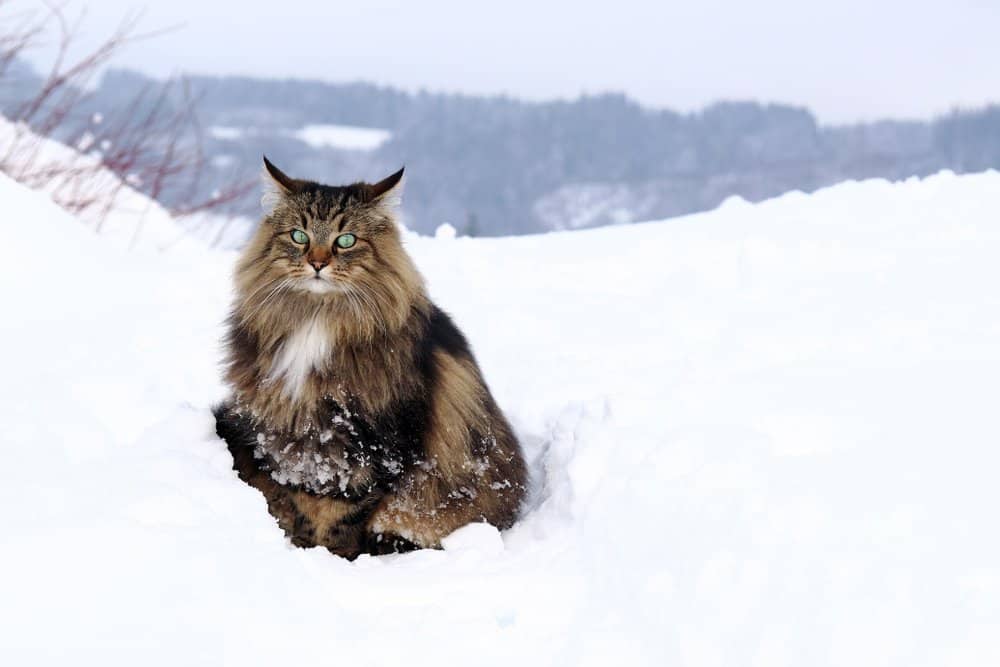
The Norwegian Forest cat could be an ancestor of the British shorthair brought to Norway by Vikings after 1000 A.D.
©Astrid Gast/Shutterstock.com
Traits: What to Know Before You Buy
If you’re considering buying a Norwegian Forest Cat, consider these factors before making the final decision.
- Comparing the Norwegian forest cat size and the normal cat, they are large and active cats. Prospective pet parents should either be ready to play or make sure that their new pet has plenty of room to move.
- Their thick coats require regular grooming, but wegies tend to enjoy the process of being groomed. Otherwise, their thick fur can become tangled and knotted.
- The Norwegian Forest Cat is especially prone to a condition called hypertrophic cardiomyopathy, which causes the heart to enlarge and can be fatal.
Personality
The Norwegian Forest is bred for some pretty harsh conditions, but it hasn’t hardened them. Wegies tend to be some of the most sociable felines around, and their propensity for bonding closely with the people in their household makes them an ideal pet for a family.
That said, the heart of a hunter still resides in the chest of the Wegie, and these felines are serious about their playtime. When it comes to chasing toys or laser pointers, a Wegie invests completely in the hunt. But those same natural instincts make them inherently territorial.
That shouldn’t be a problem for most families, as those territorial sensibilities mostly manifest as regular patrols. Wegies tend to be sociable with other domesticated animals, and their active personalities allow them to get along well with puppies and dogs.
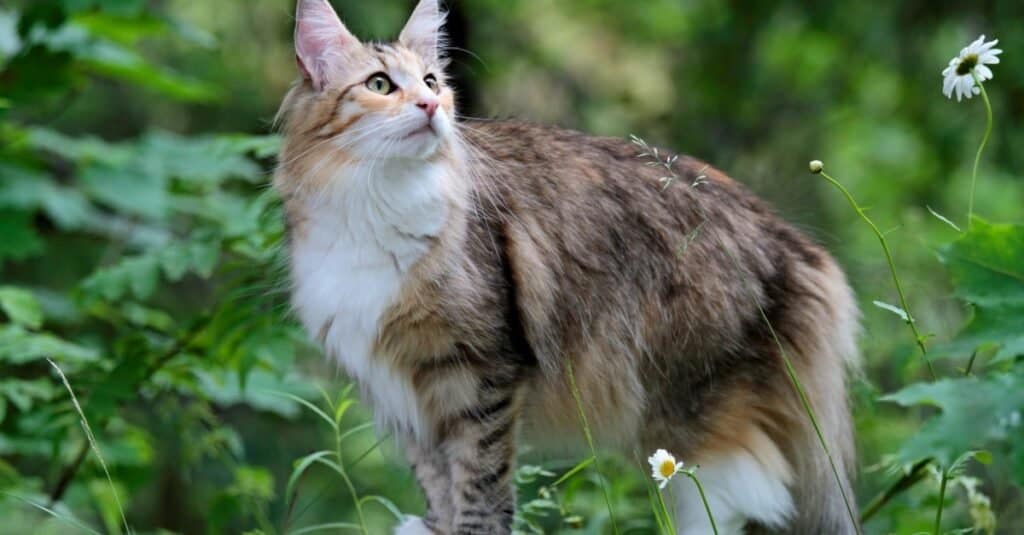
Wegies are some of the most sociable felines around, making them ideal family pets.
©iStock.com/t:undefined undefined
Size and Weight
A male Norwegian Forest cat will typically weigh somewhere between 12 and 20 pounds, while females tend to be somewhat slighter, with a weight that ranges from 8 to 18 pounds. That puts the bigger members of this breed at roughly two times the size of the average cat. You can generally expect a fully grown adult to have a length of 12 to 18 inches and a height of up to a foot.
That’s big, but it doesn’t take the cake for the largest domesticated cat breed. A Maine Coon male will usually weigh anywhere between 15 and 26 pounds, and Ragdoll cats are also known for hitting weights in that range. Stewart Gilligan, the largest Maine Coon in existence, measured a full 48.5 inches from tail to nose.
But just because your wegie doesn’t seem large now doesn’t mean that it’s not going to get there. While cats can generally be considered to reach adulthood around the time of their first birthday, it can take up to five years for a Norwegian Forest Cat to reach its full size.
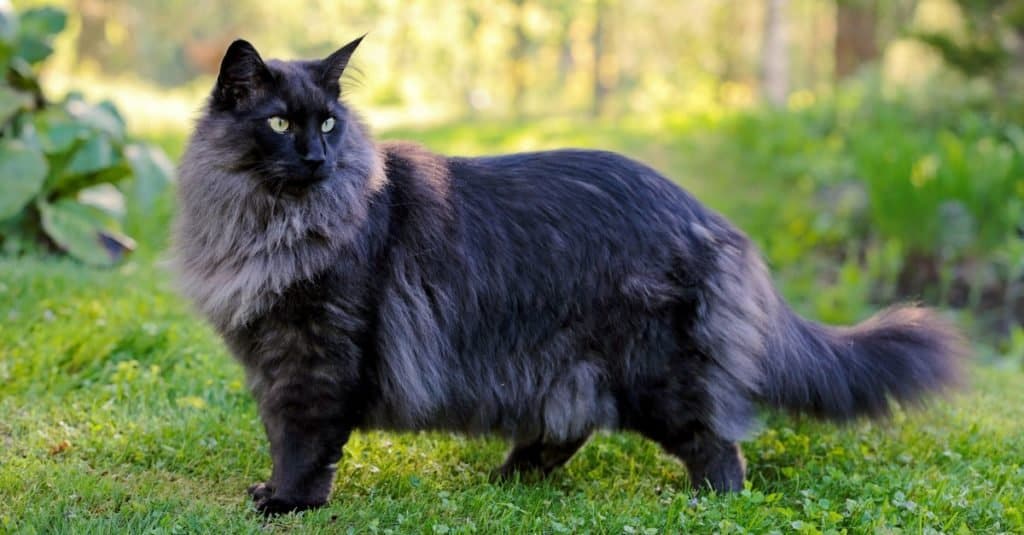
When comparing Norwegian forest cat size vs normal cat, wegies can typically be twice as large.
©Elisa Putti/Shutterstock.com
Price
Norwegian Forest Cats are a common sight in Scandinavia, but they’re still relatively scarce in the United States and other parts of the world. That scarcity results in a relatively high price tag for a Norwegian Forest cat with papers. Depending on individual circumstances, an average adult wegie will cost about $900 to $1,500.
That’s not accounting for wegies who are from prestigious pedigrees. The breed is relatively rare, and that raises the value of a good bloodline significantly. You can expect to spend up to $4,000 for a purebred of high stock, as individual breeders tend to hold more leverage than they do with more common breeds.
But if your main reason for wanting a wegie is their personality rather than their paperwork, shelters and rescues can offer far more viable options. Norwegian Forest cats that have been bred with Maine Coon cats and other long-haired breeds are common and maintain their mischievous but loving dispositions. The processing fees involved with adoption will typically cost around $150 to $200.
Just keep in mind that there might be additional expenses involved with travel. Since wegies are few and far between, you may have difficulty finding breeders near you. Most breeders won’t post prices online and may require a waiting list, so be sure to do your due diligence once you’re ready to add a wegie into your household.
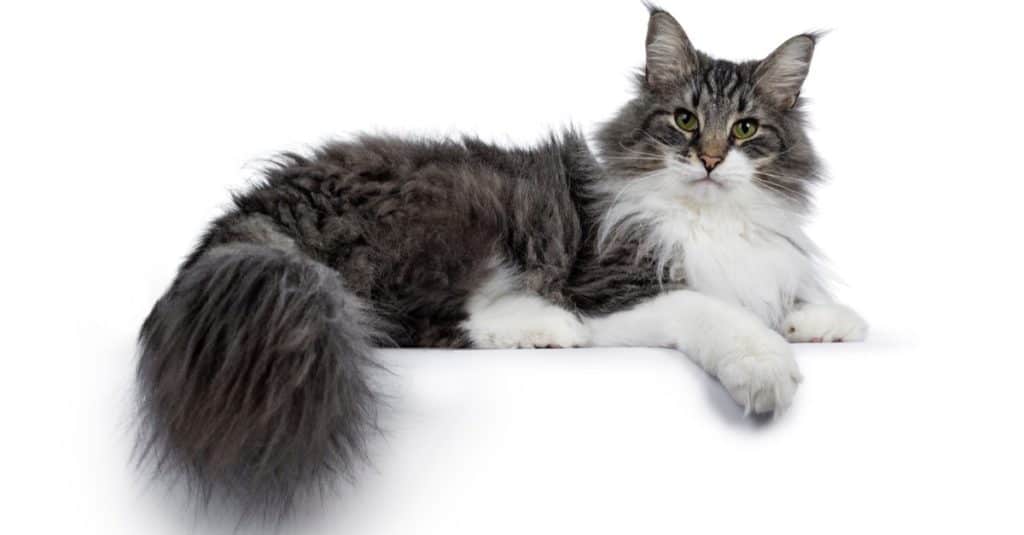
Given their rarity outside of Scandinavia, you can expect to spend up to ,000 for a purebred Norwegian Forest cat of high stock.
©Nynke van Holten/Shutterstock.com
Kittens
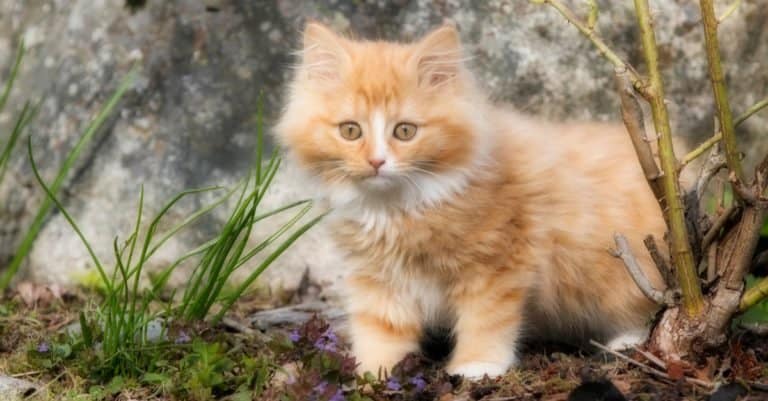
Wegie kittens tend to be a lot like wegie adults — large, playful, and loyal to their humans. Their coats develop early, and a wegie kitten will already look quite large at three months from the volume of its fur alone. Grooming habits should be developed early because they’ll continue to be a necessity throughout life.
Norwegian Forest Cats are highly curious kittens who like to get as high as possible and poke through cabinets and drawers even more than the traditional cat. Unusually, they don’t mellow out that much as adults and maintain that sense of curiosity and playfulness throughout their entire lives. They can adapt well to children and other pets at any age, but they form especially loyal bonds when they’re still kittens.
Like most cats, the wegie will hit puberty around the age of a year, although it can happen as early as six months in some early bloomers. But just because they’ve hit puberty doesn’t mean they’ve stopped growing. It can take five years for a Norwegian Forest Cat to reach its full size.
In terms of litter size, Norwegian Forest Cats aren’t especially different than other cats. You can expect a litter size of four kittens on average. While the litter size is the same, the kittens themselves are larger than their average feline counterparts.
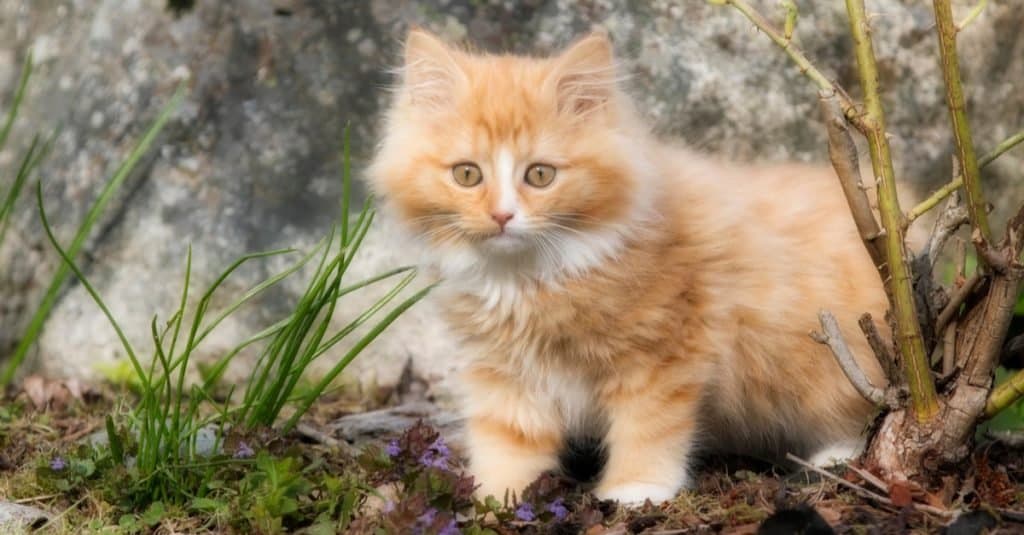
It can take five years for a Norwegian Forest Cat to reach its full size.
©Rolf E. Staerk/Shutterstock.com
Lifespan
The average lifespan of the Norwegian Forest Cat isn’t much different from that of the traditional domesticated cat, although it is a bit narrower and a bit longer. While an indoor cat is generally expected an age between 10 and 15 years, wegies tend to live between 14 and 16 years.
Two factors that mute the lifespan of this breed are their genetic predisposition to heart and kidney diseases. Glycogen storage disease type IV is more common in this breed than in the average cat, but although it can be lethal, it’s important to remember that it’s still very rare.
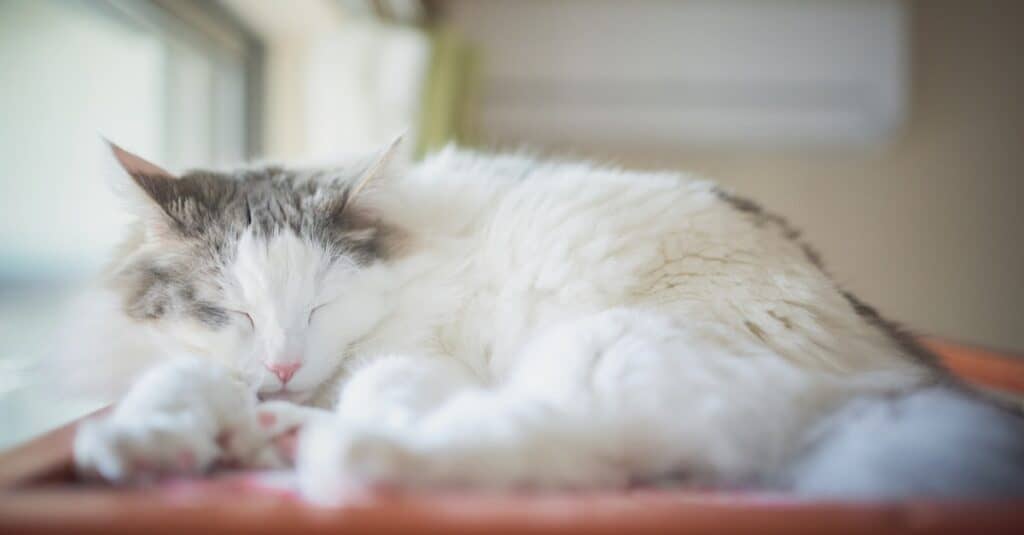
Norwegian Forest cats have a life expectancy of 14 to 16 years on average.
©catographer.mj/Shutterstock.com
Types of Norwegian Forest Cat
Norwegian Forest cats are distinguished from one another by their thick, gorgeous coats, which come in a variety of patterns and colorings. Some of the fur patterns include van, harlequin, bicolor, tortoiseshell, calico, tabby, or solid. Some typical types are:
- White Norwegian Forest Cat – Solid white coat.
- Black Norwegian Forest Cat – Solid black coat.
- Red Norwegian Forest Cat – Varied orange, flame, or red colors in patterns.
- Cream Norwegian Forest Cat – Upper coat cream, possible patterns, with lighter undercoat.
- Shell Cameo Norwegian Forest Cat – White undercoat with shell colors on the upper body.
- Blue Gray Norwegian Forest Cat – All fur is the blue-gray color.
- Chinchilla Silver Norwegian Forest Cat – White undercoat with a black and white mixed top coat, giving it a silver look.
- Shaded Silver Norwegian Forest Cat – Glacier white undercoat with black tipping at points of ears, tails, heads, and across the spine.
- Chinchilla Golden Norwegian Forest Cat – Undercoat of light cream tones with gold tipping across the head, tail, back, and sides.
- Shaded Golden Norwegian Forest Cat – Warm cream coat with black tipping, heavier than the Chinchilla Gold.
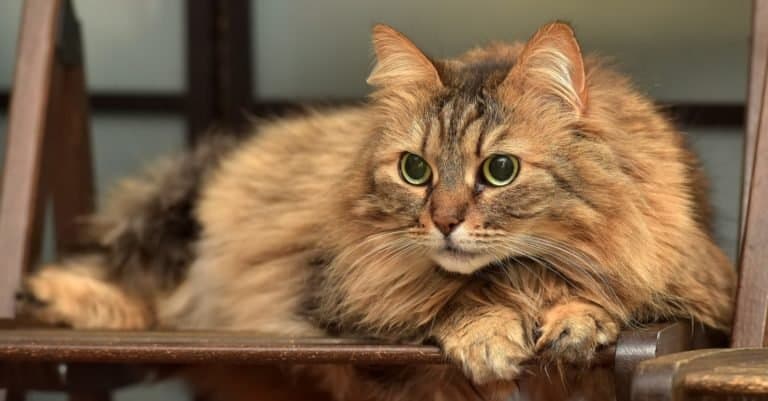
The Norwegian forest cat coat comes in an array of colors and patterns. Coat colors include white, black, blue, red, cream, silver, and golden. This fluffy cat’s coat can also have solid, bicolor, tortoiseshell, calico, and tabby fur patterns. Their eyes are shades of green, gold, or copper — or a shade somewhere between all three.
Breed vs. Mixed
The CFA establishes many standards for a purebred Norwegian Forest cat — primarily their oversized weight and length, their well-muscled body, and their unique double coat designed to insulate against water. The problem is that their builds and their personality are very similar to the Maine Coon and might be otherwise indistinguishable from the average person.
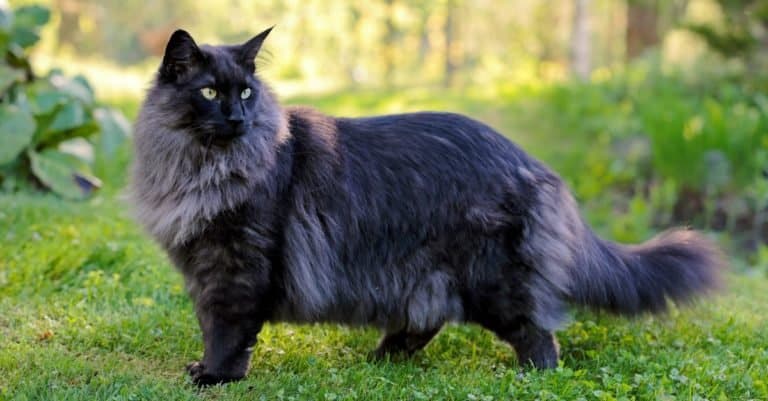
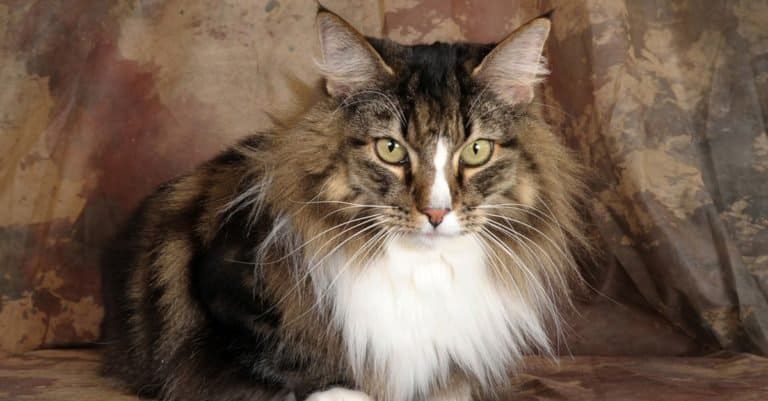
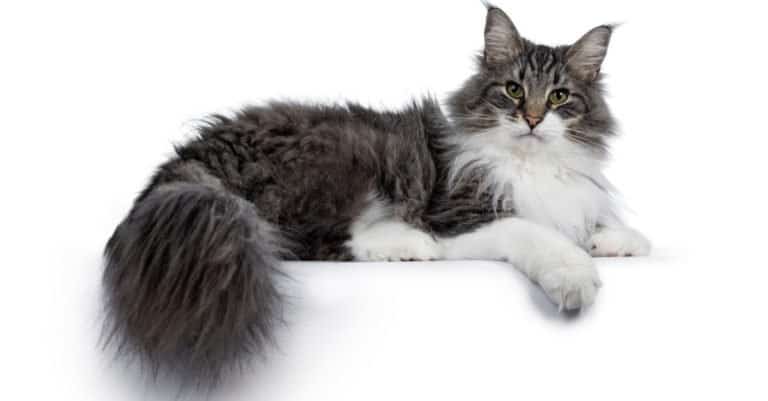
That said, you shouldn’t discount the breeding of a Norwegian Forest cat simply because it doesn’t have the same black and white markings that this breed is commonly seen with. Wegies come in a wide variety of colors and patterns, and while black or black with white are common patterns, you’ll also find tortoiseshell, tabby, and smoke wegies.
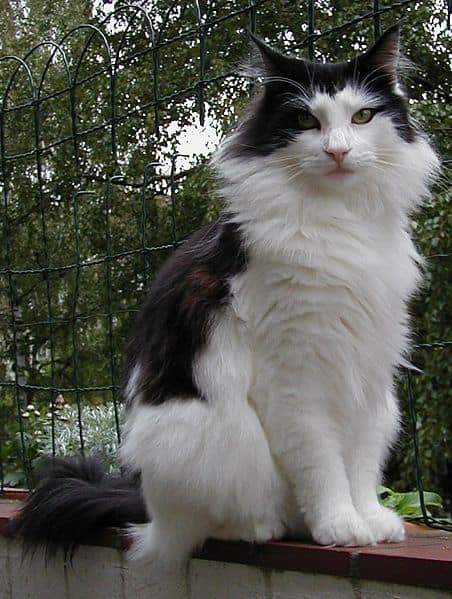
While black or black with white are common patterns, you’ll also find tortoiseshell, tabby, and smoke wegies.
©Bfe at the German language Wikipedia / Creative Commons – Original
Norwegian Forest Cat vs. Maine Coon
Just because these two cats are commonly mistaken for one another doesn’t mean that you can’t tell them apart. Norwegian Forest cats have narrower muzzles fit to a triangular nose, while Maine Coons have broader and more leonine features. Wegies also have long, bushy tails, similar to but sometimes less voluminous than those of Maine Coons. But the best way to determine the difference between the two may be personality. Norwegian Forest cats aren’t entirely mute, but they’re much more soft-spoken than the loud and conversational Maine Coon.
Norwegian Forest Cat Pictures
View all of our Norwegian Forest Cat pictures in the gallery.

Elisa Putti/Shutterstock.com
Sources
- Cat Fancier's Association / Accessed June 27, 2021
- Cat Breeds List / Accessed June 27, 2021
- Hills Pet / Accessed June 27, 2021
- TICA / Accessed June 27, 2021
- Local Kittens for Sale / Accessed June 27, 2021
- How Stuff Works / Accessed June 27, 2021
- Maine Coon / Accessed June 27, 2021