

O
Species Profile

Opossum

Didelphidae

America's adaptable marsupials
Amy / Creative Commons

Opossum Distribution

Click a location to explore more animals from that region

Loading map...

Size Comparison

Human 5'8"
Opossum 6 in

Opossum stands at 9% of average human height.

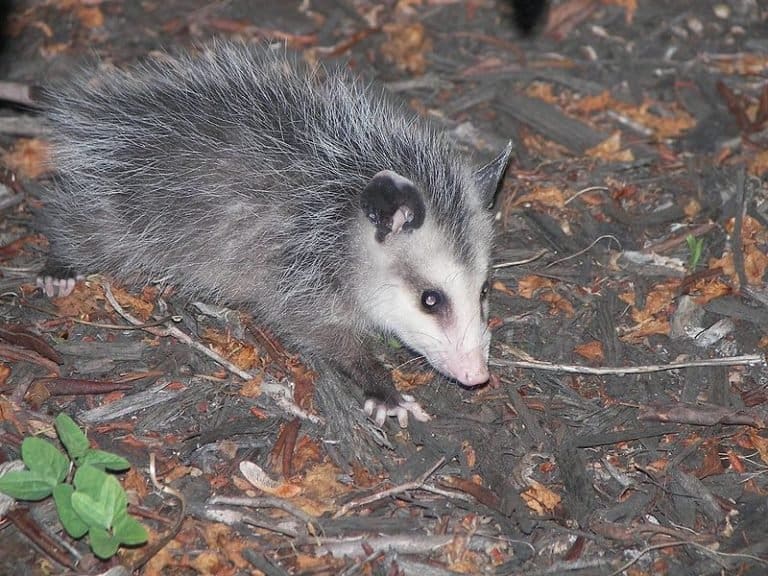
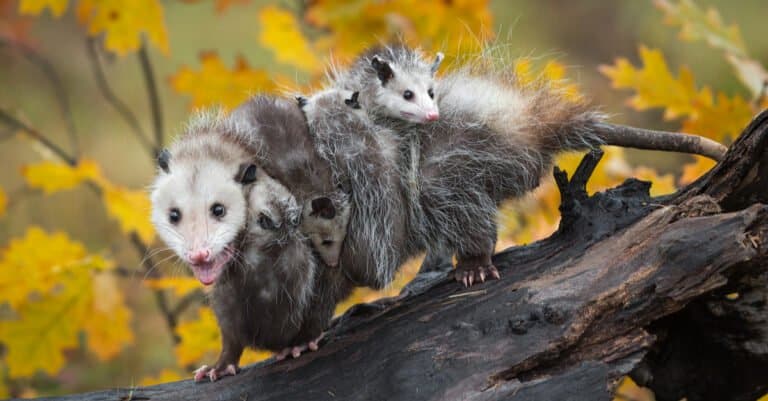
Young Opossum looking for food

At a Glance

Family Overview This page covers the Opossum family as a group. Stats below are general traits shared across the family.
Also Known As possum, tlacuache, zarigüeya, gambá
Diet Omnivore
Activity Nocturnal+
Lifespan 1.5 years
Weight 7 lbs
Status Not Evaluated
Did You Know?

Didelphidae is the largest living marsupial family, with many dozens of species across the Americas.

Scientific Classification

Family Overview "Opossum" is not a single species but represents an entire family containing multiple species.

Opossums are New World marsupials (family Didelphidae) found from southern Canada through much of Central and South America. They are typically omnivorous, opportunistic foragers, with many species being nocturnal and at least partly arboreal. Didelphidae is the largest living marsupial family and represents a major lineage of American marsupials.

Kingdom
Animalia
Phylum
Chordata
Class
Mammalia
Order
Didelphimorphia
Family
Didelphidae

Distinguishing Features

  • Marsupials: females typically have a pouch (variable development among species) and give birth to very underdeveloped young
  • Long, often hairless prehensile tail (especially in more arboreal species)
  • Pointed snout, prominent whiskers, and many teeth (notably high tooth count among mammals)
  • Nocturnal/crepuscular habits common; generalized omnivorous diet
  • Defense behaviors may include hissing, showing teeth, and thanatosis ('playing dead') in some species

Physical Measurements

Males and females differ in size

Height
6 in (2 in – 10 in)
Length
1 ft 10 in (5 in – 3 ft 3 in)
1 ft 11 in (5 in – 3 ft 5 in)
Weight
3 lbs (0 lbs – 14 lbs)
2 lbs (0 lbs – 9 lbs)
Tail Length
10 in (2 in – 1 ft 10 in)
11 in (1 in – 1 ft 10 in)
Top Speed
9 mph
running

Appearance

Primary Colors
Secondary Colors
Skin Type Dense mammalian fur over body; tail typically sparsely furred to naked with visible scales; ears often thin-skinned and lightly furred.
Distinctive Features
  • Measurements (family-wide range): head-body ~7-50 cm; tail ~5-55 cm; mass ~0.01 kg to ~6 kg.
  • Lifespan range: commonly ~1-3 years in the wild; up to ~4-7 years reported in captivity, varying by species.
  • Elongated, pointed snout with prominent vibrissae; many have strong musky scent glands.
  • Large, often naked-looking ears; dark facial markings are common but not universal.
  • Long tail; many species have a prehensile tail, while others are less prehensile or mostly terrestrial.
  • Hind feet typically have an opposable, clawless hallux aiding climbing in arboreal species.
  • Marsupium (pouch) varies widely: well-developed in some (e.g., Didelphis), reduced or absent in others.
  • Behavior/ecology generalizations: mostly nocturnal and solitary; diets range from omnivory to insectivory/carnivory, with opportunistic scavenging in some species.
  • Habitat use varies from arboreal forest specialists to terrestrial generalists; a few are semi-aquatic (notably the water opossum).
  • Geographic scope: New World only, from southern Canada through Central and South America; not Australasian 'possums'.

Sexual Dimorphism

Sexual dimorphism is generally mild to moderate across the family. Males are often larger and heavier with more robust heads and canines, while females bear the pouch/teats (pouch size varies by species) and are typically slightly smaller.

  • Often larger body mass and longer skull than females within a species
  • More pronounced canines and broader head/neck in many taxa
  • Testes often conspicuous; males may have stronger odor from scent glands
  • Pouch and teat arrangement adapted for nursing; pouch may be reduced or absent
  • Typically slightly smaller and more lightly built than males in many species
  • Nipple number and pouch development vary substantially across genera

Did You Know?

Didelphidae is the largest living marsupial family, with many dozens of species across the Americas.

Sizes range from mouse-sized species (~10 g) to the largest opossums (up to ~6 kg).

Most have a low body temperature and strong innate immune responses compared with many other mammals-part of why they can tolerate some pathogens and venoms better than expected.

Many species are nocturnal omnivores, shifting diets seasonally from insects and fruit to carrion and small vertebrates.

Several lineages evolved prehensile tails and opposable "thumb-like" big toes for climbing, but others are more ground-focused.

They're marsupials: newborns are tiny and develop further in a pouch (well-developed in some species, reduced in others).

"Opossum" (Americas) is not the same as Australasian "possums," which are unrelated marsupials in a different order (Diprotodontia).

Unique Adaptations

  • Marsupial reproduction with extreme altricial young: Gestation is short, and tiny newborns crawl to teats; developmental patterns and pouch structure vary across genera (from well-formed pouches to reduced folds).
  • Prehensile tail in many species: Acts as a gripping, balancing "fifth limb" for climbing; length and strength vary widely, and not all didelphids have strongly prehensile tails.
  • Opposable hallux (big toe) without a claw: Common in arboreal forms, improving grip on branches; degree of climbing specialization differs among lineages.
  • Remarkably generalized dentition: Many have many teeth (typical marsupial dental pattern) suited to an omnivorous diet-useful for switching food sources as seasons change.
  • Physiological resilience: Relatively low basal metabolic rate and body temperature (compared with many placental mammals) and notable tolerance to some toxins/venoms reported in several species-though this varies and is not absolute.
  • Ecological "all-rounder" toolkit: Strong sense of smell, flexible digestive strategies, and behavioral plasticity help many species occupy disturbed habitats as well as intact forests.

Interesting Behaviors

  • Opportunistic foraging: Across the family, many species eat a flexible mix of insects, fruit, nectar, carrion, eggs, and small animals; some specialize more on insects or fruit depending on habitat.
  • Nocturnality is common: Many didelphids are most active at night, using smell and hearing heavily; a few show more crepuscular or variable activity patterns.
  • Arboreal-terrestrial spectrum: Some genera (e.g., woolly opossums, many mouse opossums) are highly arboreal, while others (e.g., some short-tailed opossums, larger Didelphis) use the ground extensively-often doing both within a single night.
  • "Playing dead" (thanatosis): Best known in Virginia opossums but present to varying degrees in other didelphids; responses range from freezing/escape to prolonged immobility depending on species and threat.
  • Solitary tendencies: Many species are largely solitary outside breeding, but local food bonanzas (fruiting trees, carcasses) can draw multiple individuals.
  • Maternal transport: Young often cling to fur or ride on the mother's back after pouch time; the duration and reliance vary with species and pouch development.
  • Human-edge living: Some species tolerate farms, suburbs, and city edges; others remain forest specialists and are sensitive to fragmentation.

Cultural Significance

Opossums (New World opossums, Didelphidae) appear in Indigenous and local American stories as clever survivors. Common in yards, known for "playing possum", scavenging, and pest control. Name comes from Powhatan/Algonquian. Used in science and teaching about marsupials and New World mammal evolution.

Myths & Legends

Powhatan/Algonquian naming tradition: Early English colonists adopted the Indigenous word "opossum," recorded in 17th-century Virginia, reflecting how familiar the animal was in local knowledge systems.

Cherokee story of the opossum's tail: In a well-known Cherokee tale, Opossum brags and is punished-his tail becomes bare after being grabbed/burned, explaining its hairless appearance in a moral lesson about vanity and boasting.

Choctaw and Creek/Southeastern tales about 'playing dead': Traditional stories describe Opossum using trickery and feigned death to escape danger or outwit others, reinforcing the animal's reputation for crafty survival.

Amazonian/lowland South American trickster cycles: In multiple Indigenous traditions, opossums appear as small, clever figures in forest stories-sometimes stealing food, sometimes getting fooled-used to teach caution and humility.

African American Br'er Possum traditions: In Southern U.S. folktales alongside Br'er Rabbit, Br'er Possum appears as a comic or crafty character, reflecting the animal's presence in local life and storytelling.

In parts of Brazil, opossums appear in local folk sayings as hardy nocturnal animals that scavenge and frequently visit farms and areas near human homes.

Conservation Status

NE Not Evaluated (family-level hub). Across Didelphidae, most species are assessed as Least Concern, but some have elevated risk (NT/VU/EN) and a notable fraction are Data Deficient, especially range-restricted forest taxa.

Has not yet been evaluated against the criteria.

Population Unknown

Protected Under

  • National and subnational wildlife protection laws across the Americas (varies by country and species)
  • Occurrence in many protected-area networks (national parks, reserves, Indigenous and community conserved areas)
  • Local regulations on hunting/harvest and road/land-use planning measures (variable and unevenly enforced)

You might be looking for:

Virginia opossum

55%

Didelphis virginiana

The best-known opossum in North America; highly adaptable omnivore and common around human habitation.

Common opossum

15%

Didelphis marsupialis

Widespread Neotropical opossum; sometimes called the common or black-eared opossum depending on region/treatment.

White-eared opossums

10%

Didelphis albiventris

South American Didelphis species commonly referred to as white-eared opossums in different regions.

Mouse opossums

10%

Marmosa spp.

Small, often arboreal opossums in the Neotropics; diverse genus within Didelphidae.

Australasian possums (often mistakenly called "opossums")

10%

Phalangeriformes (e.g., Phalangeridae, Pseudocheiridae)

Unrelated marsupials from Australia/New Guinea; properly called possums, not opossums.

Life Cycle

Birth 8 joeys
Lifespan 2 years

Lifespan

In the Wild
0.5–4 years
In Captivity
1–7 years

Reproduction

Mating System Promiscuity
Social Structure Solitary
Breeding Pattern Transient
Fertilization Internal Fertilization
Birth Type Internal_fertilization

Across Didelphidae (from tiny mouse opossums to large opossums), mating is typically non-pair-bonded: males roam and compete for access to receptive females, and both sexes may mate with multiple partners. Females usually rear young alone; seasonality varies by habitat.

Behavior & Ecology

Social No fixed group name (usually solitary) Group: 1
Activity Nocturnal, Crepuscular, Cathemeral
Diet Omnivore Highly variable across species and seasons; commonly energy-rich fruits/berries and abundant invertebrates (especially insects)

Temperament

Size range across family: ~10-50+ cm head-body; ~15 g-6+ kg; tail often near body length
Lifespan range: typically ~1-2+ years in the wild; up to ~4-7 years in captivity (species-dependent)
Generally cautious and secretive; boldness increases around human food sources in some species
Opportunistic, exploratory foragers; flexible diets and habitat use across forest to urban edges
Often tolerant of overlap but avoid close contact; interactions can be tense at dens or food
Defensive when threatened: bluffing, open-mouth displays, biting, and in some species thanatosis

Communication

hisses and snorts during defense or agitation
growls/gutturals in close-range conflicts
clicks/chattering Varies by species
screeches or squeals in intense distress or fights
soft contact sounds between mother and young Subtle, variable
chemical cues: scent marking via glands, urine/feces; strong individual and reproductive odors
tactile communication: nursing, carrying young, grooming, and close-contact guidance
visual postures: teeth baring, piloerection, body stiffening, ear positioning
anti-predator displays: freezing, threat postures, and in some species feigning death
auditory non-vocal signals: rustling, foot movement, and jaw snaps during threat displays

Habitat

Biomes:
Tropical Rainforest Tropical Dry Forest Savanna Desert Hot Desert Cold Mediterranean Temperate Grassland Temperate Forest Temperate Rainforest Boreal Forest (Taiga) Alpine Freshwater Wetland +7
Terrain:
Mountainous Hilly Plateau Plains Valley Coastal Island Riverine Rocky Sandy Muddy +5
Elevation: Up to 13123 ft 4 in

Ecological Role

Generalist mesopredators and scavenging omnivores that link arthropod, small-vertebrate, and plant food webs across diverse Neotropical and Nearctic ecosystems.

suppression of insect populations (predation on insects and other invertebrates) seed dispersal via fruit consumption (and occasional secondary dispersal) scavenging and carcass removal, contributing to nutrient cycling prey base for larger predators (supporting higher trophic levels) soil/leaf-litter turnover through ground foraging and invertebrate consumption

Diet Details

Main Prey:
Insects Other arthropods Earthworms and other soil invertebrates Snails and slugs Crustaceans Small vertebrates Eggs Carrion +2
Other Foods:
Fruit and berries Seeds and nuts Flowers and nectar Fungi Tender shoots and leaves Human-associated foods

Human Interaction

Domestication Status

Wild

New World opossums (family Didelphidae) have not been domesticated and remain wild. People do not do long-term selective breeding like with dogs, cats, or livestock. Humans mainly live near them, give temporary care (wildlife rehab), keep some in zoos or for education, and breed a few species for research (notably Monodelphis domestica).

Danger Level

Low
  • Bites/scratches when cornered, handled, or trapped (risk increases during capture/rehab).
  • Zoonotic disease and parasite exposure is possible (e.g., bacterial infections such as Salmonella/Leptospira reported in some contexts; fleas/ticks/mites can be present), especially with improper handling/hygiene.
  • Rabies risk is generally considered lower than many other mammals due to lower susceptibility, but it is not zero-treat any bite as a medical issue and follow public health guidance.
  • Vehicle collision hazards where opossums forage along roads; indirect risk to drivers rather than direct aggression.
  • Nuisance issues (garbage raiding, denning in structures) leading to human-wildlife conflict, trapping, or accidental poisoning.

As a Pet

Not Suitable as Pet

Legality: Laws about keeping opossums vary by area. Many U.S. states call them native wildlife and ban private keeping without a rehabilitation or education permit. Some allow captive-bred opossums under exotic pet rules. Check local rules.

Care Level: Experienced

Purchase Cost: Up to $200
Lifetime Cost: $1,500 - $12,000

Economic Value

Uses:
Ecosystem services (scavenging/carrion removal; insect consumption) Wildlife rehabilitation and education Scientific/biomedical and ecological research Subsistence hunting/bushmeat in some regions Fur/skins (limited/localized in some areas) Pest/nuisance management and control services
Products:
  • educational programming/ambassador animal value (non-releasable individuals)
  • research data/specimens (regulated/ethical collection)
  • meat in localized subsistence contexts (species and legality vary)
  • pelts/skins in limited or historical local trade (not uniform across the family)

Relationships

Related Species 5

Shrew opossums Caenolestidae Shared Class
Quolls, dunnarts, and Tasmanian devils Dasyuridae Shared Family
Bandicoots and bilbies
Bandicoots and bilbies Peramelemorphia Shared Class
Cuscuses and brushtail possums Phalangeridae Shared Class
Kangaroos and wallabies
Kangaroos and wallabies Macropodidae Shared Family

Ecological Equivalents 5

Animals that fill a similar ecological role in their ecosystem

Raccoons Procyon lotor Similar niche: nocturnal, omnivorous, opportunistic foragers that readily exploit human-modified habitats and scavenge.
Striped skunks Mephitis mephitis Comparable generalist diet (invertebrates, small vertebrates, fruit, carrion) and nocturnal habits. Both often forage on the ground and in edge habitats.
Common brushtail possum Trichosurus vulpecula Nocturnal, often arboreal omnivores that use tree hollows and roofs and can thrive in urban and suburban settings, despite being only distantly related.
Southern brown bandicoot Isoodon obesulus Marsupial counterpart with a broadly omnivorous/insectivorous diet, nocturnal foraging, and use of dense cover; occupies a similar small-to-medium marsupial generalist role in different regions.
European hedgehog Erinaceus europaeus Analogous ground-foraging, nocturnal insectivore-omnivore that consumes many of the same prey types (beetles, worms, snails) and may use gardens and urban areas.

Types of Opossum

42

Explore 42 recognized types of opossum

Virginia opossum Didelphis virginiana
Common opossum Didelphis marsupialis
White-eared opossum Didelphis albiventris
Big-eared opossum Didelphis aurita
Andean white-eared opossum Didelphis pernigra
Guianan white-eared opossum Didelphis imperfecta
Gray four-eyed opossum Philander opossum
Anderson's four-eyed opossum Philander andersoni
Northern four-eyed opossum Philander mcilhennyi
Bare-tailed woolly opossum Caluromys philander
Derby's woolly opossum Caluromys derbianus
Brown-eared woolly opossum Caluromys lanatus
Black-shouldered opossum Caluromysiops irrupta
Water opossum (yapok) Chironectes minimus
Brown four-eyed opossum Metachirus nudicaudatus
Lutrine opossum Lutreolina crassicaudata
Bushy-tailed opossum Glironia venusta
Mexican mouse opossum Marmosa mexicana
Murine mouse opossum Marmosa murina
Robinson's mouse opossum Marmosa robinsoni
Waterhouse's mouse opossum Marmosa waterhousei
Slender mouse opossum Marmosa lepida
Demerara woolly mouse opossum Marmosa demerarae
Tate's woolly mouse opossum Marmosa paraguayana
Tropical slender opossum Marmosops noctivagus
Gray slender opossum Marmosops incanus
Brazilian slender opossum Marmosops paulensis
Gray short-tailed opossum Monodelphis domestica
Northern red-sided opossum Monodelphis brevicaudata
Dusky opossum Monodelphis adusta
Pygmy short-tailed opossum Monodelphis kunsi
Southern short-tailed opossum Monodelphis dimidiata
Amazonian short-tailed opossum Monodelphis americana
Agile gracile opossum Gracilinanus agilis
Brazilian gracile opossum Gracilinanus microtarsus
Chacoan gracile opossum Cryptonanus chacoensis
Kalinowski's mouse opossum Hyladelphys kalinowskii
Fat-tailed mouse opossum Thylamys elegans
Pallid fat-tailed opossum Thylamys pallidior
Dwarf fat-tailed opossum Thylamys pusillus
Eared fat-tailed opossum Thylamys venustus
Gray mouse opossum Tlacuatzin canescens

Opossums hold the distinction of being the only marsupial that lives in the United States and Canada!

Throughout much of United States history, opossums were animals that were widely hunted and consumed by people. Although this remains true in some areas of the southern U.S., these savvy marsupials are now better known as pests due to their scavenging habits that leave garbage cans upended and messes in their wake. They continue to be popularly hunted in many parts of Central and South America; in fact, restrictions have been enacted to curb the overhunting of these animals in those areas.

Interesting Opossum Facts!

  • Opossums are animals that migrated between South and North America and are believed to have entered North America during the Great American Interchange, which is when the continents connected and is believed to have occurred approximately 2.7 million years ago.
  • Only one species of opossum, the Virginia opossum, lives in the United States and Canada. It is also known as the common opossum.
  • Like other marsupials, these animals have a pouch where babies are kept while they mature.
  • Opossums have 50 teeth, which is more than any other land-based mammal in North America.
  • Although they share a similar name, opossums of North, Central, and South America are not related to arboreal marsupials of the suborder Phalangeriformes, which are commonly referred to as possums but are endemic to the Eastern Hemisphere.

Evolution

The opossum is believed to have originated in North America, where they began to change into the mammal we see today. Creatures resembling the opossom first appeared on earth over 65 million years ago, during the Cretaceous period and the end of the dinosaurs’ rule.
Scientific Name

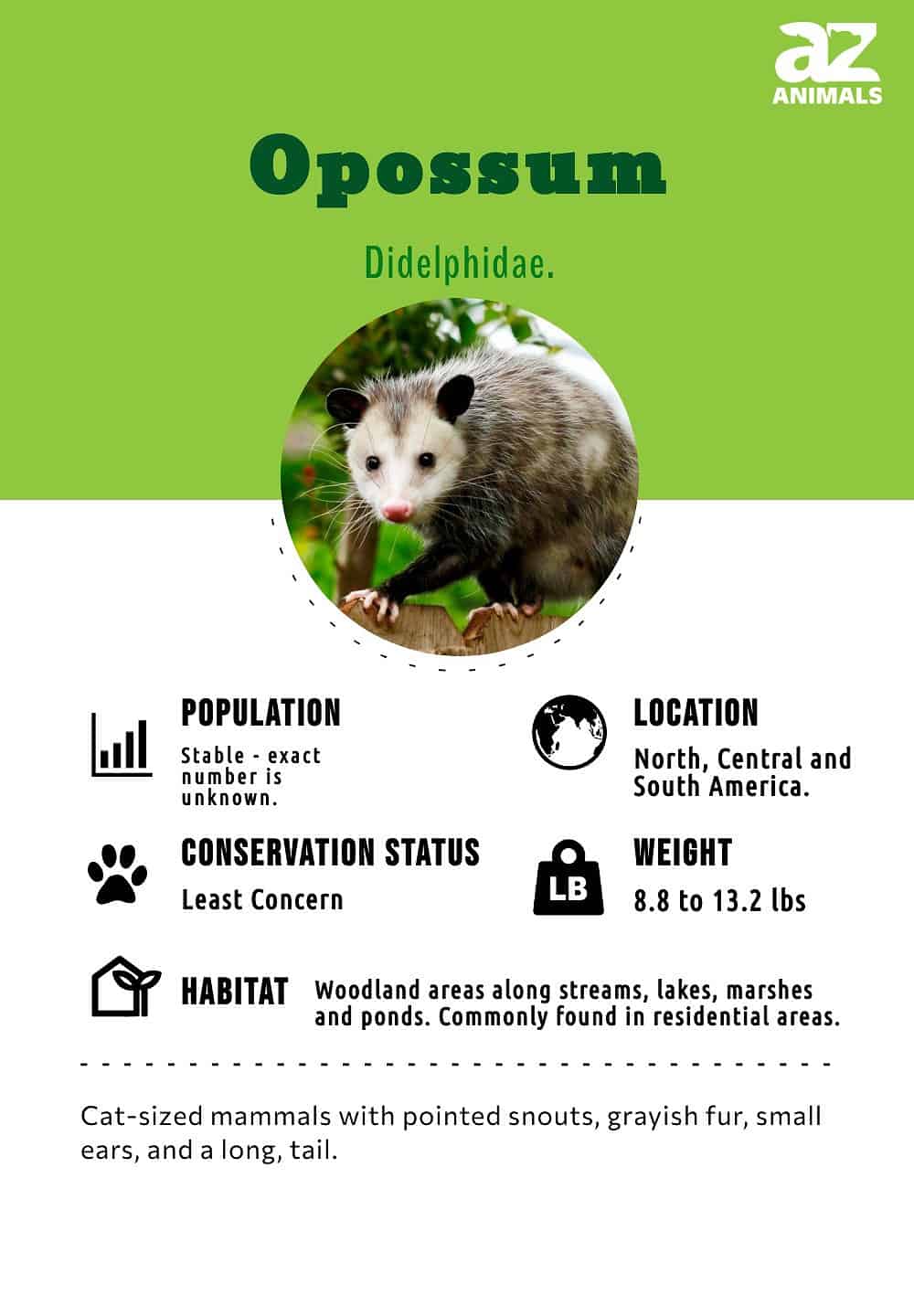
Consisting of more than 103 species that span 19 different genera, the scientific name for opossums is Didelphidae. This mammal is classified in the order of Didelphimorphia, which is the largest in the Western Hemisphere. The term reflects the fact that these marsupials essentially have two wombs – one in which babies initially grow and a pouch where they continue to mature – with “di” meaning “two” and “delphus” meaning “womb.” The Virginia opossum, the only species in the U.S. and Canada, has the scientific name Didelphis virginiana.

The word “opossum” was first recorded between the years 1607 and 1611. It is believed to have been borrowed from the Powhatan language and derived from a Proto-Algonquian word, “apousoum,” which means “white dog or dog-like animal.” The first recorded instances of the word can be traced back to John Smith and the Jamestown colony of Virginia.

Appearance
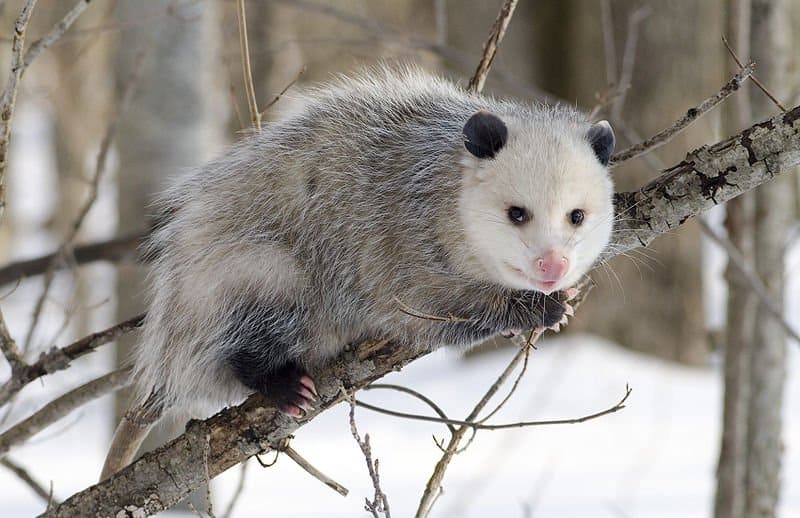
North American Opossum with winter coat.

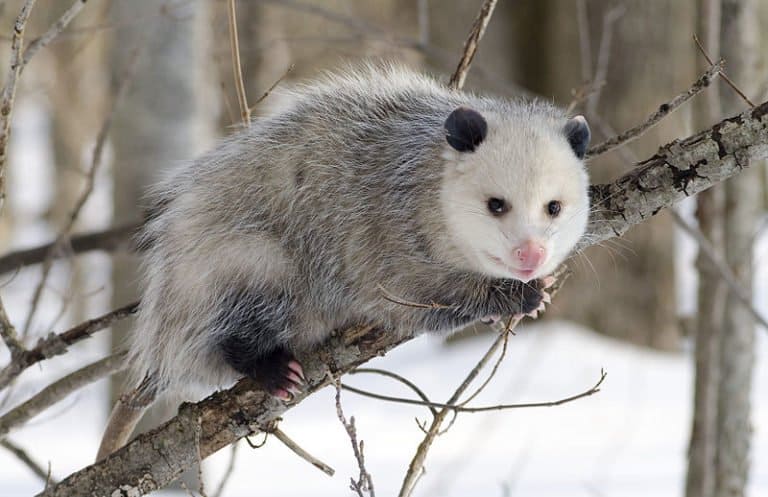
North American Opossums are typically gray with white faces.

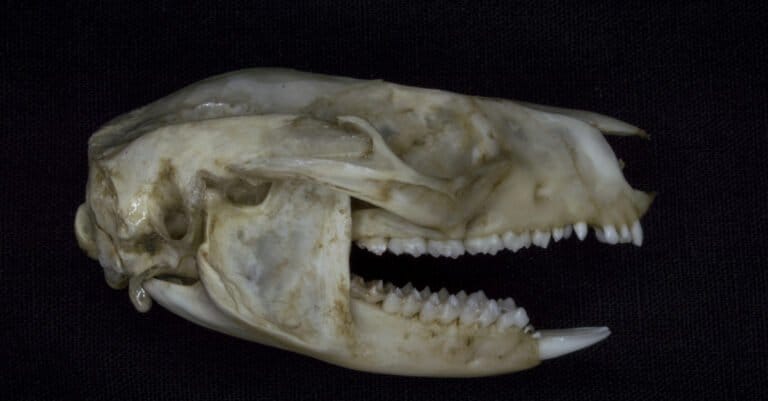
A type of mammal known as a marsupial, a fully-grown opossum is roughly the size of a house cat. On average, possums, as they are also known, measure approximately 2.5 feet long from nose to tail and weigh between 8.8 and 13.2 pounds. Mostly gray in color, these animals typically have white faces and long, pointed noses. Inside their mouths are 50 teeth – more than any other land-based mammal in North America.

In addition to having four short limbs, they have specialized tails that they use in a variety of ways. Because these rat-like tails are capable of gripping onto things, they are regarded as prehensile. Thanks to this feature, opossums can use their tails to help keep their balance, aid in climbing trees, and hold onto nesting materials while climbing. Young animals use their prehensile tails to cling to their mothers’ backs while being carried around. Contrary to popular belief, however, opossums do not hang upside down from trees by their tails like bats.

These mammals’ hind legs also feature opposable thumbs, which allow them to hold onto branches and the like even more effectively.

Males are typically slightly larger than females. They also have larger canine teeth and tend to be significantly heavier.
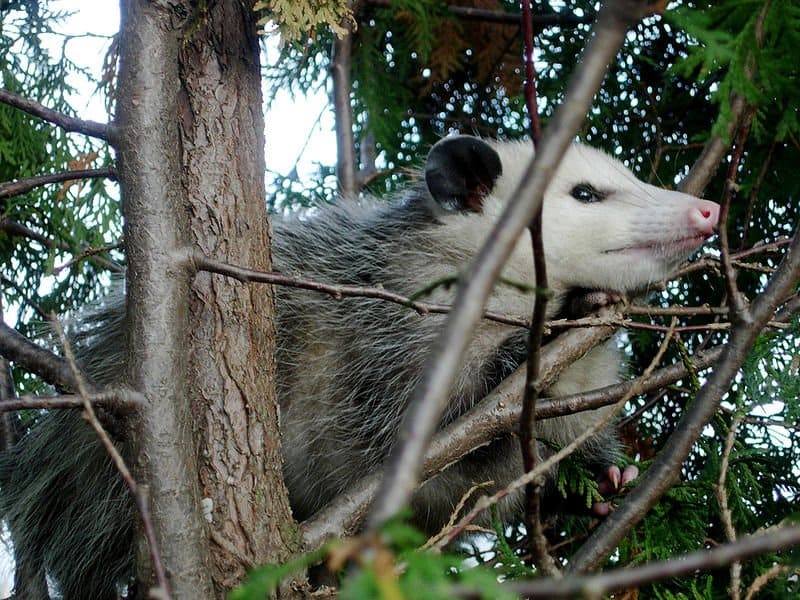
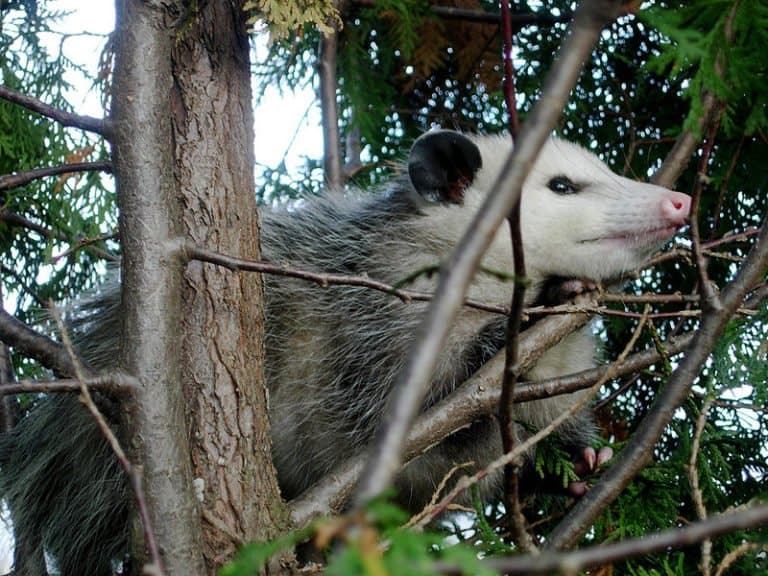
Virginia Opossum (Didelphis virginiana) in a juniper tree in northeastern Ohio.

Virginia Opossum (Didelphis virginiana). Opossums have prehensile tails that allow them to grip tree branches.

Behavior

Solitary and nomadic in general, opossums are animals that have a distinctive, slow-moving, hobbling way of getting around. Primarily active at night, when they scavenge for food and engage in most other activities, these mammals’ eyes are well-adapted to darkness. By day, opossums tend to den up in convenient cavities rather than making their own nests. Examples include inside tree holes and brush piles or underneath manmade structures.

During the warmer months, these marsupials tend to stay on the move. They typically travel wherever food takes them. In the winter, these marsupials tend to stay put in more permanent nesting sites. However, they remain moderately active throughout the colder months and therefore are not true hibernators.

One of the most well-known behavioral features of these animals is their tendency to play dead when confronted by predators. Also known as “playing possum,” the technique is a second resort if the mammal’s initial reaction to a threat – hissing, baring its teeth, and growling – fails to scare it away. If a predator proceeds to attack, the animal will become completely limp and enter an almost catatonic state. Flopped over on its side, the marsupial may close its eyes or leave them staring blankly into space. With its tongue extended, the creature can appear remarkably dead. What people often don’t know is that opossums also typically defecate and emit a foul-smelling, green substance from its anal glands while playing dead. The animal may remain in this state for up to six hours; during that time, its breathing and heart rate slow down significantly.

Although they’re not considered arboreal marsupials (which live in trees), they are excellent tree climbers and spend plenty of time up in canopies. They possess sharp claws that are excellent for grasping into tree bark, and they use their prehensile tails to assist in climbing and maneuvering around. Incredibly, opossums can also clean themselves of ticks and are capable of consuming upwards of 5,000 of them per season.

Habitat
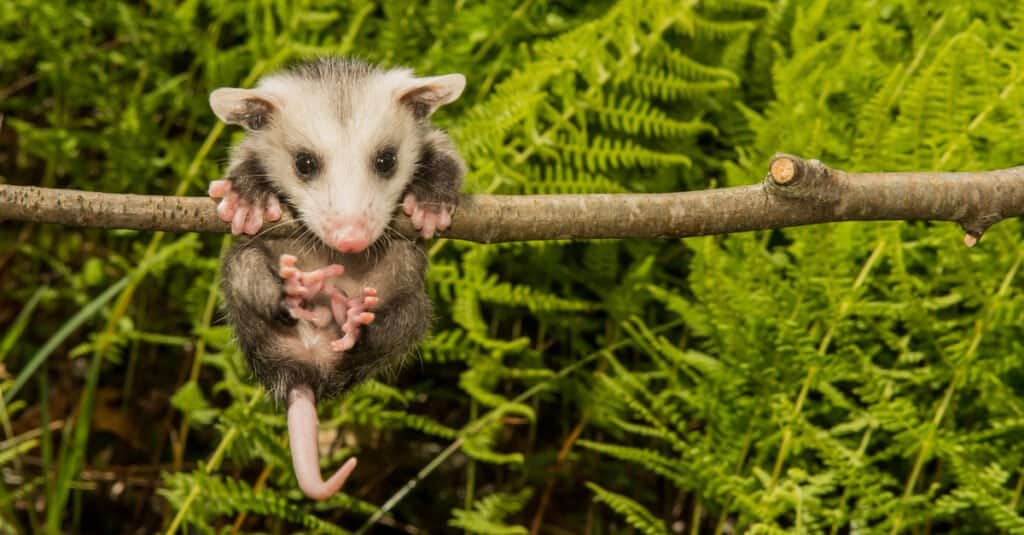
Sleepiest Animals – North American Opossum

Opossums often sleep during the day in an abandoned burrow or hollow tree.

Only a single species of opossum, the Virginia opossum, is found in the United States and Canada. This species’ habitat extends into northern Canada and as far south as Central America. South of there, dozens of additional species of opossum may be found.

Opossums have adapted for survival in North, Central, and South America by developing prehensile tails that let them grip tree limbs. The opposable thumbs on their hind legs assist in this regard too.

Given the vast area that they inhabit, opossums are capable of surviving across a variety of climates.

Diet
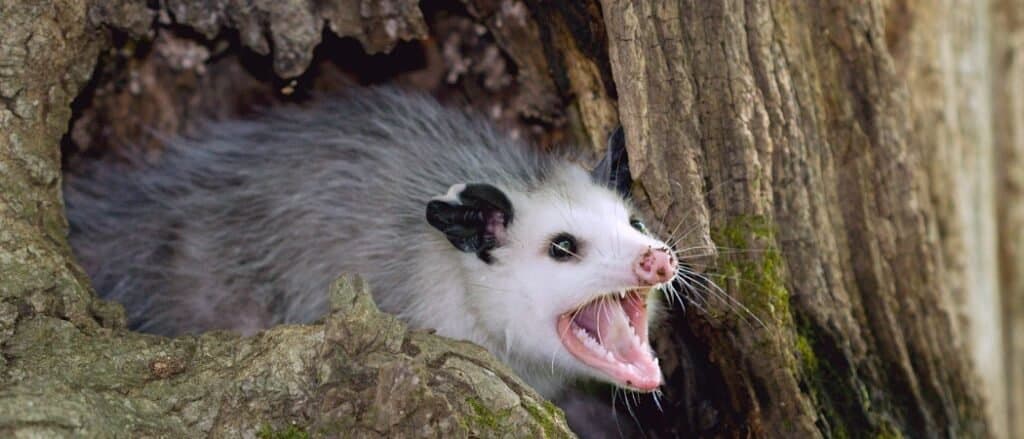
Opossums Play Dead

Opossums are known to scavenge from humans and will get into dumsters to look for food.

Opossums are scavengers. Conveniently, they are also omnivores, which means that they are willing to scavenge both plant and animal materials for subsistence. They are well-known for scavenging from humans; in particular, they tend to get into dumpsters, garbage cans, and the like looking for food.

Opossums are also attracted to carrion (decaying flesh), so they are often seen consuming roadkill. In general, opossums’ diets typically consist of fruit, grass, and various types of nuts.

These mammals will also hunt birds, mice, worms, snakes, insects, and even chickens. Many species of opossums are immune to the venom of rattlesnakes and pit vipers and are therefore able to prey upon those creatures. This diet flexibility is one of the many attributes that have made the opossum such a successful species.

Want the complete details on the opossum’s diet? Give our guide ‘What Do Possums Eat’ a read!

Predators And Threats

Humans are the biggest threat to opossums. Although not common in the United States anymore, these mammals were once hunted and consumed regularly; President Jimmy Carter was known to hunt them. Opossum hunting remains popular in many parts of Central and South America, where local governments have placed restrictions on hunting possums. However, opossums are classified as “least concern” by the International Union for the Conservation of Nature (IUCN) so they are not considered to be endangered.

Reproduction, Babies, And Lifespan
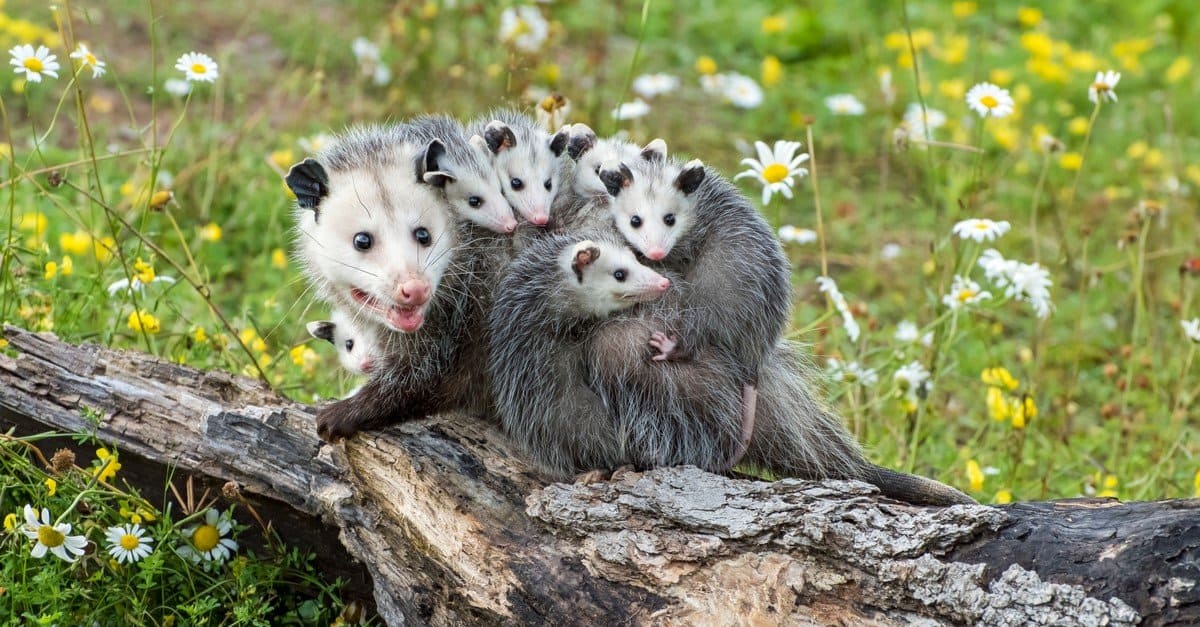
Opossums mate from the mid-winter through the mid-summer. In a single year, a female opossum can have multiple litters of baby opossums. After mating, female opossums typically give birth in about two weeks.

Up to 20 opossums may be born in a single litter. On average, however, fewer than half survive. When they are born, baby opossums are almost entirely helpless. Blind, naked, and almost transparent in appearance, newborn opossums measure about half an inch in length and weigh just 1/200th of an ounce; this makes them roughly the size of a honeybee.

Immediately after being born, baby opossums crawl into their mother’s pouch. There, they encounter a horseshoe-shaped arrangement of 13 teats, which they immediately latch onto. Those that are left without a teat to latch onto perish. Once latched on, the teat swells up and remains in place in the baby’s mouth for a period of about two months. At that point, the babies’ eyes start opening, and they start emerging from the pouch on occasion and may be carried around on their mothers’ backs while hunting. They become completely independent at around three months of age.

The average lifespan of the common, or Virginia, the opossum is one to two years.

Population
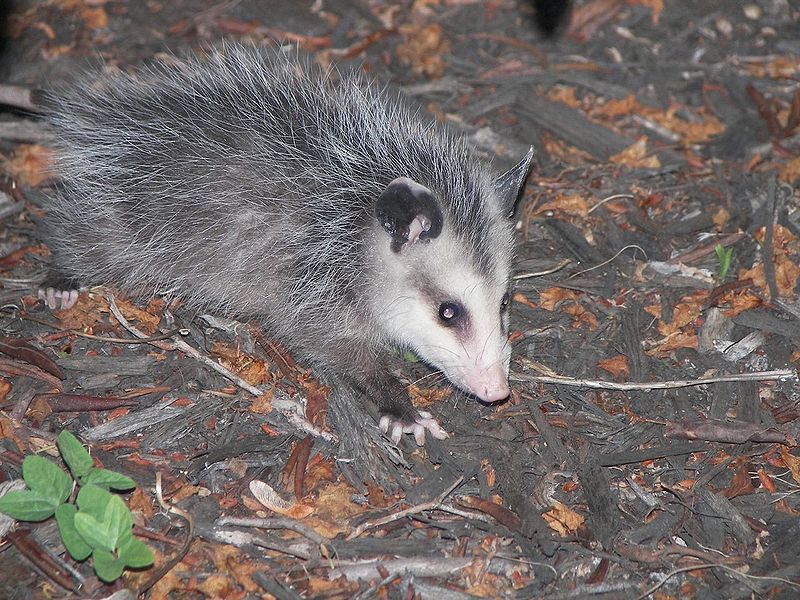
Young Opossum looking for food

Opossums are not listed as being in danger as they have stable populations.

Although they face several predators – most notably, humans, dogs, and cats – opossums are survivors that reproduce rapidly. Therefore, their populations have remained stable in modern times, and they are not classified as endangered animals.

View all 88 animals that start with O

Sources

  1. David Burnie, Dorling Kindersley (2011) Animal, The Definitive Visual Guide To The World's Wildlife / Accessed October 13, 2009
  2. Tom Jackson, Lorenz Books (2007) The World Encyclopedia Of Animals / Accessed October 13, 2009
  3. David Burnie, Kingfisher (2011) The Kingfisher Animal Encyclopedia / Accessed October 13, 2009
  4. Richard Mackay, University of California Press (2009) The Atlas Of Endangered Species / Accessed October 13, 2009
  5. David Burnie, Dorling Kindersley (2008) Illustrated Encyclopedia Of Animals / Accessed October 13, 2009
  6. Dorling Kindersley (2006) Dorling Kindersley Encyclopedia Of Animals / Accessed October 13, 2009
  7. David W. Macdonald, Oxford University Press (2010) The Encyclopedia Of Mammals / Accessed October 13, 2009
Melissa Bauernfeind

About the Author

Melissa Bauernfeind

Melissa Bauernfeind was born in NYC and got her degree in Journalism from Boston University. She lived in San Diego for 10 years and is now back in NYC. She loves adventure and traveling the world with her husband but always misses her favorite little man, "P", half Chihuahua/half Jack Russell, all trouble. She got dive-certified so she could dive with the Great White Sharks someday and is hoping to swim with the Orcas as well.
Connect:

Thank you for reading! Have some feedback for us?


Opossum FAQs (Frequently Asked Questions)

Opossums are omnivores, which means that they eat plants and animals indiscriminately. Scavenging is a major way in which they survive, so they are known for raiding dumpsters and other manmade structures for sustenance. If they encounter dead animals, or carrion, they will opportunistically eat them. As a result, it is not uncommon to find opossums eating dead animals on the side of the road.

These creatures also eat many insects and rodents, which makes their presence beneficial to humans in many ways. Indeed, they have been nicknamed “Nature’s Little Sanitation Engines” for their tendency to subsist off of common pests. They are also able to find and eat ticks off of their bodies and can consume up to 5,000 of them over the course of a single season.