Ostrich
Struthio camelus
 Verified by: AZ Animals Staff
The ostrich is among the largest types of birds in the world.
Advertisement
Ostrich Scientific Classification
- Kingdom
- Animalia
- Phylum
- Chordata
- Class
- Aves
- Order
- Struthioniformes
- Family
- Struthionidae
- Genus
- Struthio
- Scientific Name
- Struthio camelus
Read our Complete Guide to Classification of Animals.
Ostrich Conservation Status
Ostrich Facts
- Lifestyle
- Herd
- Favorite Food
- Grass
- Type
- Bird
- Average Clutch Size
- 10
- Slogan
- The largest bird in the world!
- Nesting Location
- Ground

 © muhd fuad abd rahim/Shutterstock.com
View all of the Ostrich images!



How to Add Us to Google News


The ostrich is among the largest types of birds in the world.
The ostrich bird looks like an unusual chimera cooked up in a lab. When writing about the ostrich, the Greek philosopher Aristotle did not know whether to classify it as a bird or a mammal. But in fact, the ostrich belongs to that unusual group of flightless birds that are well-adapted for life on the ground. Years of hunting almost drove them to extinction, but numbers have recovered sufficiently so that the ostrich now roams the plains of Africa once again.
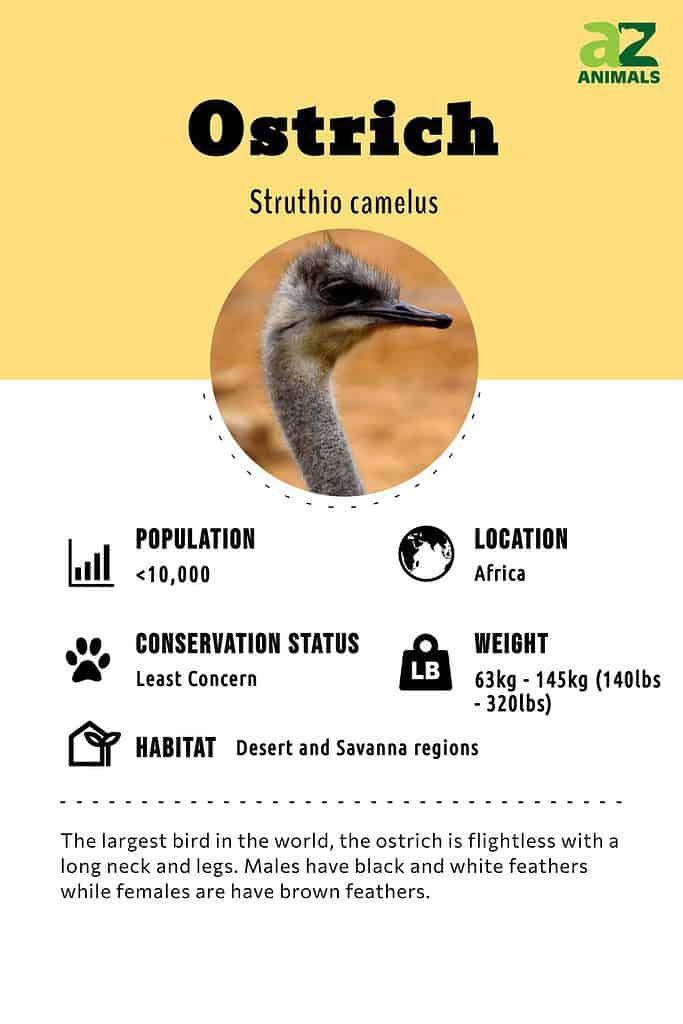
5 Incredible Ostrich Facts!
- The ostrich eye, at around 2 inches across, is the largest of any known land animal in the world.
- One of the more unusual facts is that the ostrich is the only bird with two toes. Every other type of bird has three or four.
- The ostrich bird was once hunted or farmed in large numbers for its feathers, dating as far back as ancient Egypt, Babylon, and Assyria. These feathers were used by royalty, upper-class women, and even medieval knights. By 1913, as hunting subsided, more than a million ostriches were raised on farms. But a fall in the popularity of ostrich feathers caused the farms to decline as well.
- The earliest ostrich fossils originated from around 20 to 25 million years ago. By around 12 million years ago, ostrich birds had evolved to the larger size for which they’re known. This was also the time they began to leave Africa for the rest of Eurasia. All of these non-African species are now extinct.
- Ostriches are an animal with multiple stomachs! Since ostriches don’t have teeth and swallow their food whole, they have three stomachs and a very long intestine to aid in digestion. Ostriches will swallow stones that grind up food in their stomachs, with some ostriches having more than two pounds of stones in their bodies!
Scientific Name
The scientific name of the ostrich genus is Struthio. This is derived from the Ancient Greek term for both the ostrich and the sparrow. Up until the 21st century, taxonomists recognized only a single living species of ostrich: Struthio camelus, also known simply as the common ostrich (camelus, as you might expect, is Greek for camel, perhaps named for its ability to go long periods without water).
The Somali ostrich, the Masai ostrich, the South African ostrich, and the North African ostrich were all considered to be subspecies of the common ostrich. But then taxonomists decided there were enough differences between the common ostrich and Somali ostrich (also known as the blue-necked ostrich) to warrant moving the latter to a separate species by the scientific name of Struthio molybdophanes.
The ostrich is an example of a ratite: a distantly related group of large flightless birds, including the kiwi, the emu, and the rhea. It was once assumed that the ratites belonged to a single order. However, genetic analysis suggests that these birds had separate evolutionary lineages, so they were placed in different orders entirely. The ostrich is now the only currently living member of its family and order.
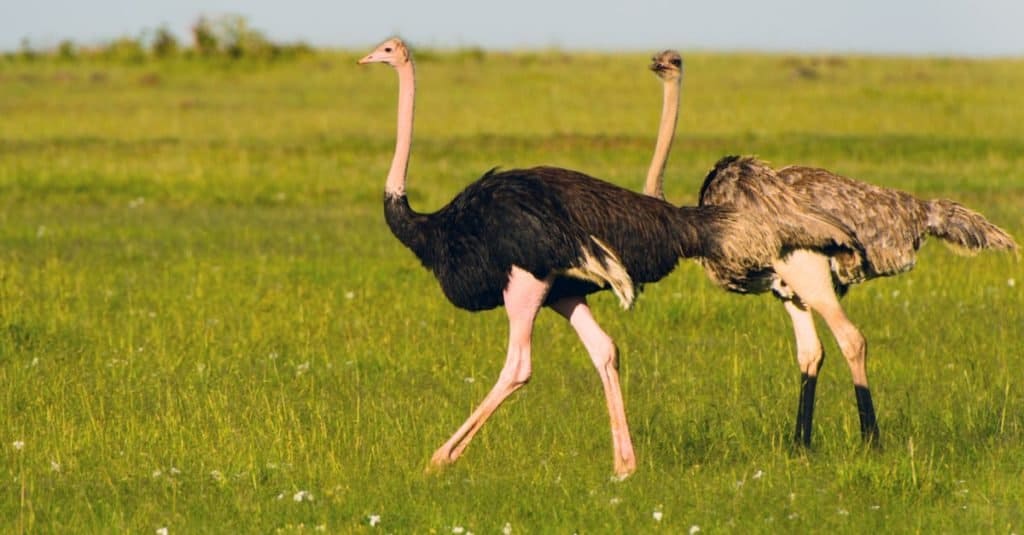
The ostrich is a ratite: a distantly related group of large flightless birds, including the
kiwi
, the
emu
, and the rhea.
©Cristian Zamfir/Shutterstock.com
Ostrich vs. Emu
Despite the similar appearance, the emu belongs to a separate order, Casuariiformes. These Australian birds are smaller than ostriches. They’re more likely to consume meat. And they have three toes instead of two. But they do share several features in common, including a featherless neck, long claws on the feet, flightless wings, polygamous mating behavior, and strong legs capable of fast running speeds. They are an example of convergent evolution: two separate lineages evolving similar features in response to the same environmental pressures.
Evolution
One interesting trait that the ostrich developed in its evolution is its two toes, whereas most birds have four. The two-toed structure of this ratite helps the ostrich run at high speeds. It’s believed that ostriches evolved in the steppes of Central Asia and then spread to Africa 20 million years ago. Their ancestors inhabited much of the Northern Hemisphere 40 million years ago in the early Cenozoic.
Not much is known of their early ancestors, or why these birds developed their large size. In fact, their closest relative is the kiwi bird, native to New Zealand. It’s speculated that early kiwis possibly could fly, explaining why they became so distant in location from their much larger relatives.
Types of Ostriches
There are two living species of ostriches, with several subspecies of the common ostrich:
- Common Ostrich (Struthio camelus) – Native to most of Africa. Sub-species include: Masai ostrich (pink skinned variety also called East African ostrich), Nominative ostrich (red-necked ostrich or Barbary ostrich), South African ostrich (Black-necked ostrich or Cape ostrich), and Arabian ostrich (Syrian or Middle Eastern ostrich, now extinct). The common ostrich mainly grazes in open savannas.
- Somali Ostrich (Struthio molybdophanes) – Native to the Horn of Africa. Other names: blue-necked ostrich. The skin and neck of this species is blue. It prefers bushier, more thickly vegetated areas where is browses for food instead of grazing.
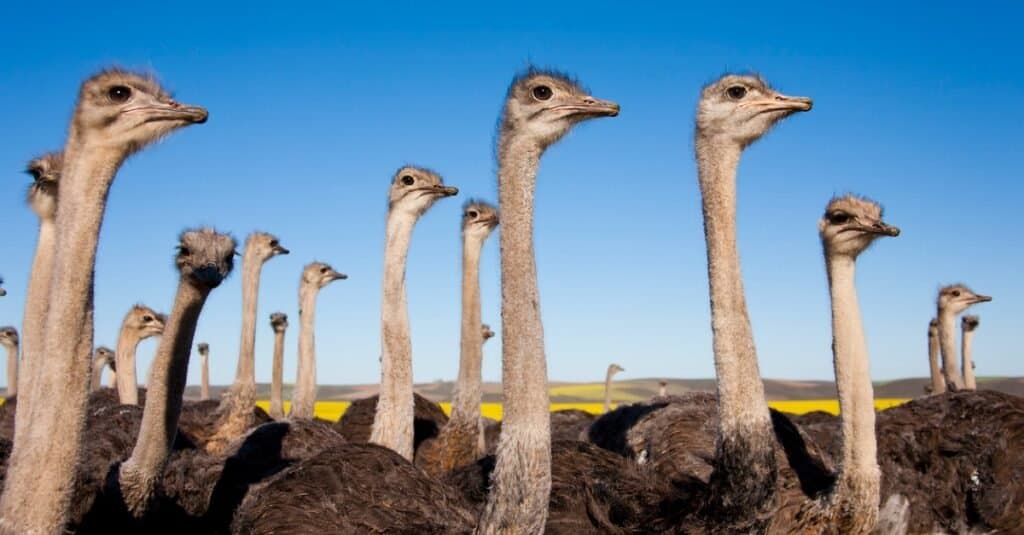
The common ostrich mainly grazes in savanna habitats.
©iStock.com/AndreaWillmore
Appearance
The ostrich is easily distinguishable from all other birds by its sheer size. Luxuriating in its soft black and white plumage, the male ostrich stands up to 9 feet high and weighs up to 320 pounds. The female, which measures up to 6 feet and 242 pounds respectively, is quite a bit smaller. She and her younger chicks exhibit more gray-brown feathers around the main body. Regardless of sex, the long and sinewy neck, head, and legs of the ostrich are almost completely bald except for a small layer of down. The skin is either pink or gray, but the exact colors and patterns may vary by the subspecies.
Given the ostrich’s large size, it’s no surprise that the wings are completely incapable of flight. The evidence suggests that the wings (along with the tail) help the bird maintain balance and court females. The incredibly soft feathers, which lack the waterproof quality of many other birds, hang rather loose off the body.
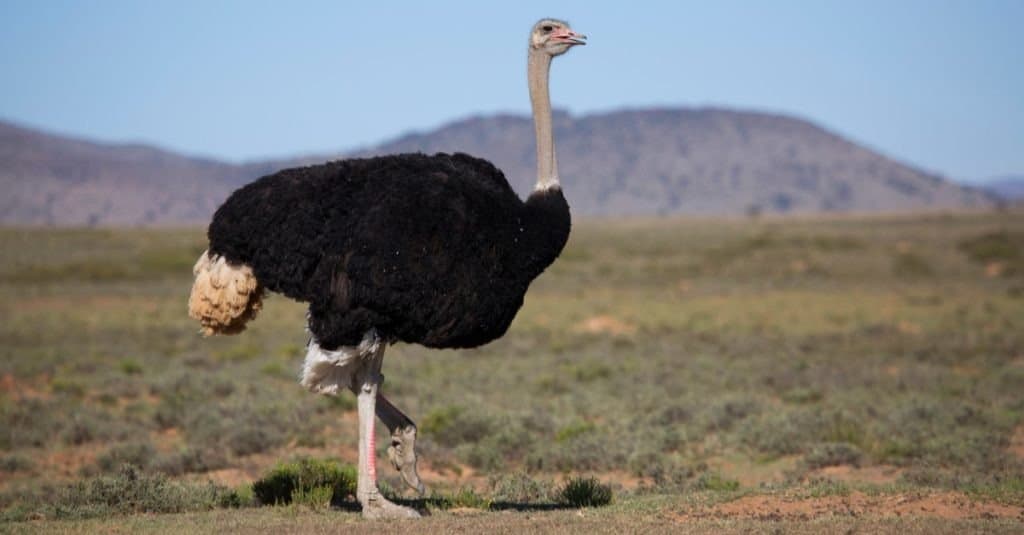
The male ostrich stands up to 9 feet high and weighs up to 320 pounds.
©Dirk M. de Boer/Shutterstock.com
Behavior
The ostrich is a social species that congregate in flocks of five to 50 birds in the breeding season and smaller groups of two to five members throughout the rest of the year. These flocks are often seen in the company of other grazing animals like antelopes and zebras. This tolerance for other species doesn’t necessarily extend to different flocks, however, since these birds will guard their territory fiercely from outside intruders. Unlike the rich sounds of many other birds, the ostrich is only capable of making a loud roar and a sharp hiss, often used by males to intimidate each other.
These birds spend almost the entire day grazing and foraging for food, which is abundant in the African savannas. Although they can go for long periods without liquids, ostriches appear to have a strong affinity for large bodies of water, where they will take bathes often to clean themselves off.
Contrary to the popular myth, ostriches do not bury their heads in the sand when threatened, but they do press the head and neck flat against the ground, perhaps as a way to avoid detection. Their first instinct is always to run away or hide from danger, but that does not mean the bird lacks defenses. The ostrich has a rather vicious clawed foot that can kill a predator as large as a lion.
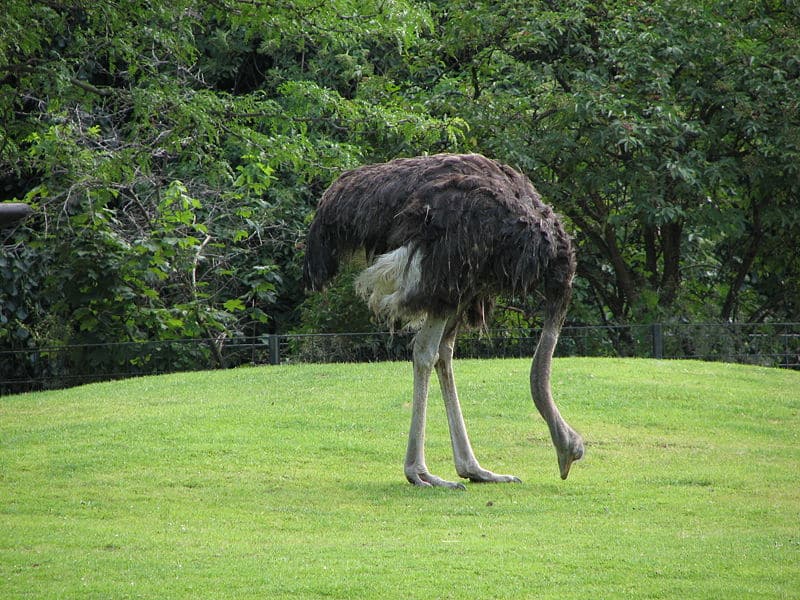
Ostriches spend almost the entire day grazing and foraging for food.
Habitat
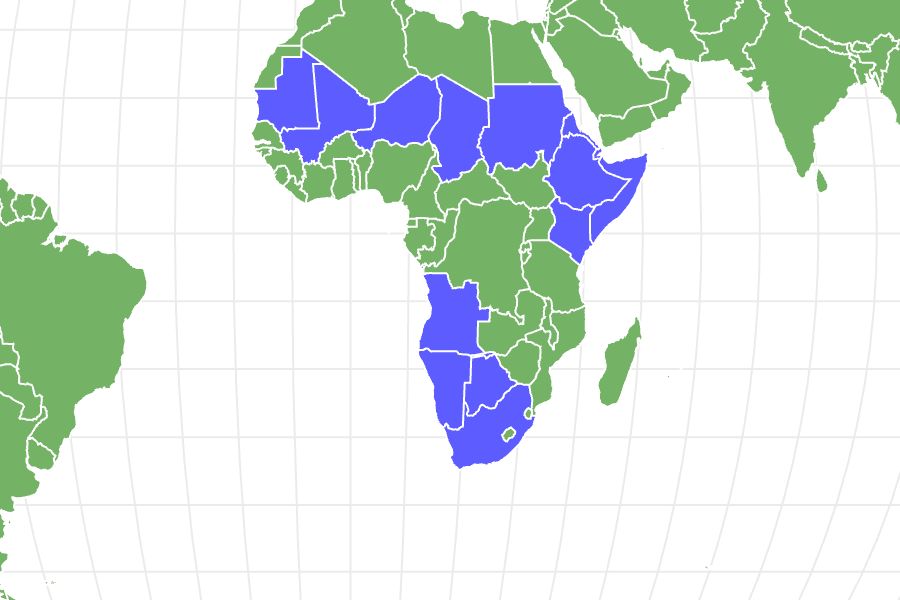
These birds inhabit the savannas, woodlands, and deserts of Africa. It is endemic to a large strip of land between Western Africa and the Horn of Africa, as well as Southern Africa. The savanna sometimes provides a brush for the ostrich to hide in. But whenever the brush is sparse, the bird mostly relies on its speed and cleverness to evade predators.
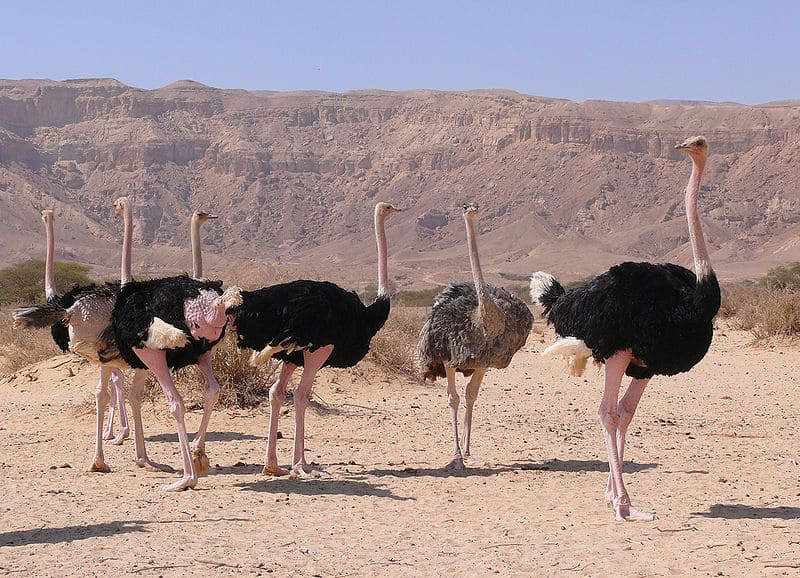
Ostriches inhabit savannas, woodlands, and desert habitats in Africa.
Diet
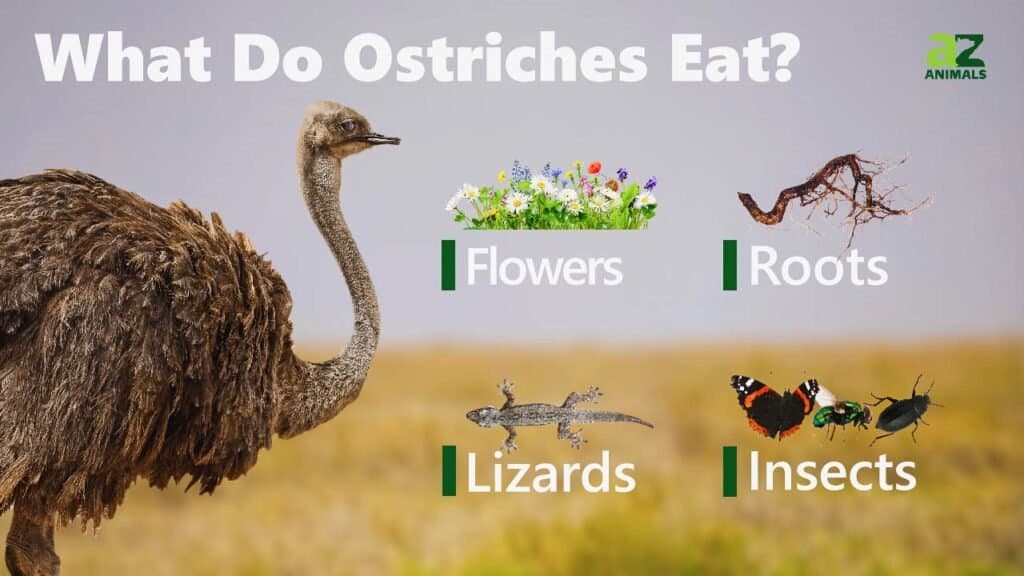
These birds enjoy an omnivorous diet heavy in plant material. To squeeze out as many nutrients as possible, this bird has an intestinal tract some 46 feet long. It consumes stones and sand along with its food and then grinds it all up in the specialized organ called a gizzard. These birds can also survive without a single drop of water for several days. It can lose up to a quarter of its body weight in water before it needs to drink again.
What does the ostrich eat?
The bird’s diet consists of seeds, grass, fruits, and flowers. It sometimes supplements this with insects, reptiles, or other meat left over by carnivores. For a complete analysis of their diet, give our ‘What Do Ostriches Eat?’ page a read!”
Predators and Threats
The biggest threat to these birds has been human hunting. The drive to harvest its feathers almost led to the ostrich’s extinction in the 18th century. As ostrich farming became more common, this practice lost some of its appeal. However, hunting, habitat loss, and even predation still pose some risks to the ostrich.
What eats the ostrich?
Despite its formidable size, the bird is under threat from all kinds of carnivores, including lions, cheetahs, leopards, hyenas, and African hunting dogs. Vultures, warthogs, and mongooses also raid nests for their eggs. Except for the cheetah, most predators cannot keep up with the ostrich’s impressive speed, so they lie in wait to ambush the unsuspecting bird.
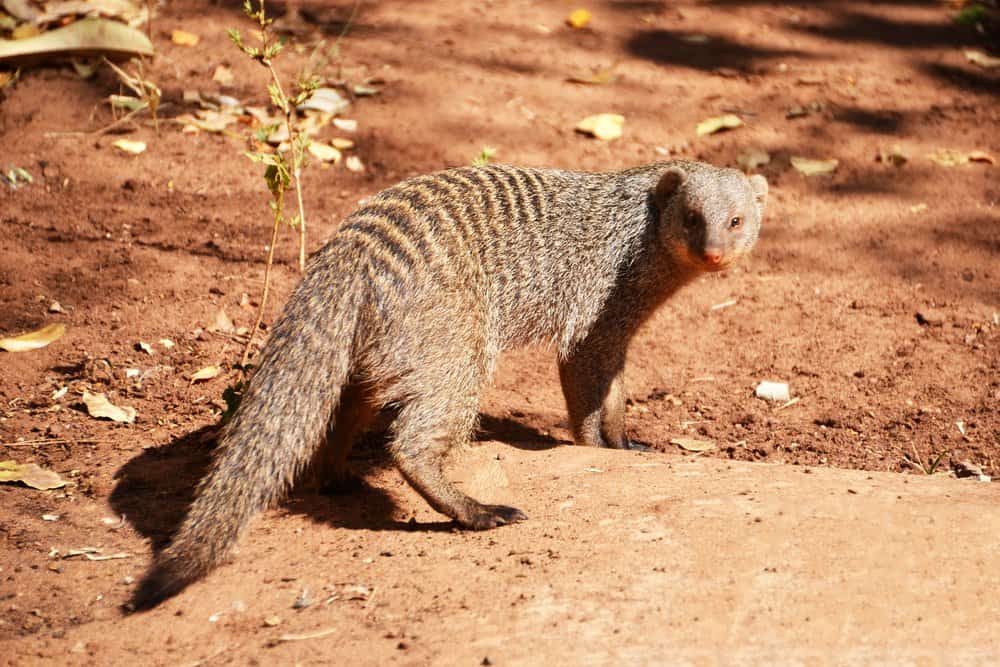
The mongoose is known to raid ostrich nests, preying on the eggs.
©Oscar David Toledo Marin/Shutterstock.com
Reproduction, Babies, and Lifespan
The breeding season lasts between March and September of each year. The male puts on an elaborate dance in which he appears to bow down to the ground and shake his feathers, first one wing and then the other, while his tail bobs up and down. The dance is intended as an exhibition of the male’s strength and health for the female to judge. The most territorial male will mate with flocks of three to five hens at a time, but it only forms a pair bond with the most dominant hen. Other males will have the opportunity to mate with the remaining females as well.
Together all of the fertilized females will dump their eggs into a communal nest (consisting of just a simple hole dug in the ground). The dominant hen places her eggs at the center, giving them the best chance at survival, but all of the eggs have a better chance to survive than if they were incubated in a separate nest. Each female bird can produce seven to 10 eggs at a time, but the communal nest can hold up to 60 eggs altogether. Weighing more than 3 pounds, these eggs are the largest of any species on the planet. They are nearly as large as dinosaur eggs. Males and females take turns guarding the nest. The females of the group watch over it during the day, while the males take over at night.
After an incubation period of 42 to 46 days, the chicks will emerge from the eggs with a stiff down, measuring about the same size as a chicken. After they leave the nest, the parents will take the chicks under the wing to protect them from the harsh sunlight or rain. When threatened, the male will attempt to distract the predator with a display of loud noises and an outstretched neck while the females and chicks attempt to find cover.
The baby bird grows quickly, and at about six months of age, they are almost the same size as the adults. They will reach sexual maturity after three to four years, which is relatively long compared to most birds. The regular lifespan of these birds is some 30 to 40 years in the wild and about 50 years in captivity.
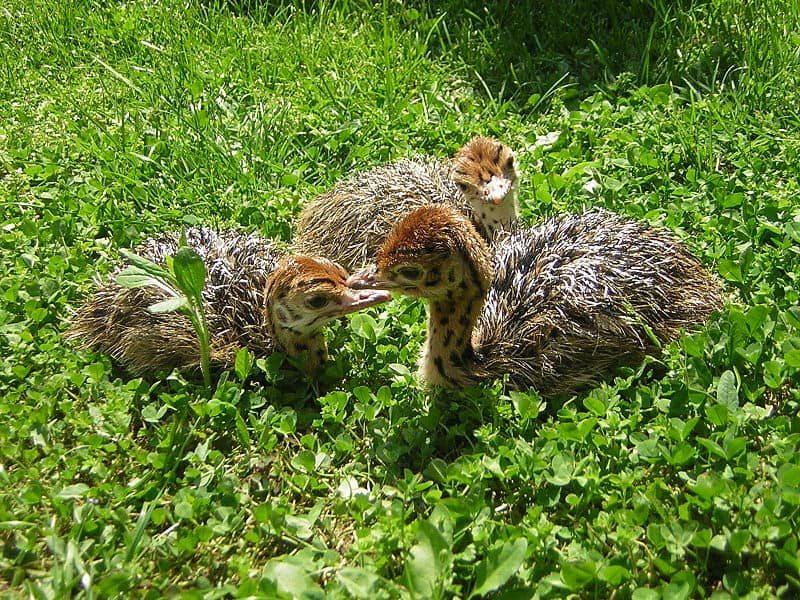
Ostrich chicks emerge from their eggs already the size of a chicken and sport a stiff down.
Population
The IUCN Red List considers the common ostrich to be a species of least concern, while the Somali ostrich is potentially vulnerable to extinction. Both species appear to be decreasing slightly in number, and it is estimated that no more than 150,000 ostriches remain in the wild. The Arabian ostrich (a subspecies of the common ostrich) went extinct in the 20th century after the development of motor vehicles made it easier to hunt them.
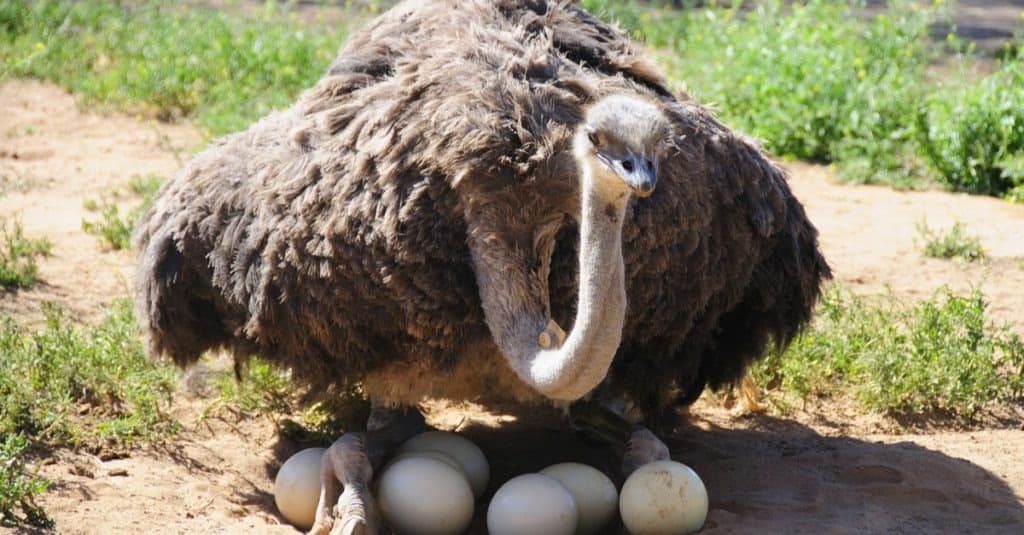
Female ostriches lay their eggs in a communal nest.
©Dominique de La Croix/Shutterstock.com
Ostriches in the Zoo
These birds are one of the most popular zoo exhibits in the United States. It can be found in the North Carolina Zoo, the Detroit Zoo, the San Diego Zoo, Zoo Atlanta, the Maryland Zoo, the Lincoln Park Zoo in Chicago, the Reid Park Zoo in Tucson, the Cincinnati Zoo and Botanical Garden, Utah’s Hogle Zoo, the Saint Louis Zoo, the San Francisco Zoo, the Indianapolis Zoo, the Houston Zoo, the LA Zoo, and almost any major zoo in the country.
More on Ostriches
View all 66 animals that start with O How to Add Us to Google News


Ostrich FAQs (Frequently Asked Questions)
Are Ostriches herbivores, carnivores, or omnivores?
Ostriches are Omnivores, meaning they eat both plants and other animals.
What Kingdom do Ostriches belong to?
Ostriches belong to the Kingdom Animalia.
What phylum do Ostriches belong to?
Ostriches belong to the phylum Chordata.
What class do Ostriches belong to?
Ostriches belong to the class Aves.
What family do Ostriches belong to?
Ostriches belong to the family Struthionidae.
What order do Ostriches belong to?
Ostriches belong to the order Struthioniformes.
What genus do Ostriches belong to?
Ostriches belong to the genus Struthio.
What type of covering do Ostriches have?
Ostriches are covered in Feathers.
In what type of habitat do Ostriches live?
Ostriches live in desert and savanna areas.
What are some distinguishing features of Ostriches?
Ostriches have small wings, long necks, and long legs.
What do ostriches eat?
Ostriches consume seeds, grass, fruits, flowers, insects, and even reptiles.
Does the ostrich migrate?
No, the ostrich stays largely within the same area all year around.
How many eggs does the ostrich lay?
A female ostrich can lay seven to 10 eggs in a single brood. Even though the egg weighs more than 3 pounds each, one of the more amazing facts is that her body is large enough to potentially carry more eggs.
How fast does the ostrich fly?
The ostrich is completely incapable of flight.
What is the ostrich’s wingspan?
Ostriches have a wingspan of around 6.6 feet. Given its overall size, the wingspan to body length is not particularly exceptional for a bird.
When do baby ostriches leave the nest?
The baby ostrich leaves the nest only a few days after hatching. They are completely ready to follow their parents around and begin foraging.
What is the scientific name for the Ostrich?
The scientific name for the Ostrich is Struthio Camelus.
What is the lifespan of an Ostrich?
Ostriches can live for 50 to 70 years.
How fast is an Ostrich?
An Ostrich can travel at speeds of up to 42 miles per hour.
How do Ostriches have babies?
Ostriches lay eggs.
How do Ostriches compare to Rheas?
When separating ostriches vs rheas, you need to consider a few key differences. First, ostriches live in Africa while rheas are found in South America. Second, ostriches are significantly larger than rheas, with a height that can reach twice as tall. Third, rheas have three toes while ostriches have two.
What are the key differences between an ostrich and a cassowary?
The key differences between a cassowary and an ostrich are the size, appearance, range, and social structure.
What are the differences between an ostrich skeleton and a T-Rex skeleton?
Ostriches have more hollow bones compared to the T-Rex, though the T-Rex has some hollow bones. In addition, the T-Rex has strikingly similar legs and walking strides compared to the ostrich.
Thank you for reading! Have some feedback for us? Contact the AZ Animals editorial team.
Sources
- San Diego Zoo, Available here: https://animals.sandiegozoo.org/animals/ostrich
- Animal Diversity Web, Available here: https://animaldiversity.org/accounts/Struthio_camelus/
- African Wildlife Foundation, Available here: https://www.awf.org/wildlife-conservation/ostrich
- Mental Floss, Available here: https://www.mentalfloss.com/article/586414/emu-vs-ostrich-what-is-difference