P
Species Profile

Patas Monkey

Erythrocebus patas

Built for the savanna sprint
Atamari / Creative Commons

Patas Monkey Distribution

Click a location to explore more animals from that region

Loading map...

At a Glance

Wild Species
Also Known As Hussar monkey
Diet Omnivore
Activity Diurnal
Lifespan 12 years
Weight 13 lbs
Status Least Concern
Did You Know?

Fastest primate reputation: patas monkeys are widely reported to sprint up to ~55 km/h in open country (often cited in field guides such as Kingdon).

Scientific Classification

A long-limbed, fast-running Old World monkey adapted to open savanna and semi-arid habitats in Africa; notable for its terrestrial lifestyle compared with many guenons.

Kingdom
Animalia
Phylum
Chordata
Class
Mammalia
Order
Primates
Family
Cercopithecidae
Genus
Erythrocebus
Species
Erythrocebus patas

Distinguishing Features

  • Reddish/tawny coat with lighter underparts
  • Dark face with a pale/whitish moustache-like facial hair in males
  • Long limbs and a slender body adapted for rapid terrestrial movement
  • Typically lives in multi-female groups with one or a few adult males

Physical Measurements

Males and females differ in size

Length
5 ft 1 in (4 ft 5 in – 5 ft 10 in)
Weight
25 lbs (15 lbs – 29 lbs)
13 lbs (10 lbs – 17 lbs)
Tail Length
2 ft 9 in (2 ft 6 in – 3 ft)
2 ft 3 in (2 ft – 2 ft 6 in)
Top Speed
34 mph
running

Appearance

Primary Colors
Secondary Colors
Skin Type Dense short fur over body; bare pigmented skin on face, ears, palms/soles, and ischial callosities.
Distinctive Features
  • Long-limbed, slender, terrestrial build adapted for fast running in open savanna.
  • Adult head-body length: males 60-87 cm; females 49-61 cm (Rowe 1996; Nowak 1999).
  • Tail length: ~75-92 cm, long and non-prehensile, often held arched while running (Rowe 1996).
  • Body mass: males ~7.5-13 kg; females ~4.5-7.5 kg (Nowak 1999; Kingdon 2015).
  • Distinct dark face with pale/cream cheek whiskers ("moustache"); reddish-tan coat distinguishes it from Chlorocebus (Rowe 1996).
  • Diurnal and highly terrestrial; among the fastest primates, documented sprint speeds up to ~55 km/h in open ground (commonly reported in field literature).
  • Typical social structure: one adult male with multiple females/young; groups often ~10-70 individuals in open country (Kingdon 2015; IUCN species accounts).
  • Longevity: ~12 years typical in the wild; up to ~20-23+ years reported in captivity (Nowak 1999; zoo records/handbooks).

Sexual Dimorphism

Males are substantially larger and heavier than females and usually show a more conspicuous pale moustache and more robust head/canine development. Female pelage is similar but generally subtler in facial contrast.

  • Larger size: 60-87 cm head-body; ~7.5-13 kg body mass.
  • More prominent cream cheek whiskers ("moustache") and stronger facial contrast.
  • More robust head/shoulders and larger canines typical of cercopithecines.
  • Smaller size: 49-61 cm head-body; ~4.5-7.5 kg body mass.
  • Moustache/whiskers present but typically less conspicuous.
  • Overall more gracile build; pelage coloration otherwise similar.

Did You Know?

Fastest primate reputation: patas monkeys are widely reported to sprint up to ~55 km/h in open country (often cited in field guides such as Kingdon).

Size (strong sexual dimorphism): adult males typically ~12-13 kg; adult females ~6-7 kg (values commonly summarized from multiple field datasets).

Body proportions for running: head-body length ~60-87 cm; tail ~75-92 cm-long limbs and a lean build suit ground travel (standard species accounts/compendia).

Social system: usually one adult male with multiple females and young; groups commonly ~15-30 individuals, with all-male "bachelor" groups also occurring.

Reproduction: single infants are typical; gestation is about ~170 days, and births tend to peak seasonally in many populations (timed to food availability).

Diet shifts with season: relies heavily on gums (especially Acacia/Vachellia), seeds/pods, insects, and other savanna foods-often increasing insect intake in dry periods.

Longevity: often ~12-20 years reported for wild individuals; captive records can exceed 20 years (species husbandry and demographic summaries).

Unique Adaptations

  • Long-limbed, lightweight build: elongated fore- and hindlimbs and a narrow trunk increase stride length and reduce energy cost for rapid ground travel compared with more arboreal guenons.
  • Savanna vision-and-vigilance toolkit: dark face contrasting with pale whiskers/moustache (especially in males) enhances facial signaling at distance in bright, open habitats.
  • Cheek pouches (Cercopithecidae trait): allows quick food collection in exposed areas and safer processing later when the group has moved away from danger.
  • Efficient use of dry-country foods: frequent reliance on Acacia/Vachellia gums and pods helps persist in semi-arid habitats where fruit can be scarce.
  • Thermal/solar coping behavior: activity patterns and use of shade (midday resting, edge-of-canopy loafing) help manage heat load in open-country climates.

Interesting Behaviors

  • Terrestrial travel and "cursorial" foraging: spends much more time on the ground than most guenons, moving efficiently between scattered food patches in open savanna and Sahel mosaics.
  • Vigilance in open habitat: individuals frequently sit upright to scan for predators; groups space out while feeding to reduce competition yet maintain visual contact.
  • Predator-avoidance strategy: when threatened, patas commonly choose speed and distance over climbing; they may still use trees as lookout points or last-resort refuge.
  • Seasonal feeding tactics: shifts day-to-day between gum-feeding (tree exudates), pod/seed harvesting, and active insect hunting (e.g., sweeping through grass for orthopterans).
  • Male turnover and loud threat displays: adult males use chases, open-mouth threats, and vocalizations during takeovers; females may remain in the group while males change.
  • All-male bands: nonbreeding males sometimes form separate groups and range widely-reducing conflict with breeding groups while waiting for opportunities.

Cultural Significance

Patas monkey (Erythrocebus patas) lives across the Sahel and savannas of West and East Africa. Often seen near acacia trees, farms, and roads. It can raid crops and is hunted for meat, affecting people's lives, causing conflict, and leads to efforts to protect it. Its name means 'red monkey'.

Myths & Legends

The name "patas" came from West African languages and was recorded early. Travelers and natural history writers called Erythrocebus patas the Sahel's typical red monkey.

In the 1700s, the patas monkey (Erythrocebus patas) was described as scientists listed nature; its red coat and living on the ground ways made it stand out in explorers' stories of African open country.

In Sahel and savanna folktales, monkeys are clever, fast, and cross borders between bush and people. These stories match ideas about ground-running monkeys, but they rarely name Erythrocebus patas.

Conservation Status

LC Least Concern

Widespread and abundant in the wild.

Population Decreasing

Protected Under

  • CITES Appendix II (species listed under the family Cercopithecidae)
  • Occurs in numerous protected areas across its range; national legal protection varies by country and is often limited by enforcement capacity

Life Cycle

Birth 1 infant
Lifespan 12 years

Lifespan

In the Wild
8–15 years
In Captivity
15–23 years

Reproduction

Mating System Polygyny
Social Structure Harem Based
Breeding Pattern Serial
Fertilization Internal Fertilization
Birth Type Internal_fertilization

Patas monkeys typically live in one-male, multi-female savanna groups; a resident male monopolizes most matings during his tenure, which may end after male challenges. Breeding is often seasonal, and females provide primary infant care with occasional allomothering.

Behavior & Ecology

Social Troop Group: 20
Activity Diurnal
Diet Omnivore Acacia (sensu lato) gum/exudates and acacia pods (highly recurrent, widely reported core foods)

Temperament

Highly terrestrial and wide-ranging; rapid running used for predator avoidance.
Female-philopatric with stable matrilines; males disperse and compete for residency.
High vigilance and strong reliance on early predator detection in open habitats.
HUBS: Across populations, core pattern is one-male multi-female troops; group size varies with food/predation (e.g., Chism & Rowell 1988; Isbell 1998).

Communication

Loud male alarm barks that recruit/coordinate group flight responses.
Contact grunts/low-frequency calls during foraging and group movement cohesion.
Threat vocalizations (barks/grunts) during aggression, especially around male takeovers.
Infant distress calls that elicit maternal retrieval and protective responses.
Visual signals: threat faces, staring, open-mouth displays, and posture-based intimidation.
Tactile: social grooming (alliances, tension reduction), infant handling, and huddling in rest.
Locomotor/spacing cues: rapid directional running and following used to coordinate group travel.
Substrate/branch shaking and lunges used as short-range threats during conflicts.

Habitat

Biomes:
Savanna Tropical Dry Forest Desert Hot
Terrain:
Plains Plateau Hilly Valley Riverine Sandy
Elevation: Up to 6561 ft 8 in

Ecological Role

Savanna omnivore and mesoconsumer linking plant productivity and invertebrate biomass to higher trophic levels.

Regulates insect populations (notably ants/termites/orthopterans) through intensive predation. Seed dispersal (via fruit consumption and defecation) and seed predation (notably on pods/seeds), influencing savanna tree recruitment patterns. Facilitates nutrient cycling by transporting and depositing organic matter (feces) across large daily travel routes in open habitats. Serves as prey for large African predators (eagles, large carnivores), supporting savanna food webs.

Diet Details

Main Prey:
Other Foods:
Savanna tree gum Seeds and seed pods Fruits Flowers Young leaves and shoots Herbaceous plant parts from savanna grasses and forbs

Human Interaction

Domestication Status

Wild

Erythrocebus patas is a wild, non-domesticated monkey. Humans have long caught it live for zoos and research, kept it as an occasional exotic pet, and hunted it for bushmeat in parts of Africa. There is no domestication; captive animals keep wild behavior and need the same care as wild ones.

Danger Level

Moderate
  • Bites and lacerations: adult males (up to ~13 kg) can inflict serious wounds if cornered, handled, or kept in captivity; risk increases sharply in private ownership contexts.
  • Zoonotic disease transmission (bidirectional): like other cercopithecines, potential pathogens include gastrointestinal bacteria (e.g., Shigella/Salmonella), intestinal parasites, and respiratory infections; risk is highest with close contact, poor hygiene, or illegal trade conditions.
  • Aggression around food/crops: in agricultural edge habitats, conflict can include chasing, defensive aggression, or property damage during crop-foraging events.
  • Capture/handling hazards: stress-induced aggression and escape behavior can endanger handlers and the public; strong terrestrial sprinting/flight responses make containment failures more likely than in less cursorial primates.

As a Pet

Not Suitable as Pet

Legality: Patas Monkey (Erythrocebus patas): keeping as a pet is often illegal or restricted. CITES (usually Appendix II) and many countries need permits. US laws vary by state; EU/UK mostly ban. Check local rules.

Care Level: Expert Only

Purchase Cost: $4,000 - $12,000
Lifetime Cost: $150,000 - $350,000

Economic Value

Uses:
Ecotourism/wildlife viewing Zoos and conservation education Biomedical/behavioral research (historical and limited ongoing) Bushmeat hunting/consumption (localized) Human-wildlife conflict (crop-raiding/edge foraging) Illegal wildlife trade (live capture; generally small compared with some other primates)
Products:
  • tourism and guide revenue from wildlife viewing
  • educational exhibit value in accredited zoos
  • research data/biological samples (under ethical regulation)
  • bushmeat (where hunted)
  • live-animal trade (illegal or tightly regulated)

Relationships

Related Species 7

Southern patas monkey Erythrocebus baumstarki Shared Genus
Blue Nile patas monkey Erythrocebus poliophaeus Shared Genus
Eastern patas monkey Erythrocebus pyrrhonotus Shared Genus
Vervet
Vervet Chlorocebus pygerythrus Shared Family
Tantalus monkey Chlorocebus tantalus Shared Family
Blue monkey Cercopithecus mitis Shared Family
Olive baboon
Olive baboon Papio anubis Shared Family

Ecological Equivalents 5

Animals that fill a similar ecological role in their ecosystem

Vervet monkey
Vervet monkey Chlorocebus pygerythrus Savanna-edge, semi-terrestrial cercopithecine that overlaps geographically with Erythrocebus patas in parts of East and Southern Africa and uses similar resources (fruits, seeds, insects). Relies primarily on trees for sleeping and refuge and is functionally comparable as a medium-sized, generalist, open-habitat monkey.
Olive baboon
Olive baboon Papio anubis Large-bodied, highly terrestrial primate that commonly occupies open woodland and savanna mosaics. Shares predator-avoidance pressures (big cats, canids, and large eagles) and ground-foraging ecology with patas monkeys, although baboons are heavier and more omnivorous.
Yellow baboon Papio cynocephalus A strongly terrestrial savanna baboon that occupies overlapping habitat (open woodland and grassland mosaics) and exhibits similar daily movement patterns across open ground. Ecologically comparable as a ground-using omnivorous primate in predator-rich landscapes.
Tantalus monkey Chlorocebus tantalus West/Central African savanna monkey that often forages on or near the ground and uses gallery trees as refuges; an ecological analogue to patas monkeys where their ranges approach in savanna belts.
Hamadryas baboon Papio hamadryas The patas monkey lives in arid to semi-arid open country, sleeps on cliffs and rocks, copes with high heat and low water, and runs very fast for a primate; males about 12 kg, females about 6.5 kg.

Patas Monkey Classification and Evolution

The Patas Monkey is a medium to large sized species of Old World Monkey that is found inhabiting the open grasslands of Central Africa. Also known as the Military Monkey, the Hussar Monkey and the Red Guenon, the Patas Monkey is the only member of its genus due to the fact that it has long limbs and short digits which are adaptations that enable it to run at great speed (something that other Guenon species do not have). Thought to be closely related to Vervet Monkeys the Patas Monkey is found in areas with little cover and simply runs away if threatened. Their long back legs are so powerful that they are able to reach speeds of up to 35mph making them the fastest primates in the world. Due to the fact that Patas Monkeys are found in more open areas, they have not been as affected by deforestation in the same way as many other primates.

Patas Monkey Anatomy and Appearance

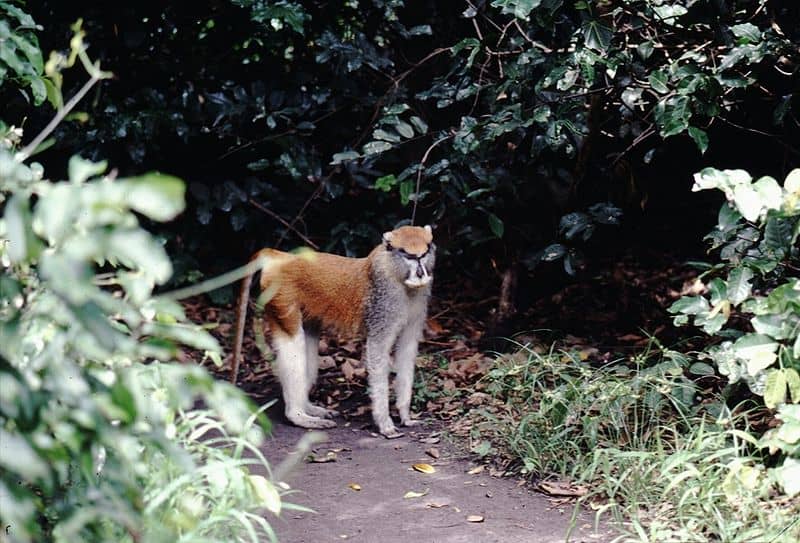
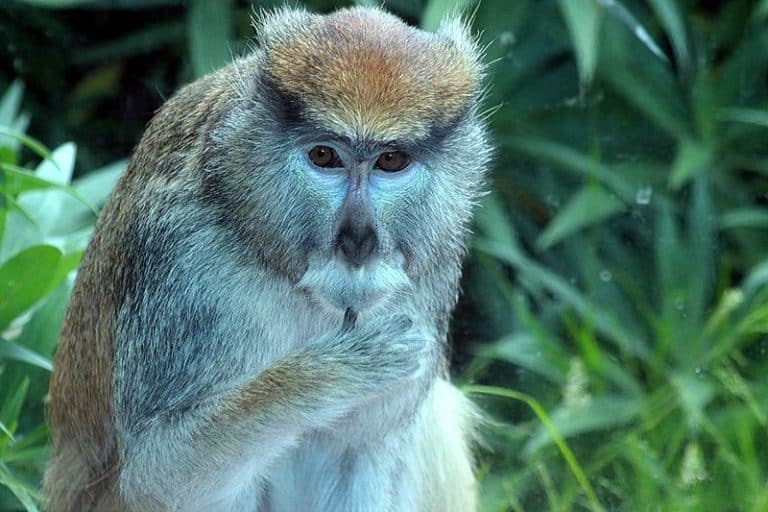
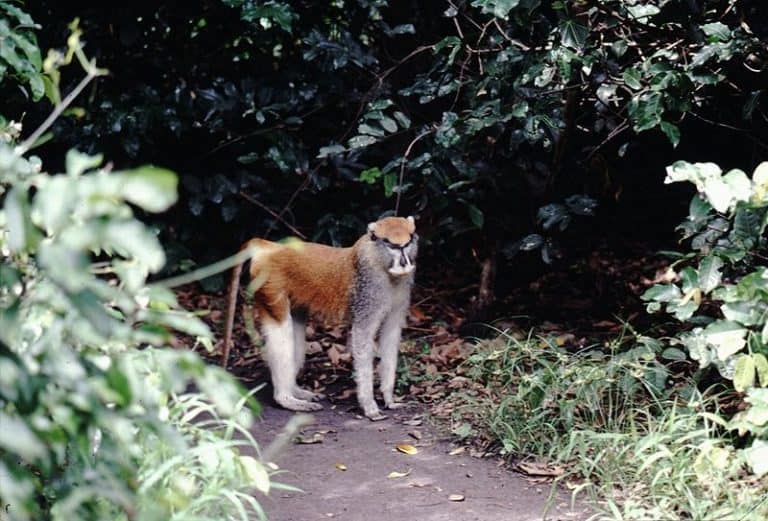
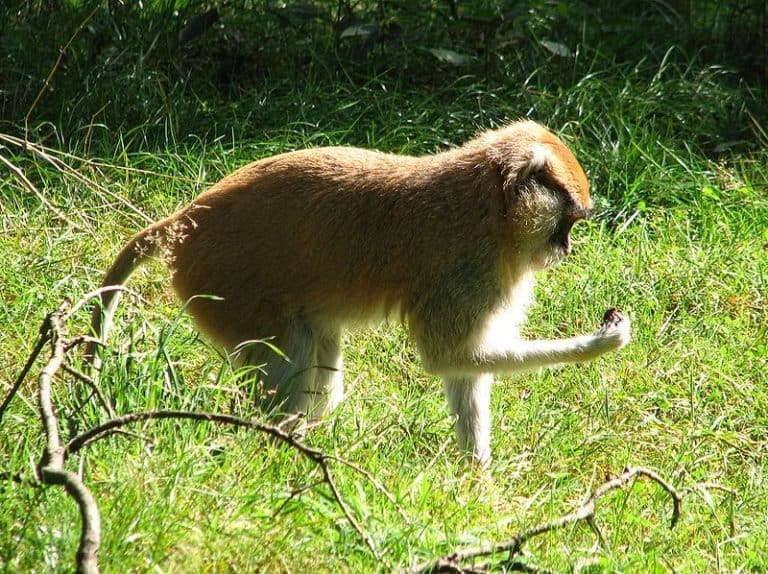
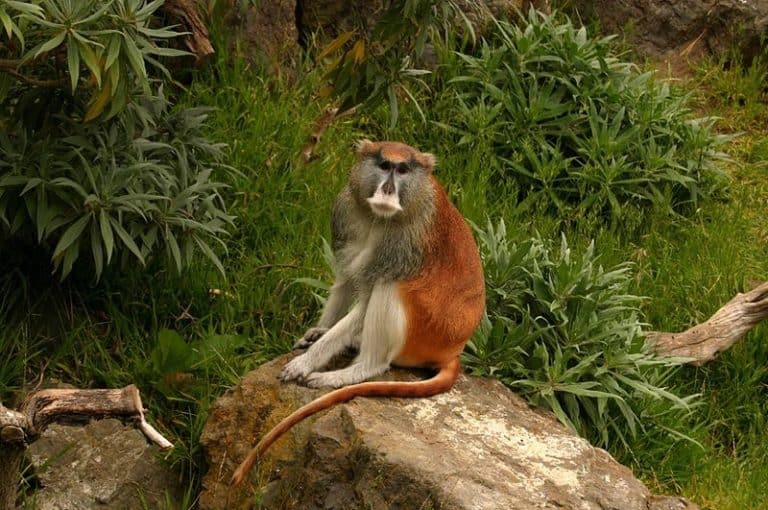
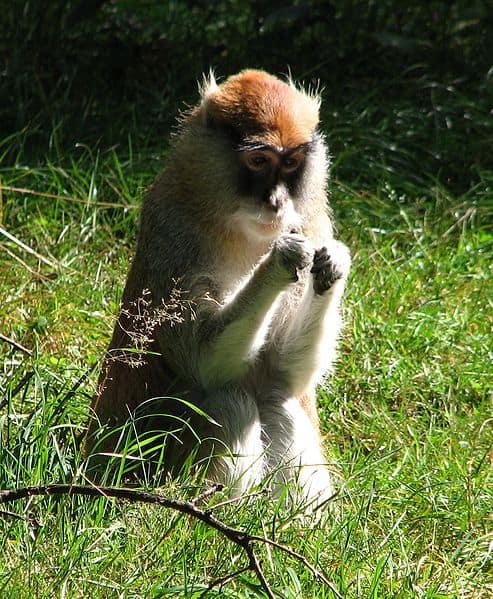
The Patas Monkey has a long and slimly built body covered in shaggy fur, which is white in colour on the underside and red on the back. Their long and powerful limbs are also white while their face is dark with a white moustache and beard, and a red cap with a heavy brow ridge that protects their eyes. They also have a distinctive black line that runs from the face up to the ear. Although male and female Patas Monkeys do look remarkably similar, the males tend to be larger in size and have a slight bump that protrudes from their head. Their lengthy limbs, hands and feet coupled with their short fingers and toes make them very adept at running at fast speeds across the open plains.

Patas Monkey Distribution and Habitat

The Patas Monkey is natively found in a broad band throughout Central Africa that is bordered by the Sahara Desert to the north and the moist tropical conditions of the equatorial forests to the south. They can be found as far west as Senegal to Ethiopia in the east and as far south as Tanzania in the east and Cameroon in the west. Patas Monkeys inhabit savanna plains, open woodlands and grass steppe that is well vegetated. They are known to be quite adaptable animals that are also found in arid areas including the southern fringes of the Sahara Desert, flooded deltas and even in moist forest where land has been cleared by people. Due to the fact that Patas Monkeys rely more on the open country than they do dense jungle, they have even been able to move into areas that have been affected by deforestation and can also be found in agricultural plantations.

Patas Monkey Behaviour and Lifestyle

The Patas Monkey is a sociable animal that is found in troops of between 10 and 40 members with only one older, dominant male and the rest being females with their young. Unlike numerous other primate communities, Patas Monkey troops are led by the females who protect their home ranges from intrusion by other troops. Although the males will not usually get involved in these disputes they will sometimes sound a loud warning call to intimidate the rival group. The role of the male Patas Monkey is not only to breed with the females in the group but also to protect them from danger. Males linger on the outskirts of the troop and watch out for approaching danger, acting as a decoy to predators so the females and the young are able to run off and hide. However, despite spending time around them, there is little interaction between males and females outside of the breeding season.

Patas Monkey Reproduction and Life Cycles

Patas Monkeys are able to reproduce at age three for females and between four and five years old for males. They have strict mating seasons which coincide with the winter months either from June to September or October to January depending on the geographic location. After a gestation period that lasts for around five months a single infant is born that is nursed and cared for by its mother. Patas Monkeys become independent of their mother when they reach breeding age when males will leave the troop to either join an all-male juvenile group or will become solitary, until they are dominant enough to challenge older males for positions in troops with females. Young females however, remain in their natal group and will stay close to their mother for their whole lives.

Patas Monkey Diet and Prey

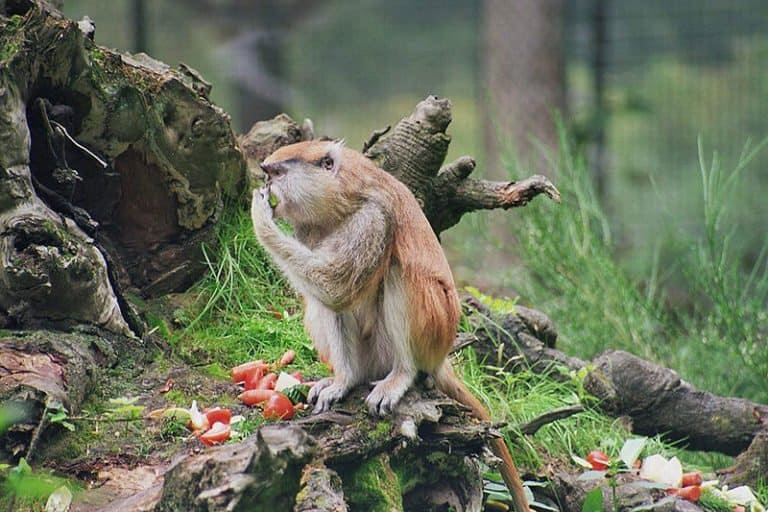
The Patas Monkey is an omnivorous animal that consumes a wide range of both plant matter and small animals in order to survive. They primarily feed on Acacia fruits, galls and leaves along with other seasonal fruits, flowers and tree gum. Patas Monkeys are also known to eat insects, lizards and birds’ eggs along with raiding crops where they are often known to cause damage to the crops themselves. Due to their predominantly terrestrial nature, more than 85% of their food is thought to be collected on ground-level. Depending on where the local population lives water can sometimes be limited which can cause conflict between rival troops as they gather at water-holes to drink. Those populations however, that are found in the flood-lands have less conflict between each other for water.

Patas Monkey Predators and Threats

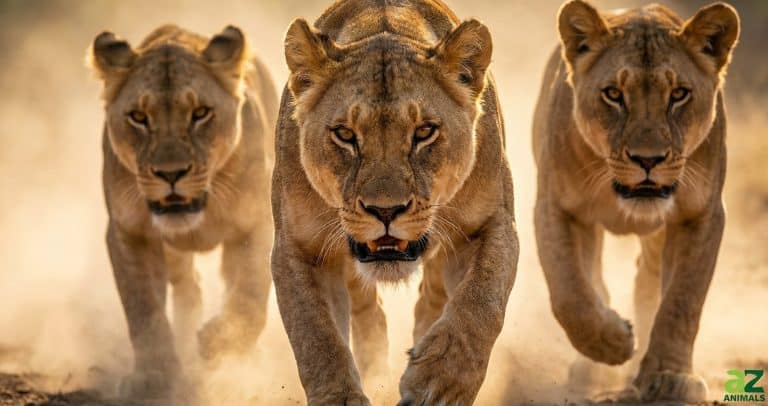
Although comparatively little is known about the predation of Patas Monkey relative to similar species, it is generally thought that due to their size, they are preyed upon by numerous carnivores that share their habitats. Wild cats such as Leopards, Cheetahs and Lions are probably their most common predators along with Hyena, African Wild Dogs, Snakes and large Birds of Prey that hunt the smaller and more vulnerable young. They are also hunted by people for meat throughout much of their natural range but the biggest threat to Patas Monkey populations is thought to be the capture of them for sale either into the exotic pet trade or to science for medical research.

Patas Monkey Interesting Facts and Features

The smart red coat and solider-like white moustache of the Patas Monkey has led to them also being commonly known as “Military Monkeys”. Despite the fact that deforestation has been devastating for numerous primates not just in Africa but around the world, it has in fact provided more and more suitable areas for Patas Monkeys to inhabit. As they have evolved to life with very little cover, areas of forest that have been cleared by people have led to them being found in regions such as moist forest that they would not normally inhabit. When they are born, young Patas Monkeys are light brown all over and have pink coloured faces, which darken by the time they are about two months old.

Patas Monkey Relationship with Humans

Native people have hunted the Patas Monkey for meat throughout much of their vast natural range for years but they are also hunted for capture and sale into the exotic pet trade and to be sold to medical research. It is estimated that over 1,000 individuals are caught every year which is leading to population declines particularly in certain areas. In others where Human settlements are encroaching further and further into their natural habitats, Patas Monkeys have been known to strip crops, raid plantations for food and simply destroy others which has led to farmers often seeing them as pests. Many Patas Monkeys are shot by people who see them close to or on their land.

Patas Monkey Conservation Status and Life Today

Today, the Patas Monkey is listed by the IUCN as a species that is of Least Concern from becoming extinct in the wild in the near future. However, due to the fact that the global population is not particularly large anyway, increased conservation of the species needs to occur to prevent populations from declining any further. There are 18 national parks and 11 reserves where Patas Monkeys can be found with some measures having been put into place to try and limit the number of individuals that can be captured from the wild.

View all 247 animals that start with P
How to say Patas Monkey in ...
Czech
Kočkodan husarský
Danish
Husarabe
German
Husarenaffe
English
Patas Monkey
Spanish
Erythrocebus patas
Finnish
Husaariapina
French
Patas
Hebrew
פרש אדום
Hungarian
Huszármajom
Italian
Erythrocebus patas
Japanese
パタスモンキー
Dutch
Huzaaraap
Polish
Koczkodan rudy
Swedish
Husarapa
Chinese
赤猴

Sources

  1. David Burnie, Dorling Kindersley (2011) Animal, The Definitive Visual Guide To The World's Wildlife / Accessed November 24, 2009
  2. Tom Jackson, Lorenz Books (2007) The World Encyclopedia Of Animals / Accessed November 24, 2009
  3. David Burnie, Kingfisher (2011) The Kingfisher Animal Encyclopedia / Accessed November 24, 2009
  4. Richard Mackay, University of California Press (2009) The Atlas Of Endangered Species / Accessed November 24, 2009
  5. David Burnie, Dorling Kindersley (2008) Illustrated Encyclopedia Of Animals / Accessed November 24, 2009
  6. Dorling Kindersley (2006) Dorling Kindersley Encyclopedia Of Animals / Accessed November 24, 2009
  7. David W. Macdonald, Oxford University Press (2010) The Encyclopedia Of Mammals / Accessed November 24, 2009
  8. Patas Monkey Information / Accessed November 24, 2009
  9. About Patas Monkeys / Accessed November 24, 2009
  10. Patas Monkey Conservation / Accessed November 24, 2009
A-Z Animals Staff

About the Author

A-Z Animals Staff

AZ Animals is a growing team of animals experts, researchers, farmers, conservationists, writers, editors, and -- of course -- pet owners who have come together to help you better understand the animal kingdom and how we interact.
Connect:

Thank you for reading! Have some feedback for us?


Patas Monkey FAQs (Frequently Asked Questions)

Patas Monkeys are Omnivores, meaning they eat both plants and other animals.