P
Species Profile

Peacock

Pavo cristatus

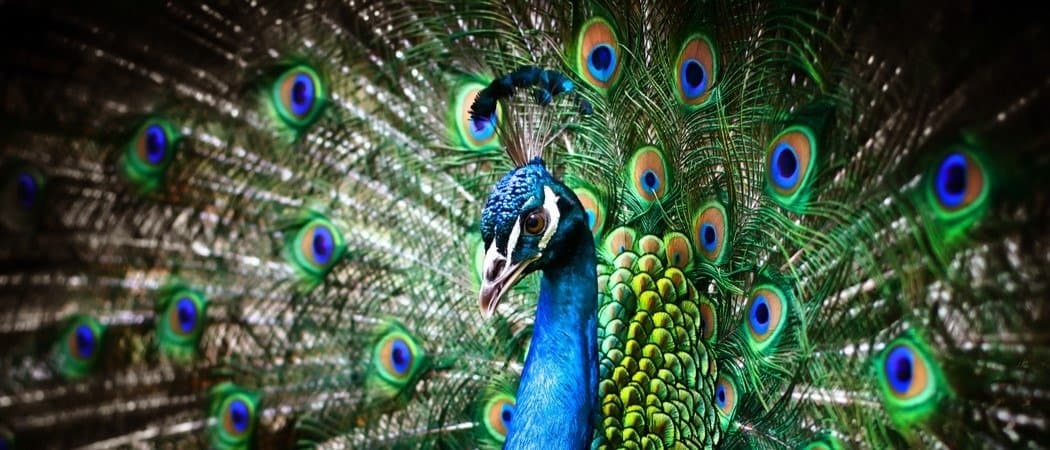
The train that stole the spotlight
Drop of Light/Shutterstock.com

Peacock Distribution

Click a location to explore more animals from that region

Invasive Species
Loading map...

Size Comparison

Human 5'8"
Peacock 3 ft 7 in

Peacock stands at 64% of average human height.

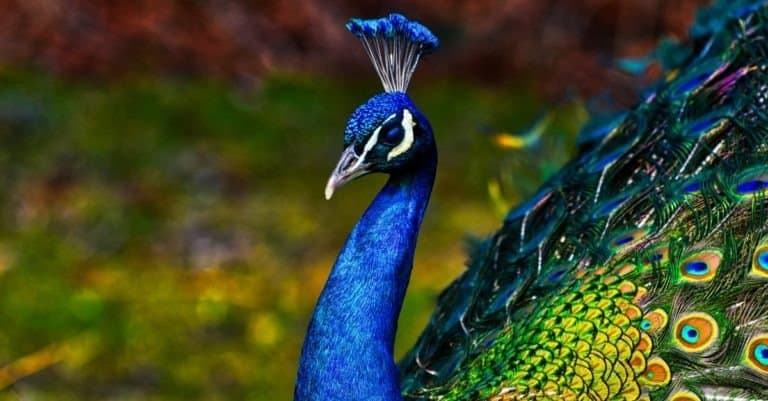
Portrait of beautiful peacock with feathers out

At a Glance

Wild Species
Also Known As Blue peafowl, Common peafowl, Peafowl, Mayur, Mor
Diet Omnivore
Activity Diurnal+
Lifespan 12 years
Weight 6 lbs
Status Least Concern
Did You Know?

Terminology: "peafowl" = the species; "peacock" = adult male; "peahen" = adult female.

Scientific Classification

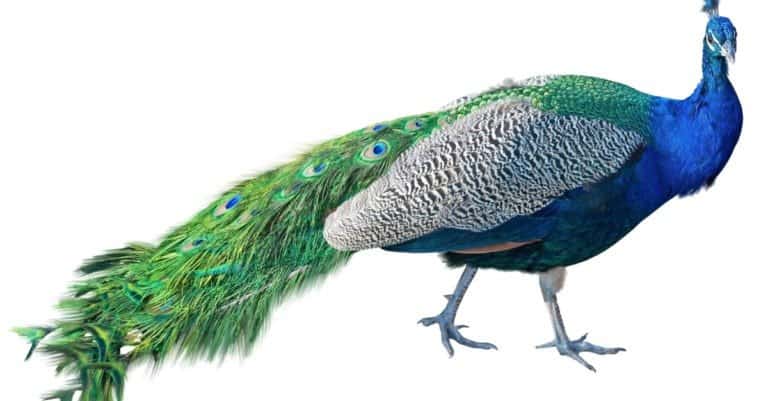
A large ground-dwelling galliform bird famous for the male’s iridescent blue neck and long, eye-spotted train used in courtship displays. Commonly kept in parks, estates, and temples; native to the Indian subcontinent.

Kingdom
Animalia
Phylum
Chordata
Class
Aves
Order
Galliformes
Family
Phasianidae
Genus
Pavo
Species
cristatus

Distinguishing Features

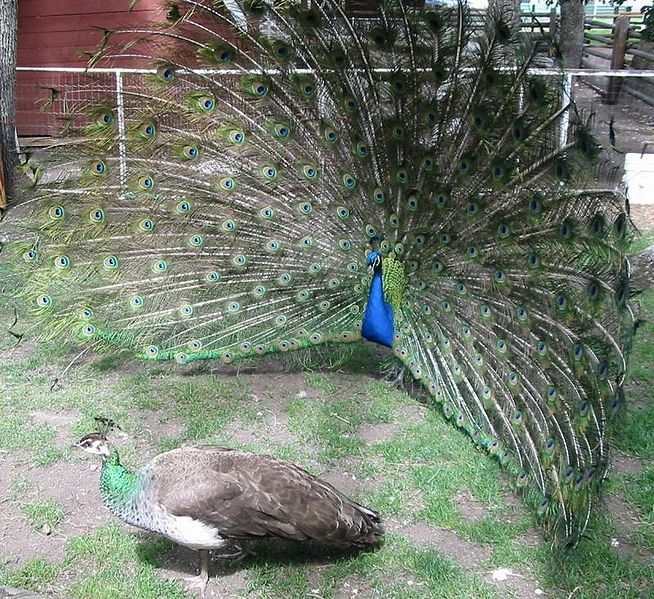
  • Male (peacock) with long train of elongated upper tail coverts bearing eye-spots; tail itself is shorter underneath
  • Iridescent cobalt-blue head/neck in males; fan-shaped crest
  • Females (peahens) are mostly brown/green with much shorter tail and reduced iridescence

Physical Measurements

Males and females differ in size

Height
♂ 3 ft 7 in (2 ft 11 in – 4 ft 1 in)
Length
♂ 6 ft 11 in (6 ft 5 in – 7 ft 5 in)
♀ 3 ft (2 ft 10 in – 3 ft 3 in)
Weight
♂ 11 lbs (9 lbs – 13 lbs)
♀ 7 lbs (6 lbs – 9 lbs)
Tail Length
♂ 4 ft 11 in (4 ft 7 in – 5 ft 3 in)
♀ 1 ft 5 in (1 ft 4 in – 1 ft 6 in)
Top Speed
10 mph
running

Appearance

Primary Colors
Secondary Colors
Skin Type Feathers; small bare facial skin around the eye with pale patches; scaly legs.
Distinctive Features
  • Male 'train' is elongated upper tail coverts (not true tail feathers) used in fanned courtship displays.
  • Adult male total length typically 180-230 cm including train; train commonly ~100-160 cm (HBW/Handbook of the Birds of the World accounts).
  • Adult female total length typically ~95-100 cm, lacking an elongated train (HBW).
  • Mass typically ~4-6 kg in males and ~2.75-4 kg in females (HBW).
  • Crest: upright fan of spatulate-tipped feathers on crown in both sexes (smaller in females).
  • Spurs on tarsus usually present in males; used in intrasexual conflicts.
  • Behavior relevant to appearance: ground-foraging omnivore; roosts in trees at night (typical galliform behavior).
  • Courtship: male faces female, fans train, and vibrates/rattles feathers to enhance iridescence and ocelli visibility.
  • Longevity: reported ~15 years in the wild; up to ~20-23+ years in captivity in managed collections (zoo/aviculture records summarized in species accounts).

Sexual Dimorphism

Males (peacocks) are larger and vividly iridescent with a long ocellated train for courtship fanning; females (peahens) are smaller, brown and cryptic, and lack the elongated train. Both sexes are 'peafowl.'

♂
  • Iridescent blue head/neck with green-bronze mantle; highly reflective in sun.
  • Long ocellated train (elongated upper tail coverts) dramatically fanned during display.
  • Generally larger body and longer total length due to train (commonly 180-230 cm).
  • Tarsal spur(s) typically well-developed; crest larger and more conspicuous.
♀
  • Overall brown/tan plumage with lighter underparts; reduced iridescence.
  • No elongated train; tail relatively short and functional for flight balance.
  • Smaller total length (~95-100 cm) and lower body mass on average.
  • Crest present but shorter; lacks prominent ocellated display plumage.

Did You Know?

Terminology: "peafowl" = the species; "peacock" = adult male; "peahen" = adult female.

Male total length is ~195-225 cm (most of it the train); females are ~95-100 cm long (HBW/field handbooks).

Adult mass: males ~4-6 kg; females ~2.75-4 kg (commonly reported across ornithological references).

The showy "tail" is mostly elongated upper tail coverts (the train), not the true tail feathers.

Peacocks can fan, shake, and "rattle" the train-producing audible rustling and low-frequency vibrations used in courtship signaling (documented in behavioral studies).

They spend much of the day walking and foraging on the ground but typically roost high in trees at night-classic galliform behavior.

Clutches are usually 3-6 eggs; incubation is ~28-30 days by the peahen (standard species accounts).

Unique Adaptations

  • Structural iridescence: the intense blue/green sheen is largely produced by microscopic feather structures that manipulate light (not just pigments).
  • Extreme sexual dimorphism: males carry the long ocellated train for sexual selection, while females are more cryptically colored for nesting camouflage.
  • Ocelli (eye-spots): repeated high-contrast markings enhance visibility during fanning and may function in female choice and/or predator intimidation.
  • Powerful legs and strong toes: built for walking, scratching, and rapid ground escape-typical of Galliformes.
  • Flexible display biomechanics: specialized feather shafts and musculature allow the train to be lifted, spread, and vibrated for visual and acoustic effects.

Interesting Behaviors

  • Courtship display: the peacock erects and fans the train into a semicircle, then pivots to keep the display oriented toward the peahen; he may add wing-shivering and rapid train-rattling.
  • Lek-like mating system: males often display in traditional "display arenas" where females visit and choose mates; mating is typically polygynous.
  • Ground foraging: walks and pecks for seeds, grains, tender shoots, insects, and other small prey; often forages in small groups.
  • Tree roosting: flies up to high branches near dusk and descends at dawn; communal roosting can occur where habitat allows.
  • Vocal signaling: loud calls (especially at dawn/dusk and before rains in many regions) used for contact and territorial advertisement.
  • Dust-bathing and preening: frequent dust-baths help manage ectoparasites; meticulous preening maintains feather condition crucial for display.

Cultural Significance

Indian Peafowl (Pavo cristatus), India's National Bird since 1963, is native to the Indian subcontinent. In South Asian art and religion it stands for beauty, rain, protection, and royalty, and is linked to Kartikeya/Murugan and Krishna. Peacock motifs are common.

Myths & Legends

Hindu (Murugan/Kartikeya): in South Indian tradition, Murugan's mount is the peacock; after defeating the demon Surapadman, the demon is transformed (in many tellings) into a peacock that becomes Murugan's mount (vehicle).

Hindu (Krishna): Krishna is traditionally depicted wearing a peacock feather, a symbol of divine beauty and playful charm in Vaishnava devotional stories and art.

Greek mythology (Hera and Argus): Hera places the hundred eyes of Argus Panoptes onto the peacock's tail, explaining the "many-eyed" eye-spots (a widely known classical origin tale for the peacock's train).

Buddhist/Jataka traditions (South & Southeast Asia): peafowl appear as emblematic birds associated with vigilance and transformation; in some regional tellings they feature as moral exemplars in story cycles that use animals to convey ethical lessons.

Persian and wider West Asian folklore: peacocks appear as royal garden birds and symbols of paradise and splendor in literature and decorative traditions, often signifying immortality or heavenly beauty.

Conservation Status

LC Least Concern

Widespread and abundant in the wild.

Population Increasing

Protected Under

  • India: Wildlife (Protection) Act, 1972 - Schedule I (highest level of protection)
  • India: National Bird status (symbolic protection supporting enforcement and cultural non-hunting norms in many areas)

Life Cycle

Birth 4 chicks
Lifespan 12 years

Lifespan

In the Wild
8–15 years
In Captivity
15–25 years

Reproduction

Mating System Polygyny
Social Structure Lek Breeding
Breeding Pattern Transient
Fertilization Internal Fertilization
Birth Type Internal_fertilization

In the monsoon breeding season, males (train up to ~1.6 m) cluster in leks and display; successful males mate with multiple females. Copulation is brief via internal fertilization; females lay 3-6 eggs and provide all care (Johnsgard 1986; Petrie et al. 1991).

Behavior & Ecology

Social Flock Group: 8
Activity Diurnal, Crepuscular
Diet Omnivore Cereal grains (especially readily available cultivated grains such as rice and wheat), supplemented heavily with insects during the monsoon/breeding season.

Temperament

HUBS: fission-fusion flocking; groups expand at food sources and communal roosts (Ali & Ripley, 1983).
Generally wary in native habitats; readily habituates and becomes bold near people in parks/temples.
Breeding males are territorial at display courts; escalation includes rushing, jumping, and spur use (Johnsgard, 1986).
Females are comparatively cryptic and avoid conflict; associate loosely and prioritize cover near nesting.
Longevity reported up to ~20 years in captivity; wild individuals often substantially shorter-lived (del Hoyo et al., HBW Alive).

Communication

Loud repeated advertising call often rendered "may-awe/mee-ow" Used at dawn/dusk, breeding season
Harsh multi-note alarm call (rapid 'kek-kek-kek'), frequently triggering flock vigilance.
Soft contact clucks and low chirps within feeding/roosting groups.
Visual courtship: full train fanning with lateral presentation and circling in lek-like systems Petrie et al., 1991
Train-rattling/shivering display produces mechanical sound and strong visual motion cues Dakin & Montgomerie, 2013
Agonistic signals: raised crest, erect posture, lateral threats, and spur presentation during male-male disputes.
Roosting coordination via spacing, approach/retreat movements, and repeated calling near traditional roost trees.

Habitat

Biomes:
Tropical Dry Forest Savanna Temperate Forest Freshwater Wetland
Terrain:
Hilly Plateau Plains Valley Riverine Coastal Island Rocky +2
Elevation: Up to 6561 ft 8 in

Ecological Role

Omnivorous ground-foraging mesopredator/seed consumer in South Asian dry forest-scrub-agroecosystem mosaics.

Regulates insect populations (including agricultural pest taxa such as orthopterans/termites) through predation Seed dispersal for some fleshy-fruited plants via fruit consumption and defecation (localized) Soil/leaf-litter turnover and microhabitat disturbance via scratching, which can influence invertebrate exposure and seed fate Nutrient cycling through droppings concentrated at roosts and regularly used feeding areas

Diet Details

Main Prey:
Termites Ants Beetles Grasshoppers and locusts Caterpillars Insect larvae Spiders Snails and other small gastropods Small lizards Small snakes Frogs and other small amphibians Small rodents +6
Other Foods:
Cereal grains and seeds wild grass seeds Legume seeds and pods Tender shoots and leaves Buds and flowers Fallen fruits and berries Roots, tubers and other underground plant parts +1

Human Interaction

Domestication Status

Semi domesticated

The Indian Peafowl (Pavo cristatus) is not fully domesticated but is widely kept as an ornamental, tame, or free‑ranging bird around temples, parks, villages, and estates. Protected by customs and law in South Asia, it was traded widely, can become feral abroad, and sometimes damages crops or is hit by cars or attacked by dogs.

Danger Level

Low
  • Physical injury: males can peck and strike with tarsal spurs during breeding-season aggression or when defending territory/food; injuries are usually minor but can cause lacerations/eye injury risk at close range.
  • Zoonoses: like other galliform/poultry birds, can carry enteric pathogens (e.g., Salmonella, Campylobacter) and ectoparasites; risk increases with close handling, poor hygiene, or mixed poultry flocks.
  • Nuisance/indirect hazards: very loud calls (frequent human complaints), property/garden damage from scratching/foraging, and road-traffic collisions involving free-ranging birds.

As a Pet

Not Suitable as Pet

Legality: Rules vary by place. Many areas allow keeping Indian Peafowl (peacock, Pavo cristatus) as ornamental birds, but local laws on noise, roaming, zoning often limit them. Permits may be needed. In India wild capture is illegal.

Care Level: Experienced

Purchase Cost: $30 - $800
Lifetime Cost: $6,000 - $30,000

Economic Value

Uses:
Ornamental/estate and park birds Cultural and religious value (temple birds; national-symbol value in India) Tourism and amenity value (parks, heritage sites, resorts) Feather and craft markets (primarily naturally molted feathers) Small-scale poultry products (limited/local eggs and meat) Pest control/foraging services (insects and small vertebrates), context-dependent
Products:
  • live birds for ornamental collections and parks
  • naturally molted train/eye feathers used in crafts, decor, and cultural items
  • paid entry/visitor attraction value in parks/heritage properties where birds are a draw
  • eggs (occasional/local use; not a major commercial poultry species)
  • meat (limited/local; often restricted/illegal where protected)

Relationships

Predators 9

Leopard
Leopard Panthera pardus
Bengal Tiger
Bengal Tiger Panthera tigris tigris
Dhole
Dhole Cuon alpinus
Golden Jackal
Golden Jackal Canis aureus
Bengal Fox Vulpes bengalensis
Jungle Cat Felis chaus
Indian Rock Python
Indian Rock Python Python molurus
Crested Serpent Eagle Spilornis cheela
Shikra Accipiter badius

Related Species 6

Green Peafowl Pavo muticus Shared Genus
Congo Peafowl Afropavo congensis Shared Family
Red Junglefowl Gallus gallus Shared Family
Grey Junglefowl Gallus sonneratii Shared Family
Common Pheasant Phasianus colchicus Shared Family
Kalij Pheasant Lophura leucomelanos Shared Family

Ecological Equivalents 5

Animals that fill a similar ecological role in their ecosystem

Great Argus Argusianus argus Large forest-edge phasianid exhibiting strong sexual selection and elaborate male visual displays (display courts/arenas). Ecologically parallels the Indian peafowl in its polygynous mating system, ground-foraging, and edge-habitat use; both commonly roost in trees and nest on the ground.
Grey Peacock-Pheasant Polyplectron bicalcaratum Asian, ground-dwelling phasianid that displays ocellated plumage in courtship; occupies an understory/forest-edge niche and shares an omnivorous diet of insects, seeds, and fruit, with terrestrial foraging behavior such as scratching and pecking.
Wild Turkey
Wild Turkey Meleagris gallopavo Large, ground-dwelling galliform with pronounced male ornamentation and display behaviors (strutting, gobbling). Functional niche similarity: omnivorous diet; flocking outside the breeding season; tree roosting; ground nesting; and high predation pressure on eggs and chicks.
Helmeted Guineafowl Numida meleagris An open-woodland and edge-dwelling galliform that forms flocks, forages on the ground for seeds and invertebrates, and is frequently commensal around human-modified landscapes, similar to Indian Peafowl's frequent use of farms, villages, temple complexes, and parklands.
Red Junglefowl Gallus gallus Shares much of the same South Asian habitat mosaic (scrub and deciduous forest edges, agricultural interfaces), an omnivorous ground-foraging strategy, and a predator-avoidance pattern of rapid running followed by short bursts of flight to tree roosts.

Peacocks are famous for their large, iridescent tail feathers. While it is the most widely recognized feature of peafowls, only males have these beautiful tail colorings. Some species have plumage that is smaller than the commonly known blue peacock, or Indian peacock, which is what most people picture when they think of a peacock.

Where To Find Peacocks

The origin of these birds is Asia. The blue peacock, specifically, has origins in India. This is why they are commonly called Indian peacocks or peafowls. They can also be found in the wild in Africa, where the lesser-known Congo peacock has its origin. You can also find peafowls in some areas of Australia. They prefer their habitat to be in a warm climate, so the best places to find them would be locations such as the desert and savannah.

The best time of year to observe peafowl is in the summer because it is breeding season and they are likely to be more active. These birds are most active in the morning and around dusk. They like to live in forest areas as well. These birds can also be seen in zoos around the world. Generally, most captive peafowls in zoos are Indian peacocks. There are also a large number of people who own peacocks as pets or have them on their farms.

Nests

Peahens build their nests on the ground, in a shallow hole padded with grass. They usually make their nests in areas that are sheltered by bushes, shrubs, or other vegetation, to keep the eggs safe from predators.
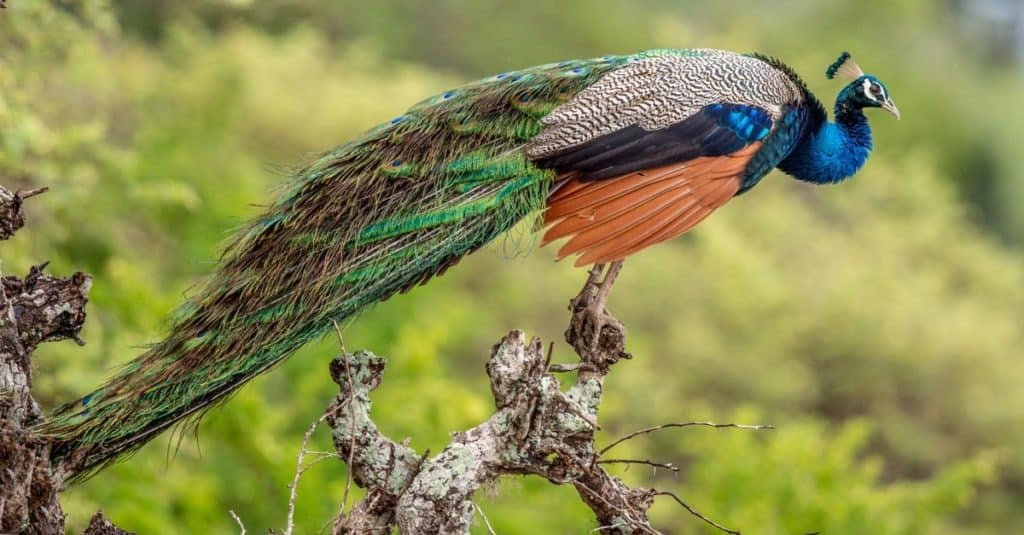
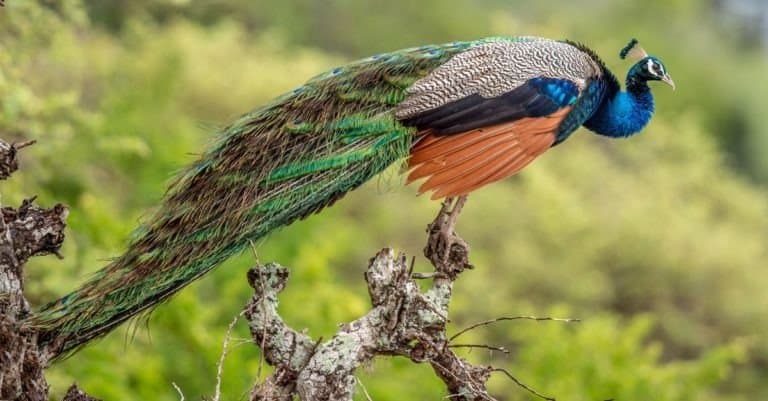
Peacock on the tree

Peacocks are most active in the morning and around dusk.

Scientific Name and Types of Peacocks

There are three species of peafowl, and they all have different colors. Their class is Aves class, and they belong to the Galliformes order. Peafowls are most closely related to pheasants. The two species both belong to the Phasianidae family and are ground birds.

  • Indian Peacock (Pavo cristatus): The most populated and most commonly known species today. While they have been introduced to other areas, they originated in India. They are known for their stunning blue color.
  • Green Peafowl (Pavo muticus): They are also called Indonesian Peafowl. They can be found in Indochina and Southeast Asia. The chest and neck of the Green Peafowl are green for both males and females.
  • Congo Peafowl (Afropavo congensis): They are also called African Peafowl and can be traced to the Congo Basin. While they still have some stunning colors, they are not as colorfully adorned as their Asian cousins.
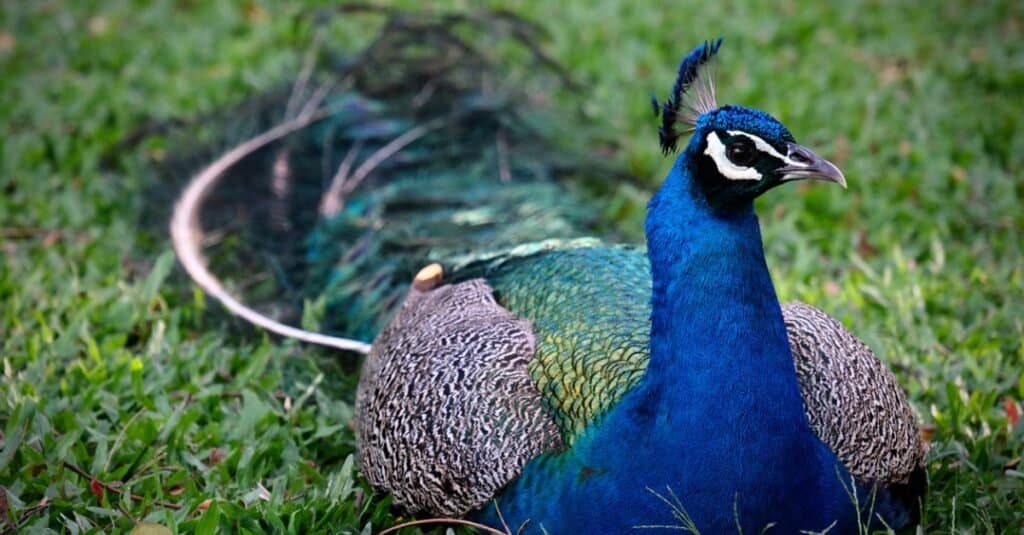
peacock laying down

Peacocks belong to the Phasianidae family and are ground birds.

History and Evolution

Because the peacock has such an obvious physical difference from the peahen, it became a fascinating study for scientists, especially Charles Darwin. He was actually stumped at the adaptation of the males’ long and beautiful train, which makes the peacock truly amazing. He finally concluded that the appearance of a rich, vibrant train was advantageous for mating, and ultimately it outweighed the disadvantages of the encumbrance of such a tail.

The peacock is the national bird of India for good reason. They truly are one of the most visually striking birds in the animal kingdom. Moreover, they can be found in different mythologies, such as in Greek and Hindu.

Size, Appearance, & Behavior

The bird’s size and appearance vary by type. Generally, these birds can weigh between eight and a half to 13 pounds and grow roughly two to ten feet long. Their height can range from just under three feet to a little over four feet. The Indian peacock is striking, with spots on its tail feathers called ocelli.

As its name suggests, the Green peacock is usually a green hue and has a similar-looking plumage to the Indian peacock when it spreads its tail feathers. The Congo peacock’s appearance is somewhat different from the other two species. The colors of a Congo peacock can be brown or gray, and the train, or tail feathers, are significantly smaller than the others.

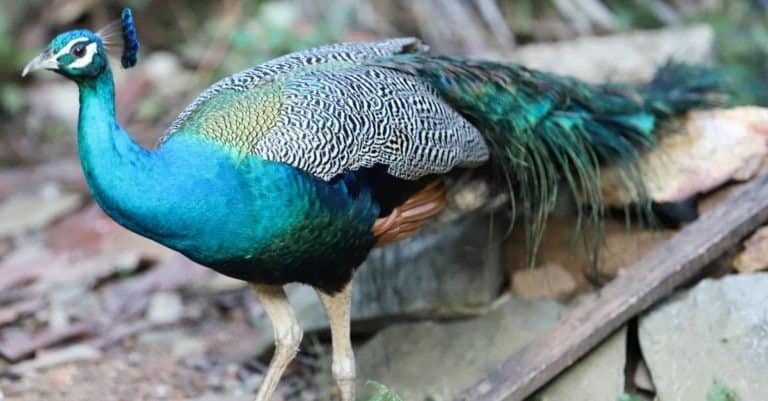
Female peafowls, called peahens, are usually smaller than males and have neutral colors rather than bright hues. Peahens also do not have the tail feather plumage that males have. Some peafowls are all white. These are commonly referred to as albino peacocks. However, it is rare for a peafowl to be a true albino. These birds have a condition called Leucism, which differs greatly from albinism. Most white peacocks are not albino at all.

Peafowls, like many other animals, use sound to communicate. A screeching sound is used to warn of a nearby predator. Peacocks will use a songlike sound as a mating call to attract peahens. The sounds made by peafowls can be extremely loud. Peacocks also fan out their train, or tail feathers, to make themselves look bigger in defense of predators.
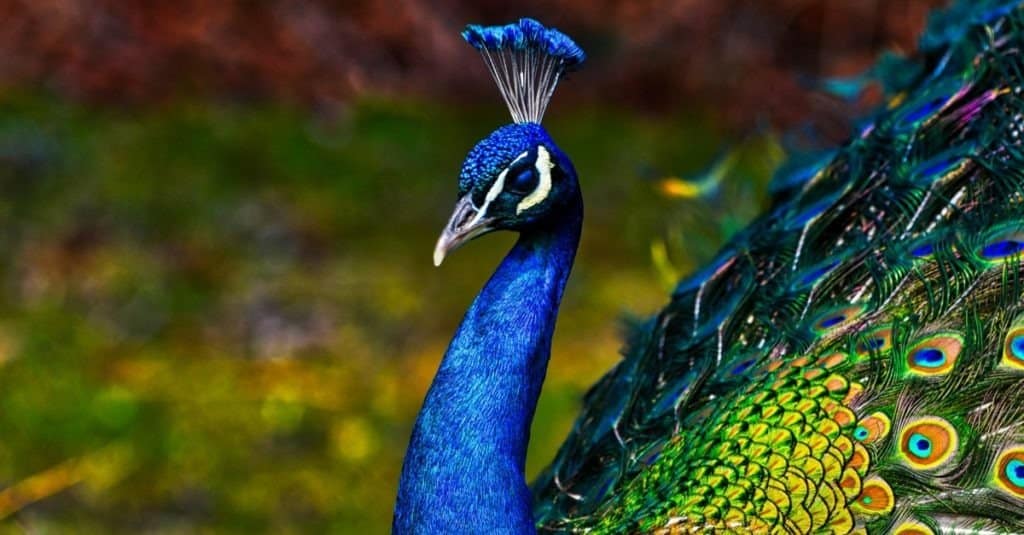
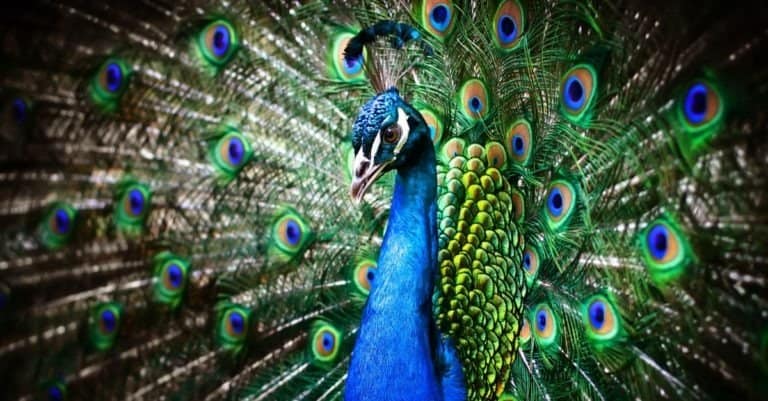
Peacock - peafowl with open tail, beautiful representative exemplar of male peacock in great metalic colors

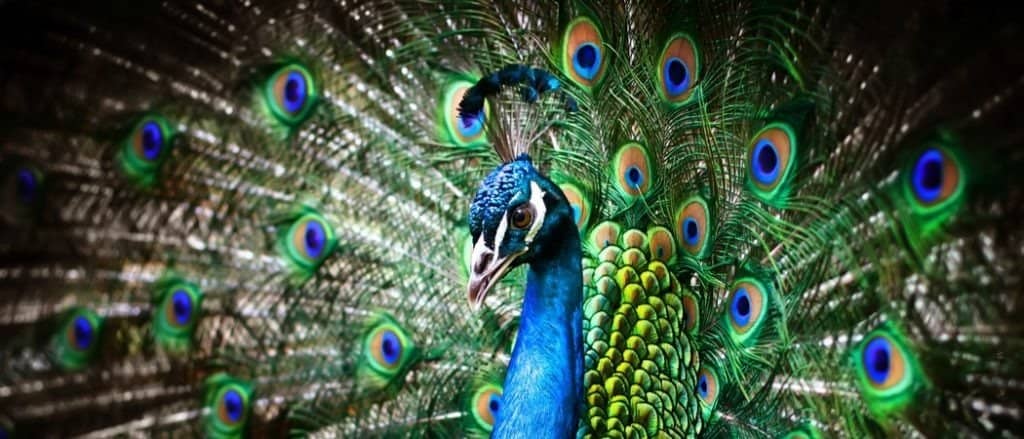
The Indian peacock is a striking, vibrant blue color with a large tail plumage covered in elaborate spots resembling eyes.

Diet

Peafowls are omnivores, which means they eat both plants and animals.

What do they eat?

The diet for these birds generally consists of a variety of plants and plant matter, including grass, roots, flowers, fruits, and seeds. They also feed on many insects, worms, and amphibians such as frogs, as well as snakes.

Predators, threats, and conservation status

In the wild, peafowls have an array of natural predators.

What eats them?

Some animals that prey on peafowls include wild cats such as tigers and leopards, wild dogs like the dhole, and even medium-sized mammals such as raccoons. Predators will stalk and attack the birds unless they get away. They fly up into trees to evade threats when they can.

Another threat to these animals is humans. Poaching and habitat loss are two of the biggest problems for these birds caused by humans. Poachers illegally kill peacocks to obtain and sell their iridescent tail feathers, meat, and sometimes eggs.

According to the International Union for the Conservation of Nature, the Indian peafowl’s status is least concern. The status of the green peafowl is endangered. The Congo peafowl is listed as near threatened.

Conservation efforts for these birds include a protection act, animal sanctuaries, captive breeding, and continued research and education. Human intervention can help safeguard these fascinating animals.
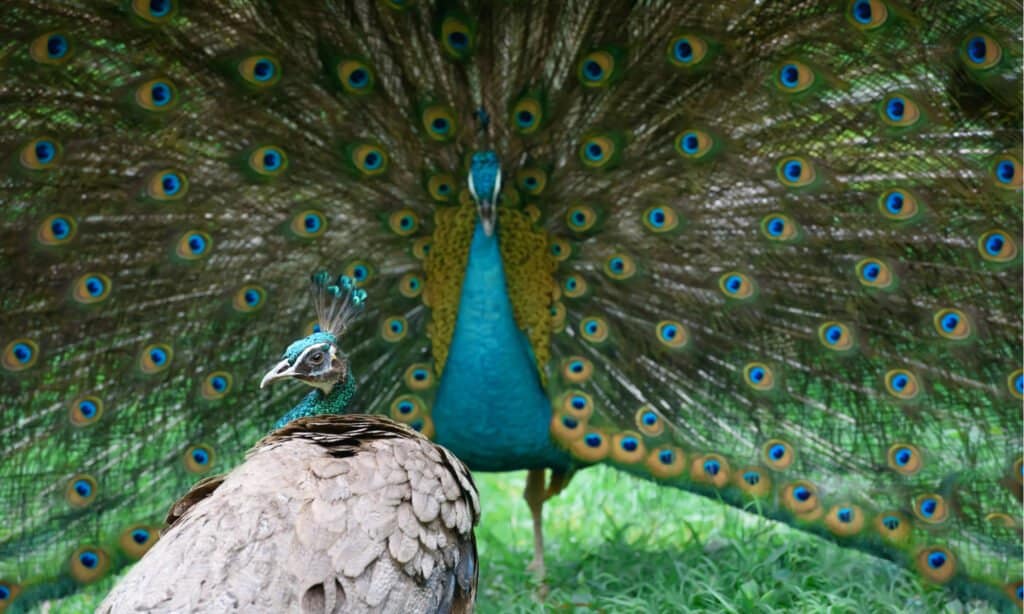
male vs female peacocks

Poaching and habitat loss are two of the biggest problems for these birds caused by humans.

Reproduction, Babies, and Lifespan

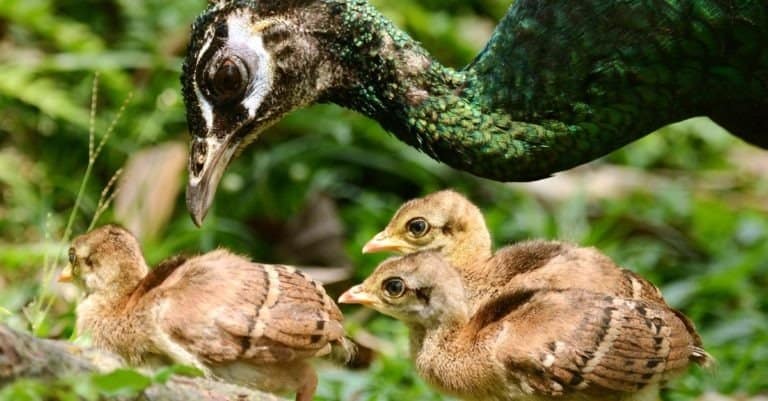
Peacocks are known to mate with many peahens during mating season. They mate by aligning their cloacas, which are their reproductive parts. Once the peahen lays its eggs, it incubates them similarly to how a chicken would incubate its eggs. The incubation period can last between 27 and 30 days. A baby peafowl is called a peachick. Each baby is taken care of solely by the mother.

Peachicks can walk as a baby, only days or sometimes moments after hatching, and can fly short distances when they are a few weeks old. They begin molting at three years old, and their feathers grow back fairly quickly. Peafowls typically live 10 to 25 years in the wild, but in captivity, they have been known to live as long as 40 to 50 years.
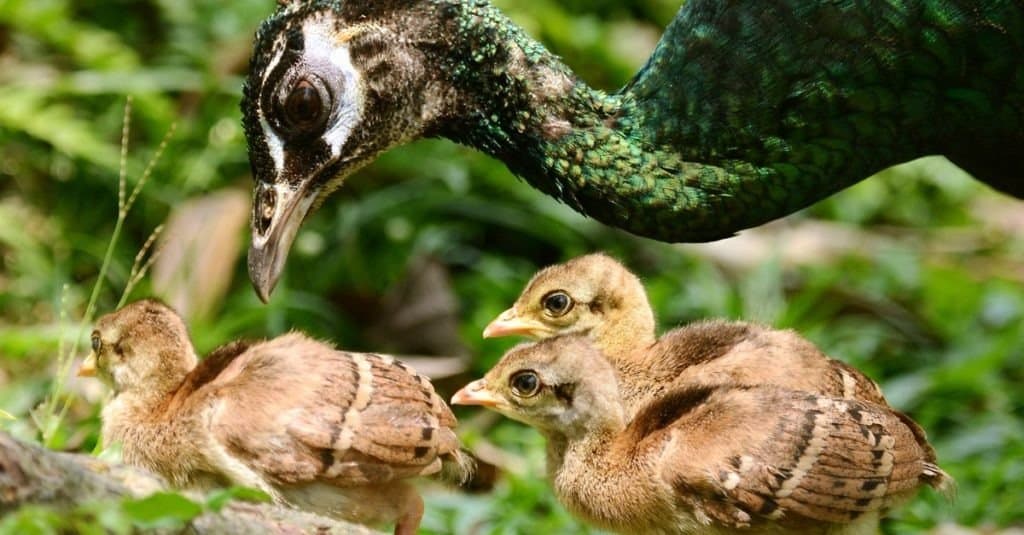
Female Peacock with group of newborn baby

A baby peafowl is called a peachick. Each baby is taken care of solely by the mother.

Population

The Indian peafowl’s status is least concern, meaning the population continues to thrive in the wild and is not threatened at this time. There are currently over 100,000 of these birds around the world. The Green peacock is considered endangered, with less than 30,000 remaining in the wild. The Congo peafowl, with numbers below 10,000, is near threatened. That means the population is declining, mostly due to habitat loss, and they are endangered.
Some breeds of peacock are in the Least Concern category, and some are in the Vulnerable category of conservation status.

Peahens and Peafowl

Peafowl is the correct term for what most people would call a peacock. This includes both males and females. Only the male is technically called a peacock. The females are called peahens. Peacocks and peahens can easily be identified as male or female based on their physical appearance. Peahens look somewhat plain compared to their male counterparts.

View all 247 animals that start with P

Sources

  1. Science Kids / Accessed February 4, 2021
  2. Britannica / Accessed February 4, 2021
  3. National Geographic / Accessed February 4, 2021
  4. Sciencing / Accessed February 4, 2021
  5. Global Giving / Accessed February 4, 2021
  6. The Arboretum / Accessed February 4, 2021
  7. Thoughtco / Accessed February 4, 2021
Heather Ross

About the Author

Heather Ross

Heather Ross is a secondary English teacher and mother of 2 humans, 2 tuxedo cats, and a golden doodle. In between taking the kids to soccer practice and grading papers, she enjoys reading and writing about all the animals!

Thank you for reading! Have some feedback for us?


Peacock FAQs (Frequently Asked Questions)

Peacocks are Omnivores, meaning they eat both plants and other animals.