
P
Species Profile

Platypus

Ornithorhynchus anatinus

Electric hunter of Australian rivers
Stefan Kraft / Creative Commons

Platypus Distribution

Click a location to explore more animals from that region

Endemic Species
Loading map...

Found in 1 country

At a Glance

Wild Species
Also Known As duck-billed mammal, duck-bill, water-mole, duck-billed monotreme, platty, ornitorrinco (Spanish), ornithorynque (French), Schnabeltier (German)
Activity Nocturnal+
Lifespan 12 years
Weight 2.4 lbs
Did You Know?

Taxonomy meaning: *Ornithorhynchus* = "bird snout"; *anatinus* = "duck-like."

Scientific Classification

The platypus is a semi-aquatic monotreme mammal endemic to eastern Australia and Tasmania, notable for egg-laying reproduction, a duck-like bill, and electrosensory foraging.

Kingdom
Animalia
Phylum
Chordata
Class
Mammalia
Order
Monotremata
Family
Ornithorhynchidae
Genus
Ornithorhynchus
Species
anatinus

Distinguishing Features

  • Egg-laying mammal (monotreme)
  • Flattened tail and dense waterproof fur for swimming
  • Soft, sensitive bill with electroreception for detecting prey
  • Males possess venomous hind-leg spurs
  • Feeds mainly on aquatic invertebrates; forages by diving with eyes/ears closed

Physical Measurements

Males and females differ in size

Length
1 ft 8 in (1 ft 6 in – 2 ft)
1 ft 5 in (1 ft 3 in – 1 ft 6 in)
Weight
4 lbs (2 lbs – 6 lbs)
2 lbs (2 lbs – 3 lbs)
Tail Length
5 in (4 in – 6 in)
5 in (4 in – 5 in)
Top Speed
2 mph
swimming
Venomous

Appearance

Primary Colors
Secondary Colors
Skin Type Very dense waterproof fur over skin; hairless flexible keratinized bill; webbed forefeet with leathery skin; thick, fatty tail covered in fur.
Distinctive Features
  • Adult size (published ranges): total length male ~45-60 cm, female ~39-55 cm; mass male ~1.0-2.4 kg, female ~0.7-1.6 kg (Serena 1994; Grant 2004).
  • Duck-like, dorsoventrally flattened bill is soft and rubbery; nostrils near bill tip close during dives.
  • Bill contains electroreceptors and mechanoreceptors; foraging is eyes/ears/nostrils closed underwater.
  • Forefeet strongly webbed for propulsion; webbing folds back on land to expose claws.
  • Hind feet less webbed; used for steering and burrowing; claws for digging riverbank burrows.
  • Tail is broad and flattened; stores fat and aids maneuvering; furred, not scaly.
  • Cloaca (single opening) consistent with monotremes; egg-laying reproduction and milk secretion without nipples.
  • Dense underfur and guard hairs form insulating, water-repellent coat for cold streams.
  • Typical diving bouts ~30-90 seconds with repeated shallow dives while benthic foraging; can extend longer when needed (commonly reported up to several minutes).
  • Burrow nesting: females excavate long nesting burrows in banks (often several meters; can be >10 m) with a grass-lined chamber and soil plugs for humidity control.
  • Endemic range appearance consistent across eastern Australia and Tasmania; fur color can vary with water staining and season.
  • Male ankle spur connected to venom gland; used mainly in male-male competition during breeding season; causes severe pain in humans but is not considered lethal. (e.g., Grant 2004; museum/clinical case literature)

Sexual Dimorphism

Males are noticeably larger and heavier than females and possess a functional venom spur on each hind ankle. Females lack functional venom and develop nesting-related body condition during breeding and lactation.

  • Larger body size and mass (commonly male up to ~2.4 kg; longer total length).
  • Functional crural (ankle) spur and venom gland on each hind leg.
  • Often broader head/neck profile and more robust forelimbs for competition.
  • Smaller body size and mass (commonly female up to ~1.6 kg).
  • No functional venom delivery (spur absent or non-functional).
  • Develops enlarged mammary tissue seasonally; milk secreted onto skin for young.

Did You Know?

Taxonomy meaning: *Ornithorhynchus* = "bird snout"; *anatinus* = "duck-like."

Adult size: males typically 50 cm long and 1.0-2.4 kg; females ~43 cm and 0.7-1.6 kg.

Body temperature averages ~32 °C (lower than most mammals).

The bill contains ~40,000 electroreceptors (plus ~60,000 mechanoreceptors), enabling prey detection by tiny bioelectric signals in murky water.

Dives are commonly ~30-60 s, with maximum submergence around ~2 minutes during foraging.

Reproduction: females lay 1-3 eggs (commonly 2); incubation is ~10 days, and hatchlings are then nursed with milk secreted onto the skin (no nipples).

Males have an ankle spur that can deliver venom causing intense, long-lasting pain in humans; it's mainly used in male-male competition during the breeding season.

Unique Adaptations

  • Monotreme biology: lays eggs and has a cloaca (single opening for digestive, urinary, and reproductive tracts), a rare mammalian condition shared only with echidnas.
  • Electroreception + mechanoreception bill: specialized skin receptors in the bill detect weak electric fields from prey muscle contractions and minute water movements-an aquatic sensory system unique among mammals.
  • Venom apparatus in males: a keratin spur connected to a venom gland on the hind limb; venom potency and gland size increase in the breeding season.
  • Aquatic streamlining: dense waterproof fur traps insulating air; a broad tail stores fat; webbed forefeet provide propulsion while hindfeet and tail aid steering.
  • Low and stable core temperature (~32 °C): supports energy balance in cold water compared with typical mammalian ~37 °C physiology.
  • Nursing without nipples: milk is secreted from mammary glands onto the mother's skin/fur for young to lap-an ancient mammalian trait retained in monotremes.

Interesting Behaviors

  • Electrosensory hunting: when submerged, the platypus closes its eyes, ears, and nostrils and sweeps its bill side-to-side to pinpoint moving prey (mostly aquatic insect larvae, freshwater shrimp/crayfish, and worms).
  • Bottom-feeding and storage: it often digs through sediment with the bill and stores food in cheek pouches, surfacing to chew and swallow.
  • Crepuscular/nocturnal activity: foraging peaks at dawn/dusk or at night, especially in warmer conditions and human-disturbed waterways.
  • Burrow use: maintains multiple burrows-short "resting" burrows for daytime refuge and longer nesting burrows for breeding.
  • Nest construction: the breeding female plugs sections of the nesting burrow with soil/vegetation, helping stabilize humidity and temperature and reducing predation risk.
  • Seasonal aggression in males: during the breeding season, males use the spur/venom system primarily against rival males rather than predators.

Cultural Significance

Platypus (Ornithorhynchus anatinus) is a national icon of Australia and a symbol of healthy freshwater habitats in eastern Australia and Tasmania. It appears on the 20-cent coin, helps conservation messages, and once shocked scientists as an egg-laying mammal.

Myths & Legends

Aboriginal Dreaming stories explain the platypus (Ornithorhynchus anatinus) as born from a duck or waterbird and a water rat, or from several animals, showing kinship among river and wetland life.

In the late 1700s, early European stories said the first platypus (Ornithorhynchus anatinus) skins looked so strange that some naturalists thought it was a hoax, imagining a duck bill stitched onto a mammal.

Naming lore in colonial Australia: popular retellings link the animal's 'puzzle' anatomy to its scientific name (*Ornithorhynchus anatinus*, "duck-like bird-snout"), reflecting how settlers tried to make sense of an animal unlike anything in Europe.

Conservation Status

NT Near Threatened

Likely to qualify for a threatened category in the near future.

Population Decreasing

Protected Under

  • Australia (general): protected native wildlife under state/territory fauna laws; take/harm generally prohibited without permits
  • New South Wales: Biodiversity Conservation Act 2016 (protected fauna provisions)
  • Victoria: Wildlife Act 1975
  • Queensland: Nature Conservation Act 1992
  • Tasmania: Nature Conservation Act 2002

Life Cycle

Birth 2 puggles
Lifespan 12 years

Lifespan

In the Wild
5–17 years
In Captivity
10–22 years

Reproduction

Mating System Polygynandry
Social Structure Solitary
Breeding Pattern Transient
Fertilization Internal Fertilization
Birth Type Internal_fertilization

Solitary adults; in the breeding season males range widely, compete, and mate with multiple females. Genetic parentage studies show some litters have multiple sires; females nest alone, incubate typically 1-3 eggs, and rear young without helpers.

Behavior & Ecology

Social Solitary Group: 1
Activity Nocturnal, Crepuscular, Cathemeral
Diet Insectivore Aquatic insect larvae (notably caddisfly and mayfly larvae)

Temperament

Predominantly solitary; individuals occupy home ranges that can overlap, but males may defend territories and become aggressive during the breeding season.
Adult males show increased aggression in breeding season; spur-venom used in male-male conflicts (Temple-Smith 1973; Grant 2007).
Home ranges are typically linear along waterways; reported male ranges commonly several kilometers, with females smaller (Grant & Carrick 1978; Serena 1994).
Activity varies geographically-mainland populations are mostly nocturnal/crepuscular, while Tasmanian or winter activity can be more diurnal/cathemeral (Serena 1994; Grant 2007).
Longevity: commonly reported up to ~17 years in the wild; captive individuals may exceed 20 years (Grant 2007).

Communication

Low growls/grunts when disturbed or handled Grant 2007
Soft calls between mothers and young in nesting context Reported in husbandry/field notes; Grant 2007
Chemical cues likely important: scent from glandular secretions/urine at burrows and along travel routes Serena 1994; Grant 2007
Tactile contact during courtship/mating, including body-to-body contact and underwater following Grant 2007
Mechanical/water-surface cues: splashing and wake-following during close encounters, especially courtship Grant 2007

Habitat

Biomes:
Freshwater Wetland Temperate Forest Temperate Rainforest Tropical Rainforest Mediterranean
Terrain:
Riverine Valley Hilly Mountainous Plateau Coastal Muddy Sandy +2
Elevation: Up to 5249 ft 4 in

Ecological Role

Benthic mesopredator in freshwater ecosystems (streams, rivers, lakes), specializing on aquatic macroinvertebrates.

Regulates populations of aquatic insect larvae and other benthic macroinvertebrates (top-down control) Bioturbation of sediments during digging/raking, which can influence substrate turnover and nutrient dynamics Links aquatic and riparian food webs by concentrating aquatic prey biomass and excreting nutrients along banks/rest sites

Diet Details

Main Prey:
Aquatic insect larvae Freshwater crustaceans Freshwater crayfish Aquatic annelid worms Freshwater molluscs

Human Interaction

Domestication Status

Wild

Platypus (Ornithorhynchus anatinus) is fully wild with no history of domestication. Native to eastern Australia and Tasmania, it is legally protected, so private keeping is banned. Human contact is mostly research, conservation, rescue and care, and zoo education. Specialized freshwater habitat, underwater foraging, and a bill with about 40,000 electroreceptors and 60,000 mechanoreceptors make domestication impractical.

Danger Level

Moderate
  • Male envenomation via crural (ankle) spur: venom can cause immediate, severe pain and significant swelling; human cases are medically important for pain management but are not generally considered fatal. Risk is highest during the breeding season when male spur/venom system is most active (venom is seasonal).
  • Bites/scratches during handling: strong jaws and claws can cause lacerations; most risk occurs during capture/rehabilitation/research handling.
  • Indirect risks: waterborne pathogens and injury during field capture in aquatic environments (drowning/entanglement hazards for handlers).

As a Pet

Not Suitable as Pet

Care Level: Expert Only

Purchase Cost:
Lifetime Cost: $50,000 - $250,000

Economic Value

Uses:
Conservation and biodiversity value (protected endemic species) Ecotourism and educational display (accredited zoos/wildlife parks) Scientific research value (monotreme reproduction, electroreception, venom, comparative genomics)
Products:
  • No legal commercial products from the species in modern practice (protected). Historically, platypuses were hunted for pelts prior to legal protections, but this is not a current lawful economic product stream.

Relationships

Related Species 4

Pliocene platypus Shared Genus
Riversleigh platypus Obdurodon dicksoni Shared Family
Oligo-Miocene platypus Obdurodon insignis Shared Family
South American monotreme Monotrematum sudamericanum Shared Family

Ecological Equivalents 5

Animals that fill a similar ecological role in their ecosystem

Rakali Hydromys chrysogaster Semi-aquatic freshwater predator that forages along banks and in benthic habitats for aquatic invertebrates and small vertebrates. Strong overlap with platypus habitat use (rivers, streams, lakes) and sheltering in burrows, though it hunts primarily by touch, vision, and smell rather than the platypus's bill electroreception.
Eurasian water shrew Neomys fodiens Small, aquatic insectivore that dives repeatedly and targets aquatic insect larvae and other invertebrates in shallow freshwater margins; functionally similar to the platypus in benthic invertebrate foraging (short, frequent dives and prey taken from the substrate).
Pyrenean desman Galemys pyrenaicus Semi-aquatic mammal specialized on aquatic invertebrates in fast-flowing streams. Convergent niche with the platypus as a stream-dwelling, bottom-feeding invertebrate specialist, though taxonomically unrelated.
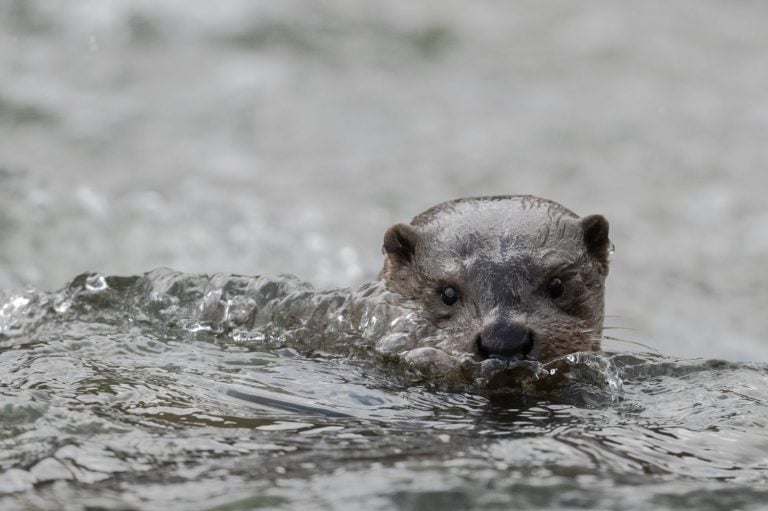
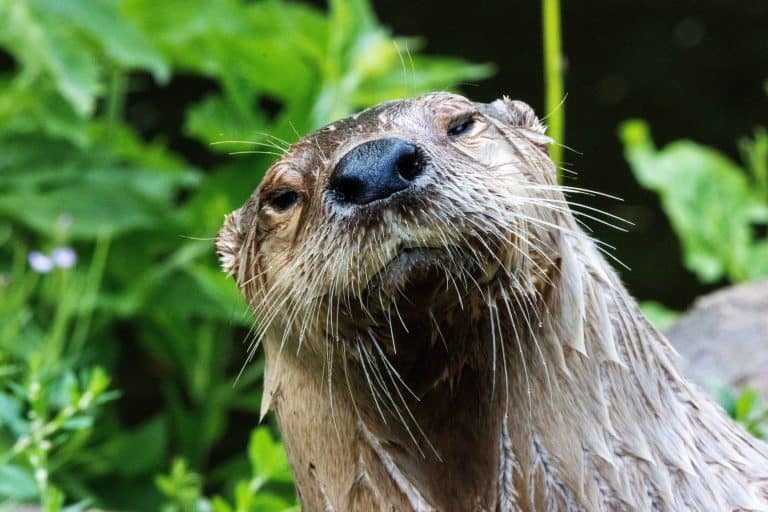
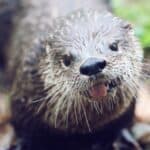
North American river otter
North American river otter Lontra canadensis Riverine, highly aquatic mammal that uses repeated dives and underwater pursuit and foraging. Overlaps in habitat and general trophic role as an aquatic predator, but typically takes larger prey (fish and crayfish) compared with the platypus's predominantly invertebrate diet.
Short-beaked echidna Tachyglossus aculeatus Fellow monotreme with a convergent emphasis on an invertebrate diet and a strong reliance on specialized snout sensory systems for foraging; differs by being primarily terrestrial rather than semi-aquatic.

Classification, Evolution, and History

The platypus (also commonly known as the duck-billed platypus) is a small species of semi-aquatic mammal indigenous to the eastern coast of Australia. Known for its unique-looking appearance, the platypus belongs to a small group of mammals called monotremes, of which there are only a few species.
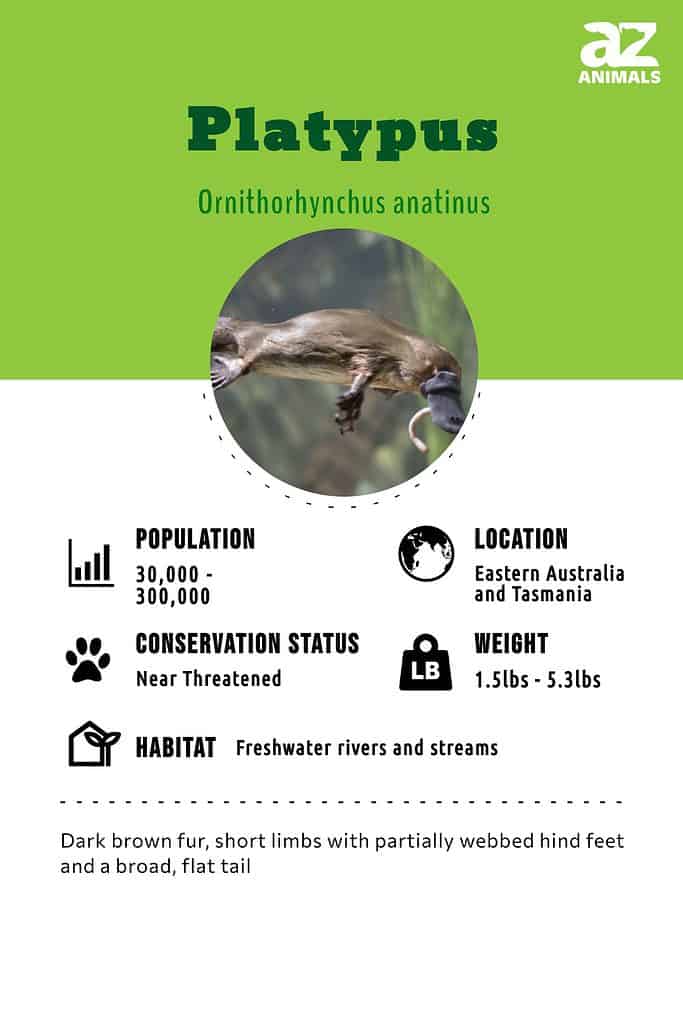
The platypus along with the short-nosed echidna and long-nosed echidna are the only mammals that are known to lay eggs instead of giving birth to live young, making them truly unique and leading to them not being recognized as true mammals for a long time. They do, however, possess and feed their young using their mammary glands – the essential characteristic from which the class Mammalia takes its name. When the first platypus specimen arrived in Britain in 1798, it was thought to be a hoax as the platypus looks like it is a mixture of a mammal and a bird.

There appears to be some evidence that, while platypuses now live in the freshwaters of Australia, they once lived in more locations, including South America! This was possible because of the geographical connection of Australia to South America via Antarctica millions of years ago.
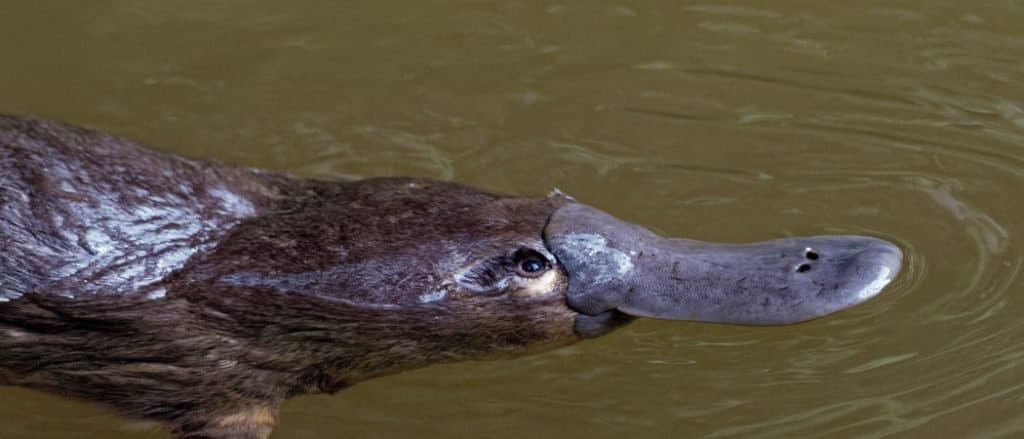
Most Venomous Mammals – Platypus

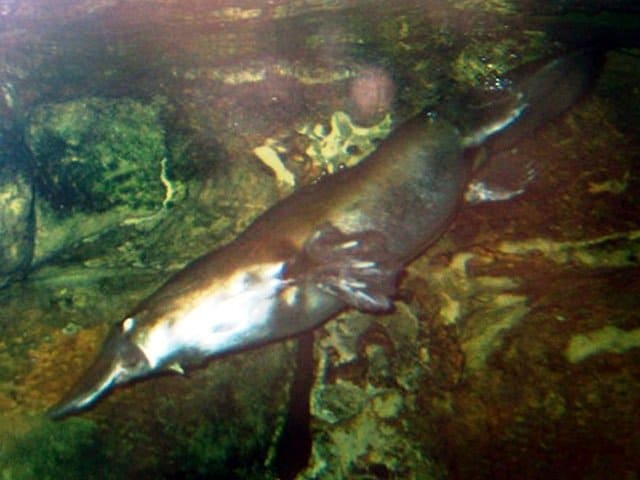
The platypus is one of the few species of monotremes and is easily identified by its ducklike nose.

Anatomy and Appearance

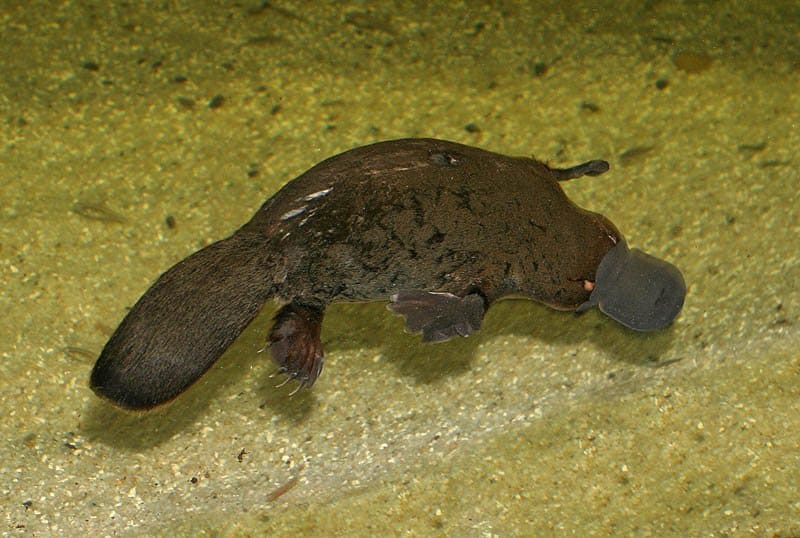
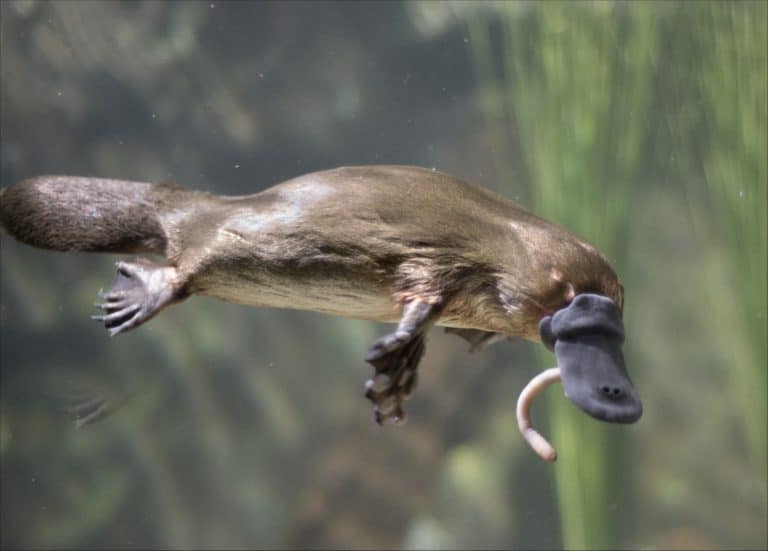
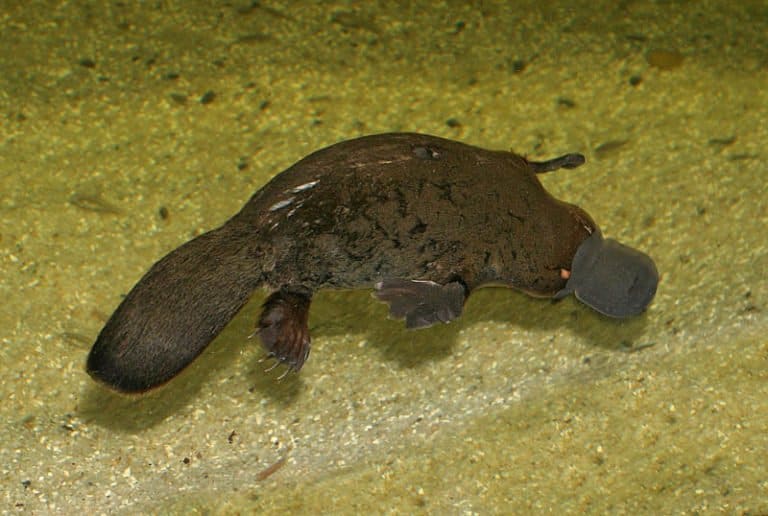
The platypus is an animal with a small, streamlined body that is covered in short and dense waterproof fur that varies in color from dark brown on its back with a light brown or silver underside and a plum-colored middle. They have short limbs with partially webbed hind feet and a broad, flat tail (which resembles the tail of a beaver) that are used as rudders when underwater. Their front feet are fully webbed and help to propel the platypus through the water and can be turned back when on land, exposing their large nails to aid them when walking or burrowing into the river banks. One of the platypus’s most distinctive and unusual features is the large, broad bill that looks like the beak of a duck. The bill of the platypus is soft and pliable and covered in a multitude of sensory receptors that help them to detect the small electrical signals emitted from their prey species. Their bills are very touch-sensitive and are often used to probe the mud on the riverbed for the small insect larvae on which they most commonly feed on. Males are larger in size than females and possess a poison spur on the ankle of each hind foot that is used to drive away rival males during the breeding season. Learn more about the most venomous mammals on earth here.
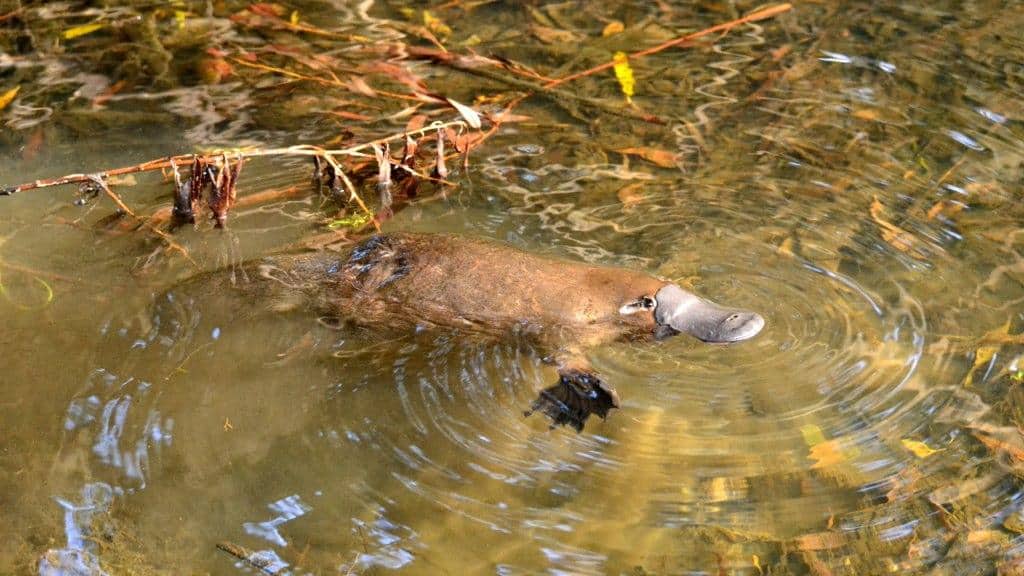
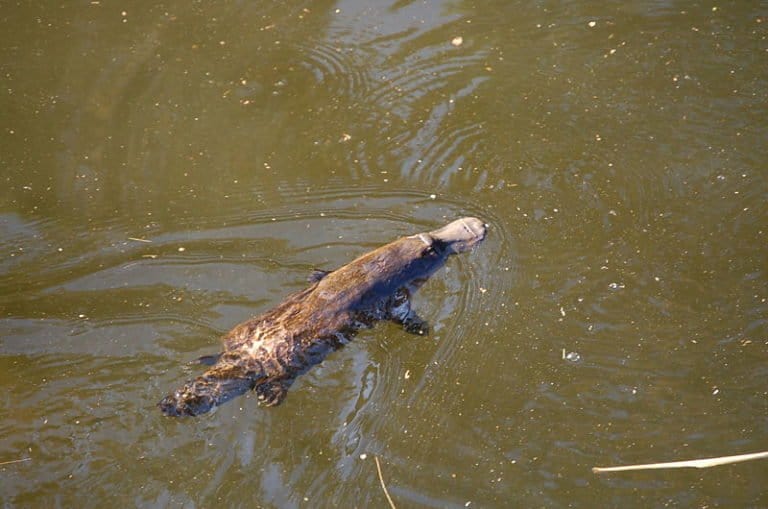
Platypuses have short limbs with partially webbed hind feet and a broad, flat tail.

Distribution and Habitat

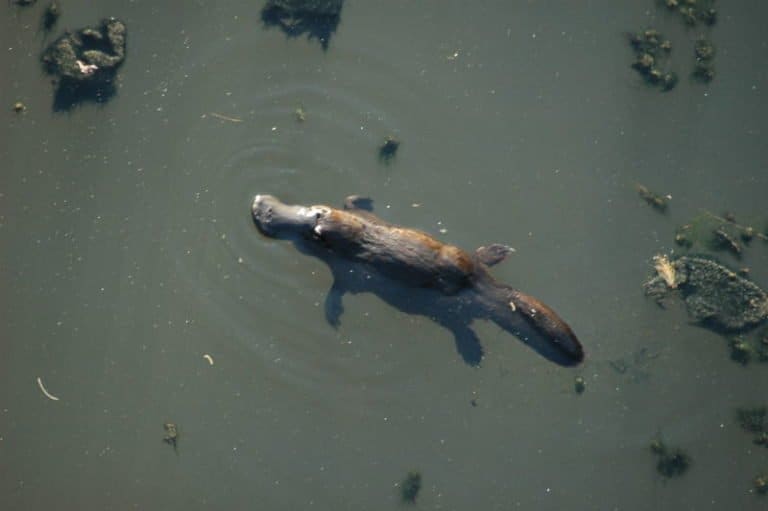
The platypus is an animal that is found on the east coast of Australia from Cooktown in Queensland in the north, all the way down to the island of Tasmania in the south and has also been introduced to Kangaroo Island in southern Australia. They inhabit streams and rivers, and some lakes that have suitable banks for burrowing in and a permanent source of water. They are highly suited to their semi-aquatic environment and possess the best physical characteristics for dealing with life both in and out of the water, with their dense fur helping to keep their warm bodies insulated even in the coldest of water. Their home ranges vary depending on the specific river system and can vary in size from less than a kilometer to more than 7 kilometers, and overlap those ranges of other individuals despite their solitary nature. The platypus is thought to be so successful as an animal species as they are able to survive in such a niche environment in the world’s driest continent.
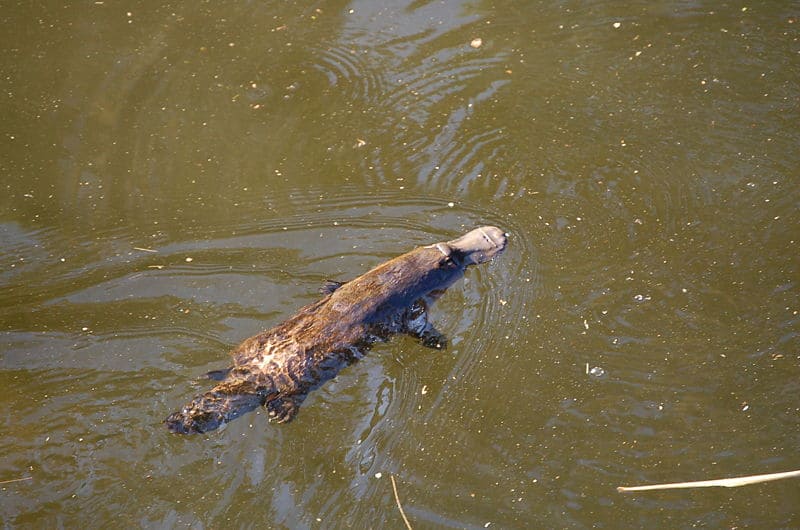
Platypuses inhabit streams, rivers, and some lakes that have suitable banks for burrowing in and are a permanent source of water.

Behavior and Lifestyle

The platypus is a solitary animal that despite occupying overlapping home ranges, only comes together during the breeding season or when a mother is looking after her young. They are nocturnal hunters that are able to close their eyes, ears, and nostrils when diving down to the river bed in search of food. During the day, they rest in burrows that are dug into the river banks using their long, broad nails and powerful front legs. There are two different types of burrows used by the platypus; one for resting and one for incubating their eggs and nursing their young. Individual animals may use a number of resting burrows within their home range. Typically resting burrows are around 5 meters in length but incubation burrows can reach up to 30 meters long and can have more than one nesting chamber.
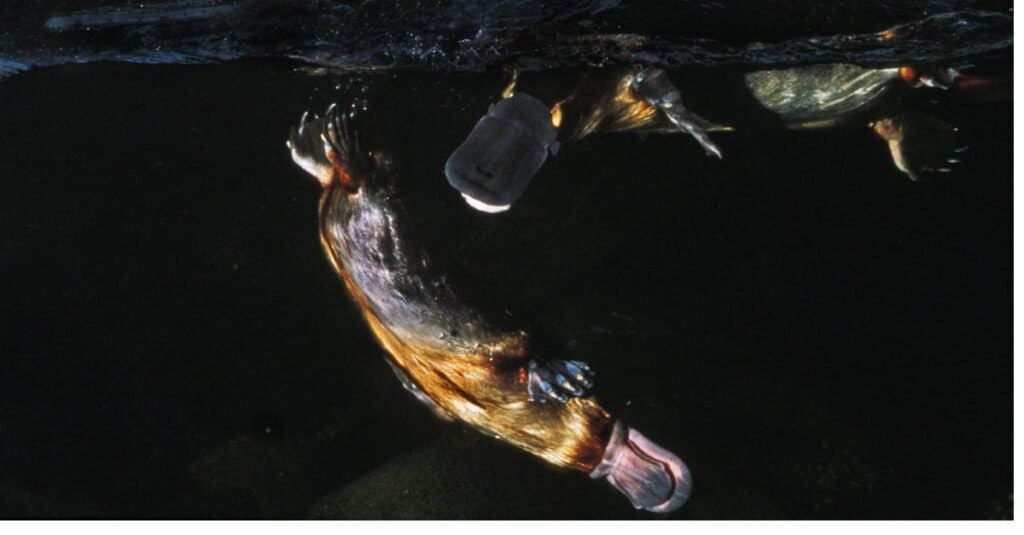
Normally solitary animals, platypuses only come together when breeding or when mothers are rearing their young.

Reproduction and Life Cycles

Breeding takes place between late winter and early spring (July – October) in the water, with males using their poison spurs to deliver a painful dose of poison to their rivals. As part of their courtship ritual, females carry bundles of wet leaves to their incubation chamber at the end of their burrow and plug the tunnel with soil. After a gestation period of between two and three weeks, the female platypus lays between one and three small, spherical eggs that are only 1.5 cm in size and are soft and leathery. After an incubation period of around 10 days, the young hatch out in a very undeveloped state measuring barely 1 cm in length, blind, hairless, and having blunt buds for limbs. They are nursed by their mother in the incubation chamber for up to 5 months suckling on the milk on her fur that is secreted by her mammary glands. A young Platypus is lighter in color than older individuals and 85% of their adult size when they first become independent. Platypuses tend to live for around 10 years in the wild but can reach ages of 17 or more when in captivity.
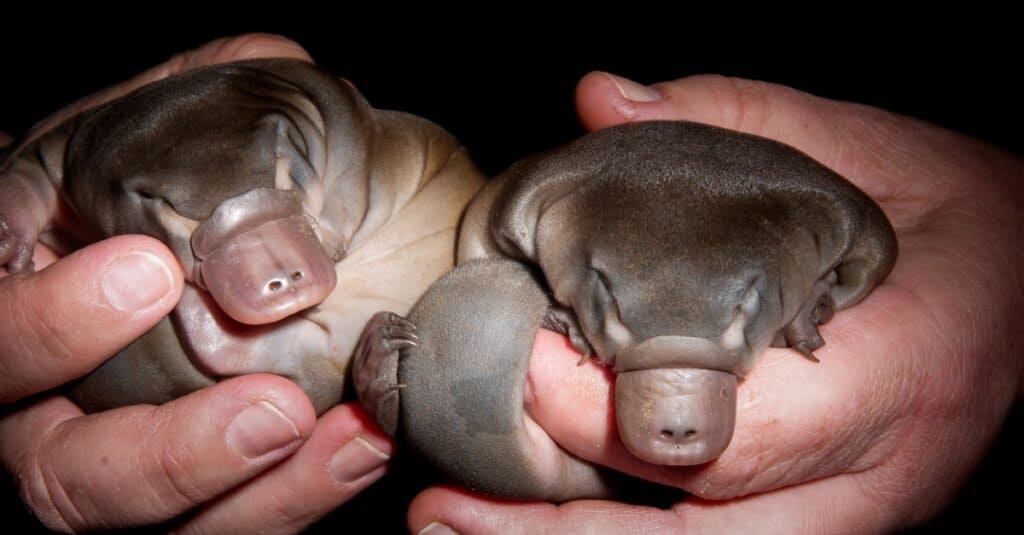
Platypuses hatch from soft, leathery eggs.

Diet and Prey

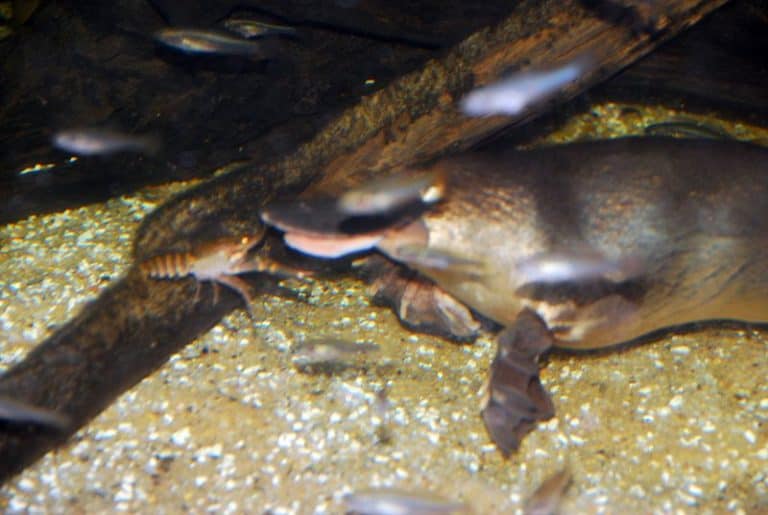
The platypus is a small, carnivorous mammal whose diet is almost solely comprised of bottom-dwelling aquatic creatures. Young insects (larvae) make up the majority of their diet along with small freshwater crustaceans, snails, tadpoles, and small fish. Due to the fact that their eyes, ears, and nostrils are closed when they are underwater, the platypus relies solely on its bill in order to find food. The small sensory receptors that cover it can detect the electrical signals created by the movement of creatures in the water and the fact that it is highly tactile means that they can also feel prey species when probing the mud on the river bed. When hunting the platypus stores food in cheek pouches located on the sides of the mouth that is then ground up using the horny ridges that the platypus has instead of teeth.
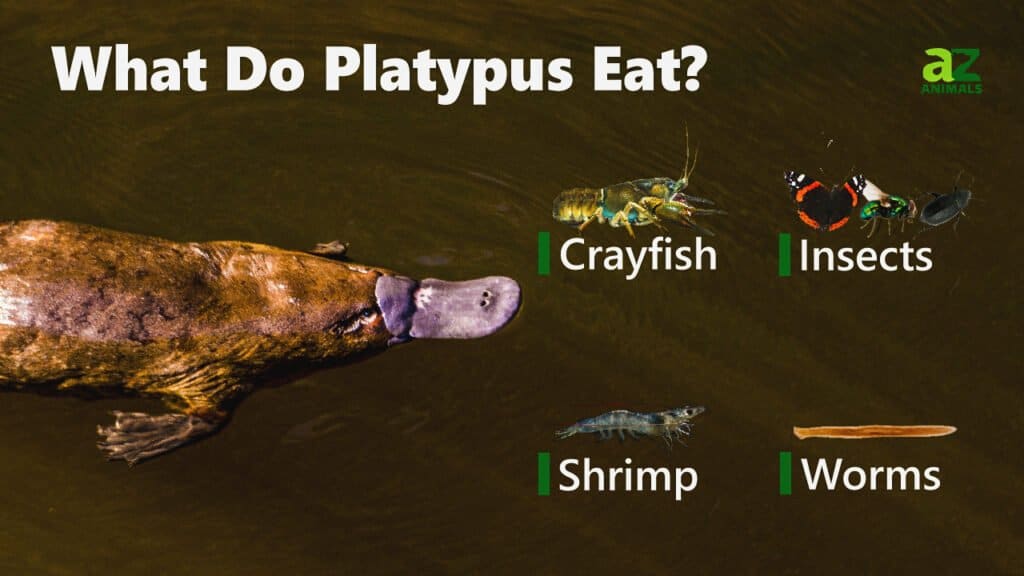
What Do Platypus Eat
Platypuses eat crayfish, insects, shrimp, and worms.

Predators and Threats

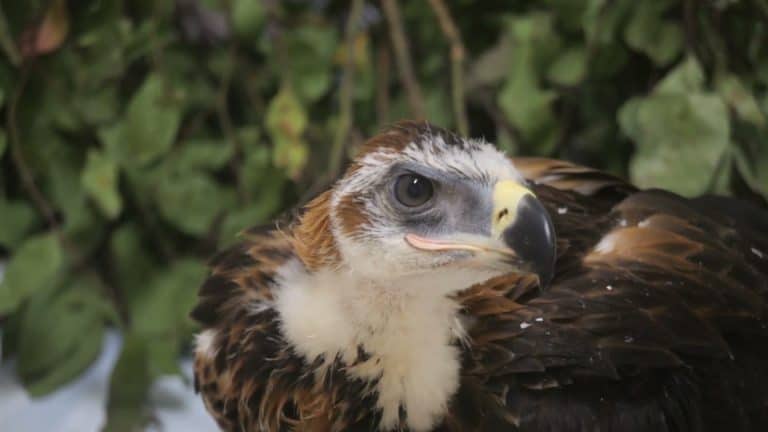
The platypus is a highly specialized animal that has evolved to survive and thrive in very specific environments and protects itself from predators when resting during the day by hiding in its river-bank burrows. However, their small size means that they are preyed upon by numerous animal species throughout their home ranges. Their most common predators include birds of prey such as hawks and eagles, large mammals including dingoes, dogs, cats, and Tasmanian devils, and reptiles such as snakes, monitor lizards, and crocodiles. Despite the fact that they are widespread and considered locally common in places, they were hunted to near extinction in the 18th century which has led to reductions and fragmentation of platypus populations in some areas. Due to their very specific evolution, they are also highly susceptible to changes in their natural habitats.

Platypus Interesting Facts and Features

The platypus is a species of monotreme, which is a small group of egg-laying mammals of which are they are only three species. Not considered true mammals by some scientists, monotremes are thought to be the most primitive group of mammals having evolved around 200 million years ago. However, despite having evolved before other mammal species, monotremes are by no means primitive and possess some highly developed features that are not found in any other group of mammals, such as the poisonous spur found on the hind ankles of males. Unlike other mammals, they do not have a birth canal and instead, their eggs travel through the same bodily opening as their urine and feces and terminate in a single bodily opening known as the cloaca. This is a feature that monotremes share with both birds and reptiles with the name monotreme actually meaning “one-holed animal”.
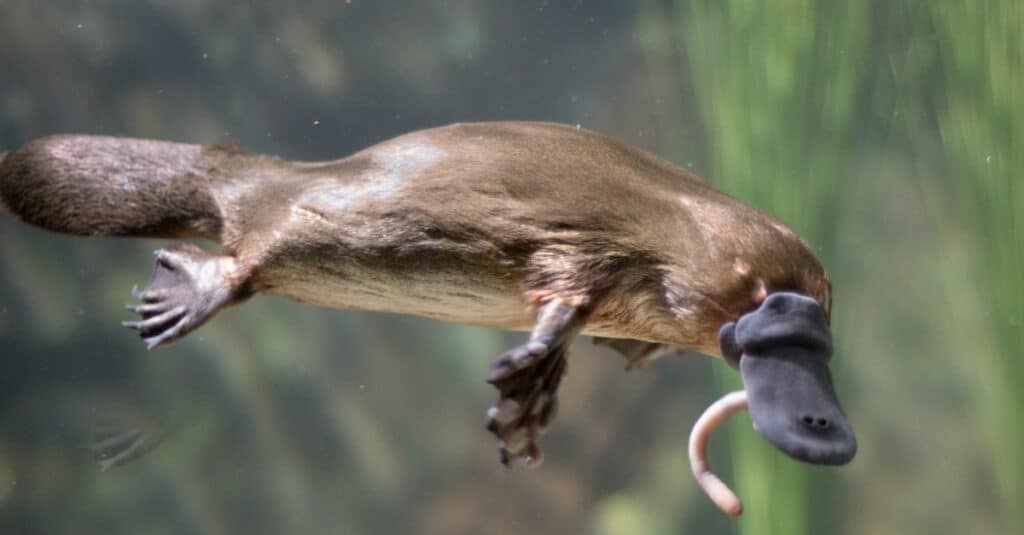
Platypuses have evolved to have features that are not found in any other group of mammals.

Relationship with Humans

With the settlement of Europeans in the 18th century came a great change for platypus populations along Australia’s eastern coast. The platypus was hunted extensively for its soft, thick fur until it became banned in 1900 which allowed populations to begin to recover. Growing human settlements and changes to the freshwater conditions caused by pollution has had a negative impact on platypus populations particularly in certain areas, where they have suffered from habitat loss.

Conservation Status and Life Today

Until 2014, the platypus was considered to be an animal that was of Least Concern from extinction by the IUCN. However, due to the constant decline in their population numbers, they are considered to be a species that is now Near Threatened. With up to 300,000 adult individuals remaining in the wild, the platypus is becoming increasingly threatened throughout its natural range. A number of captive breeding programs have been established to try and boost platypus population numbers in certain areas.

View all 247 animals that start with P
How to say Platypus in ...
English
Platypus
French
Ornithorynque
German
Schnabeltier
Bulgarian
птицечовка
English
Čudnovati kljunar
Catalan
ornitorinc
Czech
ptakopysk
Danish
Næbdyr
Esperanto
Ornitorinko
Spanish
Ornithorhynchus anatinus
Estonian
nokkloom
Finnish
Vesinokkaeläin
Galician
Ornitorrinco
Hebrew
ברווזן
Croatian
Čudnovati kljunaš
Hungarian
Kacsacsőrű emlős
Indonesian
Platipus
Italian
Ornithorhynchus anatinus
Japanese
カモノハシ
Latin
Ornithorhynchus anatinus
Malay
Platipus
Dutch
vogelbekdier
Polish
Dziobak australijski
Portuguese
Ornitorrinco
English
Ornitorinc
Swedish
Näbbdjur
Turkish
Ornitorenk
Vietnamese
Thú mỏ vịt
Chinese
鸭嘴兽

Sources

  1. David Burnie, Dorling Kindersley (2011) Animal, The Definitive Visual Guide To The World's Wildlife / Accessed November 10, 2008
  2. Tom Jackson, Lorenz Books (2007) The World Encyclopedia Of Animals / Accessed November 10, 2008
  3. David Burnie, Kingfisher (2011) The Kingfisher Animal Encyclopedia / Accessed November 10, 2008
  4. Richard Mackay, University of California Press (2009) The Atlas Of Endangered Species / Accessed November 10, 2008
  5. David Burnie, Dorling Kindersley (2008) Illustrated Encyclopedia Of Animals / Accessed November 10, 2008
  6. Dorling Kindersley (2006) Dorling Kindersley Encyclopedia Of Animals / Accessed November 10, 2008
  7. David W. Macdonald, Oxford University Press (2010) The Encyclopedia Of Mammals / Accessed November 10, 2008
Heather Ross

About the Author

Heather Ross

Heather Ross is a secondary English teacher and mother of 2 humans, 2 tuxedo cats, and a golden doodle. In between taking the kids to soccer practice and grading papers, she enjoys reading and writing about all the animals!

Thank you for reading! Have some feedback for us?


Platypus FAQs (Frequently Asked Questions)

Platypuses are Carnivores, meaning they eat other animals.