P
Species Profile

Prawn

Decapoda

From reef cleaners to river giants
Syrist / Creative Commons

At a Glance

Order Overview This page covers the Prawn order as a group. Stats below are general traits shared across the order.
Also Known As Shrimp, Scampi, Gamba, Gambas, Camarón, Camarones, Crevette, Camarão
Diet Omnivore
Activity Nocturnal+
Lifespan 4 years
Weight 0.36 lbs
Status Not Evaluated
Did You Know?

Size range across "prawns": ~1-35 cm long (from tiny caridean shrimps to large penaeids and Macrobrachium freshwater prawns).

Scientific Classification

Order Overview "Prawn" is not a single species but represents an entire order containing multiple species.

“Prawn” is a broad common name for shrimp-like decapod crustaceans. Depending on region and industry usage, it may refer to various marine or freshwater decapods—commonly penaeid prawns (Dendrobranchiata) and/or caridean shrimps (Caridea).

Kingdom
Animalia
Phylum
Arthropoda
Class
Malacostraca
Order
Decapoda

Distinguishing Features

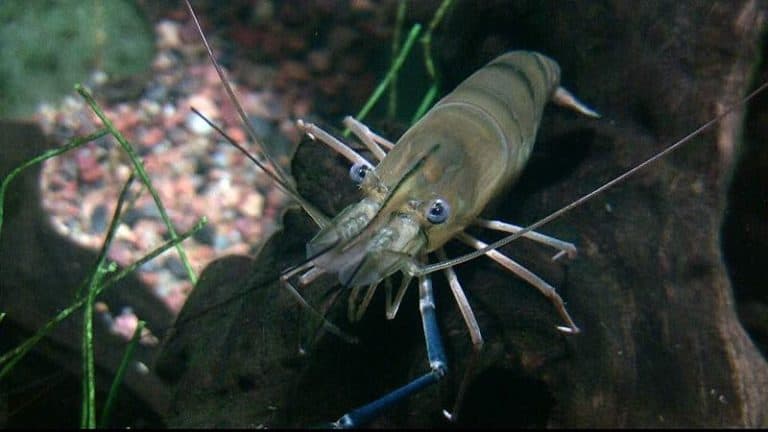
  • Crustaceans with a hard exoskeleton (carapace) and segmented abdomen ending in a tail fan
  • Five pairs of walking legs (decapods), with anterior legs often modified for grasping
  • Long antennae; compound eyes on stalks
  • Common-name usage overlaps with “shrimp” and differs by region/market

Physical Measurements

Males and females differ in size

Length
5 in (0 in – 1 ft 1 in)
Weight
0 lbs (0 lbs – 1 lbs)
Tail Length
2 in (0 in – 1 ft 1 in)
Top Speed
6 mph
swimming

Appearance

Primary Colors
Secondary Colors
Skin Type Thin, segmented chitinous exoskeleton (carapace + abdomen), frequently smooth and semi-translucent; periodic molting common. Appendages bear fine setae; gill structures differ among groups (dendrobranchiate vs phyllobranchiate).
Distinctive Features
  • Hub term spans multiple Decapoda lineages commonly called "prawns": many penaeid prawns (Dendrobranchiata) and many caridean shrimps/prawns (Caridea).
  • Overall size range across prawn-like decapods: ~5 mm to ~35 cm total length (a few milligrams to >300 g), depending on lineage and environment.
  • Body plan: laterally compressed, segmented abdomen with strong tail fan (uropods + telson) enabling rapid tail-flip escape.
  • Long antennae/antennules for touch and chemoreception; rostrum length and tooth counts vary widely among groups.
  • Legs: five pairs of walking legs; many have small chelae, with enlarged chelae in some freshwater prawns (e.g., Macrobrachium).
  • Gills and reproductive structures vary: penaeids have dendrobranchiate gills and male petasma; carideans have different gill types and typically carry eggs under the abdomen.
  • Eyes prominent, often stalked; coloration can change with stress, background, and molt stage.
  • Common habitats are benthic or demersal in marine, estuarine, and freshwater systems; some are pelagic, symbiotic (cleaners), or cave/anchialine specialists.
  • Life history often includes planktonic larvae; many species migrate between offshore waters and estuaries, while some freshwater prawns require brackish water for larval development; others complete cycles entirely in fresh water.
  • Lifespan range across species: typically ~1-7 years (many harvested species ~1-3 years), varying with temperature, predation, and growth rate.
  • Feeding ecology commonly omnivorous/scavenging (detritus, algae, small invertebrates), with variation to filter-feeding, specialized predation, or symbiosis.
  • Behavior often nocturnal/crepuscular with daytime concealment; schooling/aggregations common in some marine penaeids, while territoriality can occur in large-clawed freshwater prawns, indicating wide ecological and behavioral diversity across the hub term.

Sexual Dimorphism

Sexual dimorphism is common but variable: females are often larger-bodied or broader-abdomened for egg production, while males may show enlarged chelae or specialized reproductive structures. Penaeid males typically have a petasma, and caridean females frequently carry eggs on pleopods.

  • Enlarged second chelipeds in many freshwater prawns (not universal across all lineages).
  • Specialized copulatory structures vary by group (e.g., petasma in many penaeids).
  • Sometimes slimmer abdomen and proportionally longer appendages/antennae.
  • Often broader abdomen and more developed pleopods for egg attachment and aeration.
  • Frequently larger overall size in many commercially harvested penaeids and some carideans.
  • Visible ovarian coloration through translucent exoskeleton in some species; egg-carrying (brooding) common in carideans.

Did You Know?

Size range across "prawns": ~1-35 cm long (from tiny caridean shrimps to large penaeids and Macrobrachium freshwater prawns).

Mass ranges from under a gram in small species to ~200-250 g in the largest freshwater prawns.

Lifespan varies widely: many fast-growing penaeids live ~1-2 years, while some larger/colder-water or cleaner shrimps can reach ~5-7 years.

Two major "prawn" lineages are often confused: penaeid prawns (suborder Dendrobranchiata) typically release eggs into the water; many caridean shrimps brood eggs on their swimmerets.

Many marine prawns have a 'nursery' life cycle-larvae offshore, juveniles growing in estuaries/mangroves, adults returning deeper.

Some caridean shrimps are famous mutualists (cleaner shrimps), while others are ambush predators, scavengers, or plankton-feeders-'prawn' isn't a single lifestyle.

Molting is central to prawn life: they periodically shed the exoskeleton to grow, regenerate lost limbs, and (often) synchronize reproduction.

Unique Adaptations

  • Decapod toolkit: 5 pairs of walking legs (often with claws), specialized mouthparts, and strong abdominal muscles for the rapid 'tail-flip' escape response.
  • High-performance chemical sensing: long antennae/antennules carry chemoreceptors that detect food, mates, and predators in turbulent water.
  • Egg strategies differ by lineage: many carideans brood eggs under the abdomen (enhancing protection/oxygenation), while dendrobranchiate penaeids generally spawn free eggs that develop in the plankton.
  • Color change and camouflage: chromatophores and body translucency help many species blend into sand, seagrass, reefs, or open water; patterns can shift with background, stress, or time of day.
  • Osmoregulation across habitats: euryhaline species tolerate big salinity swings (estuaries, tidal rivers), while some freshwater prawns have adaptations for ionic regulation in low-salt environments.
  • Regeneration and autotomy: lost legs/antennae can regrow over molts; some can deliberately shed a limb to escape a predator.
  • Sound/force specializations in some carideans: enlarged snapping claws (pistol shrimps, often lumped with "prawns" in common speech) create cavitation 'snaps' used for defense, hunting, and communication.

Interesting Behaviors

  • Nocturnal foraging is common: many prawns hide by day and emerge at dusk to scavenge, graze algae/detritus, or hunt small invertebrates-though some are active by day on reefs or in clear streams.
  • Schooling/aggregation: some species form dense swarms for feeding, migration, or predator avoidance, while others are solitary and territorial.
  • Estuary 'nursery' use (common in many penaeids): juveniles concentrate in shallow mangroves/seagrasses for shelter and food, then shift offshore as they mature.
  • Cleaning symbioses (in many carideans): 'cleaner' shrimps set up stations where fish line up to have parasites and dead tissue removed-behavior ranges from obligate cleaners to occasional opportunists.
  • Burrowing and sediment-stirring: numerous prawns dig or bulldoze through sand/mud, oxygenating sediments and recycling nutrients; others live among rocks, corals, sponges, or within seagrass.
  • Amphidromous migrations (notably in some freshwater prawns, e.g., Macrobrachium lineages): adults live in rivers, but larvae may require brackish/marine water before juveniles return upstream-yet other freshwater species complete their whole life cycle inland.
  • Reproductive diversity: courtship can involve chemical cues and tactile signaling; mating often occurs soon after a female molts, but timing and social structure vary strongly among families.

Cultural Significance

Prawns (Decapoda) are vital to coastal and river jobs and global seafood markets. Wild fisheries and farms (penaeid and Macrobrachium prawns) supply food. They appear in many cuisines, festivals, art, labs, and aquaria because they shed shells and breed visibly.

Myths & Legends

Chinese Dragon Kings' courts: in traditional tales and opera imagery of the undersea Dragon Palace, the Dragon King is attended by "shrimp soldiers and crab generals," a stock cast of aquatic warriors and retainers.

Japanese symbolism of shrimp/prawn: in Japanese New Year foods, shrimp are eaten as an auspicious sign of longevity-linked to the curved body resembling an elderly person's bent back in traditional symbolism.

In East Asia, shrimp and prawn images are used in festival and banquet art as signs of good luck and abundance, showing their value as seafood rather than one fixed myth.

The word "prawn" came into English in early modern times from regional older forms (Middle English, Scots). It became a flexible common-name label, not tied to a single zoological group.

You might be looking for:

Giant tiger prawn

28%

Penaeus monodon

Large tropical penaeid widely farmed and sold as “prawn.”

Whiteleg shrimp / Pacific white shrimp

22%

Litopenaeus vannamei

Most-produced farmed shrimp globally; often marketed as prawns in some regions.

Northern prawn / Northern shrimp

18%

Pandalus borealis

Cold-water shrimp/prawn of the North Atlantic and North Pacific fisheries.

Common prawn

16%

Palaemon serratus

A coastal “true prawn” (family Palaemonidae) in European waters.

Giant river prawn

16%

Macrobrachium rosenbergii

Large freshwater prawn (Palaemonidae) widely cultured in Asia.

Life Cycle

Birth 100000 larvas
Lifespan 4 years

Lifespan

In the Wild
0.25–100 years
In Captivity
0.25–3 years

Reproduction

Mating System Promiscuity
Social Structure Transient
Breeding Pattern Transient
Fertilization Internal Fertilization
Birth Type Internal_fertilization

Across shrimp-like decapods ("prawns"), mating is typically promiscuous with brief encounters; males often compete and mate with multiple females. Sperm is transferred as spermatophores and females may store sperm; pair bonds and alloparental care are uncommon.

Behavior & Ecology

Social Aggregation Group: 30
Activity Nocturnal, Crepuscular, Cathemeral, Diurnal
Diet Omnivore Detritus and small benthic invertebrates (opportunistically supplemented with plankton when available)
Seasonal Migratory 124 mi

Temperament

Highly variable across Decapoda: from shy, cryptic species to bold, opportunistic foragers
Often risk-averse in open habitats; more active and exploratory under cover or at night
Territoriality and aggression range from minimal to pronounced, especially around shelters or mates
Cannibalism and intraspecific predation occur in some taxa, often density- and size-dependent

Communication

Generally limited; some decapods produce clicks, snaps, or stridulatory sounds in defense or displays
Chemical cues (pheromones) for mate attraction, recognition, and reproductive condition signaling
Tactile signaling via antennae/appendage contact during courtship, spacing, and conflict
Visual displays (posture, color change, limb waving) important in clear-water or daytime species
Hydrodynamic signals from tail-flips and water jets; disturbance cues can trigger group startle responses
Substrate-borne vibrations through burrows/reefs used by some species for warning or interaction

Habitat

Biomes:
Marine Freshwater Wetland Tropical Rainforest Tropical Dry Forest Savanna Mediterranean Temperate Forest Temperate Rainforest Boreal Forest (Taiga) Tundra Alpine Desert Hot Desert Cold +8
Terrain:
Coastal Island Riverine Rocky Sandy Muddy
Elevation: -433071 in – 16404 ft 3 in

Ecological Role

Mid-trophic omnivores that link detrital, algal, and small-animal food webs; both consumers and key prey for higher predators.

Detritus processing and nutrient recycling Bioturbation and sediment mixing that influences oxygenation and microbial activity Grazing on biofilms/algae that can regulate periphyton growth Energy transfer from plankton/detritus to fishes, cephalopods, seabirds, and other predators Scavenging that accelerates carrion removal and organic matter turnover

Diet Details

Main Prey:
Zooplankton Benthic worms Small crustaceans Mollusk larvae and small bivalves and gastropods Insect larvae Fish eggs and larvae Carrion and animal scraps Microfauna associated with sediments +2
Other Foods:
Detritus Microalgae and benthic algal films Phytoplankton Periphyton Seagrass and macrophyte fragments Organic particulate matter

Human Interaction

Domestication Status

Semi domesticated

Decapoda is a diverse group (prawns, shrimp, penaeids, carideans, lobsters, crayfish, crabs). Sizes and lifespans range from tiny shrimp to giant crabs and lobsters. They are not fully domesticated, but shrimp and some crayfish are farmed by aquaculture and bred; most are still wild-caught and used in fisheries, bait, aquariums, and research.

Danger Level

Moderate
  • Pinches/crush injuries from claws (risk increases with large crabs/lobsters/crayfish)
  • Cuts/punctures from spines/rostra and sharp carapace edges during handling/processing
  • Allergic reactions to shellfish (can be severe in sensitized individuals)
  • Foodborne illness if improperly stored/handled/cooked (e.g., bacterial contamination including Vibrio in warm coastal waters)
  • Toxin exposure via consumption when decapods have accumulated algal toxins (regional/seasonal risk managed by advisories)
  • Occupational hazards in fisheries/aquaculture/processing (repetitive injury, infections from wounds, slips/handling injuries)

As a Pet

Suitable as Pet

Legality: Laws vary by place. Many ornamental shrimp, prawns, hermit crabs, and some crayfish are legal, but non-native crayfish and other Decapoda often face limits on ownership, collecting from protected reefs/shorelines, and transport/welfare. Check local rules. Never release to the wild.

Care Level: Moderate

Purchase Cost: $2 - $300
Lifetime Cost: $100 - $5,000

Economic Value

Uses:
Commercial and subsistence fisheries Aquaculture (food production) Seafood processing and trade Bait and recreational fishing Aquarium/ornamental trade Biomaterials and industrial uses (e.g., chitin/chitosan) Research and education (development, neurobiology, ecology, toxicology)
Products:
  • Fresh/frozen/cooked shrimp and prawns
  • Lobster products (whole, tails, processed)
  • Crab products (whole, picked meat, processed)
  • Crayfish products
  • Shrimp paste/powders and flavoring ingredients
  • Chitin/chitosan and related biopolymers from shells
  • Fish/shrimp meal and byproducts from processing waste
  • Live ornamental shrimp/crabs/hermit crabs/crayfish for aquaria

Relationships

Predators 5

Demersal and pelagic fishes Teleostei
Cephalopods Cephalopoda
Marine mammals Pinnipedia & Cetacea
Seabirds and shorebirds
Seabirds and shorebirds Aves
Predatory crustaceans
Predatory crustaceans Decapoda

Related Species 10

Penaeid prawns Penaeidae Shared Family
Palaemonid shrimps and prawns Palaemonidae Shared Family
Pandalid shrimp Pandalidae Shared Family
snapping shrimps Alpheidae Shared Family
Sand shrimps Crangonidae Shared Family
Tiger prawns Penaeus Shared Genus
commercial penaeid prawns Litopenaeus Shared Genus
Freshwater prawns Macrobrachium Shared Genus
Cold-water shrimps Pandalus Shared Genus
Common coastal prawns/shrimps Palaemon Shared Genus

Ecological Equivalents 5

Animals that fill a similar ecological role in their ecosystem

Krill
Krill Euphausiacea Often occupy similar roles as abundant small-to-mid-sized crustacean prey and/or zooplankton grazers in marine food webs; differ from decapods in body plan and schooling ecology.
Mysids Mysida Small, shrimp-like crustaceans that strongly overlap in habitat (pelagic/nearshore) and diet (plankton and detritus). Often confused in 'shrimp-like' niche comparisons, though they are taxonomically separate from decapods.
Amphipods Amphipoda Common benthic/epibenthic detritivores and prey for fishes, similar to many small shrimps and prawns. They perform a similar ecological function but have a laterally compressed body and different locomotion.
Crayfish
Crayfish Superfamilies Astacoidea and Parastacoidea Freshwater decapods that overlap with freshwater prawns in omnivory, detritus processing, and predator–prey roles, but differ in body form and typical burrowing behavior.
Crabs Brachyura Share the same order, Decapoda, and often the same habitats. They overlap as omnivorous benthic scavengers and as prey items but occupy different microhabitats and have different foraging modes due to the crab body plan.

Types of Prawn

10

Explore 10 recognized types of prawn

Giant tiger prawn Penaeus monodon
Whiteleg shrimp (white shrimp) Litopenaeus vannamei
Northern shrimp Pandalus borealis
Giant freshwater prawn Macrobrachium rosenbergii
Common prawn (European prawn) Palaemon serratus
Brown shrimp (common shrimp) Crangon crangon
Atlantic seabob Xiphopenaeus kroyeri
Pink shrimp Farfantepenaeus duorarum
American lobster Homarus americanus
Japanese spider crab Macrocheira kaempferi

The Southern hemisphere is home to prawns, a crustaceous animal that is in some ways like shrimp. This slightly different fish has a gill structure different than the structure of a shrimp’s body. They are in the same animal family as lobsters and crabs. They live in calm waters, with certain species of them found in the Northern hemisphere.

4 Top Prawn Facts

  • Prawn is the name for aquatic crustaceans of a small size
  • There are 13 types of prawns
  • The female releases eggs in the hundreds of thousands
  • They can change color based on where they are
Scientific Name

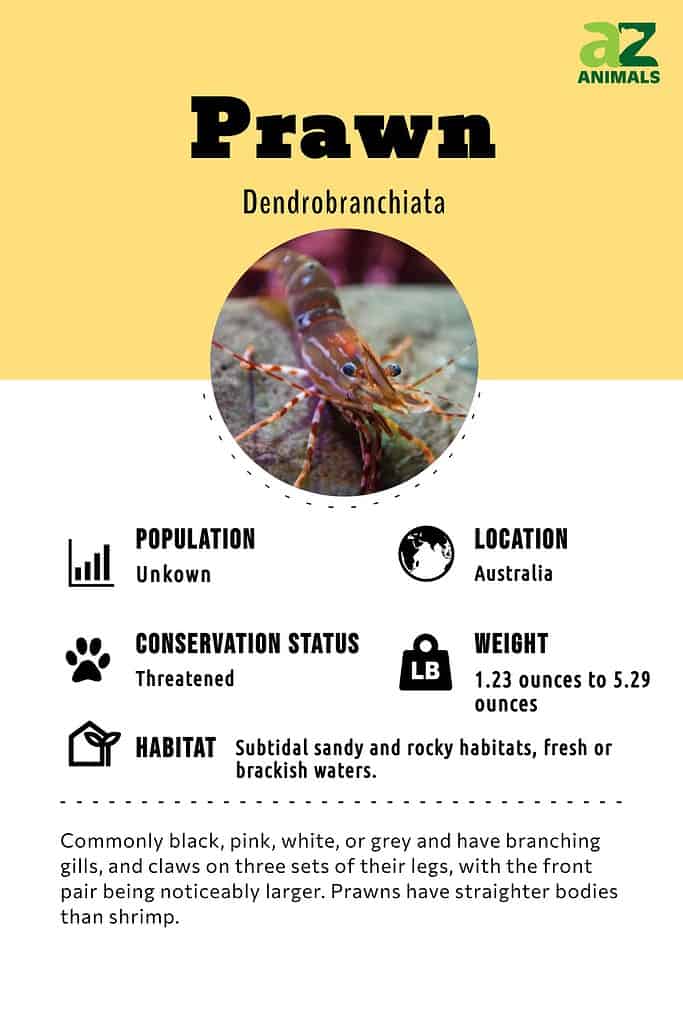
Though Prawn is the common name for this animal similar to shrimp, its scientific name is Dendrobranchiata and it is part of the crustacea class. It is typically 1 to 1.5 centimeters long. Most of them live their lives in freshwater which helps them thrive.

Evolution And Origin

The fossil of a shrimp-like species known as Kylinxia zhangi, discovered in China, that lived during the Cambrian period, around 518 million years ago, is believed to be the ancient ancestor of the arthropod, which includes the prawn. Kylinxia zhangi was a very rare species and exhibited the distinct features present in true arthropods.

Types Of
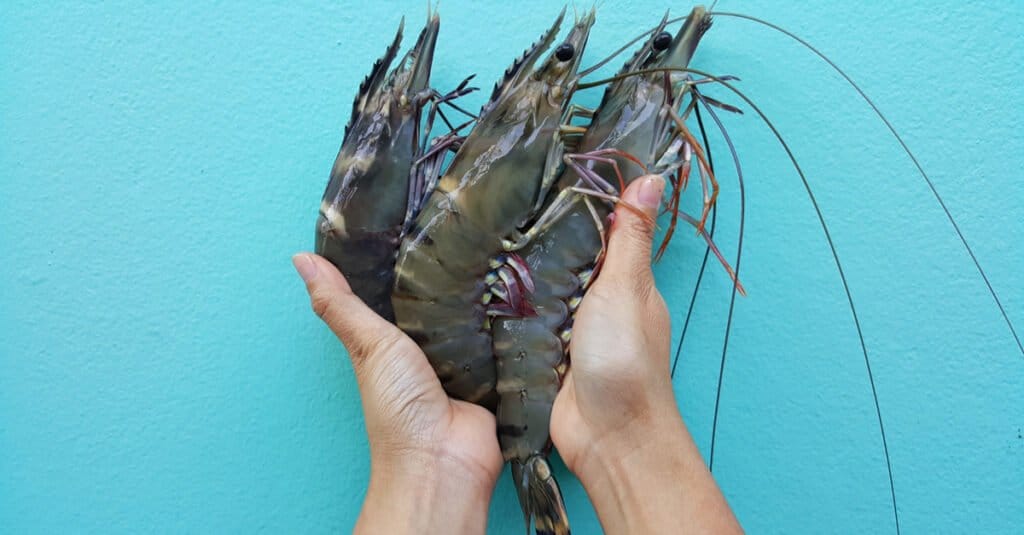
In total, there are 200 subspecies of prawns. One of the first subspecies of this crustacean discovered by scientists was the giant river prawn. The scientific name of this subspecies is Machrobachium rosenbergii. It lives in subtropical and tropical water. Machrobachium rosenbergii are found throughout the Indo-Pacific Region. Though the majority of these subspecies are found in freshwater, some live in the mouths of rivers where the water is salty.

The Palaemon, also known as the common prawn, lives in the waters of Pakistan, India, and Bangladesh in ponds, rivers, and streams. The Melicertus kerathurus, or caramote prawn, is found in the Mediterranean Sea and the eastern Atlantic Ocean. The Indian prawn, (Fenneropenaeus indicus), is one of the largest commercial species of prawn.

The word prawn dates back to 15th-century England. At that time, the animal was referred to as prane, prayne, or praine. Today, the word prawn is most often heard in Ireland and the United Kingdom.

Appearance And Behavior
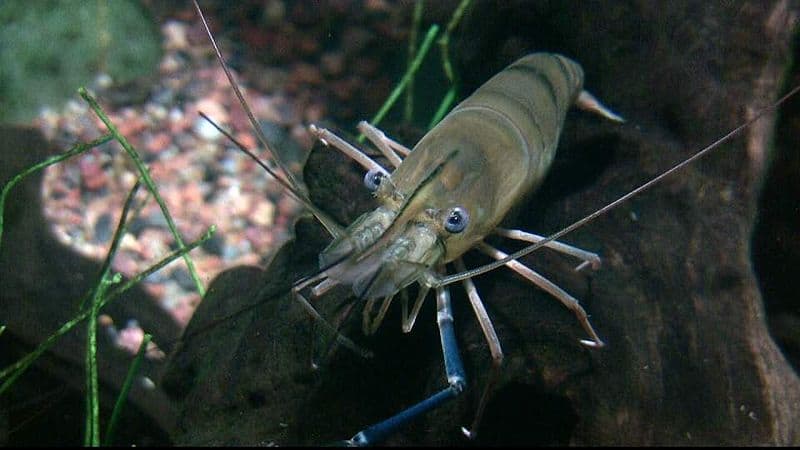
Under the right circumstances, a prawn can change colors.

Prawns are commonly black, pink, white, or grey. When a Palaemon is fully grown it is generally between six and eight inches long, or the size of a GI Joe action figure. Upon being caught, the fish is a pale blue. It has a cylindrical and elongated body. From one side to the other, their body is compressed a little bit.

A Palaemon has two parts to their bodies. One part is anterior and one is posterior. Its cephalothorax is un-jointed. This means that they have six pairs of appendages, which is any part of the body that is attached to its main part, and those parts have no joints, like what humans have in their knees to help them bend.

The posterior of a Palaemon prawn has an abdomen that is jointed, the exact opposite of its anterior. The abdomen sticks out over the rest of the invertebrate’s body. Their abdomen has six different segments. All six segments have their own set of appendages. The appendages are located on the ventral surface. This is the lower part of their body. On a human being, it would be where the liver is located.

One part of the abdomen is on the inside of the prawn’s body and one is on the outside. On the outside is a telson. The telson is located on its tail. At the other end of the abdomen is the cephalothorax. This is where the head meets its thorax. The thorax is surrounded by the abdomen and the neck. At the bottom of the body, it has thirteen pairs of appendages.

In 2014 fishermen off the coast of Florida found a record-breaking 18-inch long prawn, making it the largest ever caught and recorded.

It is common to find this large invertebrate by itself. King Prawns avoid exposure to light because they are sensitive to it. However, Tiger Prawns are active all the time. When it comes to Freshwater Prawns, they are the happiest living in shallow water with access to mud.

Under the right circumstances, a prawn can change colors. They can do this because of the pigment in their skin, located directly under their shell. The cells in their skin allow them to become blue, yellow, red, yellow-white, and sepia-brown. The color they turn is determined by how many of that color’s cells are in their bodies. The cells give school prawns pale spots, while deepwater prawns become bright red or even scarlet.

Deepwater prawns turn bright red because of where they are in the water. Color can’t be seen, so they appear black. This makes it harder for predators to spot them.

Habitat
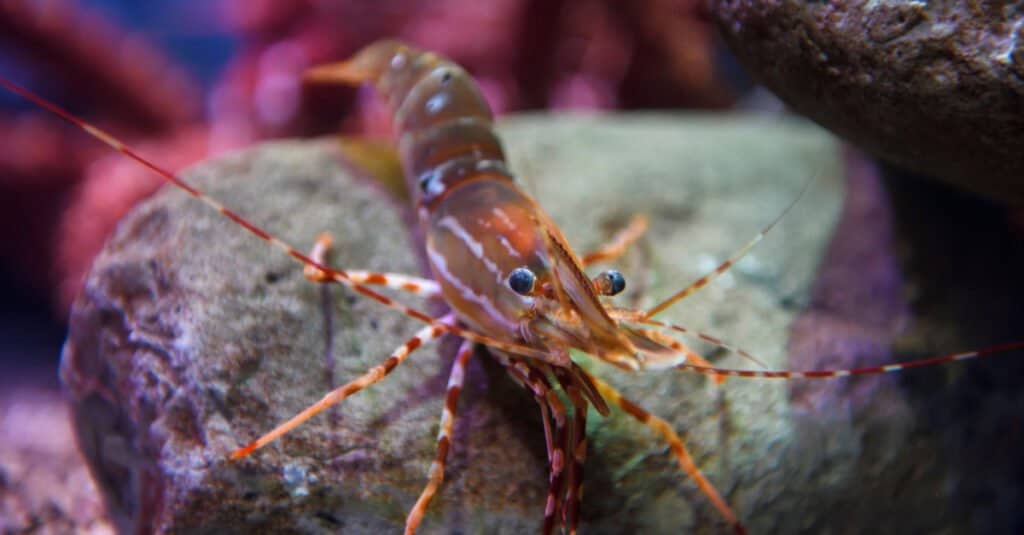
Largest Shrimp - California Spot Prawn

Prawns are found in the northern regions of Australia.

Northern regions of Australia are the homes of bananas, brown tigers, and western king prawns. They are larger in these regions than in other parts of the world and choose to live in coastal waters near the shore. Banana prawns are also frequently found in Exmouth, which is a town in England. Tiger Prawns live in Shark Bay. Along Western Australia’s coast, it is easy to find King Prawns. They can also be found in the country’s Swan River.

What Do They Eat?

As an omnivorous animal, this large crustacean commonly eats plankton and carrion, which are microorganisms. They also eat the smallest worms, shellfish, and any organic matter that is decayed.

When a prawn is first born they eat small pieces of marine plants and seaweed. When they are about one year old, they can expand their diet. Adults are scavengers who will eat what they can find. Their diet often includes dead fish, sand, crabs, and mud. Unlike other animals in the sea, they have no problem eating each other and most commonly do this if they can’t find other sources of food.

Prawns that live in cold water avoid eating sand or mud. This means that king and tiger prawns have veins that look contrasting from their cold-water counterparts. Since cold water prawns don’t eat sand or mud and Tiger & King Prawns do, the cold water prawns have clear veins in their bodies.

Predators And Threats

Both young and adult prawns are the victims of predators. Though they can be victims at any time, they are the most vulnerable when they are in the larval period of their development. At that time they are often killed by bottom-dwelling fish such as squid and cuttlefish.

Reproduction, Babies, And Life Span
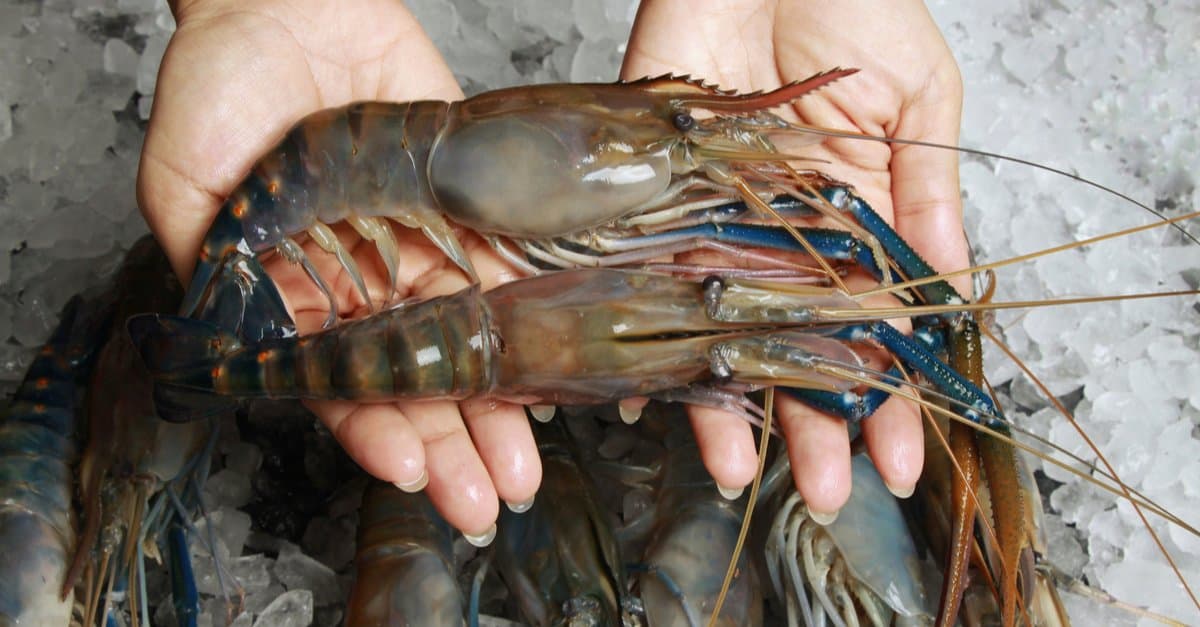
A grown female is larger than a grown male of the species. It is easy to tell if they are male or female. A male has an organ called a pestana between their legs. A female has a thelycum, which is what lets them mate with males.

Adult female prawns have visible ovaries. They are located on her head and her tail. Before ovaries mature they are pale yellow or olive. After their ovaries mature they become an orange-brown color. In order for a pair of prawns to reproduce, the male’s shell must be hard and the female’s shell must be soft.

Eggs are fertilized while still inside a female body. It is believed that spawning takes place right after the eggs have been fertilized. Females can get pregnant multiple times during the mating season. Different sizes and species of females are capable of carrying a different number of eggs. How frequently they spawn has to do with where they live. In Queensland, Australia, easter King Pawns can spawn at any time of the year. King Prawns living anywhere else will not spawn during the winter months.

There are three types of life cycles they follow and each one varies. Those types are Estuarine, Marine, and Mixed. In seawater, the Estuarine life cycle is completed. One subspecies that lives this life cycle is the greasy back prawn, Metapenaeus bennettae. In ocean waters, royal red prawns live the marine life cycle.

The mixed life cycle is different because it is the life cycle that baby prawns follow. During this life cycle, females shed their fertilized eggs at the bottom of the ocean. The eggs remain on the ocean floor until the babies are ready to be born. Babies live this cycle until they become adults. The mixed life cycle takes place over a period of two to three weeks.

Overall, the life cycle for this creature is a brief one. School prawns live an average of one year. Eastern King and other larger prawns can live to be two years old. In some cases, they may even live for three years.

View all 247 animals that start with P

Sources

  1. David Burnie, Dorling Kindersley (2011) Animal, The Definitive Visual Guide To The World's Wildlife / Accessed December 16, 2008
  2. Tom Jackson, Lorenz Books (2007) The World Encyclopedia Of Animals / Accessed December 16, 2008
  3. David Burnie, Kingfisher (2011) The Kingfisher Animal Encyclopedia / Accessed December 16, 2008
  4. Richard Mackay, University of California Press (2009) The Atlas Of Endangered Species / Accessed December 16, 2008
  5. David Burnie, Dorling Kindersley (2008) Illustrated Encyclopedia Of Animals / Accessed December 16, 2008
  6. Dorling Kindersley (2006) Dorling Kindersley Encyclopedia Of Animals / Accessed December 16, 2008
  7. Chinese Academy of Sciences / Published November 5, 2020 / Accessed March 30, 2023
Melissa Bauernfeind

About the Author

Melissa Bauernfeind

Melissa Bauernfeind was born in NYC and got her degree in Journalism from Boston University. She lived in San Diego for 10 years and is now back in NYC. She loves adventure and traveling the world with her husband but always misses her favorite little man, "P", half Chihuahua/half Jack Russell, all trouble. She got dive-certified so she could dive with the Great White Sharks someday and is hoping to swim with the Orcas as well.
Connect:

Thank you for reading! Have some feedback for us?


Prawn FAQs (Frequently Asked Questions)

Many people are confused about the differences between prawns and shrimps. Though in some parts of the word, people consider them to be the same animal, they are not. The things they have in common include the fact that they both have an exoskeleton and 10 legs. They also look similar and both live close to the floor of the ocean.

Both the pawn and the shrimp live in freshwater and saltwater. However, prawns mainly stick to freshwater. Shrimp mainly stick to saltwater. Other differences include the fact that their gills are shaped differently. While the body of a shrimp is slightly curled, the body of a prawn is completely straight.

It is easy to tell the difference between a shrimp and a prawn by looking at their legs. A shrimp’s front legs are the largest they have. The second pair of legs on a prawn is its biggest. Prawns have three pairs of legs with claws on them. Another difference is that while prawns let their fertilized eggs grow in the water, shrimp carry their eggs under their bodies until the babies are born.