Proboscis Monkey
Nasalis larvatus
 Verified by: AZ Animals Staff
Natively found on the island of Borneo!
Advertisement
Proboscis Monkey Scientific Classification
- Kingdom
- Animalia
- Phylum
- Chordata
- Class
- Mammalia
- Order
- Primates
- Family
- Cercopithecidae
- Genus
- Nasalis
- Scientific Name
- Nasalis larvatus
Read our Complete Guide to Classification of Animals.
Proboscis Monkey Conservation Status
Proboscis Monkey Facts
- Prey
- Leaves, Shoots, Fruits
- Name Of Young
- Infant
- Group Behavior
- Troop
- Fun Fact
- Natively found on the island of Borneo!
- Estimated Population Size
- 7,000
- Biggest Threat
- Habitat loss
- Most Distinctive Feature
- Long, fleshy nose and swollen stomach
- Other Name(s)
- Long-Nosed Monkey
- Gestation Period
- 166 days
- Habitat
- Coastal mangroves and riverine forests
- Predators
- Clouded Leopard, Crocodile, Human
- Diet
- Omnivore
- Average Litter Size
- 1
- Lifestyle
- Diurnal
- Common Name
- Proboscis Monkey
- Number Of Species
- 2
- Location
- Borneo
- Slogan
- Natively found on the island of Borneo!
- Group
- Mammal
Proboscis Monkey Physical Characteristics
- Color
- Brown
- Grey
- Red
- White
- Tan
- Orange
- Skin Type
- Fur
- Top Speed
- 15 mph
- Lifespan
- 15 - 20 years
- Weight
- 7kg - 22kg (15lbs - 48lbs)
- Height
- 53cm - 76cm (21in - 30in)
- Age of Sexual Maturity
- 4 - 5 years
- Age of Weaning
- 7 months

 © Wendy Bird - Copyright A-Z Animals
View all of the Proboscis Monkey images!



How to Add Us to Google News


Classification and Evolution
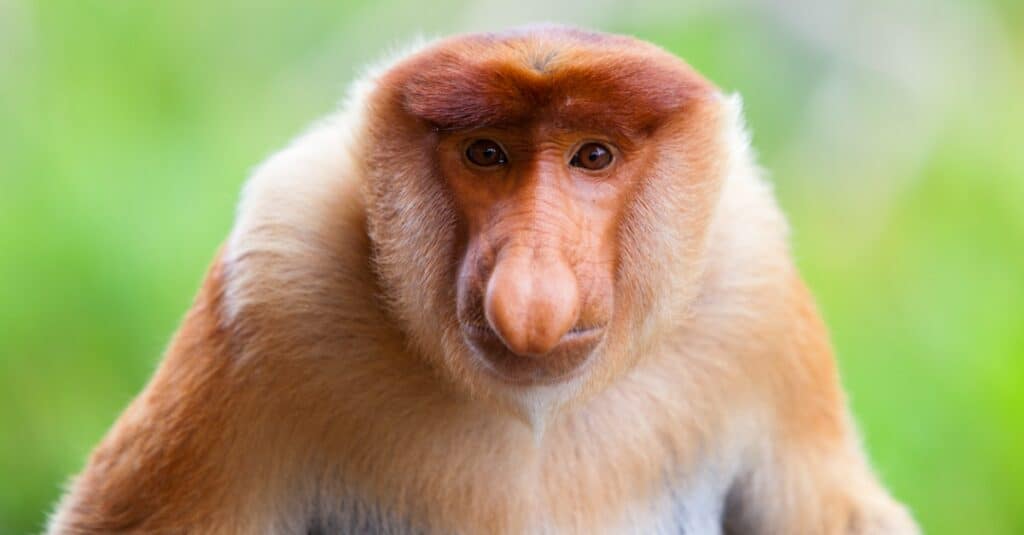
Proboscis monkeys use their large noses to attract mates.
©David Evison/Shutterstock.com
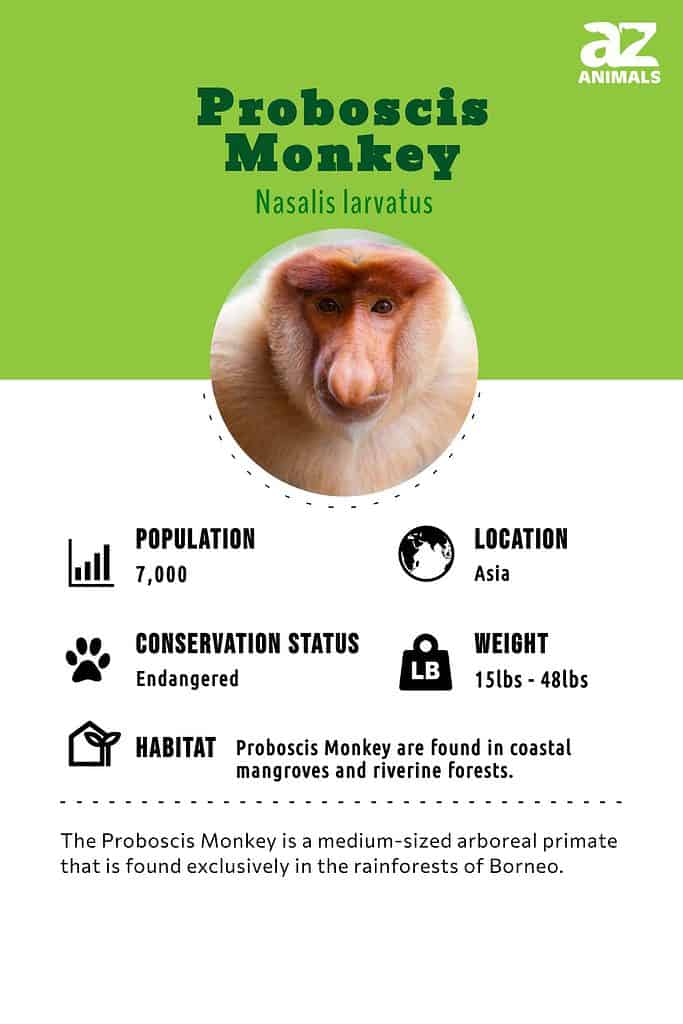
The Proboscis Monkey is a medium-sized arboreal primate that is found exclusively in the rainforests of Borneo. The male Proboscis Monkey is not only one of the largest monkeys in Asia but they are also one of the world’s most distinctive mammals, having a long and fleshy nose and a large, swollen stomach.
Although having slightly larger noses and a protruding stomach are defining of the Colobine (Leaf) Monkey family, these features on the Proboscis Monkey are more than double the size of their closest relatives.
The Proboscis Monkey today, however, is extremely threatened in its natural environment with deforestation having a devastating impact on the unique habitats where the Proboscis Monkey is found.
Anatomy and Appearance
The male Proboscis Monkey is significantly larger than the female measuring up to 76cm in height and weighing more than 20kg, both have long tails which can easily be the same length as the body, which is used to help the Proboscis Monkey to balance whilst it is leaping through the trees.
Adults are mainly pale orange to light brown in color with a richer colored head and shoulders and grey limbs and tail, and a light pink face.
The protruding nose of the Proboscis Monkey develops with age with infants having more monkey-like noses and older mature males having larger and more bulbous ones. Although scientists are still unsure as to exactly why the nose of the Proboscis
Monkey grows so big, it is widely believed to be to do with attracting a female mate as the noses of females are much smaller.
Distribution and Habitat
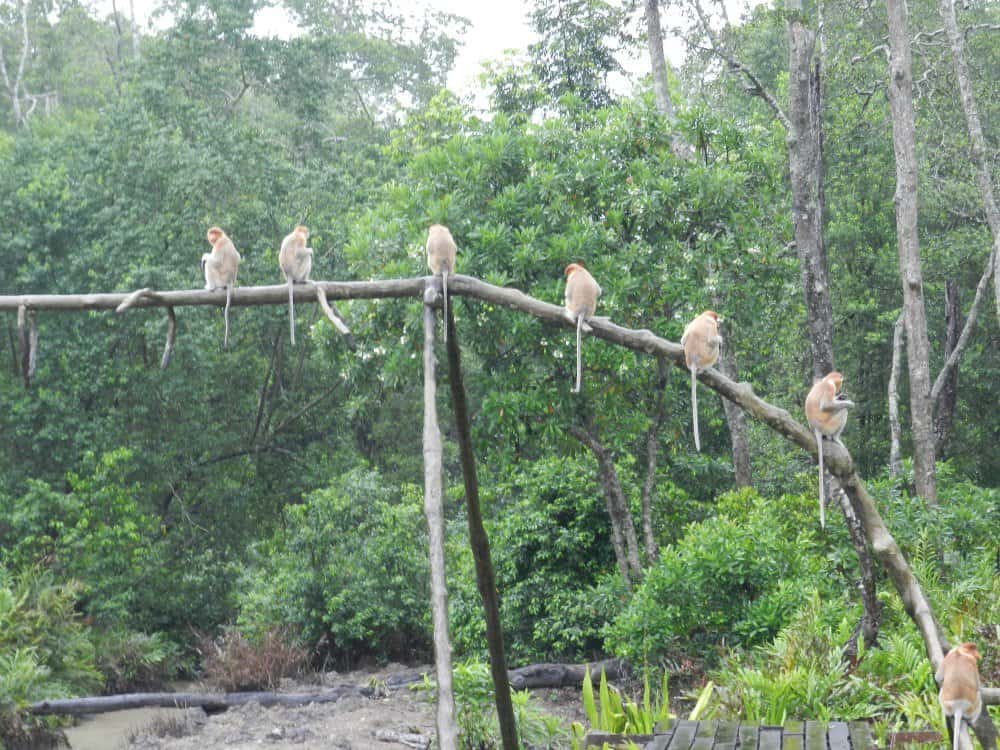
Proboscis Monkeys, Labuk Bay near Sandakan
©Millie Bond – Copyright A-Z Animals
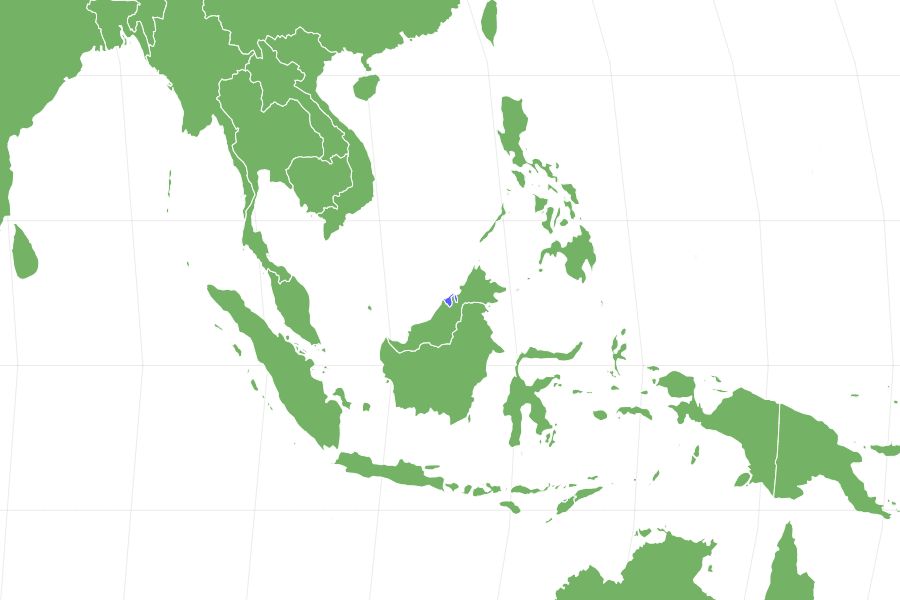
The Proboscis Monkey is natively found on the island of Borneo where it was once fairly widespread (with the exception of central Sarawak) throughout the coastal mangrove forests.
The Proboscis Monkey inhabits very unique habitats and is most commonly found in mangrove swamps, but is also known to inhabit coastal mangroves, riverine forests, and lowland rainforests providing that there is a good source of fresh water.
Due to their leaf-eating diet, the Proboscis Monkey has also managed to exploit a niche within these wetland forests and is the largest mammal found inhabiting the higher levels of the canopy.
These rare regions however have been heavily affected by deforestation meaning that Proboscis Monkey populations are becoming more isolated as they will avoid cleared forests or populated areas.
Behavior and Lifestyle
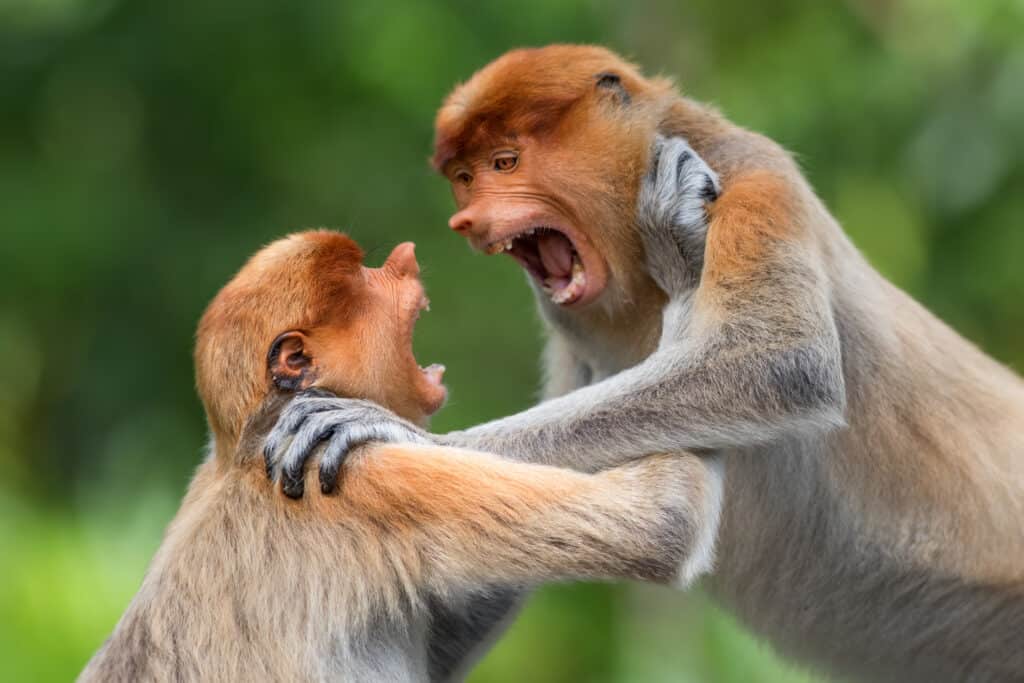
The reasons that monkeys fight extend beyond the usual suspects of food, territory, and the right to mate.
©Patrik Stanek/Shutterstock.com
The Proboscis Monkey is an incredibly sociable animal that inhabits the surrounding mangroves in troops that contain between 2 – 30 individuals and is comprised of a dominant male, with up to 10 females and they’re young.
Female Proboscis Monkeys tend to lead the searches for food and care for the young and the male defends his troop by making loud honking sounds and showing his teeth.
Proboscis Monkey troops are known to congregate together though when close to water or in an area where food is in abundance, along with at night when troops rest and sleep in the safety of the mangroves close to the water’s edge.
Due to the fact that the Proboscis Monkey requires a good fresh water supply such as a swamp or river, they are excellent swimmers and are known to travel across very deep areas to find food or to escape approaching danger.
Reproduction and Life Cycles
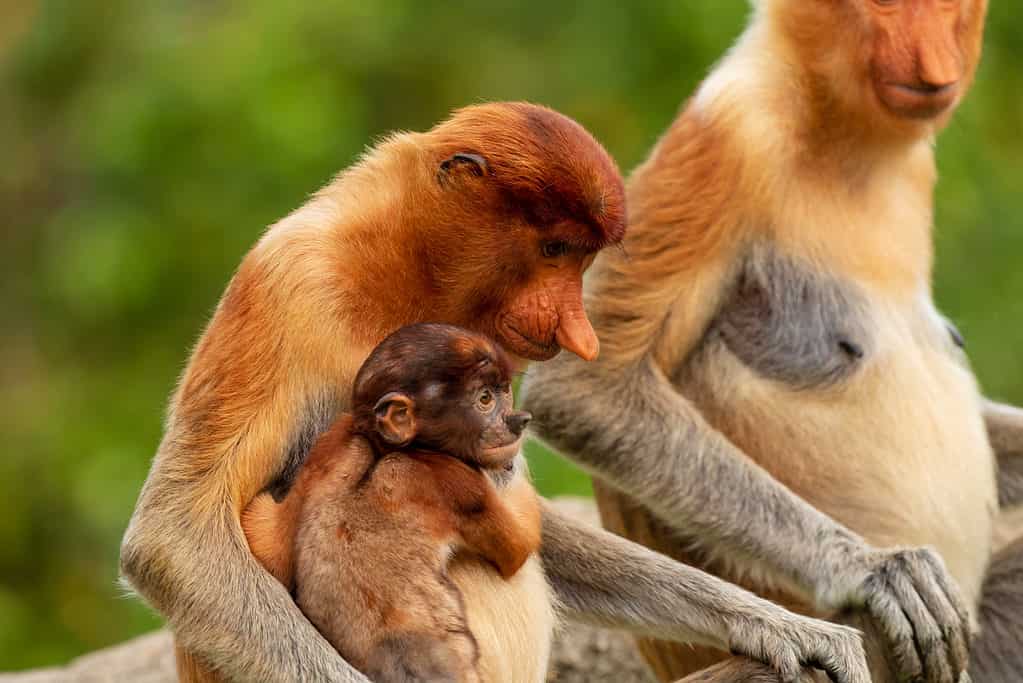
Wild mother and baby Proboscis Monkeys in the mangrove forests of Borneo
©Richard Whitcombe/Shutterstock.com
Female Proboscis Monkeys give birth to a single infant after a gestation period that lasts for around five and a half months, which has dark-colored fur and a blue face and will not develop their adult coloration until it is 3 or 4 months old.
Young Proboscis Monkeys are cared for not just by their mother but also by the other adult females in the troop and will remain with their mother until they are nearly a year old when young females tend to stay with the troop and young males will leave to join a group of bachelor males.
Although Proboscis Monkey troops tend to remain fairly stable, it is not uncommon for both males and females to move to another troop. Proboscis Monkeys tend to live for up to 20 years in the wild and are not able to reproduce until they are at least four years old.
Diet and Prey
Although the Proboscis Monkey is technically an omnivorous animal, the bulk of their diet is comprised of tough mangrove leaves which are pulled from the surrounding trees.
It is because of the fact that they are leaf-eating monkeys, that the Proboscis Monkey has a large and swollen stomach that is made up of chambers containing a special cellulose-digesting bacteria that helps to break down the leaves.
This is, however, a very slow process and means that the Proboscis Monkey’s stomach is often full and can contain up to a quarter of the individual’s total body weight.
The Proboscis Monkey supplements its diet by eating other plant matter including shoots, seeds, and unripe fruits along with a passing insect on occasion and does so predominantly in the trees, preferring not to come down to the ground.
Predators and Threats
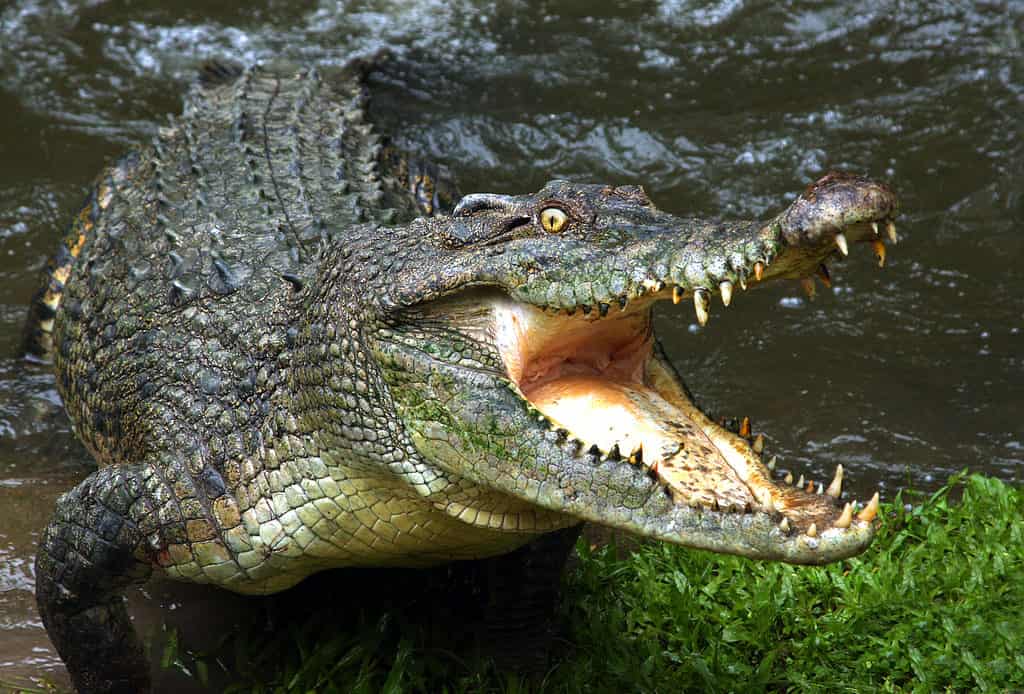
Proboscis Monkeys are preyed on by crocodiles.
©Audrey Snider-Bell/Shutterstock.com
Due to the large size and almost entirely tree-dwelling lifestyle of the Proboscis Monkey, they have very few actual predators in their natural environment, with the exception of Clouded Leopards that hunt the Proboscis Monkey when it is forced to be on the ground.
They are also preyed upon by Crocodiles whilst in the water but Humans are the biggest threat to this unique animal. Not only have Proboscis Monkeys lost vast areas of their natural habitats to deforestation but they have also not adapted well to living close to Human activity and are therefore being pushed into smaller and more isolated pockets of their native regions.
Interesting Facts and Features
The Proboscis Monkey spends the majority of its life very close to the water and is an adept swimmer, aided by its partially webbed feet which help it to both paddles in the water and walk on the slippery banks. The Proboscis Monkey is very agile whilst in the trees and is also known to leap into the water from heights of up to 50ft!
The nose of the male Proboscis Monkey can grow so big that it hangs down over its mouth and has to be pushed aside to eat, however, when calling the nose straightens up and is thought to make the monkey’s sound echo louder to both impresses mature females and to intimidate rival males in the area.
The large nose of the male Proboscis Monkey is also known to become red and swollen when the individual is either angry or excited.
Want to know more interesting facts about Proboscis Monkeys? Read: “10 Incredible Proboscis Monkey Facts.”
Relationship with Humans
Female Proboscis Monkey, Labuk Bay near Sandakan
©Wendy Bird – Copyright A-Z Animals
The Proboscis Monkey was once hunted by local people as they are seen as a culinary delicacy in some areas, but today the capture and killing of these distinctive animals is forbidden and has helped this situation slightly.
However, people have had a far bigger impact on the Proboscis Monkey through the deforestation of its natural habitat mainly for logging, growing Human settlements, and clearing land for palm oil plantations, which has led to drastic population declines in the species over the past couple of decades particularly.
They are, however, of great fascination to many people around the world and have generated tourism interest in certain areas.
Conservation Status and Life Today
Today, the Proboscis Monkey is listed by the IUCN as an animal that is Endangered in its natural environment and could face extinction in the near future if better conservation measures are not put into place.
Population numbers are thought to have dropped by up to 80% over the past 30 years with numbers continuing to decrease. There are thought to be around 7,000 Proboscis Monkeys left in the wild today and very few are found in captivity as they simply do not respond well to artificial conditions.
View all 192 animals that start with P How to Add Us to Google News


Proboscis Monkey FAQs (Frequently Asked Questions)
Are Proboscis Monkeys herbivores, carnivores, or omnivores?
Proboscis Monkeys are Omnivores, meaning they eat both plants and other animals.
What Kingdom do Proboscis Monkeys belong to?
Proboscis Monkeys belong to the Kingdom Animalia.
What class do Proboscis Monkeys belong to?
Proboscis Monkeys belong to the class Mammalia.
What phylum to Proboscis Monkeys belong to?
Proboscis Monkeys belong to the phylum Chordata.
What family do Proboscis Monkeys belong to?
Proboscis Monkeys belong to the family Cercopithecidae.
What order do Proboscis Monkeys belong to?
Proboscis Monkeys belong to the order Primates.
What type of covering do Proboscis Monkeys have?
Proboscis Monkeys are covered in Fur.
What genus do Proboscis Monkeys belong to?
Proboscis Monkeys belong to the genus Nasalis.
Where do Proboscis Monkeys live?
Proboscis Monkeys live in Borneo.
In what type of habitat do Proboscis Monkeys live?
Proboscis Monkeys live in coastal mangroves and riverine forests.
What are some predators of Proboscis Monkeys?
Predators of Proboscis Monkeys include clouded leopards, crocodiles, and humans.
How many babies do Proboscis Monkeys have?
The average number of babies a Proboscis Monkey has is 1.
What is an interesting fact about Proboscis Monkeys?
Proboscis Monkeys are natively found on the island of Borneo!
What is the scientific name for the Proboscis Monkey?
The scientific name for the Proboscis Monkey is Nasalis larvatus.
What is the lifespan of a Proboscis Monkey?
Proboscis Monkeys can live for 15 to 20 years.
What is a baby Proboscis Monkey called?
A baby Proboscis Monkey is called an infant.
How many species of Proboscis Monkey are there?
There are 2 species of Proboscis Monkey.
What is the biggest threat to the Proboscis Monkey?
The biggest threat to the Proboscis Monkey is habitat loss.
What is another name for the Proboscis Monkey?
The Proboscis Monkey is also called the long-nosed monkey.
How many Proboscis Monkeys are left in the world?
There are 7,000 Proboscis Monkeys left in the world.
How fast is a Proboscis Monkey?
A Proboscis Monkey can travel at speeds of up to 15 miles per hour.
How to say Proboscis Monkey in ...
Thank you for reading! Have some feedback for us? Contact the AZ Animals editorial team.
Sources
- David Burnie, Dorling Kindersley (2011) Animal, The Definitive Visual Guide To The World's Wildlife
- Tom Jackson, Lorenz Books (2007) The World Encyclopedia Of Animals
- David Burnie, Kingfisher (2011) The Kingfisher Animal Encyclopedia
- Richard Mackay, University of California Press (2009) The Atlas Of Endangered Species
- David Burnie, Dorling Kindersley (2008) Illustrated Encyclopedia Of Animals
- Dorling Kindersley (2006) Dorling Kindersley Encyclopedia Of Animals
- David W. Macdonald, Oxford University Press (2010) The Encyclopedia Of Mammals
- Proboscis Monkey Facts, Available here: http://www.blueplanetbiomes.org/proboscis_monkey.htm
- Proboscis Monkey Information, Available here: http://pin.primate.wisc.edu/factsheets/entry/proboscis_monkey/taxon
- About Proboscis Monkeys, Available here: http://animals.nationalgeographic.com/animals/mammals/proboscis-monkey/
- Proboscis Monkey Conservation Status, Available here: http://www.iucnredlist.org/apps/redlist/details/14352/0