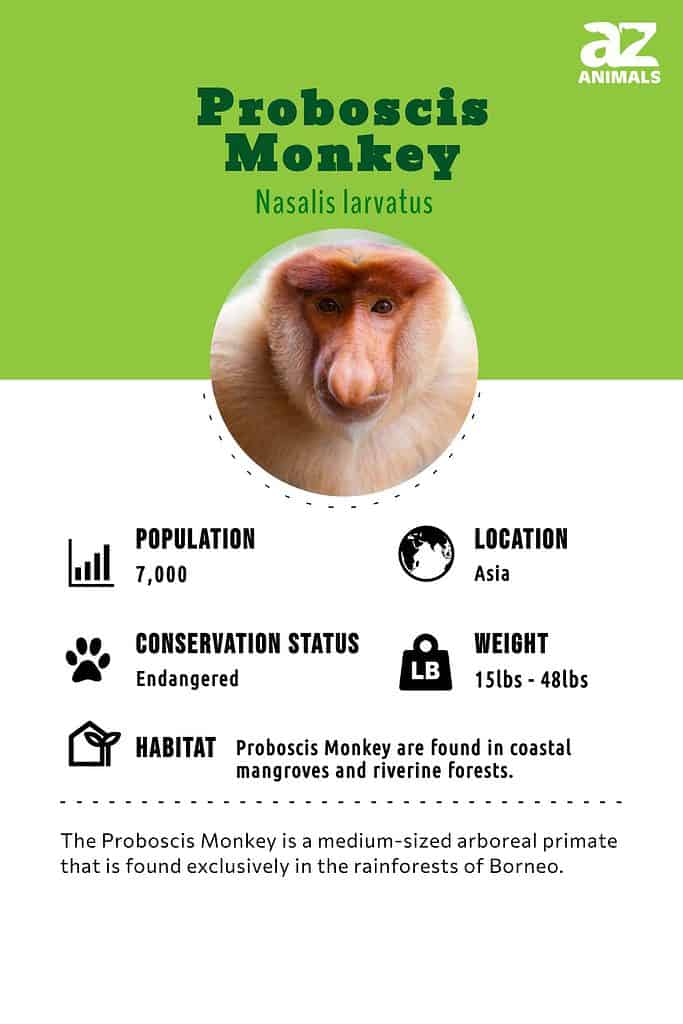
P
Species Profile

Proboscis Monkey

Nasalis larvatus

The river-nose of Borneo
Millie Bond - Copyright A-Z Animals

Proboscis Monkey Distribution

Click a location to explore more animals from that region

Endemic Species
Loading map...

At a Glance

Wild Species
Also Known As Bekantan, Long-nosed monkey, Nose monkey
Diet Folivore
Activity Diurnal+
Lifespan 12 years
Weight 22.5 lbs
Status Endangered
Did You Know?

Endemic to Borneo (Brunei, Sabah & Sarawak in Malaysia, and Indonesian Kalimantan); it does not naturally occur anywhere else (IUCN).

Scientific Classification

A large, arboreal-to-semi-terrestrial Old World monkey endemic to Borneo, famous for the adult male’s enlarged, pendulous nose and strong association with riverine and mangrove forests.

Kingdom
Animalia
Phylum
Chordata
Class
Mammalia
Order
Primates
Family
Cercopithecidae
Genus
Nasalis
Species
Nasalis larvatus

Distinguishing Features

  • Adult males have a very large, pendulous nose; females and juveniles have smaller but still prominent noses.
  • Pot-bellied appearance with a specialized, leaf-fermenting digestive system; largely folivorous.
  • Reddish-brown body with grayish limbs and tail; pale face.
  • Strong swimmer; known to cross rivers and use waterways as travel corridors.

Physical Measurements

Males and females differ in size

Length
4 ft 3 in (3 ft 7 in – 4 ft 11 in)
Weight
42 lbs (35 lbs – 50 lbs)
21 lbs (15 lbs – 26 lbs)
Tail Length
2 ft 2 in (1 ft 10 in – 2 ft 6 in)
1 ft 11 in (1 ft 10 in – 2 ft 1 in)
Top Speed
3 mph
swimming

Appearance

Primary Colors
Secondary Colors
Skin Type Mammalian skin with dense fur; face and nose sparsely haired with visible pinkish skin.
Distinctive Features
  • Endemic to Borneo; individuals often appear mud-stained from frequent riverine/mangrove use (IUCN).
  • Adult males have an enlarged, pendulous, laterally compressed nose; females/juveniles have short upturned noses (Fleagle; Nowak).
  • Pronounced distended abdomen (pot-bellied) linked to an enlarged stomach and leaf-based diet with foregut fermentation typical of leaf-eating monkeys.
  • Long tail typically near body length; tail used for balance in arboreal and river-edge travel (Nowak).
  • Partially webbed digits and strong swimming ability; commonly crosses rivers and uses mangrove/riverine corridors (field studies; IUCN).
  • Sexually dichromatic impression: adult males often look paler/grayish on shoulders with more prominent orange dorsum contrast.
  • Typical adult measurements: male head-body ~66-76 cm, tail ~55-76 cm; female head-body ~53-62 cm, tail ~52-67 cm (Nowak; primatology references).
  • Typical adult mass: males ~16-22.5 kg; females ~7-12 kg, contributing to visibly heavier male build (Nowak; primatology references).

Sexual Dimorphism

Strong sexual dimorphism: adult males are much heavier and develop a greatly enlarged pendulous nose. Females are smaller with a short, upturned nose and generally less pronounced abdominal distension.

  • Greatly enlarged pendulous nose; size increases with maturity and status (reported in primate field studies).
  • Heavier, more robust body (typical adult mass ~16-22.5 kg).
  • Broader shoulders/chest; often appears paler gray on limbs with stronger dorsal contrast.
  • Short, upturned nose without pendulous extension.
  • Smaller body size (typical adult mass ~7-12 kg).
  • Overall slimmer silhouette with less visually pronounced abdominal distension than adult males.

Did You Know?

Endemic to Borneo (Brunei, Sabah & Sarawak in Malaysia, and Indonesian Kalimantan); it does not naturally occur anywhere else (IUCN).

Adult males are much larger: head-body length 66-76 cm vs females 53-62 cm; tail length 55-75 cm (species accounts in primate field references).

Typical adult mass: males ~16-22.5 kg, females ~7-12 kg-strong sexual dimorphism for a monkey (species accounts/field references).

It's a colobine with a multi-chambered, fermenting foregut; this helps it live largely on leaves and unripe fruits that many primates can't digest well (colobine digestive physiology).

Proboscis monkeys are among the best swimmers of all primates, frequently crossing rivers and using mangrove channels as travel routes (field observations).

Their conservation is tightly linked to lowland riverine and mangrove forests-habitats heavily impacted by conversion to agriculture and oil palm (IUCN; Borneo land-use literature).

Unique Adaptations

  • Enlarged male nose (sexual selection): the pendulous nose grows with age and is linked to dominance/attractiveness signals and to acoustic resonance in calls (sexual selection/vocal resonance hypotheses in the literature).
  • Foregut fermentation (multi-chambered stomach): supports a leaf-heavy diet by microbial breakdown of cellulose and detoxification of some plant secondary compounds (colobine digestive physiology).
  • Reduced thumb (colobine trait): a shortened thumb aids rapid arboreal movement and powerful grasping on branches (Old World colobine morphology).
  • Coastal/estuarine tolerance: regular use of mangroves and river mouths where foods are patchy and tides influence movement-an ecological specialization among primates (Borneo riverine ecology studies).

Interesting Behaviors

  • River-edge sleeping: groups commonly choose trees close to rivers/mangroves for night roosts, a strategy associated with predator avoidance and access to travel corridors (field studies).
  • Group types: often seen in one-male, multi-female groups; all-male (bachelor) groups also occur, and larger aggregations can form where habitat funnels animals to riverbanks (behavioral ecology literature).
  • Male display calling: adult males give loud nasal 'honks'/calls during intergroup encounters and social tension, functioning in spacing and social signaling (primate vocal behavior studies).
  • Aquatic escape and travel: individuals may leap into water from banks/trees and swim across channels to evade threats or move between feeding areas (field observations).
  • Feeding selectivity: a strong emphasis on young leaves and unripe fruits; ripe sugary fruits can be limited because foregut fermentation makes them susceptible to digestive upset (colobine nutrition findings).

Cultural Significance

In Indonesian Borneo, the proboscis monkey is strongly associated with river life and mangroves. It is a regional icon in South Kalimantan, featured in local branding, mascots, and conservation messaging. It is also nicknamed "Dutch monkey", a colonial-era popular name referencing its prominent nose and pot-bellied appearance.

Myths & Legends

"Dutch monkey": a long-standing popular epithet from the colonial period, humorously comparing its large nose and stout body to Dutch newcomers.

Scientists named the proboscis monkey genus to mean "of the nose," and its common name "proboscis" means long, sticking out nose. Early European writers focused on this big nose.

Modern emblem story: in South Kalimantan, the proboscis monkey functions as a civic symbol tied to rivers and mangroves, used in local identity narratives about safeguarding wetlands and riverbank forests.

Conservation Status

EN Endangered

Facing a very high risk of extinction in the wild.

Population Decreasing

Protected Under

  • CITES Appendix I
  • Indonesia: protected species (Government Regulation No. 7/1999; updated protected-species list including Minister of Environment and Forestry Regulation P.106/2018)
  • Malaysia (Sabah): Wildlife Conservation Enactment 1997 (as amended, incl. 2010)
  • Malaysia (Sarawak): Wild Life Protection Ordinance 1998

Life Cycle

Birth 1 infant
Lifespan 12 years

Lifespan

In the Wild
10–13 years
In Captivity
15–23 years

Reproduction

Mating System Polygyny
Social Structure Harem Based
Breeding Pattern Serial
Fertilization Internal Fertilization
Birth Type Internal_fertilization

Proboscis monkeys live mainly in one-male, multi-female groups within fission-fusion bands; a resident male monopolizes most copulations until displaced. Reproduction is via internal fertilization; gestation is ~166 days and females provide primary care without helpers.

Behavior & Ecology

Social Troop Group: 13
Activity Diurnal, Crepuscular
Diet Folivore Young leaves of mangrove apple (Sonneratia caseolaris)

Temperament

HUB pattern: strongly group-living; one-male groups plus bachelor groups, with evening riverside aggregations; group sizes vary by habitat/food distribution (Bennett & Sebastian 1988; Yeager 1991; Boonratana 2013).
Primary unit size: one-male groups commonly average ~13 individuals, with reported ranges roughly 3-32; bachelor groups are smaller (Bennett & Sebastian 1988; Yeager 1991).
Generally tolerant within-core groups (frequent grooming, close resting), but adult males show pronounced inter-male threat/aggression and mate-guarding during takeovers (Yeager 1991; Murai et al. 2007).
Risk-avoidant: strong preference for sleeping in tall riverside trees and using waterways as escape routes; vigilance increases near human activity/boats (Yeager 1991; Matsuda et al. 2019).
Life history (reference values): maximum longevity reported 23.0 years in captivity (AnAge database: Nasalis larvatus, accessed 2025).

Communication

adult male nasal honk Often during travel/spacing and social arousal
adult male roar/bark in intergroup contexts and agonistic displays
alarm calls Sex/age classes vary; often sharp barks/screams
female/juvenile contact calls and squeals
infant distress calls
visual threat displays Open-mouth, head-bobbing, body posturing
branch shaking and loud locomotor displays during male-male encounters
social grooming for bonding and tension reduction
tactile reassurance Infant carrying, embracing/close contact
spatial signaling via group spacing at feeding and along riverbanks

Habitat

Biomes:
Tropical Rainforest Wetland Freshwater Marine
Terrain:
Coastal Island Riverine Muddy Sandy
Elevation: Up to 1148 ft 4 in

Ecological Role

Selective folivore-frugivore browser in Borneo's riverine and mangrove forests that shapes plant growth and regeneration patterns.

Canopy pruning and altered leaf/branch turnover via intensive browsing on preferred tree species (influences vegetation structure and plant competitive dynamics) Seed dispersal for some ingested fruits (when seeds survive gut passage), aiding riparian forest regeneration along river corridors Seed predation when consuming unripe fruits/seeds, affecting recruitment of certain plant species Nutrient redistribution through fecal deposition and urine in sleeping/foraging areas, contributing to nutrient cycling in riparian and mangrove systems

Diet Details

Other Foods:
Young leaves Mature leaves Unripe fruits Seeds Flowers and flower buds Young shoots and petioles Mangrove-associated foliage Nipa palm +2

Human Interaction

Domestication Status

Wild

Proboscis monkey (Nasalis larvatus) is a wild, not domesticated monkey from Borneo. It has no history of being kept or bred for people. It lives along rivers and mangroves where it meets people. Major threats are logging, farming, fires, and hunting. Conservation uses protected areas, anti-poaching patrols, and habitat restoration; some rescue and moving.

Danger Level

Moderate
  • Bites/scratches if cornered, handled, or during illegal capture; like other cercopithecids, can inflict deep lacerations.
  • Zoonotic disease transmission risk exists in both directions (human-to-primate and primate-to-human) with close contact, feeding, or handling (respiratory viruses, enteric pathogens; specific risk depends on context).
  • Boat/river-edge interactions: stress/defensive behavior may occur if approached too closely by tourists or dogs, though proboscis monkeys are generally shy and avoid direct confrontation.

As a Pet

Not Suitable as Pet

Legality: Proboscis monkey (Nasalis larvatus) is not legal as a private pet in almost all places. Trade is banned by CITES Appendix I; range countries (Indonesia, Malaysia, Brunei) allow only government-approved zoos or rescue/rehab centers with permits.

Care Level: Expert Only

Purchase Cost:
Lifetime Cost: $250,000 - $600,000

Economic Value

Uses:
Ecotourism (riverine wildlife viewing) Biodiversity/conservation flagship value Scientific research and education (non-consumptive) Ecosystem value (mangrove/riparian forest conservation leverage)
Products:
  • Non-consumptive tourism services (guided river cruises, park fees, lodging tied to wildlife viewing)
  • Educational/media value (documentaries, zoo-based conservation messaging where legally held)
  • Research outputs (datasets, publications, conservation planning tools)

Relationships

Predators 5

Sunda clouded leopard Neofelis diardi
Saltwater crocodile Crocodylus porosus
False gharial Tomistoma schlegelii
Reticulated python
Reticulated python Malayopython reticulatus
White-bellied sea eagle Haliaeetus leucogaster

Related Species 8

Silvery lutung Trachypithecus cristatus Shared Family
Dusky langur Trachypithecus obscurus Shared Family
Maroon leaf monkey Presbytis rubicunda Shared Family
White-fronted surili Presbytis frontata Shared Family
Bornean orangutan
Bornean orangutan Pongo pygmaeus Shared Order
Long-tailed macaque
Long-tailed macaque Macaca fascicularis Shared Family
Golden snub-nosed monkey Rhinopithecus roxellana Shared Family
Mentawai snub-nosed monkey Simias concolor Shared Family

Ecological Equivalents 5

Animals that fill a similar ecological role in their ecosystem

Long-tailed macaque
Long-tailed macaque Macaca fascicularis Strong overlap in coastal and riverine habitats (mangroves and river edges); both species swim well and sleep near water. The proboscis monkey (Nasalis larvatus) is a colobine leaf-and-fruit eater with a sacculated foregut and pronounced male–female size differences.
Silvery lutung Trachypithecus cristatus A colobine leaf monkey of Sundaland's mangrove and riparian forests. It eats young leaves and unripe fruit and has foregut fermentation. Lutungs are more arboreal, while proboscis monkeys are semi-terrestrial and cross water.
Maroon leaf monkey Presbytis rubicunda A Bornean colobine that shares lowland and river-edge forests and has a mostly leaf-based (folivorous) diet; both species live in tight social groups and have specialized stomachs for digesting leaves. Proboscis monkeys prefer riverine and mangrove areas and sleep near water.
Mentawai snub-nosed monkey Simias concolor Ecologically similar odd-nosed colobines: both are leaf-eating, group-living primates. They do not co-occur—Mentawai snub-nosed monkeys are restricted to the Mentawai Islands while proboscis monkeys occur on Borneo—but both occupy coastal and lowland forest mosaics and have similar colobine digestive adaptations. Proboscis monkeys also swim and preferentially use river edges.
Saltwater crocodile Crocodylus porosus Key riverine predator shaping proboscis monkey anti-predator behavior and space use, for example driving preference for sleeping sites over water and increased vigilance during river crossings. This predator–prey dynamic is characteristic of mangrove and estuarine systems in Borneo where proboscis monkeys concentrate.

Classification and Evolution
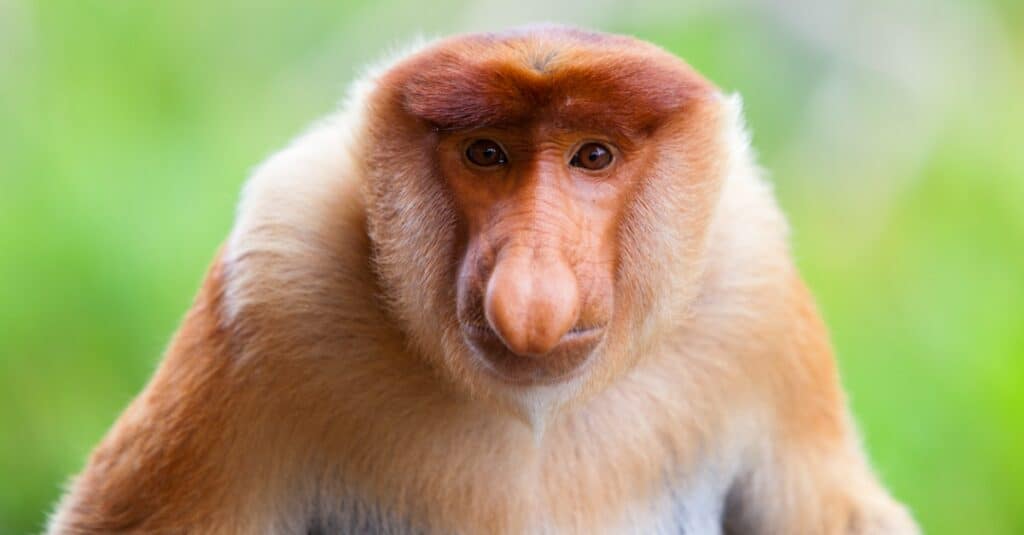
animals with big noses: proboscis monkey

Proboscis monkeys use their large noses to attract mates.

The Proboscis Monkey is a medium-sized arboreal primate that is found exclusively in the rainforests of Borneo. The male Proboscis Monkey is not only one of the largest monkeys in Asia but they are also one of the world’s most distinctive mammals, having a long and fleshy nose and a large, swollen stomach.

Although having slightly larger noses and a protruding stomach are defining of the Colobine (Leaf) Monkey family, these features on the Proboscis Monkey are more than double the size of their closest relatives.

The Proboscis Monkey today, however, is extremely threatened in its natural environment with deforestation having a devastating impact on the unique habitats where the Proboscis Monkey is found.

Anatomy and Appearance

The male Proboscis Monkey is significantly larger than the female measuring up to 76cm in height and weighing more than 20kg, both have long tails which can easily be the same length as the body, which is used to help the Proboscis Monkey to balance whilst it is leaping through the trees.

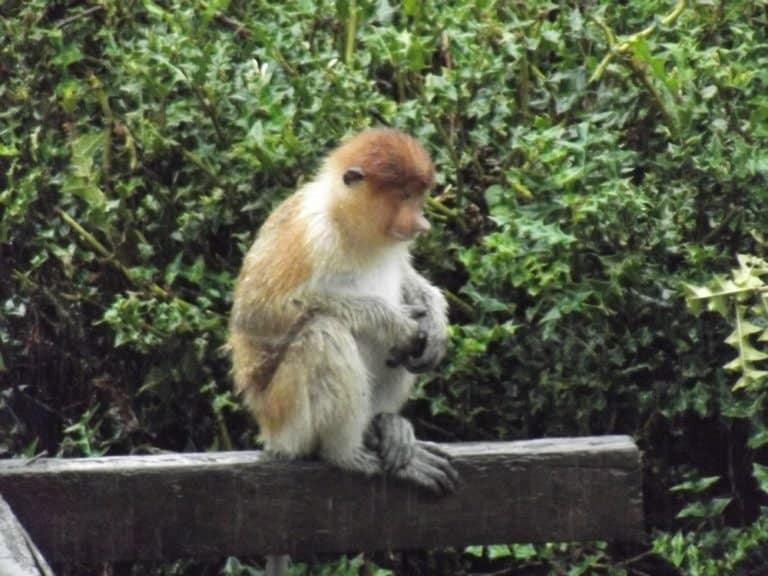
Adults are mainly pale orange to light brown in color with a richer colored head and shoulders and grey limbs and tail, and a light pink face.

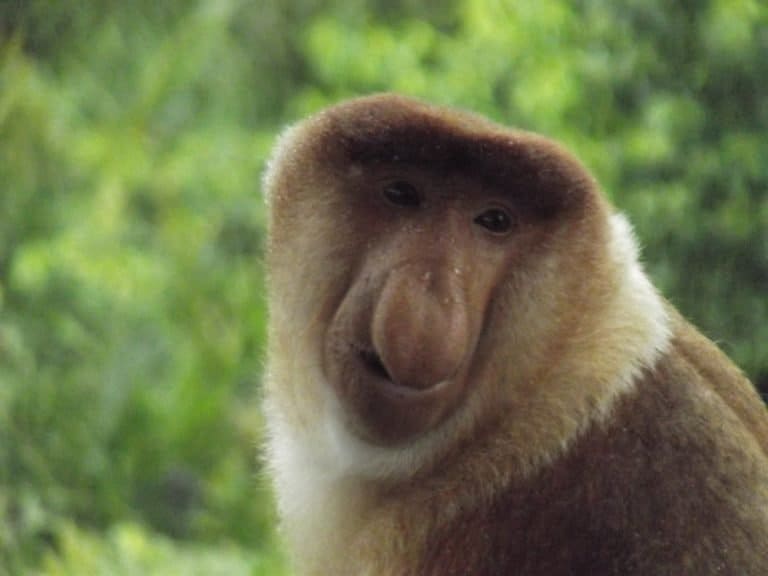
The protruding nose of the Proboscis Monkey develops with age with infants having more monkey-like noses and older mature males having larger and more bulbous ones. Although scientists are still unsure as to exactly why the nose of the Proboscis

Monkey grows so big, it is widely believed to be to do with attracting a female mate as the noses of females are much smaller.

Distribution and Habitat
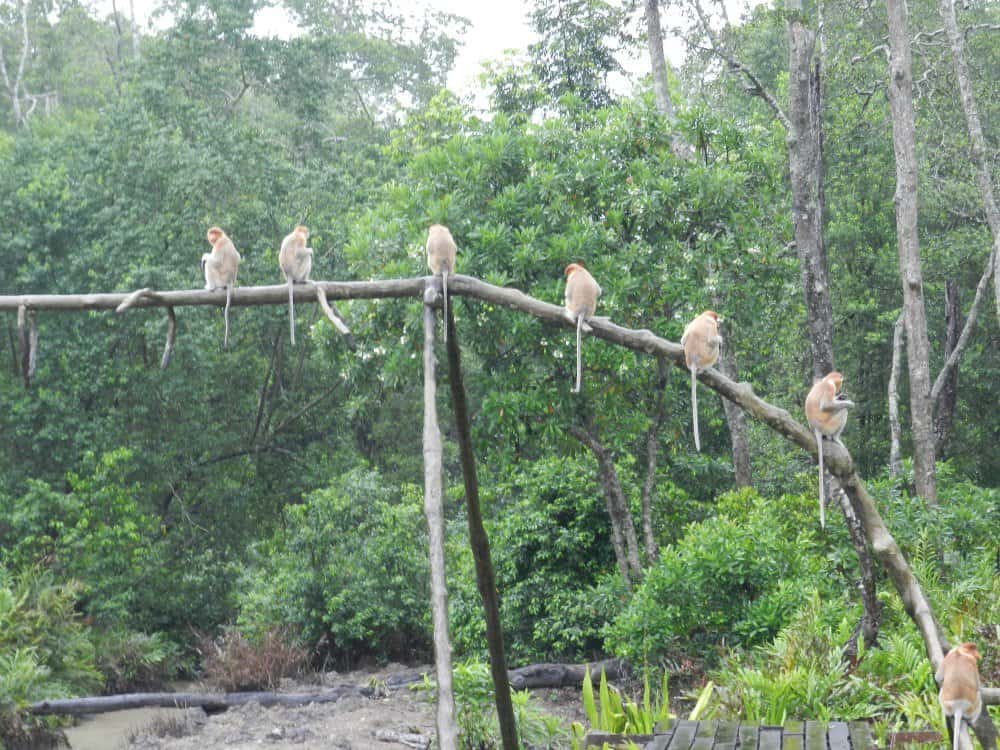
Proboscis Monkeys, Labuk Bay near Sandakan

The Proboscis Monkey is natively found on the island of Borneo where it was once fairly widespread (with the exception of central Sarawak) throughout the coastal mangrove forests.

The Proboscis Monkey inhabits very unique habitats and is most commonly found in mangrove swamps, but is also known to inhabit coastal mangroves, riverine forests, and lowland rainforests providing that there is a good source of fresh water.

Due to their leaf-eating diet, the Proboscis Monkey has also managed to exploit a niche within these wetland forests and is the largest mammal found inhabiting the higher levels of the canopy.

These rare regions however have been heavily affected by deforestation meaning that Proboscis Monkey populations are becoming more isolated as they will avoid cleared forests or populated areas.

Behavior and Lifestyle
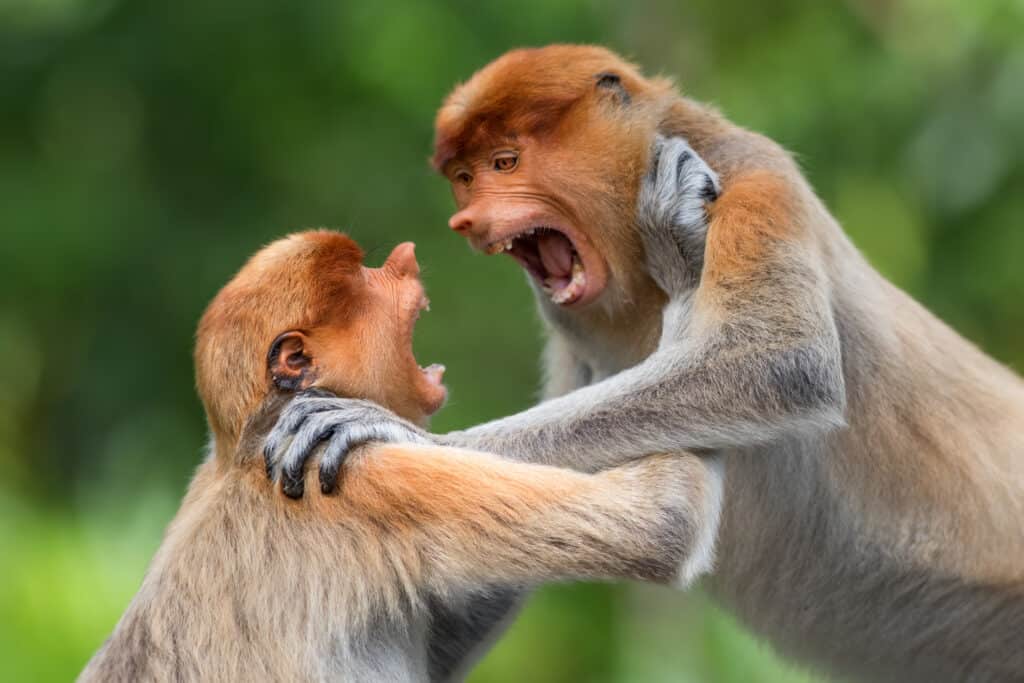
Two proboscis monkeys fighting against a blurred green background

The reasons that monkeys fight extend beyond the usual suspects of food, territory, and the right to mate.

The Proboscis Monkey is an incredibly sociable animal that inhabits the surrounding mangroves in troops that contain between 2 – 30 individuals and is comprised of a dominant male, with up to 10 females and they’re young.

Female Proboscis Monkeys tend to lead the searches for food and care for the young and the male defends his troop by making loud honking sounds and showing his teeth.

Proboscis Monkey troops are known to congregate together though when close to water or in an area where food is in abundance, along with at night when troops rest and sleep in the safety of the mangroves close to the water’s edge.

Due to the fact that the Proboscis Monkey requires a good fresh water supply such as a swamp or river, they are excellent swimmers and are known to travel across very deep areas to find food or to escape approaching danger.

Reproduction and Life Cycles
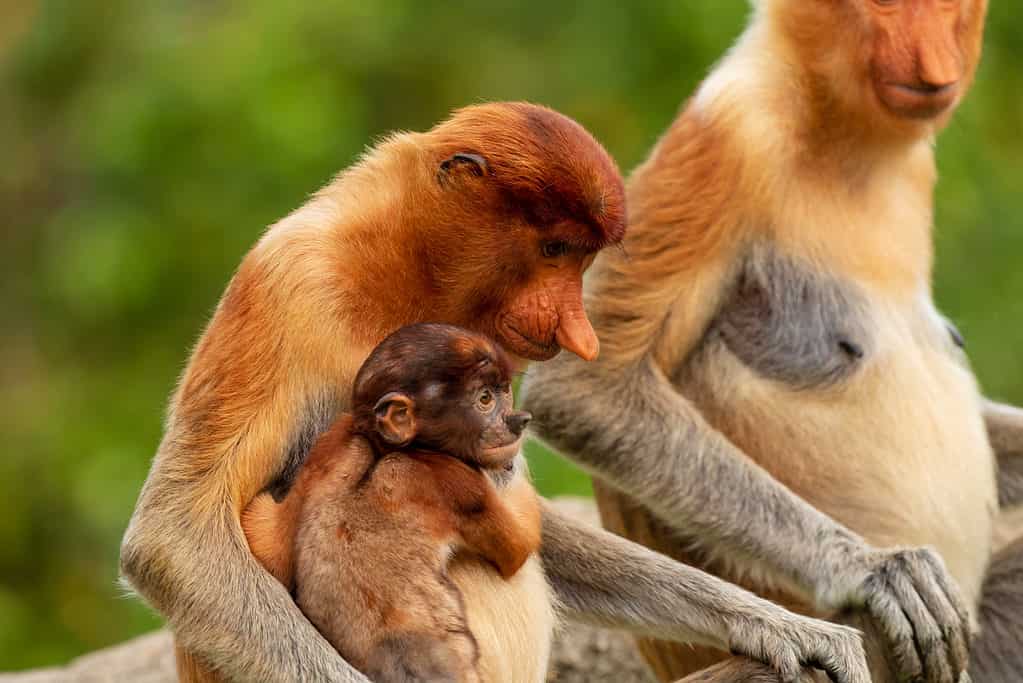
Wild mother and baby Proboscis Monkeys in the mangrove forests of Borneo

Wild mother and baby Proboscis Monkeys in the mangrove forests of Borneo

Female Proboscis Monkeys give birth to a single infant after a gestation period that lasts for around five and a half months, which has dark-colored fur and a blue face and will not develop their adult coloration until it is 3 or 4 months old.

Young Proboscis Monkeys are cared for not just by their mother but also by the other adult females in the troop and will remain with their mother until they are nearly a year old when young females tend to stay with the troop and young males will leave to join a group of bachelor males.

Although Proboscis Monkey troops tend to remain fairly stable, it is not uncommon for both males and females to move to another troop. Proboscis Monkeys tend to live for up to 20 years in the wild and are not able to reproduce until they are at least four years old.

Diet and Prey

Although the Proboscis Monkey is technically an omnivorous animal, the bulk of their diet is comprised of tough mangrove leaves which are pulled from the surrounding trees.

It is because of the fact that they are leaf-eating monkeys, that the Proboscis Monkey has a large and swollen stomach that is made up of chambers containing a special cellulose-digesting bacteria that helps to break down the leaves.

This is, however, a very slow process and means that the Proboscis Monkey’s stomach is often full and can contain up to a quarter of the individual’s total body weight.

The Proboscis Monkey supplements its diet by eating other plant matter including shoots, seeds, and unripe fruits along with a passing insect on occasion and does so predominantly in the trees, preferring not to come down to the ground.

Predators and Threats
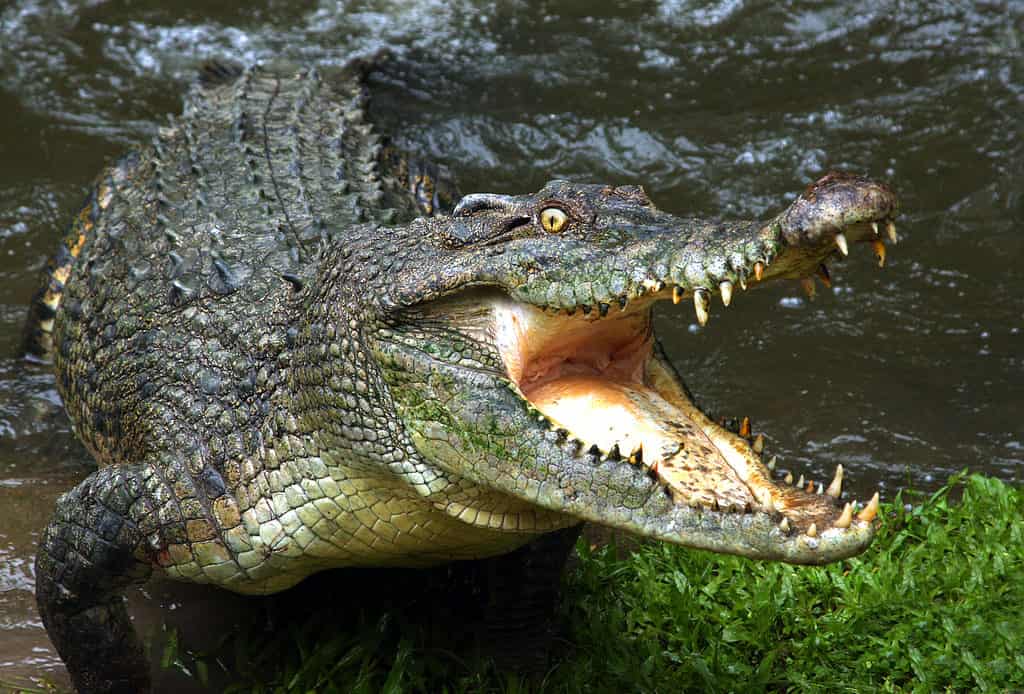
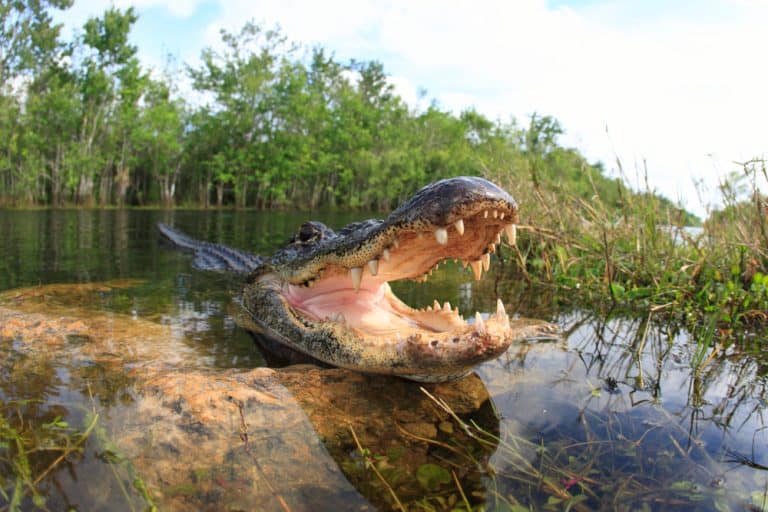
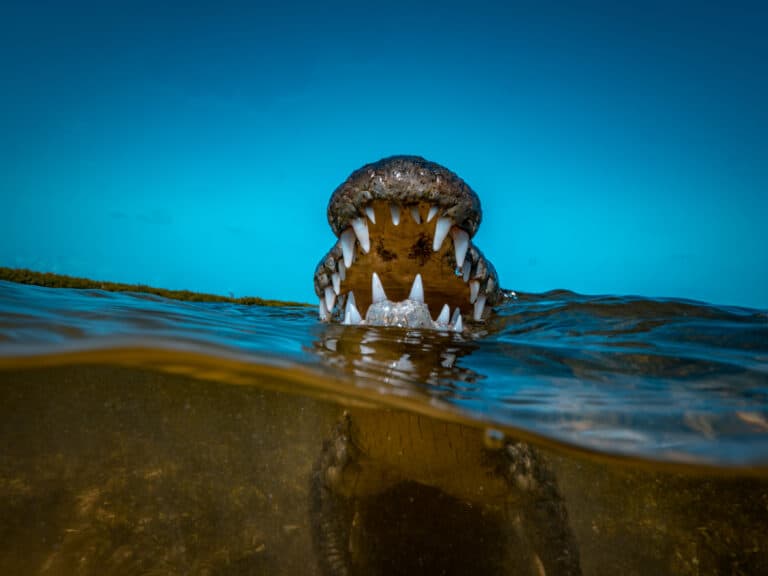
Crocodile with open mouth

Proboscis Monkeys are preyed on by crocodiles.

Due to the large size and almost entirely tree-dwelling lifestyle of the Proboscis Monkey, they have very few actual predators in their natural environment, with the exception of Clouded Leopards that hunt the Proboscis Monkey when it is forced to be on the ground.

They are also preyed upon by Crocodiles whilst in the water but Humans are the biggest threat to this unique animal. Not only have Proboscis Monkeys lost vast areas of their natural habitats to deforestation but they have also not adapted well to living close to Human activity and are therefore being pushed into smaller and more isolated pockets of their native regions.

Interesting Facts and Features

The Proboscis Monkey spends the majority of its life very close to the water and is an adept swimmer, aided by its partially webbed feet which help it to both paddles in the water and walk on the slippery banks. The Proboscis Monkey is very agile whilst in the trees and is also known to leap into the water from heights of up to 50ft!

The nose of the male Proboscis Monkey can grow so big that it hangs down over its mouth and has to be pushed aside to eat, however, when calling the nose straightens up and is thought to make the monkey’s sound echo louder to both impresses mature females and to intimidate rival males in the area.

The large nose of the male Proboscis Monkey is also known to become red and swollen when the individual is either angry or excited.

Want to know more interesting facts about Proboscis Monkeys? Read: “10 Incredible Proboscis Monkey Facts.”

Relationship with Humans
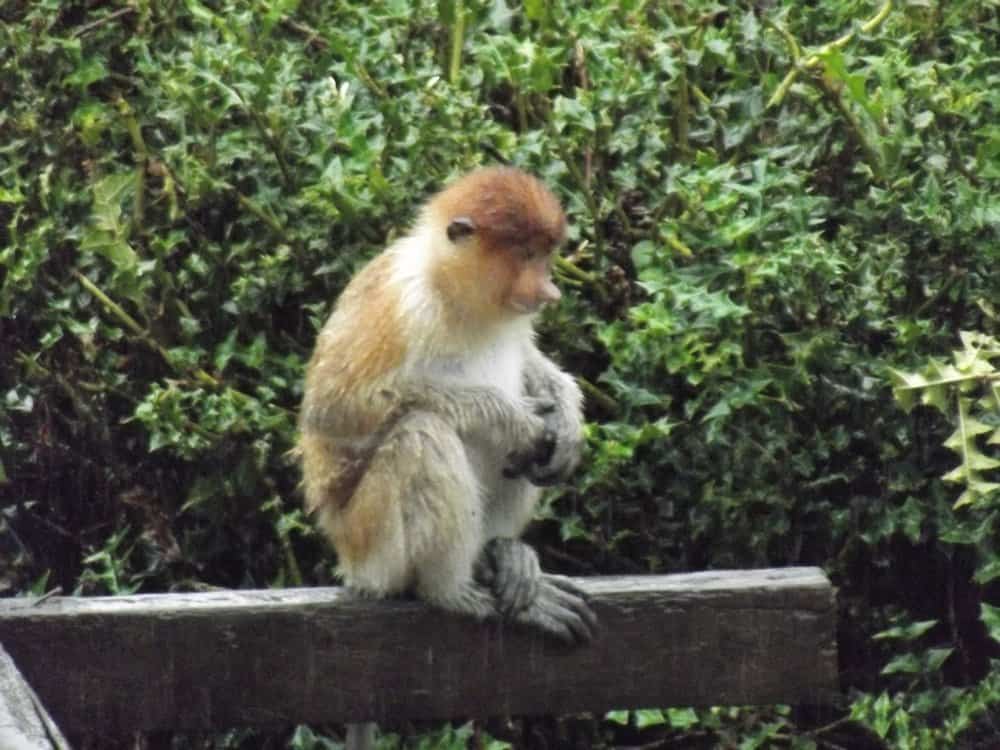
Female Proboscis Monkey, Labuk Bay near Sandakan

The Proboscis Monkey was once hunted by local people as they are seen as a culinary delicacy in some areas, but today the capture and killing of these distinctive animals is forbidden and has helped this situation slightly.

However, people have had a far bigger impact on the Proboscis Monkey through the deforestation of its natural habitat mainly for logging, growing Human settlements, and clearing land for palm oil plantations, which has led to drastic population declines in the species over the past couple of decades particularly.

They are, however, of great fascination to many people around the world and have generated tourism interest in certain areas.

Conservation Status and Life Today

Today, the Proboscis Monkey is listed by the IUCN as an animal that is Endangered in its natural environment and could face extinction in the near future if better conservation measures are not put into place.

Population numbers are thought to have dropped by up to 80% over the past 30 years with numbers continuing to decrease. There are thought to be around 7,000 Proboscis Monkeys left in the wild today and very few are found in captivity as they simply do not respond well to artificial conditions.

View all 247 animals that start with P
How to say Proboscis Monkey in ...
Danish
Næseabe
German
Nasenaffe
English
Proboscis Monkey
Spanish
Nasalis larvatus
Finnish
Nenäapina
French
Nasalis larvatus
Hebrew
קוף חוטם
Hungarian
Borneói nagyorrúmajom
Indonesian
Bekantan
Italian
Nasalis larvatus
Japanese
テングザル
Malay
Kera Bekantan
Dutch
Neusaap
English
Neseape
Polish
Nosacz
Portuguese
Macaco-narigudo
Swedish
Näsapa
Chinese
長鼻猴

Sources

  1. David Burnie, Dorling Kindersley (2011) Animal, The Definitive Visual Guide To The World's Wildlife / Accessed November 10, 2008
  2. Tom Jackson, Lorenz Books (2007) The World Encyclopedia Of Animals / Accessed November 10, 2008
  3. David Burnie, Kingfisher (2011) The Kingfisher Animal Encyclopedia / Accessed November 10, 2008
  4. Richard Mackay, University of California Press (2009) The Atlas Of Endangered Species / Accessed November 10, 2008
  5. David Burnie, Dorling Kindersley (2008) Illustrated Encyclopedia Of Animals / Accessed November 10, 2008
  6. Dorling Kindersley (2006) Dorling Kindersley Encyclopedia Of Animals / Accessed November 10, 2008
  7. David W. Macdonald, Oxford University Press (2010) The Encyclopedia Of Mammals / Accessed November 10, 2008
  8. Proboscis Monkey Facts / Accessed November 10, 2008
  9. Proboscis Monkey Information / Accessed November 10, 2008
  10. About Proboscis Monkeys / Accessed November 10, 2008
  11. Proboscis Monkey Conservation Status / Accessed November 10, 2008
Rebecca Bales

About the Author

Rebecca Bales

Rebecca is an experienced Professional Freelancer with nearly a decade of expertise in writing SEO Content, Digital Illustrations, and Graphic Design. When not engrossed in her creative endeavors, Rebecca dedicates her time to cycling and filming her nature adventures. When not focused on her passion for creating and crafting optimized materials, she harbors a deep fascination and love for cats, jumping spiders, and pet rats.
Connect:

Thank you for reading! Have some feedback for us?


Proboscis Monkey FAQs (Frequently Asked Questions)

Proboscis Monkeys are Omnivores, meaning they eat both plants and other animals.