P
Species Profile

Purple Emperor Butterfly

Apatura iris

Purple flash in the treetops
Bildagentur Zoonar GmbH/Shutterstock.com

Purple Emperor Butterfly Distribution

Click a location to explore more animals from that region

Loading map...
Purple Emperor sitting on a leaf

At a Glance

Wild Species
Diet Omnivore
Activity Diurnal
Lifespan 12 years
Weight 0.0008 lbs
Status Least Concern
Did You Know?

Wingspan typically 7.4-9.2 cm in Apatura iris, making it one of Europe's largest woodland butterflies.

Scientific Classification

A large woodland butterfly of Europe and temperate Asia, famous for the male’s strong purple iridescence (angle-dependent structural color) and canopy-dwelling behavior.

Kingdom
Animalia
Phylum
Arthropoda
Class
Insecta
Order
Lepidoptera
Family
Nymphalidae
Genus
Apatura
Species
iris

Distinguishing Features

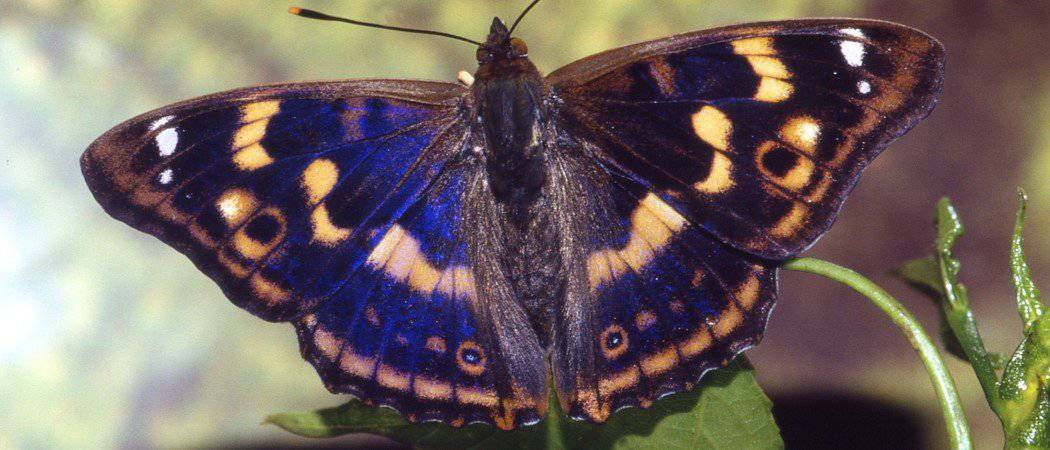
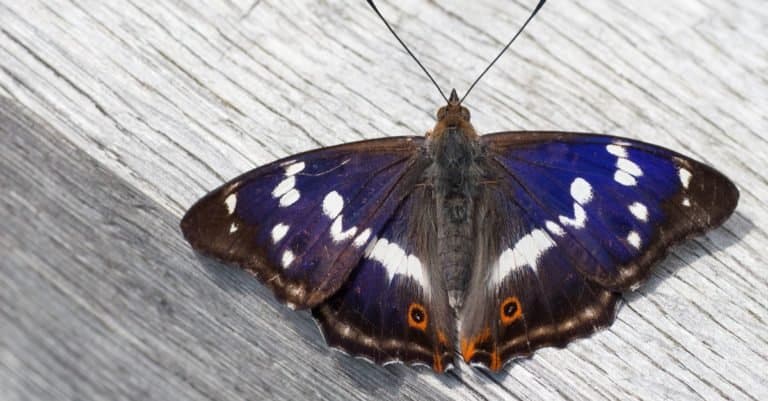
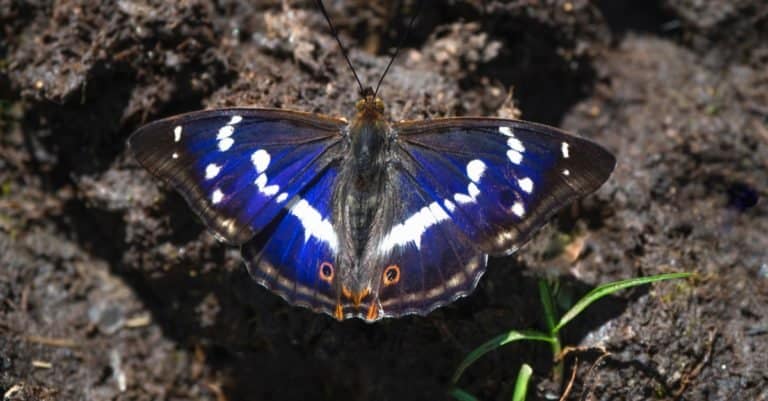
  • Males show vivid purple iridescence on dark wings (females usually lack strong purple sheen)
  • White banding/spots across the wings typical of Apatura
  • Often observed in woodland canopy; males may “hilltop” and defend territories

Physical Measurements

Weight
0 lbs (0 lbs – 0 lbs)

Appearance

Primary Colors
Secondary Colors
Skin Type Chitinous exoskeleton; wings covered in overlapping scales (including iridescence-producing microstructures in males).
Distinctive Features
  • Wingspan typically 7-8 cm (Tolman & Lewington, 2008).
  • Male dorsal wings can flash vivid purple due to structural (not pigment) coloration; effect is viewing-angle dependent.
  • Underside strongly patterned: broad white band plus several orange-ringed eyespots; excellent closed-wing camouflage on bark.
  • Adults are canopy-dwelling and strongly territorial; males defend sunlit perches along rides and treetops.
  • Larvae feed chiefly on willows/sallows (Salix spp.), matching the butterfly's woodland and riverside habitats.
  • Adult feeding often includes aphid honeydew, tree sap, and mineral sources (e.g., carrion/dung), not primarily flowers.
  • Single annual brood (univoltine) in most of its range; adults are typically on the wing June-August in Europe.

Sexual Dimorphism

Sexes differ strongly: males exhibit intense, angle-dependent purple structural iridescence, while females are larger and mostly brown with minimal or no purple flash. Both share the same underside white band and eyespots.

  • Intense purple (often bluish-purple) dorsal iridescence produced by scale microstructure.
  • Typically smaller and darker-looking when iridescence is not reflecting.
  • More frequent territorial perching and aerial contests in the canopy/rides.
  • Generally larger wings (often cited as slightly greater wingspan than males).
  • Dorsal surface predominantly brown with little to no purple iridescent flash.
  • Often less conspicuous in flight; tends to stay nearer host trees for oviposition.

Did You Know?

Wingspan typically 7.4-9.2 cm in Apatura iris, making it one of Europe's largest woodland butterflies.

Male "purple" is structural coloration: microscopic scale architecture reflects blue light (~400-450 nm) so it looks purple at certain viewing angles, but dark at others.

Adults often feed on tree sap, honeydew, rotting fruit, dung, and carrion-so you may spot them on muddy tracks or bait rather than flowers.

Usually one generation per year in most of Europe (univoltine); adults fly mainly June-August (varies with latitude and season).

Eggs are laid singly on willow/sallow leaves or twigs; the species typically overwinters as an egg on the host plant.

Males spend much of the day in the canopy, descending mainly to feed or drink; females are more often seen lower down when searching for host willows.

Caterpillars are green with small "horns" and strong leaf mimicry, helping them vanish among willow foliage.

Unique Adaptations

  • Structural iridescence in males: multilayer nanostructures in wing scales create interference-based blue reflectance; combined with wing pigments it is perceived as purple and shifts with viewing angle.
  • Canopy lifestyle: strong, fast flight and perch-and-patrol behavior are suited to navigating woodland crowns while minimizing ground-level predation.
  • Cryptic underside: when wings are closed, the mottled brown underside helps camouflage the butterfly against bark and shaded leaves.
  • Larval leaf mimicry: green caterpillars with subtle striping and small head "horns" resemble willow leaves and petioles, reducing detection by birds.
  • Egg overwintering: eggs remain on willow twigs through winter, synchronizing spring hatching with host budburst and early leaf growth.
  • Host-plant specialization: strong association with Salix (willow/sallow) species-commonly including goat willow (Salix caprea) and grey sallow (Salix cinerea)-supports larval development in woodland edges and rides.

Interesting Behaviors

  • Canopy territoriality: males hold sunlit perches high in the canopy and repeatedly patrol a "route," chasing other butterflies and even birds from their airspace.
  • Hilltopping/treetop rendezvous: males concentrate at prominent treetops or ridgelines, increasing chances of meeting females in fragmented woodland.
  • Angle-dependent signaling: males use sun and flight angles so the iridescent flash appears and disappears, functioning like a moving signal against dark foliage.
  • Sap runs and honeydew feeding: adults often feed at oozing tree wounds and aphid honeydew rather than nectaring on flowers.
  • Mineral and nitrogen seeking: adults frequently puddle on damp ground and are strongly attracted to nutrient sources such as dung and carrion (a well-known field behavior for the species).
  • Egg-laying strategy: females lay eggs singly on larval host plants (especially sallows/willows), reducing competition and making eggs harder for predators/parasitoids to locate.
  • Seasonal timing: adults are most active in warm, sunny spells; males often remain inactive in shade, conserving energy until sun patches appear.

Cultural Significance

The Purple Emperor (Apatura iris) is an iconic woodland prize in Britain and Europe. Canopy-dwelling males show dramatic purple shine. Its noble name made it a flagship for saving sunny woodland rides, old trees and sallow-rich edges, and a classic summer chase for butterfly fans.

Myths & Legends

Name-lore (European): The "Purple Emperor" title reflects a long tradition of giving regal names to striking butterflies; the sudden purple flash in sunlight suggested imperial purple dye and royal status.

Classical naming association: The species epithet "iris" echoes Iris of Greek mythology-messenger of the gods and personification of the rainbow-an allusion often linked in natural-history writing to the butterfly's shifting, light-made color.

Woodland-watcher tradition (Britain): Victorian and Edwardian lepidopterists told and retold stories of the 'emperor's throne'-favored treetops where males repeatedly returned to perch-turning particular oaks/ash trees into famed local landmarks for generations of butterfly seekers.

European field folklore said the Purple Emperor (Apatura iris) could be 'summoned' down from the tree canopy using strong baits like rotting meat or fermenting mixes as an old practice among butterfly collectors.

Conservation Status

LC Least Concern

Widespread and abundant in the wild.

Population Unknown

Protected Under

  • UK (England): Natural Environment and Rural Communities (NERC) Act 2006 - Section 41 'Species of Principal Importance' (as listed in England).

Life Cycle

Birth 1 larva
Lifespan 12 years

Lifespan

In the Wild
11–13 years
In Captivity
11–14 years

Reproduction

Mating System Polygynandry
Social Structure Solitary
Breeding Pattern Transient
Fertilization Internal Fertilization
Birth Type Internal_fertilization

Males defend sunlit canopy perches ("treetop territories") and engage in aerial contests, mating with visiting females; both sexes may mate multiple times during the roughly 2-3 week adult phase. Females oviposit singly on Salix leaves; no parental care occurs.

Behavior & Ecology

Social Solitary Group: 1
Activity Diurnal
Diet Omnivore Aphid honeydew (especially in the canopy of broadleaf woodland, frequently associated with oaks)
Seasonal Hibernates

Temperament

Strongly territorial males: perch-and-chase behavior against conspecifics and other butterflies (canopy "master of the woods").
Wary, fast-flying, often canopy-dwelling; descends mainly to feed at sap runs, dung, or carrion.
HUBS: Across populations, males commonly defend sunlit perches; intensity varies with density and weather.
Larvae are cryptic and solitary; rest aligned with leaf midrib, reducing detection by predators.
Adult flight season (most of Europe): typically June-August; adult lifespan about 2-3 weeks under natural conditions (reported in European life-history syntheses).

Communication

No known vocalizations; adults and larvae are effectively silent Typical of Nymphalidae
Visual signaling via wing pattern and angle-dependent male iridescence during flight/territorial interactions Structural color
Chemical communication: female sex pheromones and male pheromonal cues during courtship Common Lepidoptera mechanism
Tactile/chemosensory contact during courtship and mating; antennal and tarsal chemoreception.
Host-plant and oviposition mediated by chemosensory cues; larvae use silk and chemical traces for adhesion/resting.

Habitat

Deciduous Forest Woodland River/Stream
Biomes:
Temperate Forest Wetland
Terrain:
Hilly Plains Valley Riverine
Elevation: Up to 5249 ft 4 in

Ecological Role

Woodland canopy butterfly; larval specialist herbivore on willows and adult sap/honeydew/carrion fluid-feeder that links canopy resources to ground-level nutrient pathways.

Nutrient cycling/redistribution via carrion- and dung-feeding (adult males often transport minerals and nitrogenous compounds within woodland) Herbivory on willows (Salix spp.), contributing to plant-herbivore dynamics in riparian/woodland edge habitats Food-web support (eggs/larvae/pupae are prey for arthropod predators and parasitoids; adults preyed on by birds) Incidental pollination when adults take nectar (minor compared with nectar-specialist butterflies)

Diet Details

Main Prey:
Aphid honeydew Tree sap Rotting fruit juices Mineral-rich fluids from dung and carrion
Other Foods:
Aphid honeydew Tree sap and plant exudates Rotting or fallen fruit juices Willow Nectar

Human Interaction

Domestication Status

Wild

No domestication history. The Purple Emperor is a wild butterfly species and has not been domesticated; it may be reared in captivity for research or education, but there is no domesticated form or breeding history associated with human domestication.

Danger Level

Low
  • No venom or stinging apparatus; does not bite or transmit disease to humans under normal circumstances.
  • Minor risk of allergic or irritant reactions in sensitive individuals from contact with wing scales/dust (rare), similar to other Lepidoptera handling.
  • Indirect risk is negligible; at most, mild skin/eye irritation from handling, or tick exposure if people pursue the species in dense woodland habitats.

As a Pet

Not Suitable as Pet

Legality: Purple Emperor (Apatura iris) is not kept as a pet and not suitable. Laws vary: protected-area and national laws and permits may restrict capture, breeding, transport, or release; release may be banned for health or genetic risks. Check local rules.

Care Level: Expert Only

Purchase Cost: Up to $150
Lifetime Cost: $50 - $400

Economic Value

Uses:
Ecotourism & recreation (butterfly watching, nature tourism, photography) Education & outreach (life-cycle demonstrations under permit) Scientific research value (structural coloration/optics; woodland ecology) Conservation indicator value (mature woodland quality/landscape connectivity) Collecting/curation value (historical museum specimens; regulated/ethical collecting)
Products:
  • Nature-tourism experiences (guided butterfly walks, wildlife trips focused on canopy species)
  • Educational materials and exhibits (butterfly life-cycle interpretation; structural color examples)
  • Scientific outputs (papers/data on Apatura iris iridescence, behavior, and woodland management outcomes)
  • Museum collections/specimens (where legally obtained and curated)

Relationships

Related Species 5

Lesser Purple Emperor Apatura ilia Shared Genus
Freyer's Purple Emperor Apatura metis Shared Genus
Japanese Purple Emperor Sasakia charonda Shared Family
White Admiral Limenitis camilla Shared Family
Poplar Admiral Limenitis populi Shared Family

Ecological Equivalents 4

Animals that fill a similar ecological role in their ecosystem

Lesser Purple Emperor Apatura ilia Canopy-dwelling woodland nymphalid with a single main summer flight. Adults feed on tree sap, honeydew, carrion, and dung. The Purple Emperor (Apatura iris) has a 7–9 cm wingspan and flies mainly June–August, matching A. ilia.
Japanese Purple Emperor Sasakia charonda Similar East Asian forest butterfly: a large canopy-dwelling species whose males exhibit structural iridescence. Adults feed on sap, honeydew, minerals, and carrion, demonstrating similar adult foraging behavior despite different larval host plants.
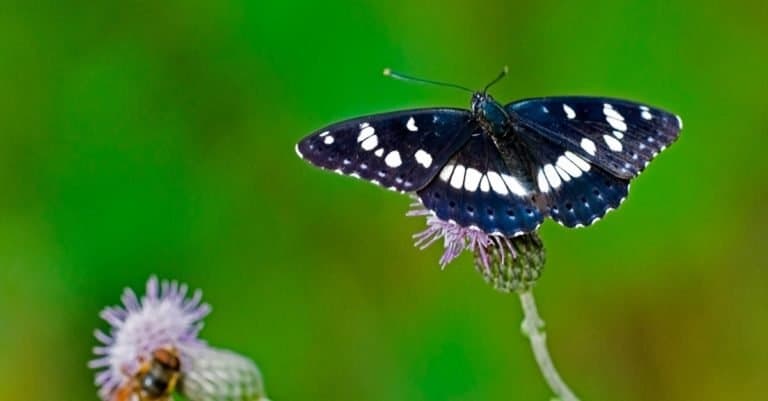
White Admiral Limenitis camilla Shares woodland canopy and edge habitats with A. iris in Europe. As a nymphalid associated with trees and the understory, Limenitis camilla often occurs alongside A. iris but feeds more on nectar and uses different larval host plants.
Mourning Cloak Nymphalis antiopa Both occur in temperate woods, and adults feed on sap, honeydew, and fermenting fruit more than on nectar. Nymphalis antiopa resembles A. iris in adult feeding habits but is less tied to the canopy.

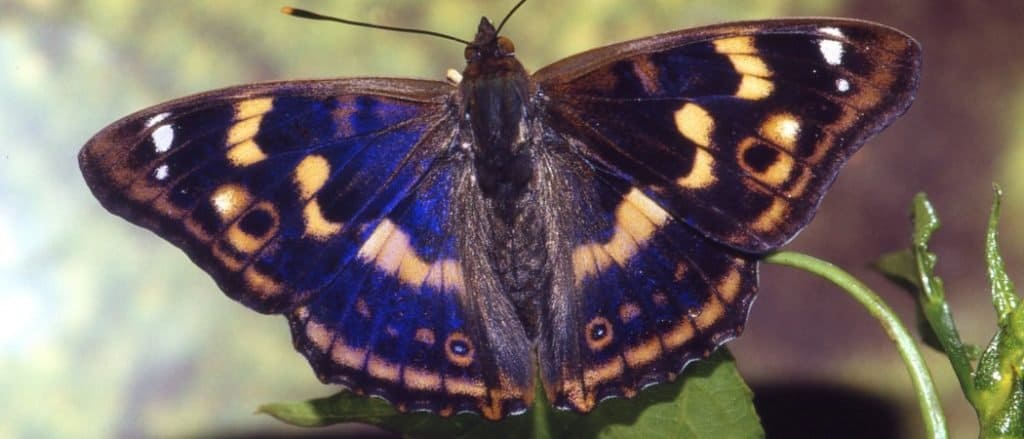
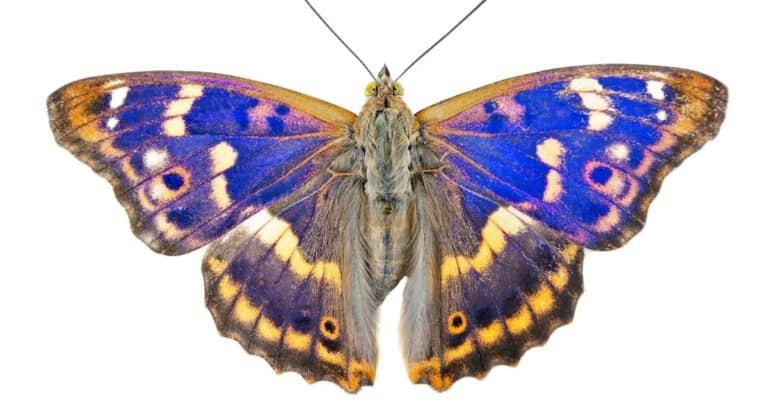
The Purple Emperor is a large butterfly whose males have areas of iridescent purple on their wings.

The larger females do not have this iridescence, which is how the sexes can be told apart. Its numbers are declining largely due to habitat loss, as the sallow or willow trees where they lay their eggs and the broadleaf trees where they live are being cut down.
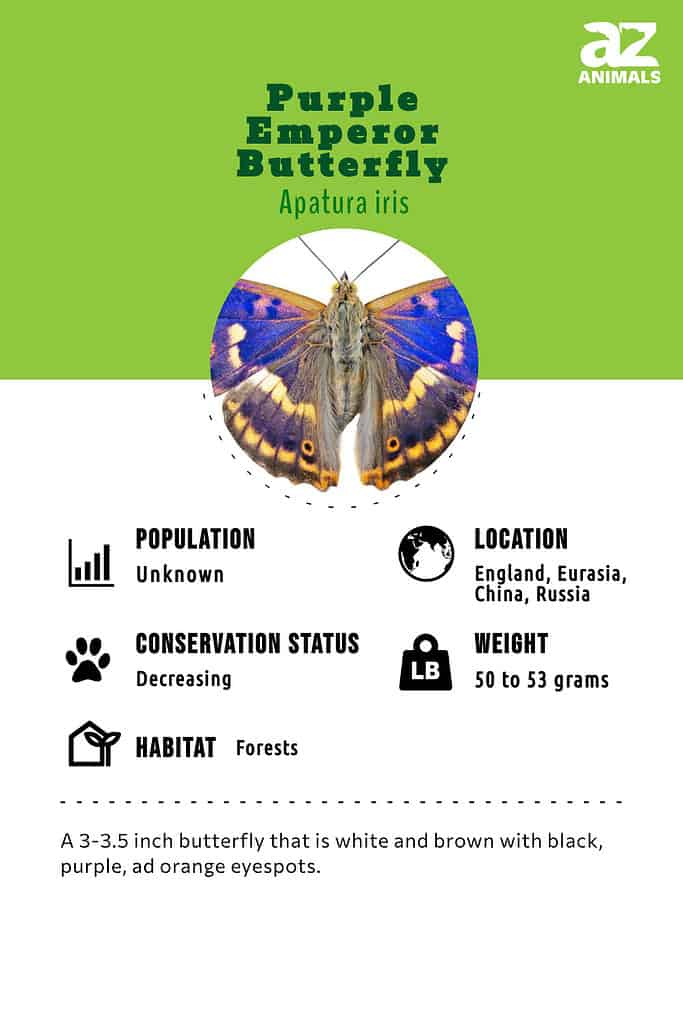
Purple Emperor infographic

5 Incredible Purple Emperor Facts!

  • The Purple Emperor is a Palearctic butterfly, which means it’s found in Europe and Asia to the Himalayan foothills and in North Africa. The Palearctic realm is the largest of the ecological realms on earth.
  • It belongs to the genus Apatura. Most of the butterflies in this genus are known as Emperors.
  • Purple Emperors lay their eggs on the leaves of sallows, or willows, especially Goat and Gray willows. Occasionally, they’ll lay their eggs on poplar trees.
  • The Purple Emperor is the second-largest type of butterfly. Only the Swallowtails are larger.
  • The Purple Emperor’s conservation status is Not Threatened, even though its numbers are declining. It’s also protected under the Wildlife and Countryside Act of 1981.

Species, Types, and Scientific Name

The scientific name of the Purple Emperor is Apatura iris. Apatura is probably from the Greek word Apaturia, which means “the deceitful one” and was used to describe several goddesses. The word probably refers to the deceptive nature of the male Purple Emperor’s wings, which only show their iridescence under the right conditions. The other half of the butterfly’s scientific name, Iris, refers to the Greek goddess of the rainbow.

There are five known subspecies of Purple Emperor. They are:

  • Apatura iris iris
  • Apatura iris bieti
  • Apatura iris xanthina
  • Apatura iris kansuensis
  • Apatura iris amurensis

Evolutionary and Origins
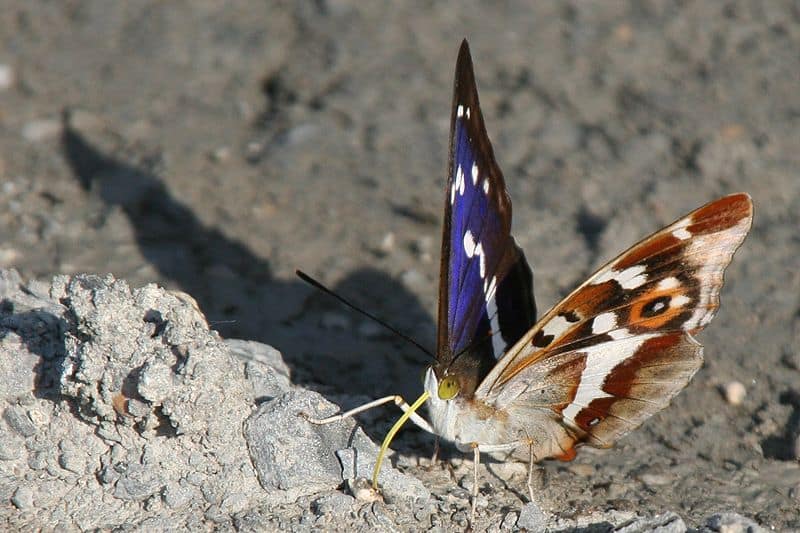
Purple Emperors have adapted unique camouflage over their history.

The purple emperor butterfly, also known as Apatura iris, has a fascinating evolutionary history that has been studied extensively by scientists and researchers. It is believed that this species of butterfly first originated in Europe and Asia, with some populations spreading to other parts of the world over time.

One interesting aspect of the purple emperor’s evolution is its unique coloration. The distinctive iridescent blue-purple hue on its wings is thought to have evolved as a form of camouflage or visual deception, helping it blend in with its surroundings and avoid predators.

Another important factor in the purple emperor’s evolution has been selective breeding. Over many generations, individuals with desirable traits such as strong flight abilities or better camouflage have been more likely to survive and pass on their genes to future generations.

Appearance: How To Identify Them
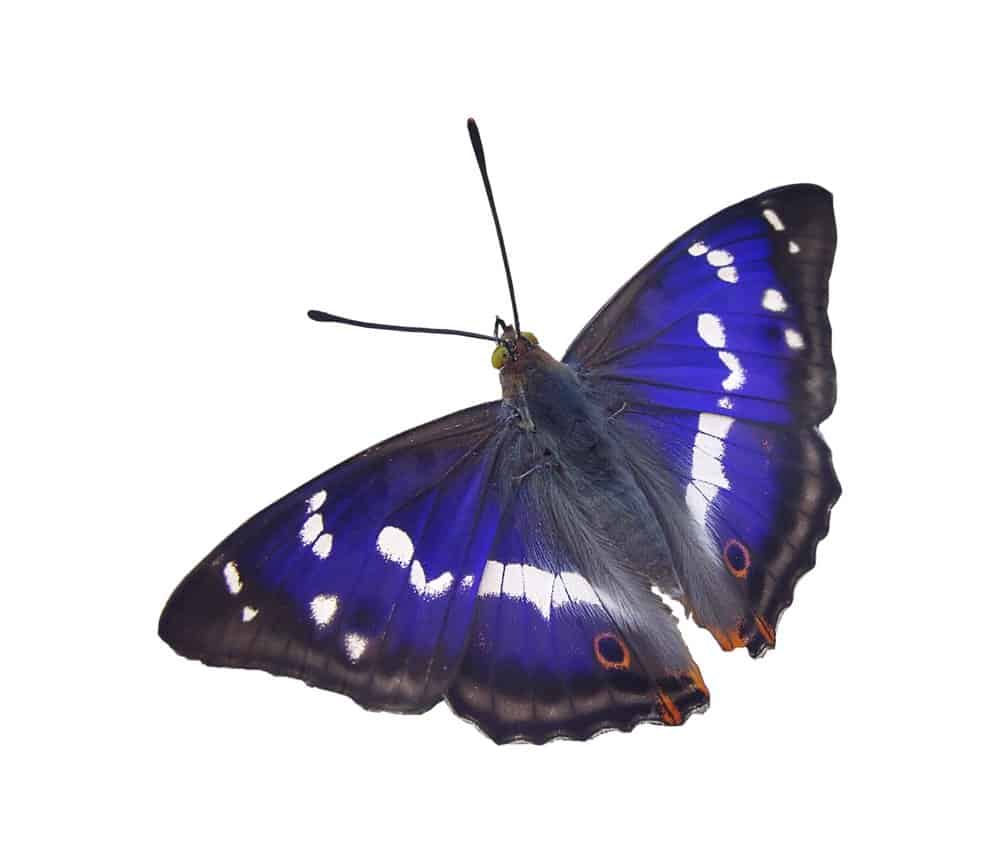
Purple Emperor (Apatura Iris) - on white background

Purple emperor butterflies are between three and three and a half inches long

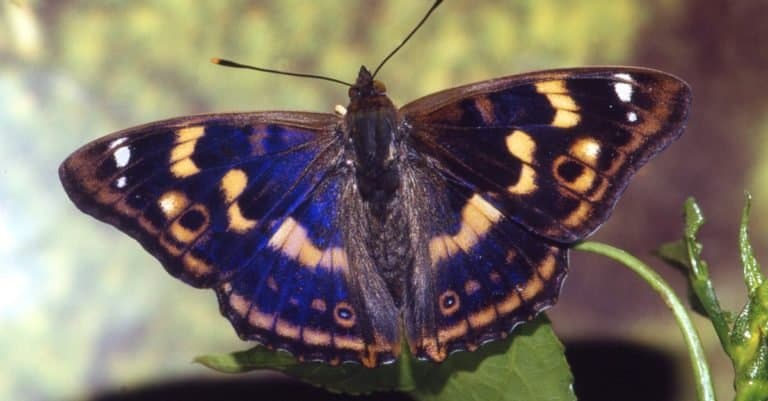
The wings of the Purple Emperor have a pattern of whites and shades of dark brown. Each hindwing has an eyespot of black, purple, and orange. The underside of the wings of both males and females are different shades of brown marked with white. Males are a bit smaller than females, with a 2.8 to 3-inch wingspan. The wingspan of the females is 3.15 to 3.54 inches.

The eggs are green or yellow and can be found on the top of sallow leaves. They usually hatch after two or three weeks.

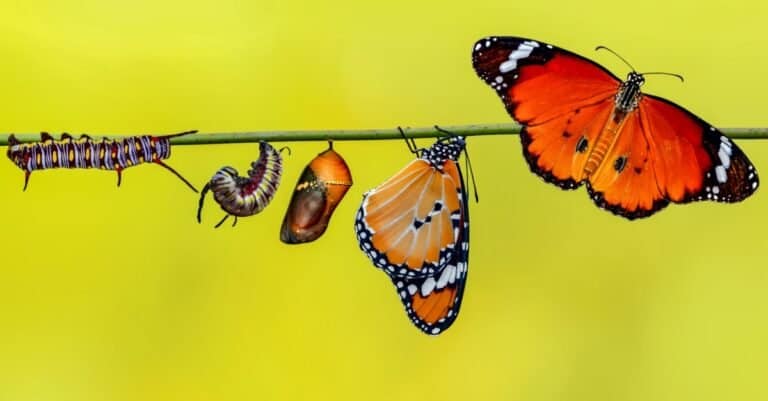
The caterpillars are green with white stripes and dots. They molt or shed their skin five times before they pupate, and during their second molt, they develop horns on their head that make them resemble bright light green slugs. At night they eat the leaves of the willow where they were hatched. It takes about 10 months for the caterpillar to become fully grown, and that often means that they need to hibernate over the winter. A fully grown Purple Emperor caterpillar can be between 1.37 and 2.2 inches long.

When the caterpillar is ready to hibernate, it stops eating, turns brown, and shelters in the fork of a branch. When it wakes up, it starts to eat again, sheds its skin one more time then crawls up to the very top of the tree to pupate. There it creates a chrysalis that is between 1.18 and 1.38 inches long and 0.47 to 0.59 inches wide. It is camouflaged as a willow leaf.

The adult finally emerges in July and has a six-week life span.

Habitat: Where to Find Them
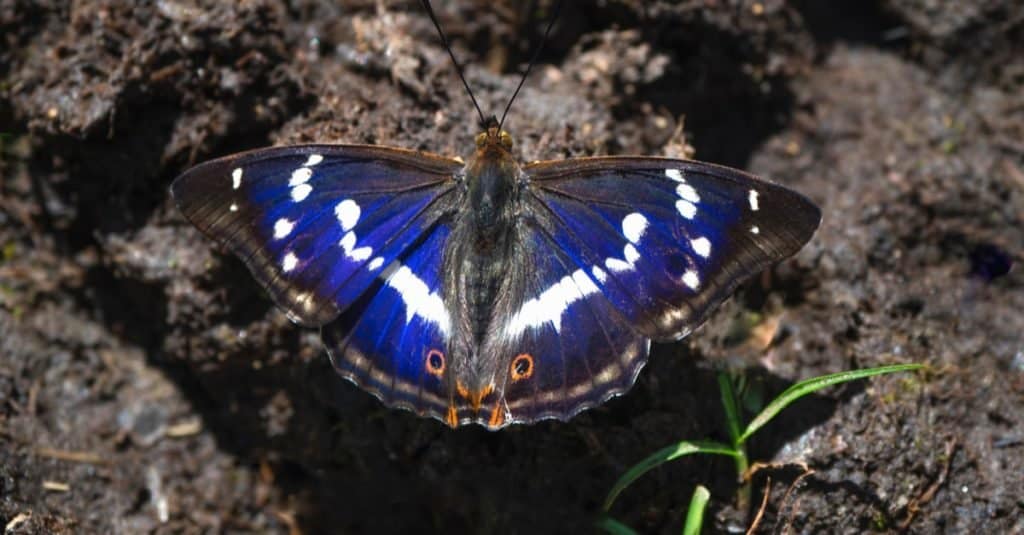
A large Purple Emperor butterfly (Apatura ilia) sits on the land on a sunny summer day.

The main species of the Purple Emperor seems to be concentrated in several areas in England, especially the forests of southern England. This is where willows and other broadleaved trees are found. Some specimens have also been found in Monmouthshire in Wales.

Subspecies of the butterfly are found in Eurasia. Apatura iris bieti is found in central and western China as well as Tibet. Apatura iris amurensis can be found around the Amur and Ussuri Rivers. The Amur River is the border between Russia and Inner Manchuria, and the Ussuri River runs through Russia and northeastern China.

Behavior
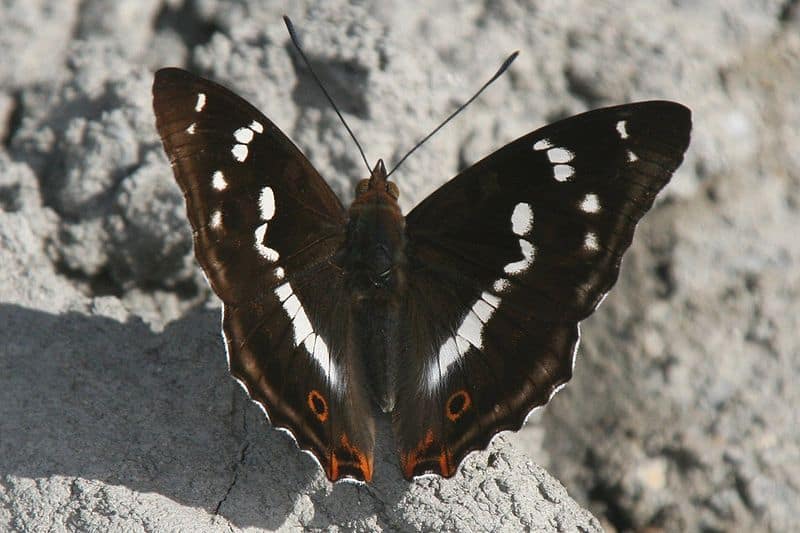
Purple Emperors use pheromones to attract a mate.

The purple emperor butterfly, also known as Apatura iris, is a majestic species with captivating behavior that has been the subject of numerous studies. These butterflies are found in woodlands and forests across Europe and Asia, where they spend most of their time flying high up in the tree canopy.

One notable aspect of their behavior is that they are highly territorial creatures. Males will fiercely defend small territories against other males to attract females for mating purposes. They use pheromones to detect each other’s presence and engage in aerial battles to establish dominance.

Purple emperors are also known for their unique feeding habits. Unlike many other butterfly species that feed on nectar from flowers, these butterflies prefer to feed on sap from trees or rotting fruit on the forest floor. This adaptation allows them to thrive in woodland habitats where flower resources may be limited.

Another fascinating behavior exhibited by purple emperor butterflies is their use of camouflage when resting on tree trunks or branches. The underside of their wings resembles bark or leaves, making it difficult for predators such as birds and lizards to spot them.

Diet
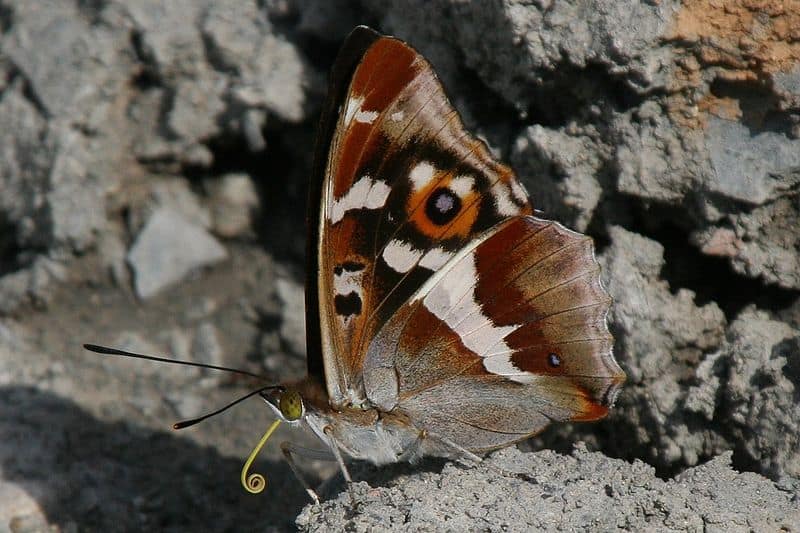
Purple Emperors eat leaves

The Purple Emperor caterpillar eats the leaves of the sallow tree. The butterfly is unusual in that it doesn’t sip nectar from flowers but takes nourishment from tree sap, the honeydew produced by aphids, and the moisture and salt produced by excreta and dead animals. Purple Emperors are so attracted to dead things that collectors used decaying animal carcasses to bait them, and the males sometimes get run over when they visit roadkill.

Predators and Threats
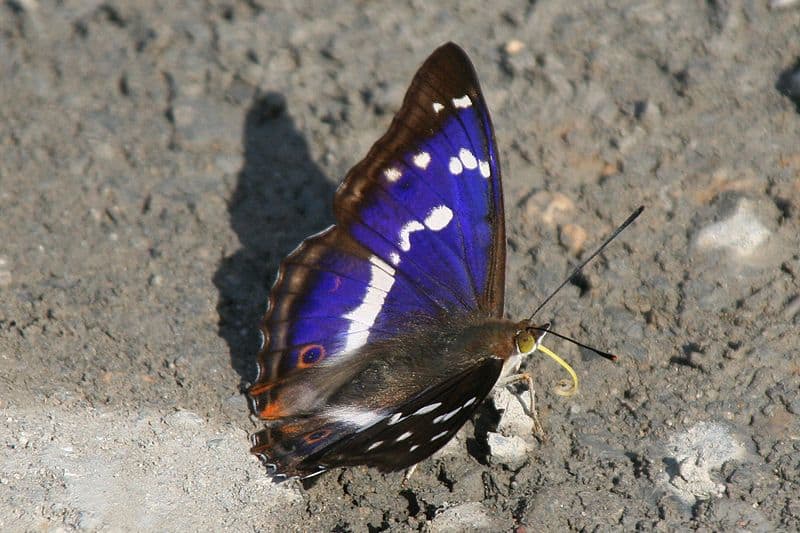
Purple Emperors face numerous threats to their survival.

The purple emperor butterfly, like many other species in the animal kingdom, faces numerous predators and threats that endanger its survival. Among its most significant natural predators are birds such as woodpeckers, jays, and cuckoos. These birds prey on the butterfly’s larvae or pupae by using their sharp beaks to extract them from their hiding places.

Other than bird predation, habitat loss is also a major threat to the purple emperor butterfly’s population. The destruction of forests and woodland areas where these butterflies typically reside has drastically reduced their numbers over recent years. This is due to deforestation activities that destroy trees where they lay eggs or feed on sap.

Furthermore, climate change poses another challenge for this species since it affects weather patterns leading to unpredictable conditions detrimental to the butterfly’s life cycle stages. Extreme heat waves can dry up habitats, while sudden temperature drops can kill off larvae before they develop into adults.

Reproduction, Life Cycle, and Lifespan
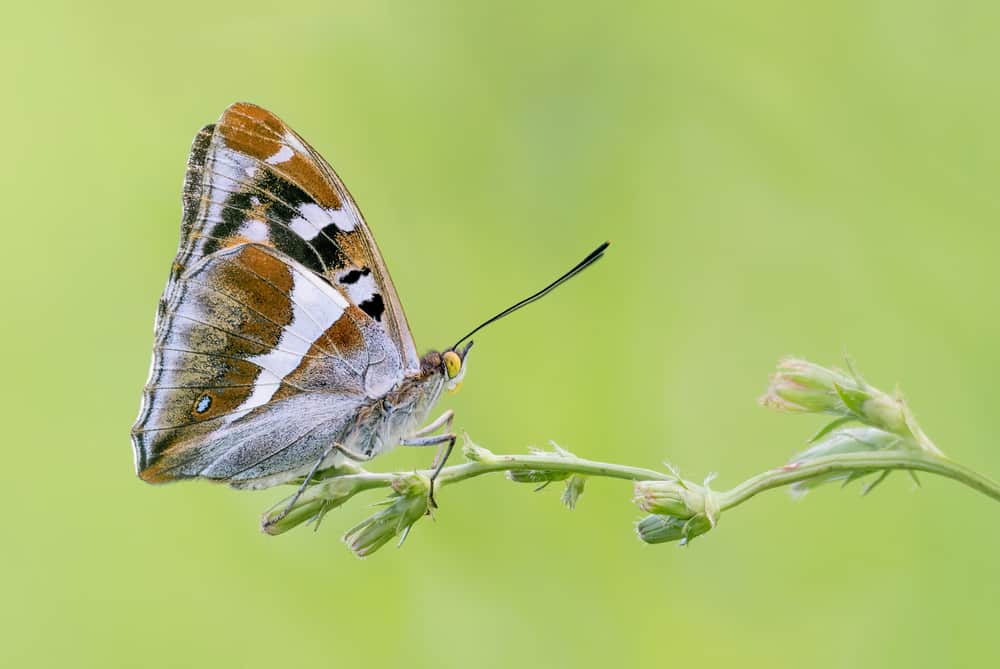
Purple Emperor (Apatura Iris) - on plant

Purple emperor butterfly court each other with a complicated fluttering of wings.

The purple emperor butterfly has a fascinating life cycle that involves four distinct stages. The first stage is the egg, which is laid by the female butterfly on the leaves of host plants such as willow or sallow. These eggs hatch into larvae or caterpillars, which go through several molts and shed their skin to grow larger.

After feeding on leaves for several weeks, the larva forms a pupa or chrysalis, where it undergoes metamorphosis and transforms into an adult butterfly. This process takes around two weeks before emerging from its cocoon as a fully-formed butterfly.

In terms of reproduction, male purple emperors are known for engaging in territorial behavior during mating season. They perch high up in trees and chase away rival males while waiting for females to come within range. Once they spot a potential mate, they fly down to her and engage in courtship rituals such as wing fluttering and pheromone release.

The lifespan of purple emperor butterflies varies depending on factors such as climate conditions and predation risk. However, most individuals live for around one year from egg to adult emergence. Overall, these beautiful insects have captured our imaginations due to their striking appearance and intriguing life cycle behaviors that make them stand out among other species of butterflies.

Population and Conservation
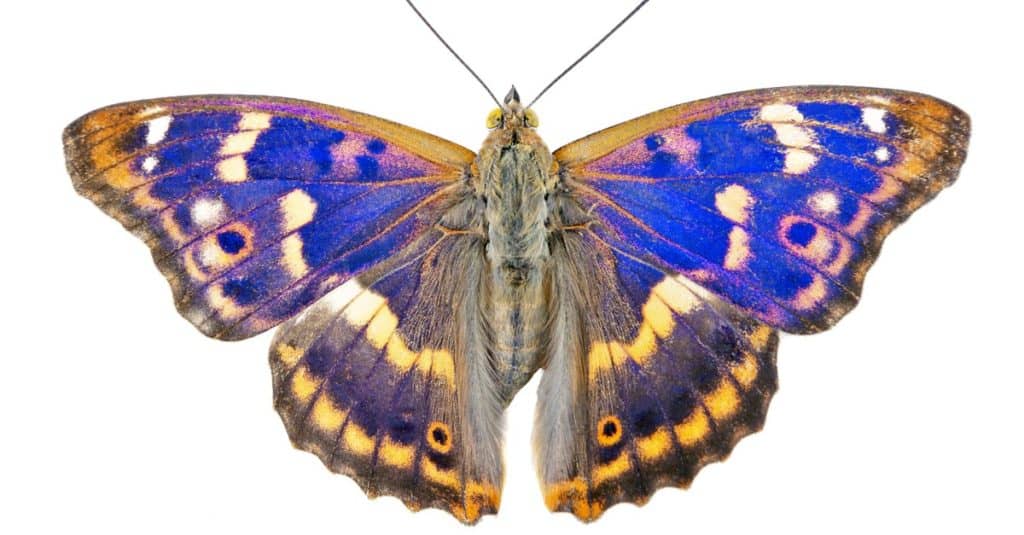
Purple emperor butterfly (Apatura iris) isolated on a white background

Habitat loss is threatening the survival of the purple emperor butterfly.

As butterfly enthusiasts, it is crucial to understand the population and conservation status of the purple emperor butterfly. The purple emperor butterfly is a rare and elusive species that inhabits deciduous woodlands across Europe, including the UK. Despite their beauty and unique behavior patterns, little is known about their current numbers or distribution.

The conservation status of the purple emperor butterfly remains uncertain due to insufficient data on its populations. However, several organizations have been actively monitoring these butterflies in recent years to gain more information about their population trends and assess potential threats.

One significant threat to this species survival is habitat loss caused by deforestation and land development for agriculture or urbanization purposes. Other factors include climate change, pesticide use, invasive species introduction, and overcollection for commercial purposes.

View all 247 animals that start with P

Sources

  1. Next Door Zoo / Accessed March 22, 2021
  2. Wikipedia / Accessed March 22, 2021
  3. Discover Wildlife / Accessed March 22, 2021
  4. Butterfly Conservation / Accessed March 22, 2021
  5. Game and Wildlife Conservation Trust / Accessed March 22, 2021
Heather Hall

About the Author

Heather Hall

Heather Hall is a writer at A-Z Animals, where her primary focus is on plants and animals. Heather has been writing and editing since 2012 and holds a Bachelor of Science in Horticulture. As a resident of the Pacific Northwest, Heather enjoys hiking, gardening, and trail running through the mountains with her dogs.

Thank you for reading! Have some feedback for us?


Purple Emperor Butterfly FAQs (Frequently Asked Questions)

Purple Emperor Butterflies are Omnivores, meaning they eat both plants and other animals.