Puss Moth
Cerura vinula
 Verified by: AZ Animals Staff
Caterpillars squirt formic acid!
Advertisement
Puss Moth Scientific Classification
- Kingdom
- Animalia
- Phylum
- Arthropoda
- Class
- Insecta
- Order
- Lepidoptera
- Family
- Notodontidae
- Genus
- Cerura
- Scientific Name
- Cerura vinula
Read our Complete Guide to Classification of Animals.
Puss Moth Conservation Status
Puss Moth Facts
- Average Litter Size
- 15
- Favorite Food
- Willow Leaves
- Common Name
- Puss Moth
- Number Of Species
- 1
- Location
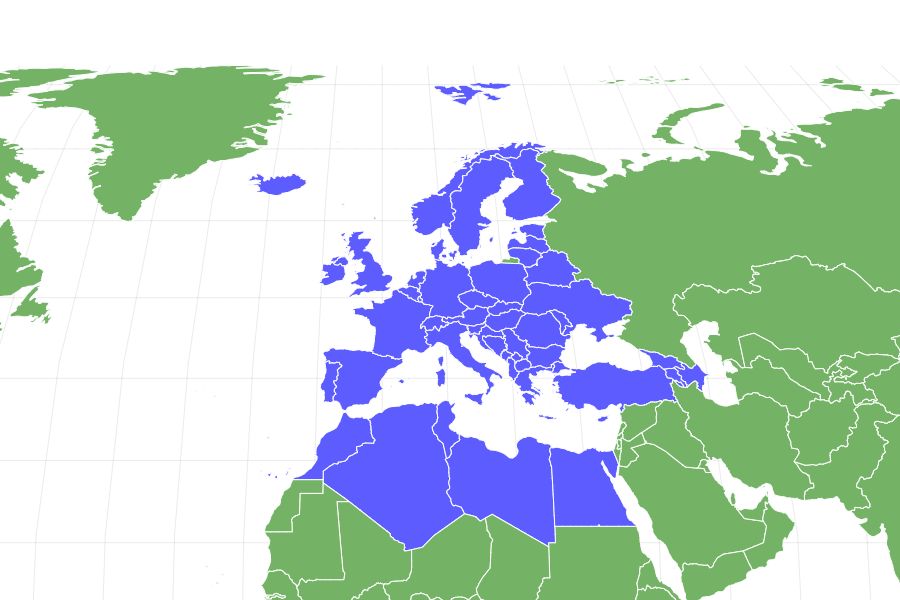
- Europe and North Africa
- Slogan
- Caterpillars squirt formic acid!

 © Sandra Standbridge/Shutterstock.com
View all of the Puss Moth images!



How to Add Us to Google News


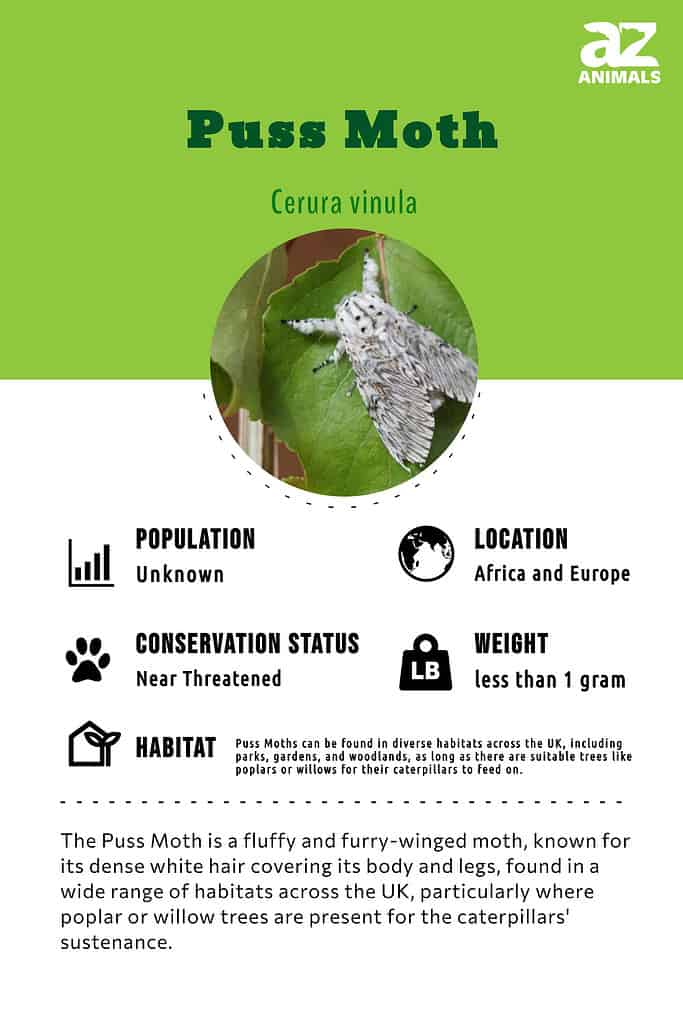
The puss moth is a large moth with a soft, striped, and fluffy coat that makes it look like a cat.
That’s where it gets its name. This strikingly beautiful moth lives in the dense woodlands, moors, and hedges of Europe, but it sometimes visits people’s gardens.
Puss moths are mostly active at night.
4 Incredible Puss Moth Facts!
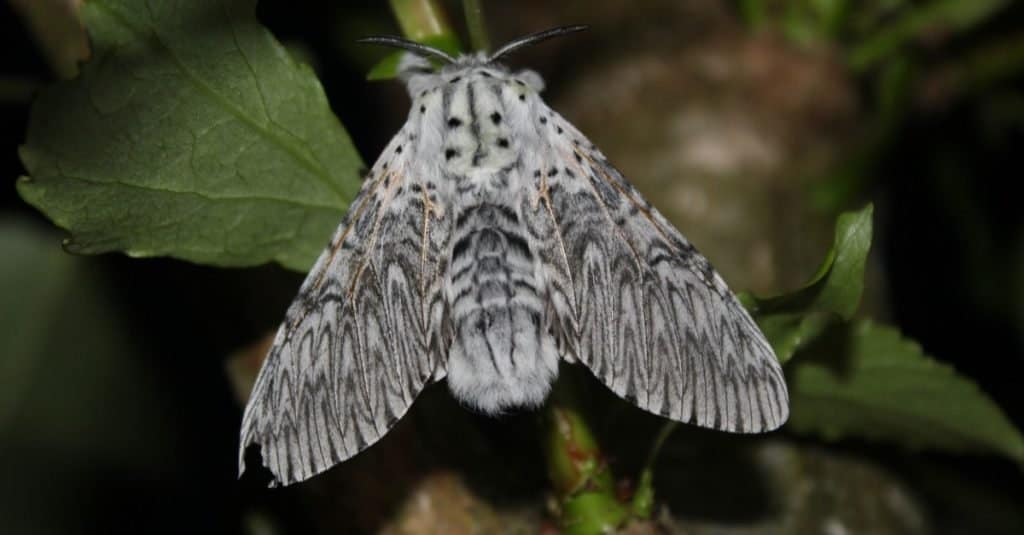
Moths utilize the moon as a navigational aid, which is why artificial lights created by humans can cause confusion for them.
©SailsKool/Shutterstock.com
- Moths use the moon to help them navigate. That’s why human lights can confuse them.
- Like every moth, the puss moth starts its life cycle as a larva and later becomes a caterpillar.
- The changes the caterpillar goes through are known as “instars.”
- Puss moth caterpillars defend themselves if they’re attacked. They use small whips attached to their wings and can also squirt formic acid, which is the same venom bees use.
Evolution and Origins
The Puss Moth, originally produced in England in 1931, was delivered to a U.S. naval attaché stationed in London during the same year.
It served in the Royal Air Force (RAF) during the Second World War and subsequently flew with different civilian operators in the United Kingdom. In 1969, RCAF Chaplain Father John MacGillivray brought it to Canada.
Puss moths earned their name due to their remarkable fluffiness, resembling that of pussycats. Their legs and body are densely covered in white hair, and even their wings have a furry appearance.
These moths can be spotted in various habitats throughout the majority of the UK, including parks and gardens, as long as there are poplar or willow trees available to sustain their caterpillars’ feeding.
Species, Type, and Scientific Names
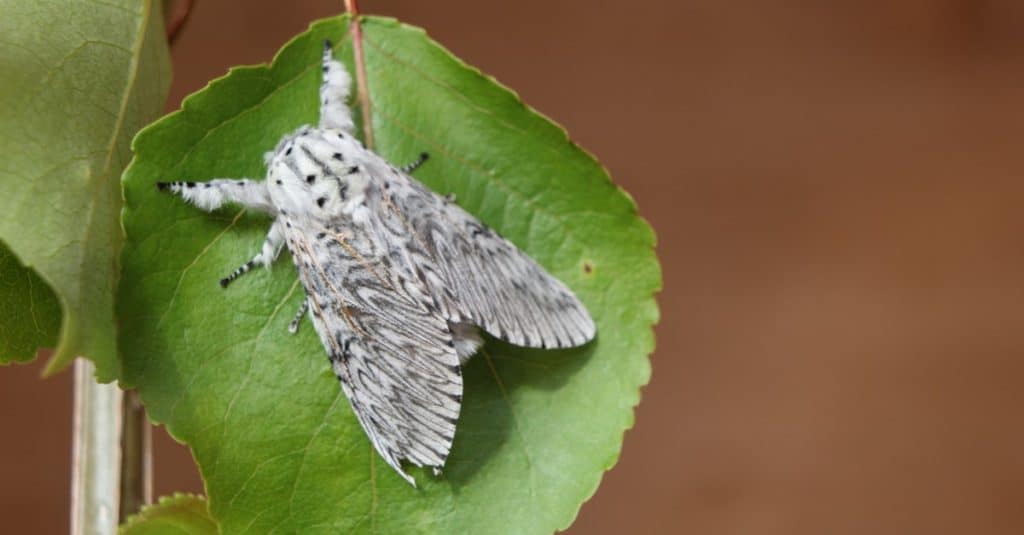
Puss moths are members of the Lepidoptera order, specifically the Notodontidae family within that order.
©SailsKool/Shutterstock.com
Puss moths belong to the insect family Notodonditae of the order Lepidoptera. Moths and butterflies both belong to Lepidoptera. The name Lepidoptera means “scale-winged.” It refers to the tiny scales that cover the wings of both insects.
Although moths and butterflies look similar, there are some key differences. Moths have thick, fuzzy bodies and are active at night. Butterflies have slender bodies and are active in the daytime. Moths usually have pale, earthy colors, while butterflies are more vibrant.
They also have different antennae. Moth antennae are feathery, while butterfly antennae have small knobs on their tips.
There are an estimated 160,000 species of moth.
There are six moth families that contain most of the moth species. They are:
- Arctiidae.
- Geometridae.
- Noctuidae.
- Saturniidae.
- Notodontidae.
- Sphingidae.
Scientists consider moths and caterpillars the harbingers of environmental health. Moth larva is a primary food source for many animals, including lizards, birds, frogs, hedgehogs, shrews, and other insects. Adult moths are a major food source for bats.
For these reasons, declining moth populations are a cause for alarm about the environment. In the past 10 years, moths and butterflies have declined because of habitat loss and pesticide use.
Appearance: How To Identify
The puss moth is a solitary species, with the female predominantly occupying trees where she lays eggs and nourishes herself by consuming leaves.
©SailsKool/Shutterstock.com
The puss moth is solitary. The female puss moth spends most of her time in trees. That’s where she lays eggs and feeds on leaves.
It is easy to recognize a puss moth because of its large size, furry texture, and marbled appearance. It resembles the coat of a striped cat. The puss moth is one of the largest moths, with an average wing span of 2.3 to 3 inches. The males are slightly smaller than the females.
Another striking moth that looks similar to these moths is the leopard moth (Zeuzera pyrina). The leopard moth has a white body with distinctive black spots that look like the coat of a leopard or a Dalmatian. It is smaller than the puss moth.
Do not confuse this moth with the tree asp or southern flannel moth caterpillar found in the United States. This caterpillar is sometimes mistakenly called a puss moth, but it’s an entirely different species.
The southern flannel moth caterpillar (Megalopyge opercularis) is round and covered in fluffy brown fur. This caterpillar is highly poisonous to humans. Its sting can cause severe skin rashes.
Habitat: Where To Find Them
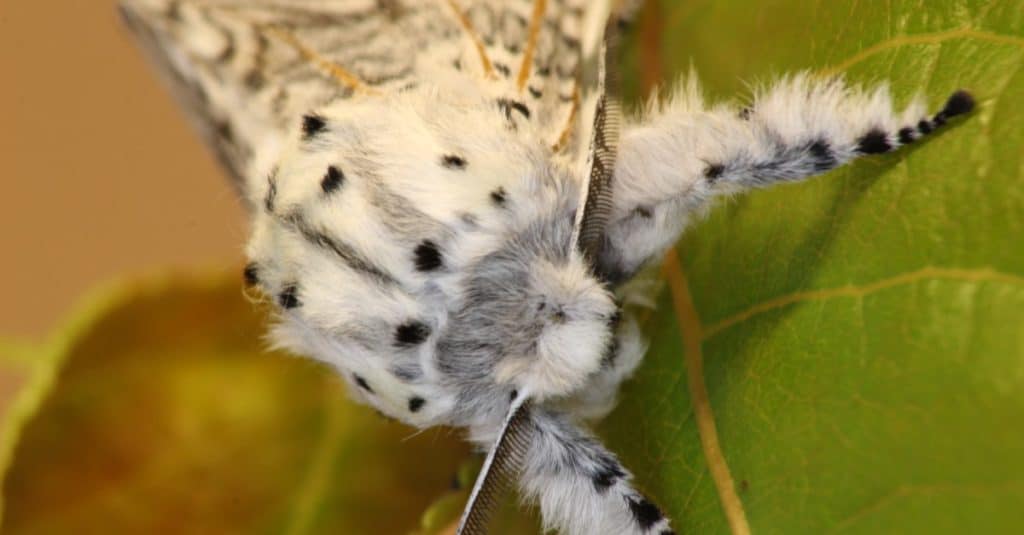
These particular moths exhibit a preference for residing in aspen, willow, or poplar trees, as those trees provide the leaves they favor.
©SailsKool/Shutterstock.com
These moths prefer to live in aspen, willow, or poplar trees because those are their preferred leaves. They are active from April to August.
These moths are common throughout Europe, Scandinavia, and Eastern Europe. They also live in parts of China and North Africa.
Diet: What Do Puss Moths Eat?
These moths eat the leaves of trees. They prefer poplars, aspens, and willows.
View all 192 animals that start with P How to Add Us to Google News


Puss Moth FAQs (Frequently Asked Questions)
Are Puss Moths herbivores, carnivores, or omnivores?
Puss Moths are Omnivores, meaning they eat both plants and other animals.
What Kingdom do Puss Moths belong to?
Puss Moths belong to the Kingdom Animalia.
Are puss moths nocturnal?
Yes, they are active at night.
Thank you for reading! Have some feedback for us? Contact the AZ Animals editorial team.
Sources
- Bug Life, Available here: https://www.buglife.org.uk/bugs/bug-directory/puss-moth/
- Smithsonian, Available here: https://www.si.edu/spotlight/buginfo/moths
- Southern Living, Available here: https://www.southernliving.com/garden/pests/southern-flannel-moth-caterpillar