P
Species Profile

Puss Moth

Cerura vinula

Big moth, bigger attitude
Sandra Standbridge/Shutterstock.com

Puss Moth Distribution

Click a location to explore more animals from that region

Loading map...
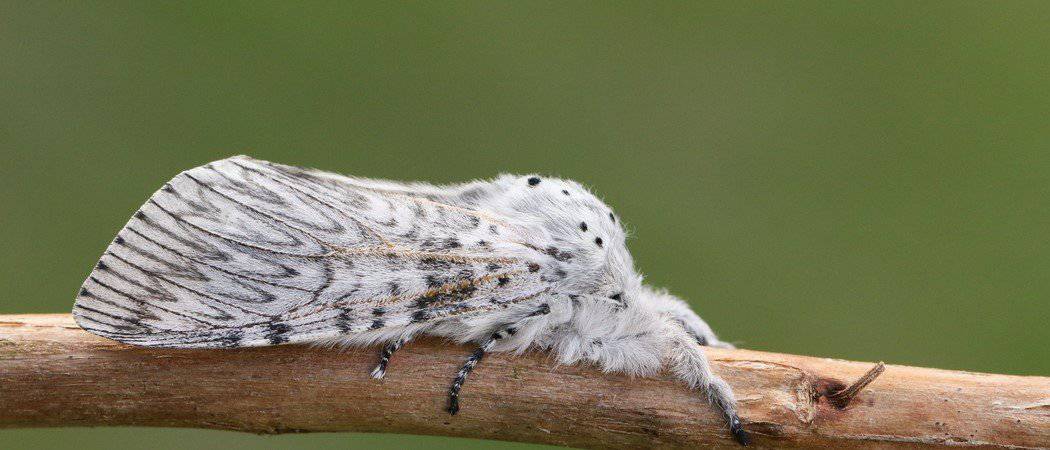
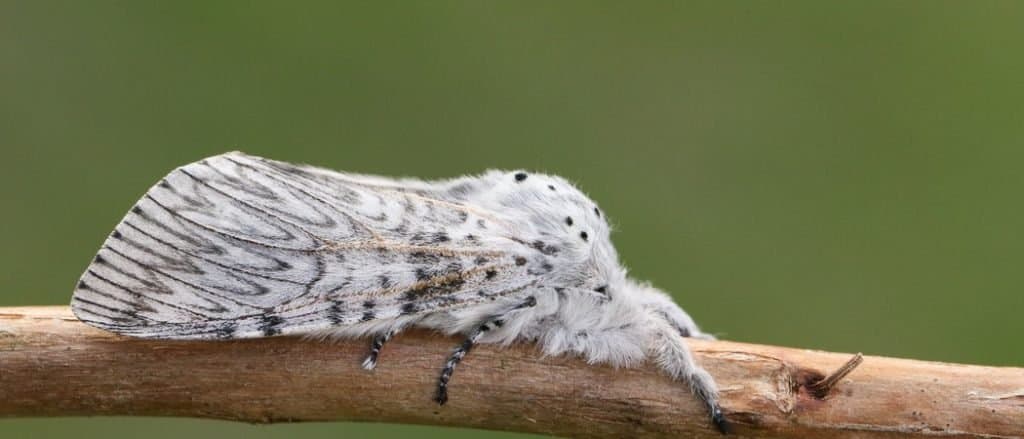
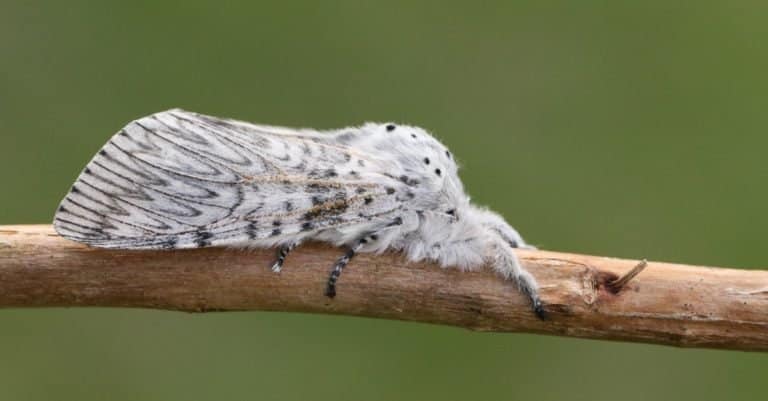
A beautiful Puss Moth, Cerura vinula, resting on a twig.

At a Glance

Wild Species
Diet Folivore
Activity Nocturnal+
Lifespan 11 years
Status Not Evaluated
Did You Know?

Adult wingspan is typically 5.8-7.5 cm, making it one of Europe's larger Notodontidae.

Scientific Classification

Cerura vinula is a distinctive notodontid moth best known for its boldly patterned black-and-white adult and its striking caterpillar, which has a forked tail and defensive displays.

Kingdom
Animalia
Phylum
Arthropoda
Class
Insecta
Order
Lepidoptera
Family
Notodontidae
Genus
Cerura
Species
vinula

Distinguishing Features

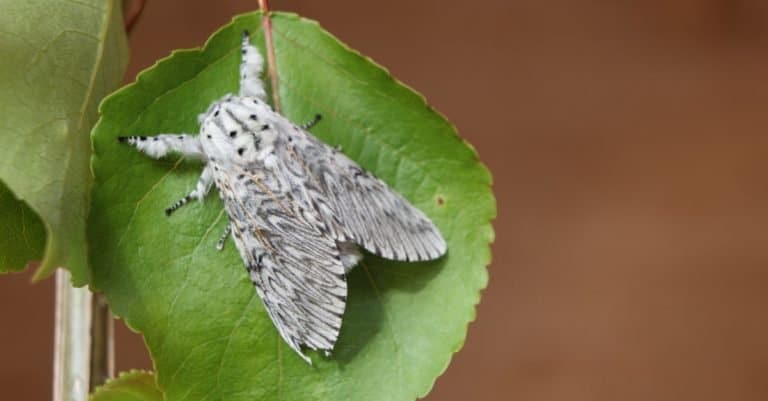
  • Adult with strong black-and-white (often zebra-like) wing patterning
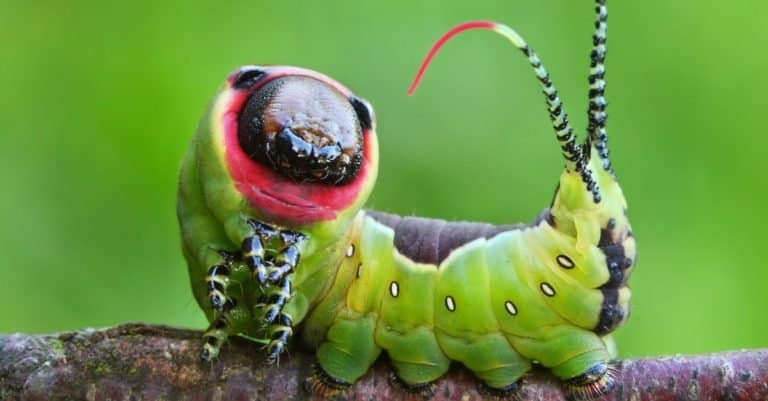
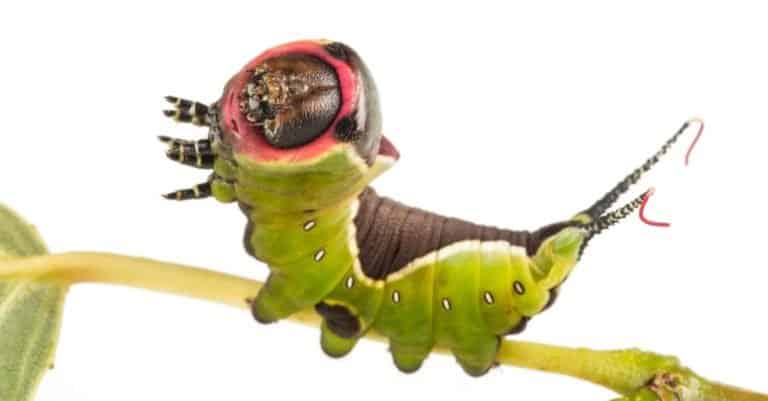
  • Larva typically green with a contrasting dorsal ‘saddle’ mark and a forked tail (caudal filaments)
  • Caterpillar defensive behavior: raises front end and can evert reddish scent organs; may produce formic acid

Did You Know?

Adult wingspan is typically 5.8-7.5 cm, making it one of Europe's larger Notodontidae.

The caterpillar can reach about 7 cm long and is famous for its forked "tail" (a paired anal horn).

When threatened, larvae rear up, show a mask-like face pattern, and extend red whip-like filaments from the tail.

Larvae defend themselves by ejecting an acidic secretion (containing formic acid) from an eversible prothoracic gland.

Caterpillars feed mainly on willows (Salix spp.) and poplars (Populus spp.), including aspen (Populus tremula).

The pupa overwinters inside an exceptionally hard cocoon cemented to bark-often remaining in diapause until the following spring.

Adults are nocturnal and readily come to light, but by day they rest tightly pressed to bark where the pattern disrupts their outline.

Unique Adaptations

  • Forked anal "tail" (paired process) with extendable filaments used in intimidation displays-an iconic ID trait of Cerura vinula larvae.
  • Eversible defensive gland capable of directing an acidic spray; the presence of formic acid is documented for this species' larval secretion.
  • Extremely hard, woody cocoon that resists weather and predators and enables overwintering diapause as a pupa.
  • High-contrast adult wing pattern (white/grey with bold black markings) that breaks up body outline against lichened bark in daylight roosts.
  • Host specialization on Salicaceae (willows and poplars), common in riparian and wet woodland habitats across the Palearctic.

Interesting Behaviors

  • Larval threat display: the caterpillar arches its front end, inflates the anterior segments, and "aims" its head region toward the attacker while the forked tail is raised.
  • Eversible tail filaments: red, whip-like threads can be protruded from the forked tail during defense displays, increasing apparent size and confusion.
  • Chemical deterrence: when handled, larvae can squirt an acidic fluid from a gland behind the head region toward predators; the secretion includes formic acid.
  • Host-plant tracking: females lay eggs on Salix/Populus; larvae typically remain on the same tree/shrub, moving between leaves and shoots as they grow.
  • Cocoon construction: mature larvae spin a cocoon reinforced with saliva and wood/bark debris, usually attached to trunks, branches, or fence posts near host plants.
  • Adult resting posture: adults align along bark or branches with wings roof-like over the body, relying on disruptive black-and-white patterning for concealment.
  • Seasonality (most of range): usually one generation per year; adults fly mainly late spring through summer, with pupae overwintering.

Cultural Significance

In Britain and northern Europe, the Puss Moth (Cerura vinula) is a classic nature-study species. Its kitten-like look and showy caterpillar defenses on willow and poplar made it a favorite in field guides and Victorian nature writing.

Myths & Legends

Name lore (British/Irish dialect tradition): "puss" meaning cat/kitten was applied to the moth for its plush, furry look-an example of folk naming that ties an insect's appearance to a familiar domestic animal.

In UK nature writing, the Puss Moth (Cerura vinula) caterpillar is known as the 'spitting' or 'squirting' willow caterpillar—stories by walkers and collectors say it spits out an acidic fluid.

European collectors in the 19th and early 20th centuries sometimes kept Puss Moth (Cerura vinula) cocoons still fixed to bark as odd objects. They looked wooden and very tough, making the moth seem well armored.

Conservation Status

NE Not Evaluated (IUCN Red List)

Has not yet been evaluated against the criteria.

Population Unknown

Life Cycle

Birth 250 larvas
Lifespan 11 years

Lifespan

In the Wild
9–24 years
In Captivity
10–24 years

Reproduction

Mating System Promiscuity
Social Structure Solitary
Breeding Pattern Transient
Fertilization Internal Fertilization
Birth Type Internal_fertilization

Adults are solitary and mate via brief pheromone-mediated encounters: females call with sex pheromones and males locate them for copulation (internal fertilization). No pair bond forms; males and females can mate with multiple partners across the short adult stage.

Behavior & Ecology

Social Solitary Group: 1
Activity Nocturnal, Crepuscular
Diet Folivore Aspen (Populus tremula) leaves (commonly recorded primary larval host)
Seasonal Hibernates

Temperament

Predominantly solitary and non-territorial; local emergence timing varies with latitude and season.
Adults are generally inactive by day, resting motionless on bark/vegetation (Waring & Townsend, 2017).
Adults fly at night and are readily attracted to artificial light (Skinner, 2009).
Larvae show strong antipredator temperament: sudden threat displays, aggressive-looking postures, and chemical deterrence (Carter, 1984).
Typically univoltine in much of its range; most activity concentrated in late spring-summer (Waring & Townsend, 2017).

Communication

Long-range mate-finding via female sex pheromones detected by male antennae General Lepidoptera mechanism; species-specific blend reported in pheromone literature
Close-range courtship uses contact chemoreception (antennae/legs) and tactile alignment during copulation.
Larval visual signaling: high-contrast patterning and conspicuous defensive display Raising anterior body, presenting forked tail
Larval chemical defense: eversible tail filaments release deterrent secretions; formic-acid-containing defenses reported in classic larval-defense accounts Carter, 1984

Habitat

Biomes:
Temperate Forest Boreal Forest (Taiga) Wetland
Terrain:
Plains Valley Riverine Hilly Coastal
Elevation: Up to 5249 ft 4 in

Ecological Role

Specialist-to-moderate specialist riparian woodland defoliator (larval herbivore) and prey item in temperate forest food webs.

Transfers primary production (tree foliage) into animal biomass (supports birds, bats, and invertebrate predators). Provides hosts for parasitoids (e.g., parasitoid wasps/flies) and thus supports higher-trophic biodiversity. Returns nutrients to soil via frass and decomposing cocoons/pupal cases, contributing to local nutrient cycling.

Diet Details

Other Foods:
Poplar leaves Willow leaves

Human Interaction

Domestication Status

Wild

Cerura vinula (Puss Moth) has no domestication history. People watch it, trap it with lights, record it in citizen science, or rear it for study or teaching. Adults 4.5–6.0 cm wingspan; larvae ~7 cm with forked tail, red filaments and acidic (formic) secretions. One generation yearly; adults May–July; pupae overwinter in cocoons on bark. Notodontidae: monitoring, occasional defoliation, education.

Danger Level

Low
  • Larval defensive secretion can be irritating if it contacts eyes or mucous membranes (reported formic-acid-containing spray in species accounts such as UKMoths).
  • Handling stress can trigger defensive 'startle' display (tail-fork raised, eversible filaments extended); not a bite/sting risk but can surprise handlers.
  • General allergy risk from scales/dust is possible for sensitive individuals when handling adult moths (nonspecific, low probability).

As a Pet

Not Suitable as Pet

Legality: Puss Moth (Cerura vinula) is usually legal to keep if obtained lawfully, but rules vary. Collecting wild eggs or caterpillars may be banned on protected sites; moving across borders can be regulated. Rear from legal stock and release only where native.

Care Level: Experienced

Purchase Cost: Up to $25
Lifetime Cost: $25 - $200

Economic Value

Uses:
Education and outreach (school/nature center rearing demonstrations) Scientific research (development, defensive chemistry/behavior, phenology) Biodiversity monitoring (light-trap and citizen science recording) Minor/occasional forestry interest (larval feeding on Salix/Populus)
Products:
  • No commercial products; value is primarily non-consumptive (education, research, biodiversity data).

Relationships

Predators 6

Great tit Parus major
Blue tit
Blue tit Cyanistes caeruleus
Common cuckoo Cuculus canorus
Common pipistrelle Pipistrellus pipistrellus
Ichneumon wasps Ichneumonidae
Tachinid flies Tachinidae

Related Species 6

White Puss Moth Cerura erminea Shared Genus
Iberian Puss Moth Cerura iberica Shared Genus
Sallow Kitten Furcula furcula Shared Family
Pebble Prominent Notodonta ziczac Shared Family
Swallow Prominent Pheosia tremula Shared Family
Buff-tip Phalera bucephala Shared Family

Ecological Equivalents 4

Animals that fill a similar ecological role in their ecosystem

Sallow Kitten Furcula furcula Cerura vinula overlaps strongly in niche. Larvae feed on Salicaceae (willows and poplars) and inhabit temperate woodland and riverine habitats. Both species are mostly univoltine, with larvae present in mid–late summer and pupae overwintering in tough cocoons on bark or litter.
Swallow Prominent Pheosia tremula Similar host-plant set (Populus and Salix) and timing/phenology: larvae are medium-to-large foliage feeders on poplar and willow and are common in the same poplar stands and riparian belts, making them ecological co-defoliators with shared predator and parasitoid communities.
Large Poplar Kitten Furcula bicuspis Very similar life history on poplars: larvae feed on Populus leaves and have overlapping seasonal development. Both use bark-associated pupation sites, exposing them to similar parasitoids and overwinter mortality factors.
Pale Tussock Calliteara pudibunda Not closely related — it is in the family Erebidae rather than Notodontidae — but ecologically similar: a broadleaf-feeding forest moth whose larvae can occur in the same mixed deciduous woodlands and share bird and bat predation pressure. Both species can be locally abundant foliage feeders.
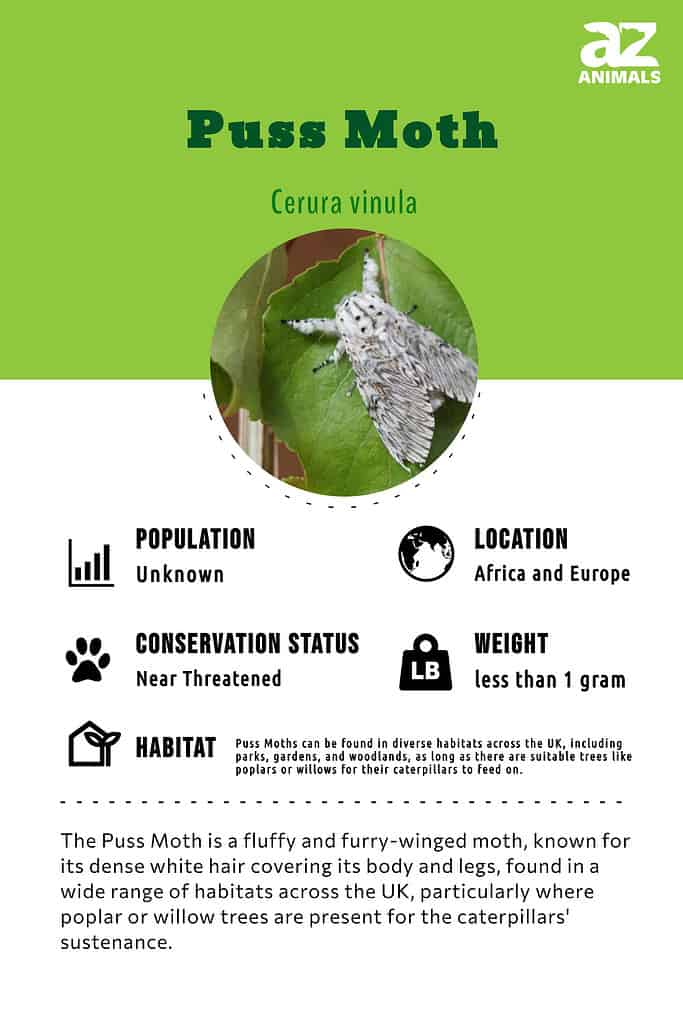
The Puss Moth is a fluffy and furry-winged moth, known for its dense white hair covering its body and legs, found in a wide range of habitats across the UK, particularly where poplar or willow trees are present for the caterpillars' sustenance.
The Puss Moth is a fluffy and furry-winged moth, known for its dense white hair covering its body and legs, found in a wide range of habitats across the UK, particularly where poplar or willow trees are present for the caterpillars’ sustenance.

The puss moth is a large moth with a soft, striped, and fluffy coat that makes it look like a cat.

That’s where it gets its name. This strikingly beautiful moth lives in the dense woodlands, moors, and hedges of Europe, but it sometimes visits people’s gardens.

Puss moths are mostly active at night.

4 Incredible Puss Moth Facts!
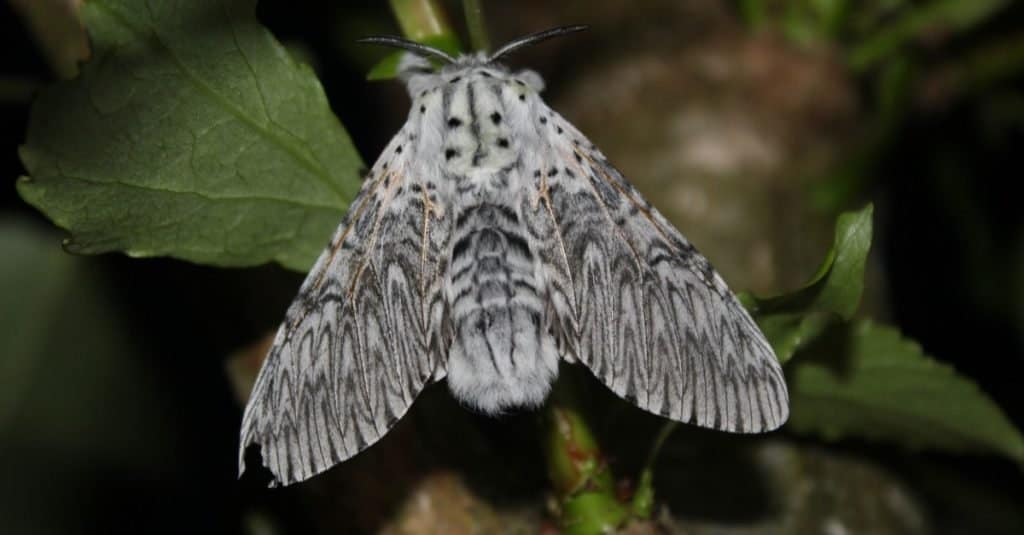
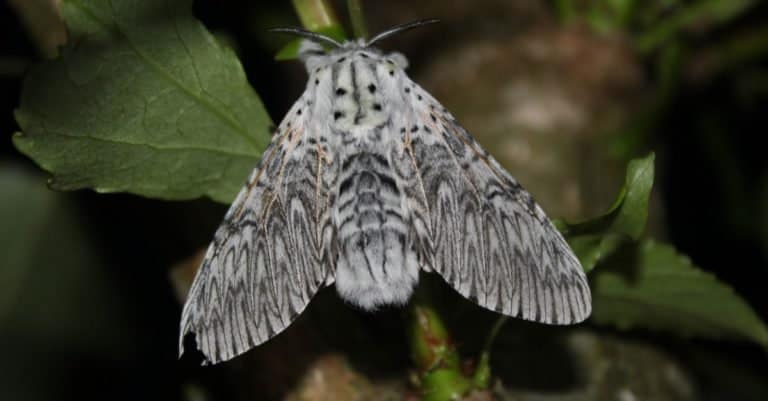
Puss moth, large white moth with dark markings, on Poplar leaf.

Moths utilize the moon as a navigational aid, which is why artificial lights created by humans can cause confusion for them.

  • Moths use the moon to help them navigate. That’s why human lights can confuse them.
  • Like every moth, the puss moth starts its life cycle as a larva and later becomes a caterpillar.
  • The changes the caterpillar goes through are known as “instars.”
  • Puss moth caterpillars defend themselves if they’re attacked. They use small whips attached to their wings and can also squirt formic acid, which is the same venom bees use.

Evolution and Origins

The Puss Moth, originally produced in England in 1931, was delivered to a U.S. naval attaché stationed in London during the same year.

It served in the Royal Air Force (RAF) during the Second World War and subsequently flew with different civilian operators in the United Kingdom. In 1969, RCAF Chaplain Father John MacGillivray brought it to Canada.

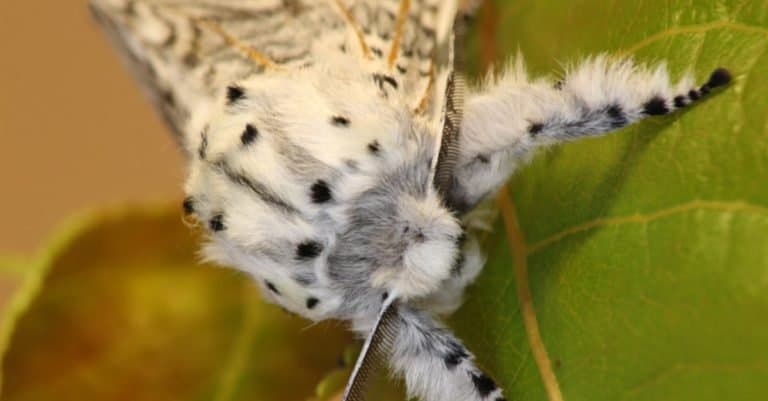
Puss moths earned their name due to their remarkable fluffiness, resembling that of pussycats. Their legs and body are densely covered in white hair, and even their wings have a furry appearance.

These moths can be spotted in various habitats throughout the majority of the UK, including parks and gardens, as long as there are poplar or willow trees available to sustain their caterpillars’ feeding.

Species, Type, and Scientific Names
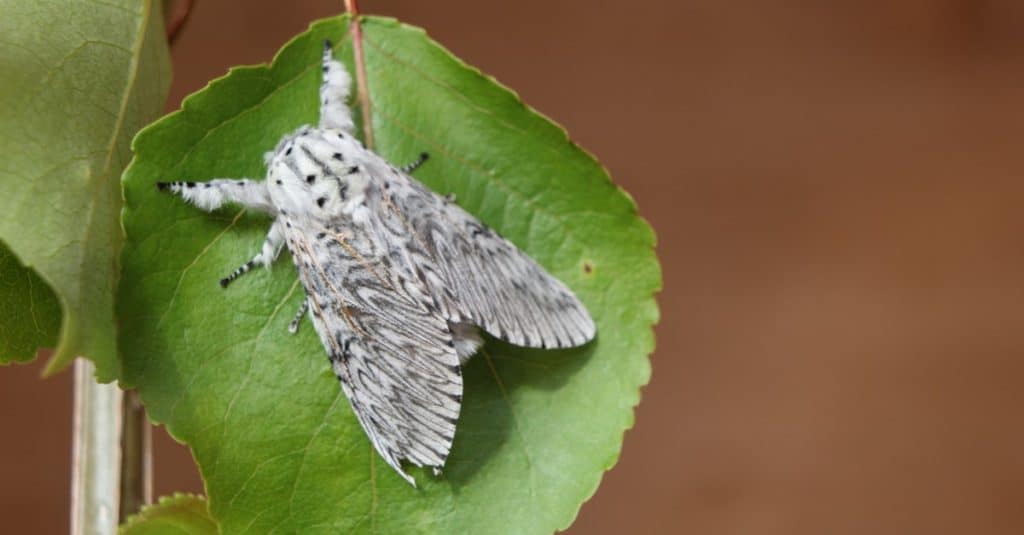
Puss moth, large white moth with dark markings, on Poplar leaf.

Puss moths are members of the Lepidoptera order, specifically the Notodontidae family within that order.

Puss moths belong to the insect family Notodonditae of the order Lepidoptera. Moths and butterflies both belong to Lepidoptera. The name Lepidoptera means “scale-winged.” It refers to the tiny scales that cover the wings of both insects.

Although moths and butterflies look similar, there are some key differences. Moths have thick, fuzzy bodies and are active at night. Butterflies have slender bodies and are active in the daytime. Moths usually have pale, earthy colors, while butterflies are more vibrant.

They also have different antennae. Moth antennae are feathery, while butterfly antennae have small knobs on their tips.

There are an estimated 160,000 species of moth.

There are six moth families that contain most of the moth species. They are:

  • Arctiidae.
  • Geometridae.
  • Noctuidae.
  • Saturniidae.
  • Notodontidae.
  • Sphingidae.

Scientists consider moths and caterpillars the harbingers of environmental health. Moth larva is a primary food source for many animals, including lizards, birds, frogs, hedgehogs, shrews, and other insects. Adult moths are a major food source for bats.

For these reasons, declining moth populations are a cause for alarm about the environment. In the past 10 years, moths and butterflies have declined because of habitat loss and pesticide use.

Appearance: How To Identify

Puss moth, large white moth with dark markings, on Poplar leaf.

The puss moth is a solitary species, with the female predominantly occupying trees where she lays eggs and nourishes herself by consuming leaves.

The puss moth is solitary. The female puss moth spends most of her time in trees. That’s where she lays eggs and feeds on leaves.

It is easy to recognize a puss moth because of its large size, furry texture, and marbled appearance. It resembles the coat of a striped cat. The puss moth is one of the largest moths, with an average wing span of 2.3 to 3 inches. The males are slightly smaller than the females.

Another striking moth that looks similar to these moths is the leopard moth (Zeuzera pyrina). The leopard moth has a white body with distinctive black spots that look like the coat of a leopard or a Dalmatian. It is smaller than the puss moth.

Do not confuse this moth with the tree asp or southern flannel moth caterpillar found in the United States. This caterpillar is sometimes mistakenly called a puss moth, but it’s an entirely different species.

The southern flannel moth caterpillar (Megalopyge opercularis) is round and covered in fluffy brown fur. This caterpillar is highly poisonous to humans. Its sting can cause severe skin rashes.

Habitat: Where To Find Them
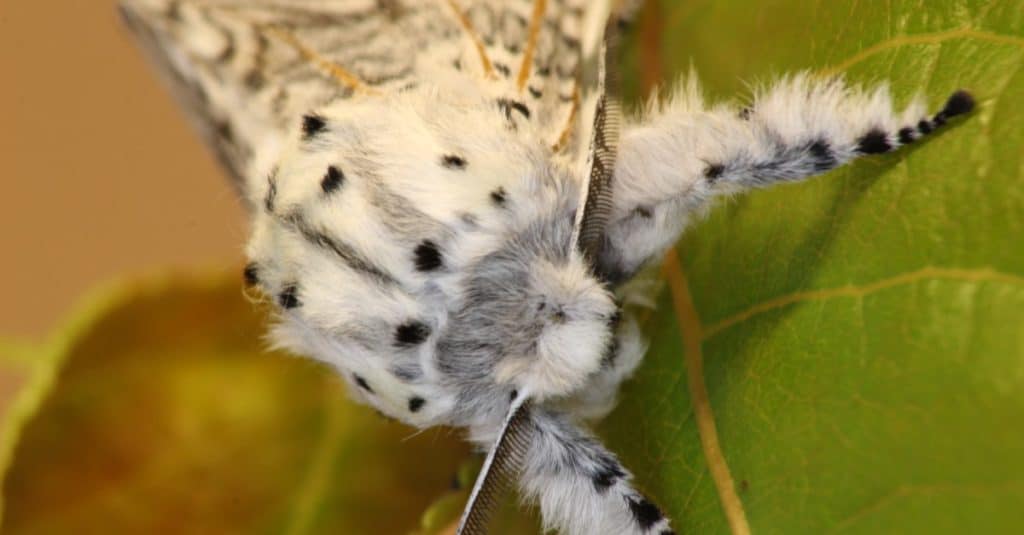
Puss moth, large white moth with dark markings, on Poplar leaf.

These particular moths exhibit a preference for residing in aspen, willow, or poplar trees, as those trees provide the leaves they favor.

These moths prefer to live in aspen, willow, or poplar trees because those are their preferred leaves. They are active from April to August.

These moths are common throughout Europe, Scandinavia, and Eastern Europe. They also live in parts of China and North Africa.

Diet: What Do Puss Moths Eat?

These moths eat the leaves of trees. They prefer poplars, aspens, and willows.

View all 247 animals that start with P

Sources

  1. Bug Life / Accessed February 15, 2021
  2. Smithsonian / Accessed February 15, 2021
  3. Southern Living / Accessed February 15, 2021
Rebecca Bales

About the Author

Rebecca Bales

Rebecca is an experienced Professional Freelancer with nearly a decade of expertise in writing SEO Content, Digital Illustrations, and Graphic Design. When not engrossed in her creative endeavors, Rebecca dedicates her time to cycling and filming her nature adventures. When not focused on her passion for creating and crafting optimized materials, she harbors a deep fascination and love for cats, jumping spiders, and pet rats.
Connect:

Thank you for reading! Have some feedback for us?


Puss Moth FAQs (Frequently Asked Questions)

Puss Moths are Omnivores, meaning they eat both plants and other animals.