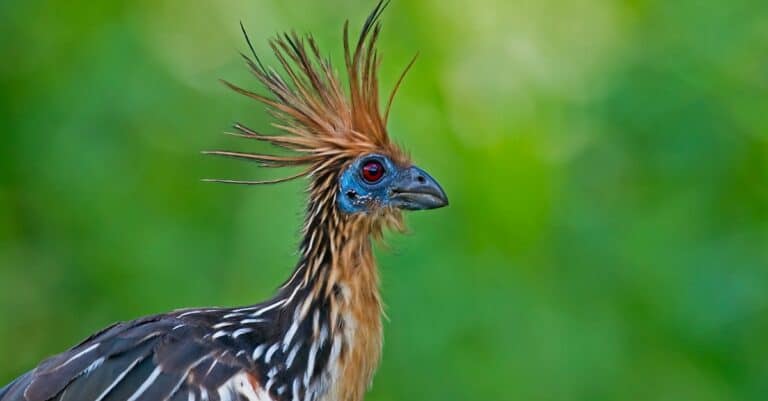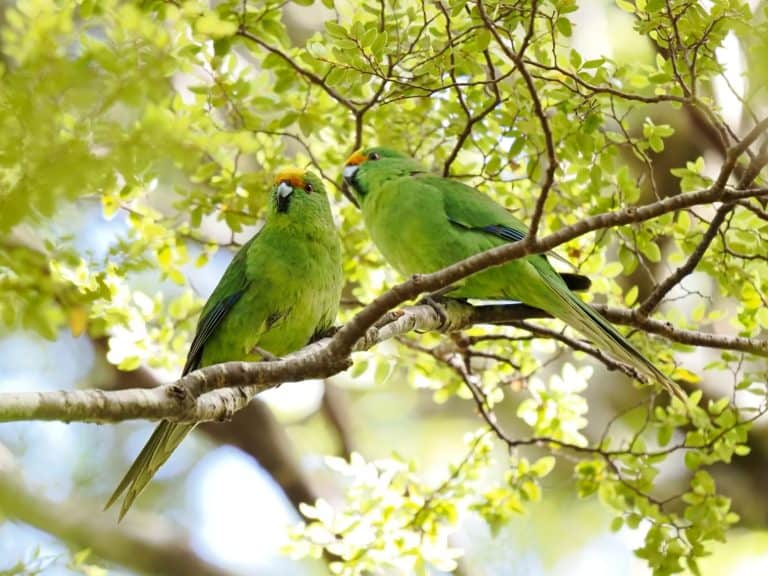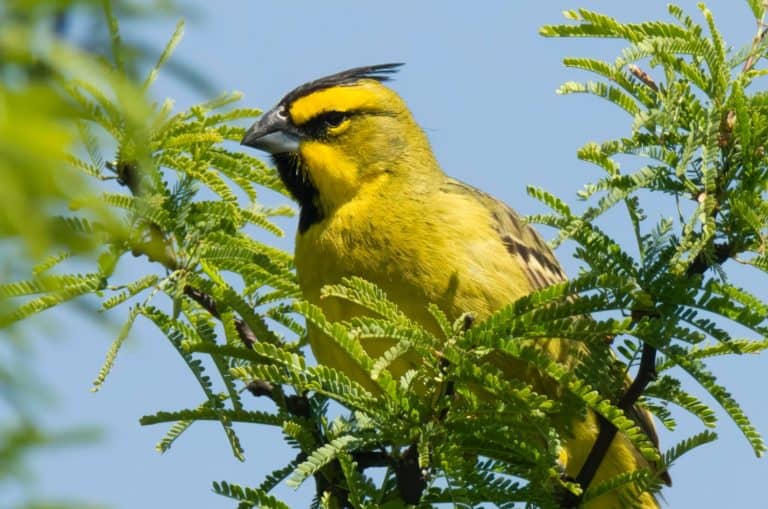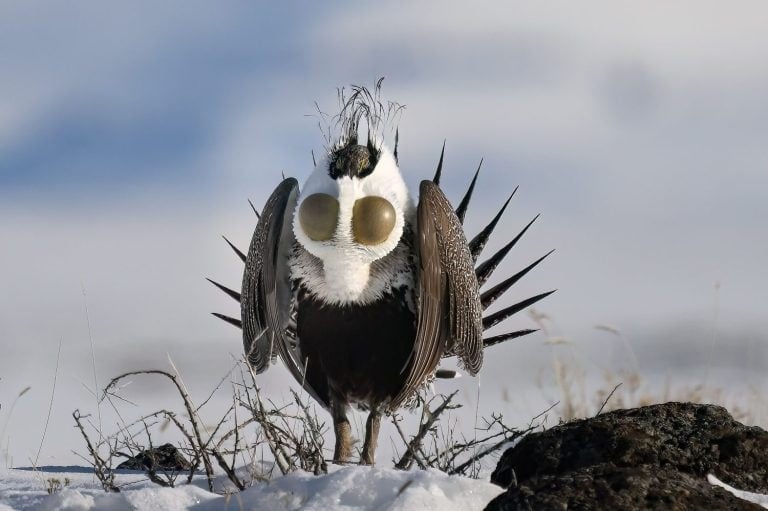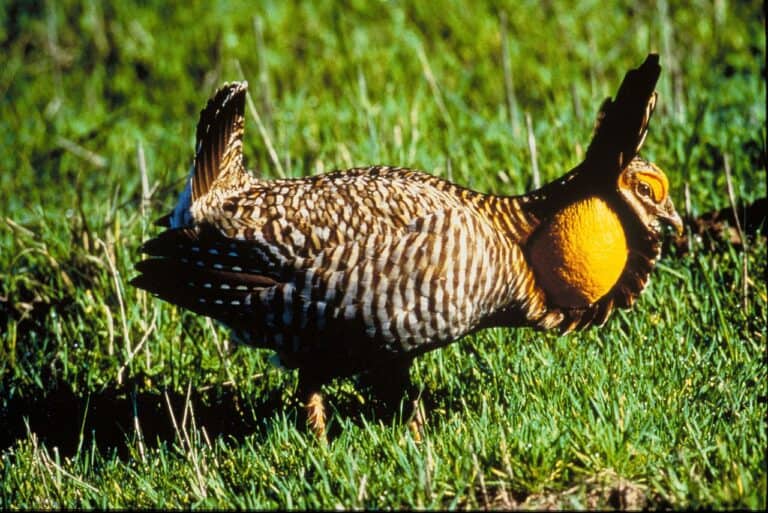
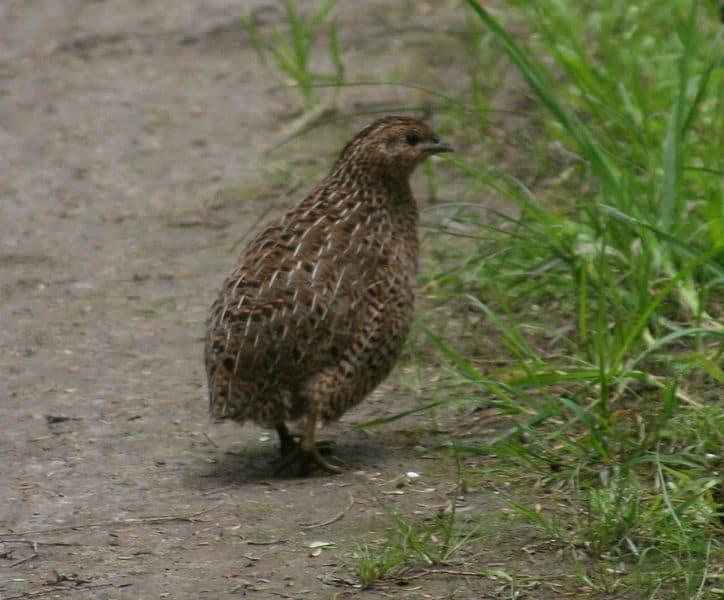
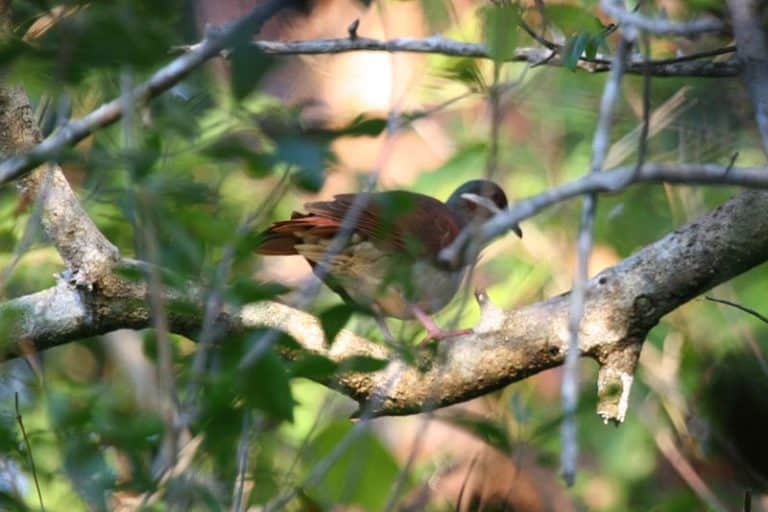
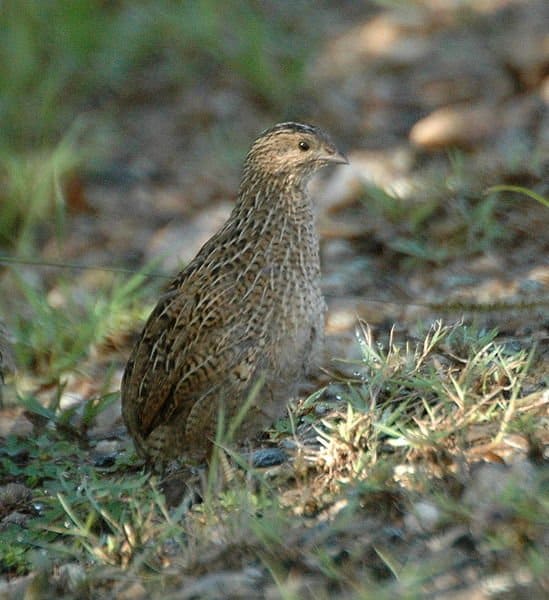
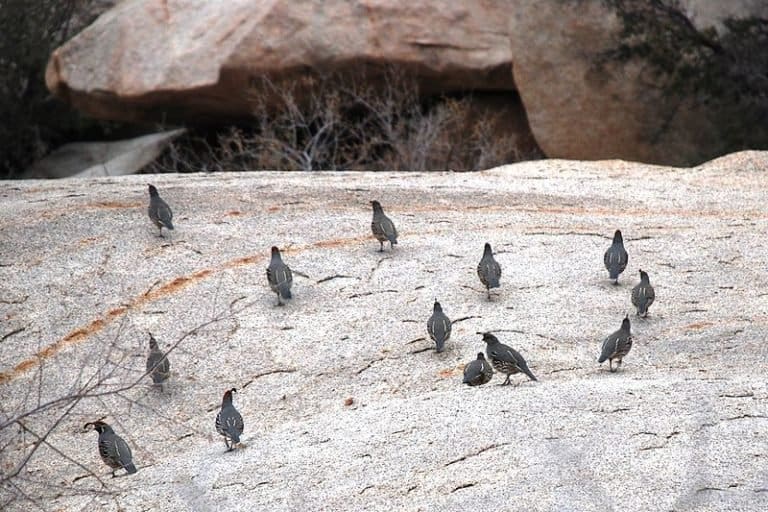

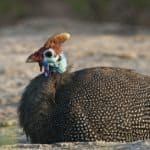
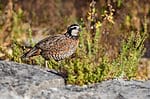
Quails are known for their plumes and distinctive calls.
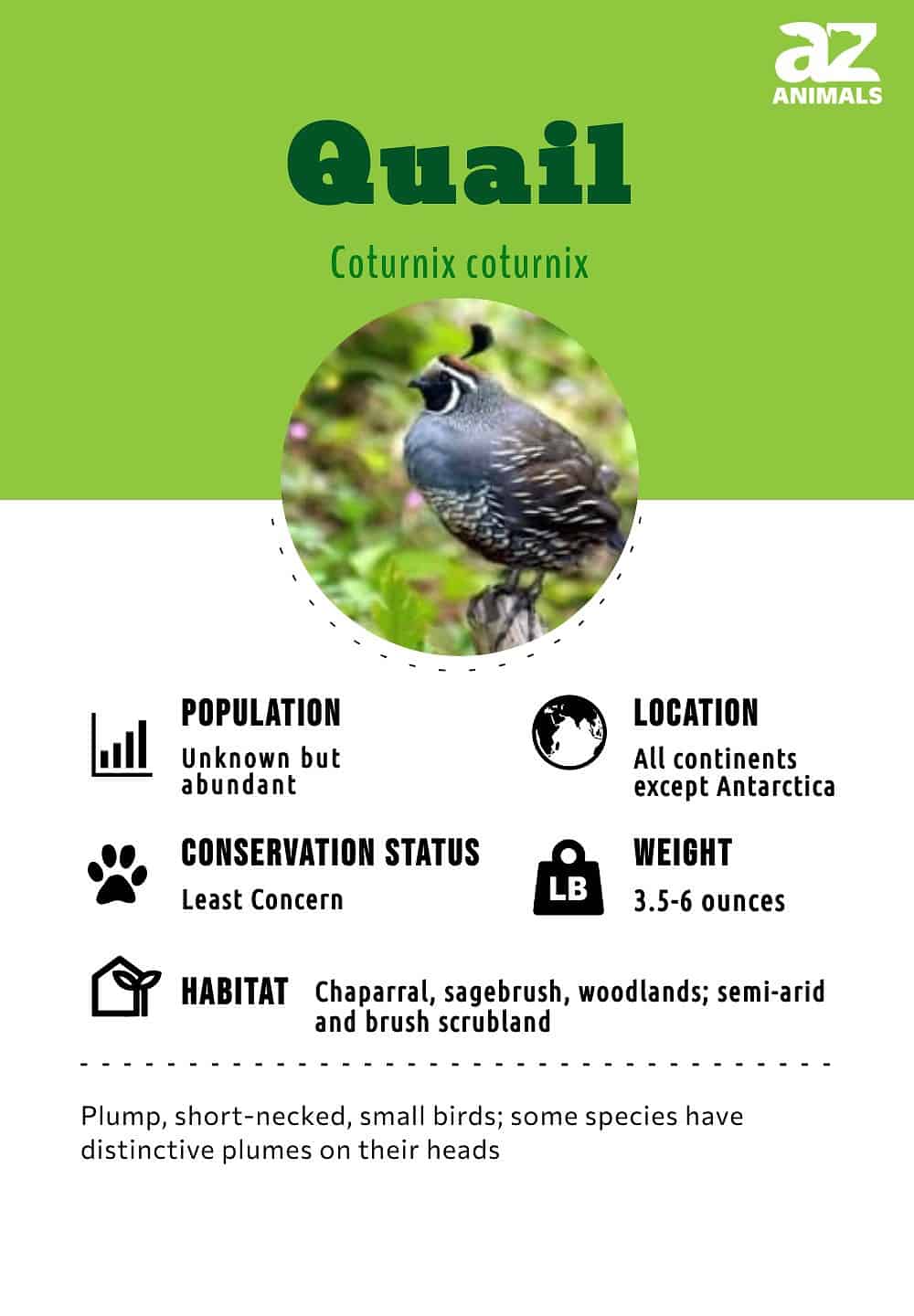
Quail are plump, short-necked game birds whose natural habitat includes large areas of North America, Europe, Asia, and northern Africa. They also inhabit South America and Australia to a lesser extent. Some species have been domesticated and raised on farms for their meat and eggs. Otherwise, wild quail are popular with hunters as a game bird.
Quail birds spend most of their time on the ground as their squat bodies often make it difficult for them to stay in flight for long distances. Birders can readily identify any species by the plumes on their heads, which are a collection of small feathers.
5 Interesting Facts:
- Quails move surprisingly fast in the underbrush and can run up to 12 mph when startled.
- The short flights that these birds take when startled are called “flushing.”
- Adult quail birds like to take dust baths by burrowing two to three inches deep into loose soil and then wriggling around, flapping their wings.
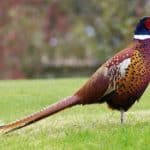
- Although they are much different in size, quail belong to the same family of game birds as pheasants.
- Quail birds are easily identified by their vocalizations, which often sound like human words such as “Chicago” or “Bob White,” which lends its name to a quail species in the southeastern United States.
Ready to learn more interesting facts about quails? Read “10 Incredible Quail Facts.”
Scientific Name and History
Common quail have the scientific name Coturnix coturnix, which means quail or a female term of endearment. Coturnix coturnix refers to Old World quails, which have five subspecies.
New World quails are members of the genus Callipepla and are sometimes referred to as crested quails. One of the most common species of New World quail is the California Quail (Callipepla californica), which has five subspecies. Bobwhites, also considered New World quail, are members of the genus Colinus, with Colinus virginianus, the Virginia Bobwhite, usually called the Northern Bobwhite, being the most widespread.
Quails share a common ancestor with chickens that goes back 22.2 million years ago. For over 4,000 years, quail have been bred domestically. They were important enough as a source of protein for laborers in ancient Egypt that they rated their own hieroglyphic symbol! Further, quail have been in China for so many centuries that the Chinese quail may be the ancestor of many modern breeds.
Appearance and Behavior
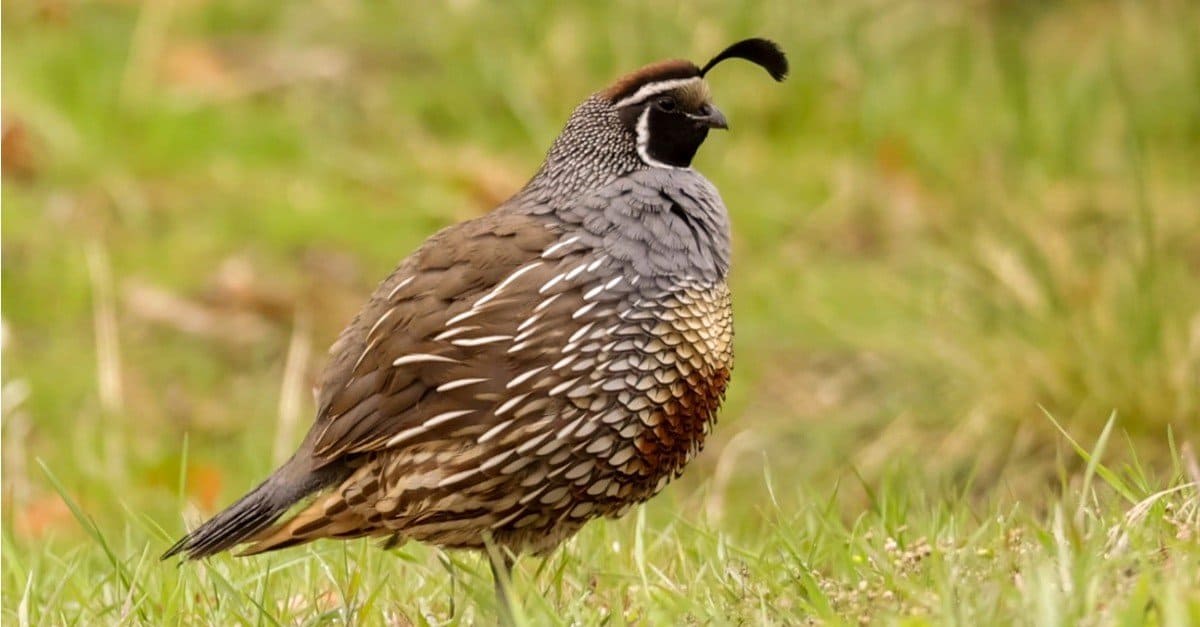
Both male and female California quails have a topknot of feathers that project forward, although the male has a bigger plume.
©iStock.com/Banu R
Quails are small birds that are generally bigger than robins but smaller than crows, although you’ll find a great difference among the species. Some are as small as four inches tall, but they can range up to 11 or 12 inches in height.
They have small heads and short, broad wings along with a long and square tail. Among the California quail, both males and females have a topknot of feathers that project forward, with males having a longer and bigger plume, which is dark and comprised of several feathers. While this topknot is a hallmark of quails, not all species have them.
The coloration and arrangement of feathers on the underbelly result in a scaly appearance. Some species also have speckling on the upper breast. Many quail have bills typical of seedeaters, meaning they are serrated, short, stout, and slightly decurved.
Japanese quail males have a clock gland on the throat, which secretes a white foamy liquid that is often used to assess reproductive fitness.
These birds can be notoriously difficult to see as they like to hide in the underbrush. You’ll often hear their distinctive calls instead of seeing them. Males vocalize in the mornings, evenings, and sometimes at night. For the most part, they are solitary birds, preferring to spend time alone or with just one other quail bird. The exception is during mating season when large flocks, known as convoys, gather in groups of about 100. The Bobwhite tends to live in coveys of 11 to 12 birds to help protect each other against predators. Some species of Old World quail migrate, but most New World species do not and live in the same general area where they were born.
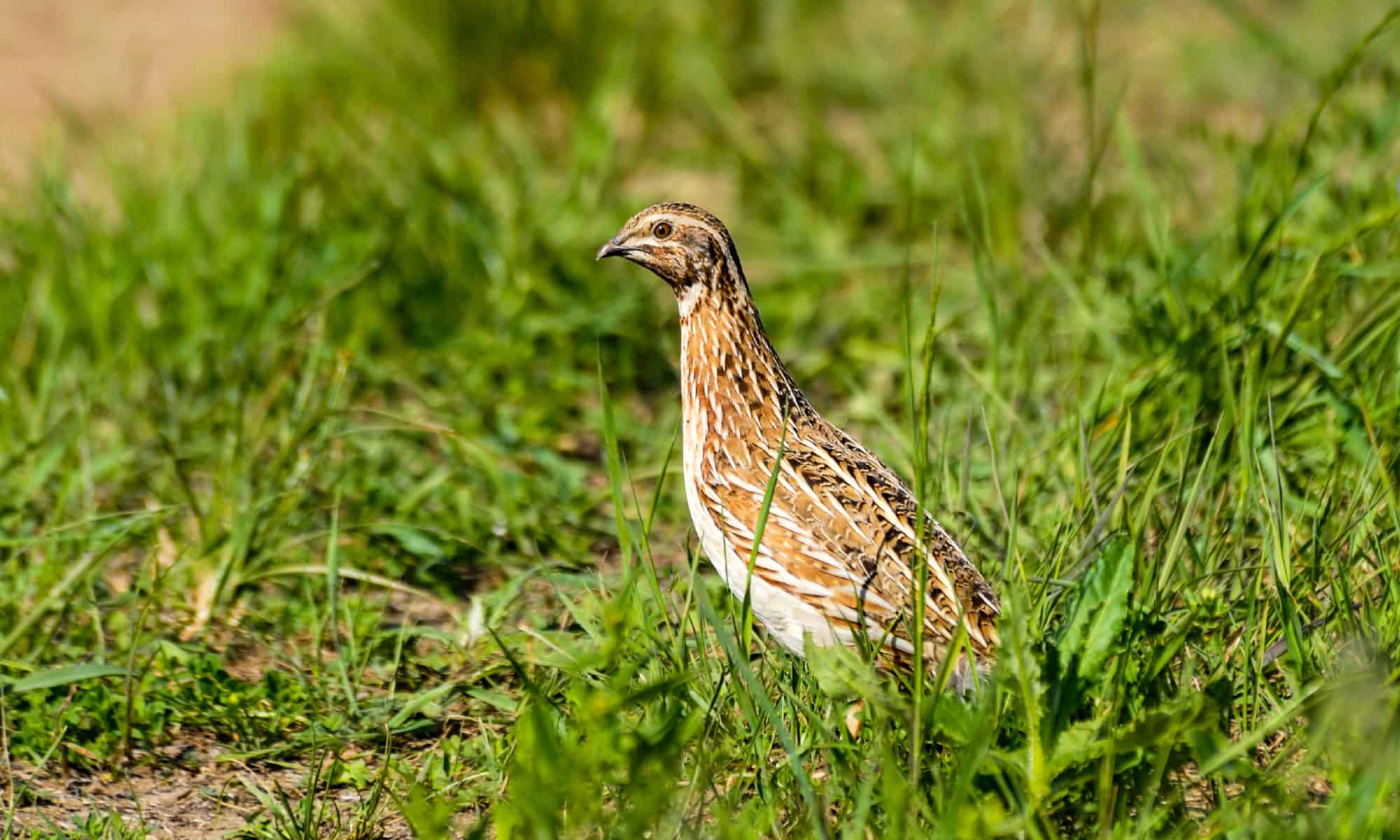
Dense vegetation provides shelter for quails from predators.
©iStock.com/VictorTyakht
They spend much of their time scratching the soil to dig up food. Quails particularly like to forage beneath shrubs or on open ground near foliage. When startled, they will suddenly take flight quickly at speeds up to 40 mph. Other species prefer to remain motionless when threatened with danger. Some species have bony heel spurs to protect them against predators. Wherever these birds live, they require cover for roosting, resting, nesting, escaping from predators, and for protection from the weather.
Some wild species, such as Gambel’s quail, like to roost in dense shrubs or trees. They love shade from various types of vegetation as dense vegetation provides shelter from predators. Females build nest sites on the ground, lining them with twigs, grass stems, leaves and feathers, and preferring to hide them under shrubs, rocks, or other protected areas. A dust bath, for some quail, helps them to get rid of pests.
In captivity, Japanese quail birds, which are the most popular species raised for their meat and eggs, are territorial, often defending their homes against intruders. They will sometimes resort to pecking or cannibalism if they have overcrowded conditions.
Habitat
In California and the Northwest, Quail habitate chaparral, sagebrush, woodlands and foothill forests. In the southwestern United States and Mexico, they tend to live in semi-arid and brush scrubland. They’re tolerant of people and can be seen in some city parks, gardens, and agricultural areas.
Quail Diet
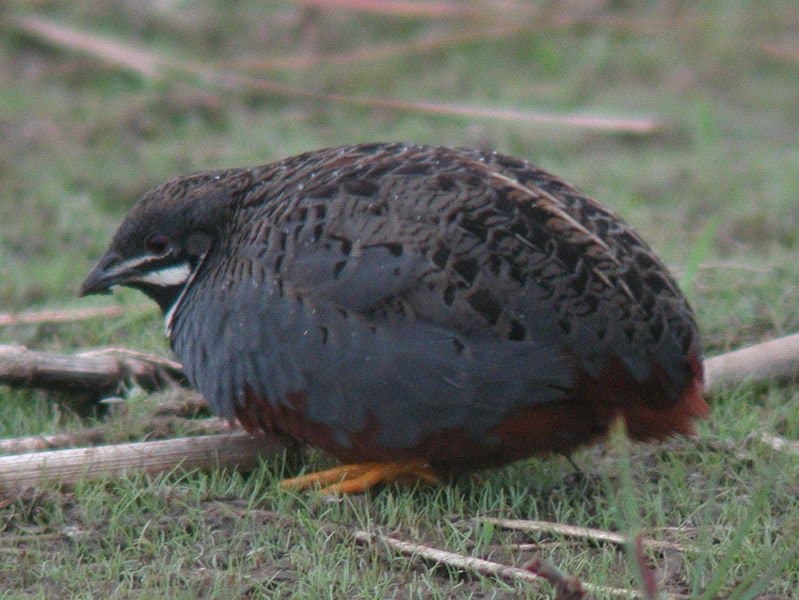
These birds are omnivorous animals, but they tend to have a primarily vegetarian diet. Chicks love to eat insects, but their diet gradually shifts to plant material as they mature. They eat seeds, leaves, wheat, barley, flowers, and fruit, along with occasional grasshoppers and worms. Some species, such as Gambel’s quail, are readily able to adapt their diet to the time of year as well as their hydration needs. When available, these quail birds will eat cacti fruits and berries.
Predators and Threats
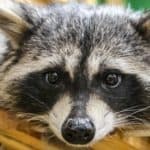
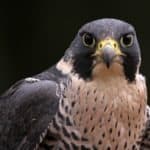
Because Quail are small, they have many different animal predators. Many small mammals like to eat them, including raccoons, foxes, squirrels, coyotes, bobcats, skunks, dogs, and cats. Hawks, owls, rats, and weasels will also hunt for quail eggs.
Humans are also considered predators, but the overwhelming number of quail and quail eggs consumed by people come from commercial farms. However, wild quail are often pursued by hunters in the southeastern United States.
Reproduction, Babies, and Lifespan
In captivity, quail birds are easy to grow. Even though common poultry diseases affect them, they are somewhat resistant. The most popularly domesticated breed, Japanese quail, mature about six weeks after hatching. With proper care, they can begin reproducing when they are 50 to 60 days old. Hens are able to lay an average of 200 eggs during their first year.
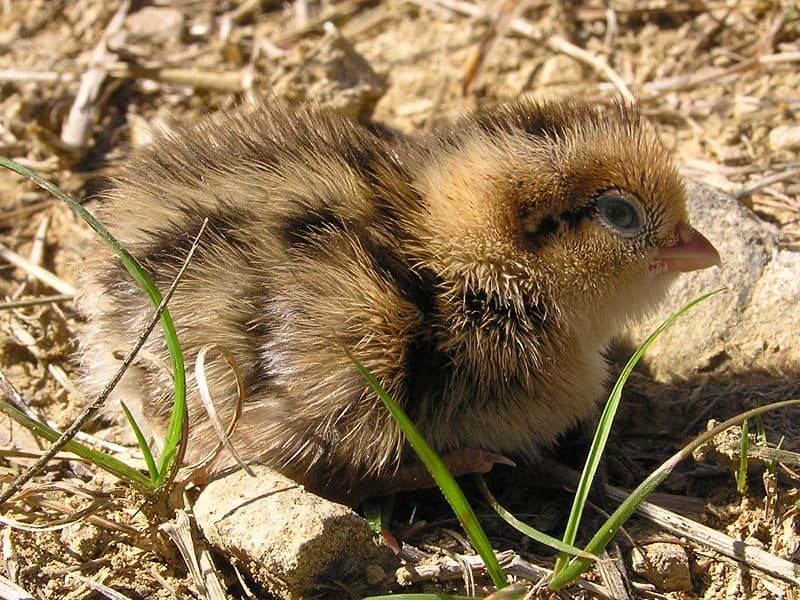
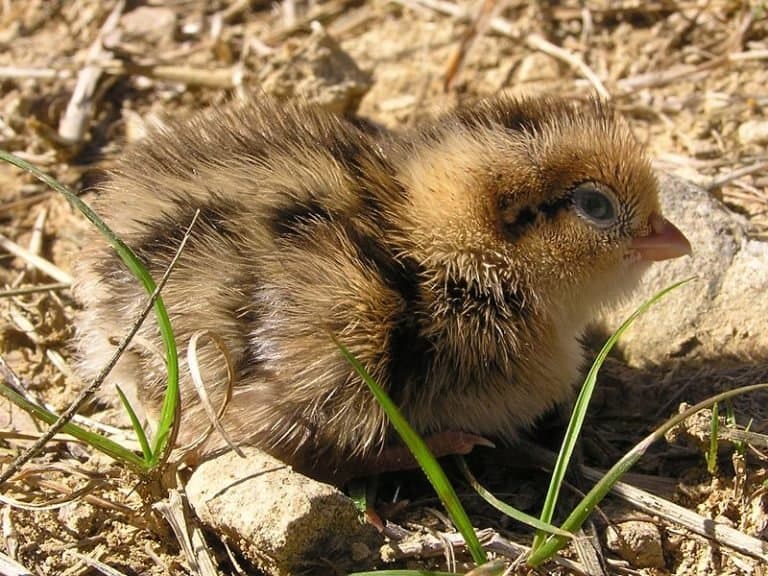
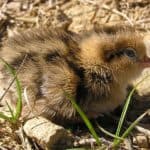
These birds have a lifespan of two-and-a-half years in captivity. Grouping a single male with three females produces high fertility. Eggs take an average of 23 days to hatch. Newly hatched quail chicks are small and have to be protected from drowning in water troughs by filling those areas with pebbles or marbles to prevent them from getting into the water. When the chicks reach one week old, the pebbles can be removed.
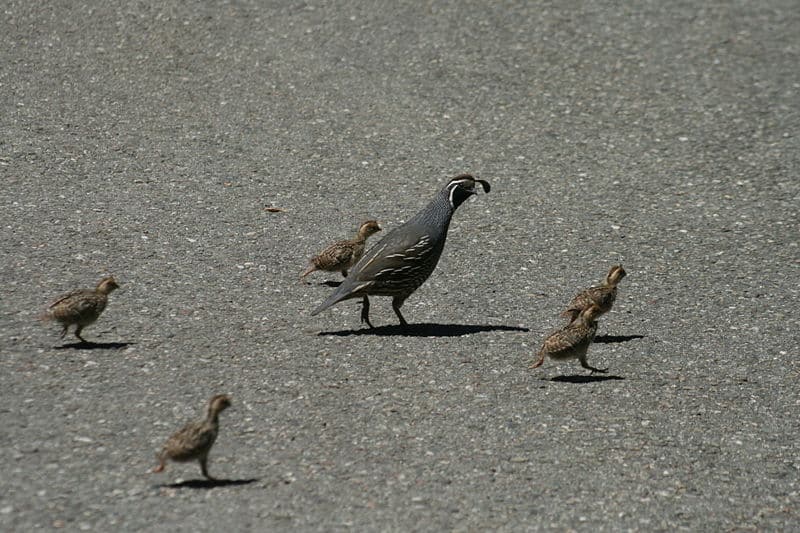
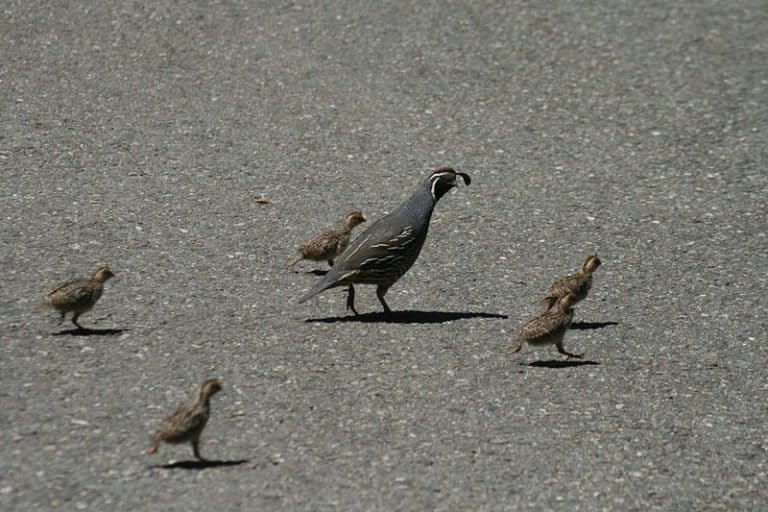
California Quail (Callipepla californica) with young. Both males and females care for the chicks.
©Brocken Inaglory / Creative Commons – Original
Some species, such as Gambel’s quail, are monogamous, but others, like the California quail, form broods that contain multiple males and females. During mating season in the spring, males claim their territories and compete for females, who build nests to lay 12 to 16 eggs after fertilization. Both males and females care for the chicks.
Chicks of most species are precocial, meaning that they are well developed at birth and able to leave the nest and follow their parents. After two weeks, they can fly and are reasonably independent at three to four weeks. The average lifespan for wild quail is two to three years, but many can live as long as five or six years.
Some species, such as the Northern Bobwhite, have only a 20 percent survival rate beyond the first year. In addition, only 32 to 44 percent of nests hatch successfully. Because of this low survival rate, Northern Bobwhite will often attempt to raise two to three broods each season. For this species, hatching starts in late April and continues to early July.
In general, about 70 to 80 percent of the wild quail population dies each year. High levels of breeding offset the mortality rate.
Population
Approximately 130 species of quail exist throughout the world, so their conservation status is considered of least concern by the International Union for the Conservation of Nature. Of those species, about 70 are domesticated.
However, in the 1990s, the California quail was deemed an endangered species as their numbers had dropped to below 100. Their numbers have rebounded, and they are no longer considered in danger of extinction.
Habitat destruction and uncontrolled hunting negatively affect a handful of wild quails. The most notable is the Southern Bobwhite, which has suffered due to urban sprawl and destruction of its favorite habitats.
Even though Gambel’s quail is a popular game bird, the numbers of this species are extensive, so there are no significant conservation or significant hunting restrictions.
Quail Pictures
View all of our Quail pictures in the gallery.

Sources
- David Burnie, Dorling Kindersley (2011) Animal, The Definitive Visual Guide To The World's Wildlife / Accessed July 6, 2009
- Tom Jackson, Lorenz Books (2007) The World Encyclopedia Of Animals / Accessed July 6, 2009
- David Burnie, Kingfisher (2011) The Kingfisher Animal Encyclopedia / Accessed July 6, 2009
- Richard Mackay, University of California Press (2009) The Atlas Of Endangered Species / Accessed July 6, 2009
- David Burnie, Dorling Kindersley (2008) Illustrated Encyclopedia Of Animals / Accessed July 6, 2009
- Dorling Kindersley (2006) Dorling Kindersley Encyclopedia Of Animals / Accessed July 6, 2009
- Christopher Perrins, Oxford University Press (2009) The Encyclopedia Of Birds / Accessed July 6, 2009