Quoll
Dasyurus Viverrinus
 Verified by: AZ Animals Staff
Found across Australia and Papua New Guinea!
Advertisement
Quoll Scientific Classification
- Kingdom
- Animalia
- Phylum
- Chordata
- Class
- Mammalia
- Order
- Dasyuromorphia
- Family
- Dasyuridae
- Genus
- Dasyurus
- Scientific Name
- Dasyurus Viverrinus
Read our Complete Guide to Classification of Animals.
Quoll Conservation Status
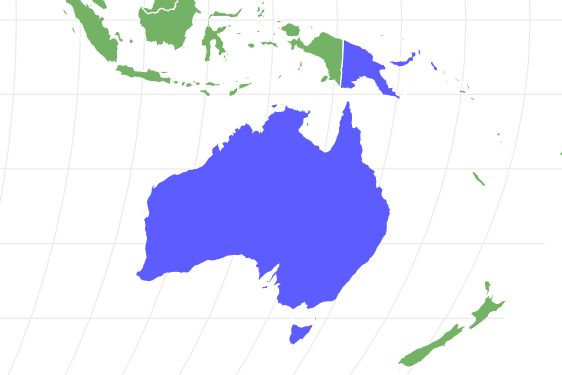
Quoll Facts
- Main Prey
- Fruit, Nuts, Small animals and reptiles
- Habitat
- Woodland and grassland
- Predators
- Human, Snakes, Crocodiles
- Diet
- Omnivore
- Average Litter Size
- 4





How to Add Us to Google News


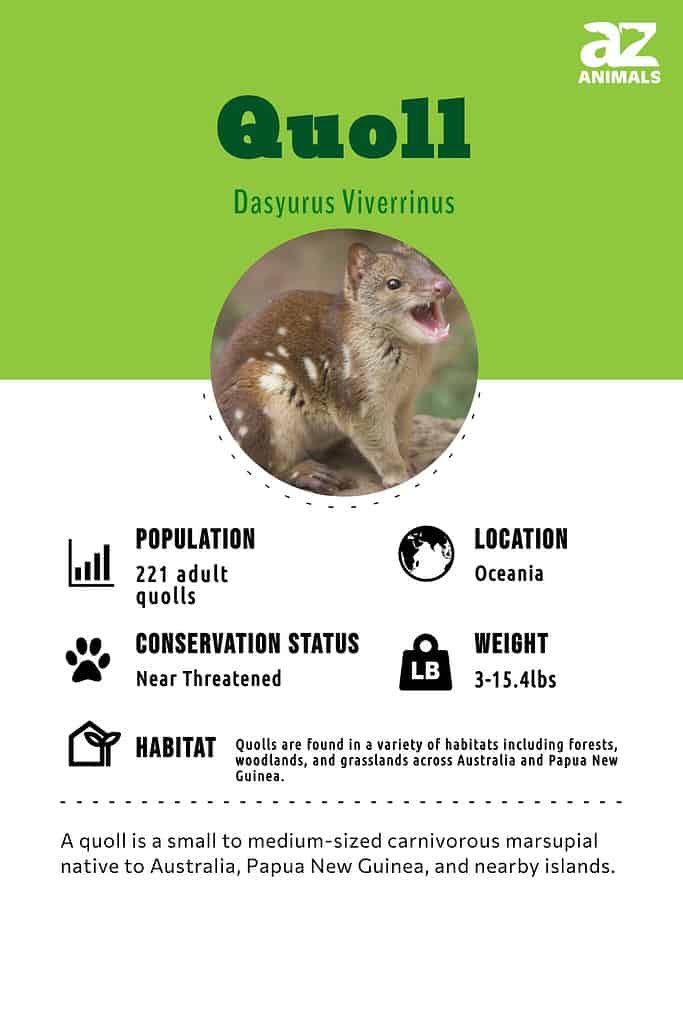
The quoll may look small and timid, but its modest size masks a fearsome disposition.
The quoll is one of the many unique marsupials found nowhere else except in Australia and New Guinea. Like many other marsupials, including the kangaroo, the evolution of the quoll was shaped by the region’s geographical isolation and diversity.
But for the past few centuries, the quoll is an animal that has been under siege in its native habitat. Fragile and at risk, these unique creatures may need the help of conservationists to survive.
Interesting Quoll Facts
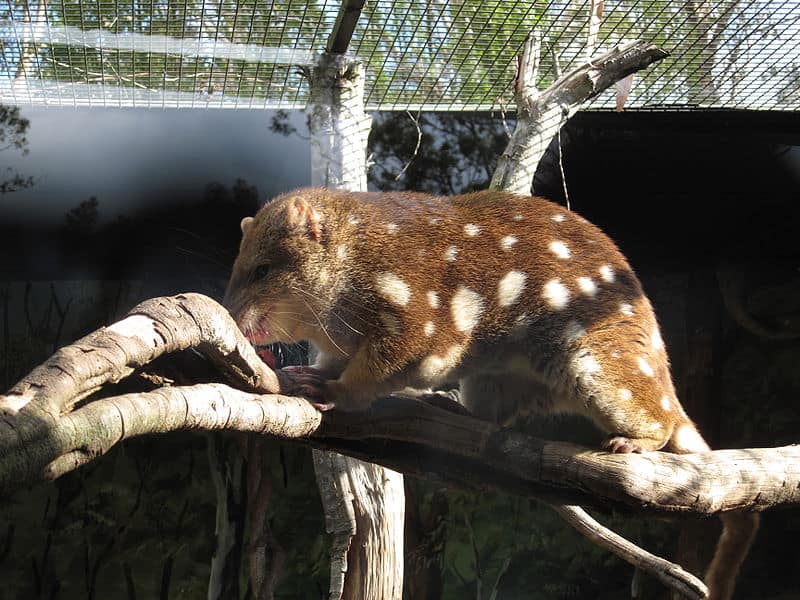
A
Tiger
Quoll in the Billabong Koala and Wildlife Park
- Captain James Cook encountered the quoll on his first voyage to the Australian coast in 1770. He apparently collected several specimens from the wild.
- Once called the “native cat” by European settlers, the term quoll gained more widespread acceptance in the 1960s. It comes from one of the Aboriginal names that Cook encountered on his first voyage.
- Quolls are nocturnal animals in nature. They perform most of their hunting and foraging at night.
Evolution and Origins
Western quolls have granular pads and five toes on their rear feet. They are well suited for nighttime existence because of their big eyes and sharp ears. Their tails feature a black brush that runs all the way down to the tip.
Eastern quolls were previously widespread throughout Australia millions of years ago. On the Australian continent, the last Eastern quoll is believed to have perished in 1963. Feral cats, foxes, dogs, roadkill, poisoning, and trapping are thought to be the key factors in their extinction on the mainland.
Furthermore, tiger Quolls have strong personalities, adorable pink noses, and white patches all over their bodies, including their tails. The Tasmanian Devil from Australia possesses the second-strongest bite of any predatory mammal in the world, pound for pound, after the Tiger Quoll.
Different Types
The quoll family includes four different species:
- The Spotted-Tailed Quoll
- Eastern Quoll
- Western Quoll
- Northern Quoll
- The spotted-tailed Quoll
- Tiger Quoll
The tiger quoll is the largest, weighing up to five kilograms, and is known for its impressive hunting skills, as it preys on a range of animals such as rabbits, birds, bandicoots, possums, and even echidnas.
Scientific Name
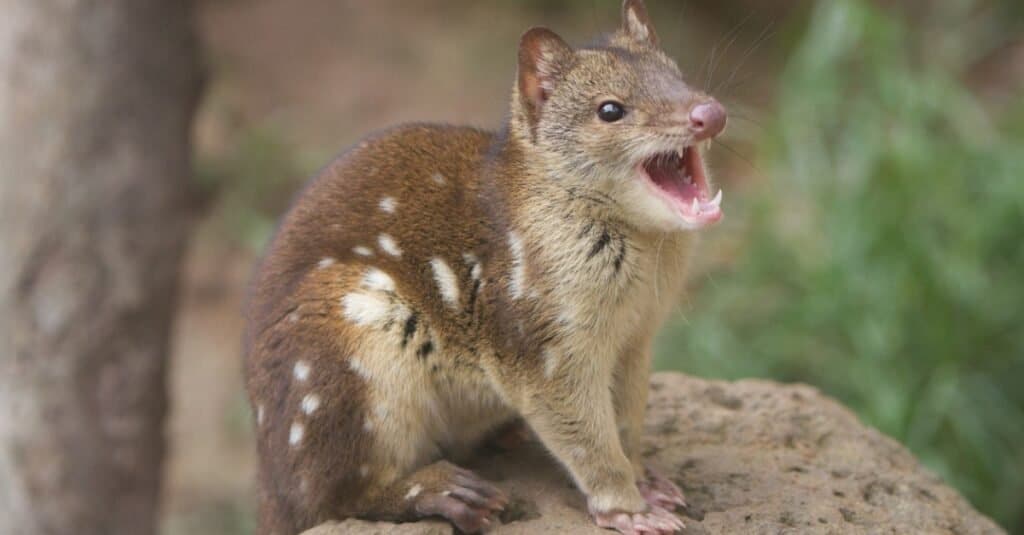
The Australian mammal, the Quoll, sitting on a rock. This species is also known as the Tiger Quoll or Spotted Quoll.
©Craig Dingle/Shutterstock.com
Dasyurus is the scientific name for the entire genus of quoll. Translated from Latin, the name means ‘hairy tail,’ reflecting the animal’s most prominent feature. The quoll is closely related to the Tasmanian devil, the dunnart, and several other small marsupials.
The genus Dasyurus includes six living species. Four of these species reside in Australia or Tasmania: the eastern quoll, the northern quoll, the western quoll, and the tiger quoll (also known as the spotted quoll or spotted-tail quoll). The remaining two species reside in New Guinea: the bronze quoll and the New Guinean quoll.
Based on genetic analysis, scientists concluded that the first quolls evolved around 15 million years ago, and the six living species can all trace their origins back to a common ancestor around four million years ago. A few extinct species have been identified from the fossil record.
Appearance and Behavior
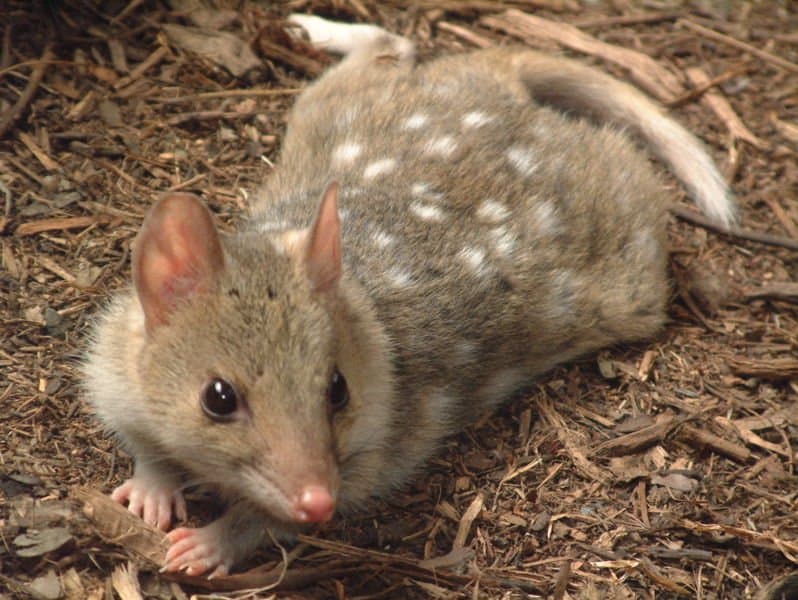
The quoll is a carnivorous marsupial. It can be distinguished by the long snout, pink nose, hairy tail, big ears, sharp teeth, long body, and a brown or black coat color with white spots. The defining feature of a marsupial is the large abdominal pouch with which it carries and protects the undeveloped offspring. However, only the tiger quoll has a true pouch. The other five species have folds in the skin that face toward the tail. These folds develop during the breeding season.
The quoll is an animal that exhibits a wide range of different sizes. The smallest species, the northern quoll, is about the size of a kitten, while the eastern quoll and western quoll are around the size of an adult cat. The impressive tiger quoll (aka spotted quoll) dwarfs all of the others. Stretching 30 inches from head to toe (plus another 15 to 20 inches with the tail fully extended), it is one of the largest carnivorous marsupial species in all of Australia. Male quolls tend to be larger than females on average, but there is otherwise little sexual dimorphism, meaning that it is difficult to distinguish the sexes from each other based on their appearance alone.
Quolls are solitary and reclusive creatures that tend to hunt, forage, and live on their own. Interactions outside of mating season are limited, but they do occur in certain areas. For example, quolls seem to have the equivalent of communal toilets. Located around rocky outcroppings, these wide-open spaces may serve as a gathering place. Females also seem to share dens with other members of their species, male or female. However, males will rarely share dens with each other.
Quolls will make almost anything into a home: rock crevices, hollowed-out trees or logs, underground burrows, and even termite mounds. They spend most of their days resting inside of the den but may sometimes come out to bask in the sunshine. Each quoll has a small core range plus a larger home range that may extend more than a mile in every direction. They will defend their territory against outside intruders, and despite their size, they can be quite aggressive. Males tend to have a bigger range than females.
Habitat
The quoll inhabits forests, woodlands, and grasslands across the Australian region. Their habitats typically receive moderate to heavy amounts of rainfall. Each species has adapted to a slightly different area.
- Eastern quoll or Dasyurus viverrinus: Once widespread across much of southeastern Australia, this species now resides almost exclusively on the island of Tasmania, where it comes into conflict with the Tasmanian devil.
- Tiger quoll or Dasyurus maculates: Also known as the spotted quoll (because the spots extend all the way to the tail), this species inhabits the dense forests of eastern Australia, including the island of Tasmania.
- Northern quoll or Dasyurus hallucatus: Evidence suggests that this species once inhabited most of northern Australia. Now it is restricted to a few discontinuous spots across the northern parts of three Australian states: Western Australia, the Northern Territory, and Queensland.
- Western quoll or Dasyurus geoffroii: This species once inhabited close to 70 percent of Australia. Now it is confined to a small corner of the state of Western Australia.
- New Guinean quoll or Dasyurus albopunctatus: This species has a large continuous distribution across the northern half of New Guinea. Habitats include grasslands, wet forests, and moss forests at various elevations.
- Bronze quoll or Dasyurus Spartacus: This species occupies a narrow range of savanna and grasslands across the southern part of New Guinea.
Diet
The quoll is an opportunistic scavenger that will consume almost anything it can find, living or dead. Their most common meals include insects, birds, mice, rats, lizards, and frogs. The largest quoll species are also known to consume medium-sized birds and mammals such as echidnas, rabbits, and possums. Although primarily a carnivore, the quoll can also consume fruits and occasional vegetable matter.
They spend most of their time foraging on the ground, but quolls can also be quite skilled at climbing. They have been known to ascend trees looking for birds to hunt. They will typically travel a few miles per night in search of food.
Predators and Threats
The quoll faces a multitude of dangerous threats in the wild. When introduced into Australia, non-native animals such as foxes and cats have had a destabilizing effect on quoll populations. They not only prey directly on the quoll but compete with the quoll for food and resources. Other sources of potential danger include pythons, dingos, eagles, and owls.
Adult quolls can bite and scratch to defend themselves, and if all else fails, they can run away and hide. The young pups are the most vulnerable to predation, as they are almost completely reliant on their mothers for protection.
The introduction of the poisonous cane toad to Australia in 1935 also had a devastating impact on the local quoll population. Originally brought to Australia from the Americas, the cane toad was considered to be effective at controlling pests, but it had the unintended effect of poisoning and killing predators instead. The toad still persists across much of northeastern Australia, threatening the quoll populations that remain. Quolls appear to have no natural resistance or immunity to the poison. Its only guaranteed defense is to avoid the toad entirely.
Quolls face yet another threat from human encroachment. When wandering into human territory, they may fall victim to dog attacks, poisonous baits, car accidents, and deliberate human persecution. Although quolls are known to prey on insects and pests that destroy crops, they have also caused damage by raiding poultry farms, which leads to retaliation from farmers. Habitat loss from logging, farming, and urbanization has constricted the natural range of the quoll as well.
In the future, quolls could be particularly vulnerable to alterations in the planet’s climate. As bushfires rage across the country with greater intensity, climate change could destroy large segments of the quoll’s natural habitat.
Reproduction, Babies, and Lifespan
The quoll breeding season begins in Australia’s autumn or winter seasons from April to July. Quoll copulation can be long and dangerous affairs full of biting and gnawing. The tiger quoll, for example, can take around eight hours to fully mate, much of it damaging to the female. The animals may have multiple partners during the mating season.
Some species can produce up to 30 offspring at a time, but only six to eight pups tend to survive because that’s the maximum number the mother can nurse at once. The remaining pups are destined to perish.
The quolls have a gestation period of approximately three weeks. Small and undeveloped, the young pups spend the first few months of their lives hidden away in their mother’s pouch, feeding on milk from the teats. As they grow, the young pups will attach to the mother’s stomach and later the back. It takes around five months to achieve full independence and around a year to become sexually mature.
The typical lifespan is two to five years, depending on the size of the species. Few individuals live beyond their first or second mating season. The maximum lifespan ever documented in captivity was approximately seven years.
Population
Quolls once covered most of mainland Australia, but the arrival of European settlers in the late 18th century began a period of decline for the animals. Now they are constricted to the fringes of Australia. Because quolls are skilled at hiding, conservationists can have a hard time counting and tracking them. However, from what we know, the quolls are in a precarious state.
Both the eastern quoll and the northern quoll are endangered. The remaining species are either vulnerable or near threatened. According to the International Union for the Conservation of Nature (IUCN)’s Red List, each species has about 10,000 to 15,000 individuals remaining.
Conservationists have successfully bred the quoll in captivity in order to save the species from destruction and provide backup populations. As long as this protected population remains, conservationists can prepare the quoll for reintroduction into its previous habitats. If something goes wrong, then they can adapt their strategy to compensate.
The eastern quoll is an interesting case study. It largely disappeared from mainland Australia in the 1960s, outside of a few sightings. The species is now protected in Tasmania, where it faces fewer threats. In 2016, conservationists began to reintroduce the species back into mainland Australia for the first time in around 50 years. The quolls showed promising signs of revival when they began to produce their first batch of offspring.
The removal of foxes and toads (as well as better awareness and stewardship by humans) has allowed the quoll to return to parts of its former range, but the challenge for animals raised in captivity or relative safety is that they may have trouble immediately identifying threats when introduced into more hostile areas. The animals have a greater chance of survival if they have learned to be wary of threats beforehand.
How to Add Us to Google News


Quoll FAQs (Frequently Asked Questions)
Are quolls Herbivores, Carnivores, or Omnivores?
Although quolls are omnivores, they have a primarily carnivorous diet. Smaller quolls tend to eat insects, reptiles, birds, and even small mammals. Larger quolls, like the spotted quoll (aka tiger quoll), are even known to eat possums and rabbits.
What does a quoll sound like?
Quolls often make growls, hisses, or screeching sounds to ward off predators or attract mates.
Are quolls related to Tasmanian devils?
Yes, quolls are related to Tasmanian devils because both are part of the Dasyuridae family – making these carnivorous marsupials cousins!
Are quolls dangerous?
Quolls will typically run to avoid contact with people. Due to their wild nature and sharp teeth, however, it is best to avoid getting too close to them if you encounter one in the wild.
What Kingdom do Quolls belong to?
Quolls belong to the Kingdom Animalia.
What phylum do Quolls belong to?
Quolls belong to the phylum Chordata.
What class do Quolls belong to?
Quolls belong to the class Mammalia.
What family do Quolls belong to?
Quolls belong to the family Dasyuridae.
What order do Quolls belong to?
Quolls belong to the order Dasyuromorphia.
What genus do Quolls belong to?
Quolls belong to the genus Dasyurus.
What type of covering do Quolls have?
Quolls are covered in Fur.
In what type of habitat do Quolls live?
Quolls live in woodlands and grasslands.
What is the main prey for Quolls?
Quolls prey on fruit, nuts, small animals, and reptiles.
What are some predators of Quolls?
Predators of Quolls include humans, snakes, and crocodiles.
What is the average litter size for a Quoll?
The average litter size for a Quoll is 4.
What is an interesting fact about Quolls?
Quolls are found across Australia and Papua New Guinea!
What is the scientific name for the Quoll?
The scientific name for the Quoll is Dasyurus Viverrinus.
What is the lifespan of a Quoll?
Quolls can live for 3 to 6 years.
How fast is a Quoll?
A Quoll can travel at speeds of up to 15 miles per hour.
Thank you for reading! Have some feedback for us? Contact the AZ Animals editorial team.
Sources
- David Burnie, Dorling Kindersley (2011) Animal, The Definitive Visual Guide To The World's Wildlife
- Tom Jackson, Lorenz Books (2007) The World Encyclopedia Of Animals
- David Burnie, Kingfisher (2011) The Kingfisher Animal Encyclopedia
- Richard Mackay, University of California Press (2009) The Atlas Of Endangered Species
- David Burnie, Dorling Kindersley (2008) Illustrated Encyclopedia Of Animals
- Dorling Kindersley (2006) Dorling Kindersley Encyclopedia Of Animals
- David W. Macdonald, Oxford University Press (2010) The Encyclopedia Of Mammals