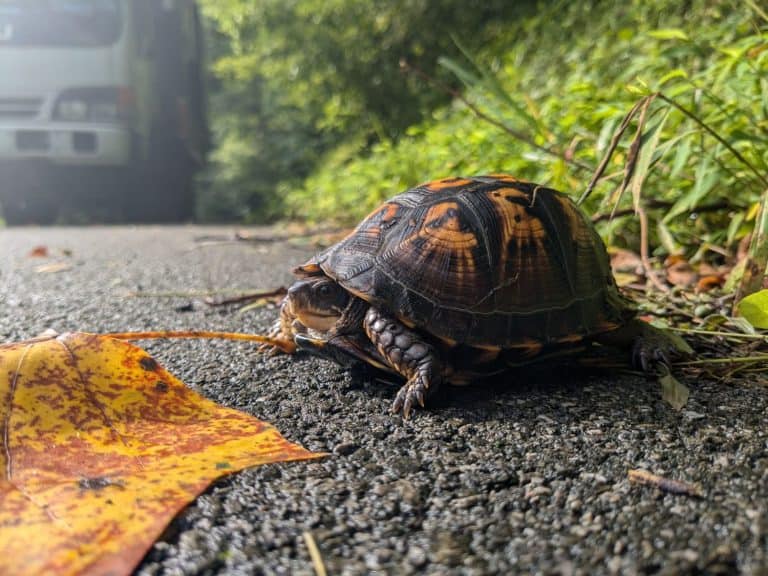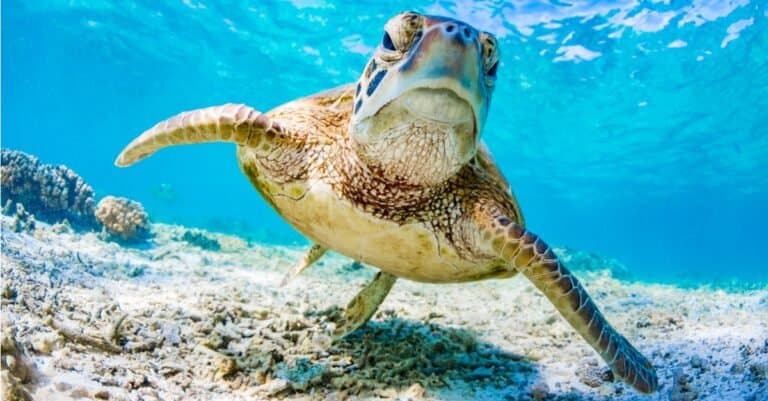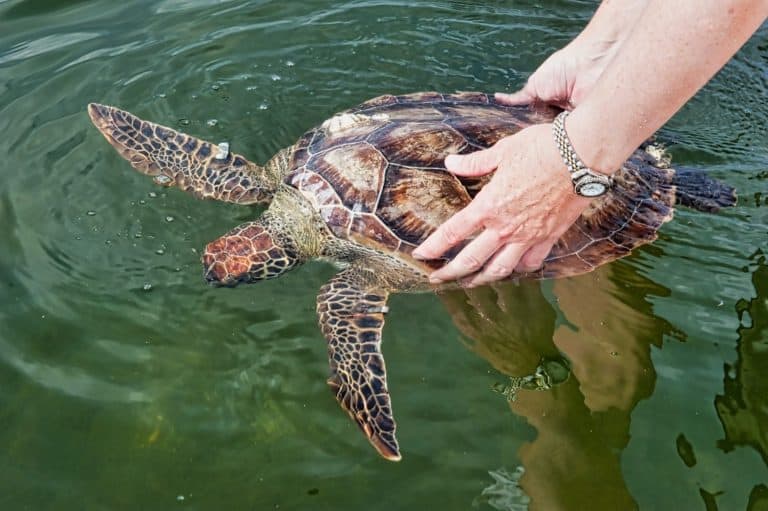
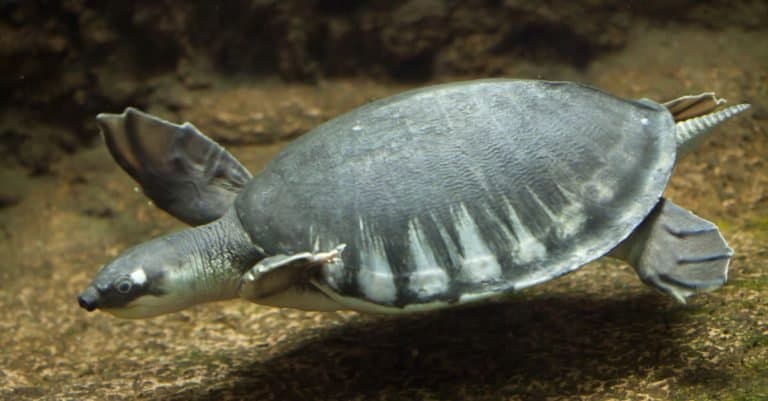
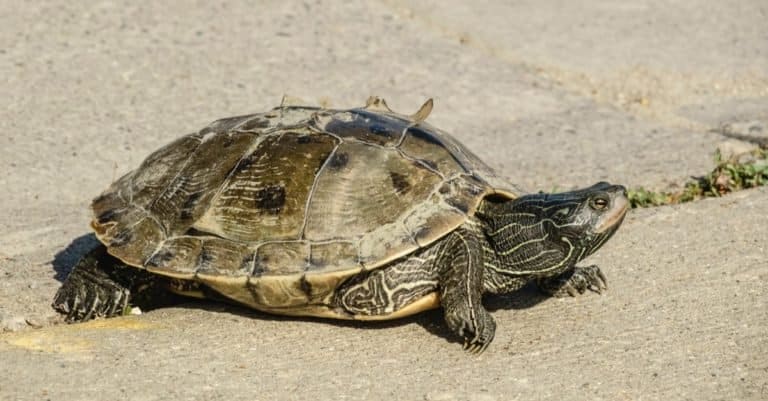
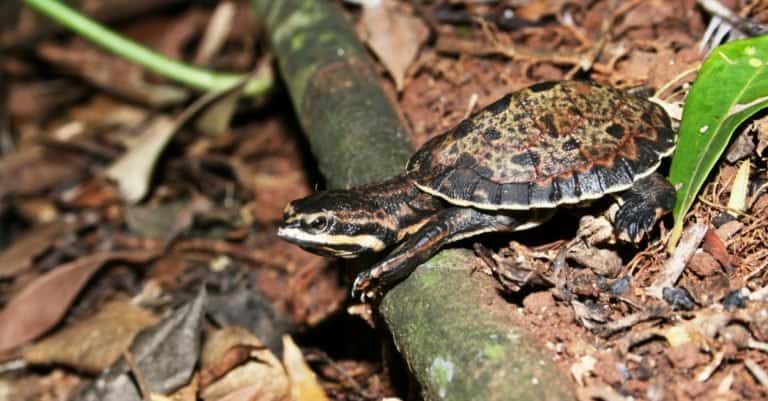
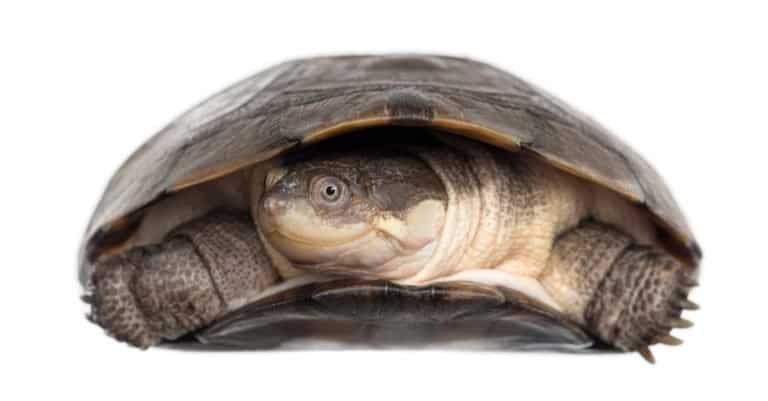




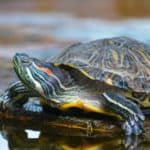
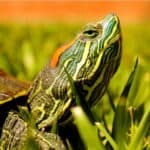
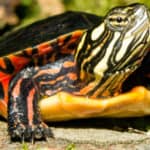
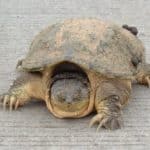
River turtles are turtles that spend most of their lives in or near rivers.
Most species are found in two families, Chelidae and Emydidae, with the latter including more than 50 species across 10 genera. The Mary river turtle, Elusar macrurus, is one of the most interesting examples of this type of turtle. Unfortunately, the species is now classified as Endangered by the IUCN Red List. Like most endangered turtle species, human activity is the Mary river turtle’s primary threat.
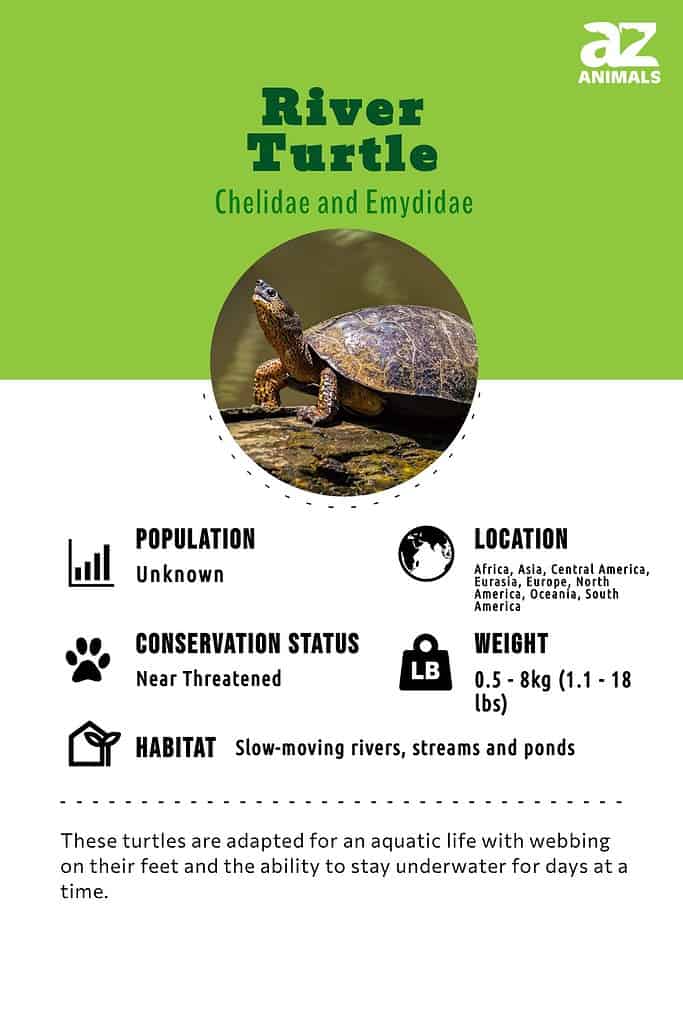
5 Incredible River Turtle Facts!
Some interesting facts about river turtles include:
- Long Tails: One of the most unique physical features of the Mary river turtle is its exceptionally long tail. On adult turtles, the tail measures up to two-thirds the length of the carapace or upper shell.
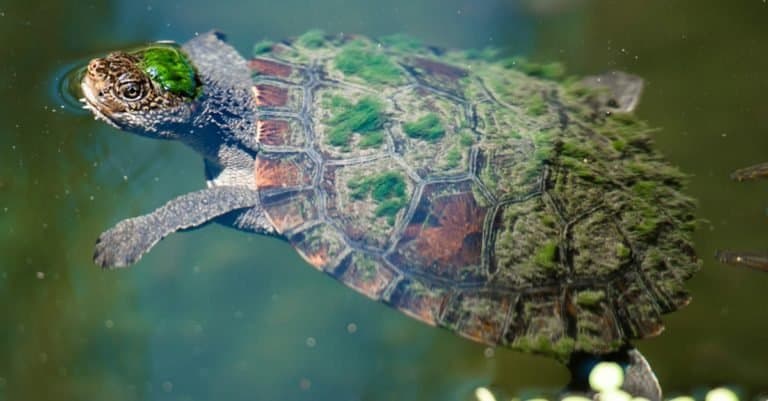
- Punk Rock Style: Since the Mary river turtle spends much of its life in the water, the species is known for developing long strands of algae along its head and body. This phenomenon makes it appear as if the turtle has long, flowing green hair, so the species is sometimes called the punk rock turtle.
- Recently Discovered: Despite being one of the largest river turtle species, the Mary river turtle was only officially identified during the 1990s. During the height of its popularity as a pet during the 1960s and 1970s, hatchlings were sold and marketed as “penny turtles.”
- Slow to Mature: It can take several years – or even decades – for these turtles to reach adulthood or sexual maturity. Typically, females become adults at around 25 years while males become adults at around 30 years.
- Side-Necked: Many species of these turtles withdraw their heads sideways into their shells. In effect, the head is tucked to the side and just beneath the rim of the shell rather than folded down vertically.
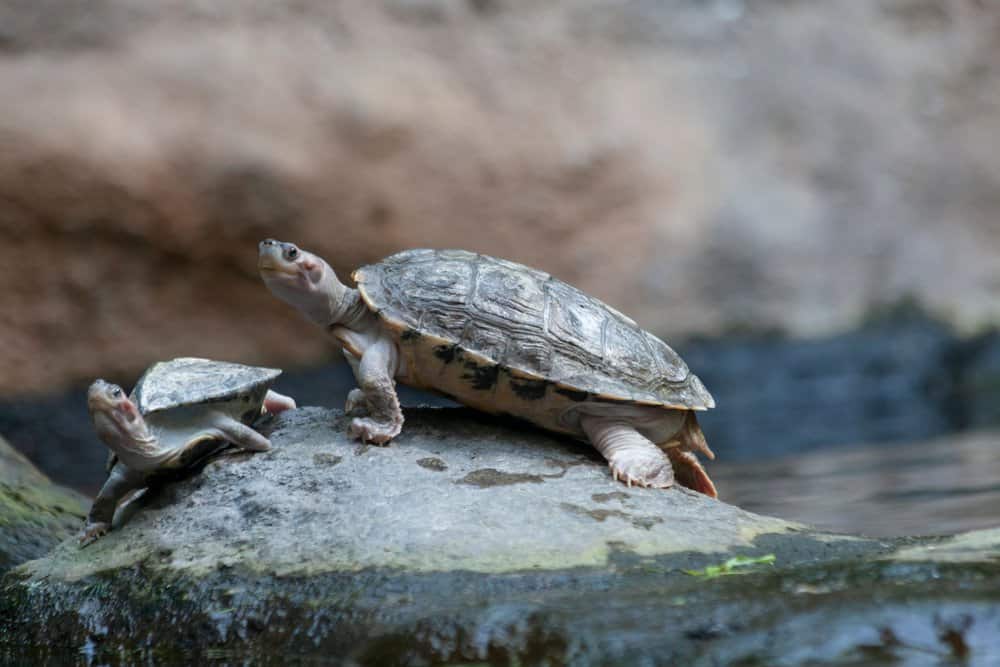
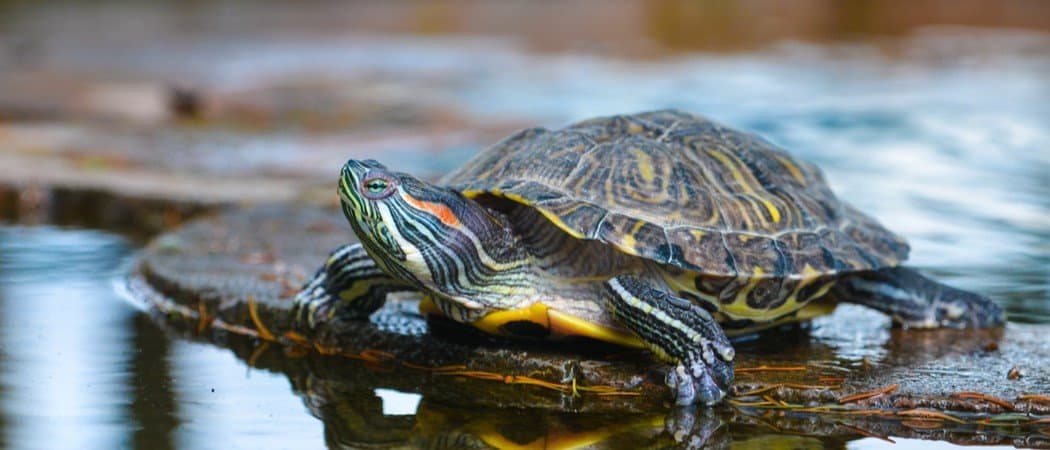
The family Emydidae spans 10 genera and more than 50 species of river turtles.
©svetjekolem/Shutterstock.com
Scientific Name
All of these turtles belong to the class Reptilia and the order Testudines. The Mary river turtle is further sub-classified into the family Chelidae and the genus Elusar. Elusar is a monotypic genus, meaning that it consists of only one species. The genus is one that has virtually disappeared from the evolutionary history of Australia and has an ancient lineage. The scientific name of the Mary river turtle is Elusar macrurus. Other names for this species include the green-haired turtle, the penny turtle, and the pet shop turtle.
Several other turtle species belong to the family Emydidae, which spans 10 genera and more than 50 species. River turtles belonging to this family include terrapins, marsh turtles, and pond turtles. All species are found in the Western Hemisphere.
Still, other species belong to the family Podocnemididae and the genus Podocnemis. The yellow-spotted turtle, Podocnemis unifilis, is a good example of a turtle from this family. Species within this family are generally native to the Amazon River basin.
Evolution
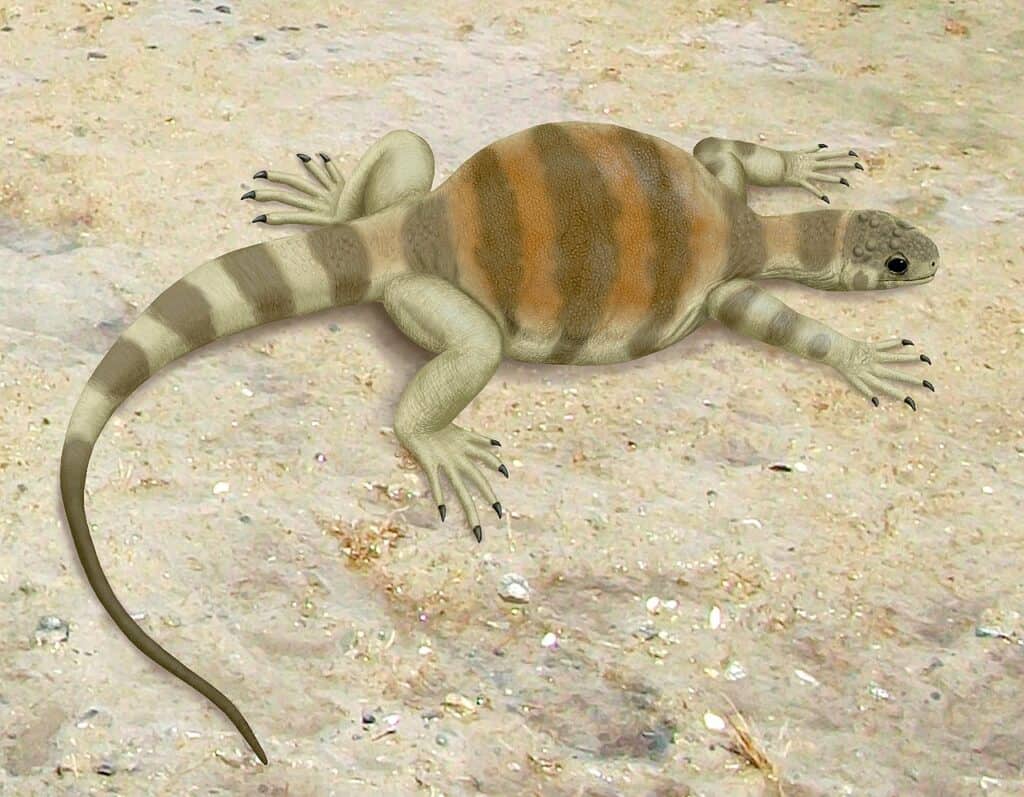
Eunotosasurus lived around 260 million years ago and is the earliest known ancestor of modern turtles.
The earliest known ancestor of modern turtles was Eunotosaurus, a reptile that existed during the Permian epoch, around 260 million years ago. Eunotosaurus didn’t have a shell but did have the framing for one with wide ribs that shielded the animal’s underside. Recent studies reveal that those wide ribs aided the animal in digging and burrowing by anchoring it to the ground. Eunotosaurus had evolved to be an efficient excavator. The animal was once thought to be a swimmer but the big claws and thick bones would have helped it to withstand compressive forces while burrowing. The powerful, back-facing front limbs and weaker back limbs indicated a master burrower.
Eunotosaurus fossils have been found in what is now, South Africa, and this turtle relative lived during a period when the land was dry and arid. The animal may have evolved its burrowing ability to escape droughts. Boney rings around Eunotosaurus’s eyes indicate that it may have spent a lot of time underground.
Pappochelys and Odontochelys also seemed to be equipped with digging abilities. It is believed that after the digging adaptations were made – many turtles became aquatic. Over time, complete shells formed from the wide ribcage, perhaps to protect the slow-moving turtles hampered by broad ribs from predators. Digging platforms evolved into suits of armor.
Species
There are at least 50 species of river turtles including:
- Arrau turtle
- Mary River turtle
- Red-bellied short-necked turtle
- Yellow-spotted river turtle
- Emydura macquarii
- Brisbane short-necked turtle
- Six-tubercled Amazon River turtle
- Common snapping turtle
- River cooter
- Painted turtle
- Southern river terrapin
- Pond slider
- Elusor
- Magdalena river turtle
- Chinese softshell turtle
Appearance
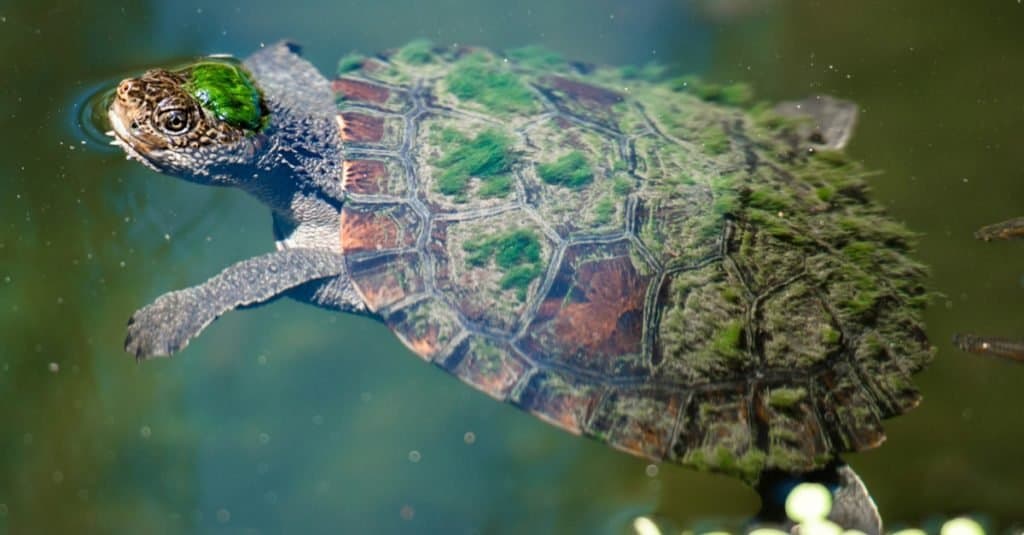
The Mary river turtle is also known as the “punk rock turtle” because of the green algae that grow on its head.
©Rob D the Baker/Shutterstock.com
The Mary river turtle, E. macrurus, is the second-largest freshwater turtle in Australia. Only the western swamp turtle, Pseudemydora umbrina is larger. The carapace, or upper shell, of this species, can grow up to a length of 20 inches, and this type of turtle has an average weight of about 8 grams. The carapace of the Mary river turtle has a streamlined, elongated appearance and may be plain or covered in intricate patterns.
In terms of coloring, the carapace of this species is typically brown, rusty red, or almost black. The lower shell, or plastron, is generally pale pink or cream and the underlying skin is usually the same color as the carapace. This turtle’s limbs and tail are usually salmon pink in color. Its tail, which can be up to two-thirds the length of the carapace, has haemal arches – a feature that is not found on any other modern turtle. The purpose of these bony arches is unclear. Long barbels – slender, whisker-like sensory organs – are located beneath the jaw.
Species like the yellow-spotted turtle, P. unifilis, attain a length of up to 18 inches and an average weight of just 0.3 ounces. Members of the Emydidae family typically have large plastrons and carapaces that are shaped like low arches. Some species have a movable hinge between the pectoral and abdominal sections.
The limbs of all these turtles are adapted for swimming, with webbing at the extremities.
Some sexual dimorphism is evident across most types of these turtles. In particular, males tend to be significantly larger than females. Other facts regarding dimorphism among these turtles may include differences in plastron shape and tail length.
Behavior
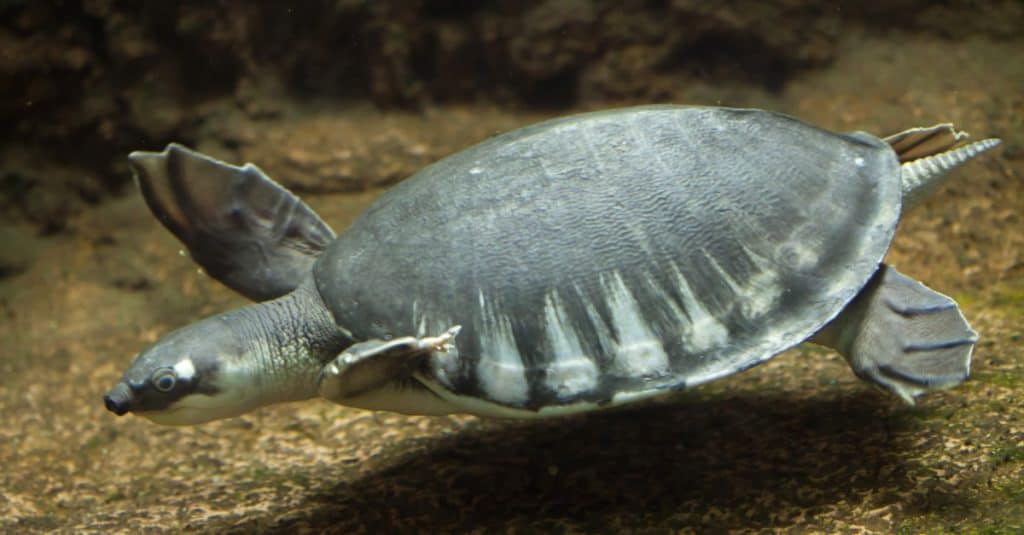
River turtles are cloacal ventilators, meaning that they can breathe oxygen out of their anuses.
©Vladimir Wrangel/Shutterstock.com
Like most turtles, these animals are mostly solitary. They only tend to get together during mating season, and females often gather at the same time to lay their eggs.
The Mary river turtle and other types of turtles engage in bimodal respiration. When above the water, they breathe and take in the air using their lungs. When submerged – which they may be for a few days at a time – they can also absorb oxygen through their cloaca. Their tails contain gill-like structures, allowing them to stay submerged for up to 2.5 days. As a result, certain river turtles are called “bum breathers.” Technically speaking, they are known as cloacal ventilators, meaning that they can breathe oxygen out of their anuses.
Highly aquatic, these turtles have webbed feet and spend much of their time submerged in the water. They are fairly fast swimmers, averaging a top speed of about 2.4 miles per hour. Unlike many turtles, which withdraw their heads directly down into their shells, species like the Mary river turtle withdraw their heads sideways into their shells. Like all reptiles, these turtles are ectothermic, or cold-blooded, and they spend many hours each day basking in the sun to increase their body temperatures.
Habitat
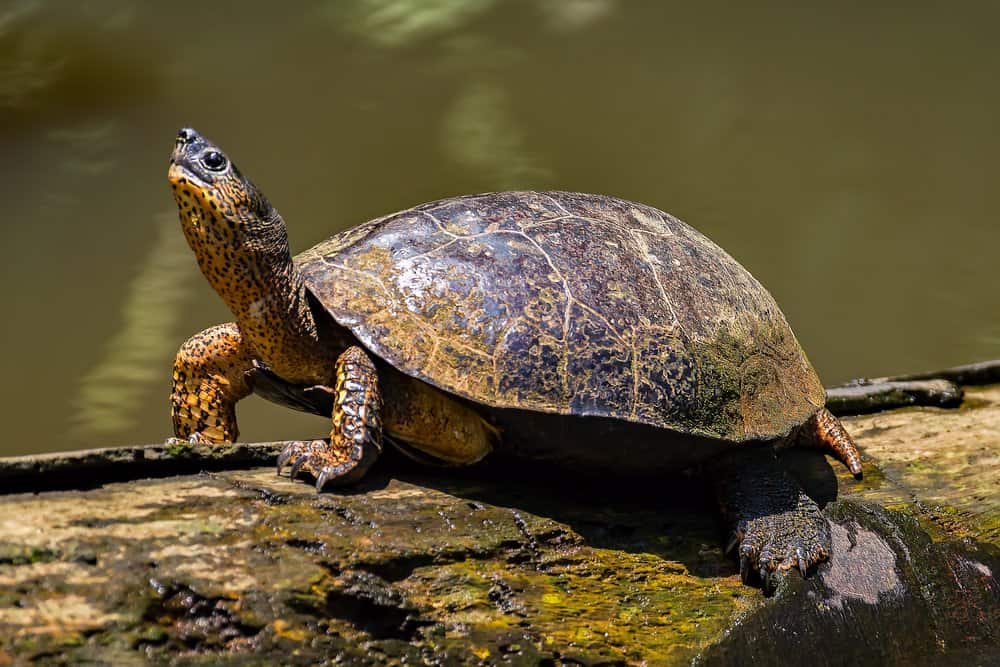
River turtles like open areas along riverbanks for basking, nesting, and resting.
©UlyssePixel/Shutterstock.com
These turtles typically inhabit freely flowing, well-oxygenated sections of rivers. Most of these turtles use terrestrial nesting sites within a short distance of such rivers. They tend to be particularly fond of pools and riffle zones. They typically need adequate foraging areas, nesting areas – usually open areas along riverbanks –basking sites, and nocturnal resting areas.
Members of the Emydidae family, which includes more than 50 species, are strictly found in the Western Hemisphere, and their range is extensive and varies significantly. The yellow-spotted turtle and several other species are native to the Amazon River basin.
One of the most unique turtles, the Mary river turtle, has a range that is strictly limited to the Mary River in southeast Queensland, Australia.
Diet
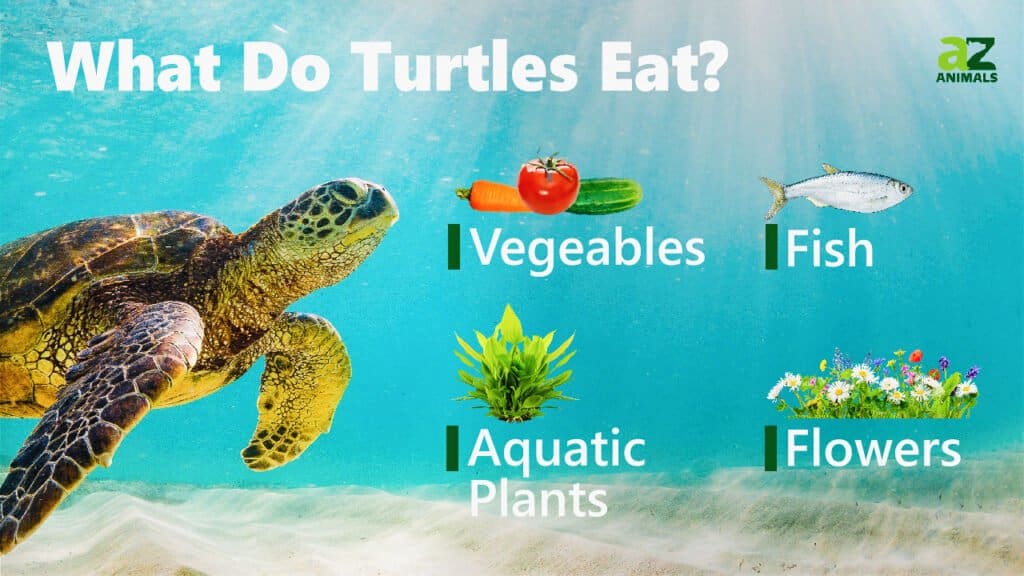
In terms of diet, turtles like the Mary river turtle are overwhelmingly herbivores, which means that the food they eat mostly consists of vegetation. Most species subsist primarily from algae and other types of plant matter. However, they can also be molluscivorous, meaning that they feed on mollusks and other bivalves. Some species may even occasionally prey on small animals for food. Therefore, these turtles are sometimes opportunistic feeders. When preying on animals, turtles like the Mary river turtle hover low against the bottom of the river, where they become camouflaged. They wait patiently for small fish, mollusks, and other prey to come along and then consume them if the opportunity arises.
Predators and Threats
Like most turtles, mature turtles don’t have many natural predators since they can hide away within their shells when threatened. These turtles also move quickly in the water, so they can flee from attackers fairly easily. The turtles’ eggs and hatchlings are much more susceptible to predation, and such activity can have negative impacts on local population numbers. Animals like snakes, foxes, birds, and even wild pigs actively hunt for and consume these turtle eggs.
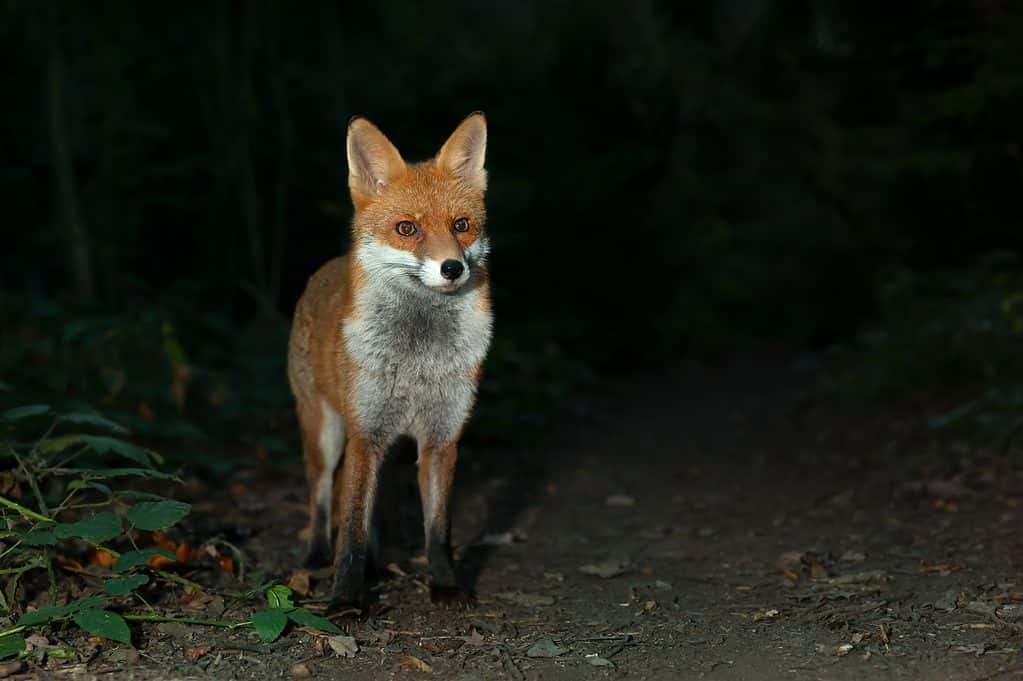
Foxes, snakes, birds, and wild pigs eat the eggs of river turtles although humans are their biggest threat.
©Giedriius/Shutterstock.com
Many of these turtles are endangered to some extent. The Mary river turtle, the second most endangered freshwater turtle in Australia, is a good example of this problem. In 2003, the Turtle Conservation Fund included the Mary river turtle on its list of the Top 25 Most Endangered Turtle Species. The species is listed as endangered under the Queensland Nature Conservation Act of 1992 and under the federal Environmental Protection and Biodiversity Conservation Act 1999. It is also classified as Endangered on the IUCN Red List. Only the western swamp turtle is considered at greater risk of extinction.
Human activity is the primary threat to most of these turtles. During the 1960s and 1970s, for example, the Mary river turtle became a popular pet across Australia; roughly 15,000 of the turtles were delivered to pet shops around the country per year over a 10-year period. Since they were sold as juveniles, they were known as penny turtles. They were also called pet shop turtles.
Like other turtles, these turtle habitats are often under threat. The Mary River, for example, first became impacted by human activity during the gold rush of the 1860s. Huge volumes of gravel and sand were excavated from the river for building materials, and large wood materials became depleted. These turtles rely on such materials, so this activity has had a negative impact on their survival. Some species may also be consumed for food by humans.
Various laws and regulations protect many species of these turtles. Efforts to increase their populations have been underway for some time. The Australian Freshwater Turtle Conservation and Research Association, for example, first started breeding Mary river turtles in captivity in 2007.
Reproduction, Babies, and Lifespan
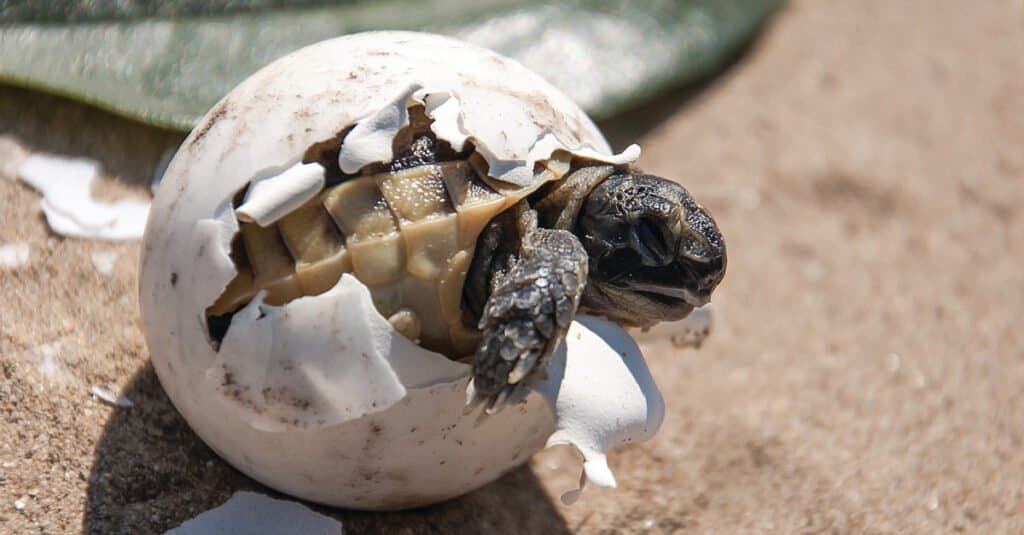
Female river turtles lay their eggs along riverbanks and do not provide care to the hatchlings.
©Attila N/Shutterstock.com
Since these turtles span so many species, there is no single, definitive average lifespan. However, most species live for an average of 30 years. It is believed that the Mary river turtle may live upwards of 100 years in the wild.
These turtles typically begin nesting after the spring rains into the summer months. Mary river turtles produce one clutch with an average of 15 eggs per year. Females lay eggs on open expanses along riverbanks, burying them in the sand, and they hatch within 50 to 79 days. Hatchlings peck their way out, climb to the surface and begin their lives. Adult turtles do not provide any care to the eggs or hatchlings, which is typical among turtles.
River Turtle Population
Most of these turtles have solid populations, but some – including the Mary river turtle – are endangered. Population estimates for river turtles around the world are not available.
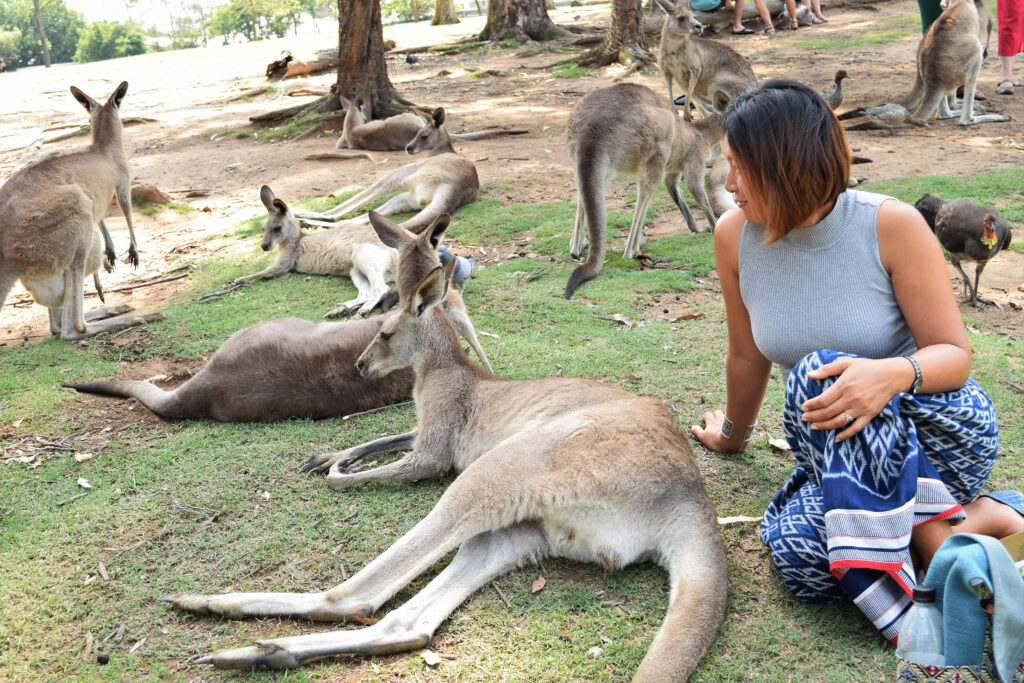
Visit the home of the crocodile hunter when you go to the Australia Zoo and see the amazing Mary river turtle!
©Patnaree Asavacharanitich/Shutterstock.com
In the Zoo
Examples of these turtle species can be found in zoos around the world. The Australia Zoo in Sydney has examples of the Mary river turtle, one of the most endangered freshwater turtles in the country.
River Turtle Pictures
View all of our River Turtle pictures in the gallery.

Orhan Cam/Shutterstock.com
Sources
- Australia Zoo / Accessed February 9, 2021
- Mary River Turtle / Accessed February 9, 2021
- Smithsonian's National Zoo & Conservation Biology Institute / Accessed February 9, 2021