R
Species Profile

Rockhopper Penguin

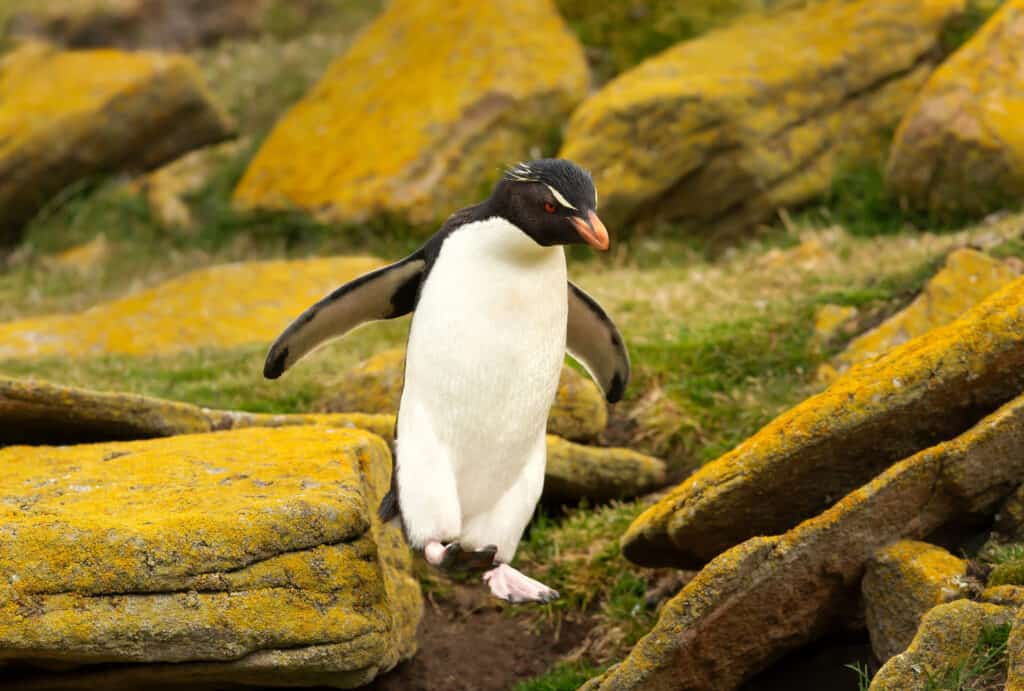
Small penguin. Big cliff-hopper energy.
William Warby (wwarby) / CC BY 2.0, Flickr

Rockhopper Penguin Distribution

Click a location to explore more animals from that region

This map shows coastal regions where Rockhopper Penguin are found.

Loading map...

Size Comparison

Human 5'8"
Rockhopper Penguin 1 ft 10 in

Rockhopper Penguin stands at 32% of average human height.

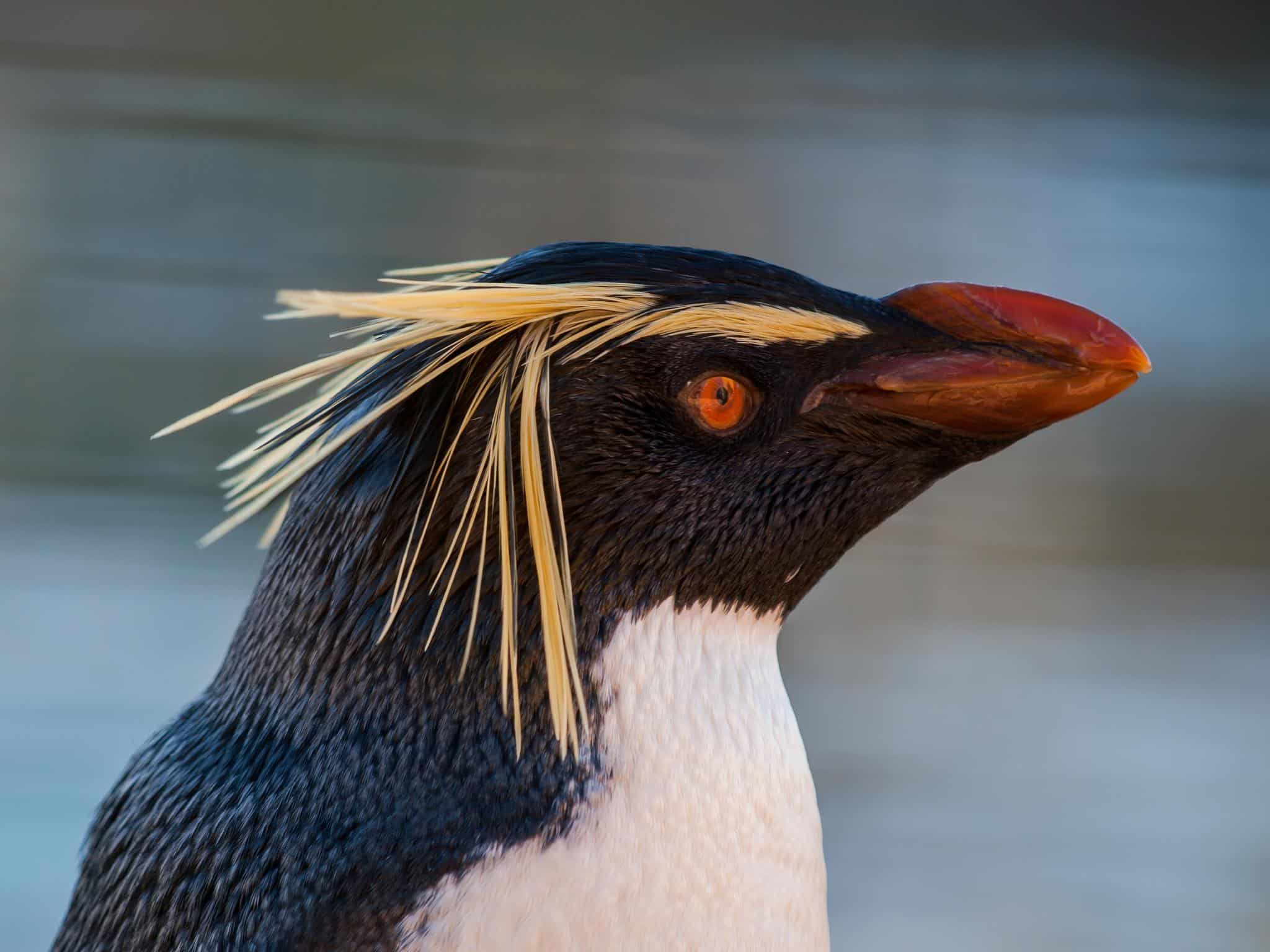
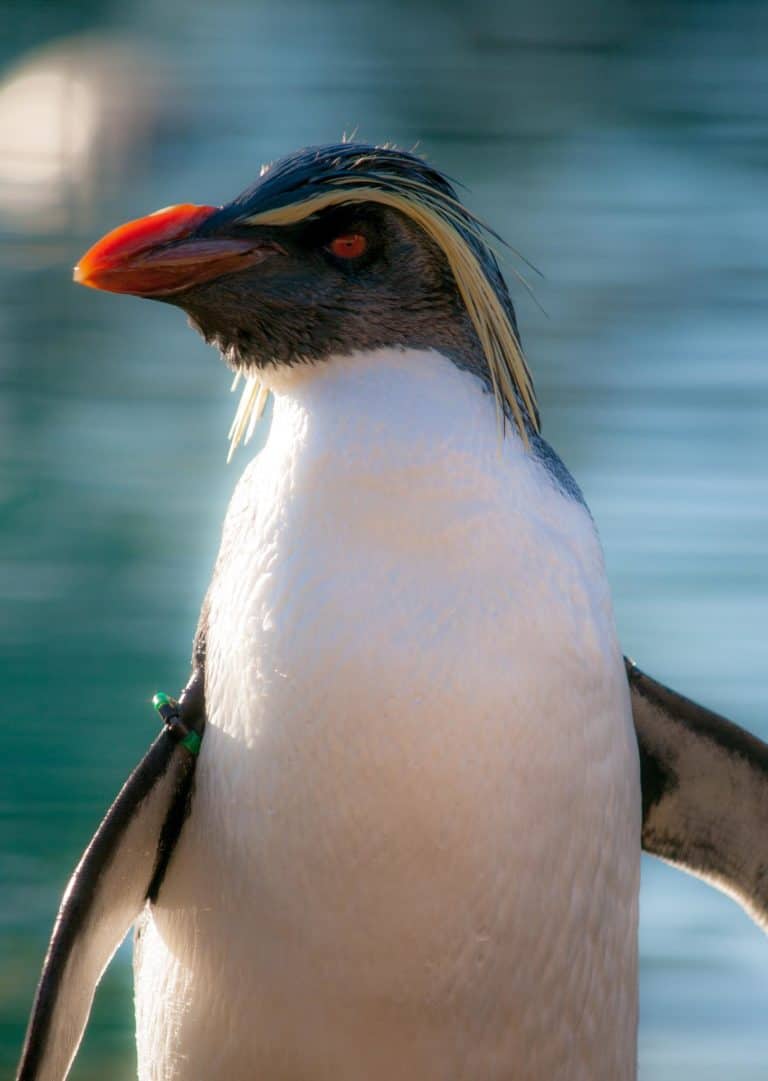
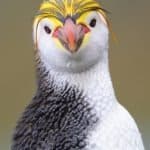
A close-up of a Rockhopper Penguin at Edinburgh Zoo, UK.

At a Glance

Wild Species
Also Known As Rockhopper penguin, Southern rockhopper penguin, Falkland rockhopper penguin, Rockhopper, Crested penguin
Diet Carnivore
Activity Diurnal
Lifespan 10 years
Weight 3.4 lbs
Status Vulnerable
Did You Know?

Size: ~45-58 cm tall; typical mass ~2.0-3.4 kg (field guides & BirdLife species accounts).

Scientific Classification

Rockhopper penguins are small crested penguins (genus Eudyptes) known for yellow eyebrow-like plumes and hopping over rocks in steep coastal colonies.

Kingdom
Animalia
Phylum
Chordata
Class
Aves
Order
Sphenisciformes
Family
Spheniscidae
Genus
Eudyptes

Distinguishing Features

  • Yellow crest/eyebrow plumes typical of crested penguins (Eudyptes)
  • Red/orange bill and pinkish bare facial skin
  • Notable hopping/rock-climbing behavior at breeding colonies
  • Compact size relative to many other penguins

Physical Measurements

Males and females differ in size

Height
1 ft 10 in (1 ft 8 in – 1 ft 11 in)
Length
1 ft 8 in (1 ft 6 in – 1 ft 11 in)
Weight
7 lbs (6 lbs – 8 lbs)
6 lbs (5 lbs – 7 lbs)
Tail Length
3 in (2 in – 3 in)
Top Speed
4 mph
swimming

Appearance

Primary Colors
Secondary Colors
Skin Type Dense waterproof feathers; small bare skin areas around bill base and eyes.
Distinctive Features
  • Adult total length commonly 48-58 cm (species accounts: BirdLife/IUCN).
  • Adult mass typically ~2.0-3.4 kg, varying by season and colony (BirdLife species factsheet).
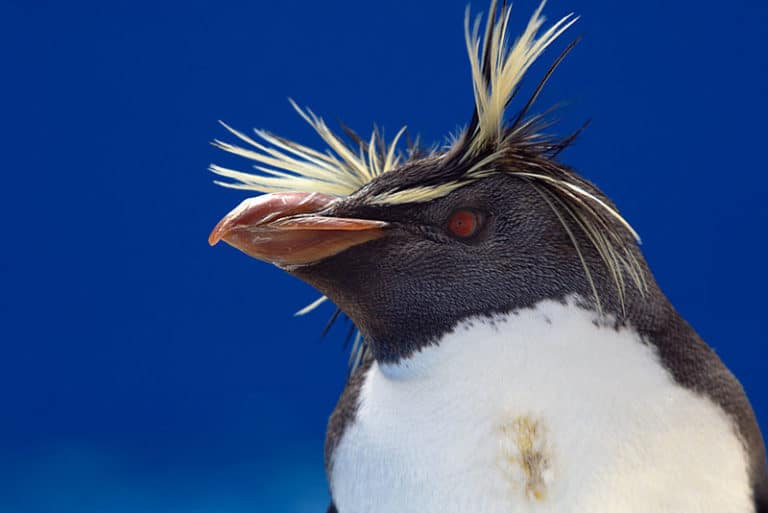
  • Yellow crest plumes form distinct 'eyebrows' that extend behind the head (genus Eudyptes trait).
  • Short, robust orange-red bill and red to red-brown eyes are key head identifiers.
  • Legs set far back; on land it characteristically hops and scrambles over steep rocks.
  • Breeds in dense colonies on rocky slopes/ledges; nests are shallow scrapes with stones/vegetation.
  • Maximum recorded longevity reported as 19.0 years (AnAge database for Eudyptes chrysocome).

Sexual Dimorphism

Males are slightly larger and heavier, with deeper/longer bills and somewhat longer crest plumes; females are smaller with finer bill proportions. Overall black-white plumage and yellow crest coloration are otherwise very similar between sexes.

  • Slightly larger overall body size (length/mass)
  • Deeper, longer, more robust bill
  • Crest plumes may average slightly longer/thicker
  • Slightly smaller overall body size (length/mass)
  • Shorter, finer bill proportions
  • Crest plumes may appear slightly less bulky

Did You Know?

Size: ~45-58 cm tall; typical mass ~2.0-3.4 kg (field guides & BirdLife species accounts).

Lays 2 eggs, but the larger second-laid "B-egg" usually produces the surviving chick; the first egg is often smaller and lost early (well-documented in Eudyptes).

Can climb to nests by literally hopping and using flippers for balance-an unusual locomotion style among penguins that suits boulder beaches and cliffs.

Two main breeding-region groupings are often discussed for this species complex: South Atlantic/South America (e.g., Falkland Islands) and Indian Ocean/subantarctic islands (e.g., Kerguelen/Crozet in some treatments as subspecies).

Foraging is mainly on krill and other crustaceans plus small fish and squid; diet shifts with season and local oceanography (multiple colony diet studies).

Longevity: commonly ~10-15 years in the wild; banding records show individuals can exceed 20 years (reported maxima ~23+ years in long-term penguin studies).

Unique Adaptations

  • Rock-hopping locomotion: strong legs/feet and balance-assisted flipper use let them traverse talus, slippery rock, and steep slopes where many penguins would struggle.
  • Crested-penguin signaling: bright yellow superciliary plumes and red eyes support rapid visual recognition and display in crowded colonies (a shared Eudyptes trait).
  • Dense waterproof plumage + preen oil: tightly packed feathers and uropygial oil maintain insulation in cold, wave-battered waters.
  • Salt excretion glands (supraorbital): allows drinking seawater and eating marine prey without dehydration-crucial for long foraging trips.
  • Countershading (dark back, pale belly): reduces detectability to predators from above and below in the water column.
  • Streamlined pursuit-diver form: rigid flippers, compact body, and strong pectoral muscles support efficient underwater "flight" while hunting krill, fish, and squid.

Interesting Behaviors

  • Cliff-and-boulder nesting: breeds in dense colonies on steep rocky slopes, scree, and cliff terraces; nests are shallow scrapes lined with small stones/vegetation when available.
  • Two-egg strategy: typically lays 2 eggs; asynchronous laying/hatching often results in one chick fledging-an important, characteristic breeding pattern in crested penguins (genus Eudyptes).
  • Biparental care with shift work: mates alternate incubation and guarding, then both provision the chick; adults commute between colony and offshore feeding grounds.
  • Creche stage: chicks may gather in groups while adults forage, reducing individual predation risk and helping thermoregulation in exposed, windy colonies.
  • Aggressive territorial displays: raised crest feathers, braying calls, bill-jabbing, and flipper-waving are used to defend nest sites in tightly packed colonies.
  • Highly synchronized colony movement: many adults enter/exit the sea in bursts, timing landings to waves and using momentum to "porpoise" and hop clear of surf.
  • If you share the breeding island/region (e.g., Falklands vs. Kerguelen/Crozet), the timing of laying, key prey, and local threats can be matched to that population.

Myths & Legends

Eudyptes chrysocome’s genus name, Eudyptes, comes from Greek for "good diver," from sailors' and scientists' ideas of their swimming skill; chrysocome means "golden-haired" for yellow crest feathers.

Seafarers' folklore and nicknames: "rockhopper" became a mariners' and islanders' descriptive nickname long before mass media-rooted in the memorable sight of these penguins leaping from wave-swept rocks onto cliffs in stormy weather.

On several subantarctic islands, Eudyptes chrysocome colonies served as seasonal landmarks for fishermen and settlers, used in local talk and navigation ("by the rockhoppers") and kept in community memory, not formal myths.

Conservation Status

VU Vulnerable

Facing a high risk of extinction in the wild.

Population Decreasing

Protected Under

  • CITES Appendix I (Spheniscidae spp.)
  • Protected under national wildlife legislation and/or within protected areas at multiple breeding locations across the range (e.g., reserves and parks in the Falkland Islands, Argentina, and Chile).

Life Cycle

Birth 2 chicks
Lifespan 10 years

Lifespan

In the Wild
5–23 years
In Captivity
10–30 years

Reproduction

Mating System Monogamy
Social Structure Socially Monogamous
Breeding Pattern Seasonal
Fertilization Internal Fertilization
Birth Type Internal_fertilization

Breeds in dense colonies; pairs are socially monogamous within a season and often reunite in later years. Typically lays a 2-egg clutch; both parents alternate incubation (~33 days) and provision the chick until fledging (~10 weeks).

Behavior & Ecology

Social Colony Group: 20000
Activity Diurnal
Diet Carnivore Euphausiid krill (often the dominant prey during chick-rearing in many colonies).
Seasonal Migratory 932 mi

Temperament

Strongly colonial; frequent aggressive interactions at high nest densities (Williams 1995).
Territorial at nest: threat postures, bill-jabbing, and chasing; tolerance increases away from nests.
High site fidelity and synchronized breeding; typical of Eudyptes crested penguins with island-to-island variation (Warham 1975; BirdLife accounts).
Social at sea, often rafting before/after foraging trips; group cohesion is loose and fluid.

Communication

Loud braying/trumpeting ecstatic display calls used for mate recognition and reunion Jouventin 1982
Mutual display duets at the nest Ecstatic/advertising calls) supporting pair-bond maintenance (Williams 1995
Contact calls between returning adults and chicks in dense colonies; individual recognition important Jouventin 1982
Visual displays: upright ecstatic posture with head-swinging; crest feather erection amplifies signals Jouventin 1982
Agonistic signals: open-bill threat, bowing, and lunging; escalates to bill-fighting at boundaries.
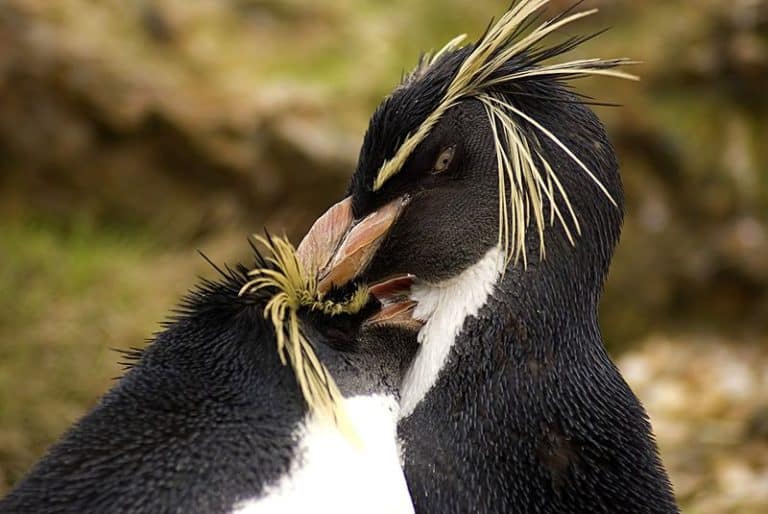
Allopreening and mutual bowing between mates; reduces aggression and reinforces pair bond.
Nest/territory cues: fixed nest sites and repeated return paths act as social-spatial communication in colonies.

Habitat

Terrain:
Coastal Island Rocky
Elevation: Up to 984 ft 3 in

Ecological Role

Mid-trophic-level marine predator (mesopredator) linking lower-trophic zooplankton/nekton (krill, amphipods, small fish, squid) to higher predators and transporting marine-derived nutrients to terrestrial island ecosystems via guano and carcasses.

Regulates local abundance/availability of pelagic prey (krill, amphipods, small fish) through predation Transfers marine nutrients (nitrogen, phosphorus) to coastal soils and nearshore waters via guano deposition, supporting island/coastal productivity Provides prey for higher-level predators (e.g., pinnipeds and large seabirds), supporting marine food-web structure Bioindicator of marine ecosystem change (diet and foraging success track shifts in krill/fish availability and oceanographic conditions)

Diet Details

Main Prey:
Euphausiid krill Amphipods Small pelagic fish Cephalopods

Human Interaction

Domestication Status

Wild

Eudyptes chrysocome (southern rockhopper penguin) is a wild seabird with no domestication history. People study it (banding, diet, tracking), visit colonies for tourism, and do conservation. Trade and keeping are tightly limited. Only licensed zoos, rehab centers, or research groups may hold them with permits under national laws and CITES. The species complex is often listed as Vulnerable.

Danger Level

Low
  • Bites and flipper strikes during handling/close approach (sharp beak; defensive behavior at nests)
  • Zoonotic/foodborne pathogens associated with wild birds and fecal contamination at colonies (e.g., Salmonella spp.; general avian disease risk-standard hygiene recommended)
  • Slip/trip/fall hazards for visitors on steep, rocky colony terrain and guano-covered rocks (a common practical risk during tourism/research work)
  • Occupational exposure risks for researchers/rehabilitators (scratches, minor trauma, bioaerosols in enclosed holding areas)

As a Pet

Not Suitable as Pet

Legality: Not legal/appropriate as a private pet in most jurisdictions. International commercial trade is highly restricted under CITES controls for penguins; legal possession is typically limited to permitted institutions (zoos/aquaria, rehab centers, research) with specialized facilities and veterinary oversight.

Care Level: Expert Only

Purchase Cost:
Lifetime Cost: $100,000 - $250,000

Economic Value

Uses:
Ecotourism/wildlife viewing Scientific research value (indicator species for ocean change) Conservation program funding/education (zoos/aquaria, where legally held)
Products:
  • Non-consumptive revenue from tourism at breeding sites (guided landings/cruises)
  • Research outputs (data supporting fisheries management, climate and ecosystem monitoring)
  • Educational programming/visitor admissions at accredited facilities (where permitted)

Relationships

Predators 7

Leopard Seal
Leopard Seal Hydrurga leptonyx
Killer Whale
Killer Whale Orcinus orca
Southern Sea Lion Otaria flavescens
South American Fur Seal Arctocephalus australis
Subantarctic Skua Stercorarius antarcticus
Southern Giant Petrel Macronectes giganteus
Kelp Gull Larus dominicanus

Ecological Equivalents 5

Animals that fill a similar ecological role in their ecosystem

Northern Rockhopper Penguin Eudyptes moseleyi Eudyptes chrysocome is a small crested, cliff-nesting penguin (45–58 cm, ~2–3.4 kg) that hunts near the surface for small fish, crustaceans, and squid, breeds in rocky colonies, lays two unequal eggs, and makes short trips to feed chicks—traits it shares with Eudyptes moseleyi.
Macaroni Penguin
Macaroni Penguin Eudyptes chrysolophus Both crested penguins nest in colonies on subantarctic islands, dive in the upper ocean to feed mainly on krill as well as small fish and squid, have crests used in display, and breed at the same time with strong site fidelity.
Fiordland Penguin Eudyptes pachyrhynchus Shares the same genus-level body plan and diving strategy, but occurs in a more coastal/forested New Zealand setting. Both are pursuit-diving penguins that feed on small fish, squid, and crustaceans, and nest in rugged, difficult-to-access terrain where hopping and clambering over rocks is common.
Snares Penguin Eudyptes robustus A small crested penguin occupying a similar subantarctic island niche: forming dense colonies, exhibiting strong intraspecific aggression and display at nesting sites, and epipelagic foraging on schooling prey. Like E. chrysocome, it is a central-place forager during incubation and chick-rearing.
Atlantic Puffin Fratercula arctica A non-penguin pursuit-diving seabird that breeds in dense colonies on islands and cliffs, feeds on small schooling fish in mid–upper water, and faces many predators near its colonies.

The smallest crested penguins.


Rockhopper penguins are a breed of penguin that live off of island coastlines in the southern hemisphere. They are one of the smallest species of penguins and are best known for their crest of long yellow feathers, as well as their bright red eyes. Rockhopper penguins are among the most numerous penguin species on Earth.

Incredible Rockhopper Penguin Facts!

  • Some scientists split these penguins into three species (southern, northern, and eastern), while others consider them one species.
  • They are known for their bright red eyes and bright yellow head plumage.
  • They can dive up to 330ft in search of prey at sea.
  • Rockhopper penguins mate for life.
  • These penguins are found all around the southern hemisphere, from the southern coast of South America all the way to New Zealand.
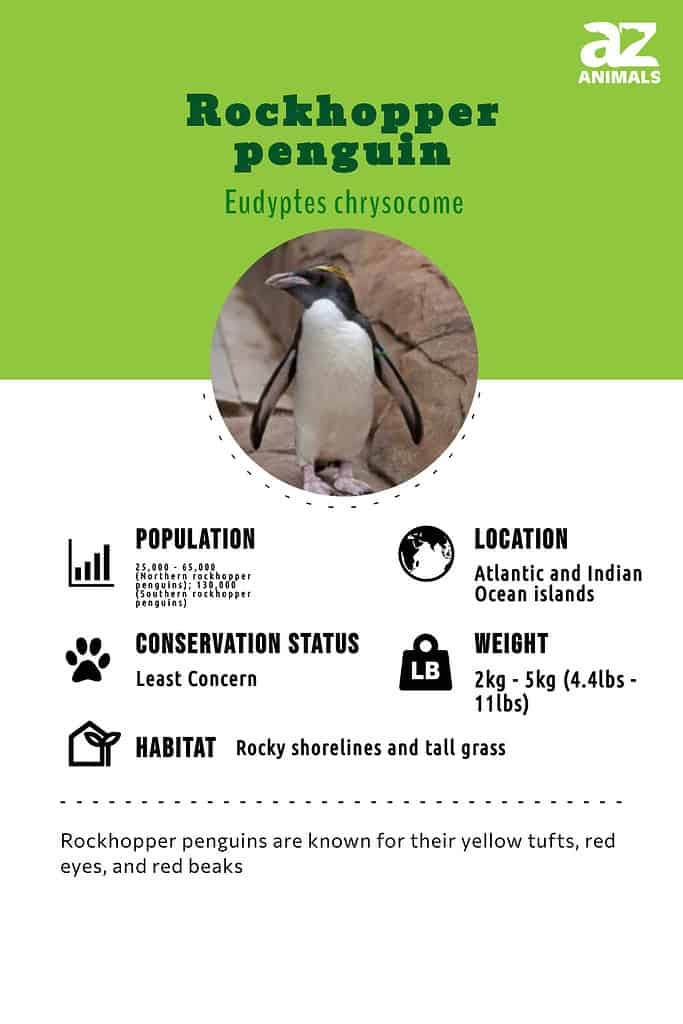
Summary of rockhopper penguins

Scientific Name

Rockhopper penguins’ closest living relatives are yellow-eyed penguins

The rockhopper penguin’s scientific name is Eudyptes chrysocome. Eudyptes means “good diver” in Latin, and the genus encompasses all the crested penguins, such as the macaroni penguin and the royal penguin. Chrysocome means “golden hair,” so the scientific name of these penguins means “golden-haired divers.”

Some scientists consider the rockhopper penguin to be one species of crested penguin . Other scientists divide the species up into three subspecies: Northern rockhopper penguin, southern rockhopper penguin, and eastern rockhopper penguin. Northern rockhopper penguins tend to be larger than the other two subspecies.

Evolution and Classification 
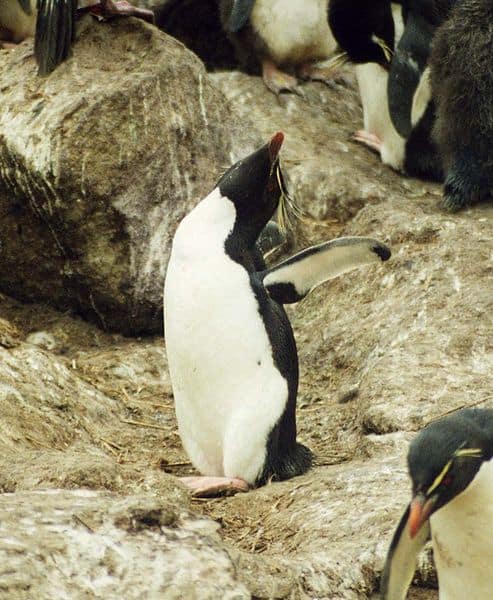
Rockhopper Penguins diverged from yellow-eyed penguins 15 million years ago

Rockhopper penguins belong to the genus Eudyptes. Each one of its seven member species is known for their black and white coloring, red beaks, and yellow tufts. They are also known for having a wider variety of calls compared to other penguin species. 

The yellow-eyed penguin happens to be their closest relative from which they separated during the Mid-Miocene, about 15 million years ago. Seven million years following that first separation, the genus separated into several different species.

Extant member species of the genus include the following:

  • Erect-crested penguin (Eudyptes sclateri)
  • Fiordland penguin (Eudyptes pachyrhynchusi)
  • Macaroni penguin (Eudyptes chrysolophus)
  • Royal penguin (Eudyptes schlegelii)
  • Northern rockhopper penguin (Eudyptes moseleyi)
  • Southern rockhopper penguin (Eudyptes chrysocomei)
    • Eastern rockhopper penguin (Eudyptes (chrysocome) filholi)
    • Western rockhopper penguin (Eudyptes (chrysocome) chrysocome)
  • Snares penguin (Eudyptes robustusi)

Types
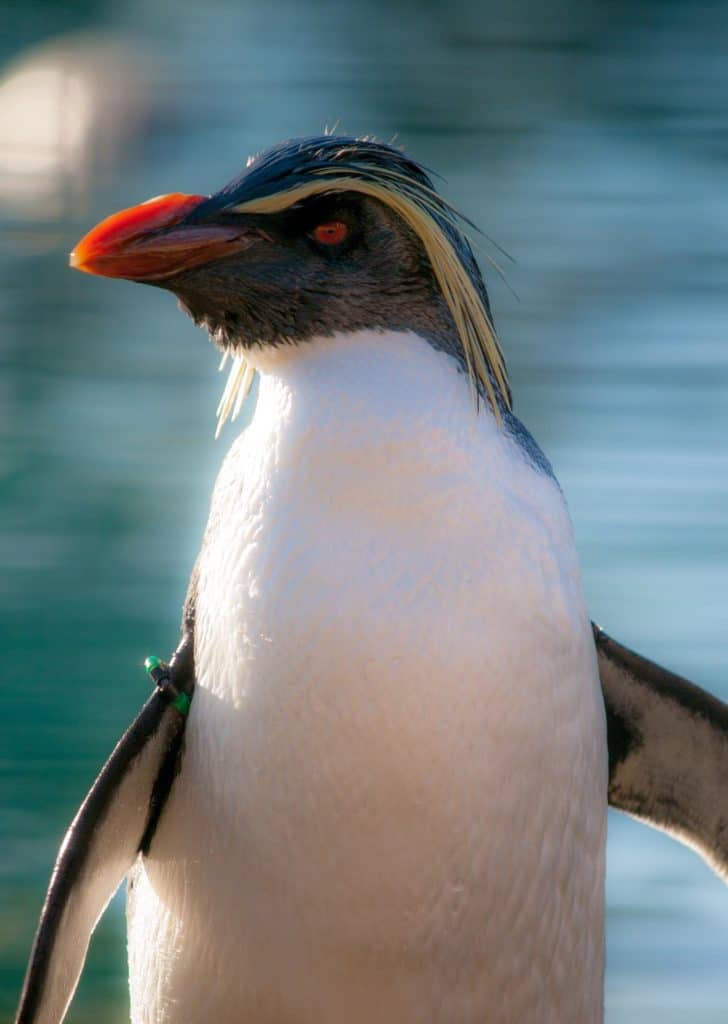
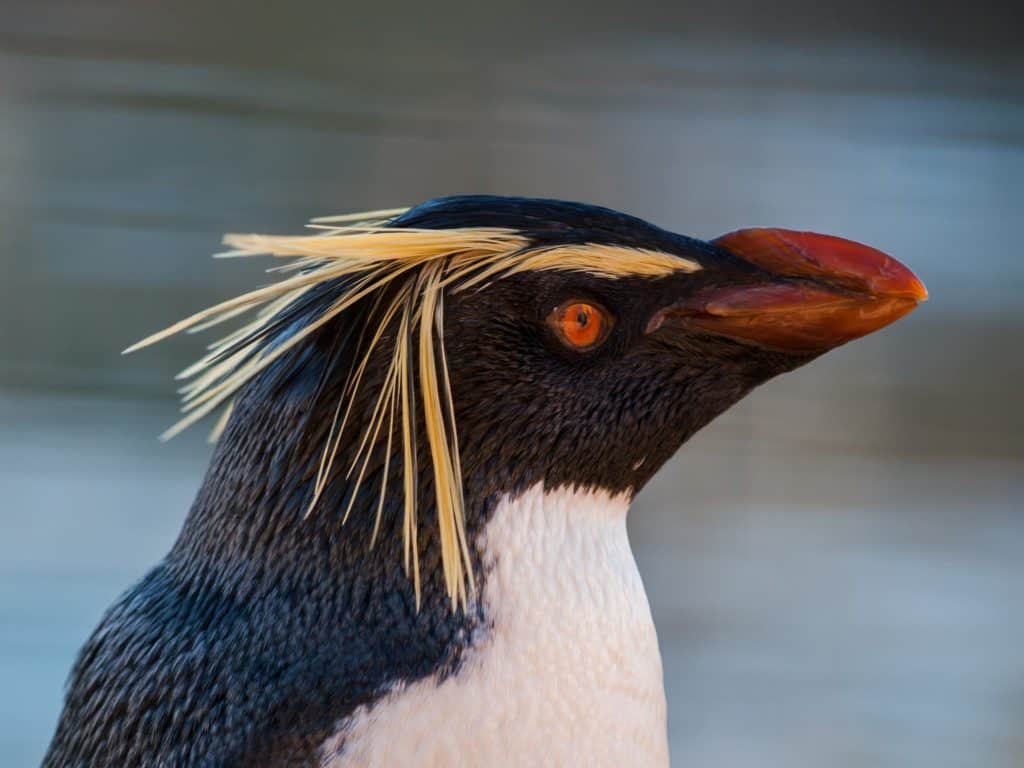
A Rockhopper Penguin at Edinburgh Zoo, UK.

There are two main subspecies of rockhopper penguin

The key differences between both subspecies of rockhopper penguin includes their sizes, their breeding grounds, their parasites, as well as their mating rituals.

  • Northern rockhopper penguins (Eudyptes moseleyi): Larger than their southern relatives, these marine avians play unwitting hosts to Austrogoniodes concii parasites (a fact which proved handy in enabling scientists to be able to tell the difference between them and their southern relatives). Their breeding colonies are located on Amsterdam Island and St Paul Island in the Indian Ocean and Tristan da Cunha and Gough Island in the Atlantic Ocean.
  • Southern rockhopper penguins (Eudyptes chrysocomei):  The smaller avian subspecies, these penguins are capable of growing to 23 inches and 7.5 lbs — certain heavyweights are however capable of tipping the scales at 9.9 lbs. They provide sustenance to Austrogoniodes keleri lice and breed on the Falkland Islands as well as islands close to Patagonia. Other breeding grounds include the Antipodes Islands, the Auckland Islands, the Crozet Islands, and the Kerguelen Islands.

Appearance
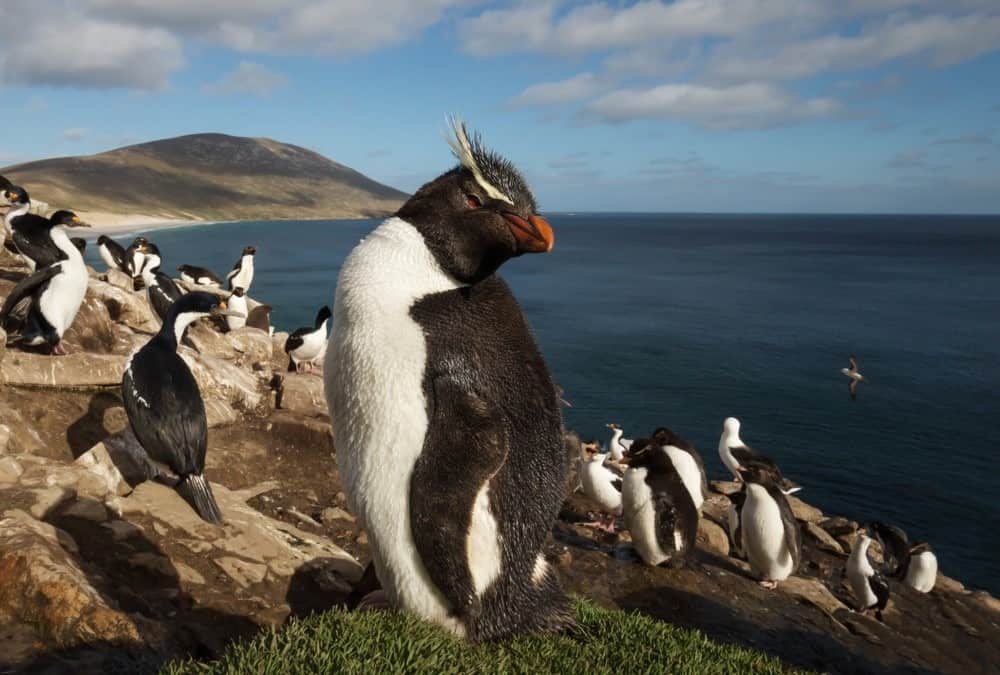
Close up of a Rockhopper penguin (Eudyptes chrysocome) standing in a group of penguins and Imperial Cormorants on a coastal area of Falkland Islands.

Rockhopper penguins are the smallest species of crested penguins

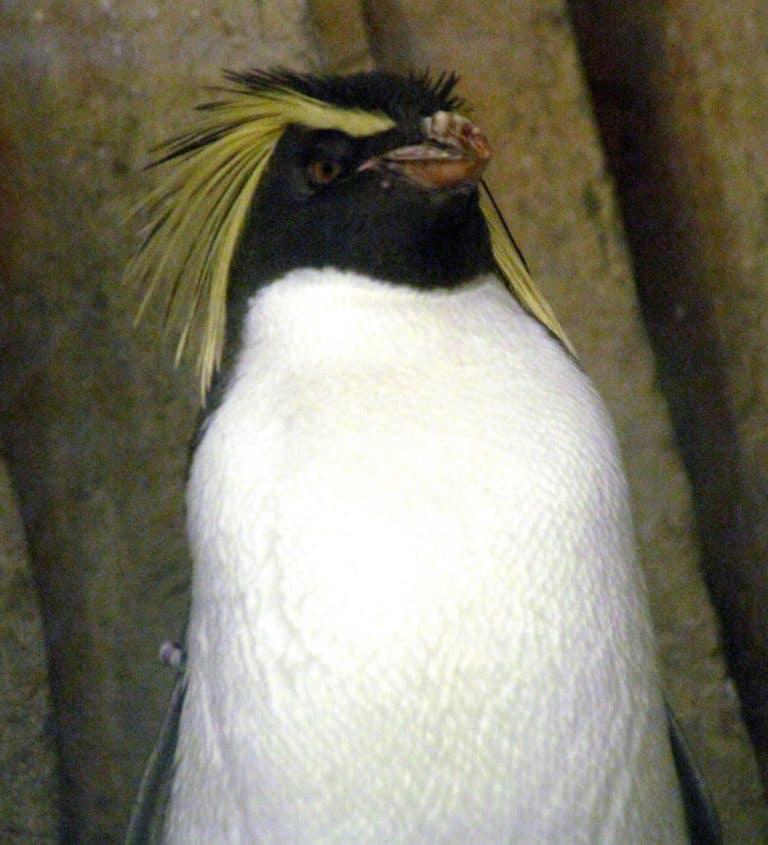
All species of these penguins have long yellow and black crest feathers, red eyes, and ruddy, red-colored beak. At slightly less than 2 feet in height, these penguins are a few inches taller than a bowling pin. Males are slightly bigger than females. These penguins weigh about 5.5lbs; they are the smallest species of crested penguins.

These penguins have the traditional black and white coloring of most penguins, with a black tuxedo covering most of their bodies except for their round white bellies. They have bold stripes in the region above their eyes called superciliary stripes. The Northern penguins have more prominent crests than the southern species.

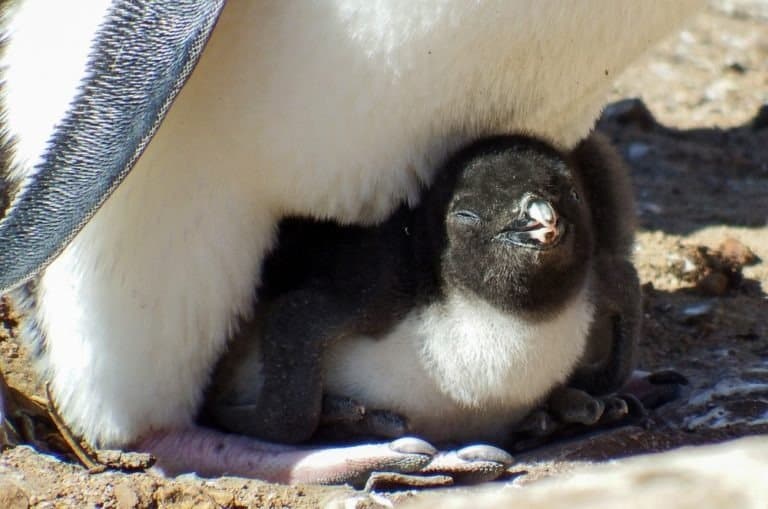
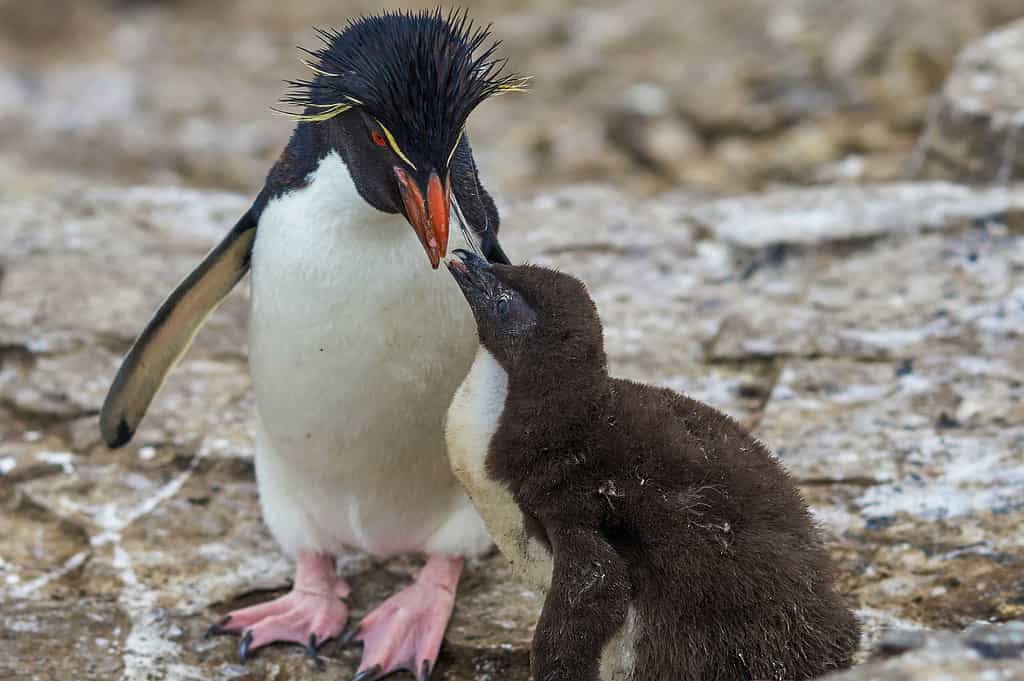
Their chicks are mostly black and gray with black beaks, which turn brighter red and orange as they age. Juvenile penguins look like their adult counterparts, save for patches of grey hair beneath their chin. Some juveniles do not possess superciliary stripes at all.

Behavior
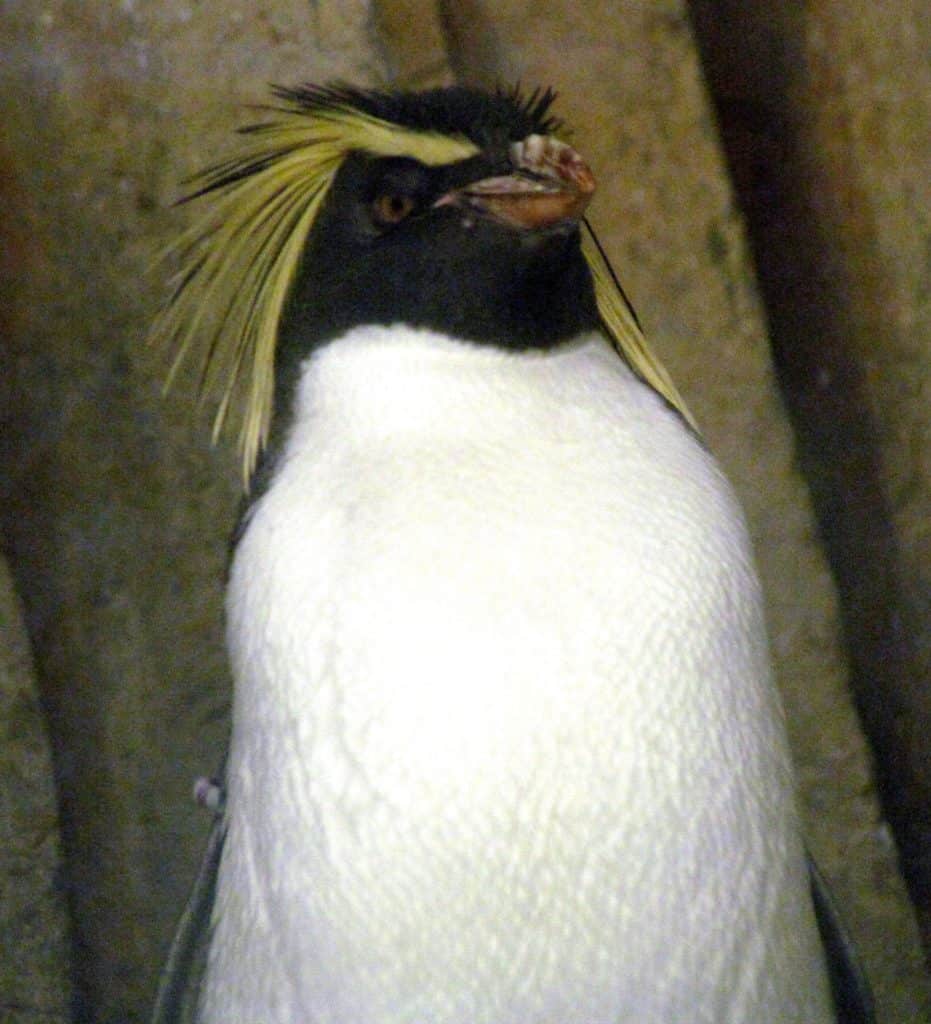
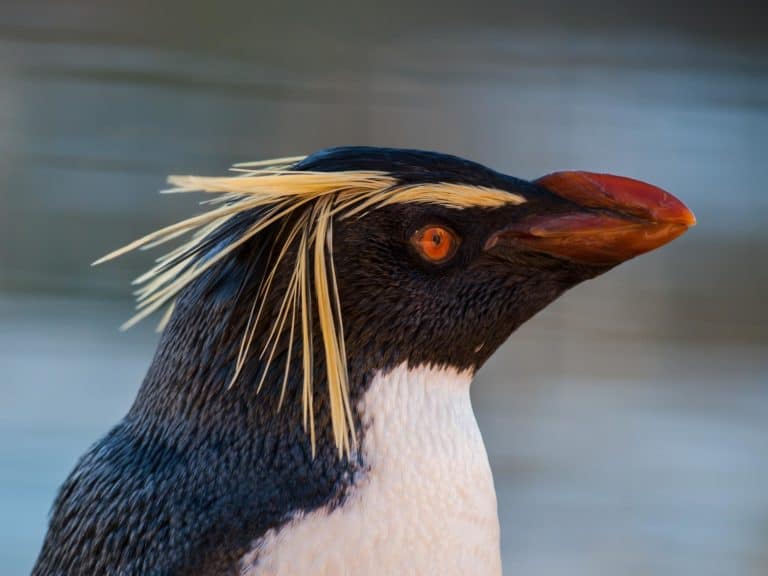
A close-up of a Rockhopper Penguin.

Rockhopper Penguins are excellent swimmers and are capable of diving to depths of 300 feet underwater

These penguins nest along rocky shorelines, hence the name rockhopper penguin. Most penguin species slide around on their bellies, but these penguins prefer to jump among the rocks where they live. They prefer dense patches of grass called tussocks for breeding and nesting.

Like most species of penguins, they are designed for swimming. They use their wings to propel themselves around in shallow water, though they are known to traverse to deeper waters as well. These penguins can dive up to 300ft below the surface and swim around 4mph underwater. When it is time to return to shore, rockhopper penguins can launch themselves out of the water and land on their bellies on the beach.

Habitat
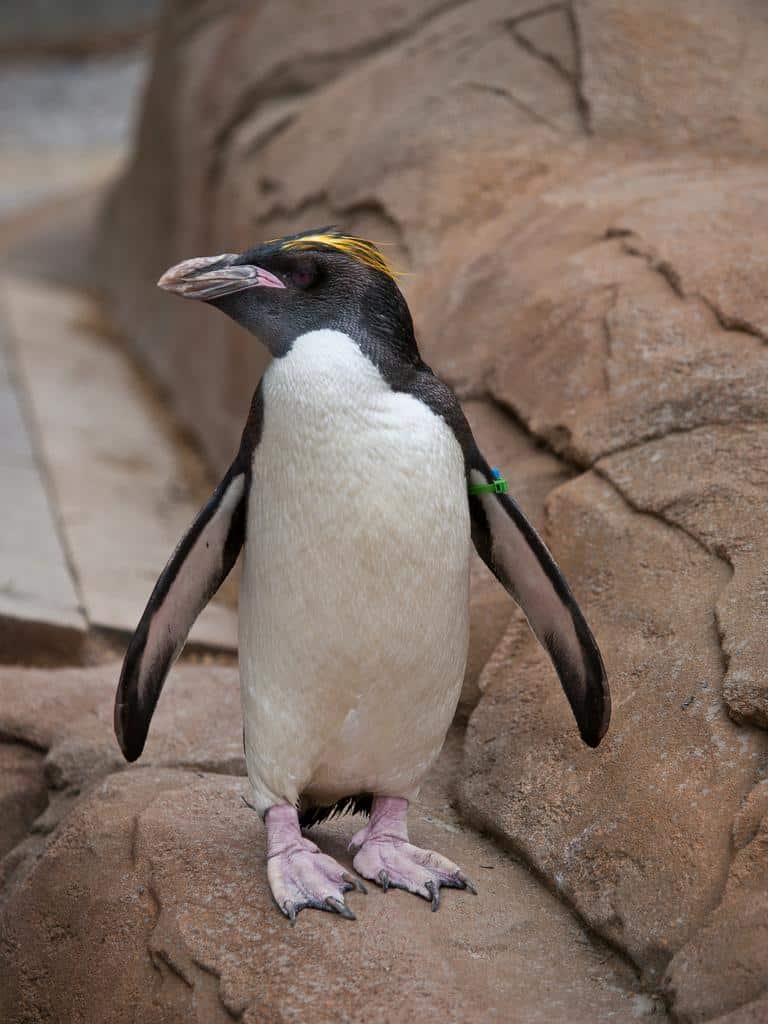
Rockhopper penguins can be found on islands surrounding Antarctica, New Zealand, and South America’s southern tip

All rockhopper penguins are found on islands surrounding Antarctica and New Zealand, as well as the southern tip of South America. The northern species of this penguin lives on Gough Island and Tristan da Cunha, as well as islands in the Indian ocean. The eastern variety of rockhopper penguin lives on the Auckland Islands and other islands surrounding New Zealand, as well as the southern French territories and Prince Edward Island and Marion islands in South Africa. The southern rockhopper penguin thrives on islands off the southmost coast of Chile and Argentina.

Diet
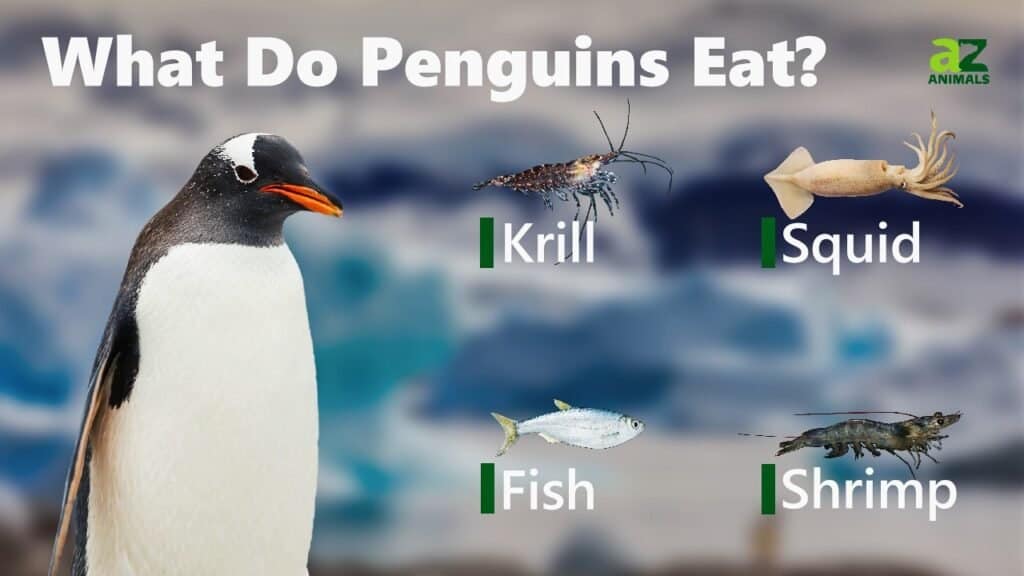
What Do Penguins Eat
Like most penguins, rockhoppers enjoy eating fish, shrimp, and krill

These penguins are carnivores, and their diet mostly consists of krill. They also partake in other small crustaceans as well as squid.

To hunt, these penguins will stay at sea for days at a time, diving deep for krill. They have a layer of fat that keeps them afloat and warm in the cold ocean. Rockhopper penguins, like other species of penguins, have a high density of feathers that overlap and lock out moisture. They have the most feathers of any bird species.

To further aid in hunting, the red eyes of this penguin can adjust so they can see both above and below the surface of the water. They can also sleep while afloat at sea.

Predators and Threats
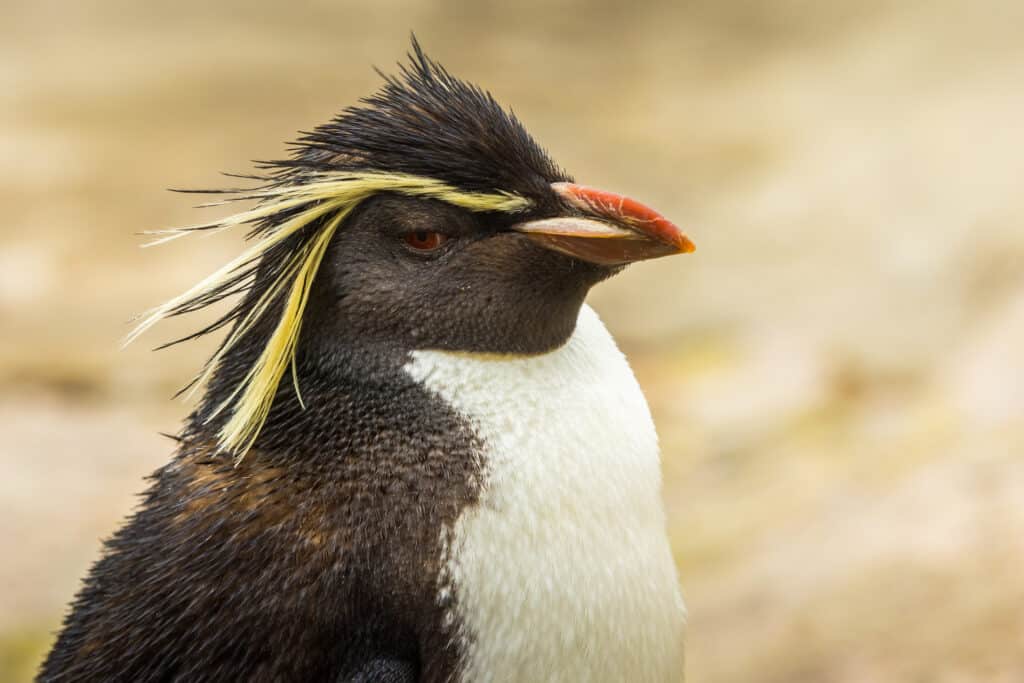
Northern Rockhoppers are hunted by orcas, sharks, and leopard seals

These penguins have no land-dwelling predators, but they have much to fear in the sea as well as from other species of birds. They fall prey to orca whales, blue sharks, fur seals, and leopard seals. Though these penguins fiercely defend their young, baby penguins often fall victim to shorebirds like fulmars, skuas, and kelp gulls.

Rockhopper penguins are threatened by humans as well. Their prey suffers from rising global temperatures due to climate change, so the penguins are in decline because they cannot find enough to eat. Overfishing and oil spills both contribute to the shortage of prey. These penguins can also accidentally be caught in fishing nets. Of the three species of these penguins, the northern variety is the most at risk.

Reproduction, Babies, and Lifespan
Rockhopper Penguin

Rockhopper penguins care for their chicks for about one month

The mating season for these penguins is in the early spring to late summer. Penguins arrive onshore, with male penguins typically arriving before the female penguins. Like most penguin species, they mate for life. The male and female pair try to find each other by calling each other. They typically locate the same nesting site they used in previous years. Males begin to breed at ages 4-5, while females start at ages 5-6. These penguins sit on their eggs for about four months. As the penguins nest in their tussocks, the parents take turns incubating the eggs. They are very aggressive and defend their eggs by pecking and squawking at anything that draws near.

Northern rockhopper penguins nest in smaller colonies than their southern counterparts. The size of northern penguin colonies ranges from about 25,000 to 65,000 individuals. Southern penguins, however, nest in colonies of up to 130,000 penguins. This difference might be the reason that southern penguins tend to have two chicks per season. The northern species lay two eggs, but under normal circumstances, only one survives.

The rockhopper penguin parents guard their babies, called chicks until they are about a month old. At this point, the chicks leave the tussocks to join other young penguins in protective groups called crèches. After they are about 66 days old, the penguins are ready to fend for themselves.

These penguins live to be about 10 years old in the wild. However, some of the oldest rockhopper penguins live to be 30 years old. As they age, they are more susceptible to predators.

Population

It is estimated that there are about 1.5 million pairs of these penguins worldwide. The species, especially the northern rockhopper penguin, has seen a decline over the last 30 years. The IUCN’s Red List of Threatened Species has classified the northern penguins as endangered due to rapid population decline, while the southern penguins are listed as “vulnerable.”

In the Zoo
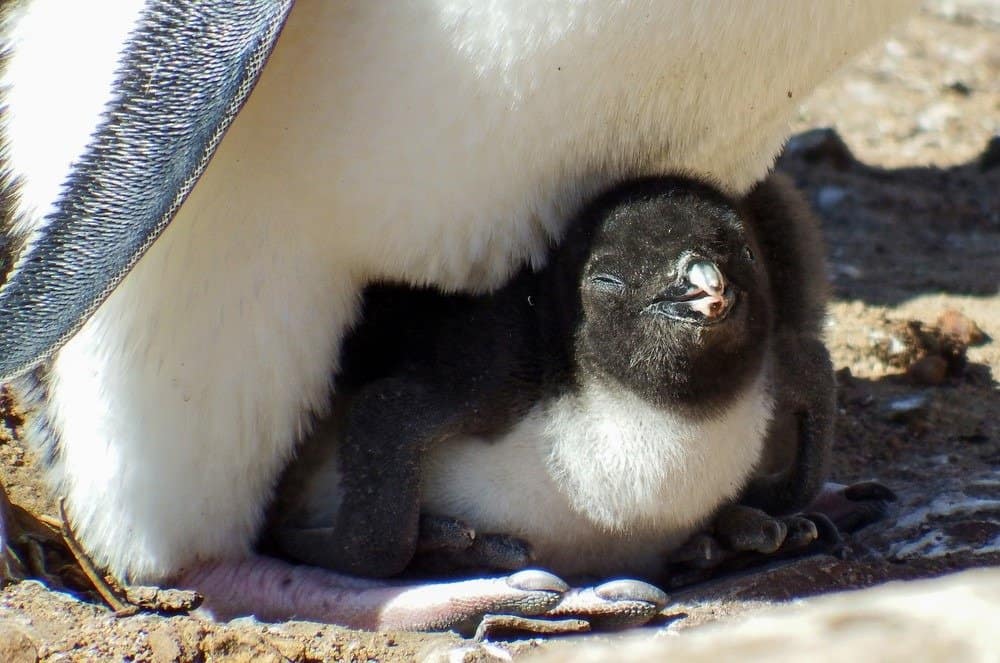
Rockhopper penguin chick enjoying the sun

Rockhopper penguins can be found in zoos across the United States

Currently, there are about 317 of these penguins in zoos across North America. Many prominent zoos feature these penguins, and they are found in many different aquariums as well.

At the Saint Louis Zoo, southern rockhopper penguins are found at their Penguin and Puffin Coast exhibit. The Cincinnati Zoo and Botanical Gardens have raised these penguin chicks. And the Indianapolis Zoo features these penguins in their Oceans exhibit and put on live demonstrations of penguin feeding, where guests can watch the penguins catch food underwater.

View all 181 animals that start with R

Sources

  1. David Burnie, Dorling Kindersley (2011) Animal, The Definitive Visual Guide To The World's Wildlife / Accessed August 3, 2010
  2. Tom Jackson, Lorenz Books (2007) The World Encyclopedia Of Animals / Accessed August 3, 2010
  3. David Burnie, Kingfisher (2011) The Kingfisher Animal Encyclopedia / Accessed August 3, 2010
  4. Richard Mackay, University of California Press (2009) The Atlas Of Endangered Species / Accessed August 3, 2010
  5. David Burnie, Dorling Kindersley (2008) Illustrated Encyclopedia Of Animals / Accessed August 3, 2010
  6. Dorling Kindersley (2006) Dorling Kindersley Encyclopedia Of Animals / Accessed August 3, 2010
  7. Christopher Perrins, Oxford University Press (2009) The Encyclopedia Of Birds / Accessed August 3, 2010
  8. National Geographic / Accessed November 9, 2020
  9. New England Acquarium / Accessed November 9, 2020
  10. Britannica / Accessed November 9, 2020
  11. Oceanwide Expeditions / Accessed November 9, 2020
  12. Center for Biological Diversity / Accessed November 9, 2020
  13. Saint Louis Zoo / Accessed November 9, 2020
Dana Mayor

About the Author

Dana Mayor

I love good books and the occasional cartoon. I am also endlessly intrigued with the beauty of nature and find hummingbirds, puppies, and marine wildlife to be the most magical creatures of all.
Connect:

Thank you for reading! Have some feedback for us?


Rockhopper Penguin FAQs (Frequently Asked Questions)

Rockhopper penguins are considered carnivores.