
S
Species Profile

Saola

Pseudoryx nghetinhensis

The Annamites' "spindlehorn" mystery
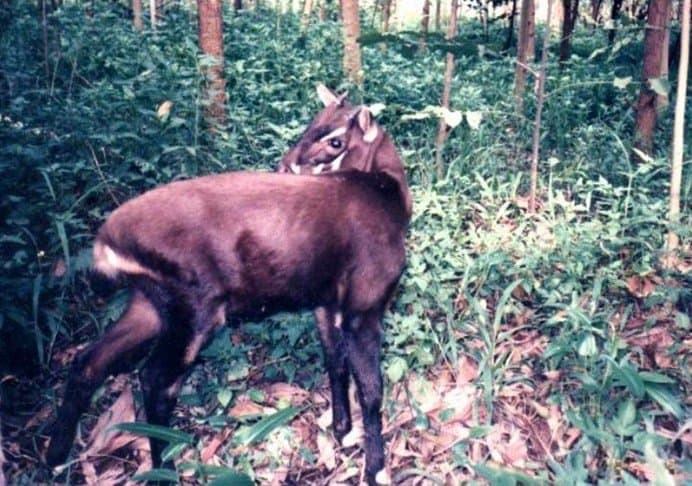
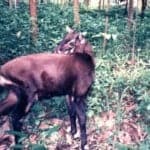
Silviculture at vi.wikipedia / Creative Commons

Saola Distribution

Click a location to explore more animals from that region

Endemic Species
Loading map...

Size Comparison

Human 5'8"
Saola 2 ft 9 in

Saola stands at 49% of average human height.

At a Glance

Wild Species
Also Known As Asian unicorn, Vu Quang ox, spindlehorn
Diet Folivore
Activity Diurnal+
Lifespan 12 years
Weight 100 lbs
Did You Know?

Science first learned of it via horn trophies in Vietnam/Laos in 1992; formally described as a new genus/species in 1993 (Dung et al., Nature 363:443-445).

Scientific Classification

The saola is a critically endangered wild bovid discovered by science in 1992, known from the Annamite Mountains. It resembles an antelope-like forest bovine with striking, straight, parallel horns and distinctive facial markings.

Kingdom
Animalia
Phylum
Chordata
Class
Mammalia
Order
Artiodactyla
Family
Bovidae
Genus
Pseudoryx
Species
Pseudoryx nghetinhensis

Distinguishing Features

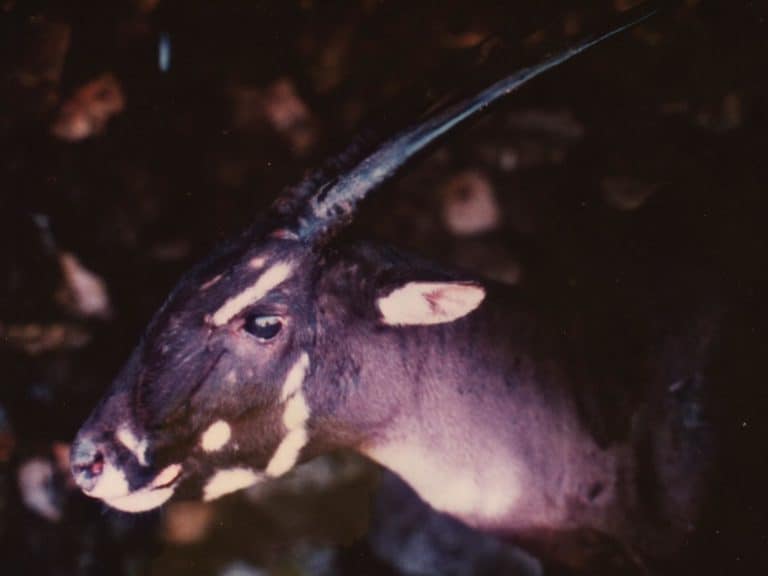
  • Long, straight, nearly parallel dark horns in both sexes
  • White facial markings and contrasting dark facial stripes
  • Compact, forest-adapted bovid body plan (not a true antelope)
  • Extremely elusive; known mostly from local knowledge, remains, and camera-trap images

Physical Measurements

Height
2 ft 9 in (2 ft 7 in – 2 ft 11 in)
Length
5 ft 8 in (5 ft 3 in – 6 ft 1 in)
Weight
198 lbs (176 lbs – 220 lbs)
Tail Length
9 in (8 in – 10 in)

Appearance

Primary Colors
Secondary Colors
Skin Type Mammalian skin covered in short, sleek hair; keratin horn sheaths on bony cores.
Distinctive Features
  • Endemic to the Annamite Mountains (Laos-Vietnam); first described by science in 1993 after 1992 discovery (Vu Van Dung et al., 1993).
  • Two straight, nearly parallel horns in both sexes; horn length commonly reported ~35-50 cm (Robichaud et al., 1999; IUCN Red List assessments).
  • Antelope-like forest bovid profile: compact body, relatively long legs, and narrow muzzle; not a cervid (family Bovidae).
  • Distinctive facial markings: dark stripes on the face with contrasting pale/white patches around lips and cheeks, creating a 'mask' effect (Robichaud et al., 1999).
  • Reported adult size from limited specimens: head-body length about 150 cm; shoulder height about 85-90 cm; mass roughly 80-100 kg (values compiled from early specimen reports; precision limited by few measured individuals).
  • Behavior (limited data): extremely elusive, likely solitary or in pairs; associated with wet evergreen forest and stream valleys; snaring is the dominant threat (IUCN).

Did You Know?

Science first learned of it via horn trophies in Vietnam/Laos in 1992; formally described as a new genus/species in 1993 (Dung et al., Nature 363:443-445).

It's so distinctive it was placed in its own genus: Pseudoryx (Dung et al., 1993).

Key ID trait: nearly parallel, straight horns typically ~35-50 cm long (measured from museum/specimen horns; Dung et al., 1993).

Known only from the Annamite Mountains of Vietnam and Laos-an exceptionally small global range for a large bovid (IUCN Red List).

It is listed as Critically Endangered; wire snaring for the bushmeat trade is identified as the dominant threat (IUCN Red List).

Very few have ever been seen alive by scientists; the best evidence often comes from camera traps and local ecological knowledge.

No long-term captive population exists; captured individuals have typically died within days to months, highlighting extreme sensitivity to captivity (IUCN/field reports).

Unique Adaptations

  • Parallel, straight horns: paired horns rise almost straight and close together-an unusual silhouette among bovids and a strong visual ID cue (Dung et al., 1993).
  • High-contrast facial markings: pale stripes/patches on a dark face likely aid species recognition in low-light forest understory (field descriptions; limited behavioral confirmation).
  • Large facial scent glands: enlarged gland openings on the muzzle/face suggest reliance on scent in dense forest where visibility is poor (Dung et al., 1993).
  • Forest-adapted body plan: compact, antelope-like forest bovid morphology suited to moving through thick understory (general morphological inference from specimens).

Interesting Behaviors

  • Extreme secretiveness: appears to use dense evergreen forest and avoids open areas; most records are indirect (tracks, horns, camera traps) rather than direct sightings (IUCN).
  • Likely solitary or in pairs: local reports and limited observations suggest single animals or mother-young rather than large herds (IUCN).
  • Scent communication: possesses prominent maxillary (facial) glands thought to be used for chemical marking/communication, as in many bovids (species descriptions; Dung et al., 1993).
  • Salt/mineral use: like many forest ungulates, it is suspected to visit natural mineral licks/river margins for salts (inferred from Annamite ungulate ecology; limited direct data for saola-treat as probable).

Cultural Significance

Saola (Pseudoryx nghetinhensis) was known to people in Vietnam and Laos before scientists described it; locals kept its horns as trophies. After 1992-1993 it became a symbol of Annamite biodiversity and urgent conservation, called the 'Asian unicorn' by the media, not from old local myths.

Myths & Legends

The Vietnamese name 'saola' (Pseudoryx nghetinhensis) means 'spindle horns.' It refers to the straight, close-set horns like spindle posts. Locals used the name and scientists later adopted it.

The Saola (Pseudoryx nghetinhensis) discovery became a modern legend in Annamite villages: hunters' tales and strange horns in homes made the 1992–1993 "found in plain sight" warning about hidden forest wildlife and fast biodiversity loss.

Among rangers and conservation groups, the saola (Pseudoryx nghetinhensis) is called an "Asian unicorn"—so rare it has a modern, legend-like status: people talk about and look for it but almost never see it.

Conservation Status

CR Critically Endangered

Facing an extremely high risk of extinction in the wild.

Population Decreasing

Protected Under

  • CITES Appendix I (international commercial trade prohibited)
  • Vietnam: Decree 06/2019/ND-CP (endangered wildlife management; exploitation prohibited for highest protection group)
  • Lao PDR: Wildlife and Aquatic Animals Law (2007; amended 2016)
  • Occurs within multiple protected areas in Vietnam and Laos, including Saola Nature Reserves and Annamite landscape protected areas

Life Cycle

Birth 1 calf
Lifespan 12 years

Lifespan

In the Wild
10–15 years
In Captivity
1–13 years

Reproduction

Mating System Data Deficient
Social Structure Solitary
Breeding Pattern Transient
Fertilization Internal Fertilization
Birth Type Internal_fertilization

Mating has never been directly observed; saola are thought to be largely solitary forest bovids, so encounters likely brief during estrus. As a placental mammal, reproduction involves internal fertilization; parental care is presumed mainly by the female.

Behavior & Ecology

Social Herd Group: 1
Activity Diurnal, Crepuscular
Diet Folivore tender young leaves from broadleaf understory plants (selective browsing; grasses generally not reported as a major food)

Temperament

Extremely shy and cryptic; avoids open areas and human activity (IUCN 2023).
Stress-sensitive: captive individuals showed high stress and short survival, limiting behavioral study (Robichaud et al. 1999).
As with many forest-dwelling bovids, saola are likely mostly solitary with brief pairing and occasional small groups, but evidence remains limited.

Communication

Snorts or explosive exhalations as alarm calls are plausible but not formally described Behavior inferred from Bovidae; IUCN 2023 notes data gaps
Low bleats/grunts likely used at close range; no published acoustic descriptions specific to saola IUCN 2023
Scent marking likely important: saola have prominent facial/maxillary glands used for chemical signaling Robichaud et al. 1999
Urine/feces deposition along travel routes, as in many bovids; unconfirmed for saola IUCN 2023 data deficient
Visual signals Body posture, head orientation, horn presentation) expected in close encounters; not systematically documented (Robichaud et al. 1999

Habitat

Biomes:
Tropical Rainforest Temperate Forest
Terrain:
Mountainous Hilly Valley Riverine
Elevation: 984 ft 3 in – 5905 ft 6 in

Ecological Role

Selective forest browser (small-bodied bovid) in Annamite evergreen forests

regulates understory plant growth through browsing pressure contributes to nutrient cycling via dung deposition in forest/riparian zones potential seed dispersal for some browsed plants via endozoochory (probable but not well quantified for this species) serves as potential prey for large sympatric predators (e.g., tiger/dhole) where still present, supporting trophic dynamics

Diet Details

Other Foods:
Young leaves of broadleaf understory shrubs and small trees Tender shoots and buds Herbaceous understory plants Ferns and soft non-woody forest plants

Human Interaction

Domestication Status

Wild

The saola (Pseudoryx nghetinhensis) is a wild bovid from the Annamite Mountains of Vietnam and Laos with no history of domestication or breeding. Human contact has been accidental (e.g., snares). First described in 1993 from specimens, live-captured saola usually die soon after and are very sensitive to stress; no captive population or full biological data exist.

Danger Level

Low
  • Generally shy, forest-dwelling; no known pattern of aggression toward humans.
  • Potential physical injury if a cornered animal uses horns defensively (theoretical risk shared by wild bovids).
  • Zoonotic risk is low/unknown; any handling of wild ungulates carries baseline risks (bites, scratches, ectoparasites), but no saola-specific human disease hazard is documented.

As a Pet

Not Suitable as Pet

Legality: The saola (Pseudoryx nghetinhensis) cannot be kept as a pet. It is Critically Endangered and protected by laws in Vietnam and Laos and by CITES; private ownership is almost always illegal.

Care Level: Expert Only

Purchase Cost:
Lifetime Cost:

Economic Value

Uses:
Subsistence/illegal bushmeat (incidental take) Illegal wildlife trade (rare; horns/trophies reported opportunistically) Conservation/flagship species value (funding, protected-area justification) Scientific value (biodiversity discovery, evolutionary/biogeographic importance)
Products:
  • Meat (from illegal or incidental killing)
  • Horns/skull (trophy/curio in opportunistic cases)
  • Non-consumptive value: conservation branding and research attention (no physical product)

Relationships

Related Species 8

Saola
Saola Pseudoryx nghetinhensis Shared Genus
Gaur Bos gaurus Shared Family
Banteng Bos javanicus Shared Family
Kouprey
Kouprey Bos sauveli Shared Family
Wild water buffalo Bubalus arnee Shared Family
Lowland anoa Bubalus depressicornis Shared Family
Nilgai
Nilgai Boselaphus tragocamelus Shared Family
Four-horned antelope Tetracerus quadricornis Shared Family

Ecological Equivalents 5

Animals that fill a similar ecological role in their ecosystem

Mainland serow Capricornis sumatraensis Forest-dwelling bovid in mainland Southeast Asia that uses rugged montane to hill evergreen forests and browses understory vegetation. Often sympatric or parapatric with saola in the Annamite region; shares a similar anti-predator strategy (cryptic, solitary) and similar habitat use along steep terrain and valleys.
Gorals
Gorals Naemorhedus spp. Small, secretive caprine bovids occupying steep forested slopes and cliffs. Niche overlap via montane forest-edge browsing and use of rocky escape terrain, broadly analogous to the saola's inferred preference for remote, rugged Annamite forest landscapes.
Red muntjac Muntiacus muntjak Solitary or paired, crepuscular browser in dense evergreen forests; overlaps in diet (browsing on woody vegetation and forbs), uses concealment-based anti-predator behavior, and frequently occupies valley bottoms and riparian forest areas — habitats often associated with saola signs (tracks and latrines) in Annamite surveys.
Sambar deer Rusa unicolor Large forest ungulate occupying tropical evergreen forest and riparian habitats. Fulfills a similar browser-grazer functional role in SE Asian forests and can overlap in the predator guild (tiger, leopard, dhole), though sambar is generally more widespread and often more grazing-inclined.
Lesser mouse-deer Tragulus kanchil Small, extremely cryptic forest ungulate occupying dense understory; shares microhabitat reliance (closed-canopy forest cover and thick undergrowth) and concealment strategies, providing an ecological analogue for how saola may persist via low detectability.

Classification and Evolution

The Saola is a species of Antelope natively found in the forests on the border of north-central Vietnam and Laos. They are one of the most recently discovered large mammals in the world but are now also believed to be one of the rarest with estimated population numbers of just in the tens of individuals.

Although the Saola is an animal that closely resembles the Arabian Desert Antelopes, they are thought to be more closely related to Wild Cattle. The Saola is such a distinctive and unique animal, that after their discovery in 1992, they were given a taxonomic group of their own.

They are incredibly rare and elusive mammals, and still today, very little is actually known about the Saola. The Saola animal is also known as the Asian Unicorn, which is not thought to be particularly related to its long horns, but more the fact that it is just so rare.

Anatomy and Appearance

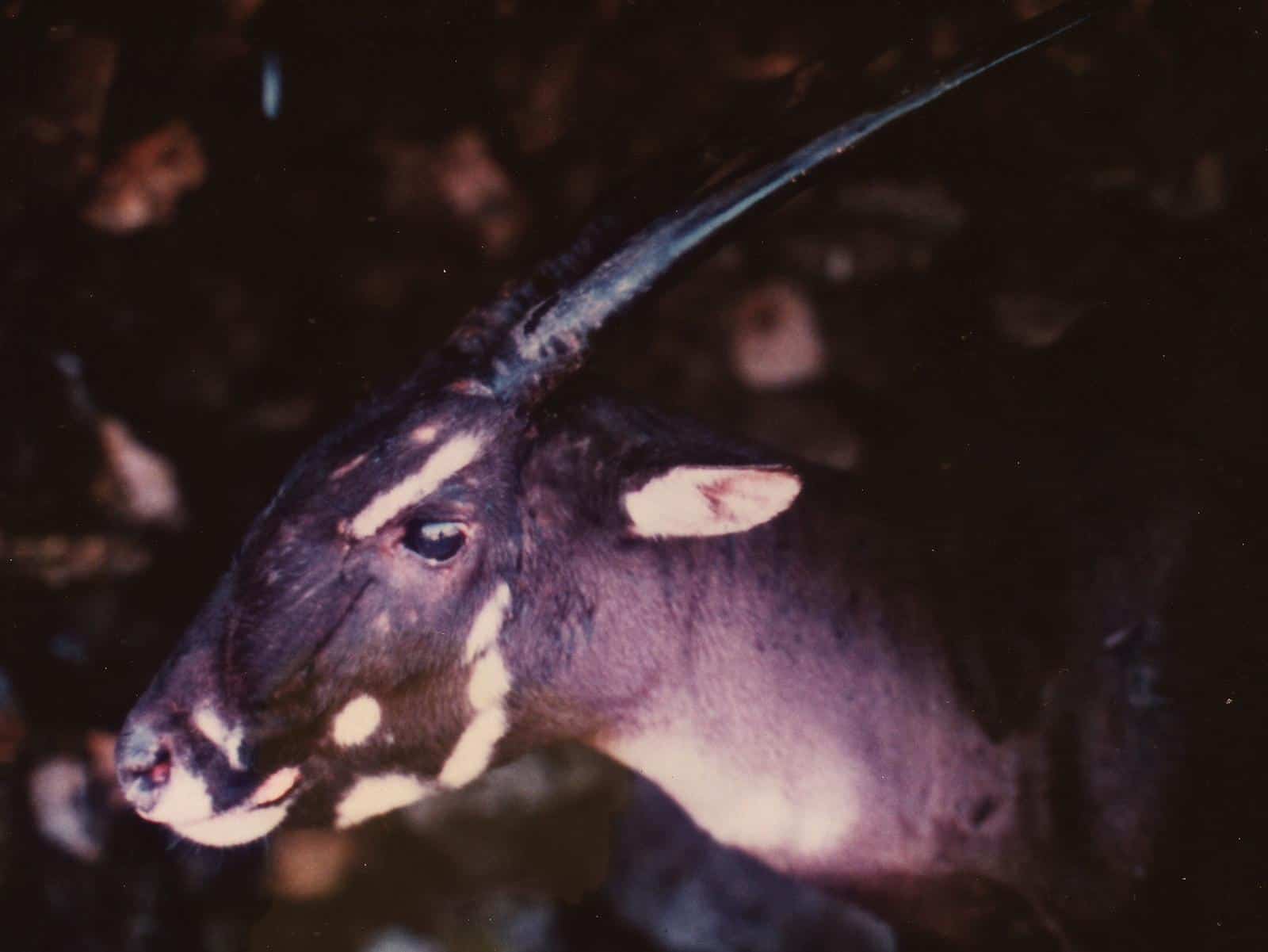
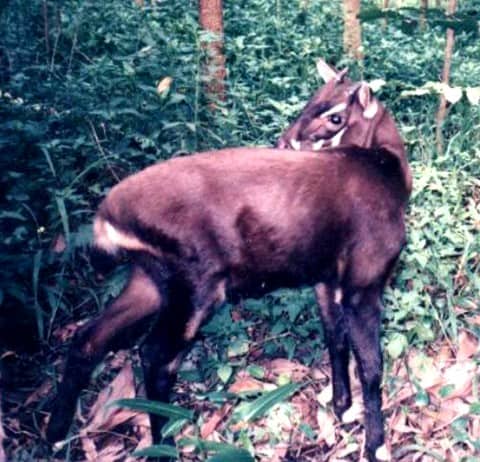
The Saola animal is one of the most distinctive Antelope species in the world, with its most characteristic feature being the long and sharply-pointed horns that sit parallel on top of the animal’s head. These smooth horns are found in both males and females of the species and can grow up to 50cm in length.

The body of the Saola animals ranges in color from chestnut brown to red, to almost black, with a dark, narrow stripe running along the back which ends in a small and fluffy black tail. The legs of the Saola are also black in color, but it is on their face that their most distinctive white markings are found.

The Saola’s fur is relatively thin and notably soft and covers their thick skin which is thought to help to protect them from being too badly injured from the horns of other individuals.

Distribution and Habitat

The Saola is an animal that is thought to be found in what forest still remains in the Annamite Mountains that sit on the border between north-central Vietnam and neighboring Laos. Although they are thought to exist in certain areas, no one really knows for sure due to the lack of a proper formal survey.

They have however been noted in 15 small pockets of forest between the two countries, generally at a mid-altitude range (between 400 meters and 1,000 meters above sea level).

The Saola animal is most commonly found in dense, evergreen forests that are moist and have a good source of running water. Locals claim that the Saola spends its summer months further up the alpine slopes, venturing down during the winter when the water sources higher up have run dry and there is therefore also less to eat.
Animal Behavior and Lifestyle

The Saola is thought to be a diurnal animal meaning that they are most active during the daylight hours, possibly resting out of sight to protect themselves from predators under the cover of night.

They are thought to lead a generally solitary lifestyle, although reports of small groups of Saola are not unknown. These most commonly contain either two or three individuals, but claims from villagers suggest that they can congregate in herds of up to seven members.

Male Saola is thought to be highly territorial and to roam a much larger range than their female counterparts, though, are believed to mark their territory using a sticky, smelly liquid that is secreted from their large maxillary glands. They are believed to be alpine migrants in certain areas, following the water supplies up and down the slopes.

Reproduction and Life Cycles

The Saola breeding season appears to coincide with the start of the rainy season which is around February to March in Vietnam and between April and June in neighboring Laos. Males are thought to find a female that often co-inhabits a small part of the male’s range.

After mating, females are thought to give birth to a single calf (much in the same way as other Bovine species) after a gestation period that is thought to last for between 7 and 8 months. Females have four nipples on their undersides where the young can suckle milk but very little is still known about the reproduction or the general life cycle of the elusive Saola. They are thought to live for between 8 and 11 years in the wild.

Diet and Prey

Like all other Antelope species and indeed Cattle, the Saola is a herbivorous animal that survives on a diet that is solely comprised of plants and plant matter. Although very few records exist on the Saola in their natural environment, they are thought to primarily feed on the leaves of figs and other trees and bushes, that grow along the moist riverbanks.

The Saola animal is also thought to feed on fruits, seeds, and berries from these plants, along with munching on grasses and herbs that grow on the ground, rather than above it. They are known to be browsing animals that nibble from plant to plant throughout their habitat and are nearly always found close to a source of fresh, running water such as a small slow-moving river or mountain stream.

Predators and Threats

Although very little is still known about the rare Saola living deep in the jungles, they are thought to be mainly preyed on by larger animals including Tigers and Crocodiles where they share their habitats. The biggest threat to the Saola, however, is the hunting of them for their horns which are a prized trophy amongst locals.

Not only that but they are also commonly caught in traps that are set for other animals and have been severely affected by habitat loss through both deforestation and growing Human settlements in the fertile lowlands around the base of the mountains, where they would have once most commonly roamed.
Interesting Facts and Features

The Saola is one of the most recently discovered large mammals, as it was first known to science as recently as May 1992. During a joint survey that was conducted by the Ministry of Forestry of Vietnam and WWF, the unique horns of the Saola were spotted in the houses of local hunters, which led to an investigation into the animal and the areas in which it lived.

Nearly all of the information that exists on the Saola animal actually comes from 13 individuals that were held in captivity (6 in Vietnam and 7 in Laos) after their discovery and from reports by local villagers. Sadly however, all but two of these Saola individuals died whilst being studied and there are no Saola found in captivity anywhere in the world as they do not seem to survive at all well in conditions outside of those that they have naturally adapted and evolved to.

Relationship with Humans

The Saola was once thought to actually primarily inhabit more lowland forests towards the base of the mountains. However, with growing Human settlements, they have been pushed higher and higher up the slopes and are now unable to enter much of their historical forests as they simply no longer exist. Having been hunted specifically as a species by Humans in the past, today hunters are still among the Saola’s biggest threats.

As a protected species, they cannot be hunted but often get caught in snares and traps that are set up in the forests where they exist, mainly to catch Wild Boar and Deer. Despite this though, extensive work is being done throughout much of their natural range to ensure that they more commonly exist in areas of protected forest that are not at as much risk from hunting and poaching.

Conservation Status and Life Today

Today, the Saola animal is listed by the IUCN as being an animal that is Critically Endangered in its natural environment. Despite the fact that no formal survey has been conducted, the IUCN estimates that populations could have been as low as 250 when the Saola was first recorded in the summer of 1992, a number that is thought to have dropped significantly since then due to the increased growth of Human settlements.

WWF claims that the rareness, distinctiveness, and uniqueness of the Saola, make it one of the greatest priorities for conservation in the Indochina region today. A small 61 square-mile reserve has just been set up in the Quang Nam province in central Vietnam, specifically to try and protect the dwindling populations of Saola today. Learn more about the most endangered species on the planet here.
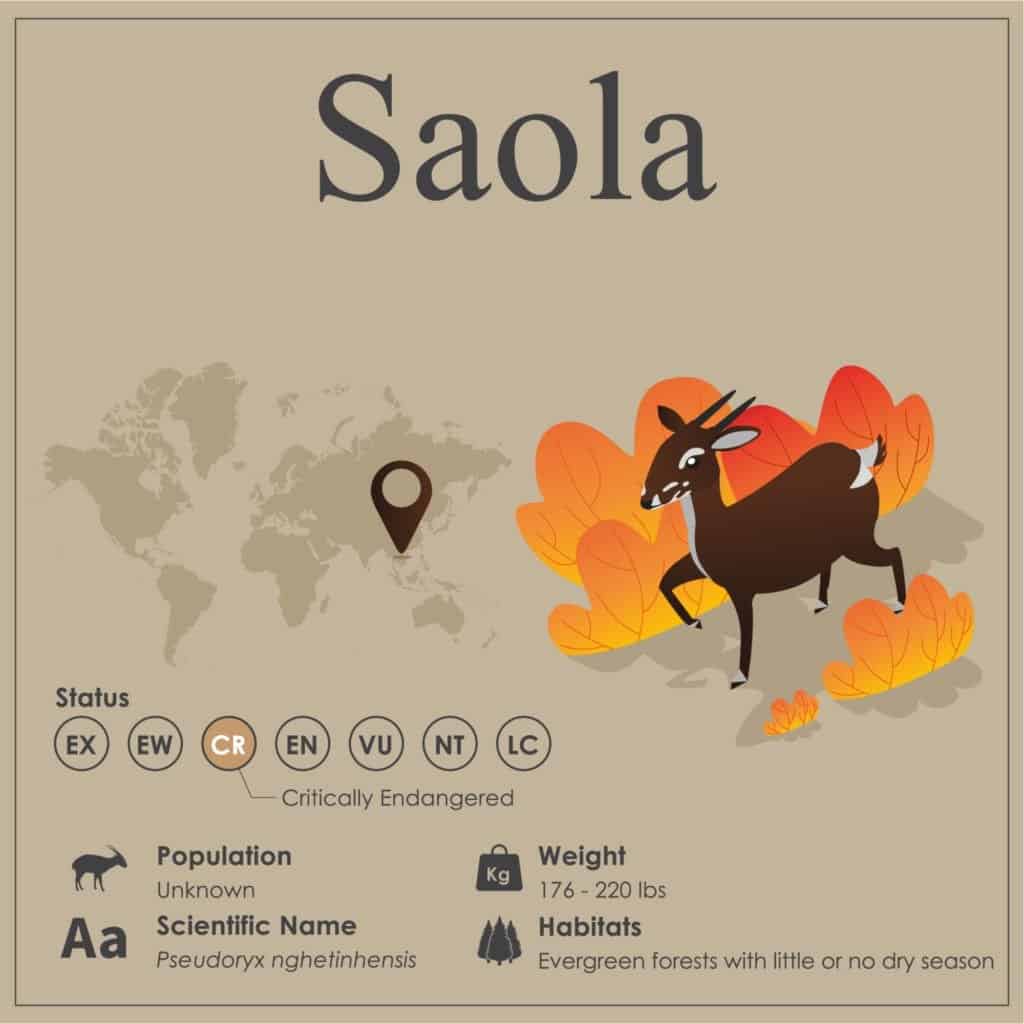
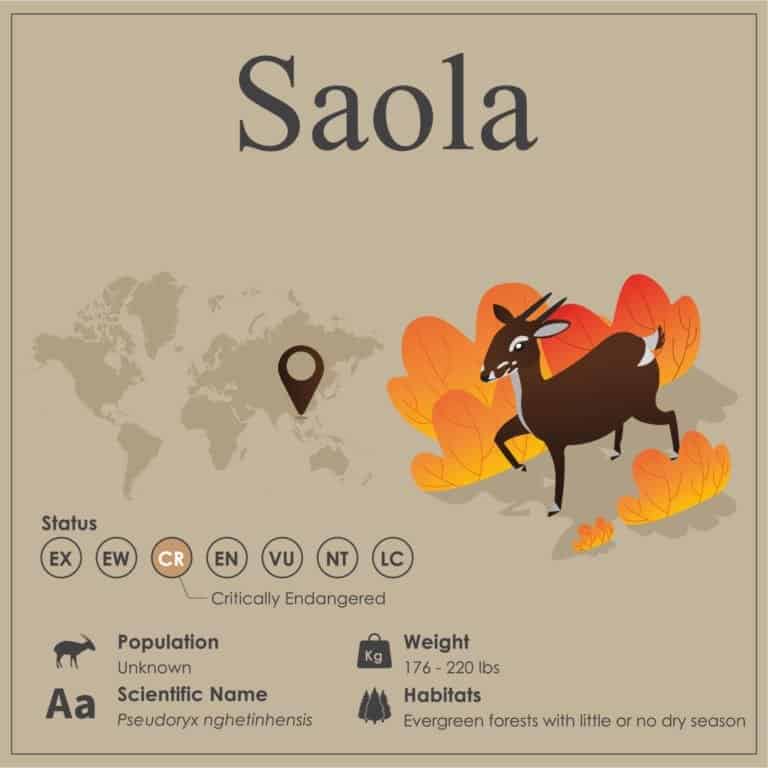
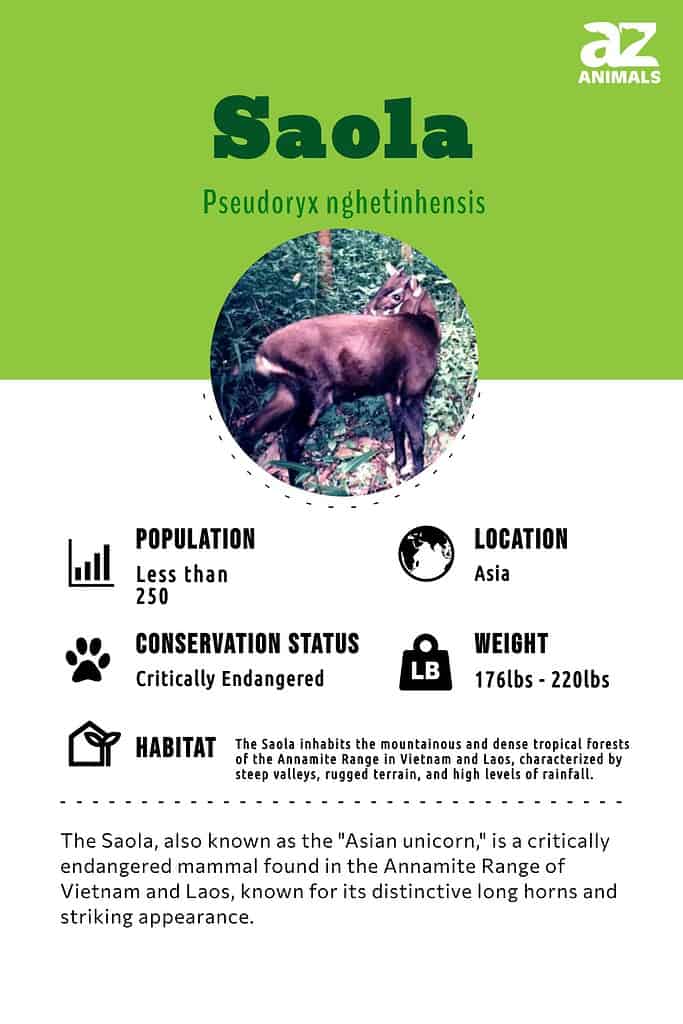
Saola Endangered Species Infographic

The Saola is one of the earth’s most threatened species

View all 390 animals that start with S
How to say Saola in ...
Danish
Saola
German
Vietnamesisches Waldrind
English
Saola
Spanish
Pseudoryx nghetinhensis
Finnish
Saola
French
Saola
Hebrew
סאולה
Hungarian
Vietnami antilop
Italian
Pseudoryx nghetinhensis
Japanese
サオラ
English
Saola
Polish
Saola
Portuguese
Pseudoryx nghetinhensis
Swedish
Vietnamantilop
Vietnamese
Sao la
Chinese
中南大羚

Sources

  1. David Burnie, Dorling Kindersley (2011) Animal, The Definitive Visual Guide To The World's Wildlife / Accessed April 20, 2011
  2. Tom Jackson, Lorenz Books (2007) The World Encyclopedia Of Animals / Accessed April 20, 2011
  3. David Burnie, Kingfisher (2011) The Kingfisher Animal Encyclopedia / Accessed April 20, 2011
  4. Richard Mackay, University of California Press (2009) The Atlas Of Endangered Species / Accessed April 20, 2011
  5. David Burnie, Dorling Kindersley (2008) Illustrated Encyclopedia Of Animals / Accessed April 20, 2011
  6. Dorling Kindersley (2006) Dorling Kindersley Encyclopedia Of Animals / Accessed April 20, 2011
  7. David W. Macdonald, Oxford University Press (2010) The Encyclopedia Of Mammals / Accessed April 20, 2011
  8. Saola Information / Accessed April 20, 2011
  9. Saola Conservation / Accessed April 20, 2011
  10. Saola Facts / Accessed April 20, 2011
Rebecca Bales

About the Author

Rebecca Bales

Rebecca is an experienced Professional Freelancer with nearly a decade of expertise in writing SEO Content, Digital Illustrations, and Graphic Design. When not engrossed in her creative endeavors, Rebecca dedicates her time to cycling and filming her nature adventures. When not focused on her passion for creating and crafting optimized materials, she harbors a deep fascination and love for cats, jumping spiders, and pet rats.
Connect:

Thank you for reading! Have some feedback for us?


Saola FAQs (Frequently Asked Questions)

Saolas are Herbivores, meaning they eat plants.