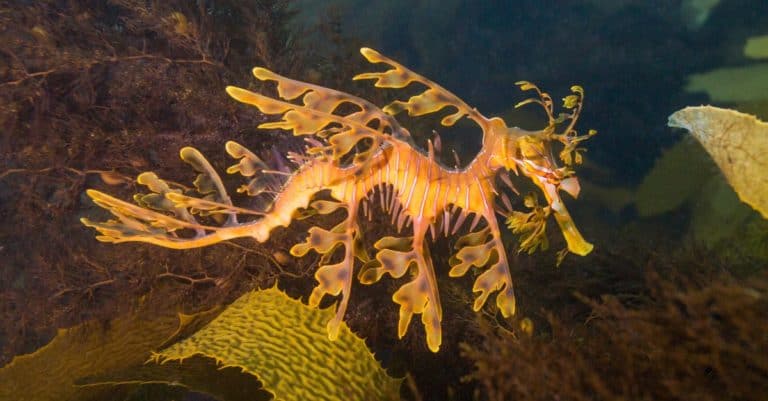
While their names may not suggest it, sea dragons are fish that are poor swimmers who typically drift with the currents instead of putting forth the effort to swim. This often bright-colored fish lives in the ocean around Australia and Tasmania. They rely on their camouflage to protect them from predators and survive by eating tiny prey, such as small fish and crustaceans — even though they have no teeth.
Scientific Name
Three different types of sea dragons have been identified. The first of these is the leafy sea dragon, Phycodurus eques. Phycodurus comes from the Latin words “phyko,” meaning seaweed, and “oura,” meaning tail. The term eques is from the Latin “equus,” meaning horse.
The second type of sea dragon is the weedy sea dragon, Phyllopteryx taeniolatus, also sometimes called the common sea dragon. The first part of its scientific name comes from the Greek words for leaf, “phyllon,” and the word for a fin or wing, “pteryx.” The second part of its name is based on the Latin word “taeniolar,” meaning ribbons.
Finally, the third known species of sea dragon is the ruby sea dragon, Phyllopteryx dewysea. The first part of its name is the same as that of the weedy, or common, sea dragon. The second part of its scientific name, dewysea, honors a longtime sea dragon supporter and researcher, Mary “Dewy” Lowe, with the word “sea” included because of her deep love of the sea.
Evolution And History
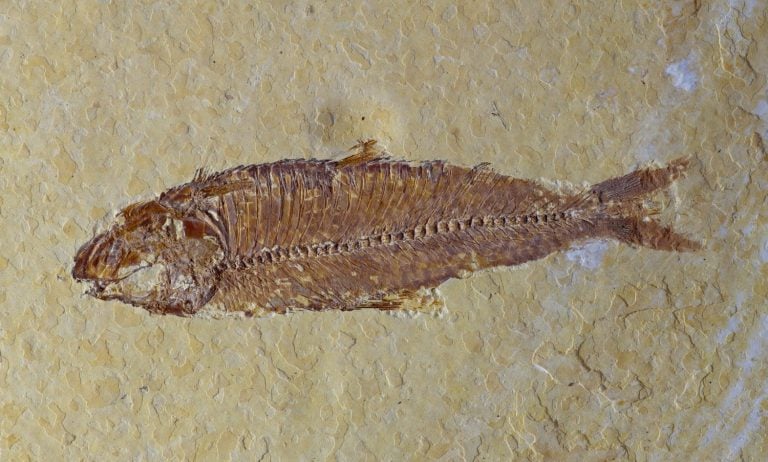
The oldest recorded fossil of a sea dragon was from more than 180 million years ago and was 33 feet long, leading researchers to believe that the ancestors were much larger than the species we see today. The leafy seadragon is part of the larger family Syngnathidae, which also includes seahorses and pipefish, although there are only three known species of sea dragons, making them incredibly rare.
It is believed that they evolved their features fairly quickly, due to repetitive DNA sequences that are called jumping genes.
Appearance And Behavior
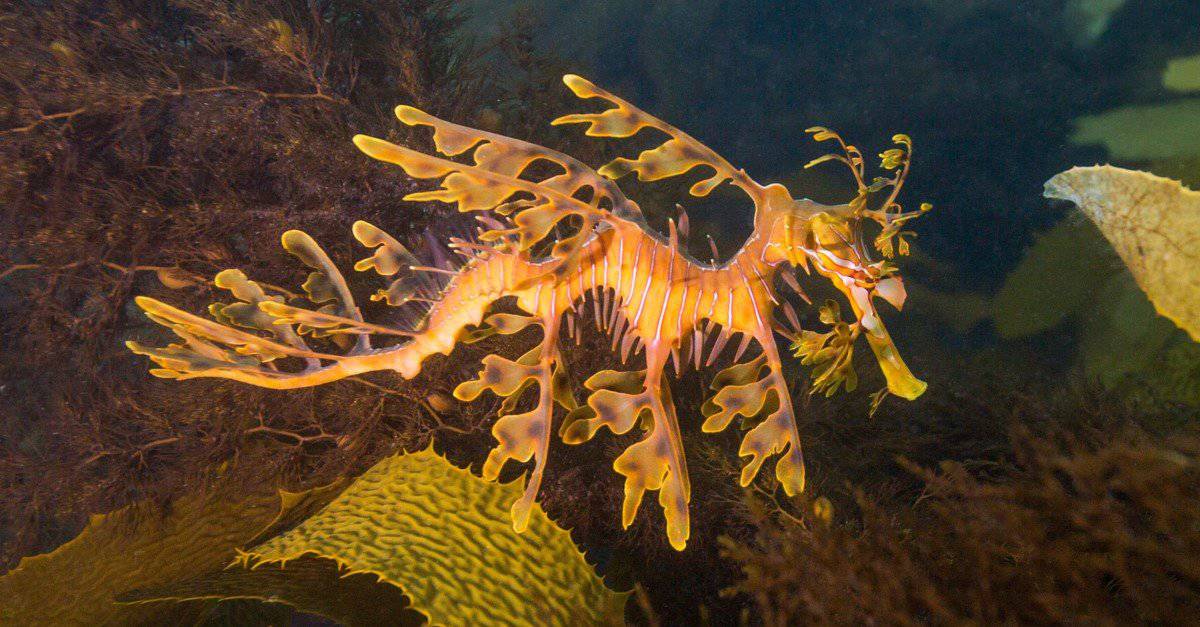
Leafy Sea dragons do not have any predators. Their combination of excellent camouflage, tough jointed plates, and sharp dorsal spines offers adequate protection.
©AshtonEa/Shutterstock.com
These animals are a type of pipefish, with long, narrow bodies and tails. They also have camouflage to help protect them from predators. For example, the leafy sea dragon’s body is covered with leaf-like appendages that help it to hide in seaweed and kelp. Its coloring is yellow to brown, with olive-colored spots that add to its ability to hide in the underwater plants where it makes its home.
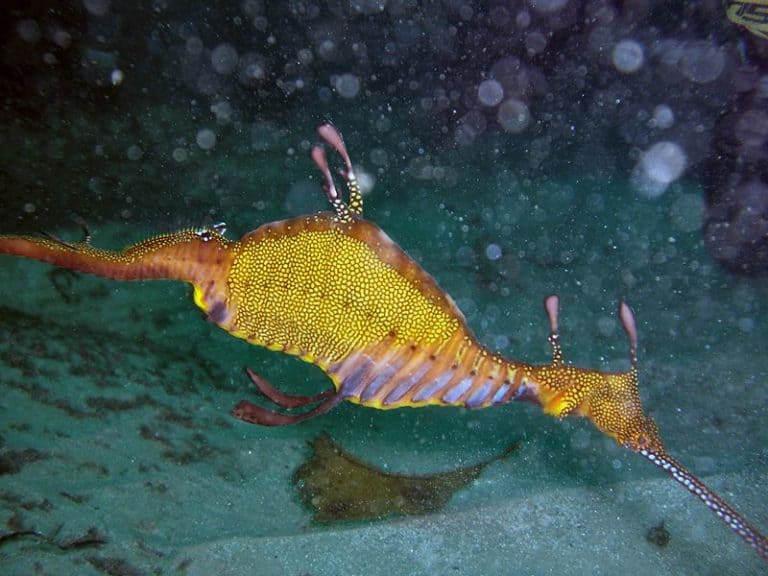
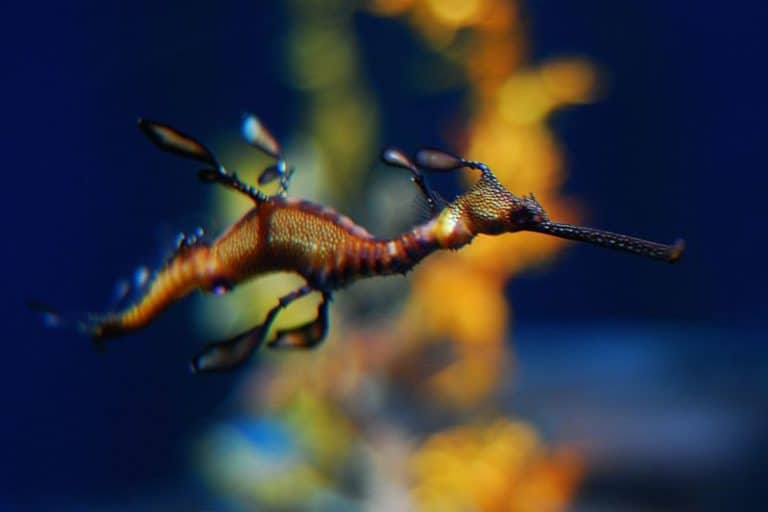
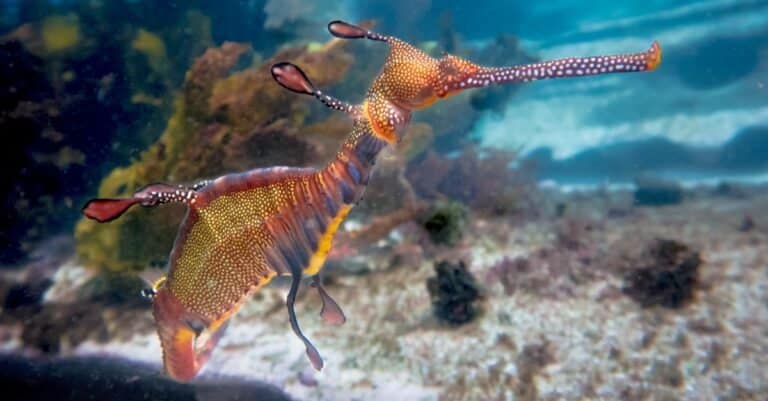
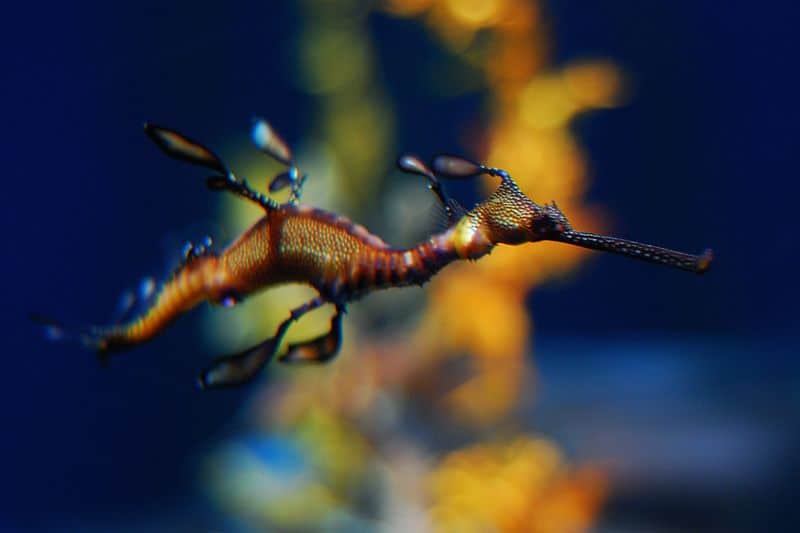
Conversely, the weedy sea dragon has just a few appendages, but these are just enough to break up its outline and help it to blend in with its environment. This fish typically lives on the ocean floor rather than in seaweed and kelp, with reddish coloring and yellow spots or markings.
The ruby sea dragon is a deep red color with just a few very short, stubby appendages. Not much is known about this sea dragon, but scientists think that its color helps to hide it in the deeper water where it lives because red is almost invisible in the depths of the ocean.
All three types of these animals tend to drift with the currents because they are not strong swimmers. They hide and wait for their prey, ambushing it when it gets close to them rather than chasing down their food. They do have small fins along their backs and sides that they can use for propulsion, but these nearly invisible fins aren’t very powerful and are mostly used for maneuvering and slow swimming. Neither the leafy nor the weedy sea dragons have prehensile tails, meaning they can’t hold onto branches or anything else with their tails, but ruby sea dragons do have prehensile tails and use them to keep themselves in one spot when they choose to do so.
Sea dragons are shy, solitary fish that do not live in large schools, though they have been observed living in pairs. Most of the time, they float freely in the water without making any effort to control where they are going, looking more like bits of seaweed than fish. Individuals vary greatly in length, but in general, sea dragons can reach up to 18 inches in length, a bit longer than the height of a bowling pin. Leafy sea dragons are smaller than weedy sea dragons.
Habitat
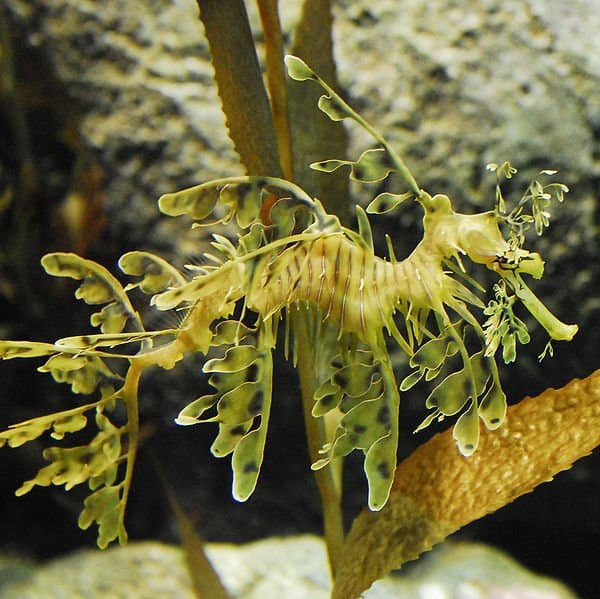
Sea Dragons live in shallow, coastal waters but may be found at depths of up to 150 feet.
©EyeKarma (original photograph); Papa Lima Whiskey (derivative edit) / public domain – Original / License
These animals are only found in the ocean near Southern and Western Australia and around Tasmania. For the most part, they live in shallow, coastal waters, but may be found at depths of up to 150 feet. Ruby sea dragons have been found living in much deeper water than the other species, which may be why they were not discovered until recently. All sea dragons live in or near seaweed, kelp forests, along rocky reefs, or in and around seagrass beds, though they also often drift freely in and around the ocean plant life.
However, the similar-looking seahorse is much more widespread and includes 46 recognized species.
Diet
These animals are carnivores, but are limited to what they can eat because their mouths form long tubes and they do not have jaws that open. Sea dragons wait in hiding for their prey, ambushing and eating any creatures small enough to fit in their mouths. They eat fish larvae, tiny crustaceans, very small fish, sea lice, mysid shrimp, worms, and zooplankton.
They swallow their food whole because they lack working jaws for chewing, plus they have no teeth. To capture their prey, they use powerful suction from their jaws that sucks in the victim. They must consume everything they eat as though they were drinking it through a straw. Once it’s in their mouths, the sea dragons can swallow their prey whole.
Predators And Threats
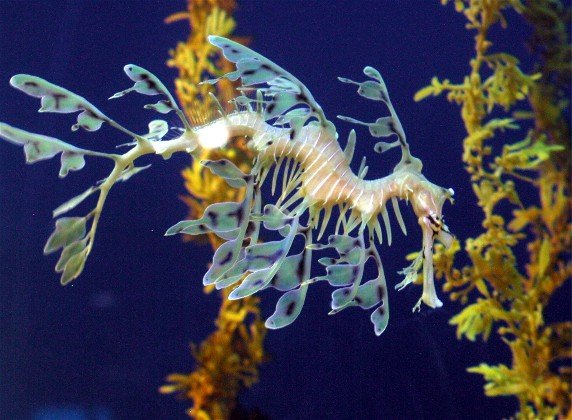
Sea Dragons aren’t appealing to predators because they are very bony.
©Wendy Rathey / Creative Commons – Original
It is unknown which, if any, predators these animals have to fear. Scientists think that the sea dragons’ camouflage helps them to avoid drawing attention to themselves, so they are not as much of a target as many other species. They are also quite bony, possibly making them less appealing to predators than many other fish. However, if a predatory fish such as a shark happens upon them, it is still likely to make a meal of them since sea dragons have no defense except for their ability to hide. Almost anything will consume babies, as they lack the camouflage of the adults, plus they hatch all at once, so they’re easy for predators to find. Not many of the young survive to adulthood.
The main threat to the continued existence of these animals is the destruction of their habitat, mainly the loss of seaweed and seagrass beds. This is caused by human activity, especially pollution, as well as changes brought about by global warming. These animals have also been harvested by humans to be kept as aquarium pets, an activity that has severely diminished the population. In the 1990s, laws were enacted in most places where sea dragons are found that protected them, and at this point, the population appears fairly stable. Sea dragons do sometimes end up entangled in fishing nets and usually die as a result, but this doesn’t generally kill large numbers of them.
The population numbers for these animals seem adequate to support them in the wild at this time, but it is possible that this could change if the loss of habitat continues.
Reproduction, Babies, And Lifespan
Once a couple has formed, they will stay together until their eggs are laid.
©Fernando Estel / Creative Commons – Original
Very little is known about the mating rituals of these animals. They do appear to have a courtship of some sort where the male approaches the female when it is time to breed. It is unknown just what triggers mating behavior in them, though. However, it is believed males may fight other males for the right to breed.
When the time is right, the female deposits her pink eggs on a spongy patch of skin under the male’s tail. He fertilizes them as they are deposited. She will lay anywhere from 100 to 300 eggs at a time. The male’s skin forms tiny cups to hold the eggs in place, keeping them safe and oxygenated until they hatch. This can take anywhere from four to eight weeks, depending on the conditions, especially water temperature. The warmer the water, the sooner the eggs will hatch. Once a couple has formed, they will stay together until the eggs are laid.
When the babies (also called fry) hatch, they look like tiny versions of their parents, except that they lack any of the camouflaging appendages the adults have. The appendages start growing soon after birth, but they won’t do the new hatchlings any good for at least a few days. Since the male’s job is done as soon as the babies hatch, and the female has left long before, the young get no care or adult protection from the moment they emerge into the world. The lack of both camouflage and parental care makes the new babies easy targets for predators and results in a high rate of mortality.
The lifespan of these animals is anywhere from three to ten years, with six being the average age for them. They can breed when they are around a year old, but it is more common to wait to breed until they are sexually mature at about two years of age.
Population
There has never been an accurate count of the population of these animals, and it is unknown how many of them exist in the wild. The leafy sea dragon’s numbers are currently endangered due to a loss of habitat as a result of pollution, human destruction, and dangerous fishing practices. There is a special concern for these fish because they inhabit such a limited range, so if their habitat is damaged or destroyed, they are likely to die rather than relocate.
Sea Dragon Pictures
View all of our Sea Dragon pictures in the gallery.

Sources
- David Burnie, Dorling Kindersley (2011) Animal, The Definitive Visual Guide To The World's Wildlife / Accessed December 21, 2009
- Tom Jackson, Lorenz Books (2007) The World Encyclopedia Of Animals / Accessed December 21, 2009
- David Burnie, Kingfisher (2011) The Kingfisher Animal Encyclopedia / Accessed December 21, 2009
- Richard Mackay, University of California Press (2009) The Atlas Of Endangered Species / Accessed December 21, 2009
- David Burnie, Dorling Kindersley (2008) Illustrated Encyclopedia Of Animals / Accessed December 21, 2009
- Dorling Kindersley (2006) Dorling Kindersley Encyclopedia Of Animals / Accessed December 21, 2009
- Science Alert / Published June 29, 2022 / Accessed March 17, 2023