S
Species Profile

Sea Urchin

Echinoidea

Spines, jaws, and ocean power
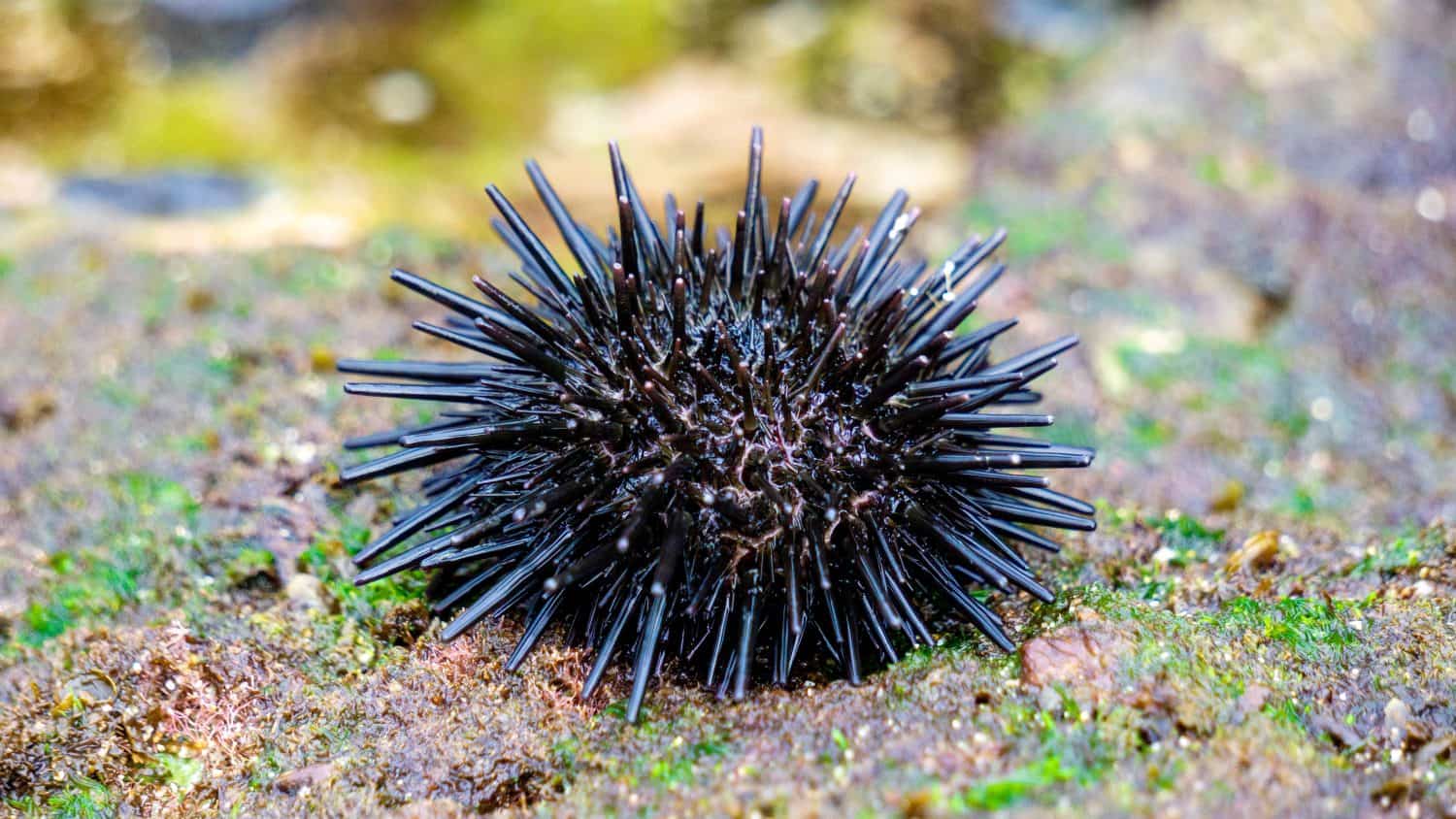
Mang Kelin/Shutterstock.com

Sea Urchin Distribution

Click a location to explore more animals from that region

This map shows coastal regions where Sea Urchin are found.

Loading map...

Size Comparison

Human 5'8"
Sea Urchin 2 in

Sea Urchin stands at 2% of average human height.

Sea urchin (Landak laut, bulu babi). About 950 species of sea urchin are distributed on the seabeds of every ocean

At a Glance

Class Overview This page covers the Sea Urchin class as a group. Stats below are general traits shared across the class.
Also Known As Sea egg, Sea hedgehog, Uni, Echinoid
Diet Omnivore
Activity Nocturnal+
Lifespan 20 years
Weight 5 lbs
Status Not Evaluated
Did You Know?

The class includes "classic" round urchins plus sand dollars and heart urchins (all Echinoidea).

Scientific Classification

Class Overview "Sea Urchin" is not a single species but represents an entire class containing multiple species.

Sea urchins are echinoderms in Class Echinoidea, characterized by a hard calcareous test (shell) covered with movable spines and tube feet. Most are marine benthic grazers, though diets range from algae and detritus to omnivory.

Kingdom
Animalia
Phylum
Echinodermata
Class
Echinoidea

Distinguishing Features

  • Hard, globular to flattened test made of fused calcareous plates
  • Movable spines for defense and locomotion
  • Five-fold radial symmetry typical of echinoderms (often subtle externally)
  • Tube feet operated by a water vascular system
  • Aristotle’s lantern (complex jaw apparatus) in many species

Physical Measurements

Height
2 in (0 in – 6 in)
Weight
0 lbs (0 lbs – 11 lbs)
Top Speed
0 mph
crawling
Venomous

Appearance

Primary Colors
Secondary Colors
Skin Type Rigid calcareous test (fused plates) covered by living epidermis; movable spines articulated by muscles; tube feet protrude through pore pairs; pedicellariae present on many species, sometimes with venom.
Distinctive Features
  • Global marine distribution from intertidal shallows to deep sea; common on rocky reefs, kelp forests, coral systems, seagrass beds, and sandy bottoms.
  • Body size varies widely: test diameters from a few millimeters to >30 cm; spine length ranges from short bristles to ~30 cm in long-spined forms.
  • Typically pentaradial symmetry with oral (mouth) and aboral surfaces; forms range from globose "regular" urchins to flattened "irregular" urchins (e.g., sand dollars, heart urchins).
  • Defining anatomy includes movable spines for defense and locomotion support, plus tube feet for adhesion and handling.
  • Mouthparts usually include Aristotle's lantern (complex jaw apparatus) for scraping and grazing; reduced or modified in some irregular urchins.
  • Behavior/ecology: many are benthic grazers on algae and biofilms, but diets span detritivory, scavenging, omnivory, and occasional predation; feeding mode varies strongly with habitat and lineage.
  • Ecological role can be major: grazing may maintain barren grounds or shape kelp recovery; some species influence coral-algal balance and reef substrate turnover; impacts vary by density and predator presence.
  • Often hide in crevices by day and forage more actively at night; many cover themselves with debris/shell fragments for UV and predator protection, though not universal.
  • Defenses include spines, pedicellariae, and in some species venomous spines; injury risk to humans varies greatly among species.
  • Lifespan is diverse: some small species live ~1-3 years, while long-lived temperate/deepwater species can exceed 30-50+ years.
  • Human interactions vary: harvested for sea urchin roe in targeted fisheries; also collected for aquarium trade and research, with sustainability dependent on local management and species biology.

Did You Know?

The class includes "classic" round urchins plus sand dollars and heart urchins (all Echinoidea).

Size spans from ~1 cm tests in small species to ~20-30 cm tests in the largest; with spines, some can exceed ~40-50 cm across.

They live from the intertidal down to deep sea (recorded to several thousand meters, ~0-6,000 m depending on species).

Many have a jaw apparatus called Aristotle's lantern-five hard teeth that can scrape rock and kelp holdfasts.

Reproduction is often broadcast spawning: many species release eggs and sperm into the water column in synchronized events.

Lifespans vary widely: a few years in some small species to 100+ years in long-lived temperate urchins (some estimates approach ~200).

Urchin grazing can flip habitats: heavy grazing may create "urchin barrens," while predators can allow kelp forests or algal beds to recover.

Unique Adaptations

  • Calcareous test (rigid "shell"): fused plates form a strong internal skeleton that anchors spines and muscles.
  • Movable spines: used for defense, leverage while walking, and (in some) stirring sediment or aiding burrowing.
  • Tube feet with suction: part of the water vascular system; enable gripping rock, manipulating objects for covering, and gas exchange.
  • Pedicellariae (tiny pincer-like organs): help keep the body surface clean, deter small predators/settlers, and handle debris.
  • Aristotle's lantern: a five-toothed jaw complex enabling scraping, biting, and grinding-key to their role as powerful grazers and bioeroders.
  • Diverse body plans within one class: from spherical, long-spined forms to flattened sand dollars and bilateral, burrowing heart urchins-adapted to rock, reef, kelp, and sediment habitats.
  • High regenerative capacity: many can regrow spines and repair damage to the test, improving survival after injury.

Interesting Behaviors

  • Grazing paths and "lawn" creation: many regular urchins crop algae close to the substrate, sometimes maintaining short algal turfs.
  • Barrens vs. kelp forests: when predator pressure is low, populations can boom and overgraze kelp; where predators thrive, urchins may stay cryptic in crevices.
  • Covering (camouflage/shade) behavior: some species actively place shells, pebbles, or algae on their spines using tube feet-varying by habitat and light exposure.
  • Nocturnality and refuge use: many urchins hide by day and forage at night; others are more exposed in high-energy or low-predation settings.
  • Burrowing and sand-swimming: irregular echinoids (heart urchins) and sand dollars often live buried, moving through sediment and feeding on detritus/microalgae.
  • Aggregation and chemical cueing: individuals can cluster in shelters or feeding areas, responding to food, predators, and conspecific cues.
  • Mass spawning synchrony: timing can track temperature, day length, tides, or lunar cycles; some species brood or have shorter-lived larvae instead of long planktonic stages.

Cultural Significance

People eat sea urchin gonads (roe), supporting fisheries and aquaculture. Overharvest and predator loss can turn reefs and kelp forests into urchin fields. Tests and spines are used for art and teaching; aquaria and easy-to-study embryos help research and kelp restoration.

Myths & Legends

In parts of Britain and Ireland, fossil sea urchins were long called "fairy loaves" or "shepherd's crowns," kept as lucky charms and associated with folk protection and good fortune.

Across parts of northern Europe, fossil echinoids were also treated as "thunderstones," believed to fall from the sky during storms and used in household superstition as protective talismans.

The name "Aristotle's lantern" links sea urchins to classical Greek natural history: Aristotle described their complex jaws long ago, and later tradition kept his name for the structure.

In Japanese culinary tradition, sea urchin roe became an emblem of coastal bounty and seasonality; coastal communities developed strong local identities around urchin harvests and festivals celebrating the delicacy.

Conservation Status

NE Not Evaluated (class-level hub). Individual Echinoidea species span multiple IUCN categories, from Least Concern to threatened listings; notable at-risk taxa include some reef-grazing Diadema species in parts of the Atlantic/Caribbean.

Has not yet been evaluated against the criteria.

Population Unknown

Protected Under

  • Local/national fisheries rules (licenses, seasons, size limits, quotas) for harvested urchin species (varies by country)
  • Marine Protected Areas and no-take zones that incidentally protect benthic invertebrates, including sea urchins
  • Species- or site-specific protections for threatened/declining populations where formally listed (jurisdiction-dependent)

You might be looking for:

Purple sea urchin

22%

Strongylocentrotus purpuratus

Common NE Pacific urchin; important model organism and kelp-grazer.

Red sea urchin

20%

Mesocentrotus franciscanus

Spiny, globular marine echinoderms belonging to the class Echinoidea (phylum Echinodermata).

Long-spined sea urchin

18%

Diadema antillarum

Caribbean reef urchin with very long spines; key grazer affecting coral–algae balance.

Green sea urchin

14%

Strongylocentrotus droebachiensis

Cold-water North Atlantic/North Pacific species; can form grazing barrens.

Slate-pencil urchin

10%

Eucidaris tribuloides

Tropical western Atlantic species with thick, blunt "pencil" spines.

Life Cycle

Birth 1000000 larvas
Lifespan 20 years

Lifespan

In the Wild
1–200 years
In Captivity
1–50 years

Reproduction

Mating System Promiscuity
Social Structure Aggregation Group
Breeding Pattern Not Applicable
Fertilization Broadcast Spawning
Birth Type Broadcast_spawning

Across Echinoidea, sexes are typically separate and individuals release eggs and sperm into the water for external fertilization. Spawning is often synchronized by seasonal cycles, lunar/tidal cues, or chemical signals, sometimes in dense aggregations, with high gamete mixing and sperm competition.

Behavior & Ecology

Social Aggregation Group: 30
Activity Nocturnal, Crepuscular, Cathemeral, Diurnal
Diet Omnivore Macroalgae (often kelps and turf algae) when abundant; many species switch to biofilm/detritus or opportunistic animal matter when algae are scarce (varies widely across Echinoidea).

Temperament

Generally non-social and non-territorial; space use driven by food availability and shelter.
Defensive when contacted: spines, pedicellariae, and tube feet resist handling or predation.
Often risk-averse; many reduce movement in daylight where visually hunting predators are common.
Aggregation propensity varies widely by species and habitat, from dispersed individuals to dense grazing fronts.
Competitive interactions are usually indirect (scramble competition for algae/detritus) rather than overt aggression.

Communication

none known
Chemical cues in seawater (including gamete-associated cues) coordinate spawning and conspecific presence.
Tactile contact via spines and tube feet during crowding, sheltering, or jostling at food patches.
Mechanosensory and chemosensory sensing through tube feet guides orientation to food, shelter, and conspecifics.
Postural/spine orientation changes function as deterrent signals and may influence spacing at close range.

Habitat

Coastal Beach Rocky Shore Coral Reef Kelp Forest Seabed/Benthic Open Ocean Deep Sea Estuary Mangrove Cave +5
Biomes:
Terrain:
Coastal Island Rocky Sandy Muddy
Elevation: -275591 in

Ecological Role

Dominant benthic consumer (often a keystone grazer) that links primary producers/detritus to higher trophic levels; can also act as an opportunistic omnivore/scavenger depending on habitat and food availability.

Controls algal biomass and community composition; can maintain or create "urchin barrens" when abundant Influences kelp forest structure and recovery via grazing pressure Bioerosion and sediment production through scraping and ingestion of calcareous material (notably in reef-associated systems) Nutrient recycling and redistribution of organic matter via feeding and excretion Provides prey/energy transfer to predators (e.g., fishes, sea stars, lobsters, sea otters in some regions) Modifies benthic microhabitats by clearing space and exposing hard substrate for colonization

Diet Details

Main Prey:
Bryozoans Hydroids Sponges Tunicates Polychaete worms Small crustaceans Mollusks Carrion and discarded organic matter +2
Other Foods:
Macroalgae Microalgal films and diatoms Drift algae Seagrass Particulate organic detritus and marine snow

Human Interaction

Domestication Status

Wild

Echinoidea (sea urchins) are wild marine animals, not domesticated. Humans harvest them for food (roe), manage and culture them in aquaculture and ranching, collect them for aquariums, and use them in developmental biology, toxicology, and ecology research. They vary widely in size, lifespan, habitat, and role in marine ecosystems.

Danger Level

Moderate
  • painful puncture wounds from spines; breakage can leave fragments that are difficult to remove
  • secondary infection or inflammation from punctures (especially in marine environments)
  • envenomation or toxin-mediated reactions in a minority of species (e.g., some long-spined forms and species with potent pedicellariae), ranging from localized pain to systemic symptoms
  • eye/face injury risk when handling or in surf zones/rocky shores
  • occupational hazards for fishers, divers, and aquarium handlers (repeated exposure)

As a Pet

Suitable as Pet

Legality: Sea urchins are legal to keep in many places, but laws often limit wild collecting, protected areas, size or bag limits, and import/export permits or quarantine. Some areas ban taking native urchins; captive-bred supply varies.

Care Level: Experienced

Purchase Cost: $10 - $120
Lifetime Cost: $200 - $2,500

Economic Value

Uses:
Food fisheries and aquaculture Aquarium/ornamental trade Biomedical and developmental research models Ecosystem impacts (both services and pest/barren formation) Tourism/diving (reef biodiversity; also injury risk management)
Products:
  • edible gonads (sea urchin roe)
  • live urchins for seafood markets
  • aquaculture seed/juveniles for grow-out or stock enhancement
  • specimens for laboratories (embryology, fertilization, toxicology assays)
  • ornamental/aquarium specimens and cleaned tests/spines (curio trade)

Relationships

Predators 8

Sea otter
Sea otter Enhydra lutris
Sunflower sea star Pycnopodia helianthoides
California sheephead Semicossyphus pulcher
Spiny lobster Panulirus interruptus
Wolf eel
Wolf eel Anarrhichthys ocellatus
Atlantic triggerfish Balistes capriscus
Red rock crab
Red rock crab Cancer productus
Human
Human Homo sapiens

Related Species 8

Sea stars
Sea stars Asteroidea Shared Phylum
Brittle stars Ophiuroidea Shared Class
Sea cucumbers Holothuroidea Shared Phylum
Feather stars & sea lilies Crinoidea Shared Phylum
Sand dollars and sea biscuits
Sand dollars and sea biscuits Clypeasteroida Shared Class
Heart urchins Spatangoida Shared Order
Pencil urchins Cidaroida Shared Order
Regular sea urchins
Regular sea urchins Echinoidea Shared Class

Ecological Equivalents 6

Animals that fill a similar ecological role in their ecosystem

Limpets Patella vulgata Intertidal and subtidal rock-grazing herbivores that scrape biofilms and algae, overlapping with the grazing role of many urchins; the degree of overlap varies strongly by habitat and latitude.
Abalone Haliotis rufescens Benthic macroalgal grazer in kelp-forest systems. Can compete with sea urchins for drift algae/kelp and share similar predators (e.g., sea otters) in some regions.
Chitons
Chitons Katharina tunicata Nocturnal, cryptic algal grazers on rocky substrates; they occupy a similar benthic-grazer niche in many temperate reefs where urchins are also common.
Parrotfish
Parrotfish Scarus vetula Herbivorous grazers that remove algal turf and can shape reef benthic communities. Broadly analogous to sea urchin grazing effects, though they operate in the water column and are often found in warmer systems.
Sea hares Aplysia californica Large gastropod herbivores that consume macroalgae; they can overlap in niche with algivorous urchins in some coastal habitats, although they differ in mobility and defenses.
Sea cucumber Holothuria atra Benthic deposit feeders that rework sediments and organic detritus. Ecologically similar to detritivorous/omnivorous echinoids (especially burrowing irregular urchins), highlighting within-class dietary and habitat diversity.

Types of Sea Urchin

15

Explore 15 recognized types of sea urchin

Purple sea urchin Strongylocentrotus purpuratus
Red sea urchin Strongylocentrotus franciscanus
Green sea urchin Strongylocentrotus droebachiensis
Common Mediterranean sea urchin Paracentrotus lividus
Edible/common sea urchin Echinus esculentus
Long-spined sea urchin Diadema antillarum
Collector urchin Tripneustes gratilla
Variegated sea urchin Lytechinus variegatus
Rock-boring sea urchin Echinometra mathaei
Atlantic purple urchin Arbacia punctulata
Red-spined urchin Heliocidaris erythrogramma
Tuxedo urchin Mespilia globulus
Eccentric sand dollar Dendraster excentricus
Keyhole sand dollar Clypeaster rosaceus
Common heart urchin Echinocardium cordatum

Sea urchins are animals that are typically small, spiny, and round. They live in all the earth’s oceans, at depths ranging from the tide line to 15,000 feet. Because they cannot swim, they live on the sea floor. Their main defense against more agile predators like eels and otters is their hard, spiny shell called a ‘test.’

3 Sea Urchin Facts

  • Secret weapon: The carrier crab uses a sea urchin like a suit of armor for extra protection from predators.
  • Five-fold symmetry: The bodies of mature sea urchins contain five symmetrical sections, unlike mammals, which have two.
  • Shy of the spotlight: They have no detectable eyes, but experts suspect their entire body is a compound eye that is sensitive to light.

Classification and Scientific Name

Sea urchins are classified in the Echinodermata phylum and the Echinoidea class. Some sea urchins are in the Camarodonta order, and families such as Echinidae and Strongylocentrotidae, which include genera like Strongylocentrotus and Lytechinus.

History and Origins

Sea urchins form colonies in the ocean for a specific purpose. When they spawn, males release sperm, and females release eggs that then fertilize when they meet. This is why larger colonies are advantageous, as they have a better chance of producing more embryos. Sea urchins have been around for an astounding 450 million years, constantly adapting to environmental changes to survive. It’s remarkable that such a creature with no brain can stay alive for so long.

Sea urchin fossils have been found dating as far back as 450 million years ago, to the Middle Ordovician period. The hard calcite plates of these creatures are well-preserved in rocks from this time period, with some specimens even having spines. Isolated spines are also commonly found as fossils. Some of the Cidaroida from the Jurassic and Cretaceous periods had club-shaped spines that were quite heavy.

Fossils of sea urchins from the Paleozoic era are often incomplete and consist of spines and pieces of crushed individuals. Estonia is well-known for its Ordovician and Silurian period shallow-water limestones featuring sea urchins. These ancient sea urchins likely lived in calmer waters, as their thin shells would not have been able to withstand being in more turbulent seas like some present-day species. During the Paleogene and Neogene periods, 66 to 1.8 million years ago, sand dollars emerged with flattened shells and small spines that were adapted for life in shallow water or even under the sand. These fossils are common in southern European limestones and sandstones.

Species
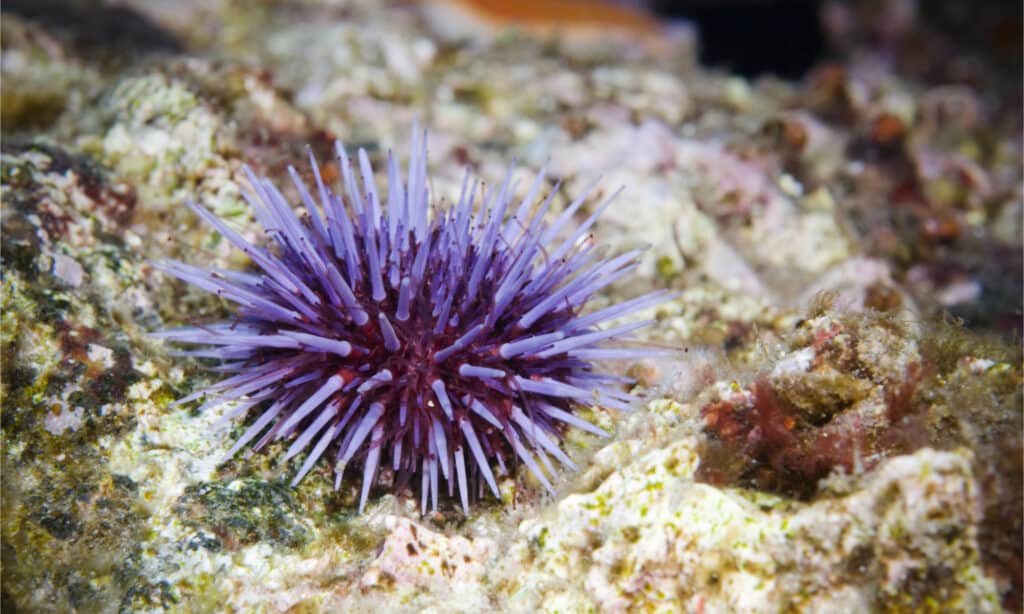
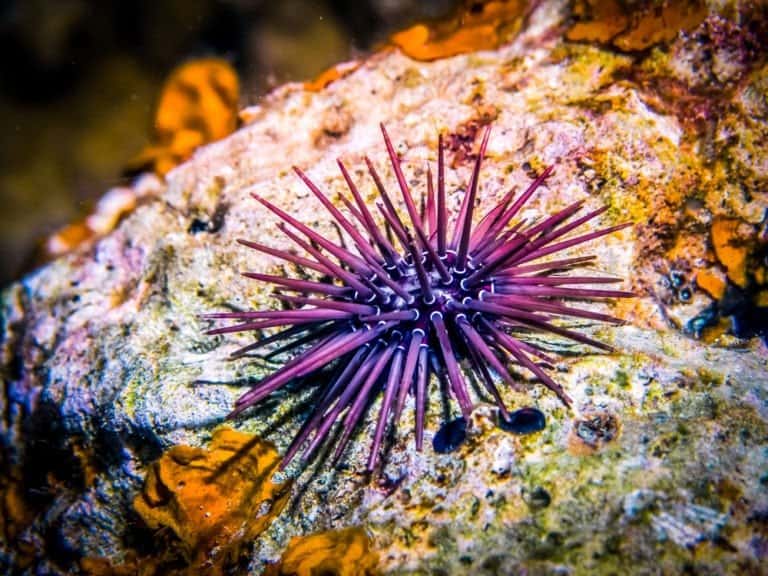
Solo purple Sea Urchin on reef

There are hundreds of species of sea urchins.

Some of the more interesting types of the 950 species include:

  • Strongylocentrotus purpuratus, the Pacific purple sea urchin, is a key ingredient in uni sushi.
  • The inky black Diadema sea urchin helps keep Caribbean coral reefs healthy by keeping plant growth down.
  • Toxopneustes pileolus, whose common name is flower urchin, is among the most toxic. It inhabits the warm oceans of the Western Indo-Pacific region.
  • The giant red sea urchin, or Mesocentrotus franciscanus, is the largest species, with its test averaging about 18 centimeters (seven inches) across and spines eight centimeters (three inches) in length. It inhabits the coastal Pacific waters of North America.
  • Heterocentrotus mamillatus, the slate pencil urchin, lives in tropical Indo-Pacific oceans. It has stubby spines with rounded, striped ends that can bore into rock.
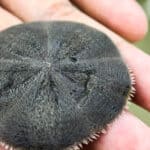
  • Echinarachnius parma, known by the common names of sand dollar, sea cookie, or pansy shell, is a flat sea urchin that has short spines called cilia for burrowing into the sand. It lives in seas throughout the Northern Hemisphere.
  • The green sea urchin, Strongylocentrotus droebachiensis, is one of the 18 edible species. Processors harvest the gonads, glands within the shell, primarily for use in Japanese uni sushi. Green sea urchins live in the Northern Atlantic waters.

Appearance
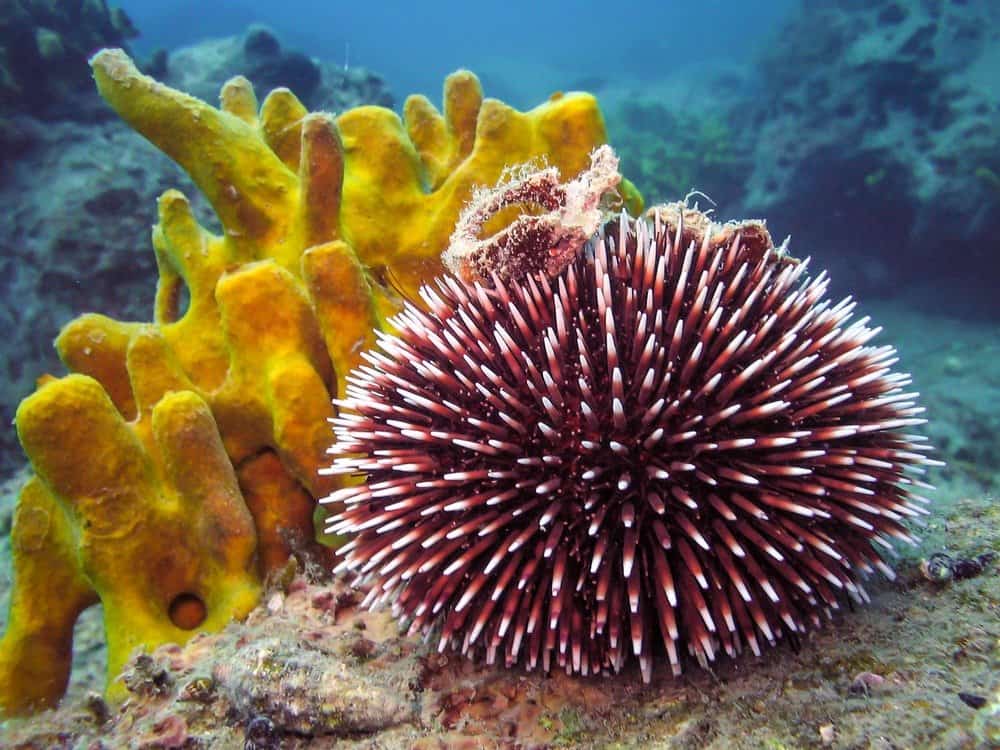
Sea Urchin

Sea urchins are animals.

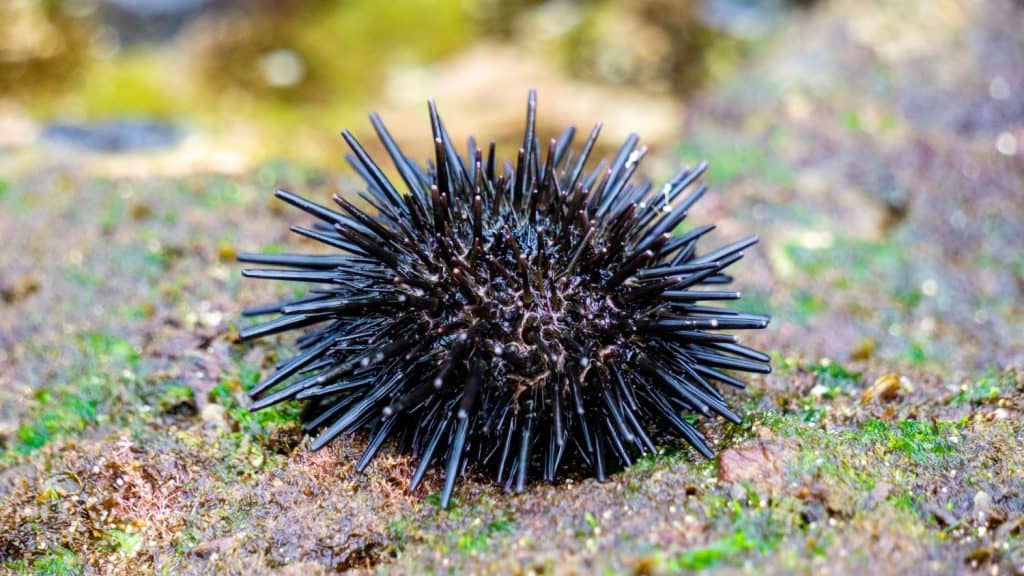
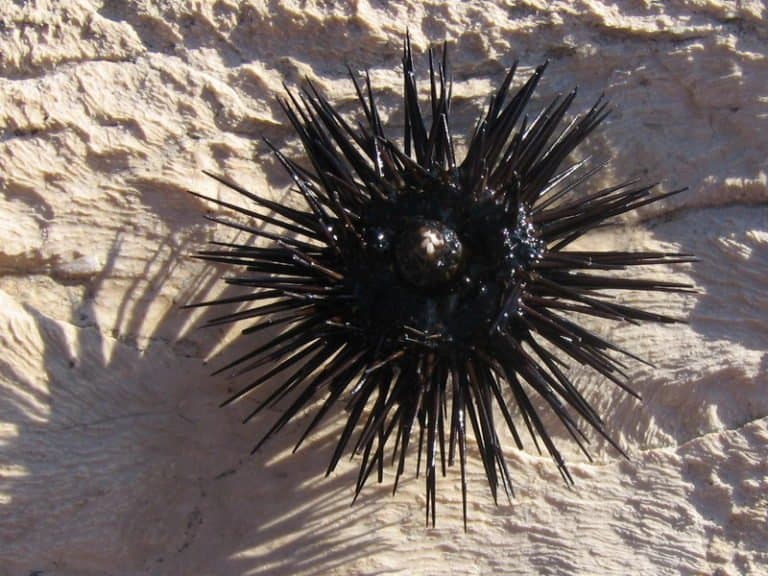
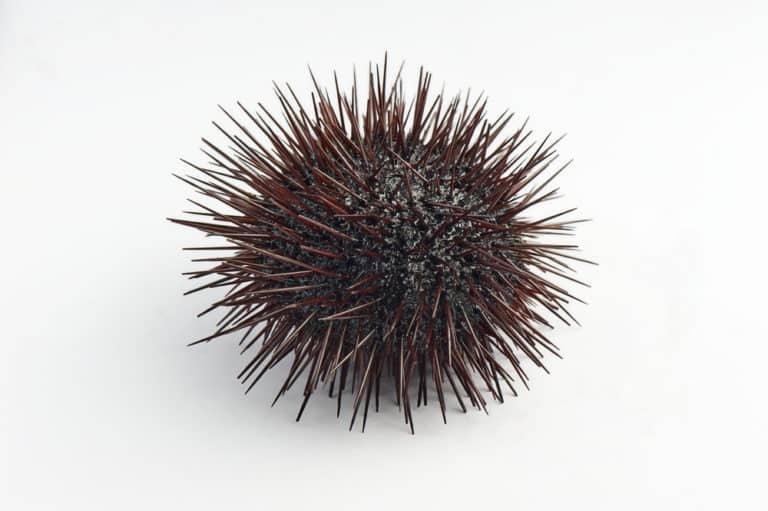
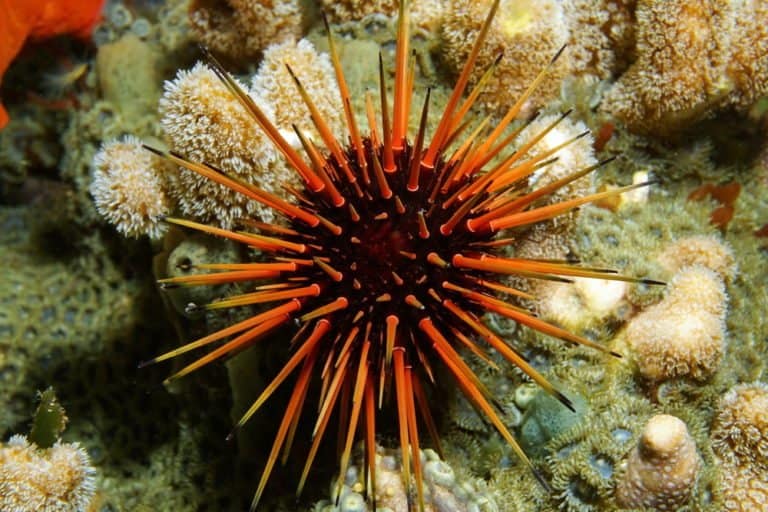
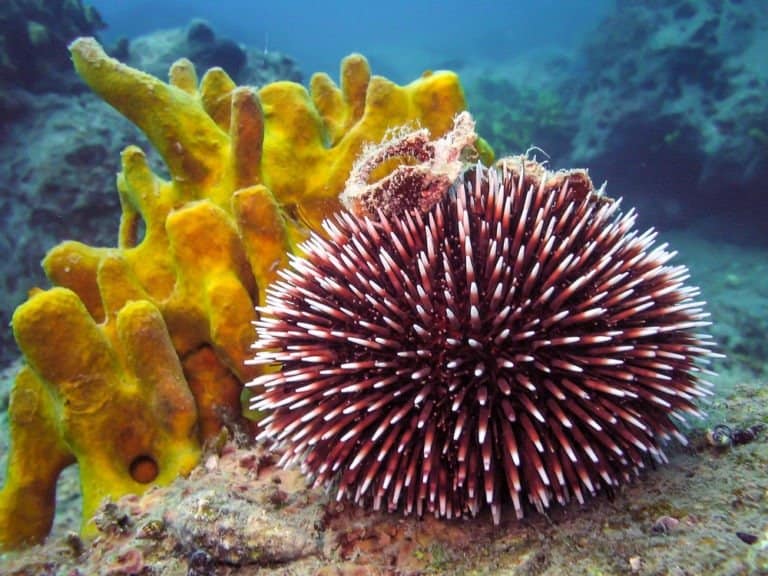
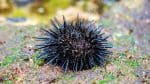
Sea urchins are small sea animals that have spherical shells called tests that are typically covered in spines similar to those of a porcupine. Very small tube-shaped feet among the spines help them move slowly along the ocean floor. They come in just about every color, from black to white, red, orange, green, brown, purple, pink, yellow, blue, and gray. They range in size from about an inch in diameter up to 14 inches. On average, they weigh about one pound.

Because there are nearly one thousand types of sea urchins, these animals can vary significantly in appearance. You can easily identify most of them by their spiny exteriors, but some, like sand dollars, have only short hairs all over their bodies. Others, like pencil sea urchins, have rounded-off spines that are not sharp like typical urchin spines.

Distribution, Population, and Habitat
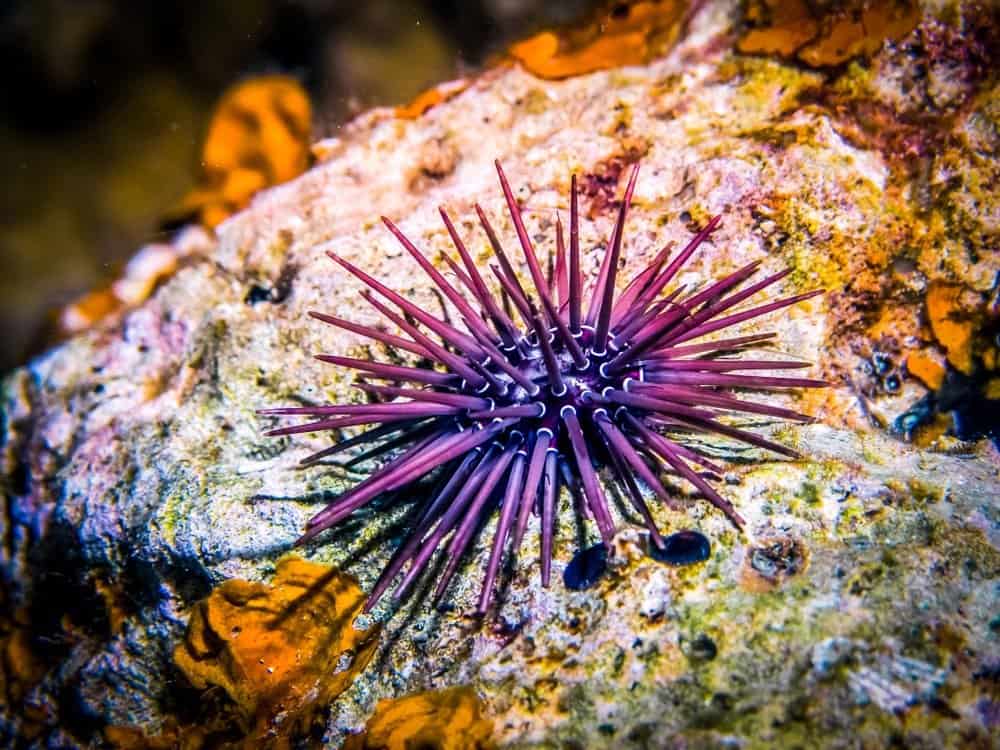
Purple sea urchin

Sea urchins live in every ocean in the world.

Sea urchins live in oceans throughout the world. Arctic or tropic, shoreline or deepest sea trenches, you can find them there. Because they cannot swim, the ocean floor is their home. Some, like the shingle urchin, live in the shallows near beaches where the sun shines. Others, like the ones in the Pourtaleslidae family, live so deep below the surface that they are in total darkness.

Barren underwater areas have dense populations of these creatures, and populations nearer to the shore are the densest by far. While they live throughout the world, the greatest numbers live in temperate and tropical ocean habitats in the shallows up to ten meters down, where the plants they eat are plentiful.

With so many types and such a wide-ranging habitat, it is impossible to know for sure. However, a recent marine study in Oregon estimated that the purple species population on just one coastal reef numbered around 350 million, a figure that represented a 10,000-fold increase in just a few years, putting them in the least concern conservation category. Researchers attributed the exponential expansion of this Pacific coast class of urchins to a marine ecosystem that is out of balance.

Meanwhile, in the Mediterranean, the purple sea urchin population is currently in a near-threatened state. Factors that have decimated the species include warming sea temperatures and invasive fish that eat algae, depriving the urchins of a dietary staple. Again, the underlying cause is an imbalance in the ecosystem.

However, scarcity of food does not necessarily mean the species is headed for extinction. Purple urchins can go dormant and survive with no food for years at a time. With such extraordinary persistence, these populations may ebb, but they also flow.

Predators and Prey
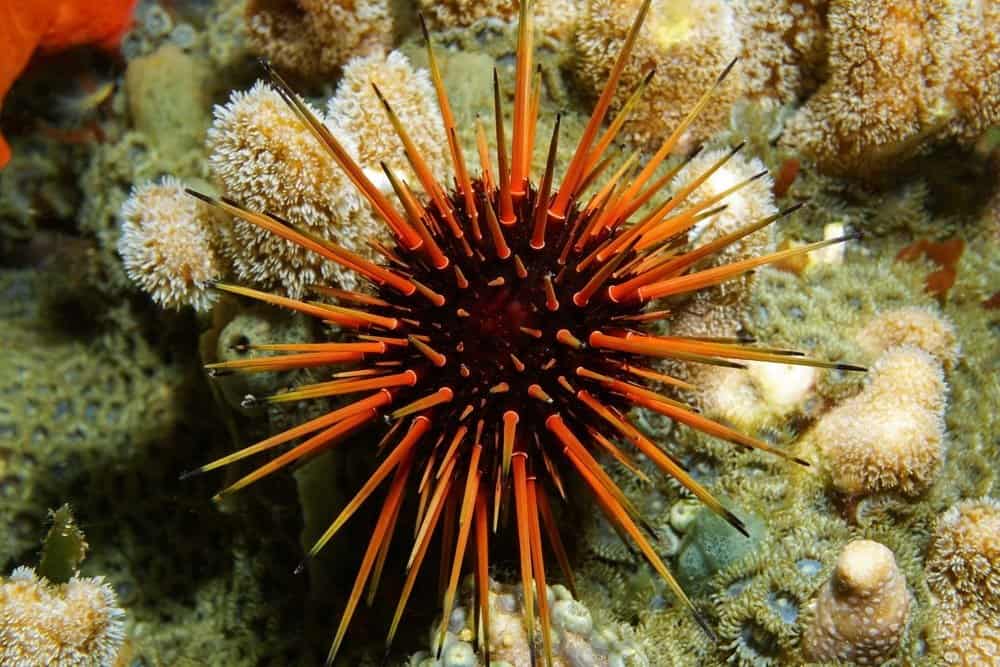
Sea Urchin

Sea urchins are vulnerable to bacterial diseases.

Despite their inborn resiliency, sea urchins are subject to threats from disease as well as predators. A 1981 bacterial disease nearly wiped out the Hemicentrotus pulcherimus and Pseudocentrotus depressus species in Japan. Bald sea urchin disease, another bacterial illness, threatens some sea urchin populations, causing the animals’ spines to fall out and leave them defenseless against predators.

What Eats Sea Urchin?

Shellfish like crabs and lobsters are among these creatures’ natural predators. Triggerfish and wrasse are two fish that prey on them. The wolf eel is specially equipped to hunt and eat those in the Northern Hemisphere. Sea otters in regions like British Columbia help maintain ecological balance by keeping urchins from overpopulating.

Although they are slow-moving, sea urchins do have some means of protecting themselves. Their sharp spines are often enough to discourage some predators. A few urchin species are venomous, too.
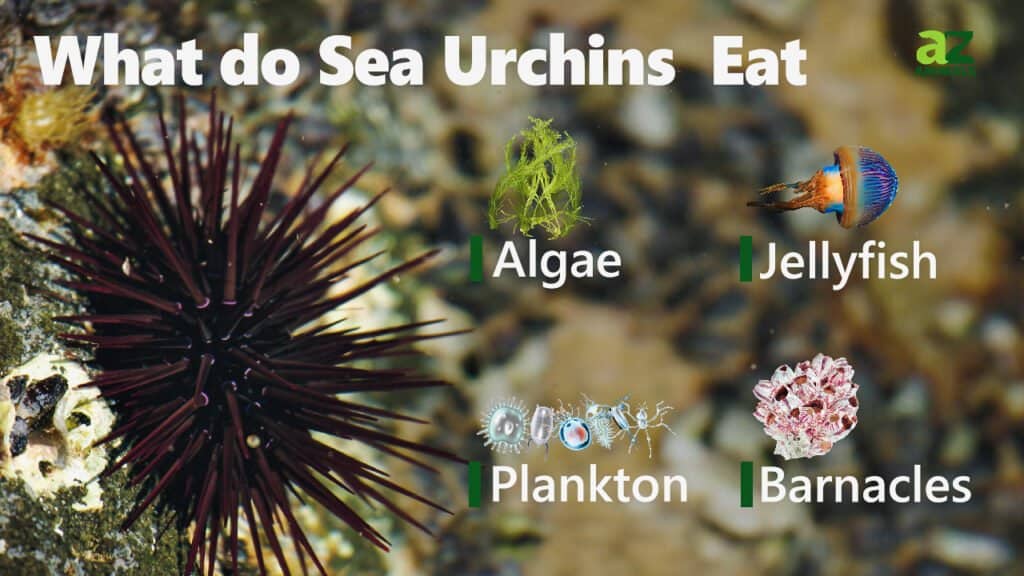
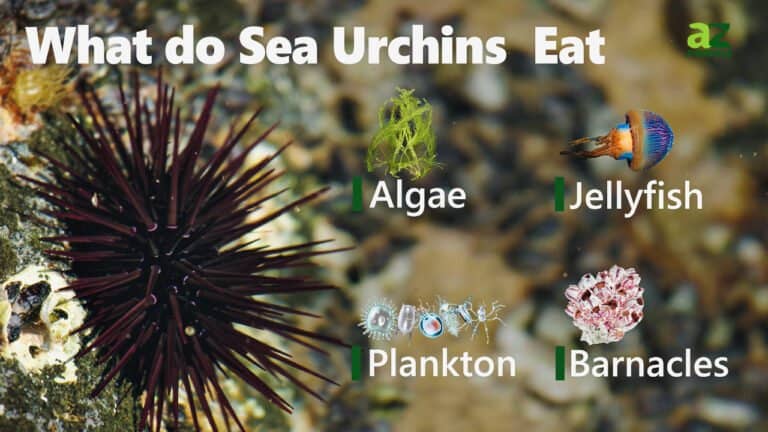
What do Sea Urchins Eat

What Do Sea Urchins Eat?

Sea urchins mainly eat marine vegetation like algae and kelp. They also prey on sessile, or immobile, sea creatures such as coral and sea sponges.

Reproduction and Lifespan
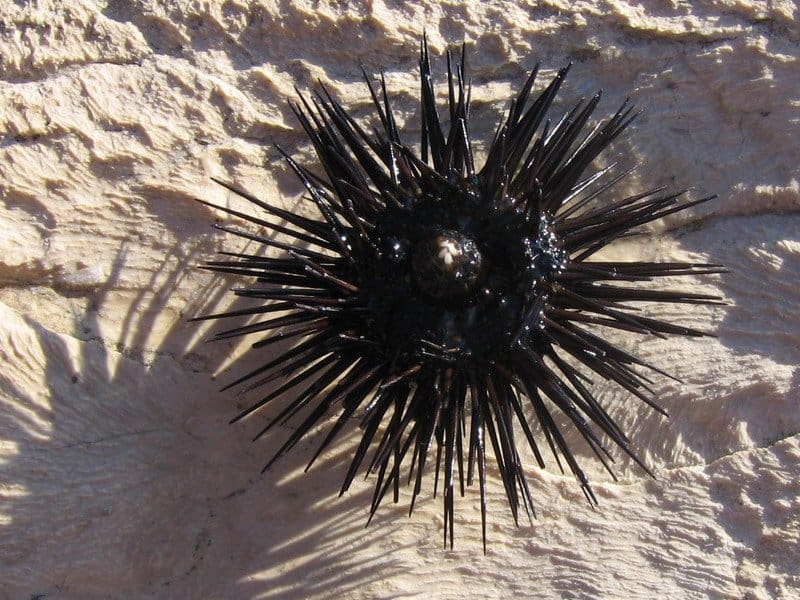
Sea Urchin

Sea Urchins eat sea vegetables.

Females of the species produce eggs. Most release these eggs into the sea for fertilization by the sperm that males have released. The females of a few species hold their eggs among their spines rather than let them float freely.

Once fertilization occurs, it takes only about 12 hours for the egg to become an embryo. Soon thereafter, the embryo becomes a larva with cilia that can collect microscopic food to nurture its growth. It takes several months for the larva to transform into a fully developed sea urchin. It will grow for a few more years to reach adulthood. Depending on the species, they live for several years. For example, the purple species has a life expectancy of around 20 years.

Fishing and Cooking
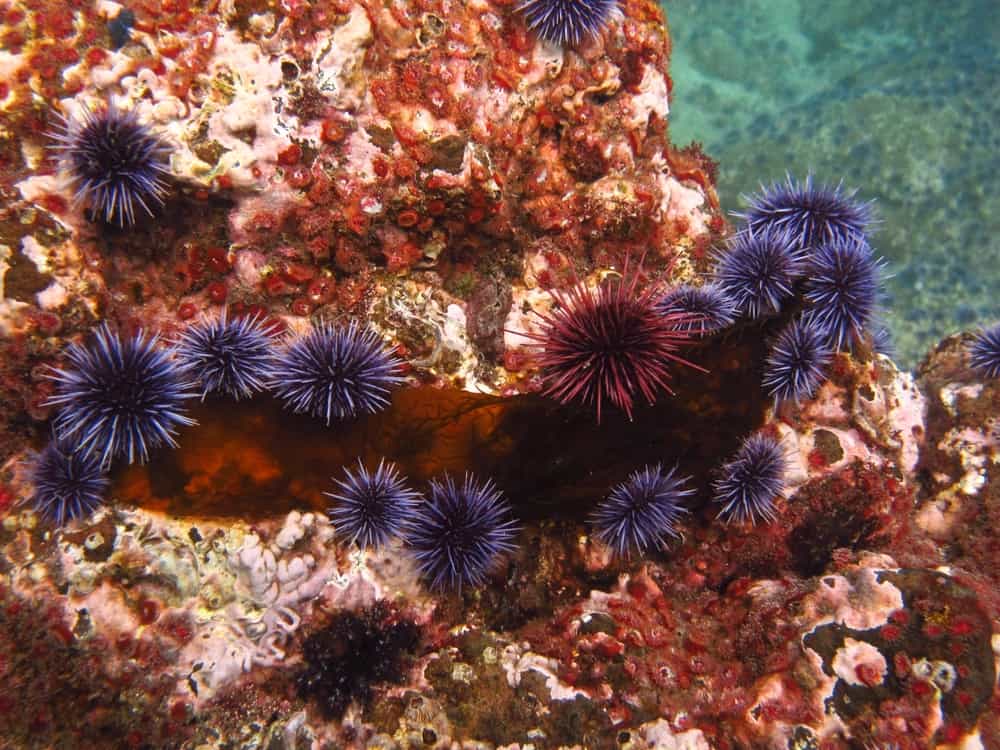
Purple and red sea urchins eat a piece of kelp.

Purple and red sea urchins eat a piece of kelp.

In many international cuisines, from Alaska to New Zealand, the gonads, or roe, are a delicacy. Typically, people eat them raw with lemon juice or olive oil. In other regions, chefs incorporate the roe in gourmet sauces, omelets, and soups.

The Japanese enjoy the roe in uni sushi. They consume about 50,000 tons of urchin roes per year, which amounts to approximately 80 percent of the world’s commercially processed supply.
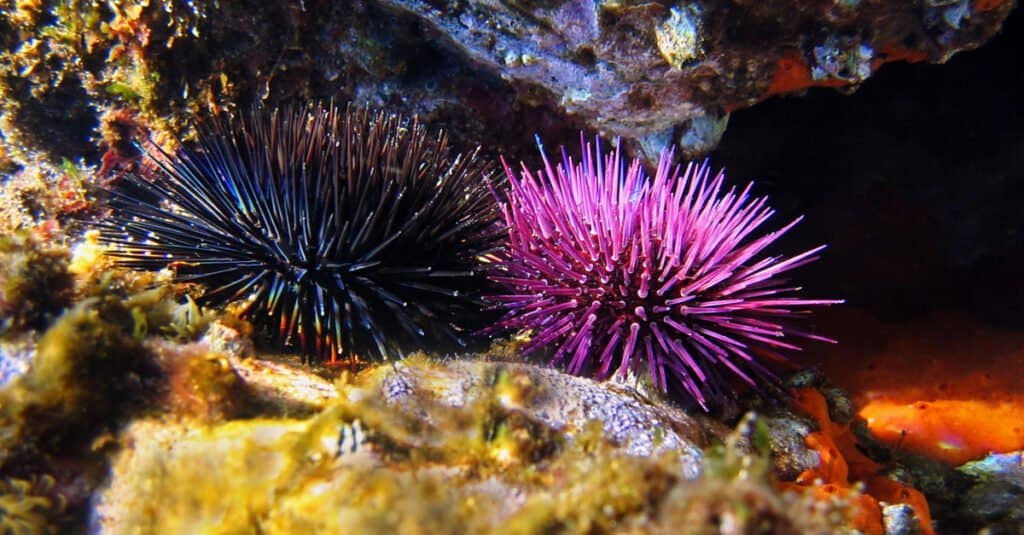
Top 10 Animals That Have Shells - sea urchin

Sea urchins use their spiked shells to protect themselves from predators.

View all 390 animals that start with S

Sources

  1. Wikipedia / Accessed November 8, 2019
  2. WHOI / Accessed November 8, 2019
  3. The Guardian / Accessed November 8, 2019
  4. Britannica / Accessed November 8, 2019
  5. The perils of reduced pH on sea urchin development, Jessica Poppe, Tufts University / Accessed November 8, 2019
  6. National Geographic / Accessed November 8, 2019
  7. Field Marine Biology / Accessed November 8, 2019
  8. Oceana / Accessed November 8, 2019
  9. Scuba Diving / Accessed November 8, 2019
  10. National Library of Medicine / Accessed November 8, 2019
Heather Hall

About the Author

Heather Hall

Heather Hall is a writer at A-Z Animals, where her primary focus is on plants and animals. Heather has been writing and editing since 2012 and holds a Bachelor of Science in Horticulture. As a resident of the Pacific Northwest, Heather enjoys hiking, gardening, and trail running through the mountains with her dogs.

Thank you for reading! Have some feedback for us?


Sea Urchin FAQs (Frequently Asked Questions)

Mainly, they eat the plants around them, including kelp, algae and phytoplankton, which is made up of microscopic plant matter. Sea urchins also eat zooplankton, made of tiny animal life, and small, non-mobile animals like sea sponges and periwinkles that they can easily catch.