S
Species Profile

Seahorse

Hippocampus

Dads who carry the ocean's babies
mc_pongsatorn/Shutterstock.com

Seahorse Distribution

Click a location to explore more animals from that region

This map shows coastal regions where Seahorse are found.

Loading map...

Size Comparison

Human 5'8"
Seahorse 4 in

Seahorse stands at 6% of average human height.

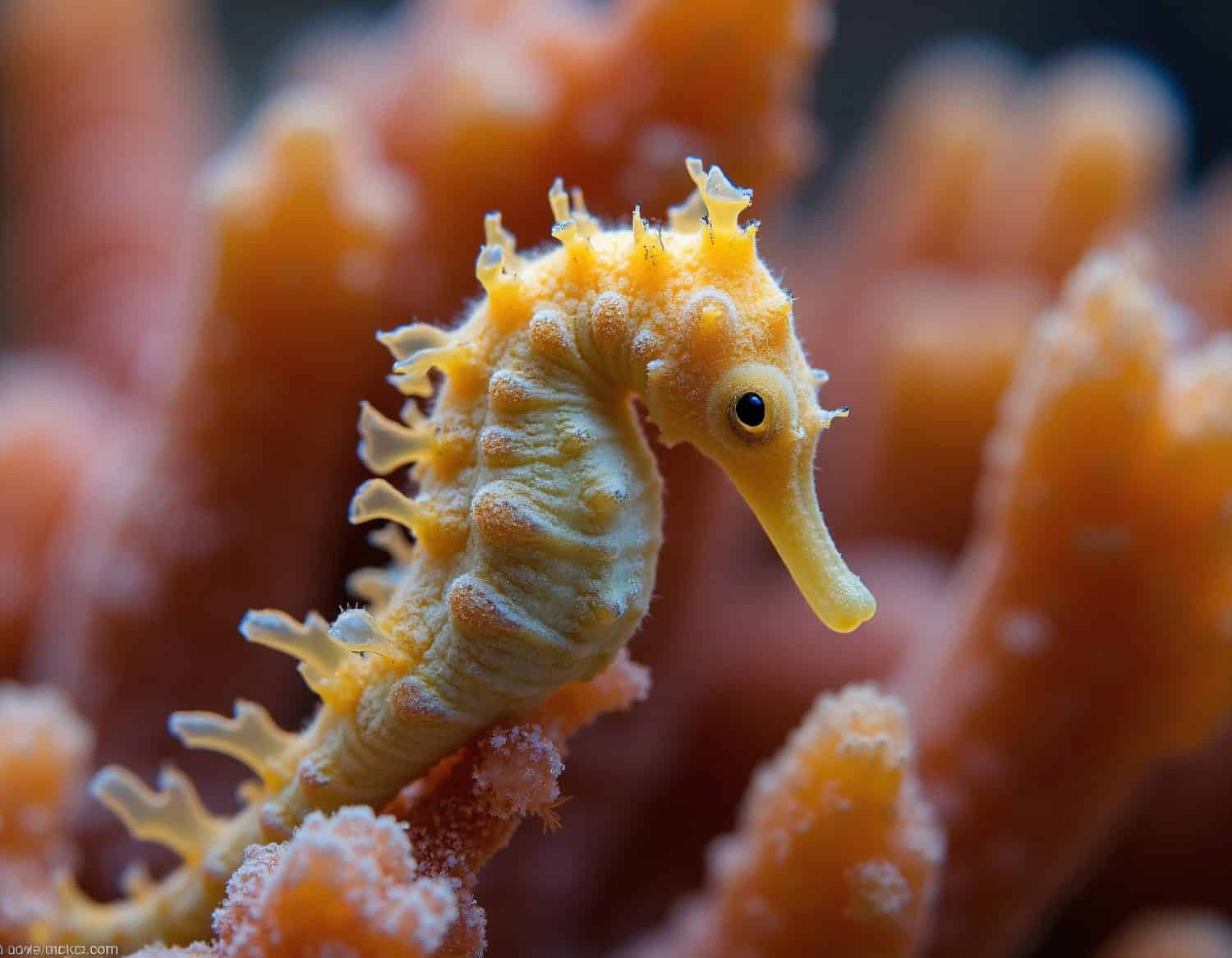
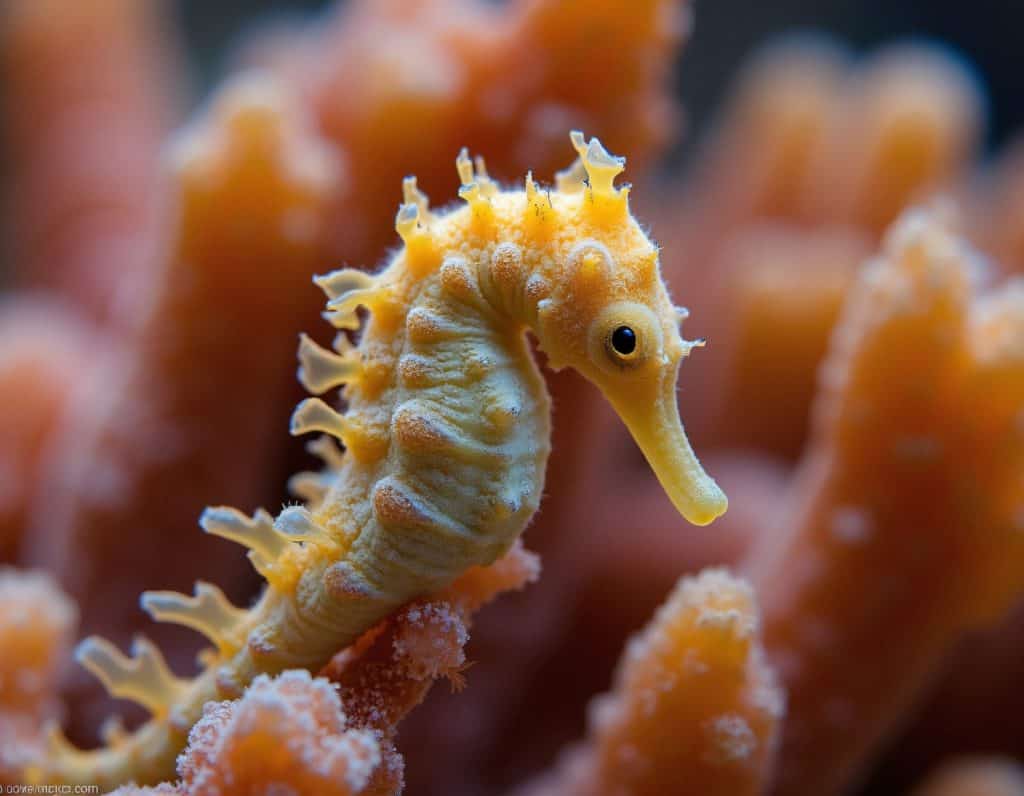
A Seahorse in the ocean

At a Glance

Genus Overview This page covers the Seahorse genus as a group. Stats below are general traits shared across the genus.
Also Known As Sea pony, caballito de mar, cavalluccio marino, hippocampe
Diet Carnivore
Activity Diurnal+
Lifespan 3.5 years
Weight 0.1 lbs
Status Not Evaluated
Did You Know?

Seahorses range from about ~1.5 cm to ~35 cm long across the genus, from tiny pygmies to giants.

Scientific Classification

Genus Overview "Seahorse" is not a single species but represents an entire genus containing multiple species.

Seahorses are ray-finned fishes in the genus Hippocampus, characterized by an upright posture, horse-like head, fused jaws forming a snout, and a prehensile tail. They are part of the pipefish/sea dragon family (Syngnathidae) and are notable for male pregnancy (males brood embryos in a brood pouch).

Kingdom
Animalia
Phylum
Chordata
Class
Actinopterygii
Order
Syngnathiformes
Family
Syngnathidae
Genus
Hippocampus

Distinguishing Features

  • Upright swimming posture with a curled, prehensile tail used for grasping
  • Bony external plates/rings instead of typical fish scales
  • Long tubular snout with small mouth; suction feeding on small crustaceans
  • Male brooding in a pouch (male pregnancy) and pair bonding in some species
  • Dorsal fin provides propulsion; limited swimming ability compared with many fishes

Physical Measurements

Males and females differ in size

Height
5 in (1 in – 1 ft 2 in)
Length
6 in (1 in – 1 ft 2 in)
5 in (1 in – 1 ft 2 in)
Weight
0 lbs (0 lbs – 1 lbs)
Tail Length
3 in (0 in – 9 in)
Top Speed
0 mph
swimming (dwarf seahorse record)

Appearance

Primary Colors
Secondary Colors
Skin Type Thin skin over bony dermal plates arranged in rings; texture ranges from smooth to strongly spined, sometimes with fleshy filaments/cirri that enhance camouflage.
Distinctive Features
  • Body size range across genus roughly ~1.5 cm to ~35 cm total length (smallest pygmy to largest temperate species).
  • Typical lifespan varies widely by species and conditions: commonly ~1-5 years, with some reaching ~6-10 years (especially in captivity).
  • Upright posture with a horse-like head; neck flexion varies among species.
  • Tubular snout with fused jaws; suction-feeding on small crustaceans and zooplankton.
  • Eyes can move largely independently, aiding prey detection while remaining cryptic.
  • Bony plated body with distinct trunk/tail rings; no true scales and no caudal fin.
  • Prehensile tail used to grasp holdfasts (seagrass, macroalgae, mangrove roots, corals, gorgonians, sponges, artificial structures).
  • Coronet (crown) on head varies markedly in shape and height among species; useful for identification.
  • Spination varies from smooth-bodied to prominently spined; some have skin filaments/cirri.
  • Locomotion primarily via rapid dorsal fin beats with pectoral fins for steering; generally weak long-distance swimmers.
  • Ecology generalization: mostly coastal and shelf-associated; habitats range from estuaries and seagrass to reefs and deeper soft-bottom sites depending on species.
  • Behavior generalization: ambush predation and strong crypsis are common; site fidelity and pair-bond duration vary from seasonal to longer-term depending on species.
  • Reproduction: male pregnancy via brood pouch in most species; brood size, gestation length, and mating systems vary across the genus.
  • Conservation/trade context: genus is listed under CITES Appendix II; widespread threats include habitat loss, bycatch, and targeted harvest for traditional medicine and aquarium trade.

Sexual Dimorphism

Sexes are similar in overall form and coloration, but males typically bear a brood pouch on the ventral tail/trunk region. Females often show a fuller abdomen and an ovipositor during breeding; the degree of size/color differences varies among species.

  • Brood pouch (marsupium) with a pouch opening; becomes distended when pregnant.
  • Pouch region may appear smoother or differently contoured than surrounding rings.
  • Can display pouch pumping/ventilation behaviors during brooding.
  • No brood pouch; ventral profile often appears flatter in the same region.
  • Ovipositor may become visible during courtship/spawning in many species.
  • Abdomen may look rounder when hydrated with eggs prior to mating.

Did You Know?

Seahorses range from about ~1.5 cm to ~35 cm long across the genus, from tiny pygmies to giants.

In many species, it's the male that becomes "pregnant," brooding embryos in a pouch until birth.

They have no true stomach-food passes quickly, so many species must feed frequently when prey is available.

Their eyes can move independently, helping them scan for prey and predators while staying still.

Most are poor long-distance swimmers and often anchor to seagrass, corals, or algae with their prehensile tails.

Color, pattern, spines, and the "coronet" (crown-like head crest) vary widely among species and help with camouflage and identification.

All seahorses are listed under CITES Appendix II, reflecting conservation concern and trade monitoring.

Unique Adaptations

  • Male brood pouch (a defining Hippocampus feature): a specialized ventral pouch where embryos develop; pouch structure and degree of enclosure vary across species.
  • Upright posture and ringed armor: bony plates form a protective "ring" exoskeleton; body shape and spine development differ widely among species (smooth to very spiny).
  • Prehensile tail: functions like a grasping limb for anchoring and maneuvering in complex habitats; tail length and robustness vary across species and habitats.
  • Tubular snout with fused jaws: enables rapid suction feeding; snout length and angle vary and are linked to prey type and feeding niche.
  • Coronet diversity: the crown-like head crest differs in shape and height among species and is used in species identification.
  • Cryptic skin features: some species have fleshy filaments, ridges, or knobs that mimic algae or coral textures; others are smoother and rely more on color matching.
  • Low-speed fin propulsion: small dorsal fin beats provide precise hovering; pectoral fins help steering-excellent maneuverability but generally weak sustained swimming.

Interesting Behaviors

  • Tail-anchoring "holdfast" behavior: many species wrap their prehensile tail around seagrass, mangrove roots, coral, or algae to resist currents; some species prefer specific holdfasts.
  • Sit-and-wait hunting: typically ambush tiny crustaceans (e.g., copepods, amphipods, mysids) by stealthily approaching and then rapidly sucking prey through a tube-like snout; hunting style can vary with habitat and snout shape.
  • Independent eye scanning: individuals often remain nearly motionless while each eye tracks different targets-useful for both feeding and vigilance.
  • Courtship displays: many species perform synchronized dances and color changes; some form pair bonds for a season or longer, though mating systems vary by species and location.
  • Male brooding and birth: females transfer eggs into the male's brood pouch; males regulate pouch conditions (salt balance, oxygenation) and later release free-swimming young-brood size and gestation length vary among species.
  • Limited dispersal vs. drift: adults are often site-attached, but juveniles of some species may drift with floating seaweed or currents, affecting gene flow and range size.
  • Camouflage and stillness: many species rely on crypsis (matching color/texture of surroundings); the degree of spines, skin filaments, and color-change ability differs among species.

Cultural Significance

Seahorses (Hippocampus) are symbols of patience, protection, and safe sea travel. Shown in art and used in medicines, they face trade and exploitation and are listed on CITES Appendix II. They are flagship species for seagrass, mangrove, and coral conservation.

Myths & Legends

In Greek and Roman art and myth, the hippocampus ("sea horse") pulls the chariots of sea gods like Poseidon/Neptune. This lasting image inspired the scientific name Hippocampus.

In European heraldry and Renaissance art, the hippocamp (shown as a horse with a fish tail) became a common symbol in sea themed coats of arms, fountains, and buildings, mixing the real seahorse with myth.

Chinese traditional symbolism: seahorses are associated with the dragon/sea-dragon realm in coastal folklore and are sometimes treated as "little sea dragons" in popular tradition, linking them to strength and protection at sea.

Polynesian and broader seafaring traditions (historical association): seahorse and "sea-horse" motifs appear in maritime storytelling and ornamentation as signs of the ocean's mysterious guardians and currents' hidden power, reflecting long-standing respect for unusual sea life.

Conservation Status

NE Not Evaluated (genus-level taxon; individual Hippocampus species on the IUCN Red List range from Least Concern to Critically Endangered, with several Data Deficient/Not Evaluated and many assessed as Vulnerable/Endangered).

Has not yet been evaluated against the criteria.

Population Unknown

Protected Under

  • CITES Appendix II: all Hippocampus species are listed (international trade regulated; implemented since 2004).
  • Many countries apply additional national protections (e.g., fishery bans/size limits, protected-species listings) and local measures within marine protected areas; coverage and enforcement vary by species and location.
  • Genus-level conservation landscape: species show a wide spread of IUCN categories (LC-CR plus DD/NE), with many populations inferred to be declining; the most at-risk tend to be range-restricted, habitat-specialist, or heavily traded/bycaught species.

You might be looking for:

Lined Seahorse

22%

Hippocampus erectus

Western Atlantic seahorse; common in seagrass beds and coastal habitats; frequently referenced in North America.

Common Seahorse

18%

Hippocampus hippocampus

Northeast Atlantic and Mediterranean species; one of the historically well-known European seahorses.

Spotted Seahorse

18%

Hippocampus kuda

Indo-Pacific species complex in shallow coastal waters; often encountered in aquarium/curio trade contexts.

Knysna Seahorse

12%

Hippocampus capensis

South African endemic with notable conservation attention due to restricted range.

Bargibant's Pygmy Seahorse

10%

Hippocampus bargibanti

Tiny, cryptic coral-associated seahorse of the Indo-Pacific; famous for camouflage on gorgonians.

Life Cycle

Birth 200 frys
Lifespan 4 years

Lifespan

In the Wild
1–8 years
In Captivity
1–10 years

Reproduction

Mating System Monogamy
Social Structure Socially Monogamous
Breeding Pattern Seasonal
Fertilization Internal Fertilization
Birth Type Internal_fertilization

Most Hippocampus form socially monogamous pairs with daily courtship; females transfer eggs into the male brood pouch where fertilization and gestation occur. Pair bonds usually last a breeding season but can be longer, and occasional polygyny/promiscuity occurs.

Behavior & Ecology

Social Loose aggregation Group: 2
Activity Diurnal, Crepuscular, Cathemeral
Diet Carnivore Small crustaceans-especially mysid shrimp and copepods (species-, size-, and habitat-dependent)

Temperament

Generally shy, cryptic, and site-attached; relies on camouflage and stealth rather than fleeing.
Low overt aggression; some species show mild territoriality or mate-guarding in crowded habitats.
Social behavior varies widely: from mostly solitary to strong pair-bonding; monogamy common but not universal.
Courtship often involves daily greeting rituals, synchronized swimming, and color/intensity changes; varies by species.
Reproduction centers on male pregnancy (brood pouch), promoting repeated partner coordination across breeding cycles.
Genus-wide size and longevity vary greatly: ~1.5-35 cm adults; ~1-5 years in wild, sometimes longer in captivity.

Communication

Soft clicks/snaps reported in some species, likely during disturbance or close interactions
Visual signaling via rapid color change, pattern intensification, and body-posture displays
Synchronized courtship 'dances' and parallel swimming to reinforce pair bonds
Tactile contact: tail grasping of holdfasts and sometimes partner during courtship
Chemical cues (pheromones) likely aid mate recognition and reproductive readiness, evidence varies by species
Spatial cues: site fidelity and repeated meeting locations function as indirect communication

Habitat

Coastal Estuary Mangrove Coral Reef Kelp Forest Rocky Shore Seabed/Benthic Open Ocean +2
Biomes:
Terrain:
Coastal Island Riverine Rocky Sandy Muddy
Elevation: -7874 in

Ecological Role

Small-bodied mesopredators/microcarnivores in coastal marine habitats (seagrass beds, mangroves, estuaries, reefs), with diet breadth and prey size varying across the many species in the genus.

Regulate local populations of zooplankton and small benthic crustaceans (top-down control at the microfaunal level) Transfer energy from planktonic/benthic microinvertebrates to higher trophic levels (they are prey for larger fishes and other predators) Link structured habitats (seagrass/macroalgae/coral) to adjacent food webs through continual predation on small mobile invertebrates Potential bioindicator value in some regions: presence/condition can reflect availability of structured habitat and healthy microcrustacean communities

Diet Details

Main Prey:
Copepods Amphipods Mysid shrimp Small shrimps Crab larvae Isopods and other small benthic crustaceans Polychaete worms Fish larvae and very small juvenile fish Small planktonic and benthic invertebrates +3

Human Interaction

Domestication Status

Wild

Seahorses (genus Hippocampus) have no domestication history. Humans mostly capture, trade, or farm them locally for aquariums, souvenirs, and traditional medicine. Some species are bred in captivity, but that is not true domestication and needs a lot of care. Many are harmed by coastal habitat loss, bycatch, and targeted collecting; trade is often regulated.

Danger Level

Low
  • Physical injury is uncommon; some species have small spines/rough bony plates that can cause minor skin scratches if mishandled.
  • Aquarium-related risks (e.g., contamination from poor water quality, opportunistic bacteria) are indirect; standard hygiene and safe handling mitigate most concerns.
  • No notable venom or aggressive behavior toward humans; primary risk is to the animals from stress/handling rather than to people.

As a Pet

Not Suitable as Pet

Legality: Laws vary by country or state. All Hippocampus species are listed on CITES Appendix II, so trade usually needs permits. Many places ban wild-caught seahorses; some require proof they were bred in captivity.

Care Level: Expert Only

Purchase Cost: $50 - $300
Lifetime Cost: $1,000 - $6,000

Economic Value

Uses:
Ornamental aquarium trade (live animals) Traditional medicine/curio trade (dried specimens) Ecotourism and diving wildlife value Research/education (reproductive biology, conservation, aquaculture)
Products:
  • live seahorses (preferably captive-bred) for aquaria
  • dried seahorses sold as traditional remedies or curios/souvenirs
  • public aquarium exhibits and educational programs
  • aquaculture broodstock and husbandry-related goods/services

Relationships

Related Species 14

Short-snouted seahorse Hippocampus hippocampus Shared Genus
Lined seahorse Hippocampus erectus Shared Genus
Knysna seahorse Hippocampus capensis Shared Genus
Bargibant's pygmy seahorse Hippocampus bargibanti Shared Genus
Dwarf seahorse Hippocampus zosterae Shared Genus
Big-belly seahorse Hippocampus abdominalis Shared Genus
Spotted seahorse Hippocampus kuda Shared Genus
Long-snouted seahorse Hippocampus guttulatus Shared Genus
Tiger tail seahorse Hippocampus comes Shared Genus
Pipefishes Syngnathus Shared Genus
Banded pipefish Doryrhamphus excisus Shared Family
Alligator pipefish Syngnathoides biaculeatus Shared Family
Weedy seadragon Phyllopteryx taeniolatus Shared Family
Leafy seadragon
Leafy seadragon Phycodurus eques Shared Family

Ecological Equivalents 5

Animals that fill a similar ecological role in their ecosystem

Ghost pipefish Solenostomus spp. Similar camouflage-heavy, slow-moving ambush lifestyle around reefs and seagrass, and a superficially seahorse- or pipefish-like body plan, but in a different family. Both rely on stealth and suction feeding on small crustaceans.
Seadragon Phyllopteryx spp., Phycodurus eques Very similar ecology within Syngnathidae: cryptic, structure-associated (kelp, seagrass, reef) predators of small crustaceans, with limited swimming ability and dependence on habitat complexity.
Pipefishes Syngnathidae Closest ecological analogs in the same family; they share tubular snouts, suction feeding, diets of small crustaceans, and frequent association with seagrass, reefs, and mangroves — though most pipefishes are more elongate and swim horizontally rather than upright.
Pipehorses Acentronura spp., Idiotropiscis spp. Structure-clinging syngnathids that use prehensile tails and camouflage in macroalgae and seagrass, overlapping microhabitats and prey types with many Hippocampus species.
Sticklebacks Gasterosteus spp. Not close relatives but often compared for convergent traits: both are small-bodied fishes with strong habitat associations, specialized courtship behaviors, and male parental care (sticklebacks exhibit nest guarding, while seahorses have a male brooding pouch).

Types of Seahorse

46

Explore 46 recognized types of seahorse

Big-belly seahorse Hippocampus abdominalis
West African seahorse Hippocampus algiricus
Narrow-bellied seahorse Hippocampus angustus
Barbour's seahorse Hippocampus barbouri
Bargibant's pygmy seahorse Hippocampus bargibanti
Little dragonfish seahorse Hippocampus biocellatus
Bourbon seahorse Hippocampus borboniensis
Short-headed seahorse Hippocampus breviceps
Giraffe seahorse Hippocampus camelopardalis
Knysna seahorse Hippocampus capensis
Tiger tail seahorse Hippocampus comes
Crowned seahorse Hippocampus coronatus
Denise's pygmy seahorse Hippocampus denise
Lined seahorse Hippocampus erectus
Falcate seahorse Hippocampus falcatus
Hawaiian seahorse Hippocampus fisheri
Sea pony (Arabic seahorse) Hippocampus fuscus
Long-snouted seahorse Hippocampus guttulatus
Short-snouted seahorse Hippocampus hippocampus
Thorny seahorse Hippocampus histrix
Pacific seahorse Hippocampus ingens
Japanese pygmy seahorse Hippocampus japapigu
Great seahorse Hippocampus kelloggi
Spotted seahorse Hippocampus kuda
Lichtenstein's seahorse Hippocampus lichtensteinii
Hedgehog seahorse Hippocampus minotaur
Japanese seahorse Hippocampus mohnikei
Montebello seahorse Hippocampus montebelloensis
Multi-spined seahorse Hippocampus multispinus
Nalu seahorse Hippocampus nalu
Paradoxical seahorse Hippocampus paradoxus
Patagonian seahorse Hippocampus patagonicus
Flat-faced seahorse Hippocampus planifrons
Pontoh's pygmy seahorse Hippocampus pontohi
Slender seahorse Hippocampus procerus
Longsnout seahorse Hippocampus reidi
Sandy seahorse Hippocampus sabinus
Satomi's pygmy seahorse Hippocampus satomiae
Softcoral pygmy seahorse Hippocampus severnsi
Seafoam seahorse Hippocampus spinosissimus
West Australian seahorse Hippocampus subelongatus
Three-spot seahorse Hippocampus trimaculatus
Tyro seahorse Hippocampus tyro
Sydney seahorse Hippocampus whitei
Zebra seahorse Hippocampus zebra
Dwarf seahorse Hippocampus zosterae

The seahorse is a small family of vertebrate species that is found in tropical shallows and temperate waters around the world. The seahorse is a fish that is also commonly found around coral reefs, where there is plenty of food and places for the seahorse to hide.

Five Facts About Seahorses

  • The seahorse is the slowest-moving marine fish in the world: According to the Guinness Book of World Records, the dwarf seahorse is the slowest-moving marine fish in the world. Its reported top speed is just 60 inches per hour!
  • They’re a fish: The seahorse has a shape that’s instantly identifiable and looks very little like other fish species. However, the seahorse is a type of fish that’s closely related to pipefish and seadragons.
  • Seahorses don’t have stomachs: Seahorses are fish that have digestive tracts that lack a stomach! That means they have to eat nearly continuously to stay alive.
  • Male seahorses give birth: It’s true, male seahorses get pregnant and give birth to more than a thousand offspring at once! Female seahorses lay their egg in a male’s pouch, which is fertilized. After about three weeks of the seahorse embryos developing, they’re ejected from the male’s pouch at an extremely rapid rate (you’ll want to see the video on what this looks like below!)
  • Seahorses are romantics and will “dance” for days before choosing their mates: Many seahorse species are monogamous, meaning a single male and female pair will mate for their entire lives. In addition, seahorse courtship often involves a “dance” that can last for days before they choose their mates!

Classification and Scientific Name

Seahorses are classified in the genus Hippocampus. The origin of Hippocampus is Greek, and roughly translates to ‘sea monster.’ Examples of individual seahorse species include the dwarf seahorse with its scientific name Hippocampus zosterae, and the Zebra seahorse, Hippocampus zebra.

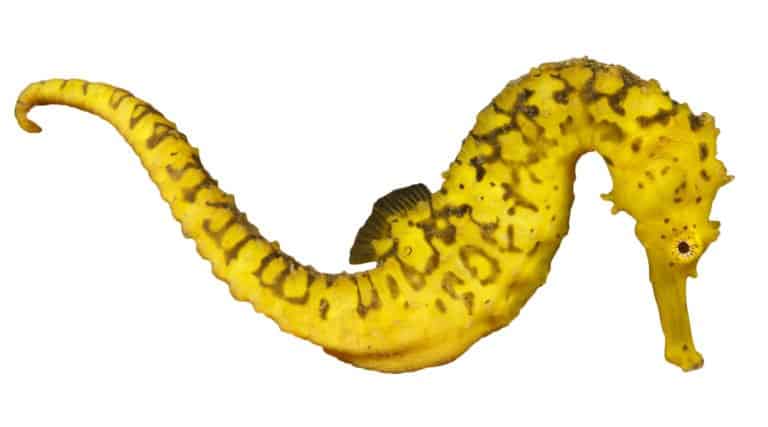
Seahorses belong to the family Syngnathidae, which includes seahorses, pipefishes, and seadragons. As of 2025, there are about 46 recognized seahorse species (genus Hippocampus), with several new species described in recent decades. The seahorse is most closely related to pipefish and seadragons. The seahorse does not have scales like most fish; instead, the seahorse has a bone structure that is made up of little plates and covered with a thin layer of skin.
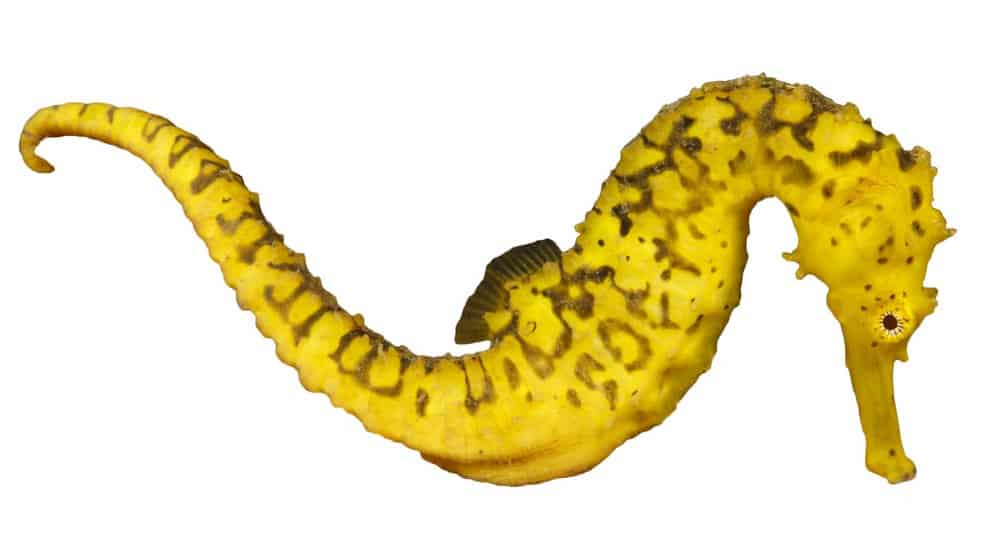
Seahorse (Hippocampus) - against white background

Seahorses do not have scales; instead, their bodies are covered with a thin layer of plates that is covered with skin.

Evolution

It is believed that pipefish and seahorses diverged during the late Oligocene in response to large areas of shallow water created as a result of tectonic events. These events happened in the western Pacific Ocean — the seahorses’ probable point of origin. The shallow water would allow seagrasses to grow, offering the seahorses camouflage for their upright posture.

Species: Types of Seahorse

There are over 46 recognized species of seahorse found in most of the world’s oceans, primarily in tropical and temperate coastal waters, but are absent from the eastern Pacific and polar regions. Seahorses are generally small animals, averaging around 10cm in height, although this is dependent on the species. For example, the big-belly seahorse can reach 14 inches (35 cm) in length. Below, we’ve detailed selected types of seahorses.

Dwarf Seahorse (Hippocampus zosterae)

The dwarf seahorse lives across the Gulf of Mexico, the Bahamas, and Florida. It reaches a max length of just 5 cm and has been named the world’s slowest fish by the Guinness Book of World Records. The dwarf seahorse is popular in aquariums but faces threats related to habitat loss.
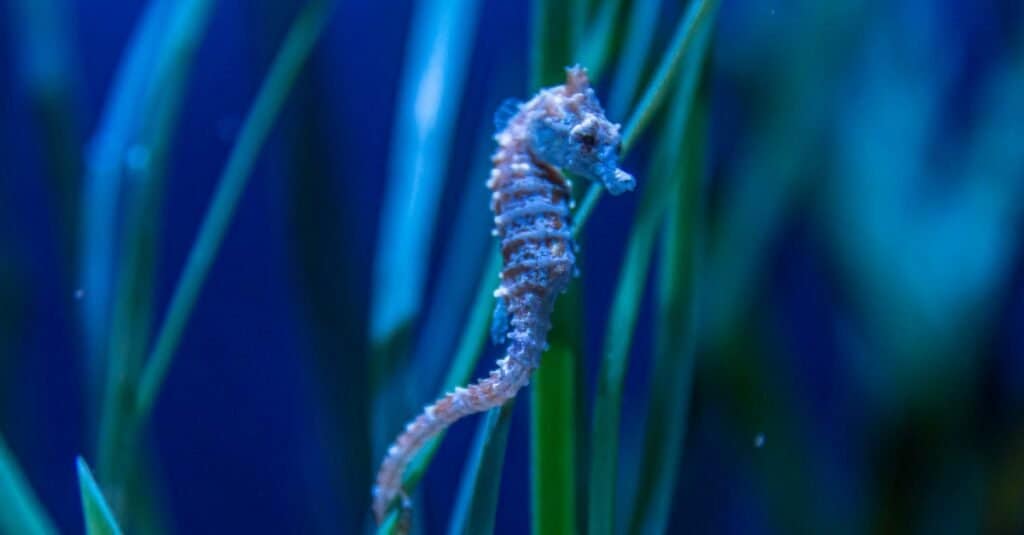
Slowest Animals In North America

A dwarf seahorse clings to an underwater leaf. It is recorded as the slowest-moving fish, with a painful top speed of about 150 centimeters per hour.

Pygmy Seahorse (Hippocampus bargibanti)

The pygmy seahorse lives in the Western Pacific offshore Indonesian islands and northern Australia at depths ranging from 16 to 40 meters. It prefers living near soft corals. The species is one of the smallest seahorses, measuring a maximum of just 2.4 cm. The pygmy seahorse has a unique appearance, with red bulbous tubercles across their body, which allow them to seamlessly blend in with coral reefs, and a short snout.

Big-Belly Seahorse (Hippocampus abdominalis)

The big-belly seahorse is found in southern Australia and New Zealand. The species can reach 35 cm (14 inches) in length, making it one of the largest seahorse species. Big-belly seahorses are nocturnal and live in depths ranging from 0 to 104 meters of water.
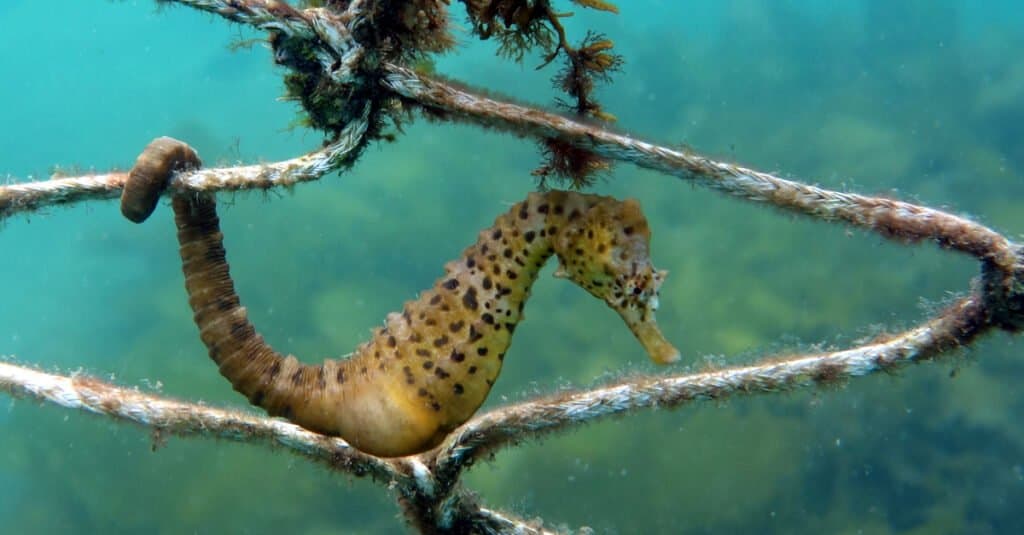
Largest seahorses - big-belly seahorse

The big-belly seahorse is found in southern Australia and New Zealand.

Zebra Seahorse (Hippocampus zebra)

The zebra seahorse gets its name from its black and white alternating stripes that look very similar to zebras. The species was first described in 1964, and relatively little is known about it. It’s found off the coast of Australia’s Queensland state along reefs and reaches a maximum length of 8 cm.

Giant Seahorse (Hippocampus ingens)

The giant seahorse reaches up to 30 cm (12 inches), which makes it slightly smaller than the big-belly seahorse. The species lives in reefs along the Eastern Pacific. Its range stretches from the northern limit of San Diego down to the Galapagos Islands. The species was assessed by the IUCN as Vulnerable in late 2016.

Barbour’s Seahorse (Hippocampus barbouri)

Barbour’s seahorse grows up to 15 cm (6 in) and lives along islands and reefs near Indonesia and the Philippines. The species prefers hard coral reefs. It was assessed in 2017 as Vulnerable by the IUCN.

Giraffe Seahorse (Hippocampus camelopardalis)

Found from Tanzania down to South Africa, the giraffe seahorse lives across Africa’s coast in waters ranging up to 45 meters in depth. The species prefers seagrass and algal beds.
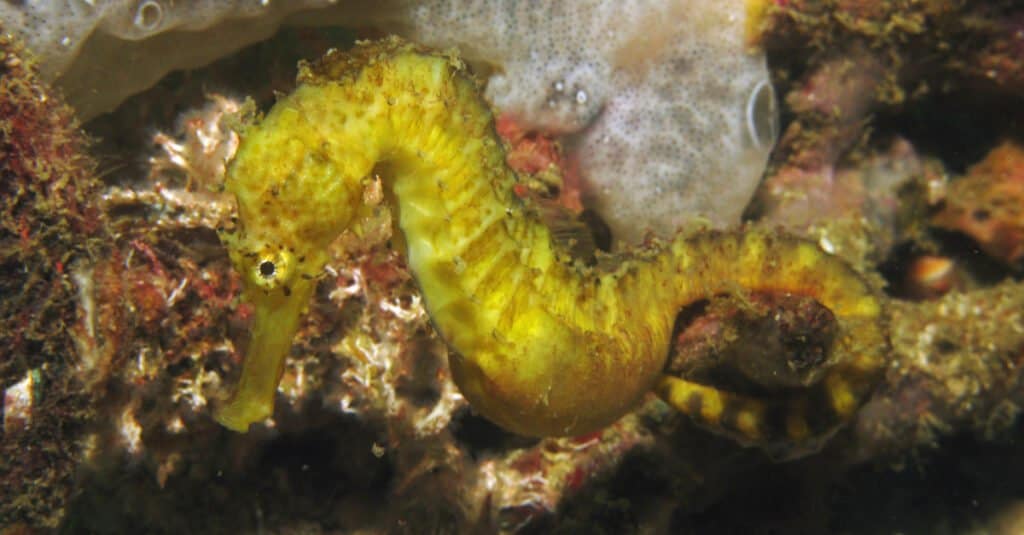
Largest seahorse - Tiger tail seahorse

Tiger Tail Seahorses are found throughout Southeast Asian waters.

Tiger Tail Seahorse (Hippocampus comes)

The tiger tail seahorse is found throughout Southeast Asian waters and can grow to nearly 20 cm (8 inches). The species is monogamous and lives along reefs and aquatic vegetation such as sponge gardens. With a “tiger-like” striping across its body, the species is a popular choice for aquariums. However, since 2013, the species has been assessed as Vulnerable by the IUCN.
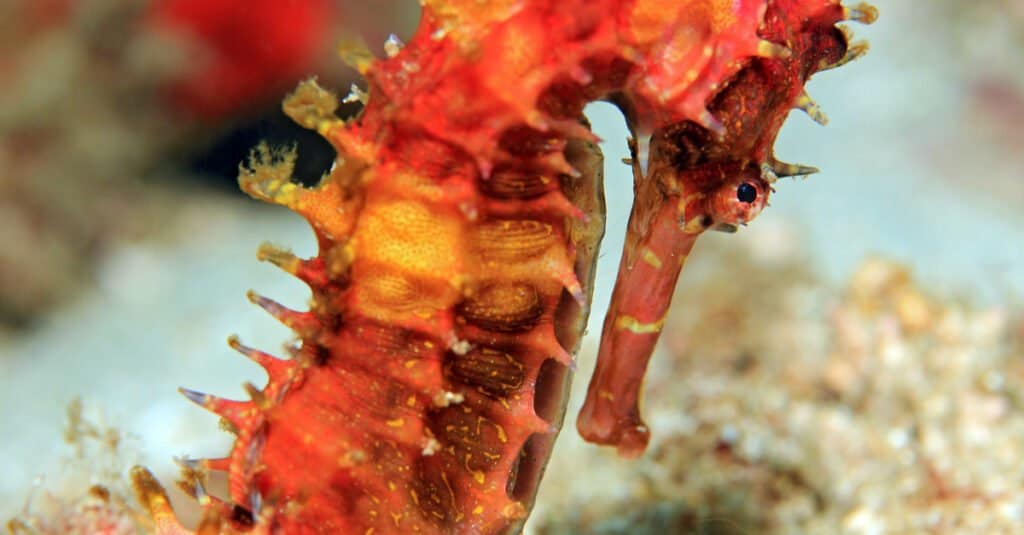
Largest seahorses - Spiny seahorse

The Spiny Seahorse gets its name from the thorny growths that cover its body.

Spiny Seahorse (Hippocampus histrix)

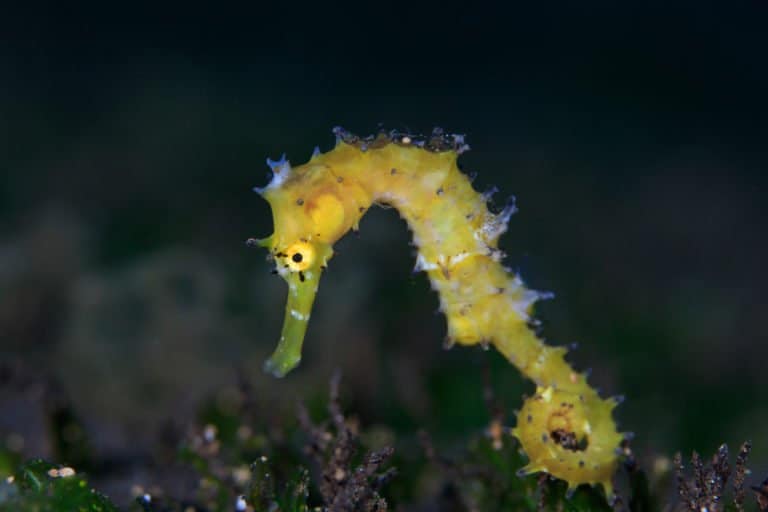
Spiny seahorse gets its name from the “thorn” objects that cover its body. The species has a long snout and one of the most distributed ranges of all seahorses. Spiny seahorses have been identified across much of the Pacific Ocean and across the Indian Ocean as well. The species has been assessed as Vulnerable by the IUCN and faces threats from habitat destruction.

Appearance

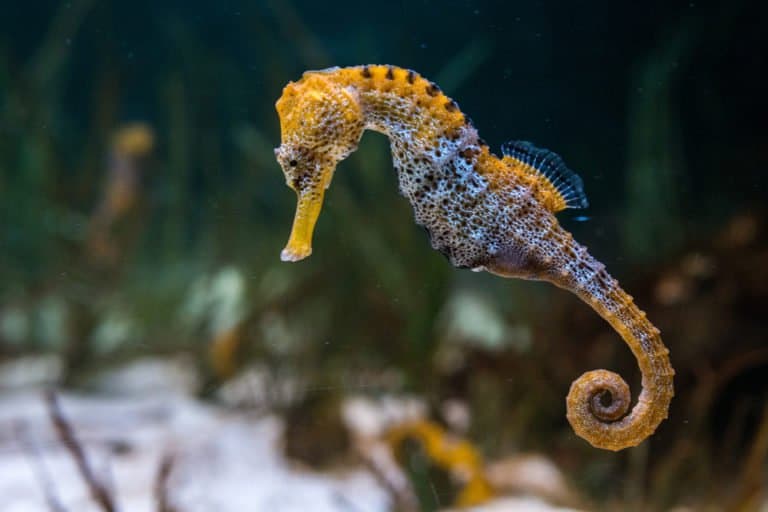
Seahorses are one of the most unique-looking animals in the world. Their head resembles a horse’s, they have a pouch like a kangaroo’s, and their tail is prehensile for gripping objects, like a monkey’s. In addition, their body is covered by a series of bony plates, and they have tiny “wings” (which are dorsal fins) for guiding them slowly and clumsily through the water.
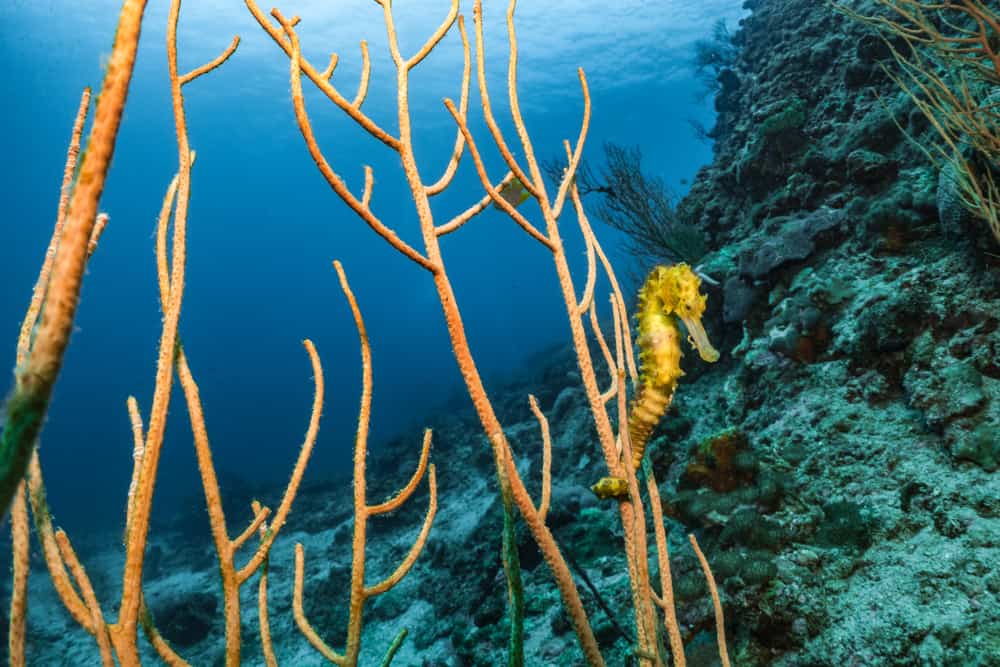
Seahorse (Hippocampus) - holding onto coral with tail ATTRIBUTION NOT FOUND

Seahorses use their excellent camouflage to hide from predators.

Seahorses are masters of camouflage, with the color and even textures of different species closely matching their environments, which helps them hide from predators. One species, the pygmy seahorse (Hippocampus bargibanti), has such extreme camouflage that the species was first discovered in 1970 after the coral colony had been collected for an aquarium, and it was later realized there was a new species of seahorse on the coral! On the other side of the size spectrum, the big-belly seahorse is the largest seahorse species in the world and can reach nearly 14 inches in length!

Seahorses move via their dorsal fins, which resemble tiny “wings” on their back. However, their movement is extremely plodding, and the Guinness Book of World Records has ranked the dwarf seahorse as the slowest marine fish in the world. During storms and adverse weather, seahorses will use their prehensile tail to grip objects to prevent getting tossed around by rough waters.

The seahorse’s snout is normally long and thin, which allows them to probe into coral and other sea vegetation to suck up small invertebrates and other food. Their jaws are fused and don’t chew food.
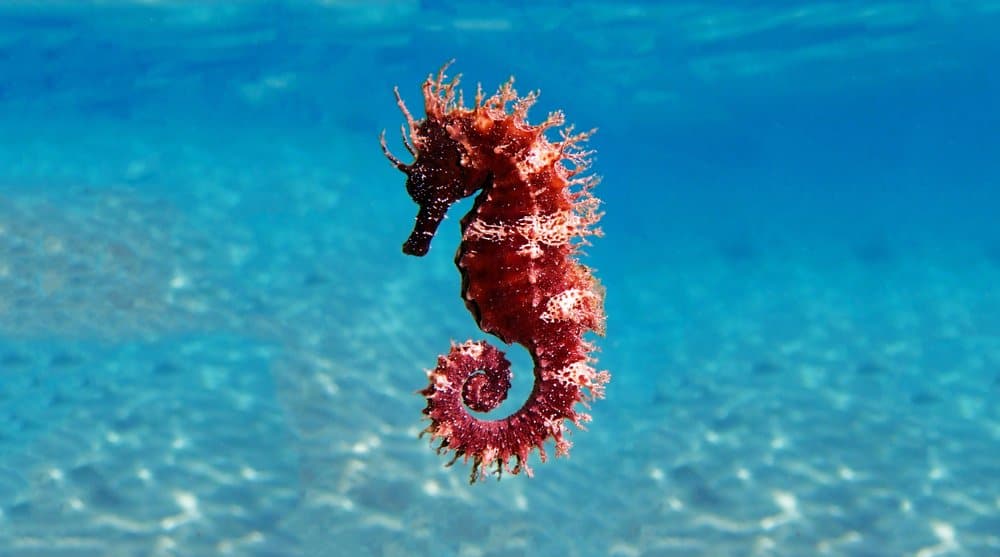
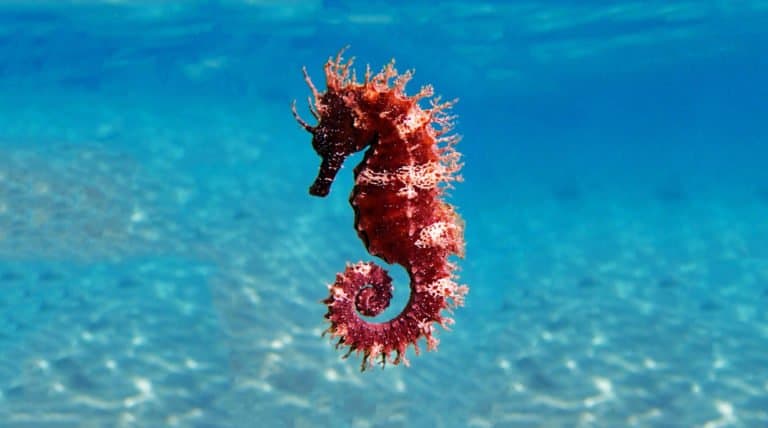
Seahorse (Hippocampus) - red and white floating swimming

A seahorse near the ocean bottom.

Distribution and Habitat

Seahorses are found across the world’s oceans, but most species reside in tropical or warm, temperate waters. The densest concentration of species is in Southeast Asia and the Western Pacific where a number of species live in different habitats.

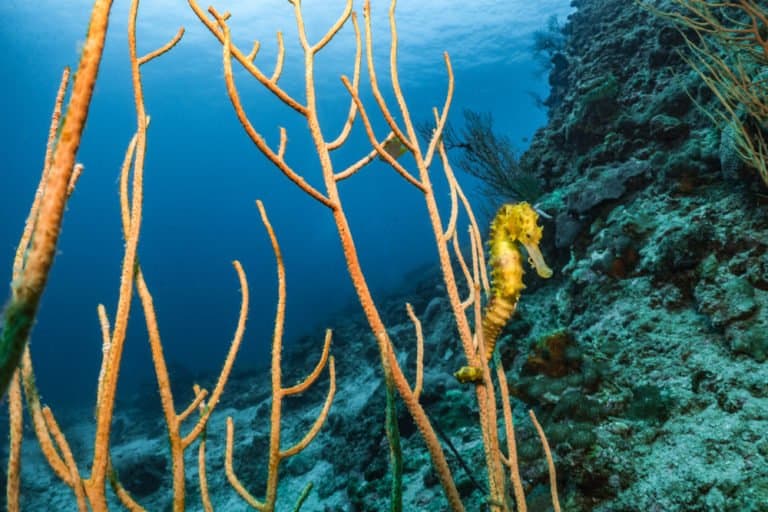
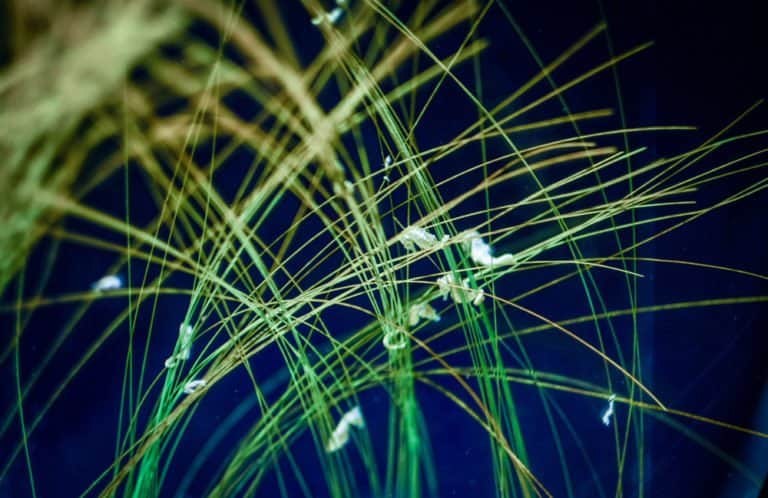
Generally, seahorses prefer soft coral environments and live in offshore reefs that rarely exceed 100 meters in depth. However, habitats the species can also be found in include kelp, eelgrass, open water, grass beds, and many other environments that feature aquatic vegetation the seahorse can cling to or blend in with.

Seahorses have a number of distinctive features that help them survive in their marine environments. The seahorse has a long snout for sucking in food and a long tail, which the seahorse uses both for moving through the water and also for clinging onto coral and aquatic plants, which the seahorse does by curling its long tail around things in order to anchor itself down.
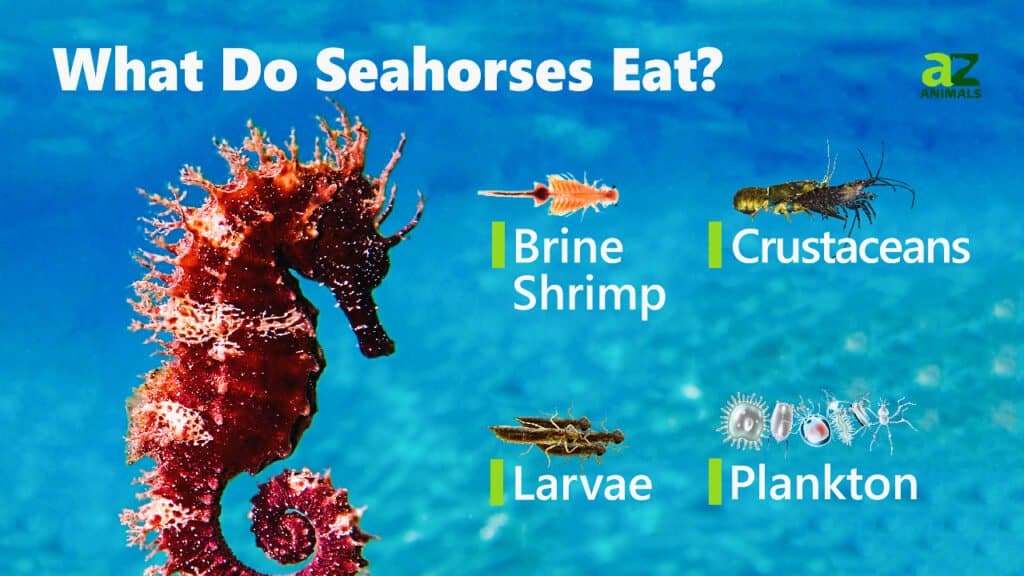
What Do Seahorses Eat
Seahorses eat small crustaceans and plankton.

Predators and Prey

The seahorse is primarily a carnivorous animal. It sucks food into its body through its elongated snout, which lacks teeth or the ability to chew. The seahorse primarily feeds on brine shrimp, plankton, and tiny species of fish. Because the seahorse lacks a stomach, it has to feed almost continuously, sometimes consuming a fourth of its body weight in a single day!

Due to the small size and vulnerability of the seahorse, the seahorse has numerous predators within its natural environment. Crustaceans such as crabs, fish, and rays are all common predators of the seahorse. Predator fish species such as the bluefin tuna have also been discovered with seahorses in their stomach. However, humans who harvest the seahorse for use in medicine are their primary threat (see more in our population and conservation status section).

The seahorse is also vulnerable to bad weather — in storms, seahorses are often thrown from the place that they were clinging onto and onto the shore.
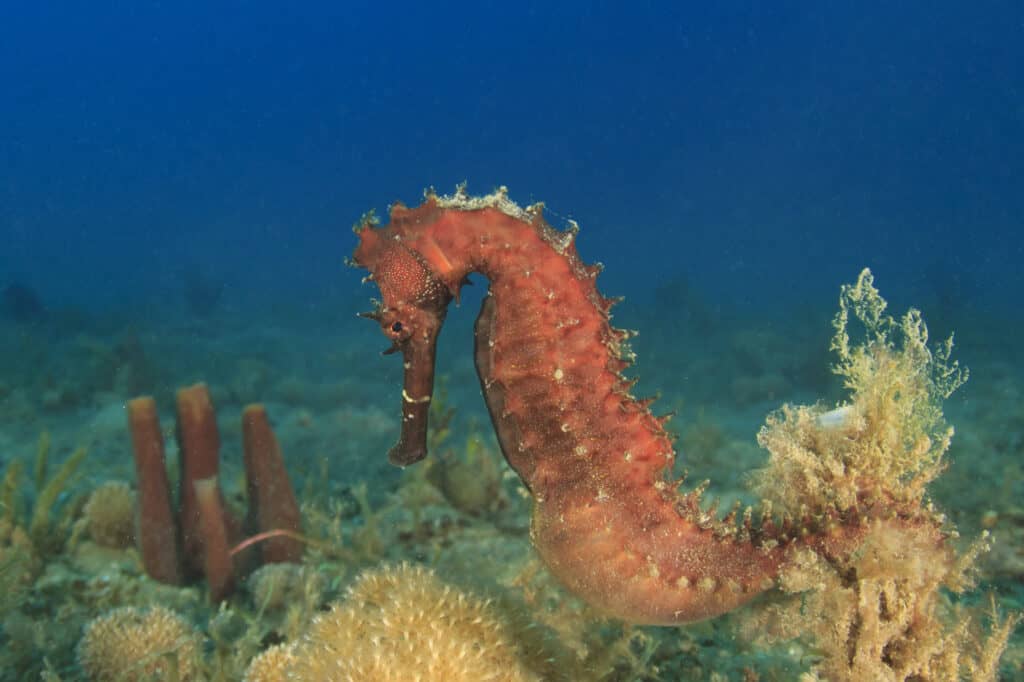
Pregnant Thorny Seahorse.

Pregnant Thorny Seahorse. The male seahorse carries the young in a pouch.

Reproduction and Lifespan

The sea horse is best known for the remarkable fact that the male seahorse is the one that actually carries the eggs before they hatch. In most other animal species, the female is the one to protect the offspring until birth. Instead, the female seahorse lays her eggs (anywhere between 5 to more than 1,000 eggs are laid, depending on the species of seahorse), into the male’s brooding pouch, where they remain until they hatch around 3 to 6 weeks later.

The birthing process is best illustrated in a short video, which you can see below:
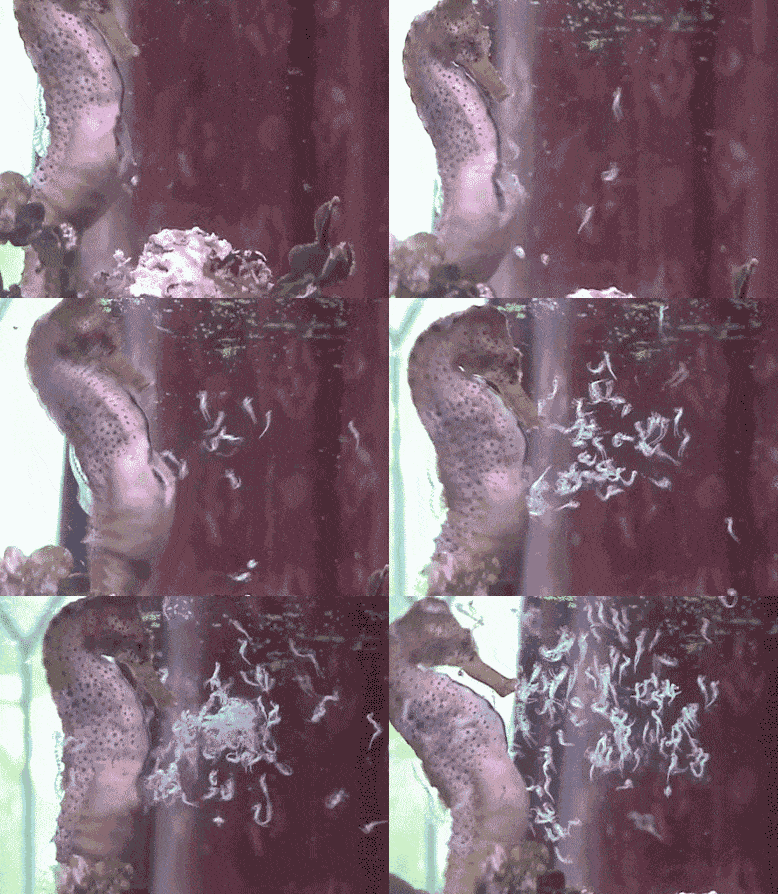
A male seahorse giving birth. Via Giphy.

After birth, seahorse offspring will cling to objects but are extremely susceptible to predators. In general, a very low percentage of seahorse babies (called “fry”) will survive. This depends on the species, but for some it can be less than 1%.

Many seahorse species are monogamous, meaning males and females will mate for life. Seahorse species are also famous for their deliberate courtship rituals, which can last anywhere from hours to days.

Courtship relies on a synchronized “dance.” Males and females will lock their prehensile tails and engage in synchronized movements, often changing colors. This “dance” can last for several days, where the males and females follow a similar swimming pattern.
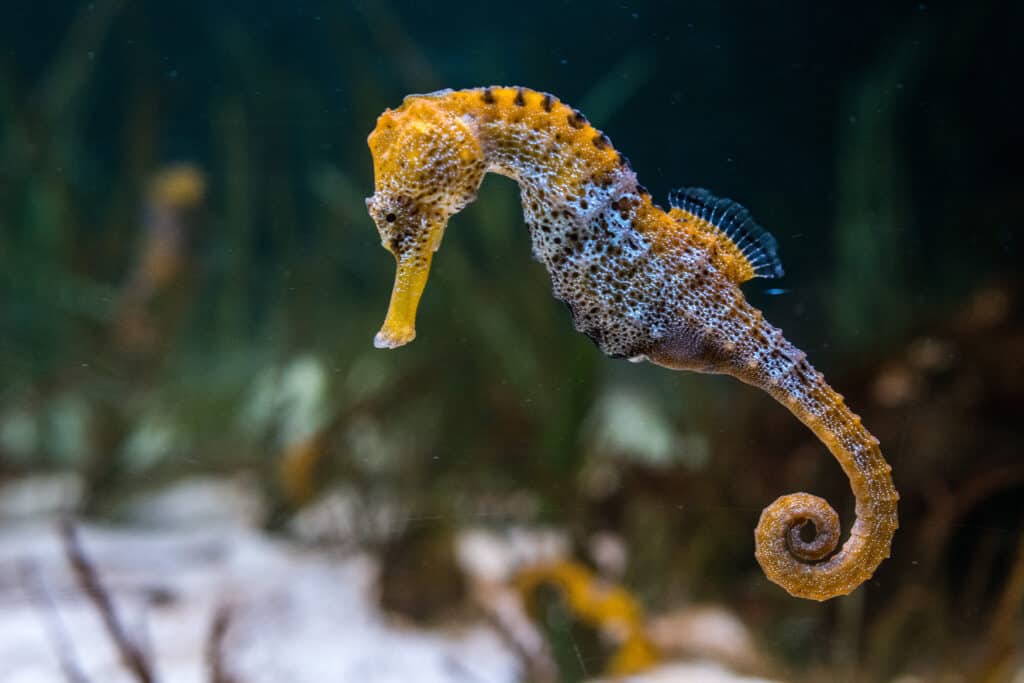
Slender seahorse

Specimen of long snout seahorse (Hippocampus reidi), also known as a slender seahorse.

Population and Conservation Status

As of late 2022, two seahorse species are listed as Endangered, and 12 are identified as Vulnerable, one as Near Threatened, and 10 as Least Concern by the IUCN. The primary threats to the species include habitat loss and its use in traditional Chinese medicine.

The loss of coral reefs and also seabeds that house seahorses has accelerated the decline of many species in recent decades. A study on the white seahorse found that significant habitat loss was the primary contributing factor to population declines.

In addition, traditional Eastern medicine (spanning several countries) values dried seahorses for their purported benefits for impotence and other medical disorders. There is no known scientific basis for these claims, but dried seahorse retails for nearly the price of gold in many Asian markets. Overfishing for traditional medicine has put pressure on many species, including pygmy seahorses.

View all 390 animals that start with S

Sources

  1. David Burnie, Dorling Kindersley Animal, The Definitive Visual Guide To The World's Wildlife / Accessed November 14, 2008
  2. Tom Jackson, Lorenz Books The World Encyclopedia Of Animals / Accessed November 14, 2008
  3. David Burnie, Kingfisher The Kingfisher Animal Encyclopedia / Accessed November 14, 2008
  4. Richard Mackay, University of California Press The Atlas Of Endangered Species / Accessed November 14, 2008
  5. David Burnie, Dorling Kindersley Illustrated Encyclopedia Of Animals / Accessed November 14, 2008
  6. Dorling Kindersley Dorling Kindersley Encyclopedia Of Animals / Accessed November 14, 2008
Lisha Pace

About the Author

Lisha Pace

After a career of working to provide opportunities for local communities to experience and create art, I am enjoying having time to write about two of my favorite things - nature and animals. Half of my life is spent outdoors, usually with my husband and sweet little fourteen year old dog. We love to take walks by the lake and take photos of the animals we meet including: otters, ospreys, Canadian geese, ducks and nesting bald eagles. I also enjoy reading, discovering books to add to my library, collecting and playing vinyl, and listening to my son's music.

Thank you for reading! Have some feedback for us?


Seahorse FAQs (Frequently Asked Questions)

The oldest fossil record of seahorses dates back 13 million years.