S
Species Profile

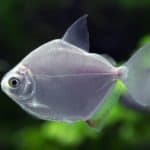
Silver Dollar

Peaceful schoolers, ruthless on plants
boban_nz/Shutterstock.com

Silver Dollar Distribution

Click a location to explore more animals from that region

This map shows coastal regions where Silver Dollar are found.

Loading map...
Metynnis hypsauchen - Silver Dollar, under water

At a Glance

Wild Species
Also Known As Silver dollar fish, Silver dollar tetra, Dollar fish, Metynnis silver dollar, Common silver dollar, Red-hook silver dollar
Diet Herbivore
Activity Diurnal+
Lifespan 10 years
Weight 1.5 lbs
Status Not Evaluated
Did You Know?

"Silver dollar" is a trade name for multiple species, especially Metynnis, Myloplus, and Myleus.

Scientific Classification

“Silver dollar” refers to several South American, laterally compressed, schooling characiform fishes kept in aquaria. They are typically peaceful to tankmates but voracious plant-eaters, and many belong to serrasalmid lineages related to pacus/piranhas.

Kingdom
Animalia
Phylum
Chordata
Class
Actinopterygii
Order
Characiformes

Distinguishing Features

  • Deep, round, coin-like laterally compressed body
  • Bright silvery flanks; sometimes spots or fin highlights
  • Schooling behavior and fast, skittish swimming
  • Strong tendency to graze and shred aquarium plants

Physical Measurements

Length
6 in (4 in – 12 in)
Weight
1 lbs (0 lbs – 3 lbs)
Top Speed
12 mph
swimming

Appearance

Primary Colors
Secondary Colors
Skin Type Cycloid scales
Distinctive Features
  • Deep, disk-shaped body, strongly laterally compressed.
  • Small terminal mouth with serrated, plant-grazing teeth.
  • Dark humeral spot just behind the gill cover.
  • Long anal fin with a gently curved trailing edge.
  • Forked caudal fin with mostly translucent lobes.

Sexual Dimorphism

Males tend to be slimmer with longer, more pointed dorsal and anal fins, often showing stronger red edging in breeding condition. Females are rounder-bodied with shorter fin extensions and duller fin color.

  • More elongated dorsal and anal fin rays.
  • Brighter red edging on anal and pelvic fins.
  • Slightly slimmer, more streamlined body profile.
  • Deeper, rounder abdomen, especially when gravid.
  • Shorter, more rounded fin tips.
  • Generally less intense red fin coloration.

Did You Know?

"Silver dollar" is a trade name for multiple species, especially Metynnis, Myloplus, and Myleus.

They're in the serrasalmid family-close relatives of pacus and piranhas, despite their calm reputation.

Most are enthusiastic herbivores/omnivores and can rapidly strip live aquarium plants to stems.

Their coin-like bodies are extremely laterally compressed, helping them turn quickly in schools.

Many species grow larger than beginners expect, commonly reaching 15-20+ cm in captivity.

They're schooling fish: keeping a group often reduces skittishness and improves natural behavior.

Several species show subtle sex differences, such as longer anal-fin lobes or deeper coloration during spawning.

Unique Adaptations

  • Disk-shaped, compressed bodies reduce drag during quick turns and help maintain position in a moving school.
  • Powerful jaw muscles and incisiform teeth suit cropping tough aquatic vegetation and seeds.
  • Shiny, reflective scales can confuse predators by creating shifting flashes in a fast-moving group.
  • Broad dorsal and anal fins provide stability, aiding precise maneuvering in midwater.
  • Many tolerate soft, acidic waters typical of Amazon/Orinoco systems, though needs vary by species.

Interesting Behaviors

  • School tightly when startled, flashing silver as they pivot together like a single moving disk.
  • Graze continuously, using repeated bites to crop leaves, soft stems, and algae films.
  • Startle-response "dart and freeze" behavior is common, especially in small groups or bare tanks.
  • In breeding setups, pairs or small groups scatter eggs among fine plants or spawning mops.
  • They often track tankmates' movements and synchronize feeding rushes at the surface or midwater.

Cultural Significance

Popular worldwide in the aquarium hobby since the mid-20th century, "silver dollars" symbolize a hardy, peaceful community fish-yet their plant-eating reputation shapes aquascaping choices and how keepers design South American-themed tanks.

Myths & Legends

The common name "silver dollar" arose in the aquarium trade from their coin-like shape and metallic sheen, echoing money-as-luck symbolism in hobby lore.

Classic aquarium books and shop stories long warned that "silver dollars eat your garden," a repeated anecdote that became part of fishkeeping culture.

In South American river communities, serrasalmids (the group that includes silver dollars, pacus, and piranhas) are widely known in everyday river lore as powerful biters-an association that follows silver dollars in hobby narratives.

Conservation Status

NE Not Evaluated (hub term spanning multiple species)

Has not yet been evaluated against the criteria.

Population Unknown

Life Cycle

Birth 800 frys
Lifespan 10 years

Lifespan

In the Wild
4–20 years
In Captivity
5–25 years

Reproduction

Mating System Polygynandry
Social Structure Aggregation Group
Breeding Season Rainy season; year-round in captivity
Breeding Pattern Transient
Fertilization Broadcast Spawning
Birth Type Broadcast_spawning

Silver dollar characiforms typically reproduce by group spawning, with multiple males and females releasing gametes among vegetation or over substrate. No lasting pair bonds or parental care are known; mating opportunities occur in brief, seasonal spawning events.

Behavior & Ecology

Social School Group: 12
Activity Diurnal, Crepuscular
Diet Herbivore Aquatic plants
Seasonal Migratory 19 mi

Temperament

Peaceful
Skittish
Social
Alert
Opportunistic

Communication

no known vocal sounds
schooling alignment cues
startle dashes
lateral line sensing
visual signaling
chemical cues

Habitat

Biomes:
Freshwater Wetland Tropical Rainforest Savanna Tropical Dry Forest
Terrain:
Riverine Plains Muddy
Elevation: Up to 4921 ft 3 in

Ecological Role

Herbivorous grazer shaping aquatic vegetation

macrophyte control energy transfer seed dispersal

Diet Details

Other Foods:
Aquatic macrophytes Submerged aquatic plants Algae and periphyton Fallen fruits Seeds and soft plant parts

Human Interaction

Domestication Status

Wild

Silver dollar fishes (Metynnis, Myleus, related serrasalmids) are wild South American river species. They are not domesticated; most individuals in the hobby are wild-caught or farm-raised for the ornamental aquarium trade, not selective breeding.

Danger Level

Low
  • Minor bite or nip
  • Startle injuries during netting
  • Allergic reaction to tank water

As a Pet

Suitable as Pet

Legality: Generally legal; some locales restrict serrasalmids.

Care Level: Moderate

Purchase Cost: $5 - $60
Lifetime Cost: $400 - $2,500

Economic Value

Uses:
Aquaculture Tourism Research
Products:
  • ornamentals
  • aquarium

Relationships

Predators 5

Peacock bass
Peacock bass Cichla ocellaris
Payara (vampire fish) Hydrolycus scomberoides
Barred sorubim Pseudoplatystoma fasciatum
Black piranha Serrasalmus rhombeus
Black caiman Melanosuchus niger

Related Species 7

Common silver dollar
Common silver dollar Metynnis argenteus Shared Genus
Spotfin silver dollar Metynnis hypsauchen Shared Genus
Lippincott's silver dollar Metynnis lippincottianus Shared Genus
Redhook silver dollar Myloplus rubripinnis Shared Family
Black-banded silver dollar Myleus schomburgkii Shared Family
Black pacu Colossoma macropomum Shared Family
Red-bellied piranha Pygocentrus nattereri Shared Family

Ecological Equivalents 4

Animals that fill a similar ecological role in their ecosystem

Leporinus (headstanders) Leporinus fasciatus Schooling river fish; nips plants and periphyton like silver dollars
Spotted headstander Chilodus punctatus Laterally compressed grazer; occupies similar midwater-edge habitats
Banded silver hatchetfish Gasteropelecus sternicla Peaceful schooling characiform; shares calm floodplain and creek habitats
Severum cichlid Heros efasciatus Plant-browsing floodplain fish; overlaps in slow-water aquarium niche

Although closely related to the piranha, silver dollar fish are generally peaceful. People don’t tend to fish for or consume them, but these freshwater fish are popularly kept in aquariums around the world.

An Incredible Fish: Five Silver Dollar Facts

  • Silver dollar fish belong to the same family, Characidae, as piranha fish and pacu fish. Unlike those types of fish, however, they are not aggressive.
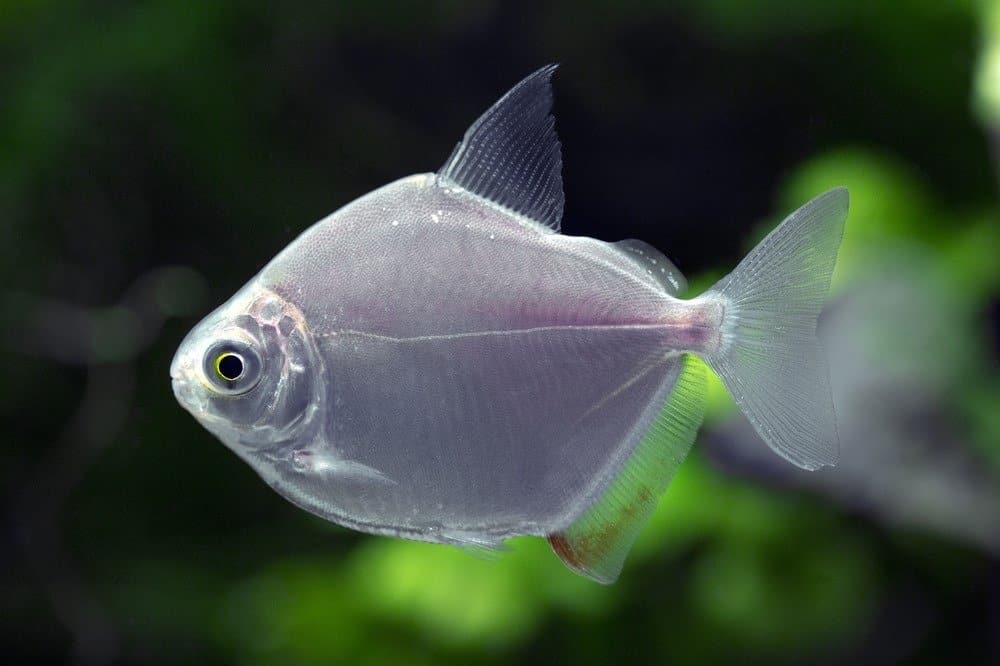
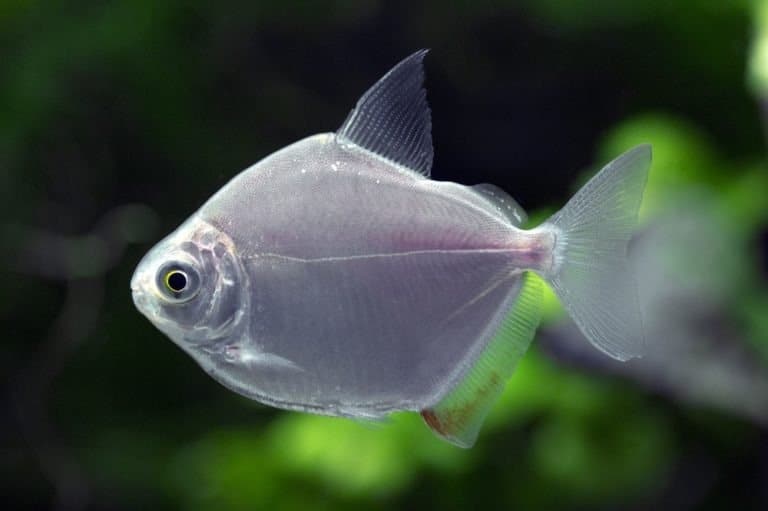
  • One of the most striking things about the silver dollar fish is its extremely flattened appearance, which is akin to that of a silver dollar coin.
  • Although silver dollar fish are omnivores, they feed primarily on plant matter and vegetation. If kept in an aquarium with living plants, they will typically consume all of them.
  • There are at least 16 species of these fish across two genera. However, when people talk about silver dollar fish, they are usually referring to one of two species: Metynnis argentus and Metynnis hypsauchen.
  • Thanks to their peaceful nature and fondness for schooling together, they are popular additions to freshwater aquariums.
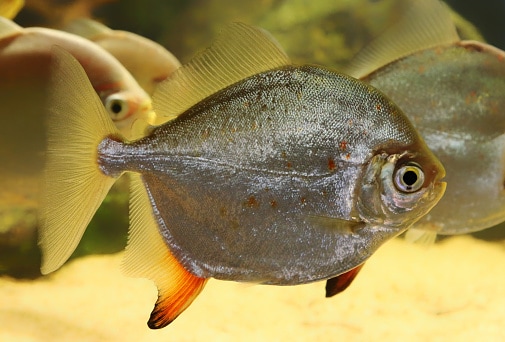
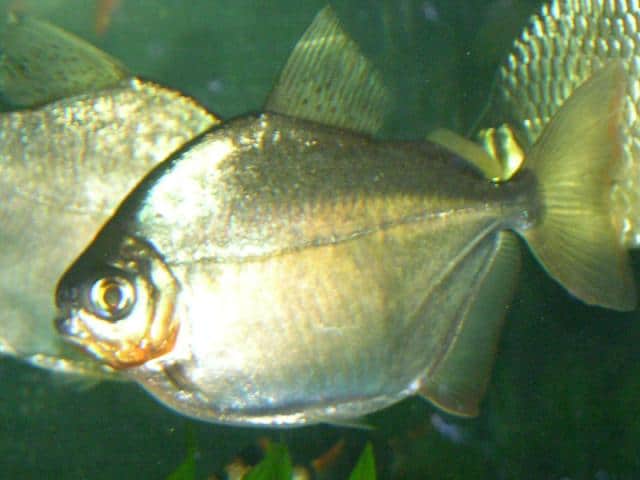
Close-up view of a Red Hook Silver Dollar

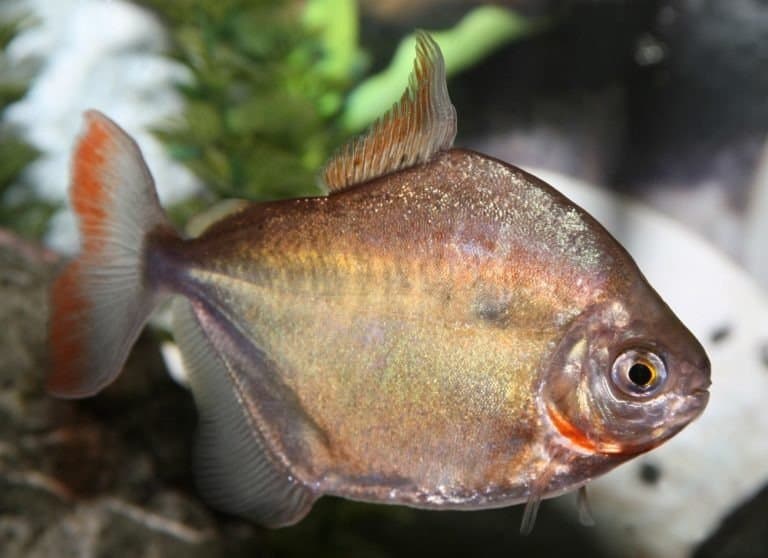
The Red Hook Silver Dollar Fish is known for its distinctive red dorsal fin hook.

Classification and Scientific Name

These fish belong to the class Actinopterygii, the order Characiformes, the family Characidae, and primarily the genus Metynnis, of which there are 14 described species. Two described species of these fish also belong to the genus Myloplus.

That being said, the most common fish that are considered to be silver dollar fish are Metynnis argentus and Metynnis hypsauchen, which are virtually identical to one another. The primary distinguishing feature between the two is the presence of black patches behind the eyes and on the body of M. hypsauchen.

This fish comes by its name honestly. The name for the most common species, Metynnis argentus, translates as follows: Metynnis means “with plowshare,” which indicates a flattened appearance; argentus means “covered with silver,” which belies the fish’s silvery appearance and coloring.

Species

These fish are members of the family Characidae, which consists of 217 genera and 1,464 species of fish. Within the two primary genera, Metynnis and Myloplus, there are 14 and two described species, respectively. Some notable species of these fish include:

  • Silver dollar fish — Species that are called simply this are Metynnis argentus and Metynnis hypsauchen, which are practically identical.
  • Red hook silver dollar fish — This species, Myleus rubripinnis, has different coloring and distinctive fin shapes when compared to generic silver dollar fish. In the wild, they can grow to lengths of up to 22 inches.
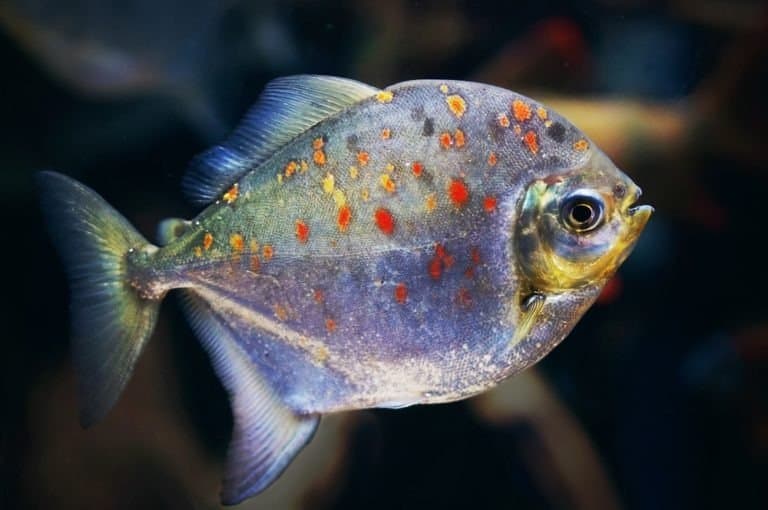
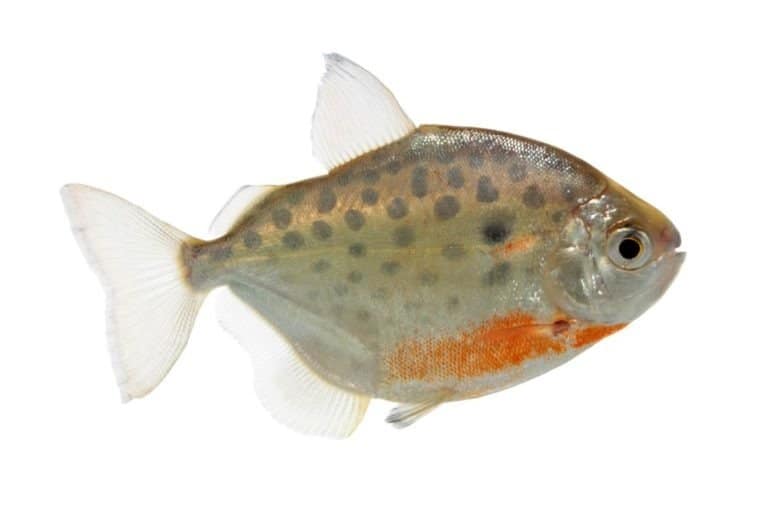
  • Spotted silver dollar fish — Found primarily in French Guyana and Brazil, this fish grows up to 6.5 inches in length and has patterns of black dots.
  • Other common types of silver dollar fish include the striped silver dollar fish, or M. fasciatus; the red-spotted silver dollar fish, or M. luna, which is known for its spotted appearance; the speckled silver dollar fish, or M. maculatus; and the black-barred silver dollar fish, or M. otuquensis.
  • Tiger silver dollar fish — This fish, Metynnis fasciatus, is striped like a tiger and lives primarily in rivers in the Amazon rainforest.

Appearance

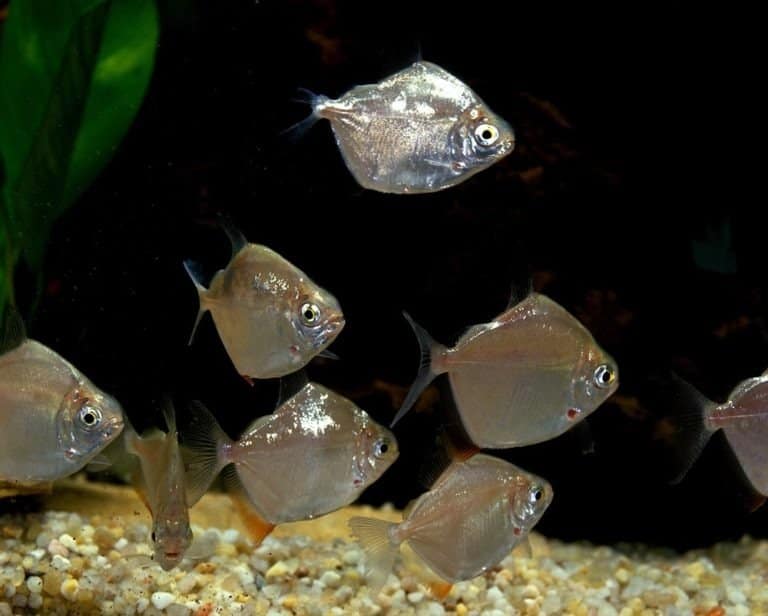
As its common name implies, this fish looks uncannily like a large silver dollar coin. These fish have round, laterally flattened bodies, are very deep-bodied, and grow to an average of 6 inches in length. Their overall coloring is silvery, but slight hints of green and blue tinting can be seen in the right light conditions.

Males and females look largely the same. However, males have fins that are slightly longer and that are tinged red.

As noted previously, some types of these fish vary in appearance and coloring. Some have patches, spots, stripes, or bar-like patterns. Myleus rubripinnis, the red hook silver dollar fish, features a red anal fin and can grow up to 22 inches in length.
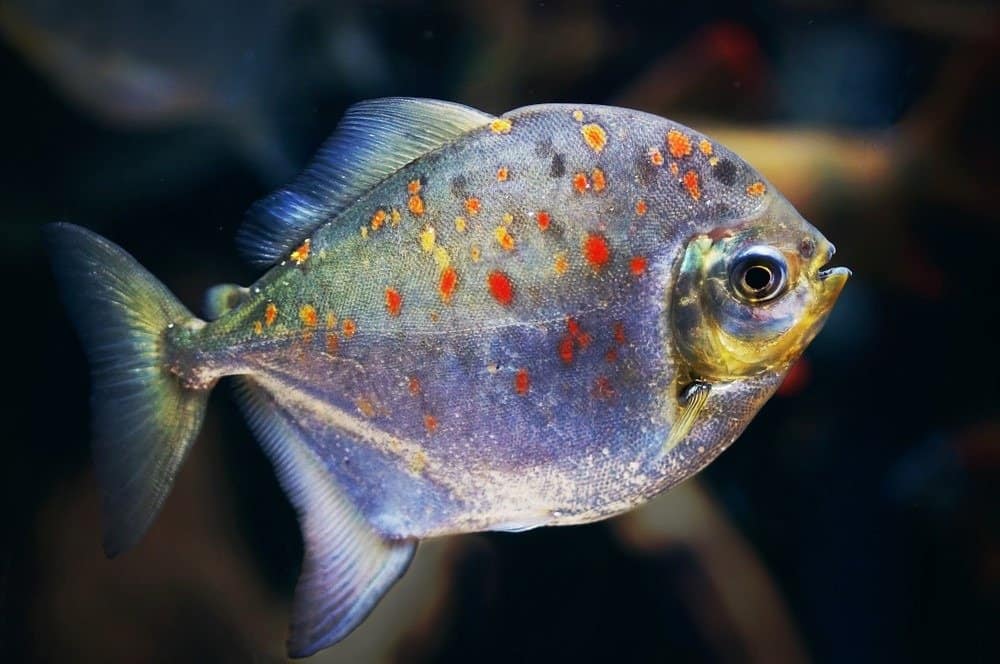
Redhook myleus (Myloplus rubripinnis) or Redhook Silver Dollar.

Redhook Silver Dollar.

Distribution, Population, and Habitat

These fish are not popularly consumed by humans, so they do not face the risk of being overfished. However, official estimates of total population numbers for these fish are not available. In the wild, these fish are endemic to South America; in particular, they are found in Guyana and in the Amazon, east of the Rio Negro to Paraguay. It is believed that they may be endemic to the Tapajos River basin in Brazil as well.

In the wild, these fish prefer rivers that are dark and filled with debris, including peat, gravel, rocks, and driftwood, which make for good hiding places. They prefer moderate water flows, and they thrive best in water with a pH level of between 5 and 7, a hardness of up to 15 dGH, and a temperature of between 24° and 28° Celsius, or 75° to 82° Fahrenheit. As pelagic fish, these fish spend most of their time near the surface of the water.

Predators and Prey

What Eats The Silver Dollar?

The primary predators of these fish are larger fish, reptiles, and birds. Humans do not enjoy fishing for or consuming these fish, so they face no risk there.

What Does The Silver Dollar Eat?

Although these fish are technically omnivores, they skew more toward being herbivores than anything else. When they do consume other animals, they tend to prey on worms and small insects.

Reproduction and Lifespan

These fish reach sexual maturity at about one year of age, or when they reach approximately 4 inches in size. In the wild, they spawn in groups in wooded, heavily vegetated, shallow waters in flooded rivers and tributaries. Males court females by chasing them around before shimmying up alongside them. Females release their eggs, around 2,000 of them, near or in floating plants. Males then fertilize the transparent, slightly yellow-colored eggs, which then fall and float off into the water. The eggs hatch in approximately three days, and the resulting fry can free swim in six to nine days; they reach adult size at about six to eight months of age.

In captivity, these fish live for an average of 10 years.

View all 390 animals that start with S

Sources

  1. Eschmeyer's Catalog of Fishes / Accessed December 2, 2020
  2. Fishbase / Accessed December 2, 2020
  3. Animal World / Accessed December 2, 2020
  4. Fishkeeping World / Accessed December 2, 2020
A-Z Animals Staff

About the Author

A-Z Animals Staff

AZ Animals is a growing team of animals experts, researchers, farmers, conservationists, writers, editors, and -- of course -- pet owners who have come together to help you better understand the animal kingdom and how we interact.
Connect:

Thank you for reading! Have some feedback for us?


Silver Dollar FAQs (Frequently Asked Questions)

In the wild, the silver dollar fish is endemic to the rivers of South America. In particular, it is found in Guyana and in the Amazon River basin east of Rio Negro through to Paraguay. It may also be endemic to the Tapajos River basin of Brazil.
Otherwise, the fish is popularly found in home aquariums around the world.