



S
Species Profile

Skunk

Mephitidae

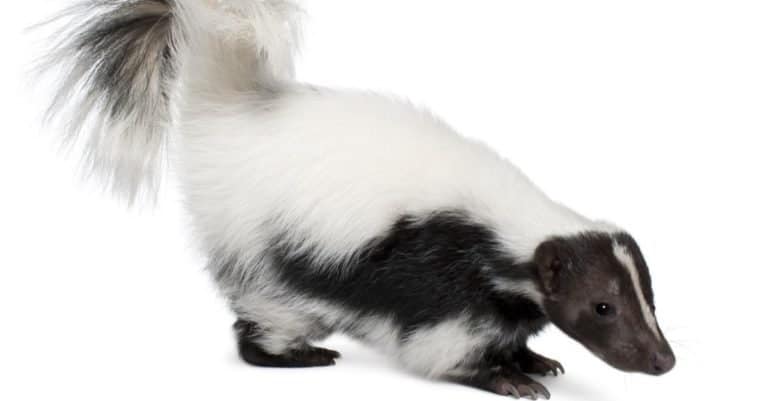
Bold stripes, bigger attitude.
Geoffrey Kuchera/Shutterstock.com

Skunk Distribution

Click a location to explore more animals from that region

Loading map...

Size Comparison

Human 5'8"
Skunk 7 in

Skunk stands at 10% of average human height.

Striped Skunk (Mephitis mephitis)

At a Glance

Family Overview This page covers the Skunk family as a group. Stats below are general traits shared across the family.
Also Known As polecat, stinker, stink badger
Diet Omnivore
Activity Nocturnal+
Lifespan 3 years
Weight 6.8 lbs
Status Not Evaluated
Did You Know?

Family-wide size range: ~35-85 cm total length (incl. tail) and roughly ~0.2-4.5+ kg, from tiny spotted skunks to hefty hog-nosed skunks.

Scientific Classification

Family Overview "Skunk" is not a single species but represents an entire family containing multiple species.

Skunks (family Mephitidae) are small-to-medium carnivorans best known for their powerful chemical defense: anal gland secretions sprayed to deter predators. The family includes New World skunks (e.g., Mephitis, Spilogale, Conepatus) and Southeast Asian stink badgers (Mydaus). Many are omnivorous, taking insects, small vertebrates, eggs, fruits, and carrion.

Kingdom
Animalia
Phylum
Chordata
Class
Mammalia
Order
Carnivora
Family
Mephitidae

Distinguishing Features

  • Conspicuous black-and-white warning coloration (variable by species: stripes, spots, or mostly white)
  • Paired anal scent glands capable of accurate defensive spray
  • Elongated body with short legs; many species have strong foreclaws for digging
  • Omnivorous diet with heavy insect component in many species
  • Typically nocturnal/crepuscular; strong sense of smell

Physical Measurements

Males and females differ in size

Height
7 in (4 in – 10 in)
7 in (4 in – 12 in)
Length
1 ft 12 in (10 in – 2 ft 9 in)
1 ft 10 in (11 in – 2 ft 9 in)
Weight
8 lbs (1 lbs – 15 lbs)
4 lbs (0 lbs – 11 lbs)
Tail Length
8 in (2 in – 12 in)
7 in (7 in – 1 ft 1 in)
Top Speed
12 mph
running

Appearance

Primary Colors
Secondary Colors
Skin Type Thick fur over tough skin; texture varies from soft to coarse. Many have prominent anal scent glands and muscular tails used for display; forequarters often adapted for digging with robust claws.
Distinctive Features
  • Measurements (family range): head-body ~20-70 cm; tail ~5-40 cm; mass ~0.2-6.8 kg (smallest spotted skunks to largest striped/hog-nosed forms).
  • Lifespan (range): commonly ~2-7 years in the wild; up to ~10-12 years in captivity (varies by species and predation/road mortality).
  • Defensive anatomy: enlarged anal scent glands with spray ducts; secretion is oily, persistent, and strongly irritating to deter predators.
  • Defensive behavior: warning postures (stamping, tail-raising, turning hindquarters); many individuals "aim" before spraying; some may bluff without spraying.
  • Mephitis are stocky with bold back stripes; Spilogale are smaller and quick with spots or broken bands; Conepatus have big heads, long snouts, and strong digging claws; Mydaus are brown, short-legged, badger-like.
  • Tail features: tail length and fluffiness vary; many show white or pale tipping that enhances warning display.
  • Foraging ecology: mostly omnivorous-especially insects/larvae, small vertebrates, eggs, fruit, and carrion; degree of insectivory vs frugivory varies by habitat and season.
  • Habitat breadth: occurs from deserts and grasslands to forests and agricultural edges; denning in burrows, rock crevices, logs, or human structures is common.
  • Social patterns: usually solitary, but seasonal tolerance occurs; some species form winter denning aggregations in colder regions.
  • Human-wildlife interactions: frequent roadside mortality and nuisance conflicts (garbage, poultry); also beneficial via insect and rodent control. Rabies can be a regional concern but is not universal across the family.

Sexual Dimorphism

Sexual dimorphism is generally mild across Mephitidae. Males are often larger/heavier with slightly broader heads and necks, but coat pattern and coloration are usually similar between sexes; degree varies among species and populations.

  • Often 5-20% larger body mass and total length on average (species-dependent).
  • Slightly broader head/neck and more robust forequarters in some species.
  • May have larger home ranges and more frequent scent-marking in breeding season (behavioral, not structural).
  • Typically smaller, more gracile build with similar stripe/spot patterns.
  • Prominent mammary development when lactating; otherwise little external difference.
  • Often show higher den fidelity during rearing, influencing wear/coat condition locally.

Did You Know?

Family-wide size range: ~35-85 cm total length (incl. tail) and roughly ~0.2-4.5+ kg, from tiny spotted skunks to hefty hog-nosed skunks.

Lifespan varies widely: often ~3-7 years in the wild, but commonly ~10-15 years in human care (species and conditions dependent).

They occur in two regions: skunks across the Americas (southern Canada to South America) and stink badgers (Mydaus) in parts of Southeast Asia (notably Indonesia and Palawan in the Philippines).

Skunk spray is an oily mix rich in sulfur compounds; it can be aimed accurately and is typically effective at a few meters (often ~3-4 m).

Not all "skunks" look the same: Mephitis are classic bold-striped; Spilogale are smaller, high-contrast "spotted" skunks; Conepatus have pig-like snouts for rooting; Mydaus stink badgers are stocky, diggy forest foragers.

Despite being in the order Carnivora, many mephitids are strong omnivores-major consumers of insects, grubs, fruit, eggs, and small vertebrates-making them important pest and carrion recyclers.

Several species are comfortable near people, which creates both benefits (insect/rodent control) and conflicts (garbage raiding, pet encounters, road mortality).

Unique Adaptations

  • Paired anal scent glands with muscular control and specialized ducts enable a directed spray rather than simple scent marking; individuals can often fire in short bursts.
  • Chemical defense optimized for persistence: the oily secretion clings to surfaces and fur, helping it remain effective long enough to deter predators.
  • High-contrast warning coloration (aposematism) across diverse body plans-striped, spotted, or badger-like-supports predator learning and avoidance.
  • Spray-aiming behavior and posture: body orientation, tail positioning, and controlled release improve accuracy while minimizing the chance of self-contamination.
  • Digging and rooting adaptations in several lineages: robust forelimbs/claws and, in hog-nosed skunks and stink badgers, a strong snout for prying in soil and leaf litter.
  • Generalist dentition and digestive flexibility support broad omnivory, allowing mephitids to exploit insects, small vertebrates, fruit, eggs, and carrion depending on season and region.

Interesting Behaviors

  • Defensive "escalation ladder": many mephitids warn first-freezing, tail raising, foot-stomping, turning the rear toward a threat-before spraying; willingness to spray varies by species and situation.
  • Aposematic display: strong black-and-white contrast (or high-contrast spotting) is used to advertise risk; patterns differ among genera and species but serve a similar warning function.
  • Foraging styles vary across the family: hog-nosed skunks (Conepatus) often root and dig for invertebrates; striped/hog-nosed types commonly patrol edges and open habitats; spotted skunks (Spilogale) tend to be more agile and can use complex maneuvers when threatened.
  • Spotted skunk "handstand" threat display: some Spilogale perform a stiff-legged handstand or rear-up display as part of warning behavior before spraying.
  • Seasonal activity and denning: many are crepuscular/nocturnal and use burrows, hollow logs, rock crevices, or human structures; in colder regions some enter extended winter torpor/denning with reduced activity (degree varies by species and climate).
  • Omnivory with local specialization: diets shift with habitat and season-more insects and larvae when abundant, more fruit/plant material in some regions, and opportunistic scavenging where available.
  • Social patterns are flexible: many are solitary foragers but may share dens in cold periods or during breeding; tolerance levels differ among species and populations.
  • Human-wildlife interactions: many learn "urban edge" behaviors (using lawns for grubs, raiding unsecured trash, denning under sheds), increasing encounters with pets and vehicles.

Cultural Significance

Skunks (Mephitidae) appear in North American language and culture: “skunk” comes from Algonquian and “Mephitis” from Latin. They stand for self-defense, appear in cartoons, help control pests, can be nuisances, and affect rabies and urban-wildlife messages.

Myths & Legends

In many Native North American stories, Skunk (Mephitidae) is small but mighty, given a strong stinky defense; its bold black-and-white marks are said to be a warning earned by bravery or cleverness.

In Coyote cycle stories from the western parts of North America, Skunk sometimes appears as a minor-but-mighty character-ignored or mocked at first, then vindicated when its scent turns the tables on a stronger, overconfident animal.

Etiological folktales found in multiple communities tell how Skunk came to wear a white stripe (or contrasting pattern): the stripe is presented as a deliberate signal-nature's reminder to heed warnings before conflict escalates.

Some traditional animal stories use Skunk as a moral teacher about boundaries and respect: characters who approach too aggressively, refuse to listen, or break social rules suffer the consequence of the spray and public embarrassment.

Early colonial-era anecdotes and travel narratives in North America often treated skunks as emblematic "new world" creatures-memorable enough that their name and reputation spread quickly through European languages and popular accounts.

Conservation Status

NE Not Evaluated (family-level unit; Mephitidae species span multiple IUCN categories from Least Concern to Endangered depending on species and region)

Has not yet been evaluated against the criteria.

Population Unknown

Protected Under

  • Protection varies by country and species: many skunks and stink badgers occur in protected areas and may be covered under national wildlife laws, while others are unprotected or managed as furbearers/pests with regulated or unregulated take.

You might be looking for:

Striped Skunk

32%

Mephitis mephitis

Most widespread and commonly encountered North American skunk; bold black-and-white striping.

Eastern Spotted Skunk

16%

Spilogale putorius

Smaller skunk with broken stripes/spots; agile and more insectivorous.

Western Spotted Skunk

12%

Spilogale gracilis

Spotted skunk of western North America; similar in size/behavior to other Spilogale.

Stink Badgers (general)

12%

Mydaus spp.

Southeast Asian members of Mephitidae; more badger-like build with strong digging habits.

Hooded Skunk

10%

Mephitis macroura

Longer tail and ‘hooded’ look; found from the southwestern U.S. into Central America.

American Hog-nosed Skunk

10%

Conepatus leuconotus

Large skunk with pig-like snout used for digging; distinctive facial pattern.

Striped Hog-nosed Skunk

8%

Conepatus semistriatus

Central/South American hog-nosed skunk; strong digging adaptations.

Life Cycle

Birth 5 kits
Lifespan 3 years

Lifespan

In the Wild
1–10 years
In Captivity
5–14 years

Reproduction

Mating System Polygyny
Social Structure Solitary
Breeding Pattern Transient
Fertilization Internal Fertilization
Birth Type Internal_fertilization

Across Mephitidae, adults are usually solitary and meet mainly to breed. Males range widely and may mate with multiple females during a seasonal rut, with brief associations; females typically rear offspring alone, with little to no male parental care.

Behavior & Ecology

Social Surfeit Group: 3
Activity Nocturnal, Crepuscular, Cathemeral
Diet Omnivore Insects and other soil/ground-dwelling invertebrates (especially larvae/grubs)

Temperament

Generally shy and conflict-avoidant, relying on warning displays before using chemical defense
Defensive when cornered or when protecting dens/young; boldness varies by species and habitat
Often tolerant at shared winter dens yet typically intolerant of close contact while foraging
Opportunistic and curious foragers; habituation to human-altered landscapes varies widely

Communication

hisses
growls
squeals
whines
chattering or clicking calls Especially in close-range interactions
scent marking with anal gland secretions and urine to signal identity and territory
ritualized warning displays: tail-raising, stomping, and body postures before spraying
chemical spray used primarily as last-resort defense; frequency varies by individual and context
tactile contact between mothers and young (nuzzling/grooming) within dens
den-site use and revisitation patterns that indirectly communicate occupancy to conspecifics

Habitat

Biomes:
Tropical Rainforest Tropical Dry Forest Savanna Desert Hot Desert Cold Mediterranean Temperate Grassland Temperate Forest Temperate Rainforest Boreal Forest (Taiga) Tundra Alpine Freshwater Wetland +8
Terrain:
Mountainous Hilly Plateau Plains Valley Coastal Island Riverine Karst Rocky Sandy Muddy +6
Elevation: Up to 14763 ft 9 in

Ecological Role

Omnivorous mesocarnivores and invertebrate predators with frequent scavenging and occasional nest predation; important ground-foraging consumers across diverse habitats.

Regulation of insect and other invertebrate populations (including many pest species) Scavenging that helps recycle nutrients and reduce carrion persistence Soil disturbance/aeration from digging and rooting while foraging Occasional seed dispersal via fruit consumption (context-dependent) Trophic link between invertebrates/plants and larger predators (prey base contribution)

Diet Details

Main Prey:
Insects Other invertebrates Small mammals Reptiles and Amphibians Ground-nesting birds and eggs Carrion
Other Foods:
Fruits and berries Seeds and grains Roots, bulbs, and tubers Nuts Fungi Human-associated foods

Human Interaction

Domestication Status

Wild

Skunks (family Mephitidae, including New World skunks and SE Asian stink badgers Mydaus) are not domesticated like livestock. Some New World skunks are kept as pets and bred in captivity, often with their scent glands removed. People see them as pests (denning, raiding poultry/garbage), helpful pest eaters, road victims, fur sources, and rabies risks.

Danger Level

Moderate
  • Rabies exposure risk in regions where skunks are significant rabies reservoirs (risk varies by species and geography); bites/scratches during handling or cornering
  • Chemical spray causing intense odor; eye and mucous-membrane irritation and temporary vision impairment at close range
  • Secondary conflicts: denning under buildings, poultry predation/egg loss, garbage raiding, and associated property damage
  • Road-safety hazard mainly from drivers swerving/stop-and-go encounters; skunks themselves are frequent roadkill near people

As a Pet

Not Suitable as Pet

Legality: Rules for keeping skunks (Mephitidae) differ by country, state, or province. Many places ban or limit them. Some allow captive-bred skunks with permits, vet papers, and rabies rules. People must check local wildlife, invasive species, and health rules.

Care Level: Expert Only

Purchase Cost: Up to $800
Lifetime Cost: $6,000 - $25,000

Economic Value

Uses:
Nuisance wildlife management Public health and disease surveillance Historical fur trade (localized/variable) Pest control/ecosystem services Education and outreach (zoos, nature centers)
Products:
  • wildlife control services (exclusion, trapping, relocation where legal)
  • fur/pelts (historical/limited modern use depending on region and regulation)
  • research and diagnostic samples for rabies and other zoonoses (public health programs)
  • educational programming/animal exhibits (captive individuals where permitted)

Relationships

Related Species 3

Ecological Equivalents 4

Animals that fill a similar ecological role in their ecosystem

Zorilla Ictonyx striatus Small carnivoran with strong chemical defenses and aposematic striping; employs a similar predator-deterrence strategy (spraying a foul-smelling odor).
American badger Taxidea taxus Shares a digging-centered foraging ecology, especially similar to hog-nosed skunks and stink badgers; takes insects and small vertebrates and extensively uses burrows.
Raccoon
Raccoon Procyon lotor An omnivorous, opportunistic forager that uses many of the same habitats, including edges, woodlands, and urban/suburban areas, and has an overlapping diet of eggs, invertebrates, fruit, and carrion.
Honey badger
Honey badger Mellivora capensis Ecologically similar as a robust, opportunistic omnivore with strong defenses and bold anti-predator behavior, though not reliant on spray.

Types of Skunk

15

Explore 15 recognized types of skunk

Striped skunk Mephitis mephitis
Hooded skunk Mephitis macroura
Eastern spotted skunk Spilogale putorius
Western spotted skunk Spilogale gracilis
Plains spotted skunk Spilogale interrupta
Southern spotted skunk Spilogale angustifrons
Desert spotted skunk Spilogale leucoparia
Pygmy spotted skunk Spilogale pygmaea
Yucatán spotted skunk Spilogale yucatanensis
American hog-nosed skunk Conepatus leuconotus
Striped hog-nosed skunk Conepatus semistriatus
Molina's hog-nosed skunk Conepatus chinga
Humboldt's hog-nosed skunk Conepatus humboldtii
Sunda stink badger Mydaus javanensis
Palawan stink badger Mydaus marchei

“A skunk’s spray can be detected at distances of up to 1.5 miles.”

Skunks are omnivores eating a diet of insects, fruit, fish, amphibians, reptiles, and small mammals. This animal is best known for its ability to spray an odorous (stinky) liquid from its scent glands. They use the spray as a defense against predators. Skunks live in Canada, the United States, Mexico, and South America. Female skunks give birth once a year.

5 Incredible Skunk Facts!
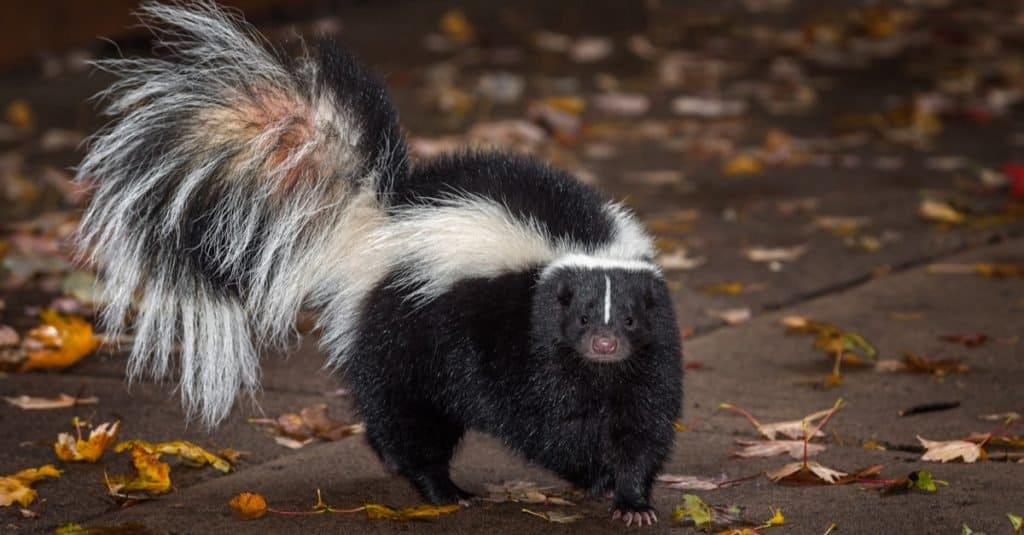
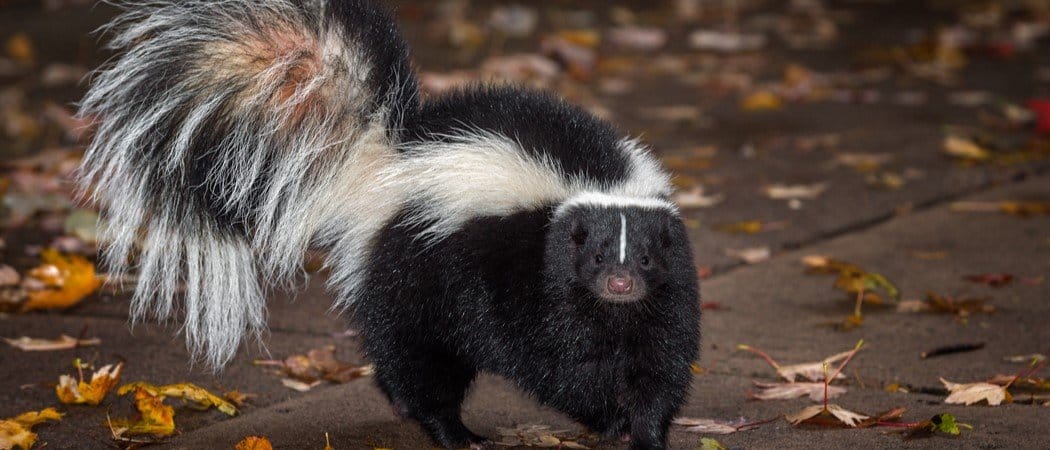
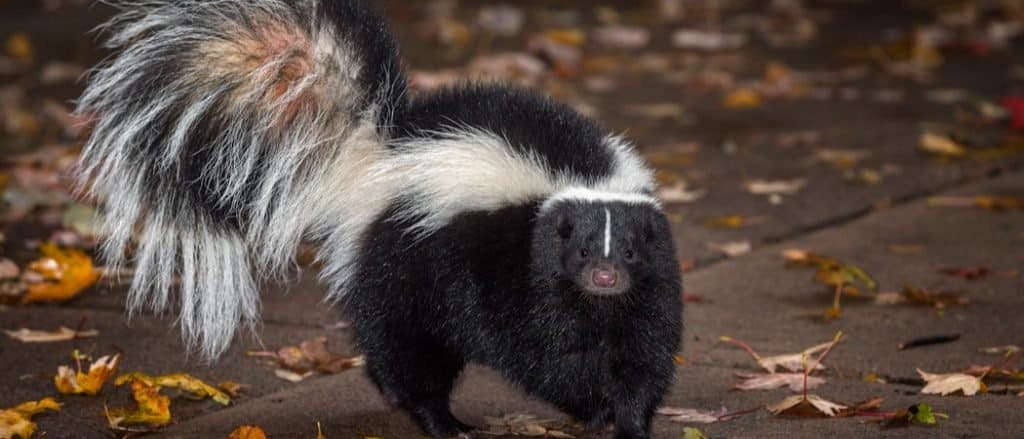
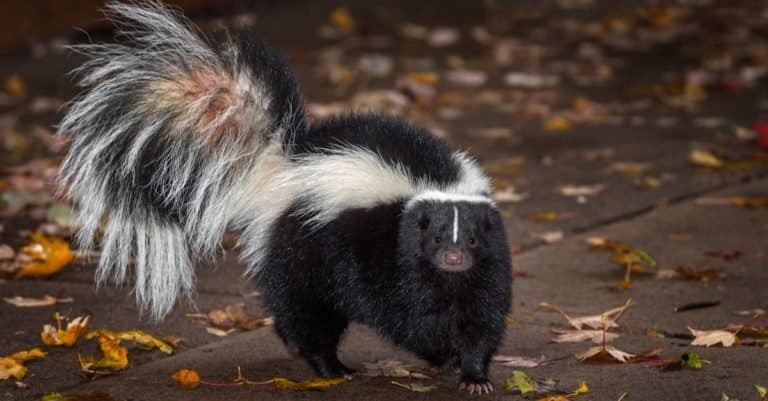
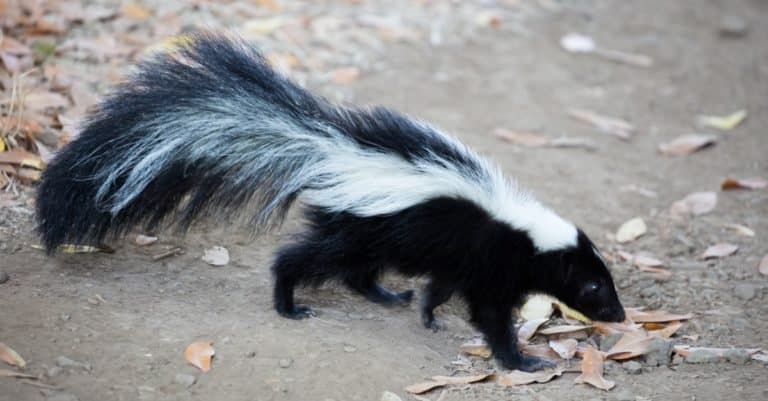
Striped Skunk (Mephitis mephitis) on a path

A female can have 2 to 10 babies in a litter

  • These animals use their strong front legs and claws to dig for insects
  • Skunks are not affected by snake venom
  • They live in dens, hollow logs, burrows, and even abandoned barns and houses
  • A female can have 2 to 10 babies in a litter
  • Skunks are known to carry rabies and can pass it to other animals or even a family pet

You can check out more incredible facts about skunks.

Evolution and Origins

Skunks have been around for millions of years. In fact, the oldest fossil identified as a skunk dates back to about 11 or 12 million years ago and was discovered in what is now Germany. Data suggests that the skunk family came appeared about 30 to 40 million years ago.

Additionally, animals have a skunklike dentition dating back to the Late Cretaceous Epoch.

Scientific Name
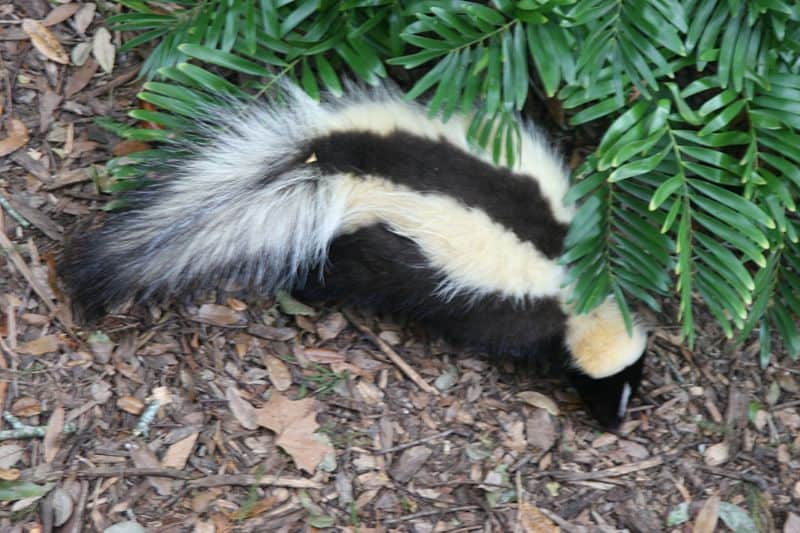
The scientific name for one of the skunk species is Mephitis mephitis.

The scientific name for one of the skunk species is Mephitis mephitis. The Latin word mephitis means poisonous smell. This animal is sometimes called a polecat. At one time, they were mistaken for striped polecats (scientific name: Ictonyx striatus) due to their similar appearance.

These animals belong to the Mephitidae family and the class Mammalia.

The skunk family includes 12 species. Some of those include:

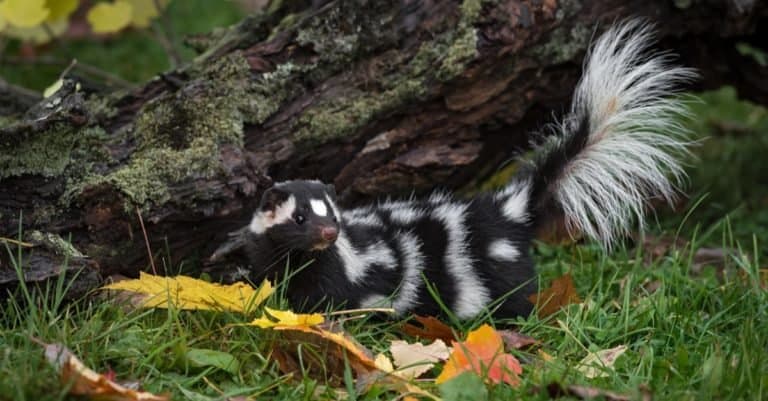
  • Eastern spotted skunk
  • Western spotted skunk
  • Hog-nosed skunk
  • Striped skunk
  • Hooded skunk
  • Mephitis
  • Spotted skunks
  • Molina’s hog-nosed skunk
  • Stink badger
  • Striped hog-nosed skunk
  • Indonesian Stink Badger
  • Palawan Stink Badger

Appearance and Behavior
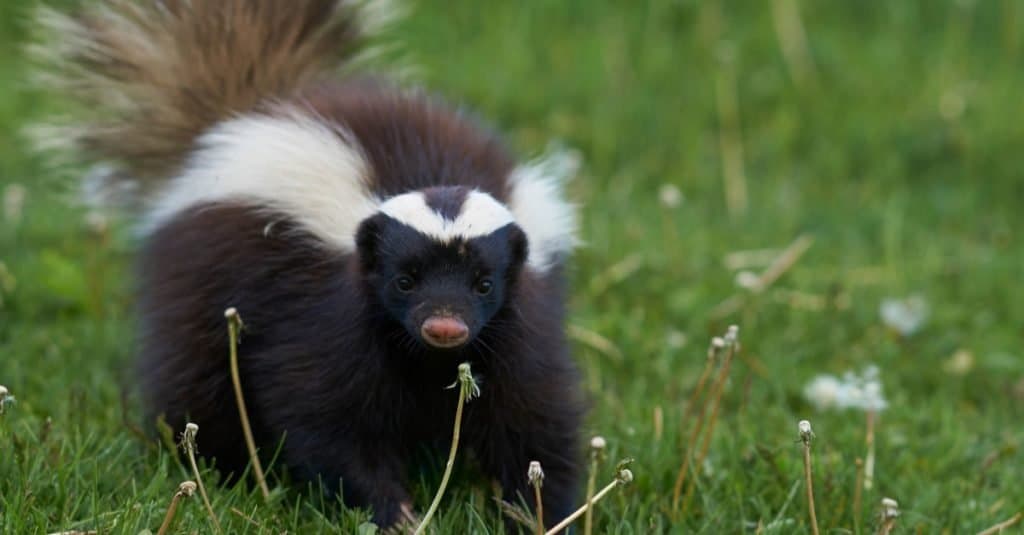
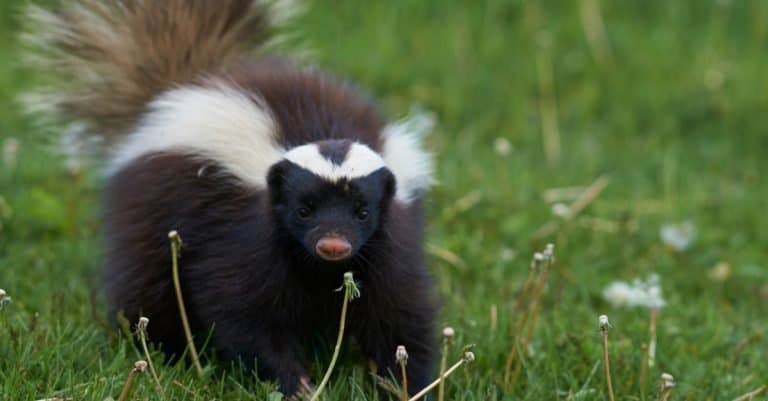
Humboldt's hog-nosed skunk (Conepatus humboldti) searching for food in Valle Chacabuco, Patagonia, Chile

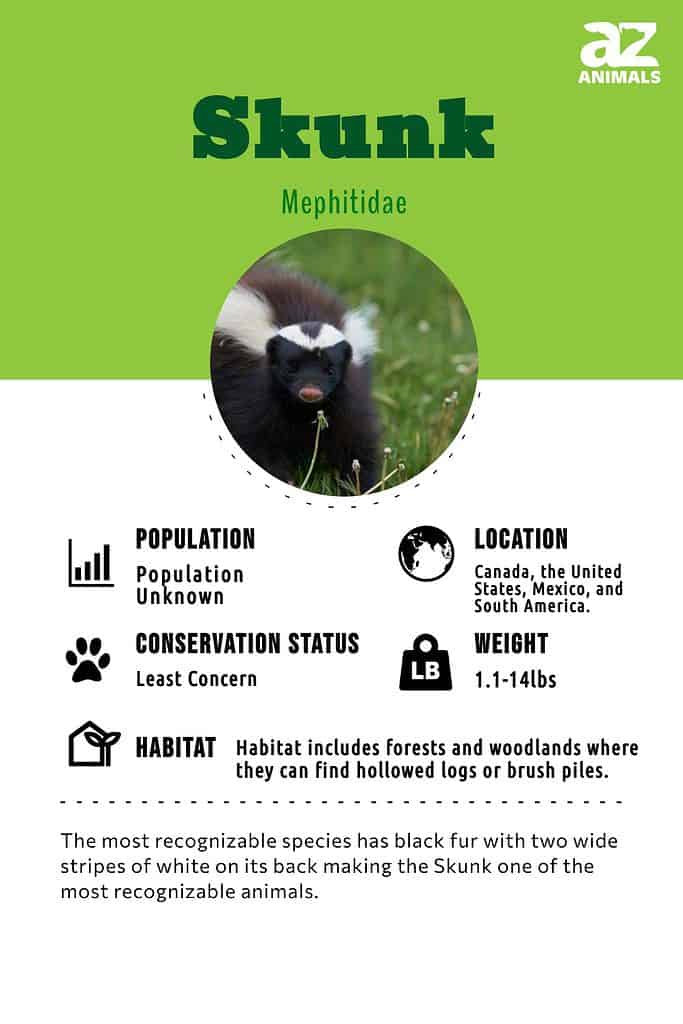
The most recognizable species has black fur with two wide stripes of white on its back making the Skunk one of the most recognizable animals.

The most recognizable species has black fur with two wide stripes of white on its back. Other species have swirls or spots of white on their black fur. An exception is an albino skunk. It has a coat of pure white fur. Albino skunks are rare.

They don’t have the ability to produce the melanin that darkens their fur. Albino skunks are different from animals with mostly white fur. One way to tell them apart is a white skunk has black eyes and an albino skunk has red eyes. Unfortunately, albino skunks usually have a short lifespan because they have other medical issues as a result of their rare genetics.

This animal’s traditional black and white coat makes it easily recognizable by humans. However, to its natural predators, the stark white stripe or spotted design of its coat is a visual signal to stay away. Don’t say I didn’t warn you!

These animals have four feet, tiny black eyes, and bristly tails with a mixture of black and white fur. Skunks have sharp teeth that help them to eat a variety of items in their diet. This animal has strong front feet with long claws that help them to dig burrows or look for worms and other insects. But you probably won’t see them digging a burrow.

They are known for taking up residence in burrows that have been abandoned by foxes, woodchucks, and other animals.

Some of these animals can use their claws to climb. The spotted skunk is able to use its strong feet and claws to climb trees. Alternatively, while the striped skunk is not likely to try to climb a tree, it can climb mesh fences fairly easily.

The animal’s body is from 8 to 19 inches long with a tail that can be as long as 15 inches. They can weigh from 6 to 14 pounds. Picture 9 golf tees lined up end to end and you’re looking at the length of a 19-inch skunk.

When it comes to weight, an average-sized skunk (about 10 pounds) weighs the same as a housecat. The American hog-nosed species is one of the longest measuring 2.7 feet from the tip of its nose to the end of its tail.

The most notable feature of this animal is its ability to spray. When this animal feels threatened, it releases a stinky liquid from scent glands beneath its tail. This liquid can travel up to 12 feet, so a predator doesn’t have to be close to a skunk to get sprayed!

Though this liquid isn’t poisonous, it takes several days for the smell to wear off an animal’s fur or body. Plus, if it gets into the eyes of an animal, it can sting. The predator runs off in an effort to get away from the powerful smell. That’s why this spray is so effective as a defense mechanism. Learn more about the stinkiest animals on earth here.

Skunks are mostly solitary animals. However, those that live in colder places may gather in groups of 10 to 20 inside burrows to keep warm.

A group of skunks is called a surfeit. Generally, they are shy creatures that try to stay out of sight. The only time these creatures show aggression is during breeding season when they are competing for mates. It is also important to know that skunks are not rodents.

Habitat
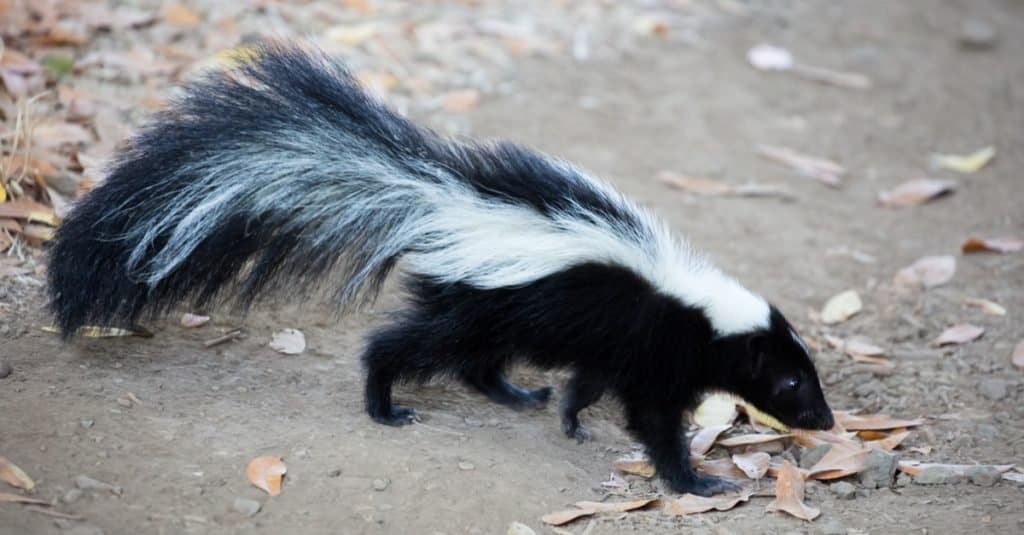
Striped Skunk - Mephitis mephitis. Rancho San Antonio County Park, Santa Clara County, California, USA.

These animals live in Canada, the United States, Mexico, and South America.

These animals live in Canada, the United States, Mexico, and South America. They live in places with a temperate climate. Specifically, their habitat includes forests and woodlands where they can find hollowed logs or brush piles.

They sometimes live in burrows that have been abandoned by another animal. Most of them are found living within 2 miles of a stream or creek, so they have access to drinking water along with fish, frogs, and other types of prey.

During the cold-weather months, These animals stay in burrows to keep warm. Though they don’t officially hibernate, they sleep a lot during this season.

Furthermore, these animals don’t migrate. In fact, they live their lives within about a 2-mile range of their hollow log, den, or other shelters.

Diet
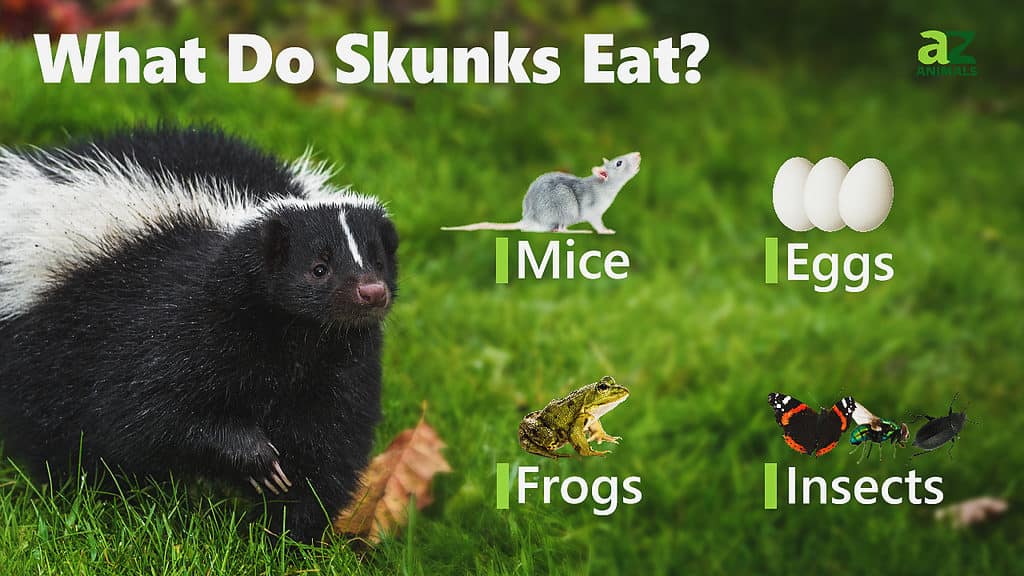
These animals are omnivores. Biologists consider them opportunistic feeders. This means they don’t have a specific list of things they eat. They’ll take the opportunity to eat anything available to them in their environment. For instance, if a skunk wanders into a neighborhood and finds a bird feeder, it will eat a seed that’s fallen on the ground.

What eats skunks?

The great horned owl is one of the main predators of these animals. Others include golden eagles, eagles, foxes, and coyotes.

What do skunks eat?

They eat fruit, plants, rodents, grasshoppers, worms, bird eggs, and frogs. They can also eat venomous snakes because they are immune to snake venom. These creatures eat whatever food source is most plentiful during the particular season.

Predators and Threats
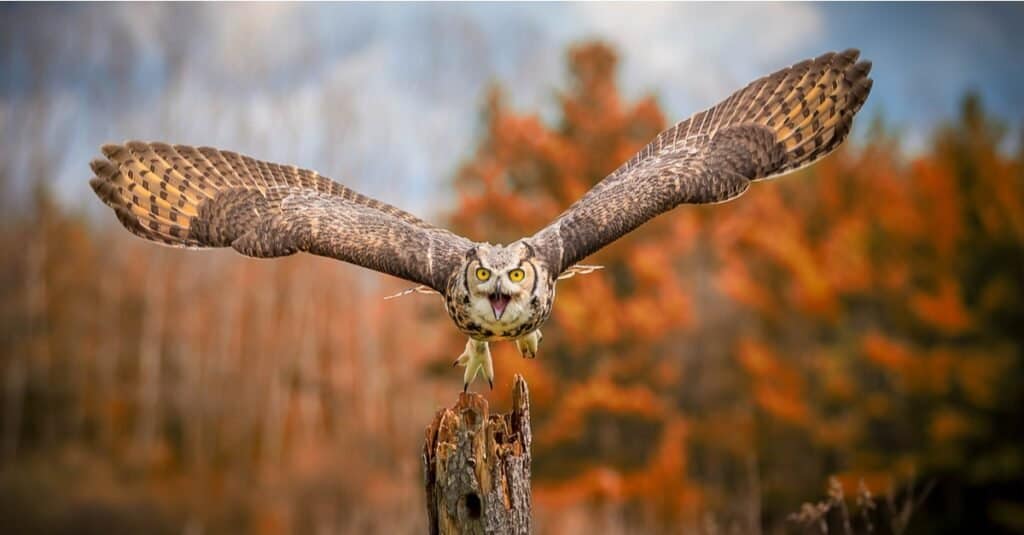
a great horned owl ,center frame, flying toward to camera. The owls massive wings are spread in flight. The bird is varying shades of brown, with a lighter face. Trees with fall foliage of red, gold and brown compete the background.

A flying Great Horned Owl prey on skunks.

Because these animals are active at night, they are vulnerable to great horned owls. This owl can see the movement of a skunk in the dark. It can swoop down to capture it before the skunk is able to turn and release its repellent.

Other winged predators of these animals include bald eagles and golden eagles. Though coyotes and foxes are predators of the skunk, they are sometimes discouraged from approaching due to the skunk’s coloration and spray.

Drought is one environmental threat to skunks. Deforestation is another threat to the habitat of these animals. These animals are sometimes killed as pests in neighborhoods because they are known carriers of rabies. This disease can be passed on to a pet dog or cat. A human can also contract rabies from a skunk if the person is bitten or scratched. Of course, a person should go to the nearest hospital if bitten or scratched by a skunk.

As a note, these animals help to keep the population of insects and mice under control. In short, they serve a purpose in the ecosystem too!

The conservation status of the skunk is Least Concern with a stable population.

Reproduction, Babies, and Lifespan
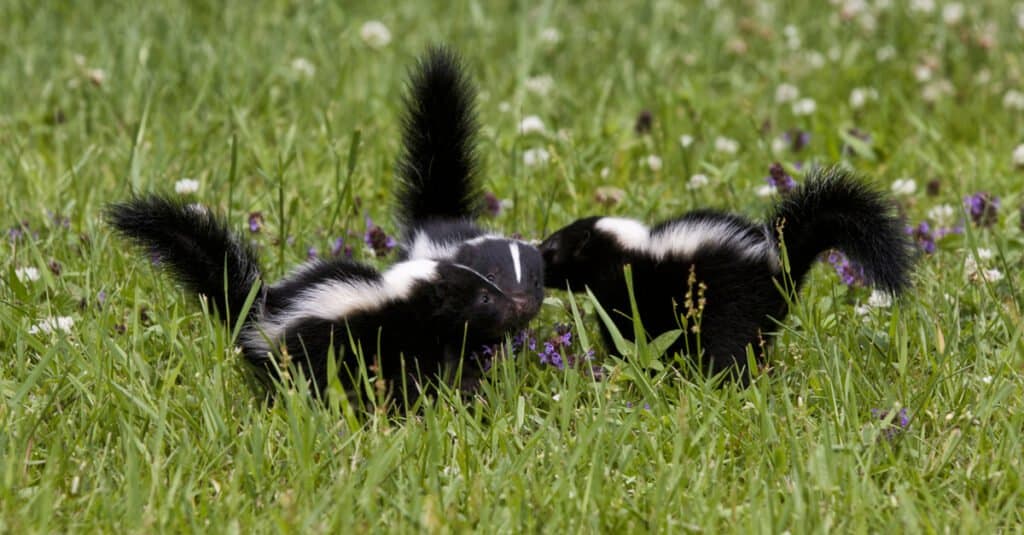
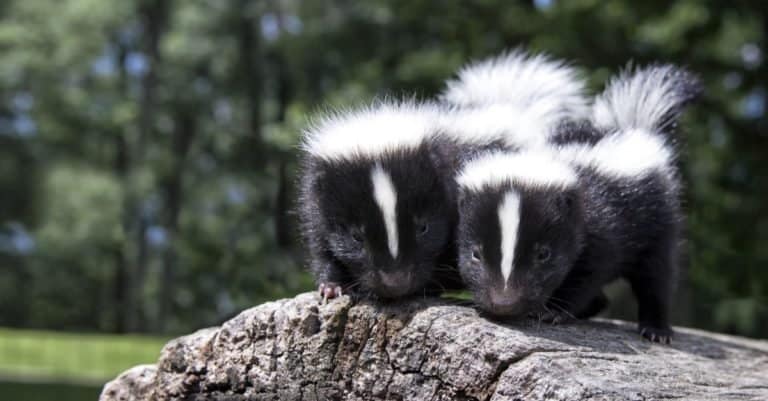
Baby Skunk - Two Skunks

Skunks give birth to live babies in a den of grass.

The breeding season of these animals is between February and April. A male looks for a female and wanders around her to see if she is ready to mate.

If the female wants nothing to do with the male, she releases her spray to chase him off. A male mates with several females in one breeding season. The gestation period of a female is 60 days. Females have just one litter per year.

The animal has live babies, aka kits, in a den filled with grass. A litter can contain from 2 to 10 kits. Each baby weighs around one ounce at birth and is not able to see or hear until it’s three weeks old. The female takes sole care of the kits and nurses them until they are six weeks old.

At that time, the female allows the kits to explore outside the den and they are weaned by the age of two months.

They become independent at around two months old and go off to look for their own shelter. Once a baby starts moving around outside of the den, it’s vulnerable to predators including owls, eagles, coyotes, and foxes. It’s not uncommon for kits to be killed before reaching one year old.

The lifespan of a skunk goes up to 7 years, but the average age is 3.

Population

The IUCN Red List of Threatened Species reports no specific population. But, because females have one litter of up to 10 kits per year, the population of this animal remains stable. The conservation status of the skunk is Least Concern.

Zoo

Can you visit these animals in the zoo? Yes, you can!

View all 390 animals that start with S

Sources

  1. Wikipedia / Accessed March 3, 2021
  2. Chesapeake Bay Program / Accessed March 3, 2021
  3. Massachusetts / Accessed March 3, 2021
Rebecca Bales

About the Author

Rebecca Bales

Rebecca is an experienced Professional Freelancer with nearly a decade of expertise in writing SEO Content, Digital Illustrations, and Graphic Design. When not engrossed in her creative endeavors, Rebecca dedicates her time to cycling and filming her nature adventures. When not focused on her passion for creating and crafting optimized materials, she harbors a deep fascination and love for cats, jumping spiders, and pet rats.
Connect:

Thank you for reading! Have some feedback for us?


Skunk FAQs (Frequently Asked Questions)

First, the legality of skunks as pets varies significantly by region and country, so make sure keeping a pet is legal wherever you live. Second, skunks can serve as good pets if they’re captive-bred, but they’re a challenging pet that requires more time than most owners are willing to give.