
S
Species Profile

Sparrow

Passeridae

Small birds, big social networks
Craig Howman/Shutterstock.com

Sparrow Distribution

Click a location to explore more animals from that region

Invasive Species
Loading map...

Found in 133 countries

Size Comparison

Human 5'8"
Sparrow 3 in

Sparrow stands at 5% of average human height.

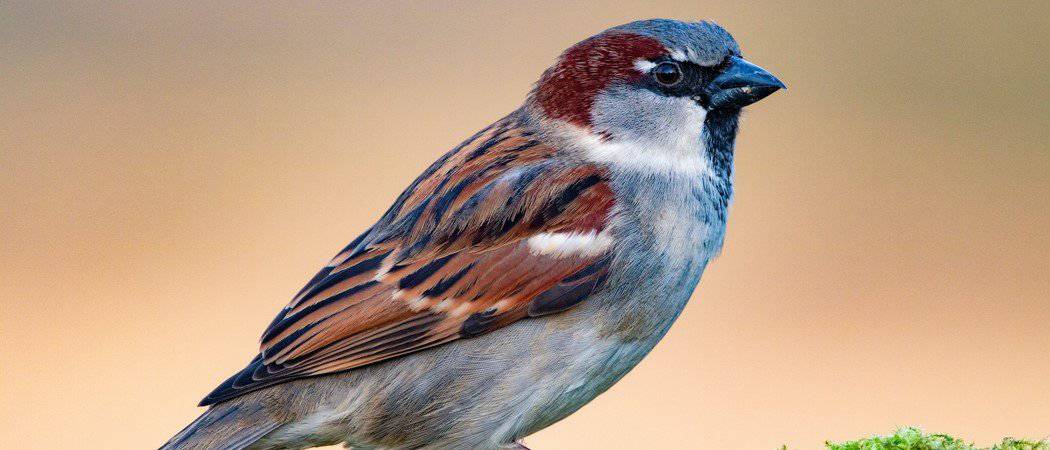
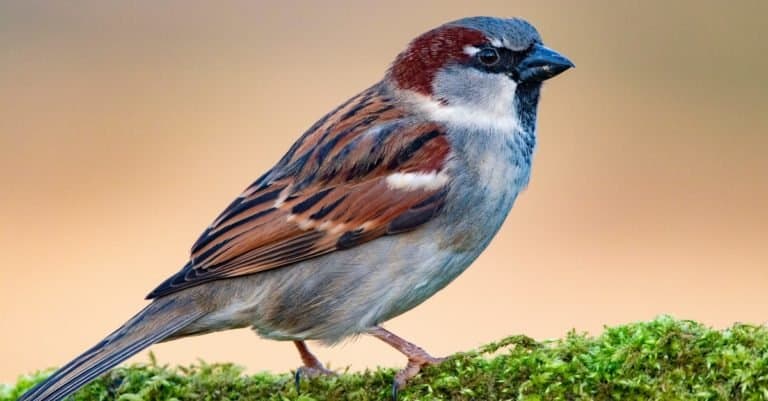
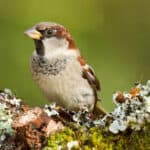
A male House Sparrow (Passer domesticus) sitting on a mossy branch

At a Glance

Family Overview This page covers the Sparrow family as a group. Stats below are general traits shared across the family.
Also Known As True sparrows, Passerids
Diet Omnivore
Activity Diurnal+
Lifespan 3 years
Weight 0.055 lbs
Status Not Evaluated
Did You Know?

Passeridae span tiny ~11 cm sparrows to larger ~18 cm snowfinches/rock sparrows; most weigh roughly ~0.011-0.040 kg depending on species.

Scientific Classification

Family Overview "Sparrow" is not a single species but represents an entire family containing multiple species.

Old World sparrows (Passeridae) are small, stout-bodied passerine birds best known for seed-eating, flocking behavior, and close association with human settlements in many species (notably the House Sparrow).

Kingdom
Animalia
Phylum
Chordata
Class
Aves
Order
Passeriformes
Family
Passeridae

Distinguishing Features

  • Small to medium-small songbirds with conical, seed-cracking bills
  • Often brown/gray plumage with streaking; many species show sexual dimorphism (males more boldly marked)
  • Typically gregarious: flocks outside breeding season
  • Frequent association with human-modified habitats in several species

Physical Measurements

Males and females differ in size

Height
3 in (2 in – 5 in)
Length
6 in (4 in – 7 in)
6 in (4 in – 7 in)
Weight
0 lbs (0 lbs – 0 lbs)
Tail Length
2 in (1 in – 3 in)
2 in (2 in – 3 in)
Top Speed
31 mph
flying

Appearance

Primary Colors
Secondary Colors
Skin Type Body covered in contour and flight feathers; bare parts include keratin bill, scaly legs/feet, and small facial skin around eyes and gape (notably in juveniles).
Distinctive Features
  • Overall size range across Passeridae: ~11-19 cm length; ~0.012-0.045 kg mass; wingspan roughly ~18-30 cm (species vary).
  • Stout-bodied passerines with relatively short necks, rounded heads, and strong conical seed-cracking bills.
  • Wing shape typically short-to-moderate and pointed; tail usually short to medium, often slightly notched.
  • Legs moderately long for hopping; feet adapted for perching and ground foraging; many species hop rather than walk.
  • Frequent head-and-throat contrast (bibs, cheek patches, supercilia); juveniles often duller and more uniformly streaked.
  • Lifespan range: commonly ~2-6 years in the wild; maximum recorded individuals often ~10-15 years (species and conditions vary).
  • Behavior/ecology generalizations: primarily granivorous but widely supplement with insects (especially when feeding nestlings); many species forage on the ground and form flocks outside breeding season.
  • Habitat association varies widely: from dense urban/settlement commensals to arid steppe, savanna, farmland, and rocky semi-desert; many tolerate human disturbance.
  • Nesting commonly in cavities (trees, cliffs, buildings), crevices, or domed nests in vegetation; colonial nesting occurs in some species, while others are territorial pairs.
  • Geographic scope: native across much of Europe, Africa, and Asia; several species introduced beyond the Old World (e.g., to the Americas, Australasia, islands).

Sexual Dimorphism

Many Old World sparrows show male-biased contrast: males typically have bolder head patterns and darker bibs, while females are browner and less contrasted. However, some species are near-monomorphic, and juveniles of both sexes are usually duller and streakier.

  • More distinct black bib/throat patch in many Passer species.
  • Higher-contrast head patterning (e.g., stronger cheek patch, eye-line, crown tones).
  • Richer or more extensive chestnut/rufous on crown or face in several species.
  • Duller, browner overall with reduced or absent bib/throat patch in many species.
  • More diffuse facial markings; supercilium often present but less crisp.
  • Heavier reliance on streaking and buff/cream tones for camouflage, especially during nesting.

Did You Know?

Passeridae span tiny ~11 cm sparrows to larger ~18 cm snowfinches/rock sparrows; most weigh roughly ~0.011-0.040 kg depending on species.

Many species thrive near people, but others are specialists of deserts (Gymnoris) or high, treeless alpine zones (Montifringilla snowfinches).

Adults are largely seed-eaters, yet chicks in many species are fed protein-rich insects-so sparrows can be both "grain birds" and important insect hunters seasonally.

They're famous for flocking: outside breeding season, mixed-age groups forage together and gather in communal night roosts.

Several Passer species have been introduced far beyond their native Old World ranges-most famously the House Sparrow, now widespread in many regions.

Old World sparrows often show clear plumage differences between sexes (especially in Passer), but some species are more subtly patterned, reflecting varied ecologies and habitats.

Urban sparrows are opportunists: they use cavities in buildings and a wide range of nest materials, from grasses and feathers to human-made debris.

Unique Adaptations

  • Short, powerful conical bills and strong jaw muscles suited to cracking seeds; many can handle hard grains but also take softer foods when available.
  • Efficient ground feeding: stout bodies and strong legs support hopping, scratching, and quick pecks on open ground, stubble fields, and urban surfaces.
  • Flexible nesting ecology: ability to exploit cavities in natural sites and human structures helps many species colonize villages, farms, and cityscapes.
  • Chick-rearing strategy: protein-focused provisioning (often insects) boosts growth-an adaptation allowing seed-eating adults to raise fast-developing young.
  • Cold- and high-altitude specializations in snowfinches (Montifringilla): dense plumage and behavioral thermoregulation (sheltering in crevices/structures) support life in harsh alpine climates.
  • Arid-land living in desert sparrows (e.g., Gymnoris): behavior and habitat choice reduce overheating and water loss, with reliance on seeds and sparse invertebrates when available.

Interesting Behaviors

  • Flocking and "follow-the-leader" foraging: groups move between feeding patches, with vigilance shared among many eyes; flock size and tightness vary by habitat and predation pressure.
  • Cavity and crevice nesting: many use holes in trees, cliffs, or buildings; some also build domed or bulky nests in shrubs-nest form varies across genera and environments.
  • Communal roosting: outside the breeding season, many gather in dense roosts (reedbeds, hedges, structures), sometimes numbering from dozens to thousands depending on local conditions.
  • Dust-bathing and sunning: individuals bathe in dry soil to manage feathers and parasites, then "sun" with feathers fluffed and wings drooped.
  • Dominance and social signaling: simple posture and vocal cues help settle access to food; hierarchies are common in dense feeding groups.
  • Seasonal diet shifts: in many species, adults take more insects during breeding, while switching back to seeds and grains in non-breeding months.
  • Local call/behavioral traditions: some populations show distinct "dialects" and learned patterns in calls used for contact, alarm, or coordination.

Cultural Significance

Old World sparrows, like the House Sparrow, live with people in towns, farms and markets across Africa and Eurasia and were moved to other continents. Their numbers change with building, farming and insects; they appear in religion and stories as symbols of humility, seen as friends or crop pests.

Myths & Legends

In ancient Greek tradition, sparrows were linked to Aphrodite: artists and poets associated the small, lively birds with love and desire, and they appear in stories and imagery connected to the goddess.

In the Christian New Testament (e.g., "Are not two sparrows sold for a farthing?"), sparrows serve as a teaching symbol for divine care over even the smallest creatures-an enduring religious and cultural motif.

Japan's folktale 'The Tongue-Cut Sparrow' centers on a sparrow rewarded for kindness and a greedy couple punished-one of the best-known traditional sparrow stories in East Asia.

European folk belief in parts of Britain and Ireland treated sparrows with superstition-sometimes as ill-omened birds tied to the household or to death-leading to customs about whether one should harm or spare them.

In Chinese history, sparrows (Passeridae) became tied to human fate during campaigns to kill them; later stories use the sparrow as a warning that simple tries to control nature can cause harm.

Conservation Status

NE Not Evaluated (family-level taxon). Across Passeridae species, most are assessed as Least Concern, but a minority of restricted-range island/montane taxa are in higher-risk categories (e.g., Near Threatened to Endangered), so conservation priorities vary widely within the family.

Has not yet been evaluated against the criteria.

Population Unknown

Protected Under

  • Legal protection for wild birds varies by country; many Passeridae species are covered under general wildlife/bird protection statutes (e.g., EU Birds Directive 2009/147/EC within the EU).
  • National wildlife legislation in many range states restricts unregulated killing and nest destruction, though enforcement and pest-control exemptions differ widely.
  • Site-based protections (protected areas and Important Bird and Biodiversity Areas) can benefit habitat-specialist and restricted-range species, especially on islands and in montane regions.

You might be looking for:

New World sparrows

32%

Passerellidae

A separate family of mainly American songbirds often called “sparrows” (e.g., Song Sparrow, White-crowned Sparrow).

House Sparrow

28%

Passer domesticus

The best-known and most widespread species commonly meant by “sparrow” in everyday speech.

View Profile

Java Sparrow (Java Finch)

10%

Lonchura oryzivora

An estrildid finch sometimes called a “sparrow,” not in Passeridae.

Savannah Sparrow

8%

Passerculus sandwichensis

A common North American ‘sparrow’ (Passerellidae), not an Old World sparrow.

View Profile

Life Cycle

Birth 4 chicks
Lifespan 3 years

Lifespan

In the Wild
1–20 years
In Captivity
2–23 years

Reproduction

Mating System Monogamy
Social Structure Socially Monogamous
Breeding Pattern Seasonal
Fertilization Internal Fertilization
Birth Type Internal_fertilization

Across Passeridae, pairs are typically socially monogamous for a breeding season with biparental care. Genetic monogamy is uncommon due to frequent extra-pair copulations, and some species show occasional polygyny tied to territory quality and local density.

Behavior & Ecology

Social Flock Group: 30
Activity Diurnal, Matutinal, Vespertine
Diet Omnivore Small seeds-especially grass/weed seeds and spilled cereal grains

Temperament

Generally gregarious outside breeding season; flock cohesion increases under predation risk.
Territorial and more aggressive around nests; intensity varies widely among species and habitats.
Often bold and tolerant of humans in synanthropic species; more wary in remote-dwelling species.
Competitive at concentrated food (feeders, grain); dominance interactions and displacement common.
Opportunistic and adaptable foragers; flexibility varies from urban generalists to habitat specialists.

Communication

Short chirps and cheeps for contact and cohesion within flocks.
Simple songs or repeated phrases used in mate attraction and territory advertisement.
Harsh scolding and alarm calls; mobbing calls may recruit nearby sparrows.
Begging calls by nestlings and fledglings to solicit feeding from adults.
Visual threat displays: feather puffing, bill pointing, wing flicking, and upright postures.
Chasing and short flights signal dominance; spacing maintained by body orientation and pecking.
Flock movement cues: rapid head turns and takeoff waves coordinate collective escape.
Nest-site advertisement via repeated visits and display at cavities or shrubs; intensity varies by species.

Habitat

Biomes:
Temperate Grassland Temperate Forest Mediterranean Savanna Tropical Dry Forest Desert Hot Desert Cold Boreal Forest (Taiga) Tundra Alpine Wetland Freshwater +6
Terrain:
Plains Hilly Plateau Valley Mountainous Coastal Island Riverine Rocky Sandy Volcanic +5
Elevation: Up to 17060 ft 5 in

Ecological Role

Primarily seed-eating passerines that also act as seasonal insect predators, especially during breeding

seed predation that can influence plant/weed community dynamics insect (and larval) consumption that can reduce local herbivorous insects, especially near nesting sites prey base for raptors and small carnivores, supporting food webs nutrient redistribution via flock foraging and droppings, especially around roosts and human-altered habitats

Diet Details

Main Prey:
Insects Insect larvae Spiders and other small arthropods Small invertebrates
Other Foods:
Grass and weed seeds Cereal grains Seed heads Buds and young plant shoots Berries and small fruits Human-associated foods

Human Interaction

Domestication Status

Wild

Passeridae (Old World sparrows) are wild birds, not domesticated. Human contact is mainly commensalism (living near people). Some Passer spp. exploit villages, farms, grain stores and cities, nesting in buildings without selective breeding. Mostly seed-eaters, they feed insects to young; many live 2–5 years, some reach 10–15.

Danger Level

Low
  • Nuisance impacts: noise, droppings, fouling of buildings and stored feed where dense roosts occur
  • Disease/parasite exposure risk is generally low but can include Salmonella or other pathogens via droppings/contaminated feed; ectoparasites (mites, lice) may affect nests near homes or poultry
  • Allergy/asthma irritation from accumulated droppings or nest debris in enclosed spaces
  • Rare bird-strike hazards around buildings/airfields when large flocks are present (more a safety management issue than direct aggression)
  • Occasional minor bites/scratches if handled; not inherently dangerous or aggressive toward humans, though some species can be aggressive toward other birds at feeders/nest sites

As a Pet

Not Suitable as Pet

Legality: Laws vary by country. In many places keeping wild Old World sparrows (Passeridae) is illegal without permits. Some non-native sparrows may be allowed, but welfare rules and local permits still apply.

Care Level: Experienced

Purchase Cost: Up to $200
Lifetime Cost: $500 - $5,000

Economic Value

Uses:
Ecosystem services (insect consumption, seed removal) Cultural/aesthetic value (urban wildlife, birdwatching) Agricultural impact (localized grain/seed loss, feed contamination) Research/education (urban ecology, behavior studies)
Products:
  • No standard commercial products across the family; limited local trade historically as cagebirds in some regions, now often restricted.

Relationships

Predators 12

Related Species 11

House Sparrow
House Sparrow Passer domesticus Shared Family
Eurasian Tree Sparrow Passer montanus Shared Family
Spanish Sparrow Passer hispaniolensis Shared Family
Rock Sparrow Petronia petronia Shared Family
Cape Sparrow Passer melanurus Shared Family
Northern Grey-headed Sparrow Passer griseus Shared Family
Sudan Golden Sparrow Passer luteus Shared Family
Yellow-throated Sparrow Gymnoris xanthocollis Shared Family
Pale Rockfinch Carpospiza brachydactyla Shared Family
White-winged Snowfinch Montifringilla nivalis Shared Family
Madagascar Sparrow Passer rufocinctus Shared Family

Ecological Equivalents 5

Animals that fill a similar ecological role in their ecosystem

New World sparrows Passerellidae Small ground- and low-vegetation foragers that often have seed-heavy diets and form flocks; occupy a similar niche and have a similar body plan but belong to a different passerine lineage.
True finches Fringillidae Many species are granivores with strong conical bills, frequently flocking and using similar habitats such as open country, edges, and towns, and overlapping in food resources like seeds and buds.
Weavers Ploceidae Ecologically similar in many regions: seed- and insect-based diets and flocking behavior. Some species occupy comparable human-modified habitats. They differ markedly in nesting style, often constructing woven nests.
Buntings and allies Emberizidae Comparable size and feeding ecology (seeds and insects, especially in the breeding season), often occupying scrub/grassland mosaics and forming non-breeding flocks.
Estrildid finches Estrildidae Small, social granivores that often flock and exploit grass seeds; occur especially in Africa and Asia in open habitats and around cultivated areas.

Types of Sparrow

30

Explore 30 recognized types of sparrow

House Sparrow
House Sparrow Passer domesticus
Eurasian Tree Sparrow Passer montanus
Spanish Sparrow Passer hispaniolensis
Italian Sparrow Passer italiae
Sind Sparrow Passer pyrrhonotus
Russet Sparrow Passer cinnamomeus
Chestnut Sparrow Passer rutilans
Plain-backed Sparrow Passer flaveolus
Yellow-throated Sparrow Gymnoris xanthocollis
Bush Sparrow Gymnoris dentata
Sahel Bush Sparrow Gymnoris pyrgita
Sudan Golden Sparrow Passer luteus
Cape Sparrow Passer melanurus
Northern Grey-headed Sparrow Passer griseus
Southern Grey-headed Sparrow Passer diffusus
Swainson's Sparrow Passer swainsonii
Shelley's Sparrow Passer shelleyi
Kordofan Sparrow Passer cordofanicus
Dead Sea Sparrow Passer moabiticus
Saxaul Sparrow Passer ammodendri
Somali Sparrow Passer castanopterus
Kenya Rufous Sparrow Passer gongonensis
Iago Sparrow Passer iagoensis
Rock Sparrow Petronia petronia
Pale Rockfinch Carpospiza brachydactyla
White-winged Snowfinch Montifringilla nivalis
Rufous-necked Snowfinch Pyrgilauda ruficollis
White-rumped Snowfinch Onychostruthus taczanowskii
Madagascar Sparrow Passer (Histurgops) rufocinctus
Bush Petronia Petronia dentata

Sparrows are a common sight the world over. Eurasian house sparrows and tree sparrows are among the most common. Not only do they occupy a large natural range, but they’ve also invaded several continents as settlers took the birds with them. These birds have adapted well to living near people, from cities to farm fields.

These birds have been symbols in songs, pets, and food sources. You can learn more about this small bird that has played a role in human lives throughout history.

Habitat: Where To Find Them
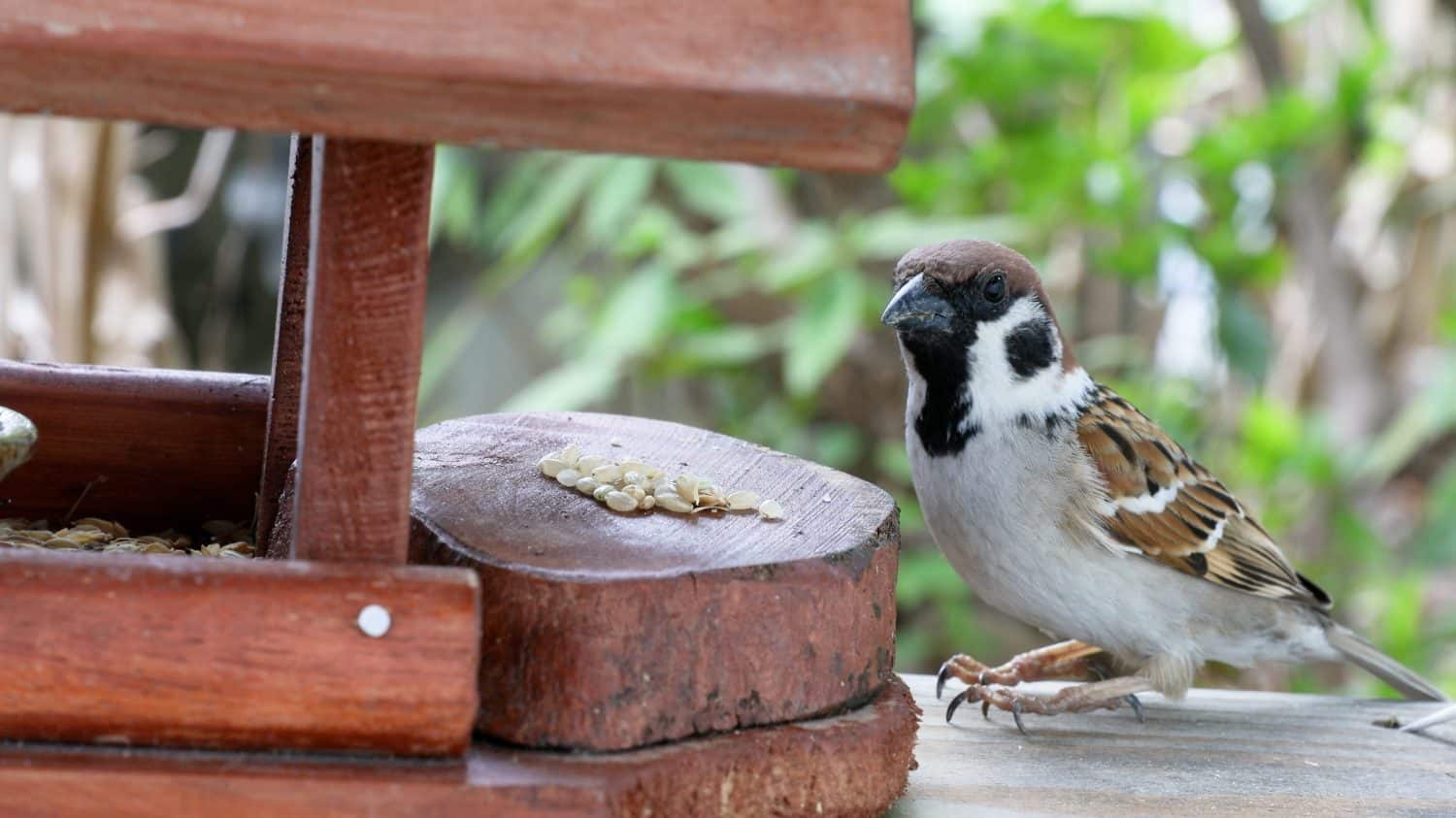
A sparrow eating some rice at a bird feeder.

Sparrows are easy to attract to your backyard.

Old World species are native to Africa, Asia, and Europe, but they have been naturalized in the Americas and Australia. New World sparrows live in the Americas.

The bird’s natural habitat is that of open woodlands, fields, grasslands, scrubland, and deserts. They have adapted well to life around humans, and they can be found in cities and neighborhoods in large numbers. If you want to view these birds, you are certain to attract them with a backyard bird feeder.

Scientific Names
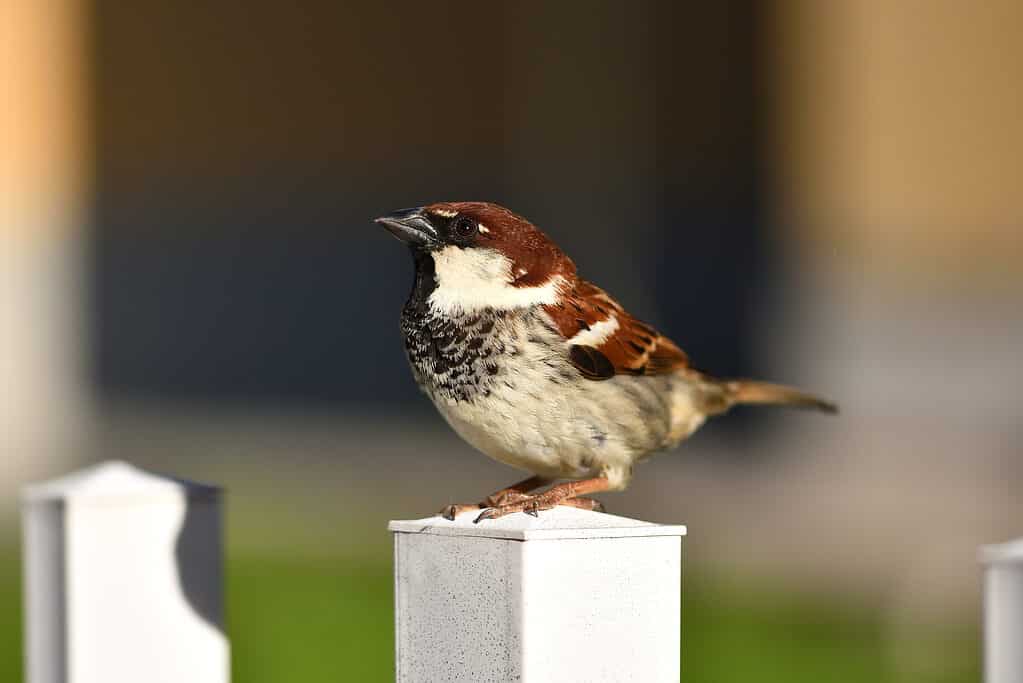
Italian sparrow

The common Italian sparrow is the national bird of Italy.

Most of these birds are classed as Old World or New World sparrows. The Old World species are also called “true sparrows.” They make up eight genera in the family Passeridae, superfamily Passeroidae, infraorder Passerida, suborder Passeri, order Passeriformes, class Aves (birds), phylum Chordata, and kingdom Animalia.

The 43 species of Old World sparrows, with their scientific names, include:

  • Abd al-Kuri sp. (Passer hemileucus)
  • Afghan snowfinch (Montifringilla theresae)
  • Arabian golden sp. (Passer euchlorus)
  • Black-winged snowfinch (Montifringilla adamsi)
  • Blanford’s snowfinch (Montifringilla blanfordi)
  • Cape sp. (Passer melanurus)
  • Chestnut sp. (Passer eminibey)
  • Cinnamon ibon (Hypocryptadius cinnamomeus)
  • Dead Sea sp. (Passer moabiticus)
  • Desert spa. (Passer simplex)
  • Eurasian tree sp. (Passer montanus)
  • Great sp. (Passer motitensis)
  • House sp. (Passer domesticus)
  • Iago sp. (Passer iagoensis)
  • Italian sp. (Passer italiae)
  • Kenya sp. (Passer rufocinctus)
  • Kordofan sp. (Passer cordofanicus)
  • Northern grey-headed sp. (Passer griseus)
  • Pale rockfinch (Carpospiza brachydactyla)
  • Parrot-billed sp. (Passer gongonensis)
  • Père David’s snowfinch (Montifringilla davidiana)
  • Plain-backed sp. (Passer flaveolus)
  • Rock sp. (Petronia petronia)
  • Rufous-necked snowfinch (Montifringilla ruficollis)
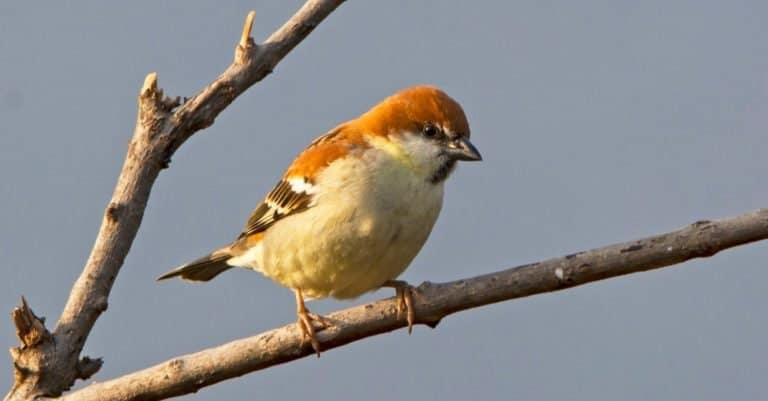
  • Russet sp. (Passer cinnamomeus)
  • Sahel bush sp. (Gymnoris dentata)
  • Saxaul sp. (Passer ammodendri)
  • Shelley’s sp. (Passer shelleyi)
  • Sind sp. (Passer pyrrhonotus)
  • Socotra sp. (Passer insularis)
  • Somali sp. (Passer castanopterus)
  • Southern grey-headed sp. (Passer diffusus)
  • Spanish sp. (Passer hispaniolensis)
  • Sudan golden sp. (Passer luteus)
  • Swahili sp. (Passer suahelicus)
  • Swainson’s sp. (Passer swainsonii)
  • Tibetan snowfinch (Montifringilla henrici)
  • White-rumped snowfinch (Montifringilla taczanowskii)
  • White-winged snowfinch (Montifringilla nivalis)
  • Yellow-spotted bush sp. (Gymnoris pyrgita)
  • Yellow-throated bush sp. (Gymnoris superciliaris)
  • Yellow-throated sp. (Gymnoris xanthocollis)
  • Zarudny’s sp. (Passer zarudnyi)

There are around 138 species of New World sparrows divided into 29 genera. These birds are more closely related to Old World finches than to Old World sparrows. The chipping, white-throated, and field sparrows are examples of New World sparrows.

Other sparrows include the Java (scientific name Lonchura oryzivora) and Timor sparrows (L. fuscata) of the family Estrilididae and the dunnock or hedge accentor (Prunella modularis) of the family Prunelidae.

Evolution
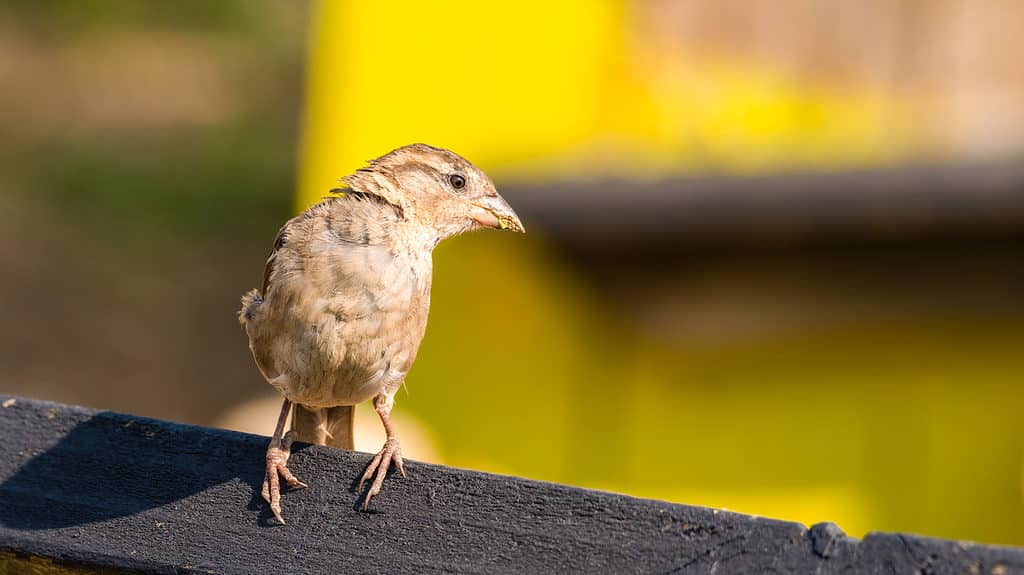
tree sparrow

Sparrows have a mysterious evolutionary history.

It is hard to account for the history of house sparrows because they are so ubiquitous. We have a tendency to overlook commonplace creatures, and even scientists would rather study rare species than those that are common. The story of the relationship between sparrows and humans is ancient and incomplete, much like our own history. As a result, it is difficult to tell the story of the house sparrow accurately.

Evidence of the house sparrow first appears in Africa, and two jawbones belonging to a bird called Passer predomesticus were found in Israel in sediment more than 100,000 years old. After this, other birds similar to the modern house sparrow began appearing in the fossil record approximately 10,000 or 20,000 years ago. These birds had distinct features on their mandibles, like a crest of bone where there had been only a furrow before.

As humans spread agriculture across the world, house sparrows spread with them and evolved to adapt to the different regions. This caused sparrows around the globe to all originate from one single line of descent. House sparrows have continued to evolve as humans have taken them to different environments, leading scientists to classify them into subspecies and even species. An example of this is when house sparrows met with Spanish sparrows in parts of Italy, forming a hybrid species called the Italian sparrow.

Size, Appearance, & Behavior
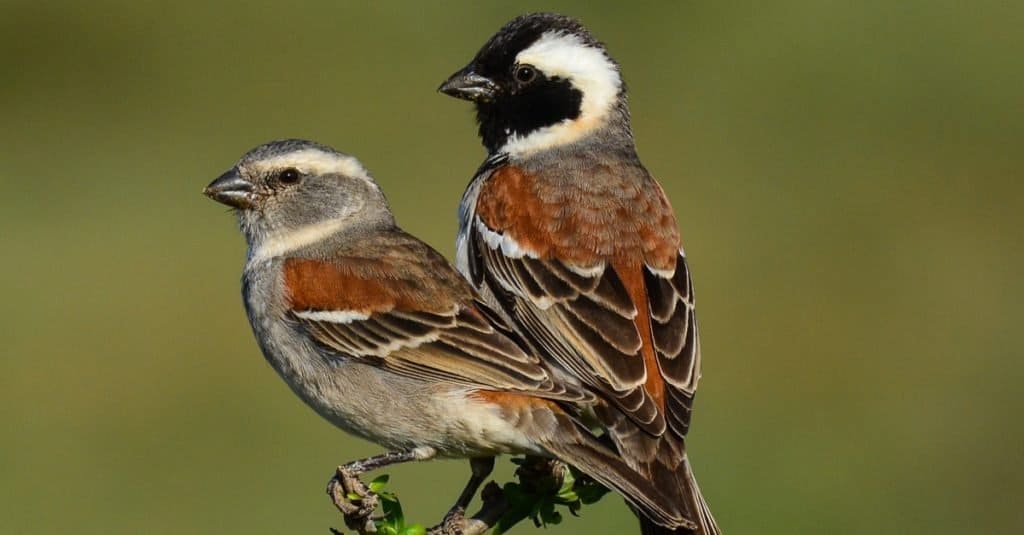
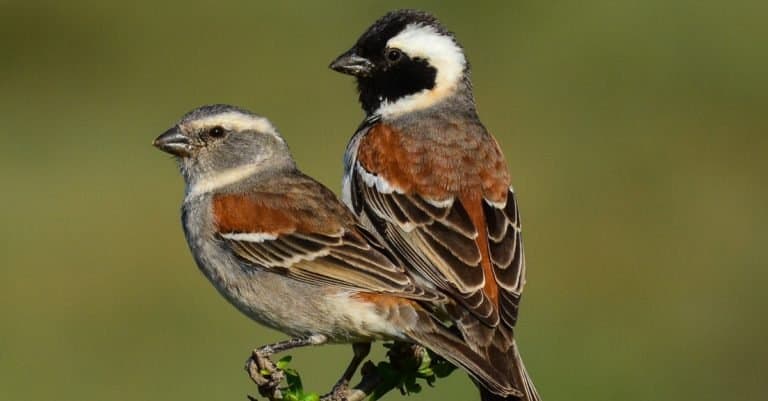
A pair of Cape sparrows sitting on a branch

Sparrows like to forage for food together.

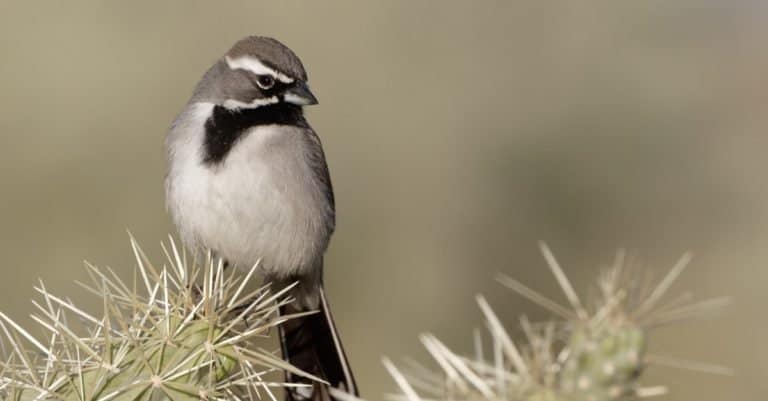
These are small brown and gray birds with conical or cone-shaped beaks. Some, like the red-headed chipping and white-throated sparrows, have distinctive markings on their heads. Others, like the song sparrow, are blotched in brown and cream. Finches, such as the red-headed house finch, are often mistaken for sparrows.

The smallest is the chestnut sparrow. It is 4.5 inches (11.4) long and weighs less than half an ounce (13.4g). The largest is the parrot-billed sparrow, which weighs in at 1.5 oz (42g) and has a length of 7.1 inches (18 cm).

These birds forage in small to large flocks. Many species may be present in a single flock. This changes at mating time, when the flock is limited to just one type of sparrow. Abundant varieties include song, chipping, white-throated, and red-headed sparrows.

A common behavior of these birds is dust bathing. The bird scratches a hole in the ground with its feet, settles into it, and flings dust onto its body using its wings. They also like to bathe in puddles.

Migration Pattern and Timing
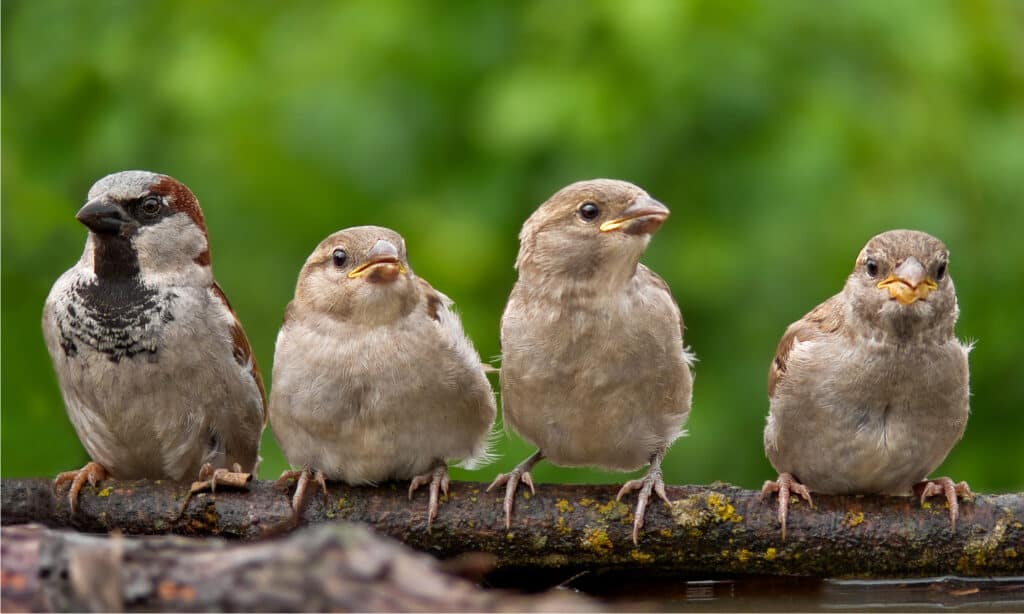
house sparrow

Some sparrows migrate south for winter.

Many types of sparrows survive cold or inclement weather by retreating into the eaves of buildings, tree cavities, or even behind sections of loose tree bark. Others, such as the American tree sparrows, migrate south to find warmer weather.

Sparrows are small, brown birds that migrate seasonally. During their migration, sparrows travel in large groups and fly from one place to another to find food or a more suitable climate for nesting. Sparrows usually migrate during the fall months when temperatures start to drop and food sources become scarce. They can be seen flying in tight formations as they make their way southward. This helps them stay together as a group and also protects against predators such as hawks. Some sparrows will even take breaks along the way at stopover sites where they can rest before continuing with their journey. It is estimated that some species of sparrows have traveled over 10,000 miles during their migrations!

Diet

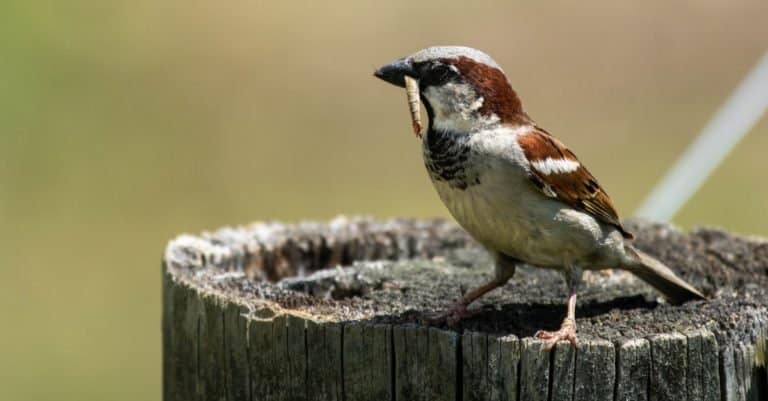
These birds are opportunistic feeders. Sparrows mainly eat seeds and grains, but they will also supplement their diet with insects, fruits, and small animals such as spiders or snails. Sparrows typically hunt for food by hopping along the ground, looking for insects to eat, or searching trees and shrubs for berries or seeds. They may also scavenge around human dwellings, looking for crumbs that have been left behind. To get a better view of their surroundings while hunting, sparrows often perch atop branches or telephone wires.

Predators and Threats
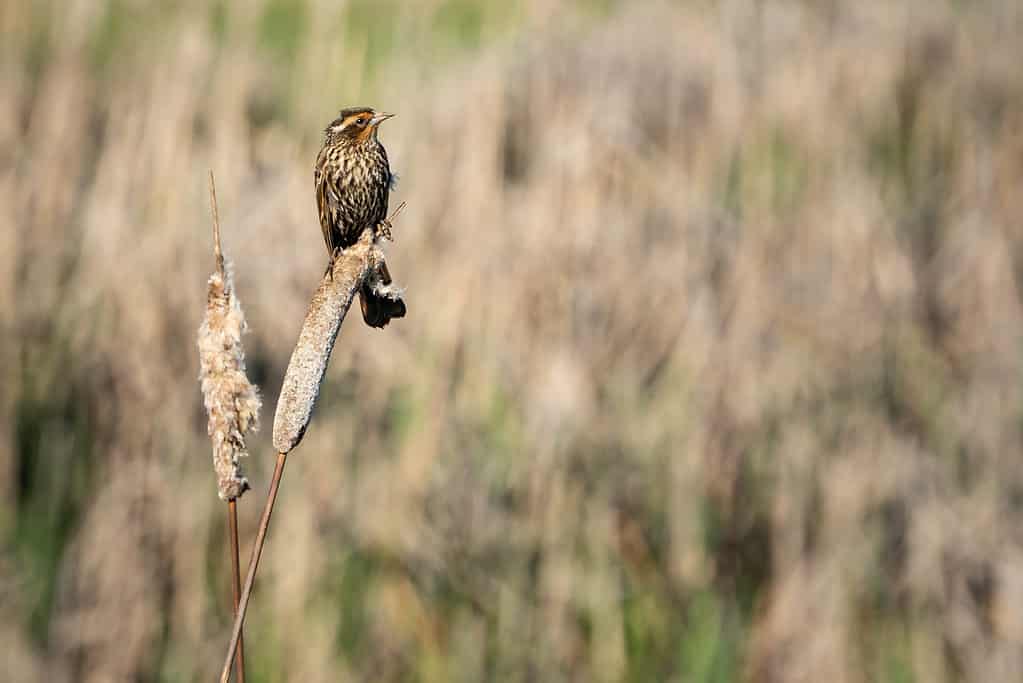
saltmarsh sparrow

Saltmarsh sparrows have to watch out for large birds of prey.

Hawks, owls, and cats commonly hunt adult birds. Young flightless birds and unhatched eggs are preyed upon by raccoons and snakes. Crows, jays, and grackles may also eat the eggs.

In some parts of the world, people eat these birds. People have also been a threat to sparrows through intentional and unintentional agricultural poisoning.

What Eats Sparrows?

Birds of prey, cats, snakes, and sometimes people are their predators.

Reproduction, Babies, and Lifespan
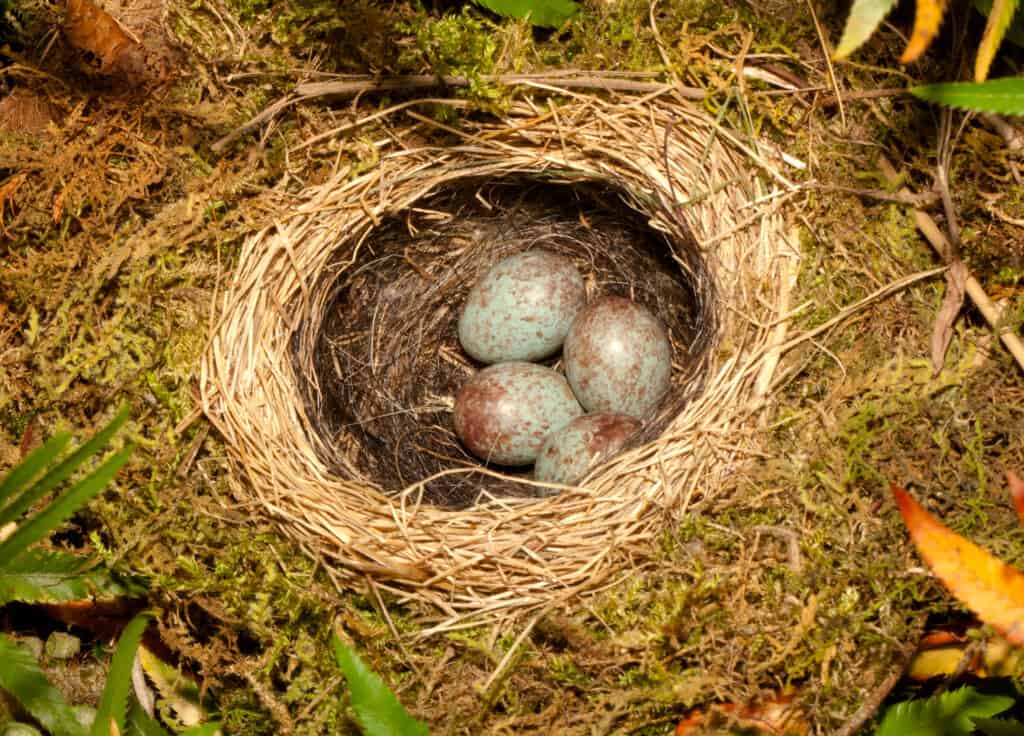
White-crowned sparrow

Sparrows will use the same nest year after year if it is undisturbed.

Sparrows are social and colonial in their habits, meaning they live in large groups or flocks. These groups have been known to include up to 10,000 individuals. The exception is the great sparrow, which prefers small family groups and breeds only in pairs.

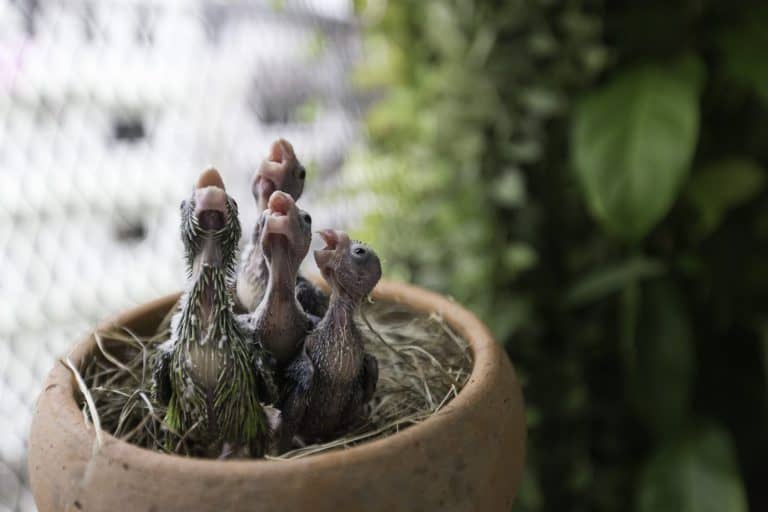
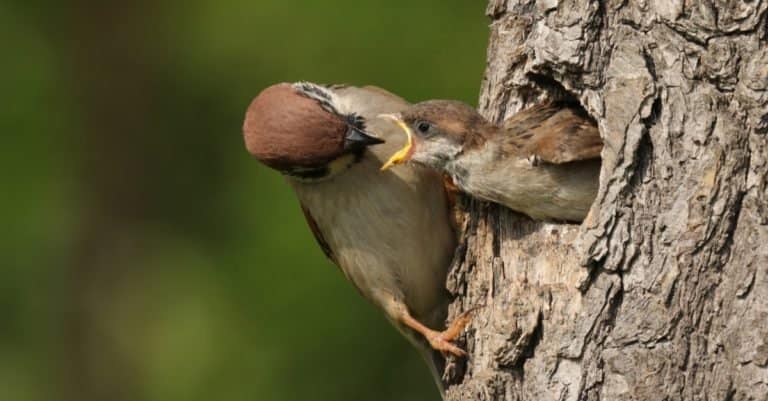
These birds often nest on buildings, finding protected areas to build a nest and lay 4 to 5 eggs. Eggs hatch after 10 to 14 days. Both parents feed the babies, and each baby leaves the nest in about two weeks.

In many species, these birds mate for life and continue to use the same nest site, clutch after clutch, baby after baby. If a sparrow’s mate dies, it typically finds a new one within a few days.

Population

The house sparrow (Passer domesticus) is thought to be the most abundant bird in the world, with an estimated population of 1.6 billion individuals. When combined with nearly 200 additional species, there are no doubt many more of these birds than humans in the world!

Some species of sparrows are in decline due to habitat loss. For example, the chipping sparrow, savannah sparrow, song sparrow, vesper sparrow, field sparrow, and Italian sparrow are all in decline.

View all 390 animals that start with S

Sources

  1. Britannica / Accessed June 1, 2021
  2. Wikipedia / Accessed June 1, 2021
  3. Wikipedia / Accessed June 1, 2021
  4. National Geographic https://www.nationalgeographic.com/animals/article/how-many-birds-are-there-in-the-world-science-estimates#:~:text=According%20to%20the%20paper%2C%20the,alder%20flycatchers%20(896%20million). https://wol.jw.org/en/wol/d/r1/lp-e/1200004200 / Accessed June 1, 2021
Heather Hall

About the Author

Heather Hall

Heather Hall is a writer at A-Z Animals, where her primary focus is on plants and animals. Heather has been writing and editing since 2012 and holds a Bachelor of Science in Horticulture. As a resident of the Pacific Northwest, Heather enjoys hiking, gardening, and trail running through the mountains with her dogs.

Thank you for reading! Have some feedback for us?


Sparrow FAQs (Frequently Asked Questions)

Sparrows are Omnivores, meaning they eat both plants and other animals.