

S
Species Profile

Spiny Dogfish

Squalus acanthias

Two spines. Slow life. Big schools.
Boris Pamikov/Shutterstock.com

Spiny Dogfish Distribution

Click a location to explore more animals from that region

This map shows coastal regions where Spiny Dogfish are found.

Loading map...
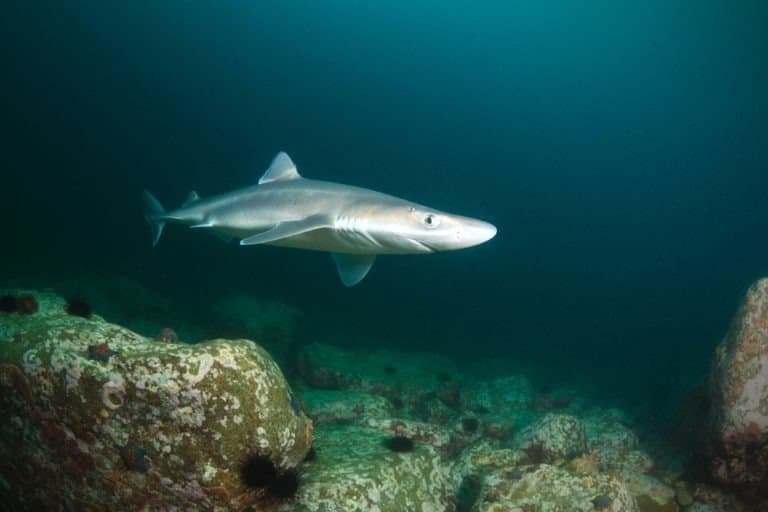
Spiny dogfish shark, deep - 15 meters, sea of japan, Russia

At a Glance

Wild Species
Also Known As Spurdog, Piked dogfish, Dogfish, Rock salmon, Atlantic spurdog
Diet Carnivore
Activity Cathemeral+
Lifespan 40 years
Weight 9.1 lbs
Status Vulnerable
Did You Know?

It has TWO dorsal fins, each with a rigid spine in front-hence "spiny" dogfish (spines can deliver a painful jab).

Scientific Classification

A small, slender squaliform shark characterized by two dorsal fins each preceded by a sharp spine; widespread in temperate marine waters and often forms large schools.

Kingdom
Animalia
Phylum
Chordata
Class
Chondrichthyes
Order
Squaliformes
Family
Squalidae
Genus
Squalus
Species
Squalus acanthias

Distinguishing Features

  • Two dorsal fins, each with a prominent anterior spine
  • No anal fin (typical of many squaliform sharks)
  • Slender body with long snout; gray-brown dorsally, pale ventrally
  • Often occurs in large, segregated schools (by size/sex)

Physical Measurements

Males and females differ in size

Length
♂ 2 ft 7 in (1 ft 12 in – 3 ft 3 in)
♀ 3 ft 1 in (2 ft 4 in – 4 ft 1 in)
Weight
♂ 8 lbs (3 lbs – 13 lbs)
♀ 10 lbs (4 lbs – 20 lbs)
Top Speed
4 mph
swimming
Venomous

Appearance

Primary Colors
Secondary Colors
Skin Type Tough, abrasive placoid scales (dermal denticles); skin feels sandpaper-rough, reducing drag and abrasion.
Distinctive Features
  • Two dorsal fins, each preceded by a prominent sharp spine (diagnostic for Squalus acanthias).
  • No anal fin; slender, streamlined body with narrow caudal peduncle.
  • Elongate pointed snout; relatively large eyes; small spiracles behind eyes.
  • White dorsal spotting common but not universal; spots are small and irregularly distributed.
  • Typical adult total length: males ~60-100 cm; females ~70-125 cm (females larger).
  • Newborn (pup) length typically ~20-33 cm total length.
  • Very slow life history: late maturity (males often ~11-13 years; females commonly ~18-21+ years, region-dependent).
  • Long-lived shark: maximum reported longevity commonly ~35-70+ years depending on ocean basin and study methods.
  • Reproduction is low-rate: internal fertilization; long gestation about ~18-24 months; litters usually ~4-11 (range reported ~1-20).
  • Behavior/habitat context: temperate continental shelf and upper slope; often forms large schools/aggregations, affecting fishery catchability and management.

Sexual Dimorphism

Females grow larger and mature later than males; males have pelvic claspers. Otherwise coloration and dorsal-fin spines are similar between sexes, with differences mainly in size and reproductive anatomy.

♂
  • Pelvic claspers present (external reproductive appendages).
  • Generally smaller maximum size (~100 cm total length typical upper range).
  • Earlier maturation than females (often ~11-13 years, region-dependent).
♀
  • Larger maximum size (commonly up to ~125 cm total length).
  • Later maturation than males (often ~18-21+ years, region-dependent).
  • Gravid females develop visibly distended abdomen late in the long gestation.

Did You Know?

It has TWO dorsal fins, each with a rigid spine in front-hence "spiny" dogfish (spines can deliver a painful jab).

One of the longest known shark pregnancies: ~18-24 months (aplacental viviparity/ovoviviparity).

Pups are born already ~20-33 cm long (FAO), after developing inside the mother without a placenta.

Females grow larger than males: up to ~160 cm total length vs ~125 cm in males (FAO species account).

It matures very late: females commonly ~18-21 years; males ~11-12 years in the North Atlantic (classic age/growth syntheses such as Ketchen 1975 and later regional assessments).

Longevity is high for a small shark-reported to at least ~70+ years (e.g., maximum ~73 years in widely cited North Pacific/North Atlantic ageing work; Ketchen 1975).

They often form large, coordinated schools that can number in the hundreds to thousands, frequently segregated by size and sex.

Unique Adaptations

  • Paired dorsal-fin spines with associated glandular tissue: a strong mechanical defense that can puncture skin and deter predators (and makes handling risky).
  • Exceptionally slow life history for its size: late maturity and long gestation (~18-24 months) reduce population rebound after heavy fishing pressure.
  • Aplacental viviparity (ovoviviparity): embryos develop internally and are born live, avoiding egg predation in the environment.
  • Broad thermal and depth use in temperate seas: occurs from near-surface to ~900 m depth (FAO), allowing it to exploit shelf and upper-slope food webs.
  • Elasmobranch osmoregulation (urea/TMAO retention): helps maintain internal salt/water balance and supports active life in cold-temperate marine habitats.

Interesting Behaviors

  • Large schooling: forms dense groups that can be size- and sex-segregated (e.g., mature females often schooling separately from smaller males/juveniles).
  • Seasonal migrations along temperate continental shelves: many populations shift inshore/offshore and north/south with temperature and prey (tagging studies document movements on the order of hundreds to >1,000 km in some regions).
  • Diel vertical movement: commonly deeper by day and shallower at night when tracking prey layers, especially over the shelf edge.
  • Opportunistic pack-feeding: schools can herd and exploit baitfish concentrations (herring, mackerel, sand lance) as well as squid and crustaceans.
  • Anti-predator/handling response: when threatened or captured, individuals arch the body so the dorsal spines present a hazard to predators and fishers.

Cultural Significance

Spiny dogfish (Squalus acanthias) is important to fishers and markets and sold as spurdog, rock salmon, or huss. It was used for liver oil and sharkskin. Females mature late and give birth slowly, so strict rules and quotas apply.

Myths & Legends

Name-origin tradition (British Isles/Atlantic coasts): "dogfish" is commonly explained in coastal tradition as referring to their tendency to hunt and travel in packs like dogs; "spurdog" refers to the sharp 'cock-spur'-like dorsal spines.

North Atlantic fisher story: Spiny dogfish (Squalus acanthias) schools were called 'sea pests' for overrunning hooks and nets, arriving like a moving wall that drove off or scattered target fish.

Old craft use of sharkskin ("shagreen") for tool and sword handles created the lasting idea that shark hides are protective and give good grip, linking small sharks like the spiny dogfish to trade.

Conservation Status

VU Vulnerable

Facing a high risk of extinction in the wild.

Population Decreasing

Protected Under

  • Convention on Migratory Species (CMS) Appendix II (listed in some jurisdictions/contexts for management cooperation)
  • European Union Common Fisheries Policy (CFP) - management via TACs/landing restrictions in parts of its range (e.g., NE Atlantic measures)
  • United States Atlantic Spiny Dogfish Fishery Management Plan (NOAA/MAFMC/NEFMC with ASMFC) - quotas, trip limits, and monitoring
  • Canada Atlantic management measures (e.g., DFO quota-based management in relevant regions)
  • National/regional shark finning prohibitions and fisheries regulations that indirectly reduce mortality

Life Cycle

Birth 6 pups
Lifespan 40 years

Lifespan

In the Wild
20–80 years
In Captivity
5–25 years

Reproduction

Mating System Polygynandry
Social Structure Aggregation Group
Breeding Pattern Transient
Fertilization Internal Fertilization
Birth Type Internal_fertilization

In seasonal schools, males court by biting and grasping females and transfer sperm with claspers (internal fertilization). Females may mate with multiple males and can store sperm; embryos develop aplacentally for ~18-24 months, with no postnatal parental care.

Behavior & Ecology

Social School Group: 300
Activity Cathemeral, Nocturnal
Diet Carnivore Clupeid forage fish-especially Atlantic herring (Clupea harengus) where available
Seasonal Migratory 870 mi

Temperament

Strongly gregarious and schooling; individuals maintain close spacing and coordinated swimming.
Marked sexual and size segregation within schools is common across regions and seasons.
Non-territorial; generally non-aggressive toward humans; defensive behavior includes spine use when handled.
Typically forms large, mobile schools; group composition shifts with season, depth, sex, and size class.

Communication

Olfaction/chemoreception for locating prey and likely mate-related cues Ebert, Fowler & Compagno, 2013
Hydrodynamic signaling via lateral line to maintain schooling spacing and alignment Carrier, Musick & Heithaus, 2012
Electroreception Ampullae of Lorenzini) for close-range detection of prey/conspecific bioelectric fields (Carrier, Musick & Heithaus, 2012
Visual cues Body orientation, spacing) supporting cohesive schooling, especially in clearer water (Ebert et al., 2013
Tactile contact during mating/handling; males bite/hold females during copulation General elasmobranch pattern; Carrier et al., 2012

Habitat

Coastal Open Ocean Seabed/Benthic Deep Sea Estuary
Biomes:
Terrain:
Coastal Rocky Sandy Muddy
Elevation: Up to 2952 ft 9 in

Ecological Role

Mid-trophic (mesopredator) shark linking lower-trophic forage fishes/invertebrates to higher predators in temperate shelf ecosystems; can strongly influence local forage-fish and squid dynamics when abundant.

Regulates populations of small pelagic and demersal fishes and cephalopods through predation (top-down control) Transfers energy from schooling forage fish and benthic/nektonic invertebrates to higher trophic levels (trophic coupling between pelagic and demersal food webs) Provides prey/food resource for larger sharks and marine mammals (supporting higher-trophic consumers) Contributes to community structuring by shifting predation pressure with seasonal prey availability (stabilizing/redistributing predation across prey species)

Diet Details

Main Prey:
Small pelagic fishes Sand lances Capelin Mackerel Gadoids Flatfish Squids Octopus Shrimps Crabs Krill Polychaete worms +6

Human Interaction

Domestication Status

Wild

Spiny dogfish (Squalus acanthias) is fully wild with no history of domestication. People mainly catch it in fisheries, take it as bycatch, or show it in public aquariums rather than breed it. Its very slow life—matures late, long pregnancy (~18–24 months), long life (up to ~70 years), and small litters (1–20, often 4–11 pups about 20–33 cm)—limits captive breeding.

Danger Level

Low
  • Defensive injury from the two dorsal-fin spines: each dorsal fin is preceded by a sharp spine that can puncture skin during handling; envenomation/toxin-associated pain and localized swelling have been reported in the fisheries-handling context (occupational hazard).
  • Handling risk on deck: large schools can lead to many individuals in nets; thrashing and spines increase puncture-wound frequency for fishers.
  • Bite risk is generally low: spiny dogfish are not typically implicated in serious unprovoked attacks; most injuries are handling-related rather than predatory.

As a Pet

Not Suitable as Pet

Legality: Spiny Dogfish (Squalus acanthias) is not a practical pet. Many places treat it as a wild shark: permits, size/season rules, and trade limits apply. Private ownership is usually not allowed; aquaria may keep them with permits and vet care.

Care Level: Expert Only

Purchase Cost: Up to $500
Lifetime Cost: $50,000 - $250,000

Economic Value

Uses:
Commercial fisheries (meat for human consumption; often sold under market names such as 'dogfish', 'rock salmon', 'flake' depending on region) Bycatch in mixed demersal fisheries Processing (fresh/frozen fillets; sometimes salted/smoked products) Historical/limited use of liver oil products (more prominent in some squaliforms; spiny dogfish less dominant than deepwater squaloids) Research value (life-history, contaminant and food-web studies) Public-aquarium display (limited; requires large chilled marine systems)
Products:
  • Meat/fillets (food fish)
  • Skins (minor/local use; abrasive 'shagreen' historically in some sharks)
  • Liver oil (historically; squalene-related products more associated with other squaliforms)
  • Fishmeal/byproduct streams (where landed in volume)

Relationships

Related Species 7

Pacific spiny dogfish Squalus suckleyi Shared Genus
Longnose spurdog Squalus blainville Shared Genus
Shortspine spurdog Squalus mitsukurii Shared Genus
Shortfin spurdog Squalus megalops Shared Genus
Japanese spurdog Squalus japonicus Shared Genus
Roughskin spurdog Cirrhigaleus asper Shared Family
Mandarin dogfish Cirrhigaleus barbifer Shared Family

Ecological Equivalents 5

Animals that fill a similar ecological role in their ecosystem

Pacific spiny dogfish Squalus suckleyi Very similar small-bodied, schooling squaliform mesopredator occupying temperate shelf and slope waters. Comparable life history: slow growth, late maturity, and long gestation (~18–24 months, typical for spiny dogfishes). Often functionally interchangeable in food webs where ranges do not overlap.
Gummy shark Mustelus antarcticus Temperate shelf mesopredator with a strong reliance on benthic and epibenthic prey (crustaceans and small fishes) and broad habitat overlap on continental shelves. Fulfills a similar mid-trophic predator role, although it is from a different order (Carcharhiniformes).
Smooth dogfish Mustelus canis Small-to-medium coastal shark using temperate shelves and nearshore waters. Feeds heavily on fishes and invertebrates and can co-occur with spiny dogfish, partitioning prey and habitat depth. Both are common mesopredators in temperate food webs.
Tope Galeorhinus galeus Mobile temperate-shelf predator that often targets the same schooling forage fishes (e.g., clupeids, scombrids) and occupies overlapping depth ranges. It may also prey on smaller sharks, linking similar trophic pathways.
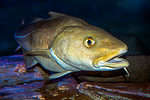
Atlantic cod
Atlantic cod Gadus morhua Not a shark, but an ecologically comparable mid- to upper-level demersal predator on temperate shelves. Overlaps with spiny dogfish in depth and prey (small fishes and invertebrates) and can be both a competitor and an occasional predator of juveniles.

The Spiny Dogfish is a smaller shark that is found in both the Atlantic and Pacific Oceans. They prefer a saltwater habitat but may enter brackish water. Spiny Dogfish are unique in that they have two spines. If they are attacked, they will use these two spines to arch their backs and inject venom into their attacker.

Some other key characteristics of a Dogfish include the white spots on its side, large eyes, and the brownish/grayish coloring on its top that fades to a white belly.
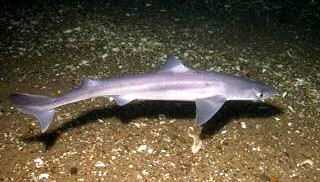
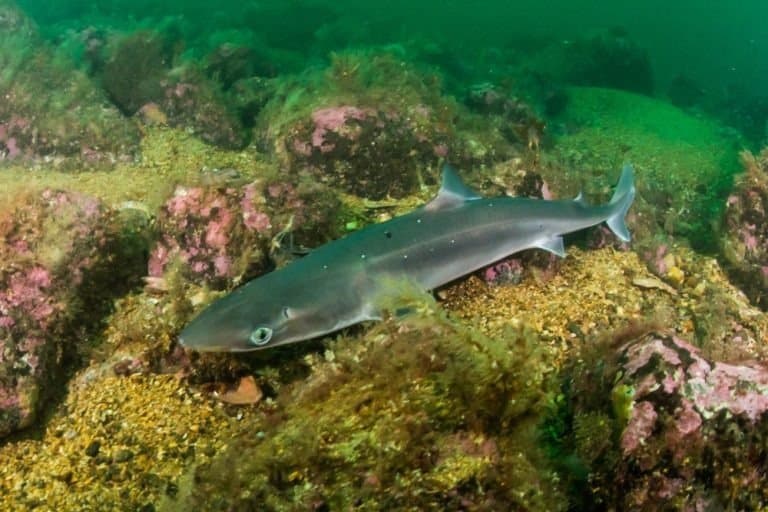
Spiny Dogfish patrolling the seafloor

The Dogfish possesses a pair of spines that it can use to pierce predators with its venomous spines by arching its back, allowing venom to enter the wound.

Classification and Scientific Name

The scientific name for these sharks is Squalus acanthias. Squalus comes from the Latin word for shark, and acanthias is derived from the Greek word akanthias, which refers to the spines of a Spiny Dogfish.

The Spiny Dogfish is also known by many other names, including piked dogfish, spiky dog, and rock salmon. It belongs to the Squalidae family and is in the Chondrichthyes class. There are 40 different species in the Squalidae family.

Recently, scientists determined that the Spiny Dogfish that live in the northern Pacific Ocean were a separate species. This species is called the Pacific Spiny Dogfish. Its scientific name is Squalus suckleyi.
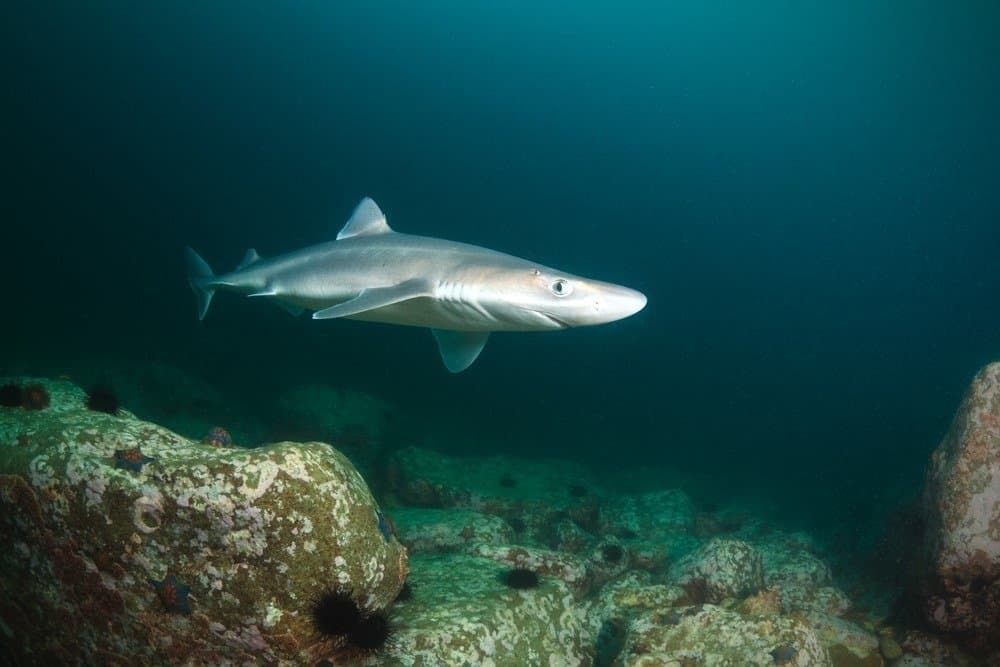
Spiny dogfish shark, deep - 15 meters, sea of japan, Russia

The sharks commonly known as dogfish have a scientific name of Squalus acanthias.

Appearance

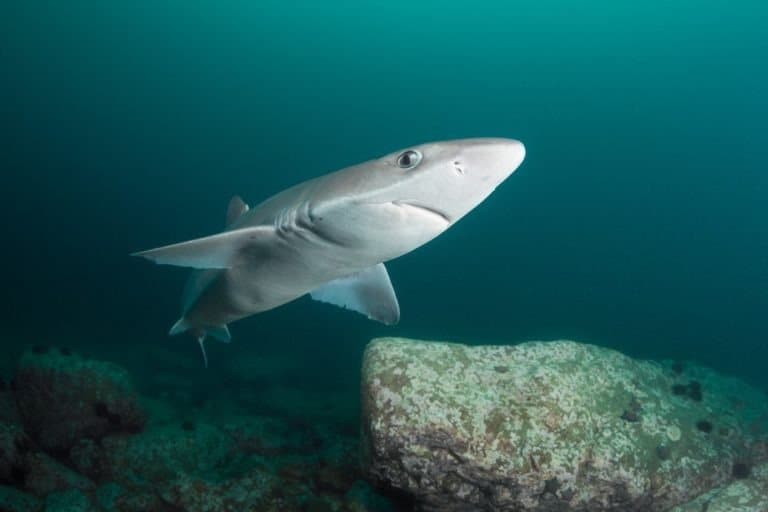
The Spiny Dogfish, or Dogfish Shark, is smaller than many other species of sharks. A male’s body has a maximum length of 39 inches, and a female’s body has a maximum length of 49 inches. Most of them weigh around 8 pounds.

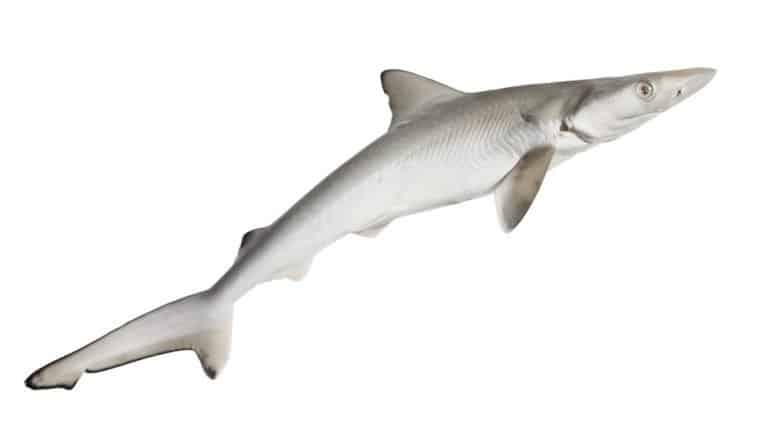
These sharks have a very slender body with a pointy snout and large eyes. A Spiny Dogfish’s skin is darker on the top and fades to white or a pale color on the belly.

The skin is brown or gray along the top of the body. Another one of the key characteristics is the small white spots that go along the sides of their body. As a Spiny Dogfish ages, these spots will begin to fade.

Spiny Dogfish have two spines that they use for self-defense. If they get captured, they will arch their back and use the spines near their dorsal fin to pierce the predator and secrete venom into it.
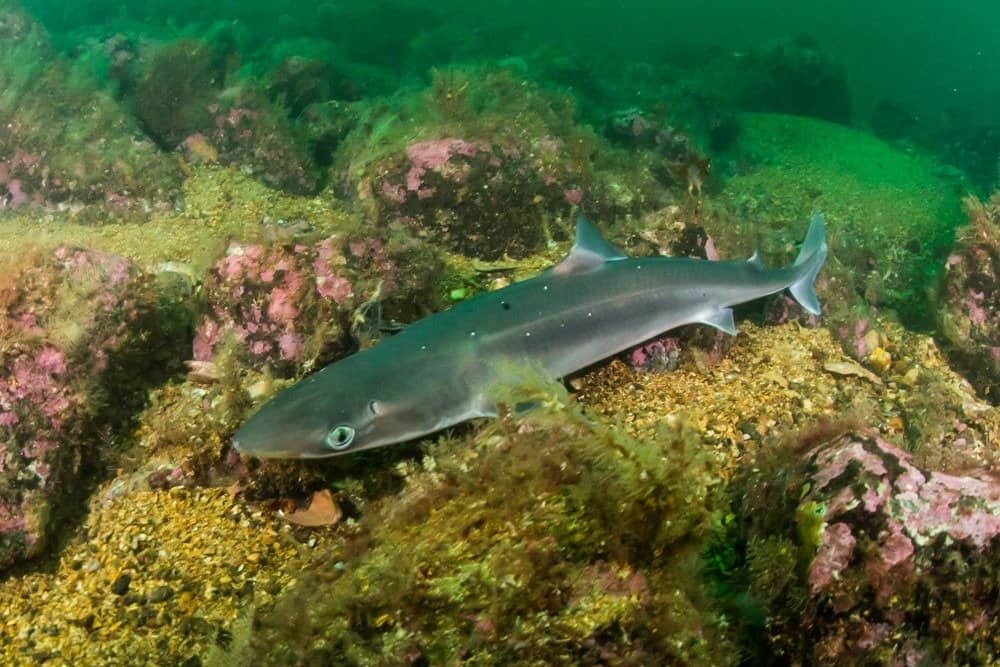
Spiny Dogfish (Squalus acanthias) at the south coast of Norway

Compared to other shark species, the Spiny Dogfish, also known as the Dogfish Shark, is relatively small.

Distribution, Population, and Habitat

These sharks are found in the Atlantic and Pacific Oceans. Recently, the Spiny Dogfish in the Pacific Ocean was determined to be a separate species and was given the name Pacific Spiny Dogfish.

In the Atlantic Ocean, they are found between Greenland and Argentina on the western side of the ocean. They can also be found in the eastern Atlantic Ocean between Iceland/the Murmansk Coast down to South Africa. These sharks are also found in the Black Sea and the Mediterranean Sea. The Pacific Spiny Dogfish can be found in the Pacific Ocean between the Bering Sea and Baja California.

These sharks may swim both inshore and offshore over the continental shelf. They prefer to swim in saltwater, but they may enter brackish water at times. They cannot be found in freshwater, however. Most of the time, Spiny Dogfish prefer to swim at depths between 160 and 490 feet beneath the surface. However, they may venture as deep as 2,300 feet beneath the surface at times.

This shark population has seen a big decrease over the years. At one time, they were the most abundant species of sharks, but now the International Union for Conservation of Nature has given them a classification as vulnerable globally and critically endangered in the northeast section of the Atlantic Ocean.

In 2010, it was estimated that these sharks had a total biomass of 106.8 thousand metric tons in the Atlantic Ocean and that there were about 44,660,000 fish in the Pacific Ocean.
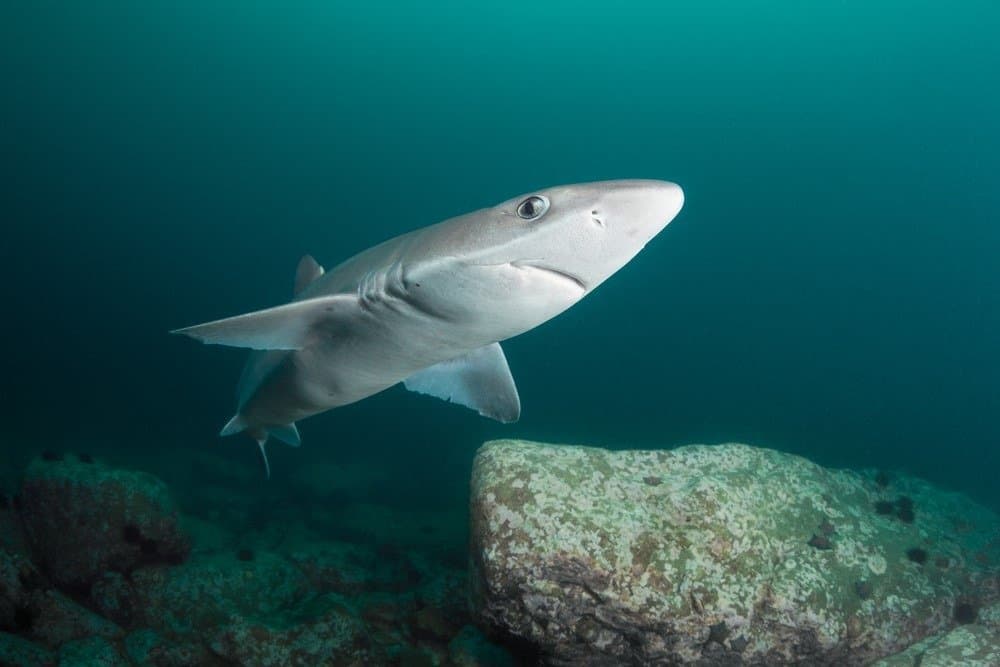
Spiny dogfish shark Deep - 15 meters Japan sea Russia

The Spiny Dogfish, or Dogfish Shark, is distributed in the Atlantic and Pacific Oceans; however, the Pacific Spiny Dogfish has recently been recognized as a distinct species.

Predators and Prey

What Threatens the Spiny Dogfish?

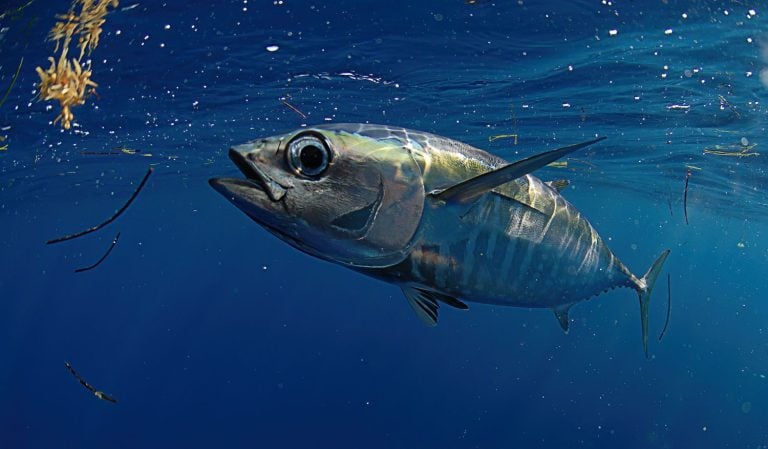
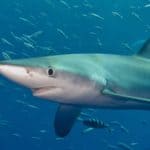
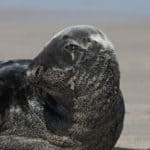
There are a few natural predators that threaten these sharks. These include Killer Whales, seals, large sharks, tuna, and American anglerfish. When attacked, the Dogfish will try to protect itself by arching its back and using its dorsal spines to inject venom into its attacker.

Humans also pose a threat to the Dogfish. Overfishing by humans has led to a significant decrease in the population of Spiny Dogfish. One of the reasons they are so impacted by fishing is that this species has a longer gestation period than many other species of fish and has smaller litters of young.

It also takes females longer to reach sexual maturity, which makes it harder for the population to grow quickly. The sharp decrease in their numbers in the past years has led to them being classified as vulnerable by the International Union for Conservation of Nature.

What do Spiny Dogfish Eat?

These sharks often hunt for food in a larger pack of up to 1,000 Dogfish. They eat octopuses, crabs, squid, smaller sharks, jellyfish, shrimp, and sea cucumbers. They use their very strong jaws and sharp teeth to bite their prey. It is believed that they consume less food during winter when they spend more time in deeper water. During the spring and summer months, they swim towards the coasts where it is warmer, and they can find more food.

Reproduction and Lifespan
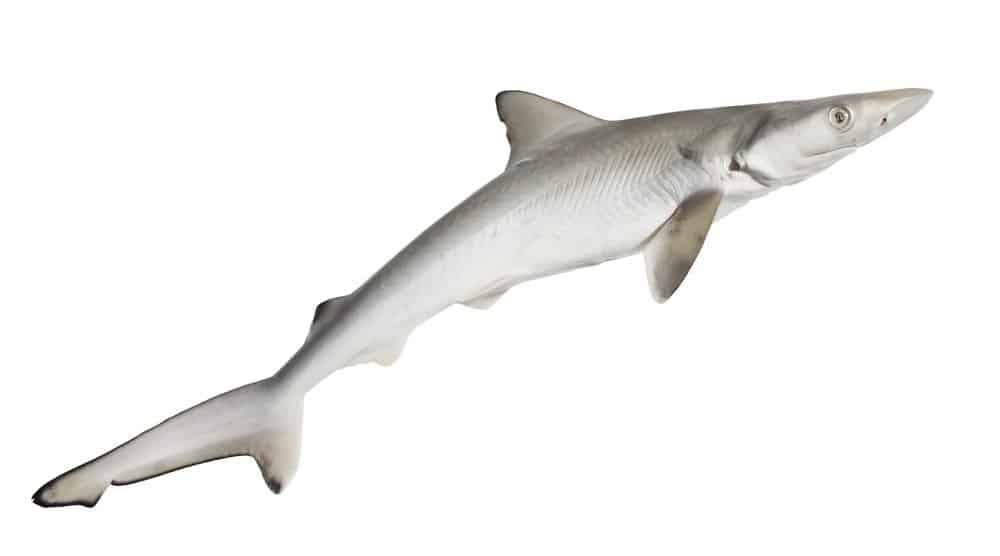
The spiny dogfish isolated on white background

The total gestation period for the Spiny Dogfish is about 2 years.

Males reach the age of sexual maturity around the age of 11 years, and females reach the age of sexual maturity by the time they are 12 or 14 years old. Mating normally takes place in offshore waters with internal fertilization.

After fertilization, a hard shell forms around the embryos to keep them protected. This shell will shed off after four to six months, but the young fish will continue to gestate for 18 to 20 more months. This means that the total gestation period for the Spiny Dogfish is about 2 years, the longest of any vertebrate.

On average, six pups are born in each litter. There could be as few as two pups or as many as 11 pups in each litter, though. The pups are between 20 and 33 centimeters long when they are born. Nearly right away, Spiny Dogfish will begin hunting for food. They may even start hunting food that is more than twice their size.

The lifespan of these sharks is typically between 20 and 24 years, but there have been some that lived to be 50 years old.

Fishing and Cooking

These sharks are fished both commercially and recreationally. Their meat is particularly popular in France, Italy, Germany, England, and other European countries. They are also eaten in the United States, Chile, Canada, New Zealand, and other places around the globe.

In Chinese cuisine, they are used to make fin-needles as an alternative to shark fin soup. The fins and tails of these sharks are used to make the fin needles. Spiny Dogfish are sold as “huss” in England, “small salmon” in France, and “sea eel” in Germany and Belgium.

View all 390 animals that start with S

Sources

  1. David Burnie, Dorling Kindersley Animal, The Definitive Visual Guide To The World's Wildlife / Accessed January 18, 2010
  2. Tom Jackson, Lorenz Books (2007) The World Encyclopedia Of Animals / Accessed January 18, 2010
  3. David Burnie, Kingfisher The Kingfisher Animal Encyclopedia / Accessed January 18, 2010
  4. Richard Mackay, University of California Press (2009) The Atlas Of Endangered Species / Accessed January 18, 2010
  5. David Burnie, Dorling Kindersley (2008) Illustrated Encyclopedia Of Animals / Accessed January 18, 2010
  6. Dorling Kindersley (2006) Dorling Kindersley Encyclopedia Of Animals / Accessed January 18, 2010
  7. Wikipedia / Accessed November 19, 2020
  8. Oceana / Accessed November 19, 2020
  9. Fishbase / Accessed November 19, 2020
  10. Florida Museum / Accessed November 19, 2020
  11. Chesapeake Bay Program / Accessed November 19, 2020
Rebecca Bales

About the Author

Rebecca Bales

Rebecca is an experienced Professional Freelancer with nearly a decade of expertise in writing SEO Content, Digital Illustrations, and Graphic Design. When not engrossed in her creative endeavors, Rebecca dedicates her time to cycling and filming her nature adventures. When not focused on her passion for creating and crafting optimized materials, she harbors a deep fascination and love for cats, jumping spiders, and pet rats.
Connect:

Thank you for reading! Have some feedback for us?


Spiny Dogfish FAQs (Frequently Asked Questions)

Spiny Dogfish are located in the Atlantic and Pacific Oceans. In the Atlantic Ocean, they are spread out between Greenland and Argentina on the west side and Iceland and South Africa on the east side. They range from the Bearing Sea to New Zealand in the western Pacific Ocean and the Bearing Sea to Chile in the eastern Pacific Ocean.