




S
Species Profile

Squirrel Monkey

Saimiri

Big eyes. Fast feet. Forest teamwork.
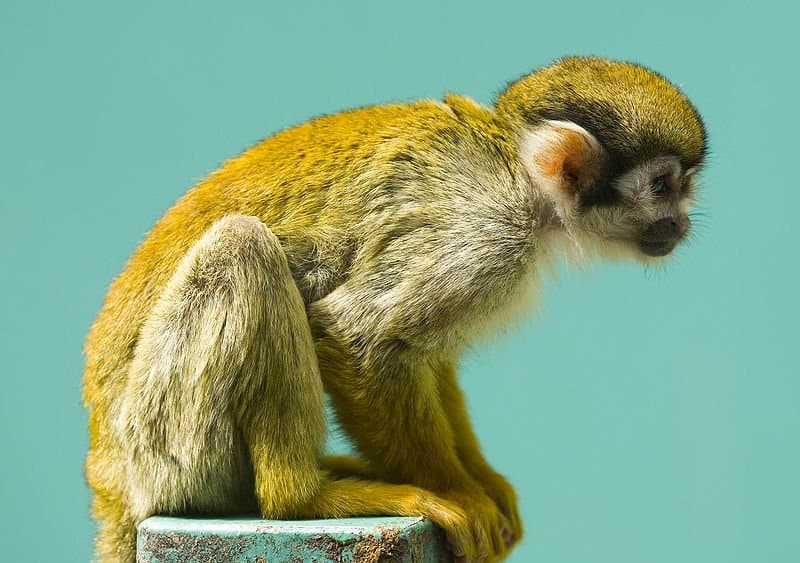
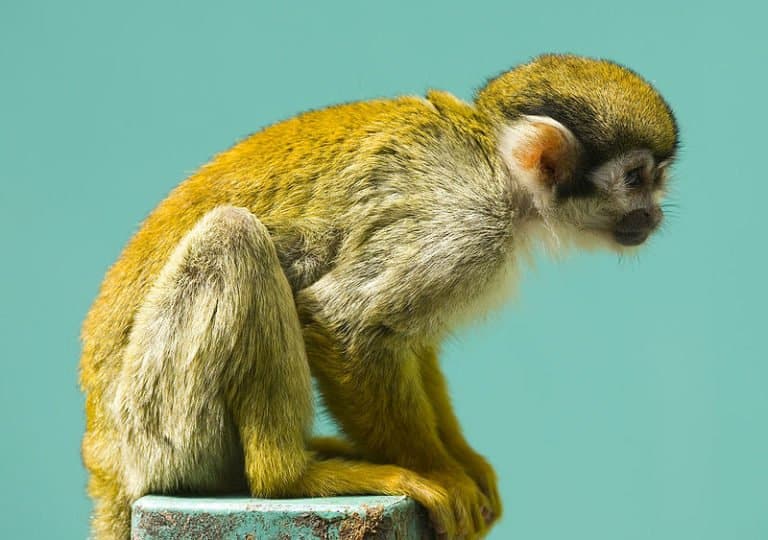
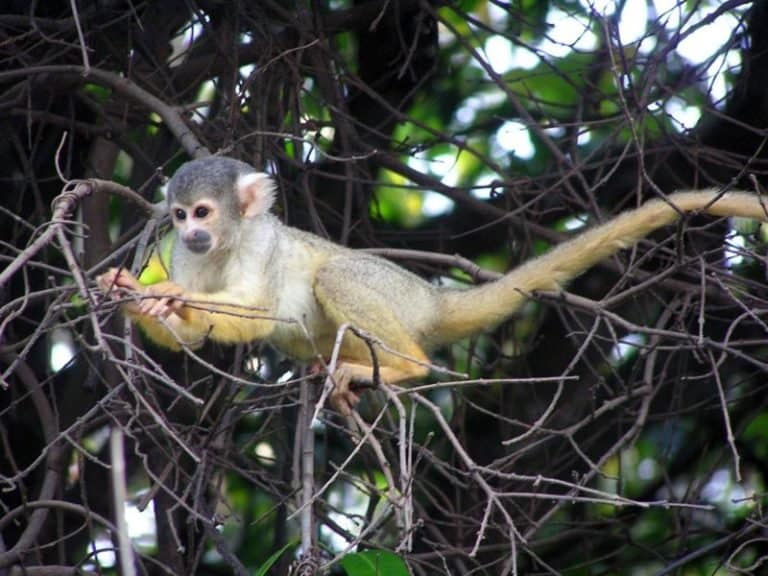
Megapixie, Public domain, via Wikimedia Commons

Squirrel Monkey Distribution

Click a location to explore more animals from that region

Loading map...
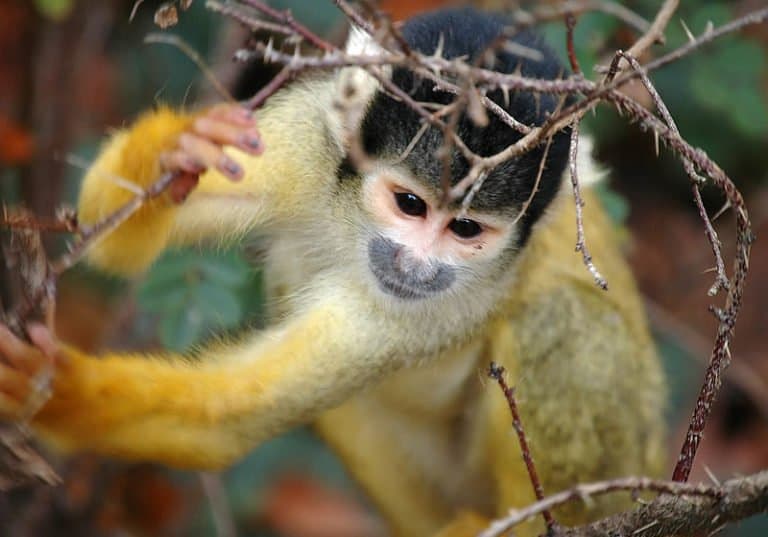
A Squirrel Monkey at Fuji Safari park Japan

At a Glance

Genus Overview This page covers the Squirrel Monkey genus as a group. Stats below are general traits shared across the genus.
Also Known As mono ardilla, macaco-esquilo, singe-écureuil, Eichhörnchenaffe, scimmia scoiattolo
Diet Omnivore
Activity Diurnal
Lifespan 15 years
Weight 1.1 lbs
Status Not Evaluated
Did You Know?

Across Saimiri, adults range ~25-35 cm head-body, with a longer tail ~35-45 cm (the tail is not prehensile).

Scientific Classification

Genus Overview "Squirrel Monkey" is not a single species but represents an entire genus containing multiple species.

Squirrel monkeys are small New World monkeys of the genus Saimiri, known for their compact build, large expressive eyes, high-energy social behavior, and group living in Neotropical forests.

Kingdom
Animalia
Phylum
Chordata
Class
Mammalia
Order
Primates
Family
Cebidae
Genus
Saimiri

Distinguishing Features

  • Small-bodied primate with very long tail (used for balance, not typically prehensile)
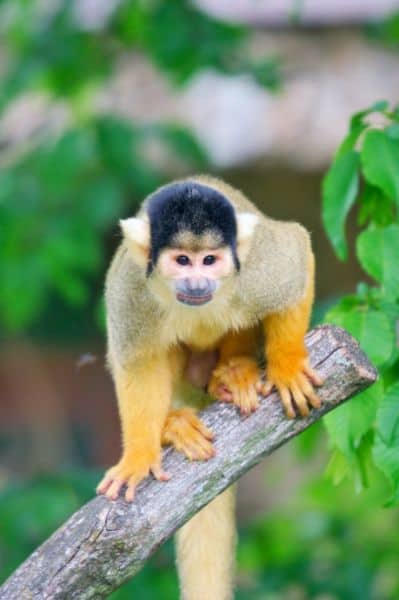
  • Bold facial mask with pale muzzle and dark mouth/eye markings
  • Highly social; often forms large multi-male/multi-female troops
  • Active, agile canopy movement and frequent vocalizations

Physical Measurements

Males and females differ in size

Length
2 ft 4 in (1 ft 10 in – 2 ft 8 in)
2 ft 2 in (1 ft 10 in – 2 ft 6 in)
Weight
2 lbs (1 lbs – 3 lbs)
1 lbs (1 lbs – 2 lbs)
Tail Length
1 ft 4 in (1 ft 2 in – 1 ft 6 in)
Top Speed
16 mph
running

Appearance

Primary Colors
Secondary Colors
Skin Type Short, dense fur over body; face partially bare with pigmented skin; palms and soles mostly hairless.
Distinctive Features
  • Genus-wide size range: head-body ~23-37 cm; tail ~35-42+ cm; mass ~0.55-1.25 kg (species, sex, and season vary).
  • Lifespan range: typically ~12-18 years in the wild; up to ~20-25 years in captivity.
  • Large, forward-facing eyes; expressive, mask-like face with contrasting pale muzzle and darker crown.
  • Long, slim tail used mainly for balance and signaling; not truly prehensile.
  • Slender limbs and agile, rapid quadrupedal running and leaping in the mid-to-upper canopy; mostly diurnal.
  • Highly social: multi-male/multi-female groups commonly ~20-100+, sometimes far larger depending on habitat and season.
  • Diet broadly insect-heavy plus fruit, nectar, and other plant items; degree of insectivory versus frugivory varies by locality.
  • Occupy diverse Neotropical forests and edges (from lowland rainforest to more seasonal habitats); coat tone and facial pattern show notable geographic variation.
  • Conservation status varies across the genus (some populations more threatened than others due to habitat loss and fragmentation).

Sexual Dimorphism

Males are generally larger and more robust, and many show strong seasonal fattening and shoulder/torso musculature during the breeding season. Females are typically smaller and more gracile, with less pronounced seasonal body-mass change.

  • Larger average body mass and head size across most species
  • Seasonal 'fatted male' condition with increased torso/shoulder bulk
  • Often more conspicuous genital tuft and scrotal visibility in adults
  • Smaller, more gracile build on average
  • Less pronounced seasonal body-mass increase
  • Nipples may be more apparent during lactation

Did You Know?

Across Saimiri, adults range ~25-35 cm head-body, with a longer tail ~35-45 cm (the tail is not prehensile).

Typical adult mass spans ~0.5-1.2 kg across species/sexes, with males usually heavier than females.

Troops are often 20-75 animals, but some populations form groups of 100+ when resources and habitat allow.

Many species show distinct facial "mask" patterns used in field ID (often described as Roman vs. Gothic styles), highlighting diversity within the genus.

Diet is broadly omnivorous but strongly insect-leaning compared with many other New World monkeys: insects, fruit, nectar, and occasional small vertebrates/eggs.

Breeding is often seasonal; in several species males show pronounced seasonal weight/condition changes during the mating period.

Lifespan varies by species and setting: roughly ~10-18 years in the wild; commonly ~20-25 years in well-managed captivity.

Unique Adaptations

  • Extreme arboreal agility: powerful leaping and rapid quadrupedal running on small branches; the long tail functions mainly as a counterbalance.
  • Large eyes and strong visual attention support fast prey detection in complex canopy light; color-vision ability varies (many populations show sex-linked differences, with some females able to see more color hues than males).
  • Digestive flexibility for a mixed diet (arthropods + fruit/nectar), allowing quick shifts as seasonal foods change across different forest types.
  • Social information use: individuals track alarm calls and neighbor behavior, improving predator avoidance in dense vegetation.
  • Behavioral thermoregulation: huddling and close contact resting can help conserve heat during cool or rainy periods in parts of their range.
  • Fine finger dexterity for manipulating small prey and probing curled leaves/crevices, an advantage in insect-rich microhabitats.

Interesting Behaviors

  • High-energy "foraging waves": troops spread out, then regroup, continuously scanning leaves and branches for prey.
  • Insect "gleaning" and rapid hand-to-mouth captures; some groups exploit insects flushed by other animals (including army-ant activity where present).
  • Mixed-species associations: in parts of their range, squirrel monkeys may travel near other primates, gaining extra vigilance benefits (frequency varies by region/species).
  • Rich vocal repertoire (chirps, peeps, alarms) to coordinate movement, maintain contact, and signal predators.
  • Female-centered social structure is common (females often remain in natal areas while males disperse), though details vary among species and sites.
  • Scent-related behaviors, including urine-washing (rubbing urine on hands/feet), which may aid scent communication and grip in humid forests.
  • Seasonal mating dynamics: temporary male-male competition and increased mate-guarding can occur during breeding peaks, with intensity varying among species.

Cultural Significance

Saimiri squirrel monkeys are key animals for Neotropical forest conservation and ecotourism; they form large, visible groups. They were kept in zoos and used in biomedical and space research, though ethics now limit this. In Costa Rica and Panama they are a symbol for environmental education and forest restoration.

Myths & Legends

Name origin (Indigenous → scientific): "Saimiri" comes from Indigenous South American language usage (recorded from Tupi-Guarani-region vocabularies in early natural history sources) and was adopted into Linnaean-era scientific naming.

Name origin (European vernacular): the English and Spanish common names both mean "squirrel monkey," reflecting early travelers' comparisons of their speed and balance in trees to squirrels.

In the 18th and 19th centuries, explorers and naturalists in northern South America described large, quick groups of small monkeys in river forests. Their travel stories made squirrel monkeys (Saimiri) symbols of busy canopy life.

Modern historical anecdote: squirrel monkeys became widely recognized in popular science during mid-20th-century laboratory and aerospace-era research programs, a cultural association that persists in media references to "tiny primates" in early research history.

In parts of Central America, guides and teachers say the presence or absence of squirrel monkey (Saimiri) troops shows forest health and corridor links—a community-told indicator story used in restoration.

Conservation Status

NE Not Evaluated (genus-level; species assessed individually)

Has not yet been evaluated against the criteria.

Population Unknown

Protected Under

  • CITES Appendix II (Saimiri spp.), except Saimiri oerstedii in Appendix I
  • National wildlife protection laws in multiple range states (vary by country)
  • Occurrence in numerous protected areas across the Neotropics (coverage varies by species and region)

You might be looking for:

Common squirrel monkey

30%

Saimiri sciureus

Widespread Amazon/Guiana Shield squirrel monkey; among the most commonly referenced species in captivity and media.

Black-capped squirrel monkey

25%

Saimiri boliviensis

Often called Bolivian squirrel monkey; commonly kept in zoos and research settings.

Central American squirrel monkey

20%

Saimiri oerstedii

Endemic to Costa Rica and Panama; notable for conservation concern and restricted range.

Tufted (Gothic) squirrel monkey

15%

Saimiri ustus

Amazonian species sometimes referenced in regional field guides; taxonomy has been revised historically.

Collins’ squirrel monkey

10%

Saimiri collinsi

A Guianan/Amazonian taxon recognized by many modern sources; less commonly cited by the public.

Life Cycle

Birth 1 infant
Lifespan 15 years

Lifespan

In the Wild
10–20 years
In Captivity
15–30 years

Reproduction

Mating System Polygynandry
Social Structure Aggregation Group
Breeding Pattern Seasonal
Fertilization Internal Fertilization
Birth Type Internal_fertilization

Across Saimiri, large multi-male/multi-female groups show seasonal breeding with weak or absent pair bonds. Males compete and court multiple females, and females often mate with multiple males; mothers provide most infant care.

Behavior & Ecology

Social Troop Group: 40
Activity Diurnal
Diet Omnivore Large insects (especially grasshoppers/katydids) and ripe, soft fruits

Temperament

High-energy and very active foragers, moving rapidly through canopy and midstory
Strongly social, with frequent affiliative contact (grooming, play) alongside short disputes
Vigilant and skittish around predators; quick to join or initiate mobbing/alarm responses
Seasonally variable competitiveness, with increased tension during mating periods in some species
Generally tolerant within groups but can show dominance-related displacement at food patches

Communication

high-pitched chirps and peeps for contact and cohesion
rapid chatter/trills during excitement and group movement
squeals/screams during aggression, distress, or separation
distinct alarm calls for aerial versus terrestrial predators in many populations
soft grunts or short barks in close-range interactions
facial expressions and body postures Piloerection, open-mouth threats, avoidance displays
tactile communication via grooming, huddling, and play wrestling
scent communication including urine washing and scent marking on substrates
tail and limb gestures to coordinate movement through branches
rapid approach/retreat and chase behaviors to signal status or resolve conflicts

Habitat

Biomes:
Tropical Rainforest Tropical Dry Forest Wetland Freshwater
Terrain:
Plains Hilly Valley Riverine
Elevation: Up to 5905 ft 6 in

Ecological Role

Omnivorous canopy/understory mesopredator and frugivore that links arthropod prey dynamics with plant reproduction in Neotropical forests.

Arthropod/insect population regulation through intensive predation Seed dispersal for many small-fruited plants via frugivory Supports food webs as a common prey base for larger predators (raptors, snakes, felids) Nutrient redistribution through movement and defecation across forest strata

Diet Details

Main Prey:
Beetles and insect larvae Grasshoppers and katydids Ants and termites Caterpillar Arachnids Small arthropods Small lizards and geckos Tree frog Bird eggs and nestlings +3
Other Foods:
Ripe forest fruits Flowers and nectar Seeds Buds and young leaves Tree gums and sap

Human Interaction

Domestication Status

Wild

Saimiri (squirrel monkeys) are wild New World primates and are not domesticated. People meet them in Neotropical forests, at wildlife tourism sites, in research colonies, and through the pet and entertainment trade. Captive breeding occurs but is not domestication and does not usually make pet-ready animals. Some taxa are common; others are rare or threatened; escaped groups are feral.

Danger Level

Moderate
  • Bites and lacerations (sharp canines; injuries can become infected)
  • Zoonotic disease risk typical of close contact with primates (e.g., enteric bacteria such as Salmonella/Shigella, intestinal parasites; risk profile depends on origin, screening, and hygiene)
  • Allergic reactions/asthma triggers from dander and waste in enclosed settings
  • Public safety issues from unpredictable behavior, especially at sexual maturity or under stress (aggression, grabbing/escaping, property damage)
  • Welfare and legal risks: improper keeping increases stress-related aggression and disease shedding, raising risk to handlers

As a Pet

Not Suitable as Pet

Legality: Rules vary by country and state. Many places ban or limit keeping squirrel monkeys; some need permits, cages, vet checks. International trade under CITES: most Saimiri Appendix II, Saimiri oerstedii Appendix I. Extra welfare and health rules often apply.

Care Level: Expert Only

Purchase Cost: $4,000 - $12,000
Lifetime Cost: $50,000 - $200,000

Economic Value

Uses:
Ecotourism and wildlife viewing in Neotropical forests Biomedical and behavioral research (historically significant; currently regulated/variable by country) Zoo and conservation-breeding/education programs Illegal or tightly regulated exotic pet trade Ecosystem services (insect predation; seed dispersal in some contexts)
Products:
  • Tourism revenue (guided forest tours, protected area visitation)
  • Research data/models (neuroscience, behavior, vision, infectious disease ecology-use depends on regulation and ethics frameworks)
  • Educational value in accredited zoological institutions
  • No legitimate livestock-style commodities (not domesticated; trade is often restricted)

Relationships

Related Species 3

Ecological Equivalents 4

Animals that fill a similar ecological role in their ecosystem

Owl monkeys Aotus spp. Small-bodied, arboreal Neotropical monkeys that occupy similar forest strata and rely heavily on fruit and animal prey; they differ strongly in activity pattern (Aotus is nocturnal while Saimiri are diurnal).
Tamarins
Tamarins Saguinus spp. Comparable size and use of insects and fruit in Neotropical forests; they often overlap in habitat types and foraging microhabitats, although tamarins more frequently use trunks and forest edges and exploit gum and nectar depending on species.
Marmoset
Marmoset Callitrichidae Small, social, arboreal primates that consume a high proportion of insects and frequently use secondary forest; many species specialize on tree exudates more than Saimiri.
Titi monkey Plecturocebus spp. Diurnal, arboreal forest monkeys that can share ranges and food resources such as fruit and invertebrates, but tend to live in small family groups rather than large multi-male/multi-female troops.

Types of Squirrel Monkey

9

Explore 9 recognized types of squirrel monkey

Common squirrel monkey Saimiri sciureus
Black-capped squirrel monkey Saimiri boliviensis
Central American squirrel monkey Saimiri oerstedii
Bare-eared squirrel monkey Saimiri ustus
Black squirrel monkey Saimiri vanzolinii
Humboldt's squirrel monkey Saimiri cassiquiarensis
Colombian squirrel monkey Saimiri albigena
Collins' squirrel monkey Saimiri collinsi
Peruvian (large-toothed) squirrel monkey Saimiri macrodon

Classification And Evolution

The Squirrel Monkey is the smallest species of New World monkey that is native to the forests and tropical jungles of Central and South America. Measuring only .84 ounces from the top of the head to the base of their tail, these mini monkeys are more than double their size when you include their long tail. Unlike many other species of small monkeys, the tail of the squirrel monkey is not prehensile and therefore cannot be utilized for gripping branches. Rather, their long tail is used to help the squirrel monkey balance when climbing on high branches.

As a new world monkey, the squirrel monkey is a descendant of an ancient African primate that is said to have migrated to South America on a raft constructed of vegetation. Due to a lack of fossil evidence, the exact origin of the early primates is not fully known. It is believed that new-world monkeys began to appear in the middle of the Cenozoic epoch, during the Paleogene era, from 66 million to 23 million years ago, and they most likely split from the old-world monkeys sometime around 40 million years ago.
Types Of

Squirrel monkeys are divided into two groups, which contain a total of five species that are found in varying locations. While all the squirrel monkey species do resemble each other in appearance, they all have slight variations in fur color and reside in different regions.

There is the Saimiri sciureus group, which contains the Common Squirrel Monkey, the Central American Squirrel Monkey, and the Bare-eared Squirrel Monkey, and the Saimiri boliviensis group, which contains the Black Squirrel Monkey and the Black-Capped Squirrel Monkey. Each monkey species contains its own subspecies as well.

Anatomy And Appearance
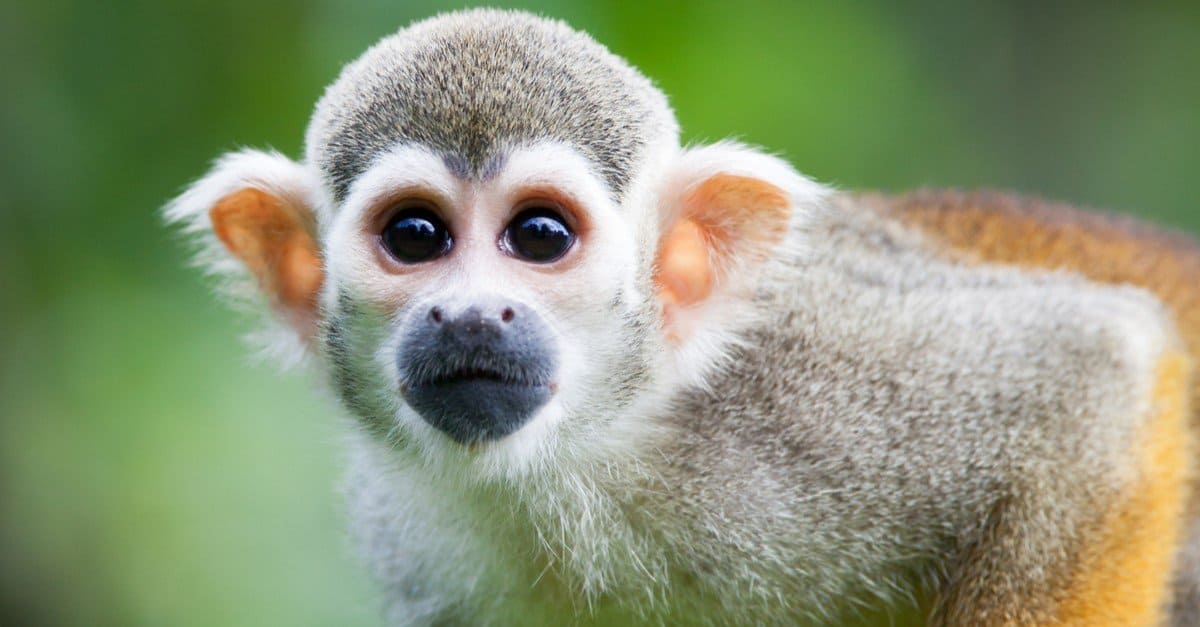
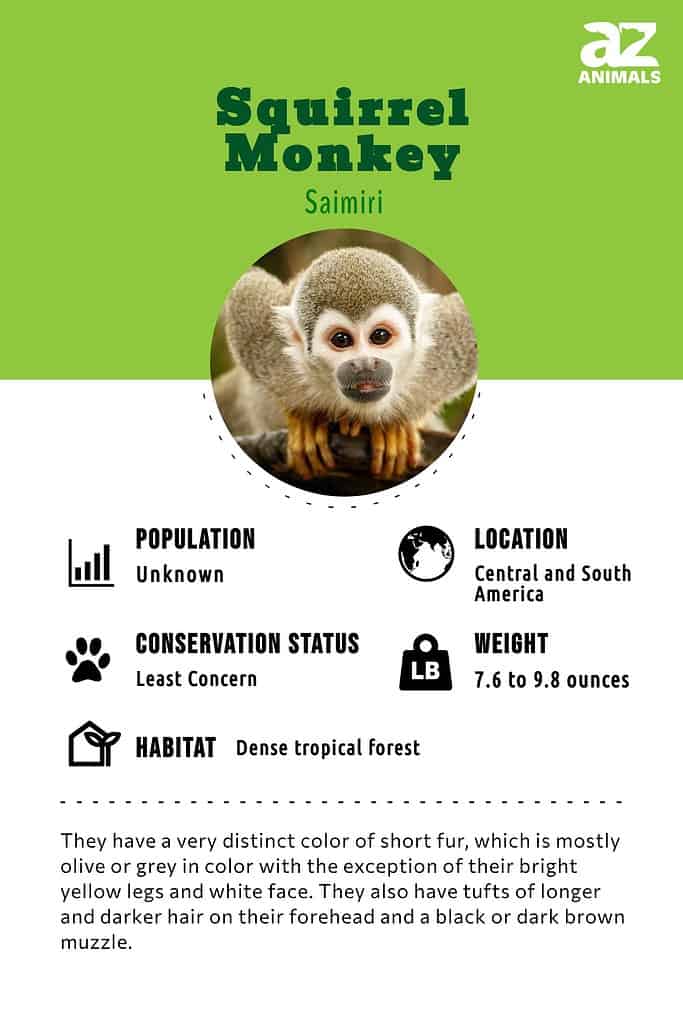
Although both male and female Squirrel Monkeys appear to be almost identical in size and appearance, males actually tend to be slightly larger and heavier than their female counterparts. Squirrel Monkeys have a very distinct color of short fur, which is mostly olive or grey in color with the exception of their bright yellow legs and white face. The Squirrel Monkey also has a tuft of longer and darker hair on its forehead and a black or dark brown muzzle.

These little primates spend a great deal of time high in the trees and are very well adapted to doing so with incredibly dexterous fingers that are not only great for gripping onto branches, but also come in very useful when opening fruits and holding onto prey. The long tail of the Squirrel Monkey is longer than its body and has a quite slim ending with a dark, bushy tip.

Distribution And Habitat
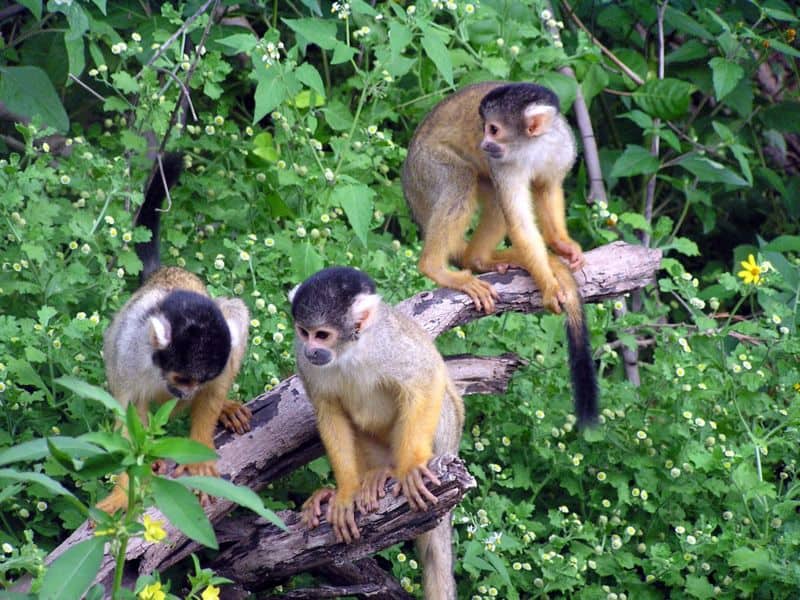
The five different species of squirrel monkeys are found throughout Central and South America, extending as far as the upper Amazon Basin. Squirrel monkeys tend to prefer regions of dense, tropical forests that are close to a stream or other flowing water source which is thought to be for safety. Most active during the day, this mammal can be found at the middle level of the forest canopy and will rarely venture towards the top as they are in danger of being caught by birds, or down to the ground in fear of other predators. Squirrel Monkeys can, however, be found in a variety of forest types and have even been known to inhabit areas that have been cleared for agriculture. They are under threat though from habitat loss that is primarily in the form of deforestation for agriculture and growing Human settlements.

Behavior And Lifestyle
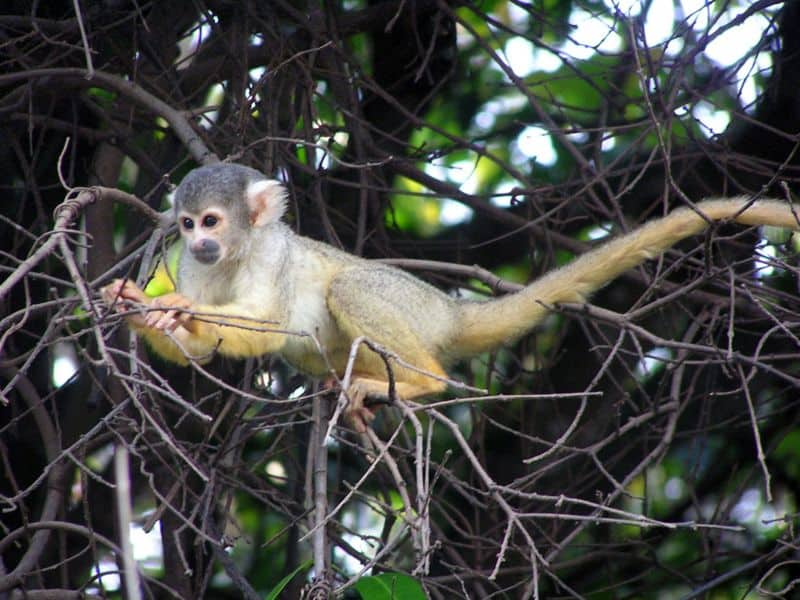
Squirrel monkeys are incredibly sociable animals that move about noisily in the trees in large troops that are usually 40 or 50 animals large but can contain up to 500 individuals. These troops usually contain a number of sub-groups including adult males, pregnant females, females with their young, and groups of young squirrel monkeys. They communicate with one another using a range of different noises with these complex social troops sleeping together at night before breaking up into their sub-groups to feed during the day.

Adept climbers, leaping between branches to travel through the forest, their long tails provide them with excellent balance and aided by their nimble hands and feet, allow Squirrel Monkeys to cover vast areas of the jungle. They are also known to follow other troops at a distance to take advantage of the food left in their path.

Reproduction And Life Cycles
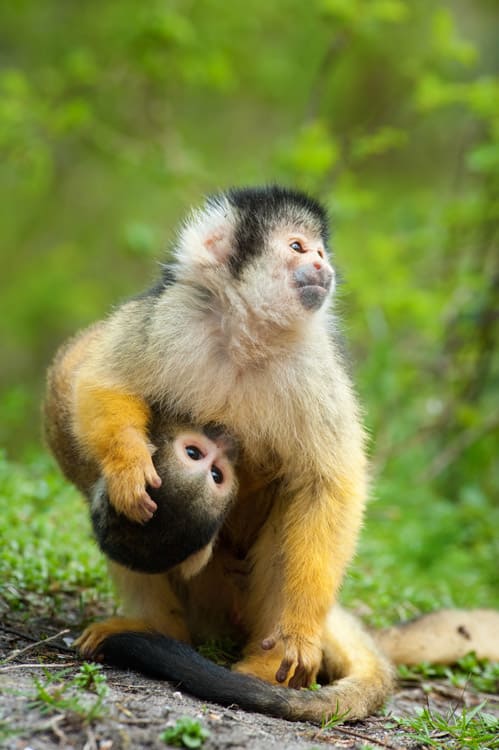
Females have a gestation period that lasts 5 months and will then carry her young on her back.

At the start of the breeding season, the shoulders of male Squirrel Monkeys broaden and they begin to fight aggressively for their right to mate, with the winner earning mating rights with the most females. Shortly after giving birth, the female Squirrel Monkey will chase away the male who plays no part in raising the single infant and leaves to join his all-male group. Births tend to occur during a short period of time which corresponds with the heaviest annual rainfall between June and August.

After a gestation period that lasts for around five months, the female begins to carry her young on her back from the first day. By the time the infant is two months old, it begins to explore more without its mother and is almost completely independent by the time it is 10 months old. Young females may stay with or close to their mother for some time but males will leave her to join a young all-male group.

Diet And Prey
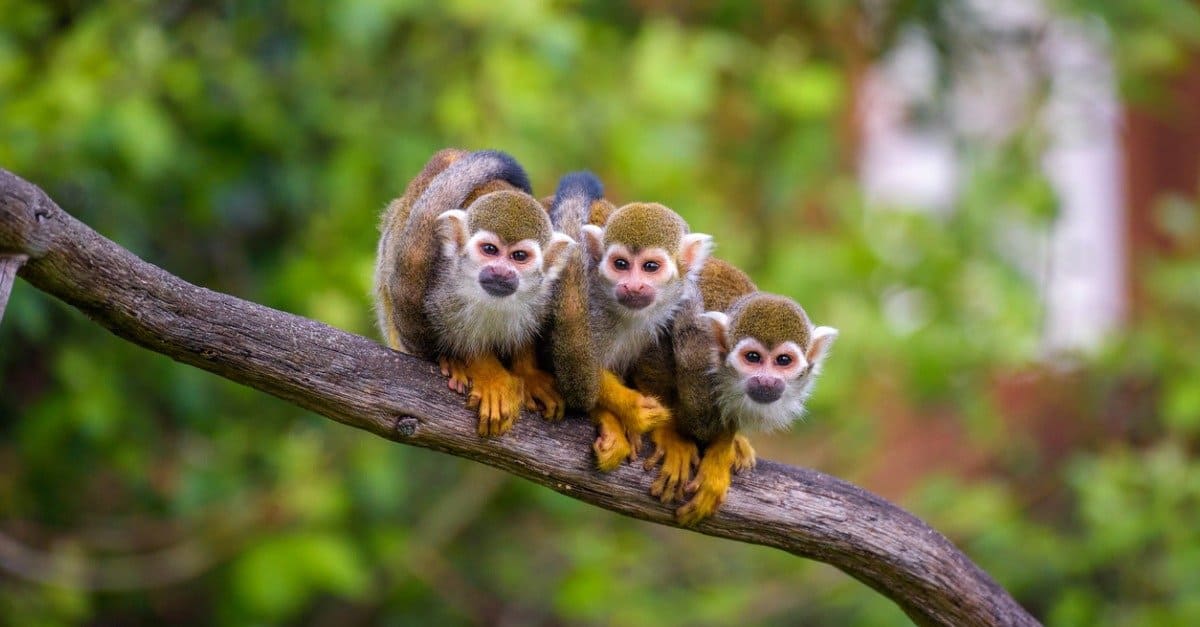
The Squirrel Monkey is an omnivorous animal that eats small animals, plants, and plant matter in order to survive, feeding during the day in their smaller sub-groups. Squirrel Monkeys have a widely varied diet that is primarily comprised of fruits and insects. They are also known to eat flowers, buds, eggs, nuts, lizards, and other small vertebrates that are found amongst the surrounding leaves and branches.

The hands and fingers of the Squirrel Monkey are perfectly designed for holding onto food while either peeling it or eating it, which it does with the use of its small but sharp teeth. However, in areas that have been more affected by deforestation, squirrel monkeys have been known to raid agricultural plantations in search of food.

Predators And Threats
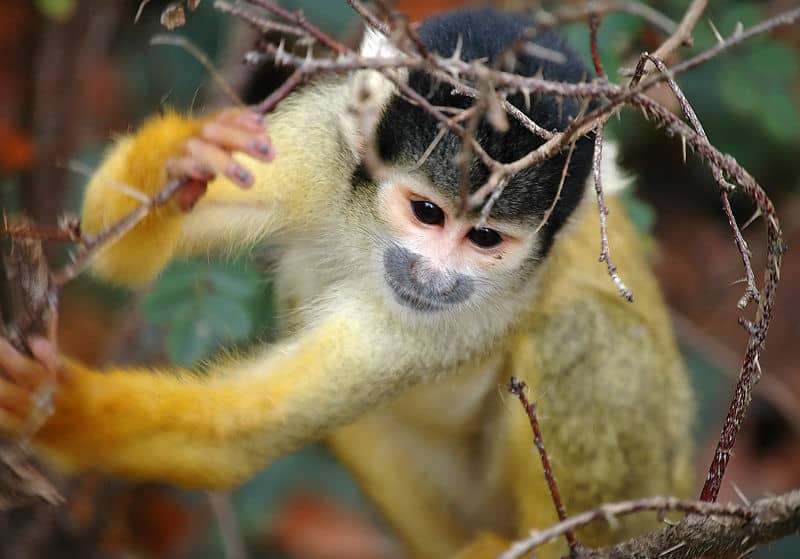
The Squirrel monkey will use a special warning sound to communicate with their troop.

The Squirrel Monkey uses a number of vocal commands to communicate with the rest of the troop including special warning sounds which indicate the presence of a dangerous predator. As one of the smallest species of New World Monkeys, they are preyed upon by a variety of forest animals. Birds of Prey are the biggest threat to squirrel monkeys along with snakes that are able to hunt them in the trees.

Due to the fact that habitat loss has forced Squirrel Monkeys in some areas to eat crops, they are threatened by methods used to try and keep them away. The fact that they inhabit the jungle with enormous troops means that they have also been severely affected by the decrease in the forest as there is not enough food to sustain the whole troop.

Interesting Facts And Features
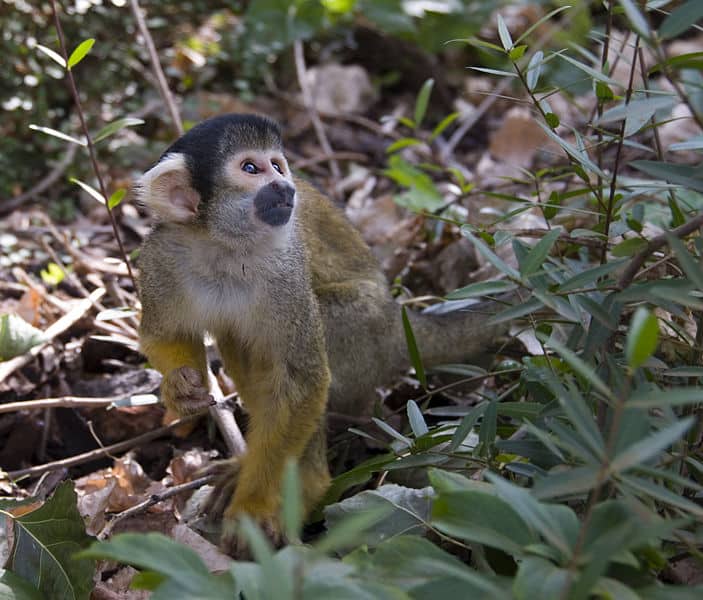
The Squirrel Monkey is thought to be one of the most intelligent species of primate and is known to have the largest brain-to-body mass ratio of all the monkey species in the world. They have incredibly good eyesight and color vision which means that they are able to spot fruits amongst the dense vegetation with ease. While feeding in really dense foliage, they are known to make a “chuck-chuck” sound to indicate their location to other members of their troop and are also known to spread urine on their hands and feet which enables them to leave a scent trail while moving about in the trees.

Relationship With Humans

Due to the small size and highly intelligent nature of squirrel monkeys, they have been captured and kept as pets in both their native regions and around the world. Although the majority of squirrel monkey pets today are bred from captive animals, the capture of them in the past for the exotic pet trade has had an effect on wild populations, particularly in certain areas. The squirrel monkey is still more threatened by increasing levels of human activity in their native regions, particularly in the form of deforestation for logging and land clearance for agriculture.

Conservation Status

As of today, the squirrel monkey is an animal species that is at a lower risk in its natural environment than a number of other New World Monkey species. However, two out of the five Squirrel Monkey species are listed as Vulnerable by the IUCN and two are listed as being of Least Concern. Population numbers of all five species though are threatened by habitat loss, with their large troops being pushed into smaller and smaller areas of their natural habitat.

View all 390 animals that start with S
How to say Squirrel Monkey in ...
Catalan
Mona esquirol
German
Totenkopfaffen
English
Squirrel monkey
Spanish
Saimiri
French
Saïmiri
Hebrew
קוף סנאי
Italian
Saimiri
Japanese
リスザル
Dutch
Doodshoofdaapjes
Polish
Saimiri
Swedish
Dödskalleapor
Turkish
Sincap maymunu
Chinese
松鼠猴屬

Sources

  1. David Burnie, Dorling Kindersley (2011) Animal, The Definitive Visual Guide To The World's Wildlife / Accessed December 16, 2008
  2. Tom Jackson, Lorenz Books (2007) The World Encyclopedia Of Animals / Accessed December 16, 2008
  3. David Burnie, Kingfisher (2011) The Kingfisher Animal Encyclopedia / Accessed December 16, 2008
  4. Richard Mackay, University of California Press (2009) The Atlas Of Endangered Species / Accessed December 16, 2008
  5. David Burnie, Dorling Kindersley (2008) Illustrated Encyclopedia Of Animals / Accessed December 16, 2008
  6. Dorling Kindersley (2006) Dorling Kindersley Encyclopedia Of Animals / Accessed December 16, 2008
  7. David W. Macdonald, Oxford University Press (2010) The Encyclopedia Of Mammals / Accessed December 16, 2008
  8. Squirrel Monkey Information / Accessed December 16, 2008
  9. About Squirrel Monkeys / Accessed December 16, 2008
A-Z Animals Staff

About the Author

A-Z Animals Staff

AZ Animals is a growing team of animals experts, researchers, farmers, conservationists, writers, editors, and -- of course -- pet owners who have come together to help you better understand the animal kingdom and how we interact.
Connect:

Thank you for reading! Have some feedback for us?


Squirrel Monkey FAQs (Frequently Asked Questions)

Squirrel Monkeys are Omnivores, meaning they eat both plants and other animals.