
S
Species Profile

Steller’s Sea Cow

Hydrodamalis gigas

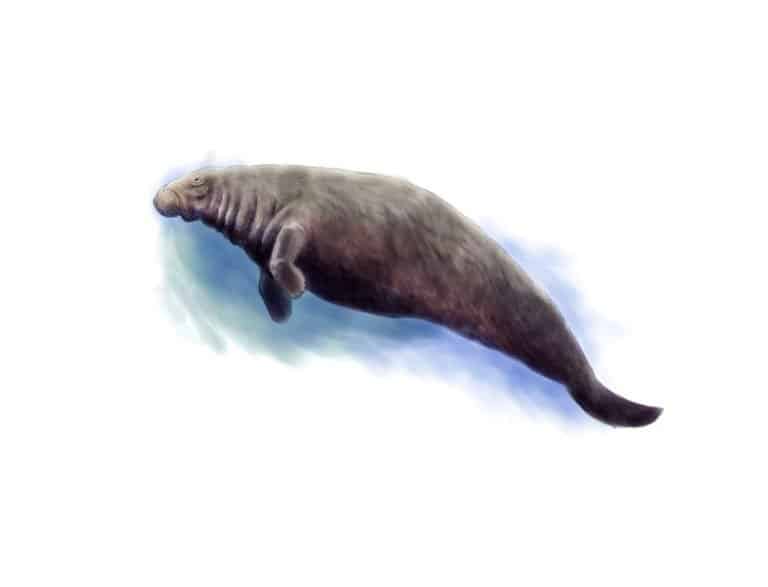
The kelp giant we lost
F. John - Public Domain

Steller’s Sea Cow Distribution

Click a location to explore more animals from that region

This map shows coastal regions where Steller’s Sea Cow are found.

Loading map...
Steller's Sea Cow

At a Glance

Wild Species
Also Known As Giant sea cow, Sea cow, Commander Islands sea cow, sea-cow, Stellar sea cow
Diet Herbivore
Activity Cathemeral
Lifespan 70 years
Weight 10000 lbs
Status Extinct
Did You Know?

Extinct within ~27 years of its scientific discovery: described by Georg W. Steller (1741) and last known individuals killed by 1768.

Scientific Classification

Steller's sea cow (Hydrodamalis gigas) was a very large, herbivorous marine mammal (order Sirenia) native to the cold, shallow coastal waters of the North Pacific, especially around the Commander Islands. It was described in the 18th century and was rapidly hunted to extinction shortly thereafter.

Kingdom
Animalia
Phylum
Chordata
Class
Mammalia
Order
Sirenia
Family
Dugongidae
Genus
Hydrodamalis
Species
Hydrodamalis gigas

Distinguishing Features

  • Extinct sirenian of the North Pacific (not a manatee; closest living relative is the dugong)
  • Very large-bodied marine herbivore associated with kelp-rich coastal shallows
  • Thick, tough skin and a slow-moving nearshore lifestyle that made it vulnerable to hunting

Physical Measurements

Length
27 ft 11 in (22 ft 12 in – 32 ft 10 in)
Weight
8.8 tons (8.8 tons – 11.0 tons)
Top Speed
5 mph
swimming

Appearance

Primary Colors
Secondary Colors
Skin Type Extremely thick, rough, wrinkled, hair-sparse skin likened to tree bark; heavily calloused.
Distinctive Features
  • Extinct sirenian (Dugongidae); described 1741, hunted to extinction by 1768 (Commander Islands).
  • Very large body: reported total length ~7-9 m; estimated mass commonly ~8000-10000 kg.
  • Barrel-shaped torso with deep skin folds; slow, buoyant nearshore form adapted to cold North Pacific waters.
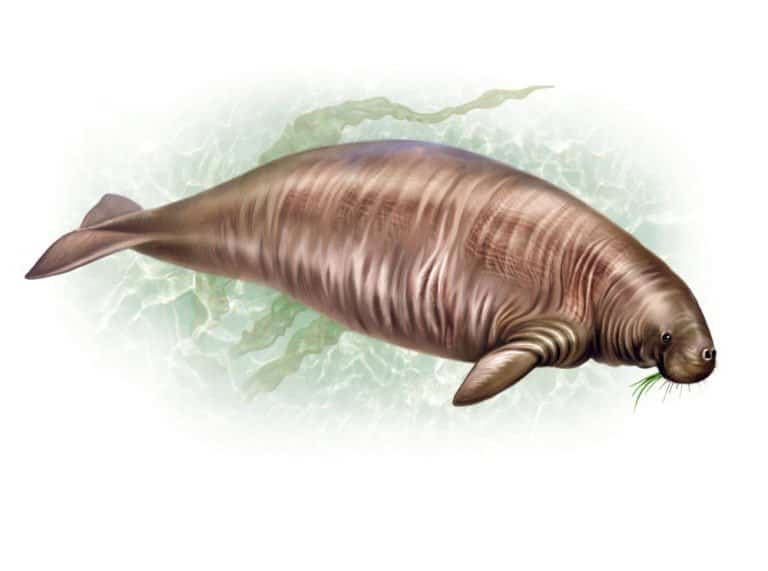
  • Small head with downturned snout and bristly upper lip; adapted for grasping kelp/seaweeds.
  • No functional teeth; used keratinous oral pads for crushing vegetation (appearance and mouth structure).
  • Forelimbs short and paddle-like; no external hind limbs.
  • Broad horizontal tail fluke with a shallow central notch (distinctive sirenian tail shape).
  • Skin frequently scarred and abraded from rocks/ice/kelp habitat, contributing to mottled appearance.

Did You Know?

Extinct within ~27 years of its scientific discovery: described by Georg W. Steller (1741) and last known individuals killed by 1768.

It was the largest known sirenian: Steller reported adults about 8-9 m long and estimated masses around 8,000-10,000 kg.

Unlike manatees and dugongs, it lived in cold subarctic seas (Commander Islands, Bering Sea), relying on a huge body and thick blubber for insulation.

Diet was marine algae-especially kelps (e.g., brown algae); it fed in very shallow nearshore water, often at the surface.

It lacked functional teeth; food was likely processed with keratinized "chewing" plates/pads in the mouth (as in other sirenians, but apparently more specialized).

Steller described them as slow-moving and unwary of humans-traits that made hunting devastatingly efficient.

Russian hunters nicknamed it the "cabbage-eater," reflecting its seaweed (kelp) diet.

Unique Adaptations

  • Cold-water sirenian physiology: large body size and thick blubber would have reduced heat loss in subarctic water-unusual among Sirenia, which are mostly tropical/subtropical.
  • Kelp-specialist feeding apparatus: reports and anatomy indicate no functional teeth; grinding likely relied on tough keratinized oral pads suited to abrasive marine algae.
  • Pachyosteosclerosis (very dense, heavy bones): a sirenian hallmark that provides ballast for shallow grazing; in Steller's sea cow it appears especially pronounced, fitting a nearshore, low-speed lifestyle.
  • Bark-like skin: described as very thick and rough, possibly offering protection from cold, abrasion in kelp beds, and parasites.
  • Commander Islands endemism: a restricted range around Bering and Copper Islands meant any sustained hunting pressure could eliminate the entire species quickly.

Interesting Behaviors

  • Nearshore surface grazing: Steller described animals feeding in the surf zone on kelp/seaweeds, often remaining close to shore in very shallow water.
  • Social grouping: accounts describe individuals commonly seen in pairs or small groups, with strong attention to wounded companions.
  • Low wariness: Steller's observations emphasize that sea cows did not flee quickly from boats, allowing repeated harpooning/club-hunting.
  • Slow locomotion: movement was described as deliberate and sluggish, consistent with dense bones (ballast) and a lifestyle focused on grazing rather than fast escape.
  • Probable long parental care: Steller noted maternal attendance and the presence of calves; as in other sirenians, reproduction was likely slow (single calves), intensifying vulnerability to hunting.

Cultural Significance

Steller's sea cow (Hydrodamalis gigas) is a famous example of fast, human-caused extinction. Steller saw it after the 1741–42 Bering Island shipwreck; survivors ate it. Called the "cabbage-eater," this slow-breeding sea cow that lived in a small area was hunted to extinction within decades.

Myths & Legends

On Bering Island (1741–1742), stranded crew stories say they hunted the huge, gentle Steller's sea cows (Hydrodamalis gigas) for food and lamp oil, later told as sea tales of danger and help.

The "cabbage-eater" sailor's nickname: Russian hunters' traditional epithet ("cabbage-eater") functioned as a piece of working folklore-an identity tale that framed the animal as a floating store of 'sea cabbage' meat in the kelp shallows.

Steller's sea cow, called a 'gentle giant,' was said to be calm. Naturalists used this to tell a moral story about human greed and losing an innocent, once-common animal—an early warning about extinction.

Conservation Status

EX Extinct

No known individuals remaining.

Population Unknown

Life Cycle

Birth 1 calf
Lifespan 70 years

Lifespan

In the Wild
50–90 years

Reproduction

Mating System Data Deficient
Social Structure Aggregation Group
Breeding Pattern Transient
Fertilization Internal Fertilization
Birth Type Internal_fertilization

Direct observations of mating in Hydrodamalis gigas were not recorded before extinction. By analogy with other sirenians, breeding likely involved temporary mating aggregations with short-lived associations, internal fertilization, and maternal-only care of a single calf.

Behavior & Ecology

Social Herd Group: 6
Activity Cathemeral
Diet Herbivore Large brown kelps (laminarian kelp; e.g., Laminaria-type kelp described as primary food by G.W. Steller)

Temperament

Docile, slow-moving, and largely non-aggressive toward humans in historical observations.
Socially tolerant; close-spacing in kelp beds suggests low intraspecific aggression at feeding sites.
Protective behavior reported: nearby animals approached and attempted to assist injured individuals (Steller, 1751).
HUBS (Sirenia): typically non-territorial, low-aggression herbivores; Hydrodamalis likely matched this baseline.
Variation (HUBS): aggregation size likely tracked kelp density, tides/season, and disturbance (e.g., hunting pressure).
Life history often described as slow; longevity sometimes reported up to ~90 years in early accounts (uncertain).

Communication

No confirmed vocal repertoire recorded for Hydrodamalis gigas; historical accounts are non-specific.
Likely low-frequency grunts/whistles similar to other sirenians Inference; not directly measured for this species
Tactile contact (body rubbing, close flank-to-flank positioning) likely important for pair and mother-calf cohesion.
Hydrodynamic cues: following wakes and maintaining close proximity in kelp beds for group coordination.
Surface splashes and body pushes described during disturbance events, consistent with alarm/aid behavior Steller, 1751

Habitat

Coastal Kelp Forest Rocky Shore Seabed/Benthic
Biomes:
Terrain:
Coastal Island Rocky
Elevation: -1181 in

Ecological Role

Large-bodied kelp-forest megaherbivore (primary consumer) in cold, shallow North Pacific coastal ecosystems.

Top-down control of kelp biomass and alteration of kelp-canopy structure via surface grazing/cropping Nutrient recycling and localized fertilization of nearshore waters through excretion (enhancing primary productivity) Physical disturbance/redistribution of floating kelp and wrack, influencing detrital pathways and nearshore food webs Potential indirect habitat shaping for kelp-associated invertebrates and fishes by modifying kelp density and frond turnover

Diet Details

Other Foods:
Kelp and other large brown macroalgae Kelp fronds

Human Interaction

Domestication Status

Wild

Steller's sea cow (Hydrodamalis gigas) was never domesticated and is now extinct. Georg Steller reported it in 1741. People quickly hunted it for meat and oil around the Commander Islands, and its slow, nearshore life made it easy to kill. Heavy hunting drove it extinct by about 1768, about 27 years after discovery.

Danger Level

Low
  • No evidence of active aggression toward humans; as a large marine herbivore it was considered docile and easily approached (per historical accounts).
  • The main hazard would have been incidental: size/weight in shallow water could pose a minor risk of accidental collision if closely approached, but this is speculative and not documented as a recurrent danger.

As a Pet

Not Suitable as Pet

Legality: Steller's sea cow (Hydrodamalis gigas) is extinct and cannot be legally owned or bought. Any claimed specimens are controlled by wildlife, antiquities, and protected-species laws; museum pieces need permits and collection rules.

Care Level: Expert Only

Purchase Cost:
Lifetime Cost:

Economic Value

Uses:
Historical subsistence/commercial exploitation Materials (hide, oil/fat) Scientific and educational value (museum collections, research)
Products:
  • meat (historically harvested for food)
  • fat/oil (rendered for fuel/food use historically)
  • hide/leather (reported heavy skin used for covering boats/gear historically)
  • bones (historically used as material; now scientific specimens)

Relationships

Related Species 4

Cuesta sea cow Hydrodamalis cuestae Shared Genus
Dugong
Dugong Dugong dugon Shared Family
Lesser sea cow Dusisiren jordani Shared Family
Sea cow
Sea cow Metaxytherium medium Shared Family

Ecological Equivalents 5

Animals that fill a similar ecological role in their ecosystem

Dugong
Dugong Dugong dugon Closest living analogue is the dugong; both are large, marine, coastal herbivores. Dugongs eat seagrass in warm, shallow seas, while Steller's sea cow fed on kelp and other seaweeds in cold North Pacific kelp beds.
West Indian manatee Trichechus manatus Like manatees, Steller's sea cow was a slow, large aquatic herbivore that could shape shallow coastal plant beds. Unlike manatees, it lived only in cold, northern kelp forests around the Commander Islands.
Amazonian manatee Trichechus inunguis Herbivorous sirenian with a comparable feeding mode (cropping aquatic vegetation) and generally social, low-aggression behavior reported for sirenians. Included as a niche analogue in trophic function (a large aquatic browser), though it is freshwater and tropical, unlike the cold-marine Steller's sea cow.
African manatee Trichechus senegalensis Large-bodied sirenian herbivore occupying shallow-water plant-grazing and browsing roles; an ecological parallel in trophic level and foraging strategy (vegetation removal and sediment/plant-bed disturbance), but differs in geography (West Africa) and in occurring in warmer waters.
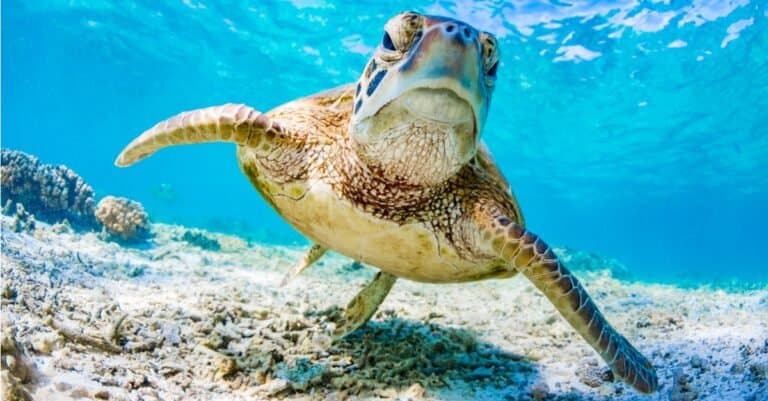
Green sea turtle Chelonia mydas Non-mammalian ecological analogue: a large marine herbivore that can structure nearshore primary-producer communities (seagrass and algae). Steller's sea cow likely played a similar macrograzer/browsing role in kelp and seaweed communities of cold North Pacific coasts.

Steller’s sea cow was a huge, aquatic animal that closely resembled a manatee or dugong.”
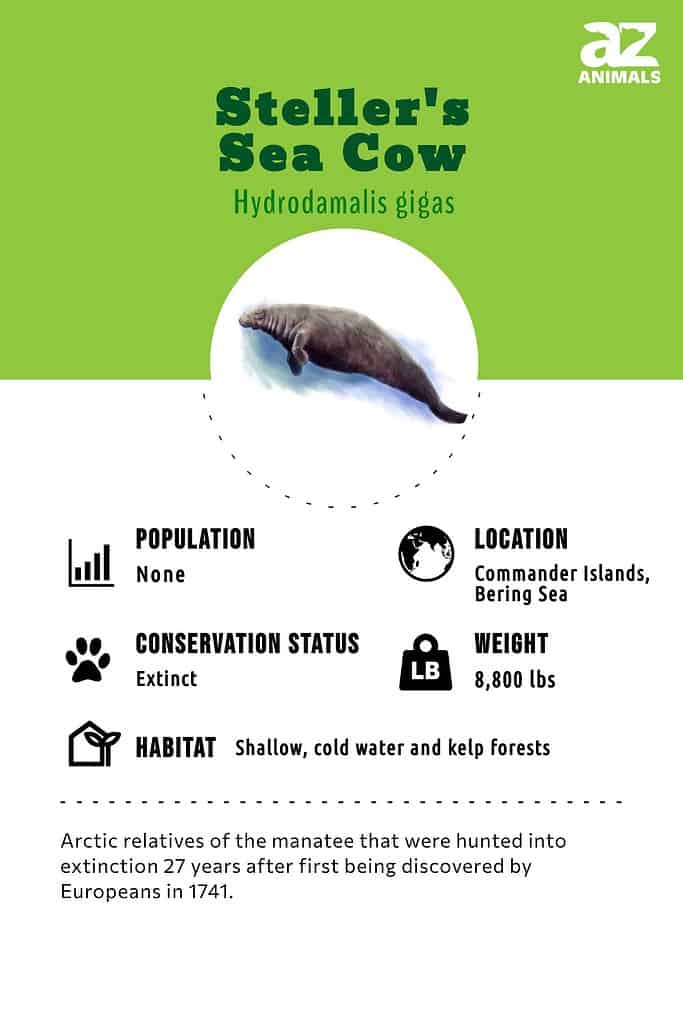
This fascinating creature was first discovered in 1741 by a German naturalist named Georg Steller. Its valuable meat, skin and fat caused humans to hunt it into extinction by 1768.

Steller’s Sea Cow Facts

  • Other than soft snorts, this animal was completely mute.
  • The Steller’s sea cow was hunted into extinction within 27 years of its initial discovery.
  • The dugong is the closest living relative of the Steller’s sea cow, and it is also near extinction.
  • This animal had such a thick layer of blubber that it could not submerge itself in the water.

Scientific Name
Steller's Sea Cow

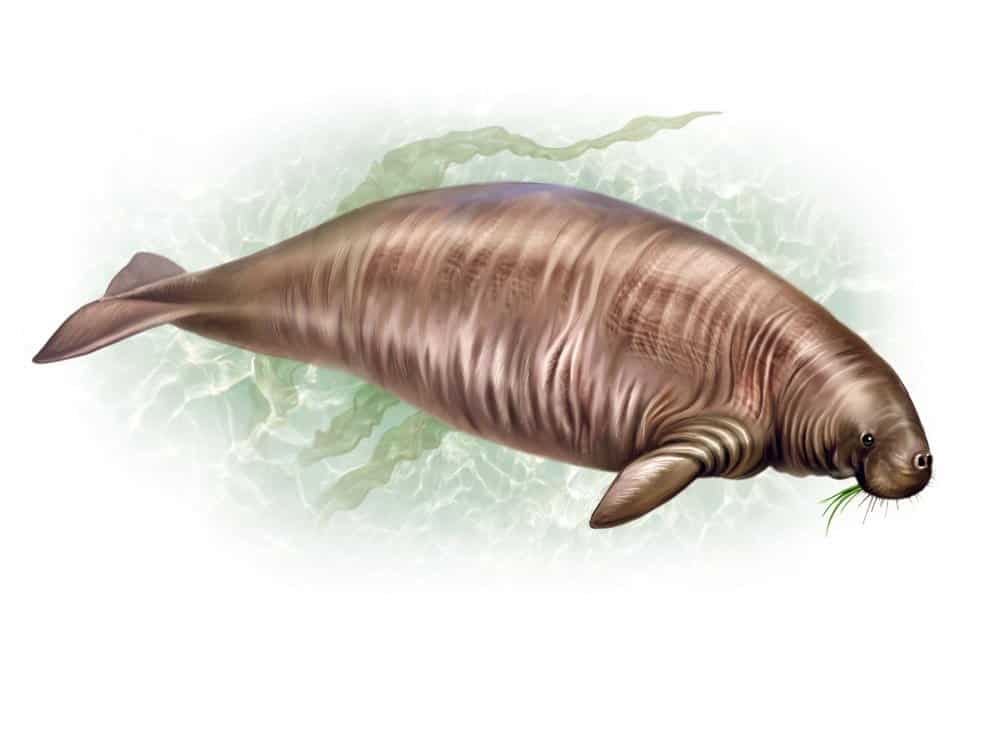
Steller’s Sea Cow’s scientific name roughly translates to “giant water cow.”

The scientific name for Steller’s sea cow is Hydrodamalis gigas. It is part of the order Sirenia, which also includes several manatee species and the taxonomical family Dugongidae. The Dugongidae family used to be quite diverse, but its only surviving member now is the dugong.

The name “Hydrodamalis” is a combination of the Greek prefix “hydro-,” or “water,” and the Greek word “damalis,” which means “heifer” or “young bull.” Gigas is also an ancient Greek word that means “giant.” This means that the scientific name roughly translates to “giant water cow.”

The common name of this creature comes from the fact that these animals were first encountered and documented by the German naturalist Georg Wilhelm Steller.

Appearance
Steller's Sea Cow

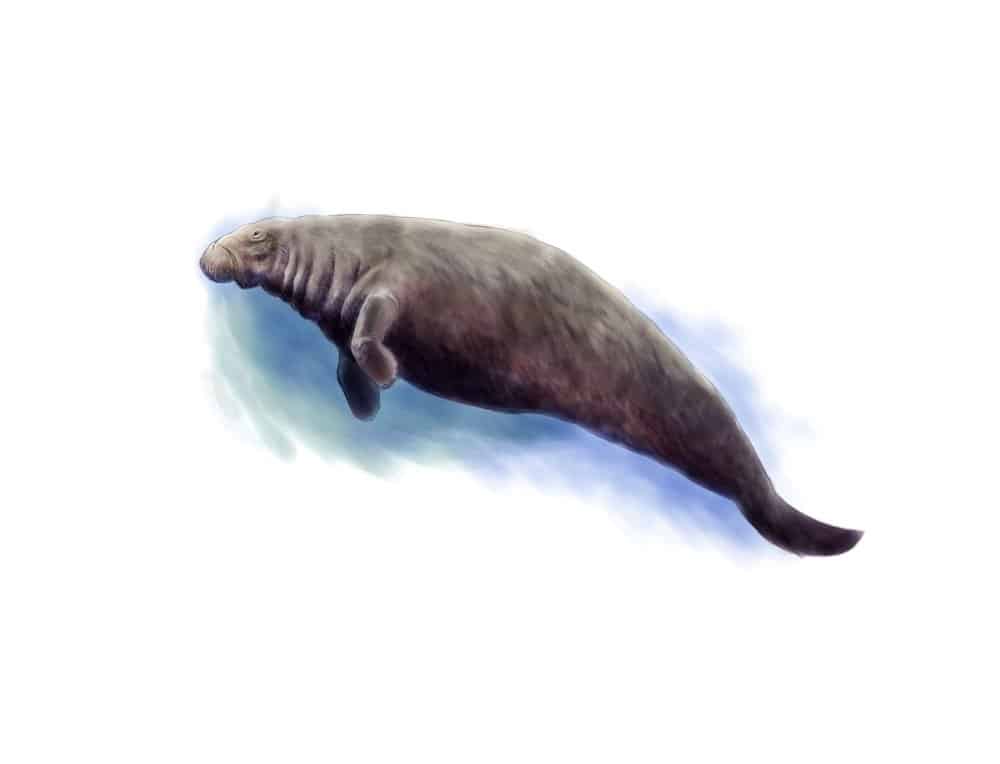
There are very few depictions of the Steller’s Sea Cow from when these creatures were alive.

Like many other species that survived from the Pleistocene era, the Steller’s sea cow was a giant among its taxonomical family.

While there are no fully preserved specimens of these fantastic creatures, there are descriptions, illustrations, and skeletal remains that can be studied for information.

Fully grown, these creatures would typically grow to be about 30 feet in length. For comparison, a fully grown adult manatee usually only grows to be up to 10 feet long.

Scientists don’t know exactly how much an adult of this species weighed. Georg Steller recorded two very different weight estimates: The first was about 4 short tons or 8,000 pounds, and the second was about 26 short tons or 52,000 pounds. To help you visualize the difference, one adult hippopotamus weighs about 8,000 pounds. Four fully grown elephants put together would weigh about 52,000 pounds. In reality, experts guess that the actual size of the Steller’s sea cow fell somewhere in the middle of those estimates at about 10 short tons or about 20,000 pounds. That’s nearly equal to three adult-sized hippos.

They had thick, dark skin that was brownish-black in color, rough to the touch, and deeply pockmarked. They had very little body hair, but the insides of their flippers were covered in a layer of tough bristles.

Like other animals in the order Sirenia, these creatures had small, squat heads with broad upper lips, small eyes, and downward-pointing snouts. They also had stumpy front flippers and forked tail flukes like the dugong.

One interesting feature of this animal is that it did not have teeth like the manatee species that exist today. Instead, they had a layer of stiff, dense white bristles on their upper lips and two tough, scaly plates inside their mouths to help with tearing and chewing plant matter.

Evolution

It is thought that before the Ice Age, ancient ancestors of Steller’s Sea Cow lived in tropical mangrove forests much like modern day manatees, and when the cold set in, these creatures were able to adapt perfectly to survive in the frosty environment. They achieved this by developing massive fat stores and incredibly thick hide that provided them with bouyancy, warmth, and protection from predators. When the Ice Age ended and climates around the world grew to be more temperate, the Steller’s Sea Cow is believed to have migrated north to its known habitat of the Bering Sea in between Alaska and Russia. Other traits believed to have been adapted sometime around the Sea Cow’s great migration were their loss of teeth in favor of keratine bristles and the absence of phalanges in their forelimbs. These traits, along with their downward facing snout, were likely evolved in order to aid in the consumption of kelp which was made difficult by their inability to submerge themselves fully due to the natural flotation provided by their extensive blubber.

Behavior
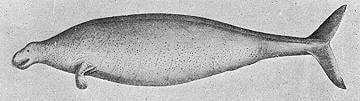
Steller's Sea Cow

Stellers Sea Cows were described as extremely social creatures loyal to their families.

Nearly everything that scientists know about these creatures comes from the observations of Georg Steller.

He noted that they were extremely social creatures that lived in small family pods. They were observed helping injured family members, and they also exhibited protective behaviors like placing the young in the safest position among other herd members. Dolphins and elephants also show these types of behaviors.

They were also monogamous, and mating typically happened in early spring. Based on his observations, Steller estimated that female sea cows only birthed one calf at a time, and he believed that gestation took just over a year. In keeping with their social, family-oriented nature, Steller observed parental care for new calves, and the entire herd worked together to protect offspring.

Habitat
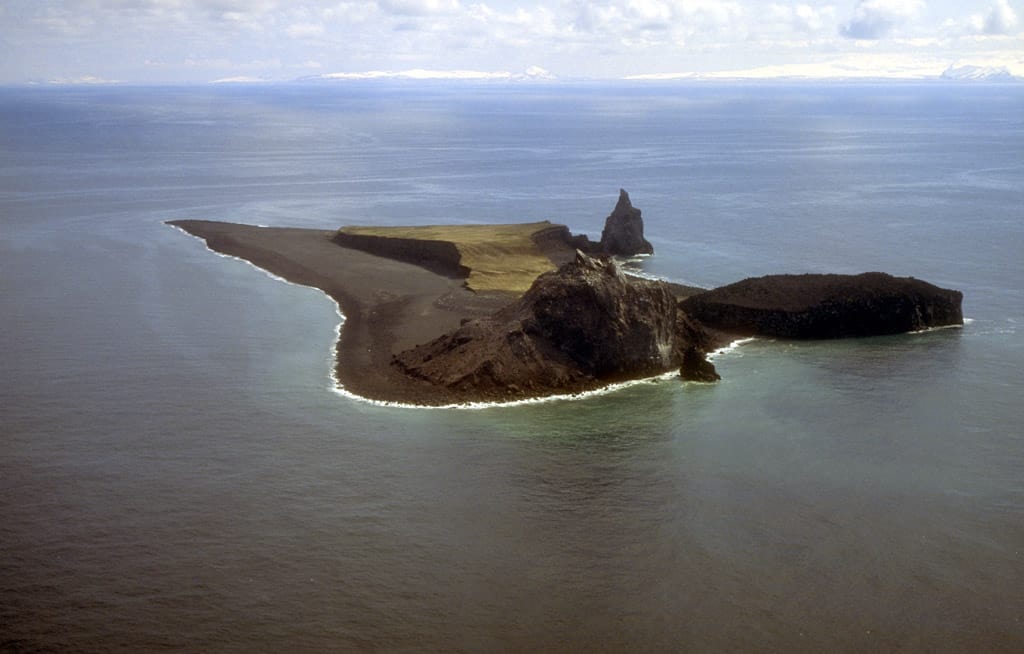
The Bering Sea is the only known location of the Steller’s Sea Cow.

This animal was first discovered in 1741 in a small portion of the Bering Sea, which is frigid nearly year-round. During the Pleistocene era, they would have likely been found much further out into the Arctic and Pacific waters.

Their icy living conditions caused them to have a much thicker layer of fat than most manatee species today as well as a thicker outer layer of skin. The average Steller’s sea cow had a tough hide about an inch thick and a blubber layer up to 4 inches thick.

Such a thick layer of fat made them very buoyant, so they had to live on the surface of the Bering Sea and could not totally submerge themselves.

Diet
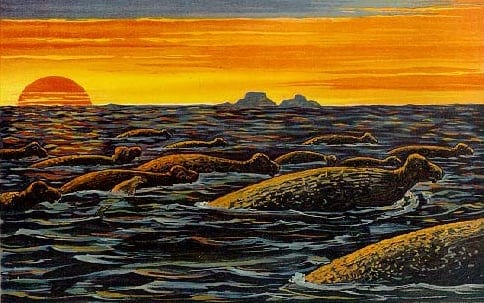
Steller's Sea Cow

Steller’s Sea Cow primarily ate kelp.

Like all other related species, these creatures were herbivores. They survived on a diet of kelp and would typically spend the majority of their days grazing. They would only need to lift their heads out of the water every few minutes to breathe before returning to grazing on various species of kelp that grew near the surface of the water.

Predators and Threats
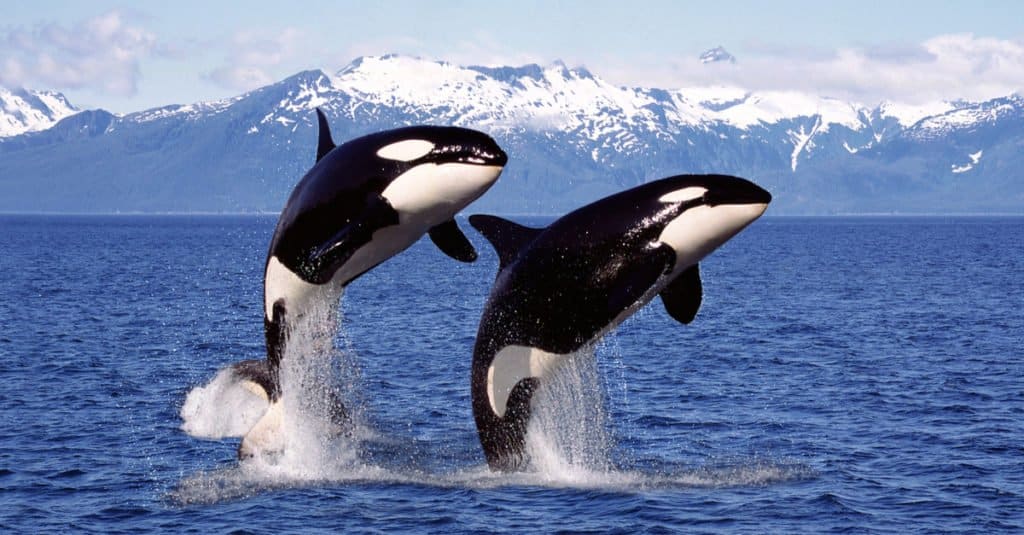
Apex predator: Killer whales

It is theorized orcas may have hunted Steller’s Sea Cow, but humans were their biggest threat by far.

While Steller noted that adult sea cows guarded their young against harm, he did not say whether or not they had any natural predators. Experts think it could be possible that killer whales or sharks may have tried to prey on the sea cows, but it would have been difficult for either creature to successfully kill one.

Sadly, the threat that caused them to go extinct came from humans. They were quickly recognized as extremely valuable commodities, and they were heavily hunted for their meat, hides, and blubber.

Some experts believe that the population was already dangerously low when they were initially discovered, so they were hunted into extinction incredibly quickly.

The last sighting of a Steller’s sea cow in the wild came from a group of fur hunters in 1768, just 27 years after they were first discovered.

Reproduction, Babies, and Lifespan

Georg Steller observed that female sea cows only had one set of mammary glands, so he concluded that they only gave birth to one calf per pregnancy. He said that mating took place in early spring, and the copulation took place under the water. He observed that male sea cows used their front flippers to hold onto the females during copulation.

Though none exist today, researchers think that the average lifespan of a Steller’s sea cow was 50 to 80 years. The Florida manatee can live more than 60 years, so this would be a reasonable estimate.

Population
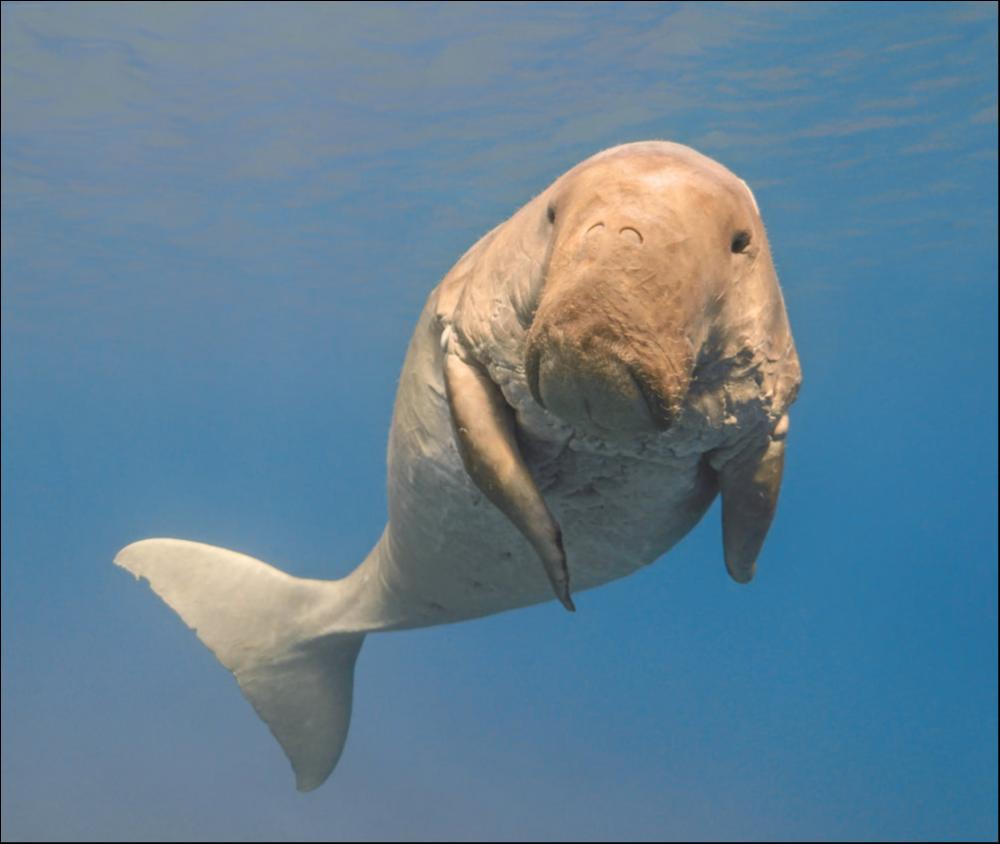
The dugong is the closest living relative of Steller’s Sea Cow.

The Steller’s sea cow has been extinct since 1768 because of uncontrolled human hunting. At the time of its initial discovery in 1741, experts believe that there were only about 1,500 sea cows left in the Bering Sea.

Steller’s Sea Cow in the Zoo

Unfortunately, this species has been extinct for over two centuries. Their closest living relative, the dugong, is near extinction as well, so there are only three in captivity worldwide.

However, many zoos feature manatee exhibits, and they are closely related to Steller’s sea cows.

View all 390 animals that start with S

Sources

  1. Wikipedia
  2. Brittanica
  3. Bluebulb Projects
  4. The Atlantic
  5. EverythingWhat
  6. Merriam-Webster
Corinna Cybele

About the Author

Corinna Cybele

My name is Corinna! In my profile photo you can see me with one of my two cats, Bisky! The other's name is Yma and she's a beautiful black Bombay kitty. I'm 24 years old and I live in Birmingham, AL with my partner Anastasia and like to spend my free time making music, collecting records and reading. Some other animals I've owned were a hamster, 2 chihuahuas and many different kinds of fish.

Thank you for reading! Have some feedback for us?


Steller’s Sea Cow FAQs (Frequently Asked Questions)

The last report of a Steller’s sea cow in the wild came in 1768, so this is the year that experts believe that they became extinct.