

T
Species Profile

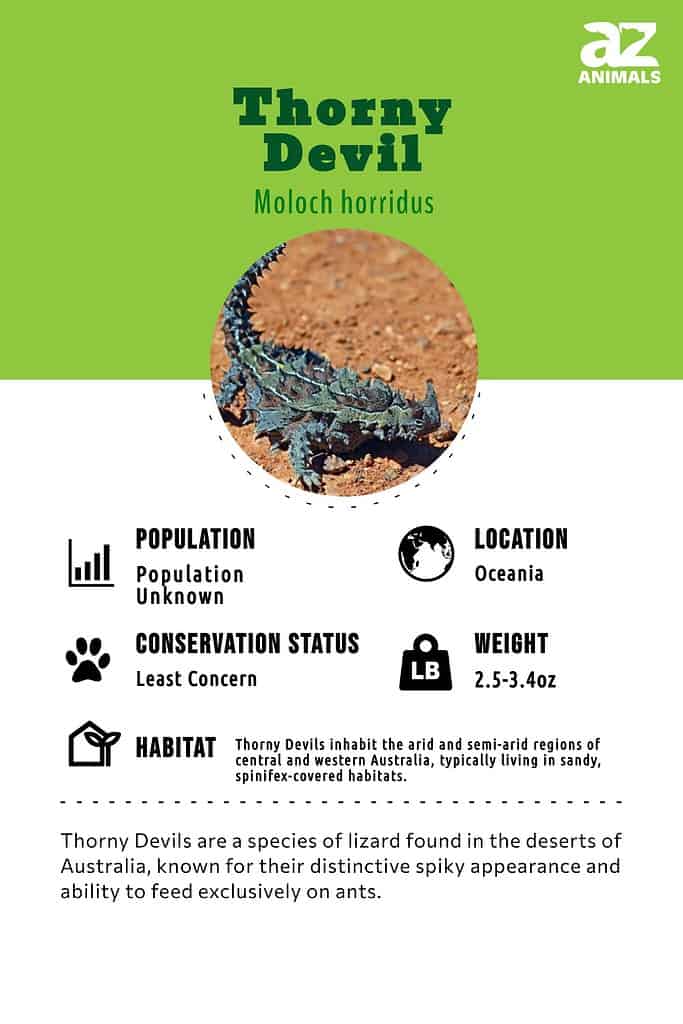
Thorny Devil

Moloch horridus

The ant-eating, water-wicking lizard
Uwe Bergwitz/Shutterstock.com

Thorny Devil Distribution

Click a location to explore more animals from that region

Endemic Species
Loading map...

Found in 1 country

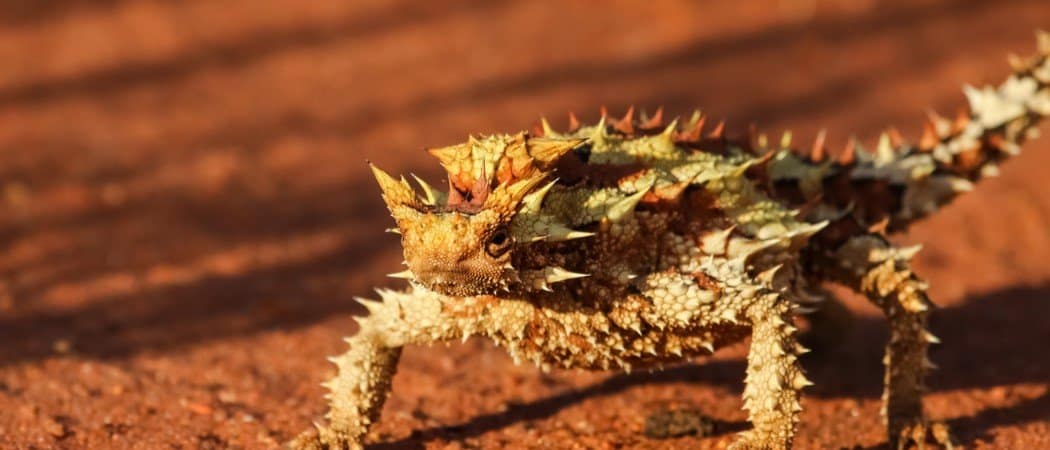
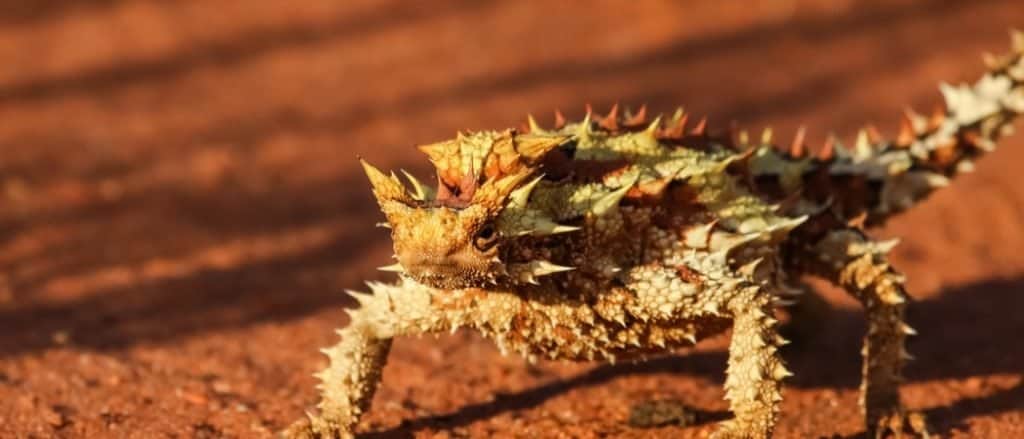
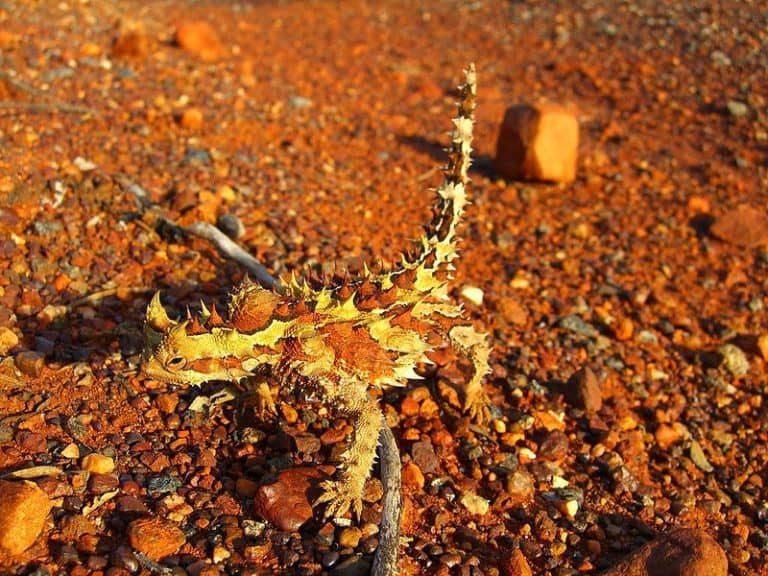
Thorny Devil in the Australian outback, Northern Territory, Australia

At a Glance

Wild Species
Also Known As Thorny dragon, Mountain devil, Moloch
Activity Diurnal+
Lifespan 15 years
Weight 0.1 lbs
Status Least Concern
Did You Know?

Adult thorny devils reach ~21 cm total length (most ~15-20 cm).

Scientific Classification

The thorny devil is a small, highly spined desert agamid lizard endemic to arid and semi-arid regions of Australia, famous for its specialized ant-based diet and water-harvesting skin adaptations.

Kingdom
Animalia
Phylum
Chordata
Class
Reptilia
Order
Squamata
Family
Agamidae
Genus
Moloch
Species
Moloch horridus

Distinguishing Features

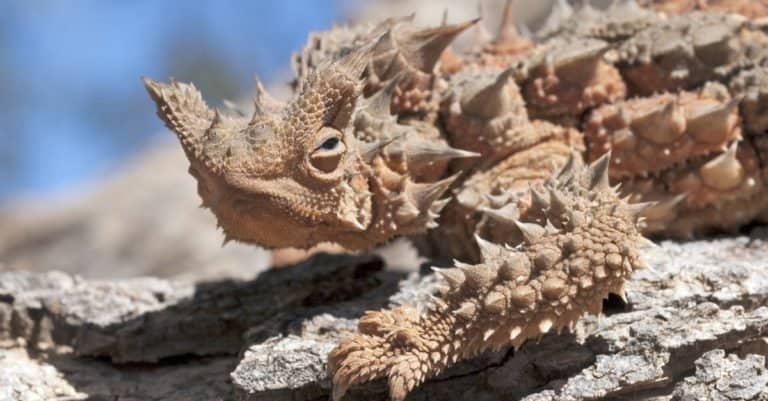
  • Dense covering of conical spines over body and head; cryptic desert coloration
  • Specialized ant-eater, consuming large numbers of small ants
  • Capillary channels between scales that help collect and direct moisture toward the mouth
  • False 'head' (a raised knob behind the true head) used as a defensive adaptation
  • Slow, deliberate gait; relies heavily on camouflage and spines for defense

Physical Measurements

Length
7 in (4 in – 8 in)
Weight
0 lbs (0 lbs – 0 lbs)
Tail Length
3 in (1 in – 3 in)
Top Speed
1 mph
running

Appearance

Primary Colors
Secondary Colors
Skin Type Heavily keratinized, spinose scales; interscale microgrooves form capillary channels that wick water toward the mouth.
Distinctive Features
  • Adult total length typically ~15-20 cm; reported maximum about 21 cm.
  • Body covered in conical spines; enlarged cranial and lateral spines deter predators.
  • Prominent occipital 'false head' (spiny knob behind skull) used in defensive posturing.
  • Capillary water-harvesting skin: moisture (dew/rain/wet sand) is drawn along channels to mouth corners.
  • Short, stout tail; squat body and slow, rocking gait typical of ant-specialist foraging.
  • Ant-specialist dentition and narrow mouth; individuals can consume thousands of small ants per day.
  • Defense: crouches, tucks real head down, presents false head and spines; can inflate body to appear larger.

Sexual Dimorphism

Sexual dimorphism is subtle. Females average slightly larger and heavier, especially when gravid, while males tend to show a relatively thicker tail base associated with hemipenal structures; coloration and spination are otherwise very similar.

  • Slightly thicker tail base (hemipenal bulges) compared with similar-sized females.
  • Often slightly smaller average body size than females in the same population.
  • Typically slightly larger overall length and mass; abdomen may appear broader when gravid.
  • Tail base usually slimmer relative to males of comparable size.

Did You Know?

Adult thorny devils reach ~21 cm total length (most ~15-20 cm).

They specialize on tiny ants (often Iridomyrmex spp.), consuming hundreds to >1,000 ants in a day in field observations.

Their skin forms interconnected capillary channels that can move water (rain/dew/condensation) across the body toward the mouth (described in detail by Sherbrooke et al., 2007; biomimicry studies incl. Comanns et al., 2015).

A 'false head' (a knob at the back of the neck) plus spines can misdirect predator bites while the real head tucks down.

They're endemic to arid and semi-arid Australia, occurring widely across sandy deserts and spinifex country.

Females lay small clutches (commonly reported ~3-10 eggs) in a nest burrow; reproduction is strongly seasonal with rainfall/temperature.

The genus name Moloch references the intimidating, armored look-despite the lizard being non-venomous and generally docile.

Unique Adaptations

  • Water-harvesting integument: microscopic surface structuring and scale-to-scale grooves create a capillary network that can transport water across the body to the mouth (documented experimentally; e.g., Sherbrooke et al., 2007; Comanns et al., 2015).
  • Extreme spination (armor): conical, keratinized spines across head/body reduce predator handling success and add apparent size; coloration aids camouflage in red/yellow sands.
  • False-head decoy: a raised, spiny 'knob' at the back of the neck functions as a target substitute when the head is tucked down.
  • Ant-specialist feeding apparatus: small, narrow mouth and a sticky tongue suited to repeatedly picking up tiny ants efficiently, rather than crushing large prey.
  • Desert water economy: behavioral and anatomical traits (burrowing, heat-avoidance timing, reduced exposure) minimize dehydration risk in arid habitats.
  • Egg-laying in burrows: nesting underground buffers embryos from extreme surface temperatures and desiccation typical of Australian deserts.

Interesting Behaviors

  • Ant-specialist foraging: moves slowly between ant trails, then feeds with rapid tongue flicks and sticky capture; diet is dominated by small ants rather than diverse insects (a rare strategy among lizards).
  • Defensive posture and 'false head' use: when threatened, it may lower the real head and present the spiny back/neck knob to attackers; the body inflates slightly to make spines harder to grasp.
  • Rocking gait: often walks with a gentle side-to-side 'rocking' motion, which can break up its outline and resemble wind-moved vegetation in open desert.
  • Thermoregulation in extremes: basks to warm quickly on cool mornings, then seeks shade or burrows into sand during peak heat; may partially bury to reduce water loss and overheating.
  • Water collection behavior: will stand in light rain or on dewy mornings to let moisture spread through skin channels, then periodically lap at the mouth corners as water arrives.
  • Low-energy desert routine: spends long periods inactive compared with many lizards, matching activity to cooler parts of the day and prey availability.

Cultural Significance

The thorny devil (Moloch horridus), called mountain devil, is a symbol of Australia's arid interior. Used in education, tourism and biomimicry for its water-wicking skin. This desert agamid is studied for ant-eating and skin water collection. Named by J.E. Gray in 1841; settlers admired its armored look, not its danger.

Myths & Legends

The genus name Moloch refers to the ancient Near Eastern figure Moloch, later seen as a fearsome idol. Early European naturalists picked the dramatic name for the thorny devil's horned, 'devilish' look.

Early settler bush stories named the thorny devil (Moloch horridus) and 'mountain devil' for its spines and posture. Calling striking animals 'devil' (e.g., Tasmanian devil) made it seem scary though harmless.

19th and 20th century natural history collectors and reports called the thorny devil (Moloch horridus) a 'living thorn-bush.' This repeated image in Australian nature writing made it a desert curiosity and symbol of harsh-country survival.

Conservation Status

LC Least Concern

Widespread and abundant in the wild.

Population Unknown

Protected Under

  • Environment Protection and Biodiversity Conservation Act 1999 (Australia) - protected native species (not listed as threatened)
  • Western Australia Biodiversity Conservation Act 2016
  • South Australia National Parks and Wildlife Act 1972
  • Northern Territory Territory Parks and Wildlife Conservation Act 1976
  • Queensland Nature Conservation Act 1992

Life Cycle

Birth 8 hatchlings
Lifespan 15 years

Lifespan

In the Wild
6–20 years
In Captivity
1–15 years

Reproduction

Mating System Promiscuity
Social Structure Solitary
Breeding Pattern Seasonal
Fertilization Internal Fertilization
Birth Type Internal_fertilization

Thorny devils are largely solitary; in spring males actively search for and court females, with brief encounters and no enduring pair bonds, suggesting multiple mating. Copulation is via internal fertilization; females lay one clutch (~3-10 eggs) in a burrow and provide no parental care.

Behavior & Ecology

Social Solitary Group: 1
Activity Diurnal, Matutinal, Vespertine
Diet Myrmecophage Ants-especially Iridomyrmex spp. encountered on active trails
Seasonal Hibernates

Temperament

Typically docile and slow-moving; relies on crypsis, spines, and stillness over flight.
Breeding-season variation: males increase roaming and may briefly grapple competing males near receptive females.

Communication

No vocalizations documented in primary accounts; communication appears predominantly non-vocal Greer 1989
Visual signaling at close range (agamid-typical head-bobbing, body elevation, orientation displays) during encounters.
Tactile cues during courtship/copulation Close body contact; brief holding/biting reported in mating interactions

Habitat

Biomes:
Desert Hot Temperate Grassland
Terrain:
Plains Plateau Sandy Rocky
Elevation: Up to 3280 ft 10 in

Ecological Role

Specialized mesopredator of arid-zone ant communities (ant-trail predator) and prey item for larger desert predators.

Top-down control on local ant foraging activity and potentially colony-level resource flow via high daily ant consumption Energy transfer from abundant ant biomass to higher trophic levels (supports predators that eat Moloch horridus) Contributes to desert food-web stability through extreme trophic specialization (reduces prey switching and predation pressure on non-ant arthropods)

Diet Details

Main Prey:
Ants Iridomyrmex ants Pheidole ants Small arid-zone ants

Human Interaction

Domestication Status

Wild

The thorny devil (Moloch horridus) has no history of domestication. It is a wild Australian desert lizard that eats only ants and uses skin channels to drink. It is protected and usually cannot be taken from the wild except by permit. It has Indigenous recognition, is studied, shown in zoos, and sometimes harmed by habitat loss and road kills.

Danger Level

Low
  • Defensive spines can cause minor skin pricks if handled; it is non-venomous and not known to inflict serious injury.
  • As with many reptiles, potential zoonotic Salmonella risk from contact with the animal or its enclosure if hygiene is poor.
  • Handling/collection poses greater risk to the animal than to humans: high stress sensitivity and husbandry failure due to highly specialized diet (primarily ants; reported intake can reach ~1,000-3,000 small ants/day in the wild in field observations).

As a Pet

Not Suitable as Pet

Legality: In Australia the thorny devil (Moloch horridus) is protected; private ownership is generally illegal without state/territory permits and export is banned under national law (EPBC). Elsewhere rules vary; often only captive-bred with paperwork, rarely available.

Care Level: Expert Only

Purchase Cost: $300 - $1,500
Lifetime Cost: $3,000 - $12,000

Economic Value

Uses:
Education and outreach (zoos/wildlife parks) Ecotourism/wildlife viewing Scientific research model (arid adaptation, integumentary water transport, dietary specialization) Conservation value (flagship arid-zone reptile)
Products:
  • non-consumptive tourism/interpretive programs featuring thorny devils
  • research outputs (biomechanics and physiology studies of skin water-transport microstructures; diet ecology studies on obligate ant-eating)
  • media/branding and nature merchandise imagery (species as an iconic Australian desert animal)

Relationships

Predators 7

Wedge-tailed eagle Aquila audax
Brown falcon Falco berigora
Sand goanna Varanus gouldii
Perentie Varanus giganteus
Mulga snake
Mulga snake Pseudechis australis
Red fox
Red fox Vulpes vulpes
Feral cat
Feral cat Felis catus

Related Species 5

Central bearded dragon
Central bearded dragon Pogona vitticeps Shared Family
Eastern bearded dragon Pogona barbata Shared Family
Nobbi dragon Rankinia diemensis Shared Family
Military dragon Ctenophorus isolepis Shared Family
Gibber dragon Ctenophorus gibba Shared Family

Ecological Equivalents 4

Animals that fill a similar ecological role in their ecosystem

Texas horned lizard Phrynosoma cornutum Both are ground-dwelling in dry, hot habitats, have large head and body spines, and primarily eat ants. Moloch horridus (about 15–20 cm) is an ant specialist; Phrynosoma cornutum can tolerate ant stings.
Short-horned lizard Phrynosoma hernandesi Both are squat, spiny, cryptic lizards that use camouflage and thorny body shapes to deter predators, inhabit dry open habitats, and move little, employing sit-and-wait hunting. Moloch horridus eats almost exclusively ants and harvests water via its skin.
Painted dragon Ctenophorus pictus Both occur on the same continent and inhabit desert or semi-arid open sandy or loamy areas. Ctenophorus pictus is less specialized than M. horridus but eats ground arthropods, faces thermal and water limitations, and shares predators, including raptors, varanids, and snakes.
Desert horned lizard Phrynosoma platyrhinos Close ecological analogue from a different lineage: an arid-habitat horned lizard with cryptic coloration and spines that feeds heavily on ants. Often used in comparative discussions of convergent evolution with Moloch horridus (shared spines, ant specialization, and arid-zone living).

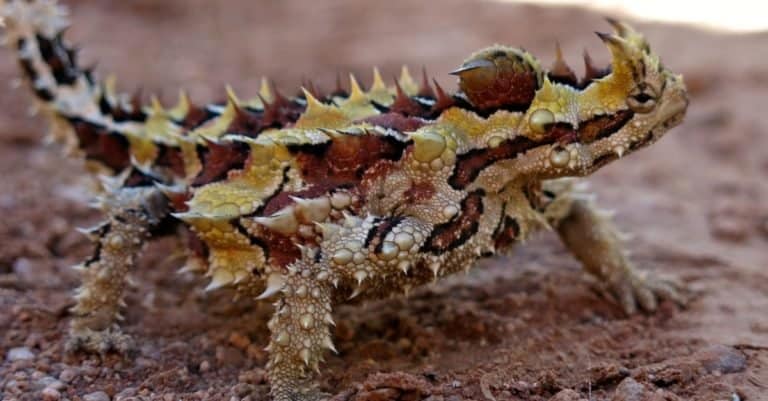
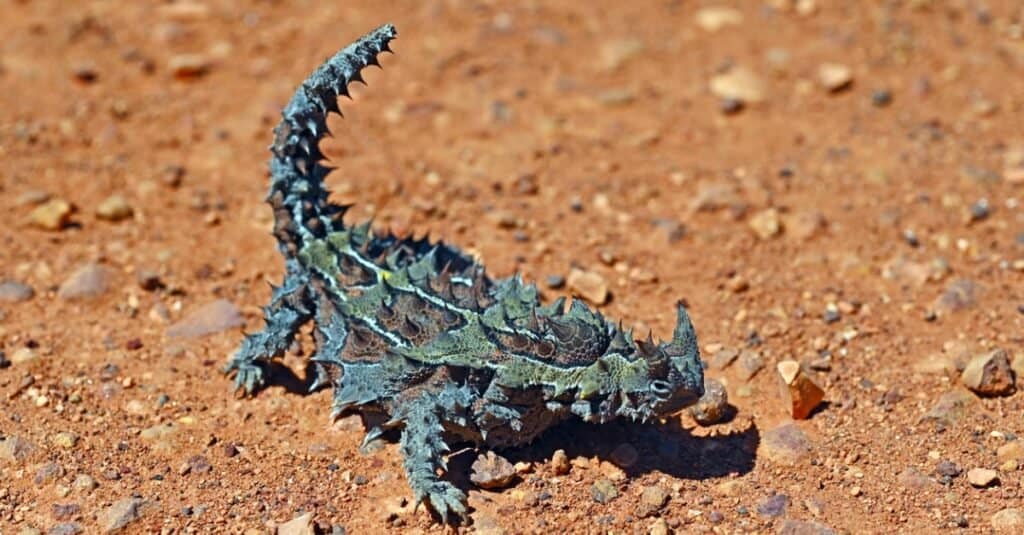
The thorny devil is covered in thorny spikes that make it look like a miniature dragon.

A small lizard native to Australia, the thorny devil is known by various other names like a thorny dragon, moloch, and mountain devil. It’s mainly active during the day and can change colors to blend into its environment.

As intimidating as it looks, the thorny devil is actually a slow-moving lizard that mainly eats ants. It has a “fake head” behind its neck that works as a way to fool predators.

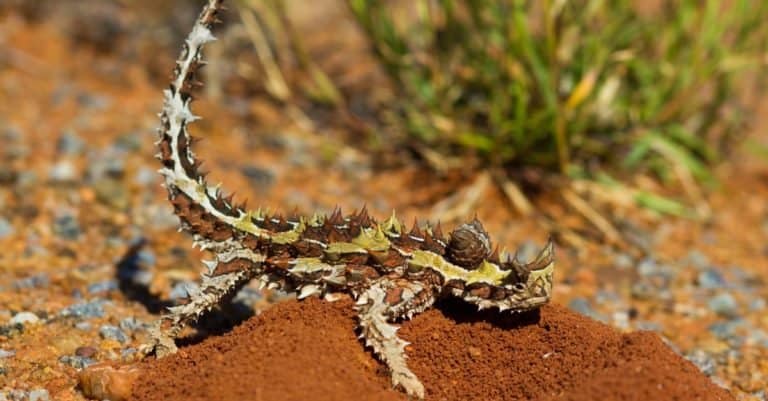
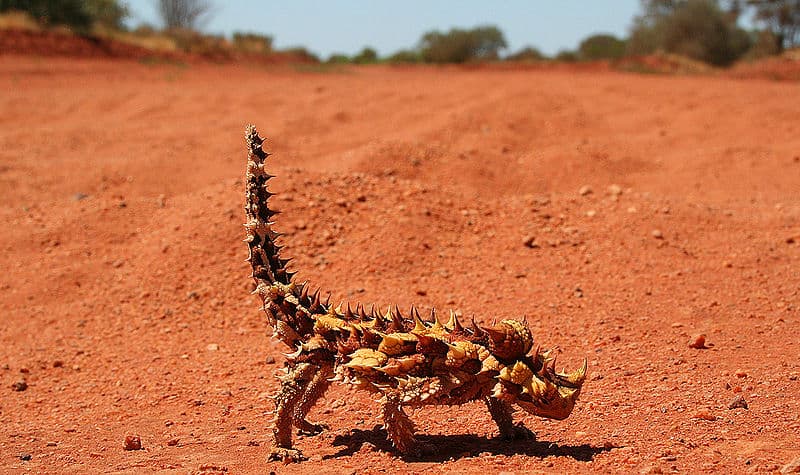
Thorny devils sport a unique gait, which is slow and halting with their tails straight up in the air.

5 Incredible Thorny Devil Facts!
lizards with spikes thorny devil

The scientific name of the thorny devil, Moloch, which was an early divinity shown as a hideous beast, reflects its fearsome look.

  • The names for the thorny devil reflect its intimidating appearance, including its scientific name Moloch, which was an ancient god depicted as a horrible beast.
  • These lizards can puff out their chests to look bigger and make themselves more difficult to eat due to all their spines.
  • The animal eats about 750 ants per day, but it’s capable of eating as many as 3,000 ants in one day.
  • Thorny devils have a strange gait where they freeze and rock in jerky movements. They may freeze midstep to throw off predators.
  • The ridged scales on the thorny devil aren’t just for protection. They also serve to channel water to the lizard’s mouth.

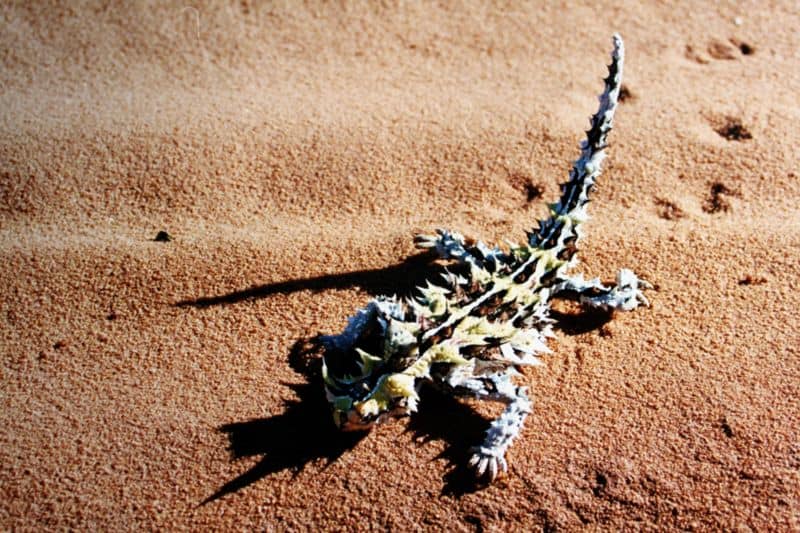
Additionally, there are between four and six different color variations of thorny devils, though the number of recognized morphs varies depending on the source. The “red morph,” “yellow morph,” “orange morph,” “grey morph,” and possibly others are among them.

Evolution and Origins

In 1841, biologist John Edward Gray provided the first description of the thorny devil, which is currently the only species in the Moloch genus.

Although some taxonomists believe that there may be another undiscovered species in the wild, this has not been confirmed. The thorny devil is not closely related to the North American horned lizards of the Phrynosoma genus, even though they share a similar appearance.

This resemblance is generally considered to be the result of convergent evolution.

The North American horned lizards, which belong to the Phrynosoma genus and are known for their horns, also eat ants like the thorny devil. While other lizards may have some spines, none are quite as spiky as these two species.

Additionally, Moloch and Phrynosoma are frequently used as an example of convergent evolution, which means that they developed similar features independently of each other due to similar ecological pressures.

Scientific Name
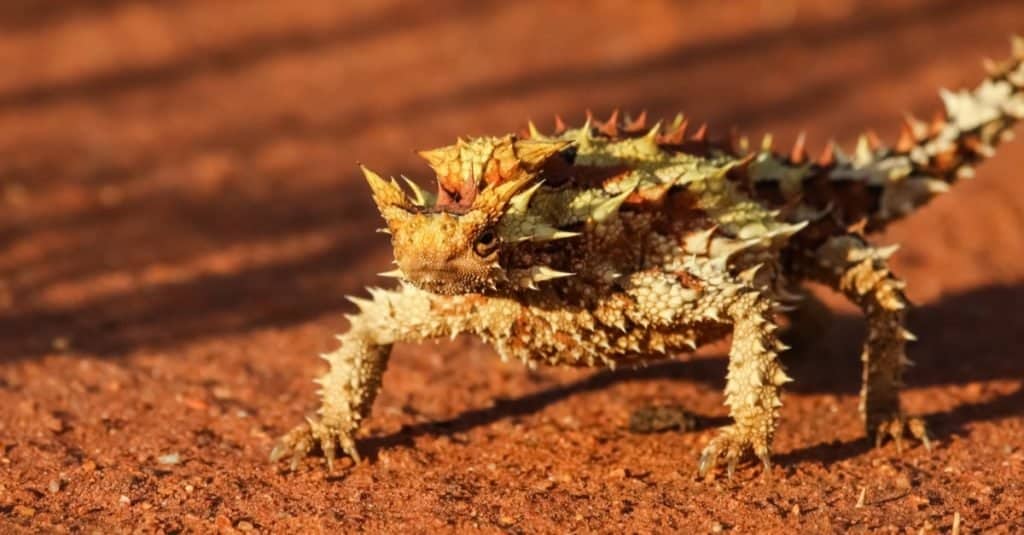
Thorny Devil in the Australian outback, Northern Territory, Australia

The scientific name of the thorny devil is Moloch horridus.

The scientific name of the thorny devil is Moloch horridus. The lizard belongs to the kingdom Animalia, the phylum Chordata, the class Reptilia, the order Squamata, the suborder Iguania, the family Agamidae, the subfamily Amphibolurinae and the genus Moloch.

The name Moloch horridus comes from the Canaanite demon god named Moloch, and horridus, which means dreadful or thorny. The name is related to the thorny devil’s imposing devilish appearance with spines and spikes all over its body.

The thorny devil has a number of other nicknames, including the following:

  • Devil lizard
  • Horned lizard
  • Thorny toad
  • Mountain devil
  • Thorny dragon
  • Thorny lizard
  • Moloch

Appearance

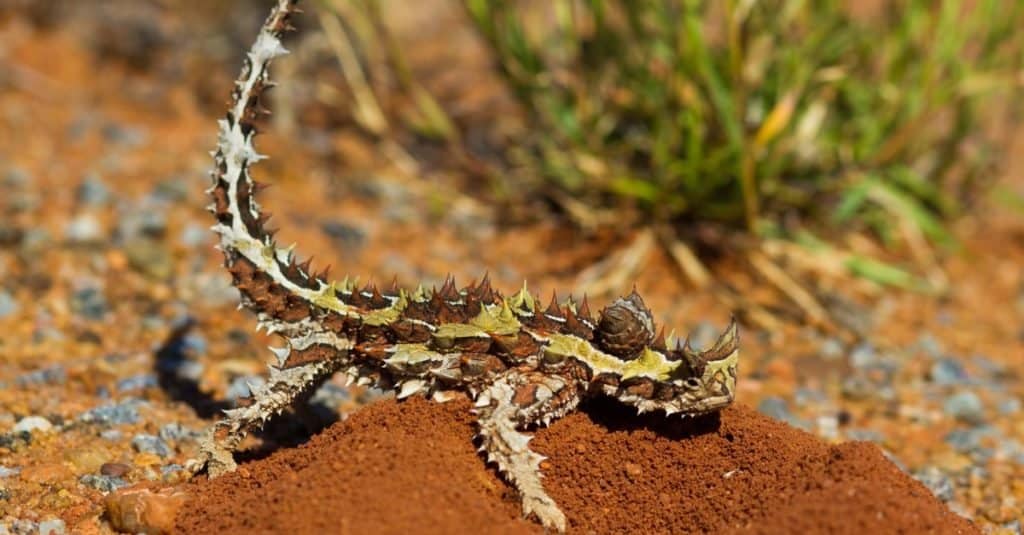
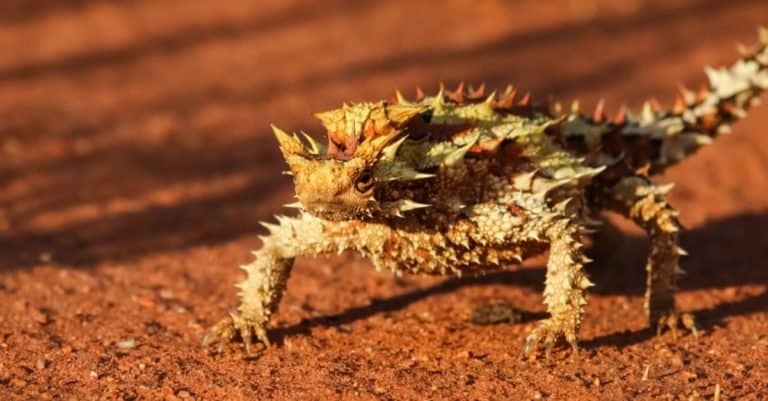
Spiny Thorny Devil lizard sitting on a red dirt ants nest

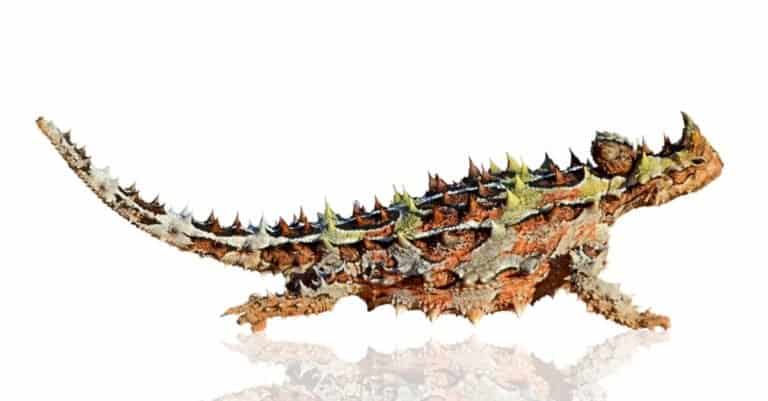
The lizard’s unique appearance definitely makes it stand out, but it’s also an adaptation. The lizards are covered with large spines all over their bodies. The spikes are mostly boneless, except for on the lizard’s skull. The thorny devil isn’t a very big lizard, however. It grows up to around eight inches total, including the tail. Females are larger than males.

Another unique aspect of their appearance is their ability to change color to match their habitat and even the time of day. In the mornings when temperatures are cooler, the animal has brown or olive skin. They become light yellow as the temperature gets higher in the afternoon.

The thorny devil’s appearance is mainly to blend in with its environment and ward off predators.

Behavior
Evolution

These animals are active in a range of temperatures in their native habitat. They are the most active between March and May, and from August through December. They go almost totally inactive between January and February when the temperatures are the highest, and also during June and July when temperatures are the coldest.

During these times, the lizard will dig burrows in the ground and hide. When the animal is active, its daily routine is to emerge from its shrub resting spot and warm itself on the sand. Thorny devils roam a small area to eat ants and defecate. They roam further when they are looking for mates.

The lizards walk with a unique slow, halting gait. The animal is mostly solitary, and they are not particularly territorial so their territory may overlap with other lizards.

Habitat
Thorny Devil

Australia’s Great Sandy Desert interior provides the native habitat for the lizard. They can be found in sandy deserts and scrub with sandy soil.

They are only found in areas with significant sandy soil. They don’t like areas with rocky or hard soil. The lizard has unique physical features that enable it to survive in the arid parts of Australia.

Moisture-attracting grooves between the lizard’s scales can channel any minute amount of water to their mouths. This means that even just collected dew from overnight or on vegetation can provide water for the animal. In extreme situations, the lizard can also bury itself in the sand to draw moisture to its scales.

Diet

The animal mainly eats ants. The spinifex and rainbow ant are two preferred ant species. The lizard isn’t a particularly active predator. It typically sits and waits for ants to cross its path and then laps them up with its sticky tongue.

They only feed in temperatures above 75 degrees Fahrenheit. Depending on the time of year, this might mean only in the morning or only in the afternoon. The lizard can eat thousands of ants in one day, but the average amount is about 750 ants per day.

What eats thorny devils?

Birds of prey and goannas are natural predators of the animal.

What does a thorny devil eat?

These lizards are carnivores and specifically, insectivores. They mainly eat ants and might eat thousands of ants in a single day.

Predators and threats

The main predators of these animals are Australian bustards, black-breasted bustards, goanna lizards, and humans. It’s also possible that dingos, foxes, and snakes might try to eat them. However, these lizards are hard to see due to their natural camouflage and spiny skin.

They move slowly with jerky movements, and they will freeze completely motionless when they sense a threat. This makes them fairly unattractive prey. The main threat to these lizards is the loss of their ant food source. This is possible in areas where humans kill ants as pests.

However, these animals currently have a conservation status of least concern, which means that they are not facing any significant threat to their habitat or population.

Reproduction, Babies, and Lifespan

The mating behavior of the thorny devil is not well-known. Limited observation shows that males seek out females and will mate if the female is receptive. The thorny devil usually mates and lays eggs in the late winter into the early summer. Females lay their eggs in burrows.

These burrows are different from the normal burrows used by the lizard. They are usually dug into sand ridges that face south. The females lay between three and 10 eggs with an average of eight. The eggs are incubated for a period between 90 and 132 days. The babies eat their own egg casings before leaving the burrow.

Thorny devils generally live between six and 20 years in the wild.

Population

There is no confirmed population data for these lizards. The IUCN finds that the lizard is very common in its local habitat, but there is no firm population estimate. Thorny devils face no serious threats to their habitat or numbers, and their conservation is listed as the least concern.

View all 606 animals that start with T

Sources

  1. Bush Heritage / Accessed March 7, 2021
  2. Wikipedia / Accessed March 7, 2021
  3. Animal Diversity Web / Accessed March 7, 2021
  4. Animalia / Accessed March 7, 2021
  5. Reptiles / Accessed March 7, 2021
  6. Fact Animal / Accessed March 7, 2021
Rebecca Bales

About the Author

Rebecca Bales

Rebecca is an experienced Professional Freelancer with nearly a decade of expertise in writing SEO Content, Digital Illustrations, and Graphic Design. When not engrossed in her creative endeavors, Rebecca dedicates her time to cycling and filming her nature adventures. When not focused on her passion for creating and crafting optimized materials, she harbors a deep fascination and love for cats, jumping spiders, and pet rats.
Connect:

Thank you for reading! Have some feedback for us?


Thorny Devil FAQs (Frequently Asked Questions)

Thorny devils are carnivores and specifically, obligate myrmecophages insectivores. They only eat ants.