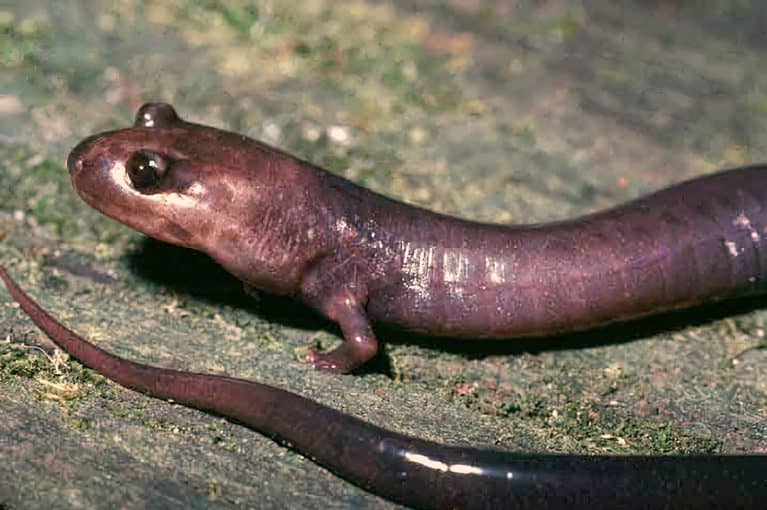









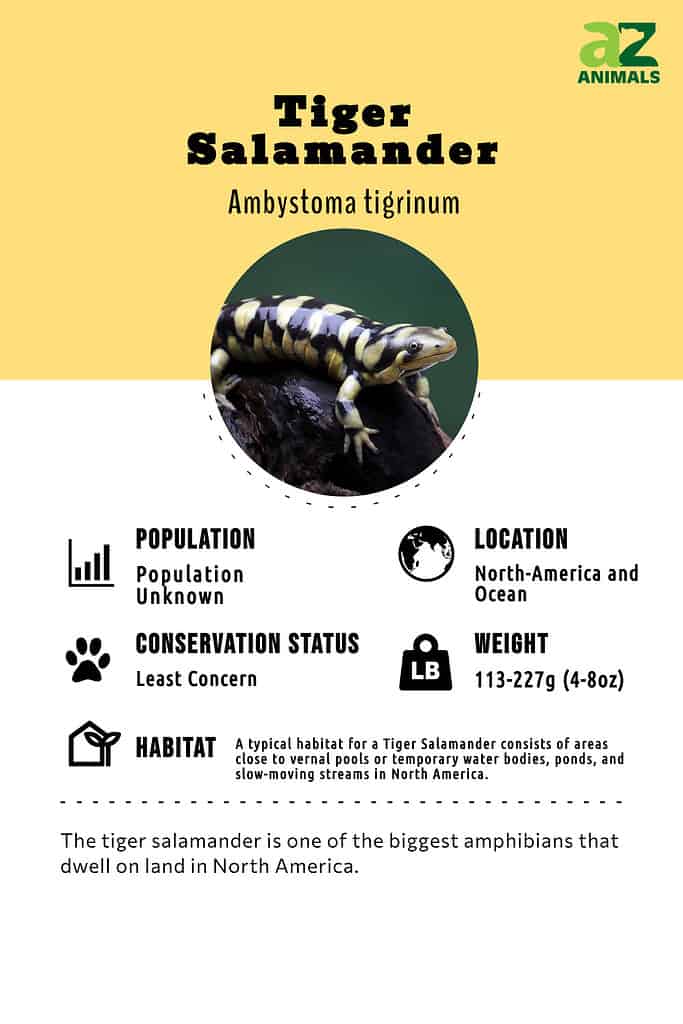
The tiger salamander is among the largest terrestrial amphibians in North America.
Found almost anywhere with a suitable climate and sufficient bodies of water, the tiger salamander undergoes a remarkable transformation early in its life as it transitions between water and land.
Although very susceptible to habitat degradation and high levels of acidity, the tiger salamander has managed to endure and thrive across the continent.
3 Incredible Tiger Salamander Facts!
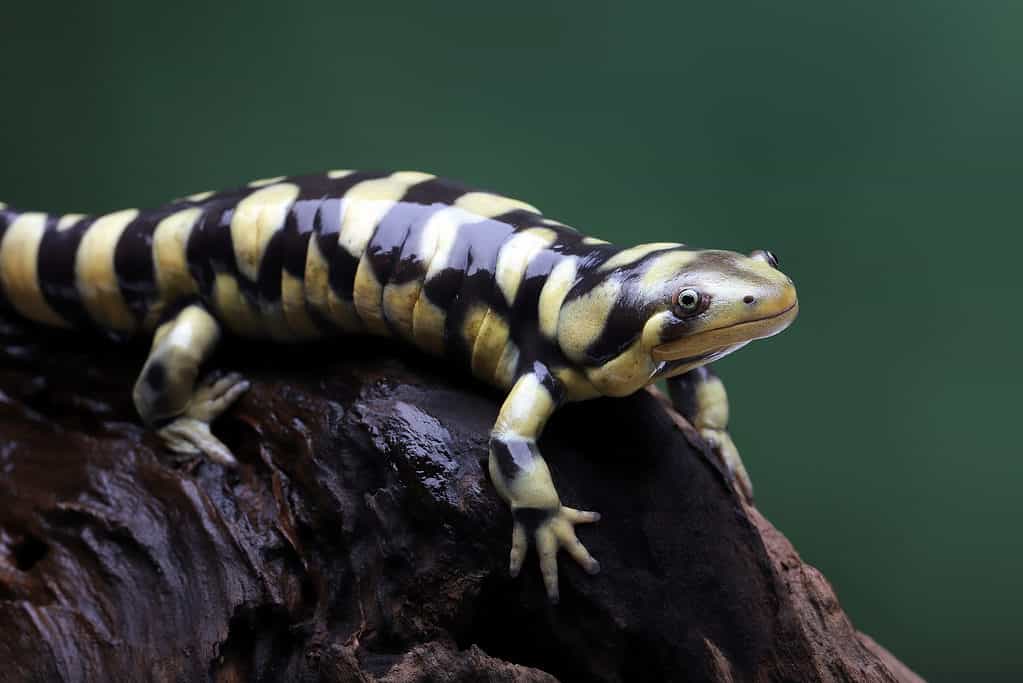
©Lauren Suryanata/Shutterstock.com
- Like many other types of salamanders, this species has the ability to regenerate a detached limb. These limbs sometimes have a different pigmentation than the rest of the body.
- The tiger salamander has porous skin through which it breathes. It also must constantly secrete mucus to keep the skin moist. Unfortunately, this porous skin also leaves it highly vulnerable to pollution.
- The eastern tiger salamander is the official state amphibian of Illinois.
Scientific Name

Previously, there existed a solitary and coherent type of salamander known as Ambystoma tigrinum, which belonged to the tiger salamander family.
©Wapcaplet at the English language Wikipedia / Creative Commons – Original
The tiger salamander was once represented by a single unified species called Ambystoma tigrinum. This group had many different subspecies within it, including the California tiger salamander, the plateau tiger salamander, the eastern salamander, and the western or barred salamander, but after careful genetic analysis, it was determined that many of these groups should be spun off into their own separate species. Although these new species are geographically isolated, they are fairly similar and still appear to be capable of producing hybridized offspring with each other.
All tiger salamanders currently belong to the same genus of Ambystoma. This genus, which roughly translates from two Greek words meaning dull mouth, represents a collection of North American mole salamanders whose defining characteristic is the tendency to live in underground burrows. But each separate tiger salamander species has its own distinctive scientific name. The eastern tiger salamander (and formerly, all tiger salamanders as a whole) goes by the name of Ambystoma tigrinum, which simply derives from the Latin word for the tiger.
In addition, the California tiger salamander is called Ambystoma californiense. The barred or western tiger salamander goes by the name of Ambystoma mavortium and has several additional subspecies within it. Finally, the plateau tiger salamander goes by the name of Ambystoma velasci.
Evolution and Origins
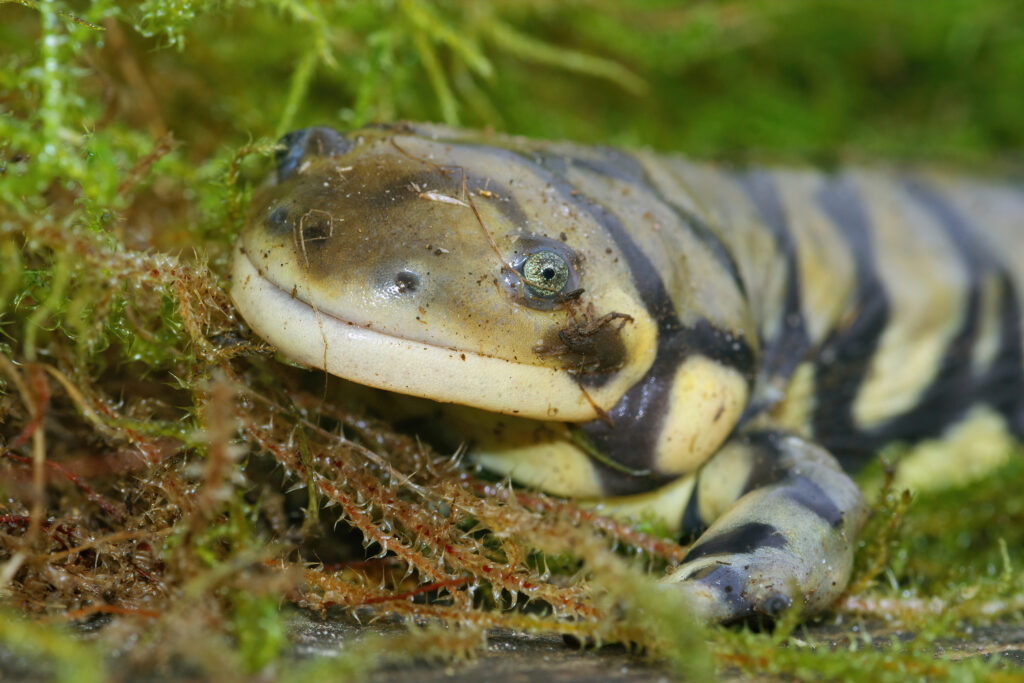
The tiger salamander is a type of salamander that occupies a wide region in North America.
©iStock.com/Wirestock
The tiger salamander is a species that inhabits a broad area in North America, spanning from the Eastern coast of the United States, through the Great Plains, and reaching into the Rocky Mountains of Colorado, Wyoming, and Utah.
Most tiger salamanders reside in the central region of the country, extending from Arizona and Montana to Ohio and Kentucky. They typically inhabit areas close to vernal pools (temporary bodies of freshwater), ponds, and sluggish streams.
The tiger salamander group has been recognized as a significant cluster where differences in life history have resulted in a fast pace of speciation, primarily due to the emergence of obligatory paedomorphosis, which is when mature salamanders retain their larval, aquatic characteristics.
In November 2012, the Tiger Salamander was categorized into two distinct species, the Eastern Tiger Salamander (Ambystoma tigrinum) and Western Tiger Salamander (Ambystoma tigrinum). Each of these species was further classified into two different populations and received their own unique labels.
Appearance
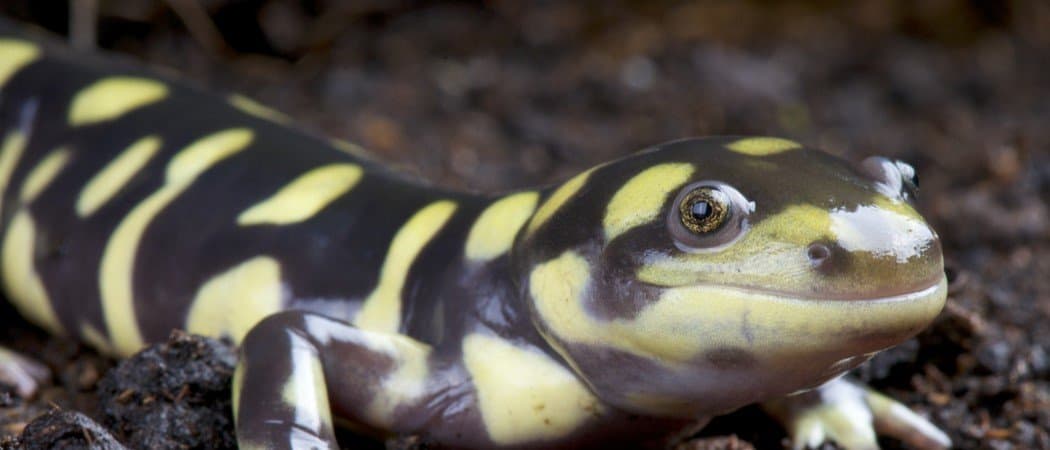
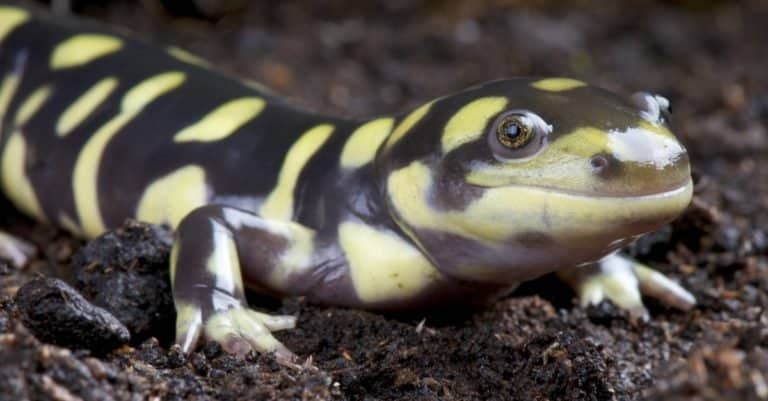
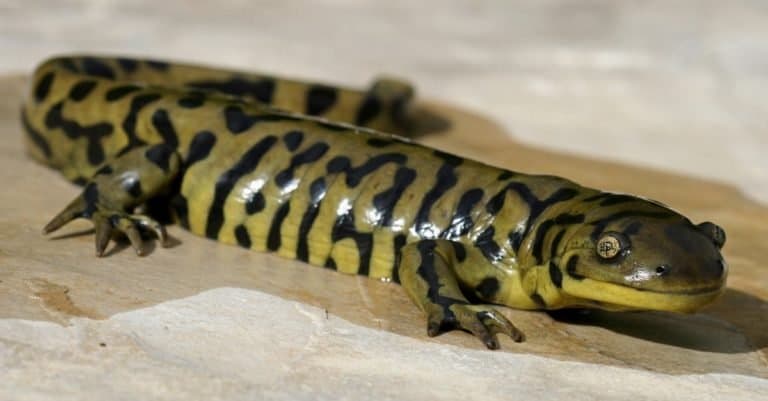
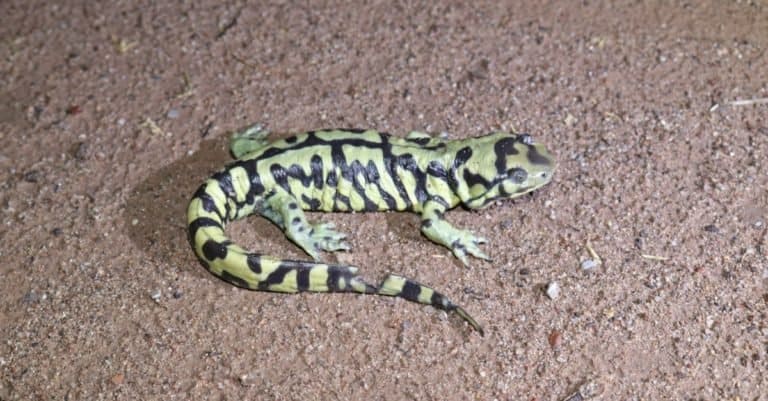
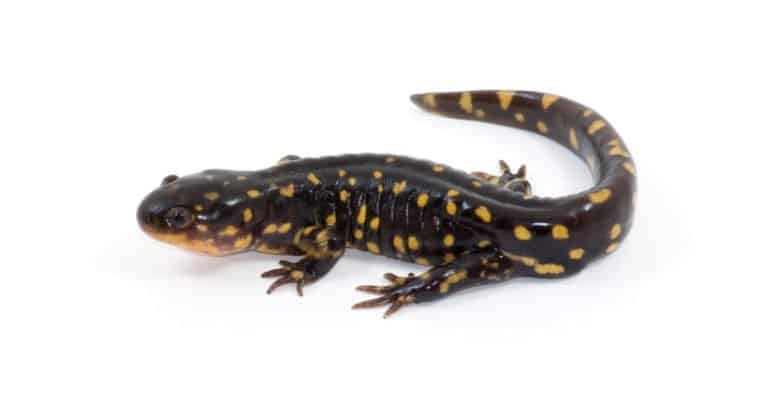
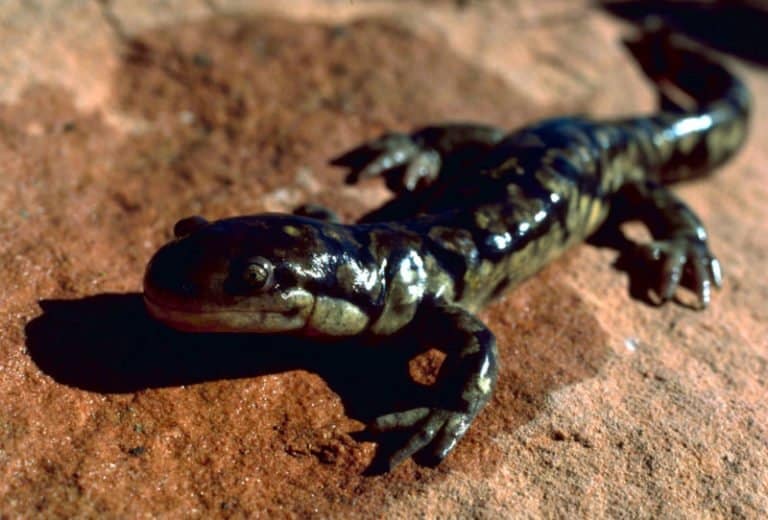
The tiger salamander has a rather short, rounded snout, strong legs, a thick head, and a long tail. The exact colors and patterns vary throughout the entire range based on the species, but the base color of the body is usually brown, green, or gray. This is overlaid with bright yellow or duller brown dots or stripes, which give it to the name. The average size of the tiger salamander is about 6 to 8 inches in length and 4.4 ounces in weight, or about the same weight as a teacup. The largest specimens can grow up to 14 inches in length, which is very large for a salamander.
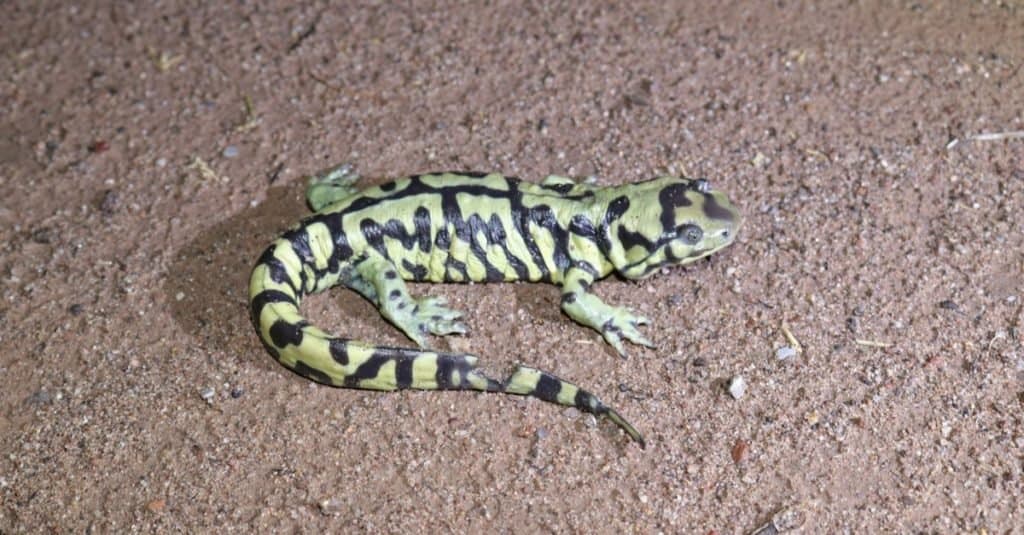
The tiger salamander possesses a concise and circular muzzle, sturdy limbs, a bulky cranium, and an elongated tail.
©Creeping Things/Shutterstock.com
Behavior
As with all other members of the mole salamander genus, this species spends most of its life in underground burrows extending about 2 feet down to escape the temperature fluctuations near the surface. Whereas many other species of mole salamanders are drawn to abandoned burrows, the tiger salamander digs its own burrows right beside a large body of water. The creature rarely ventures out of these holes except to feed at night or to mate, which can make them very difficult to find. In fact, this reclusive salamander has very little social contact even with members of its own species outside of the breeding season.
The skin is an important element of the salamander’s survival. It serves as the main means of respiration. Chemicals released from the skin are an important signal in the mating season. And in order to defend itself against predators, the tiger salamander produces a toxin from its tail gland. When the salamander is threatened, it will rear up and display the gland, sometimes squirting the toxin directly at the predator. Although not deadly, this substance produces a very painful stinging sensation. The markings and colors serve as a warning to avoid the salamander altogether. Many predators will learn this painful lesson.
Habitat

Being possibly the most widespread and fruitful kind of salamander in North America, the tiger salamander is present in the majority of the United States, Canada, and Eastern Mexico.
©John Cleckler – Public Domain
As perhaps the most common and prolific salamander species in North America, the tiger salamander occurs throughout most of the United States, Canada, and Eastern Mexico. Each species or subspecies has a different geographical range, which is usually indicated by its name (eastern tiger salamander, western barred tiger salamander, California tiger salamander, etc). But regardless of species, this salamander’s preferred habitats are grasslands and woodlands right next to ponds, lakes, and streams with loose soil in which to dig. It thrives best with a consistent temperature and humidity.
Diet
The tiger salamander plays an important part in the food chain by keeping common prey populations in check. When nighttime arrives, it comes out of the burrow and begins hunting for food.
What does the tiger salamander eat?
The tiger salamander will consume almost anything it can find, including worms, frogs, insects, snails, slugs, fish, and even other salamanders. If there isn’t enough prey in the area, then the tiger salamander may resort to cannibalizing other members of its own species.
Predators and Threats
The tiger salamander faces many threats in the wild, including predation, pollution, deforestation and habitat destruction, high acidity levels in their breeding pools, and even vehicular accidents. Acid rain was a particular problem before the implementation of the Clean Air Act of 1990, which, according to National Geographic, cut sulfur dioxide emissions by 88% as of 2017. Nitrogen dioxide levels also fell by 50% in the same period.
What eats the tiger salamander?
An adult tiger salamander is preyed upon by birds (such as owls), turtles, snakes, badgers, and bobcats. The larvae are also vulnerable to aquatic insects and snakes.
Reproduction, Babies, and Lifespan
The tiger salamander initiates the reproductive process at some point between late winter and early spring when they migrate to their collective breeding pools. The courtship process involves a complicated set of behaviors.
After the male finds a suitable mate, he will nudge her with his head to express his interest. She reciprocates this behavior by nudging the male’s vent area, inducing him to release his sperm material, which the female will collect. The competition for females is so fierce that some males will interrupt the courtship process of another male and attempt to substitute his own sperm instead.
After a very short gestation period of only one or two days, the female lays up to 100 eggs at a time and then secures them to twigs, grasses, and leaves at the bottom of the pool. She can deposit multiple masses of eggs in a single breeding season to ensure the viability of the next generation. Many of these young are not expected to survive, and their parents provide no particular protection for them. The reproduction strategy is based on sheer numbers.
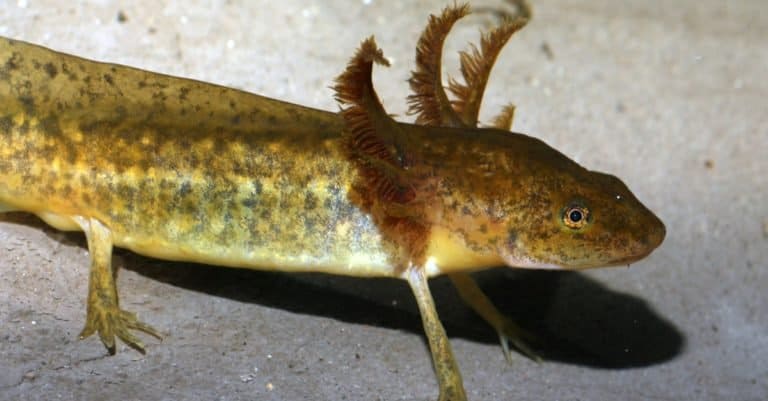
After an incubation period of about four weeks, the larvae emerge from the eggs with a yellowish or olive body, dark blotches or stripes along the side, a white belly, large external gills, and an aquatic tail. They spend most of the spring and early summer period feeding and growing in the original pool of their birth. At about two to five months of age, they undergo a transformative metamorphosis by which they reach their adult phase. As they adapt to a new terrestrial life, the salamanders fully lose their gills and develop a set of lungs to breathe.
If conditions on land are particularly poor, then the larva may delay metamorphosis for as long as necessary so they can continue to live underwater. Although they are still able to reproduce sexually, these salamanders maintain the same basic physiology as their larval stage through a process known as neoteny. The salamanders can be stuck in the larval form for months, years, or even their entire lives. However, they still retain the option to undergo metamorphosis at any time once conditions improve.
If they survive the juvenile stage, when many of them fall victim to predators, the average salamander reaches sexual maturity at around four to five years of age. This species has a lifespan of 10 to 16 years in the wild – relatively long-lived for a salamander. Some individuals have been known to live almost 25 years in captivity.
Population
These animals are currently considered to be a species of least concern by the IUCN Red List. It is not quite known how many of these salamanders exist in the wild, but population numbers appear to be stable, despite some populations being isolated and fragmented from each other. The decline of pollution, acid rain, and habitat destruction have helped to secure the future of this species.
Zoo
Because of this animal’s reclusive nature, the best chance you may have to see one is in a zoo. They can be found at the Saint Louis Zoo, Central Florida Zoo and Botanical Garden, Zoo Atlanta, the Maryland Zoo, Louisville Zoo, Utah’s Hogle Zoo, San Francisco Zoo, and the Smithsonian’s National Zoo in Washington, DC.
Tiger Salamander Pictures
View all of our Tiger Salamander pictures in the gallery.

reptiles4all/Shutterstock.com
Sources
- Animal Diversity Web / Accessed February 6, 2021
- National Geographic / Accessed February 6, 2021
- Sea World / Accessed February 6, 2021
- The Spruce Pets / Accessed February 6, 2021