

T
Species Profile

Tiger

Panthera tigris

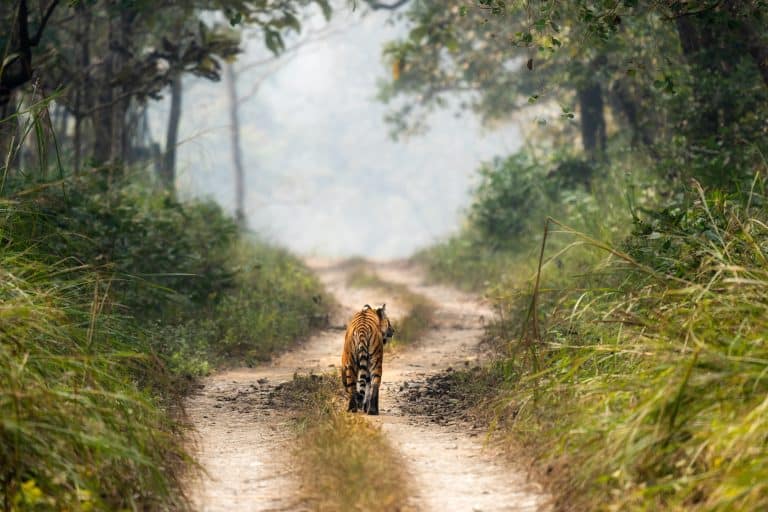
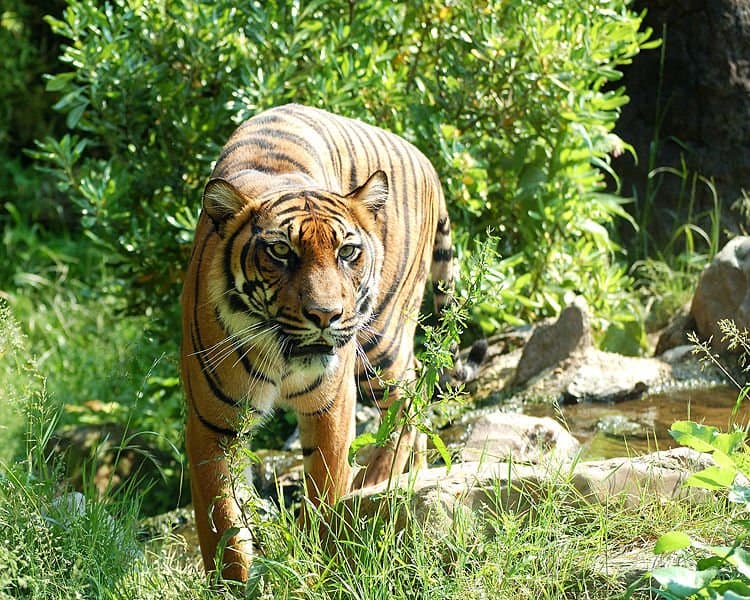
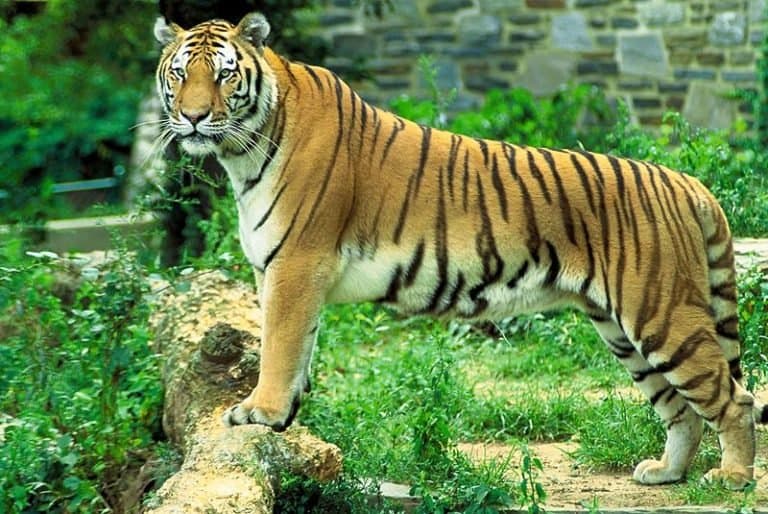
Stripes of Asia's top predator
Dick Mudde - Public Domain

Tiger Distribution

Click a location to explore more animals from that region

Loading map...

Size Comparison

Human 5'8"
Tiger 3 ft 3 in

Tiger stands at 58% of average human height.

Tiger

At a Glance

Wild Species
Also Known As Tigre, Sher, Bagh, Puli, Tora, Hu
Diet Carnivore
Activity Cathemeral+
Lifespan 12 years
Weight 310 lbs
Status Endangered
Did You Know?

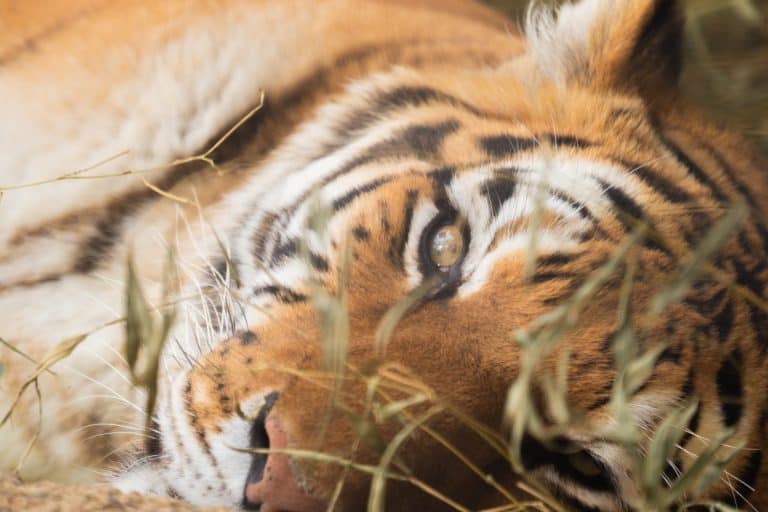
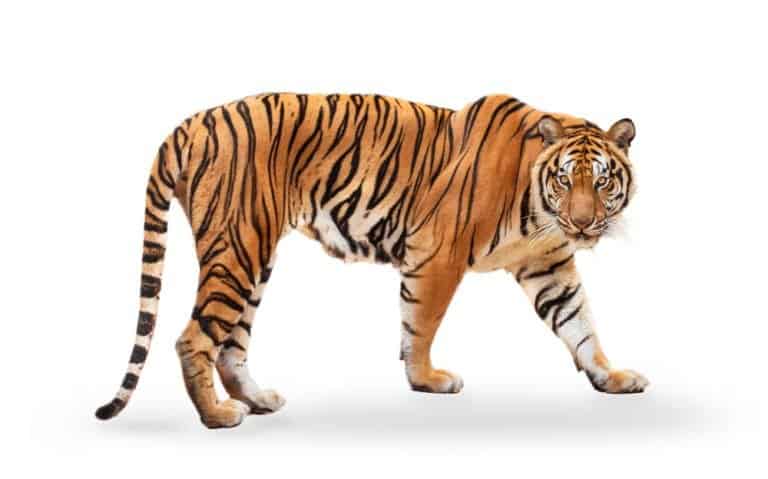
Only big cat with true vertical stripes; stripe patterns are individually unique and persist on the skin under the fur.

Scientific Classification

The tiger (Panthera tigris) is the largest living cat species, a solitary apex predator characterized by orange coat with dark vertical stripes and a powerful build. It historically ranged widely across Asia but is now fragmented into smaller populations.

Kingdom
Animalia
Phylum
Chordata
Class
Mammalia
Order
Carnivora
Family
Felidae
Genus
Panthera
Species
Panthera tigris

Distinguishing Features

  • Orange to pale coat with dark vertical stripes (unique stripe patterns per individual)
  • Robust forelimbs and large head; strong bite force adapted for large ungulate prey
  • Solitary territorial behavior; extensive scent-marking and vocalizations (roars)
  • Strong swimmer compared with many other cats

Physical Measurements

Males and females differ in size

Height
3 ft 3 in (2 ft 11 in – 3 ft 7 in)
2 ft 11 in (2 ft 7 in – 3 ft 3 in)
Length
9 ft 10 in (8 ft 10 in – 10 ft 10 in)
8 ft 2 in (6 ft 11 in – 9 ft 6 in)
Weight
485 lbs (265 lbs – 675 lbs)
243 lbs (143 lbs – 375 lbs)
Tail Length
3 ft 3 in (2 ft 11 in – 3 ft 7 in)
2 ft 9 in (2 ft 4 in – 3 ft 3 in)
Top Speed
40 mph
running

Appearance

Primary Colors
Secondary Colors
Skin Type Dense fur over thick skin; short-to-moderate guard hairs with insulating underfur; retractile claws and vibrissae.
Distinctive Features
  • Largest living felid; robust, muscular body with powerful forequarters and large skull.
  • Head-body length typically ~140-280 cm; tail ~60-110 cm; shoulder height commonly ~90-110 cm (species-level ranges across populations).
  • Body mass varies widely: males commonly ~90-310 kg; females ~65-170 kg (reported across the species).
  • Coat: orange ground color with black vertical stripes and white/cream ventrum; stripe layout is individually distinctive (key field ID trait).
  • Compared with other big cats: striped (not spotted/rosetted) and no mane; facial white patches and bold cheek striping.
  • Apex predator ecology: primarily solitary; hunts mainly large ungulates (e.g., deer and wild boar) and takes smaller prey opportunistically.
  • Territorial behavior: maintains home ranges marked by scent (urine spraying/scrapes) and vocalizations; males' ranges may overlap several females.
  • Habitat diversity across Asia where extant: tropical and subtropical forests, mangroves, grasslands/savannas, and temperate forests; current distribution is fragmented, not continuous.
  • Typical wild longevity ~10-15 years; captivity often ~16-20+ years (reported maxima >20 years in managed care).
  • Conservation status: Endangered (IUCN Red List); major threats include habitat loss/fragmentation, prey depletion, and poaching/illegal trade.
  • Key sensory/weapon traits: large canines, strong bite, enlarged forelimb musculature, retractile claws, and acute night vision for ambush hunting.

Sexual Dimorphism

Sexual dimorphism is pronounced: adult males are substantially heavier and longer than females, with broader heads, thicker necks, and more developed forequarters. Females are smaller and more gracile overall, reflecting typical Panthera mating ecology.

  • Typically larger body mass and shoulder height; broader skull and heavier neck musculature.
  • More pronounced forequarter build and head breadth; often larger paw size and canines.
  • Smaller, lighter build with narrower head and less massive neck/shoulders.
  • Generally shorter head-body length and lower average mass than males.

Did You Know?

Only big cat with true vertical stripes; stripe patterns are individually unique and persist on the skin under the fur.

Gestation is typically ~103 days (reported range 93-114 days); litters are usually 2-4 cubs (recorded range 1-7).

Adult size varies strongly by region: total length commonly ~2.4-3.3 m including tail, with shoulder height often ~0.9-1.1 m (compilations in Nowell & Jackson 1996; Sunquist & Sunquist 2002).

Tigers are powerful swimmers and readily cross rivers; unlike most cats they frequently enter water to travel, cool down, or hunt.

A tiger's roar is produced by a specialized, robust larynx and can carry over long distances in forest, supporting territorial spacing and mate location.

IUCN Red List lists Panthera tigris as Endangered; a widely cited global estimate is ~3,726-5,578 individuals of all ages, including ~2,604-3,905 mature individuals (IUCN/Goodrich et al.).

Key field mark vs other big cats: bold dark stripes on orange coat plus distinct white "ear spots" (ocelli) on the backs of the ears-often used in intraspecific signaling.

Unique Adaptations

  • Stripe camouflage ("disruptive coloration") that breaks up body outline in tall grass, bamboo, and dappled forest light; each individual's pattern is unique.
  • Exceptionally robust forelimbs/shoulders for grappling large prey; a quick bite to the throat or nape is typical depending on prey size and position.
  • Large canines and carnassial teeth specialized for seizing and slicing flesh; wide gape supports deep, controlling bites.
  • Padded paws and retractable claws for silent stalking, traction, and grip on struggling prey.
  • Enhanced low-light vision and hearing typical of large felids, supporting crepuscular/night hunting in dense cover.
  • Fur/physiology plasticity across Asia: from dense, long winter coats in the Russian Far East to shorter coats in tropical forests-supporting one species across extreme climates.

Interesting Behaviors

  • Solitary hunting and spacing: adults usually travel and hunt alone, meeting mainly to mate; males' ranges typically overlap several females while excluding other males.
  • Territorial marking: repeated scent-marking with urine spray, scrapes, and feces, plus "raking" trees with claws; individuals revisit boundary routes.
  • Ambush predation: relies on stealth and short bursts of speed from cover; common prey includes deer and wild boar, with diet shaped by local availability.
  • Crepuscular/nocturnal activity shifts: activity peaks often align with prey movement and human disturbance levels (more nocturnal where persecution is high).
  • Water use: regular bathing/wading in hot climates; river and mangrove crossings are common where habitats are dissected by waterways (e.g., Sundarbans).
  • Parental care: females rear cubs alone; cubs begin following the mother on hunts in late infancy and may remain with her for ~18-24 months before dispersing.
  • Vocal and chemical communication: roars and "chuffing" at close range, plus rich scent communication, allow low-visibility coordination over large territories.

Cultural Significance

Across Asia the tiger symbolizes power, royalty, and protection. It is India's national animal and appears on emblems. In China and Korea it is a zodiac, protective sign, and guardian. Indigenous peoples in the Russian Far East and South/Southeast Asia respect it as an apex predator and 'forest authority.'

Myths & Legends

China: The White Tiger is one of four celestial guardian symbols, linked to the west, autumn, and metal; tiger imagery wards off harmful spirits.

China: Folklore of the Five Tigers portrays tigers as guardians of the cardinal directions who maintain order and protect people from disasters.

Korea: In a founding myth, a tiger (Panthera tigris) and a bear ask to become human. The bear finishes a hard test and becomes a woman, while the tiger quits and fails, teaching patience.

India: A Hindu warrior goddess is often shown riding a tiger, symbolizing power used for protection and the victory of moral order over chaos.

Bangladesh/India (Sundarbans): Tales of a forest guardian protect honey collectors and woodcutters; the tiger is linked to a forest spirit enforcing respect for the mangroves.

Bhutan and Tibetan Buddhism: A legend tells of a Buddhist teacher flying on a tigress to a cliffside meditation site known as the Tiger's Nest, linking tigers with spiritual power.

Malay/Indonesian folklore: Stories of people who become tigers describe them as protectors or avengers, reflecting awe and fear of the forest predator.

Russian Far East: Some Indigenous traditions revere the Amur tiger as a powerful forest being; taboos emphasize respect and restraint toward tigers and their territory.

Conservation Status

EN Endangered

Facing a very high risk of extinction in the wild.

Population Decreasing

Protected Under

  • CITES Appendix I (international commercial trade prohibited)
  • Convention on Migratory Species (CMS) Appendix I
  • India: Wildlife (Protection) Act, 1972 (Schedule I)
  • Bangladesh: Wildlife (Conservation and Security) Act, 2012
  • Nepal: National Parks and Wildlife Conservation Act, 1973

Life Cycle

Birth 3 cubs
Lifespan 12 years

Lifespan

In the Wild
8–20 years
In Captivity
10–26 years

Reproduction

Mating System Polygyny
Social Structure Solitary
Breeding Pattern Transient
Fertilization Internal Fertilization
Birth Type Internal_fertilization

Solitary adults; a male's territory commonly overlaps several females. During female estrus (~3-7 days) mating is brief and repeated; gestation lasts 93-112 days with litters usually 2-4 cubs. Females raise cubs alone.

Behavior & Ecology

Social Streak Group: 1
Activity Cathemeral, Crepuscular, Nocturnal
Diet Carnivore Medium-to-large ungulates-especially deer and wild boar (with sambar deer frequently documented as a key prey species where it co-occurs).

Temperament

Strongly territorial; boundary maintenance via scent and scrape-marking (Sunquist & Sunquist, 2002).
Generally avoids conspecifics; intraspecific aggression can be severe during territorial disputes (Schaller, 1967).
Male home ranges commonly overlap multiple females; females overlap less and center on prey/denning (Smith et al., 1987).
Mothers with cubs are highly defensive; cub dependency typically ~18-24 months (Sunquist & Sunquist, 2002).
Longevity: wild commonly ~10-15 years; captive individuals documented >20 years (Sunquist & Sunquist, 2002; AZA husbandry records).

Communication

roar Long-distance advertisement; often during mating/territorial contexts
chuff/prusten Friendly close-range greeting
growl Agonistic warning at close range
hiss/spit Defensive, short-range threat
moan/yowl Mate-attraction/estrus-associated calls
urine spraying on trees/rocks to signal identity and reproductive status Sunquist & Sunquist, 2002
fecal deposition in conspicuous sites; often combined with scraping to enhance detectability
scrape-marking with hind feet, frequently with scent from interdigital glands
claw raking/tree scratching as visual signal and scent deposition
cheek rubbing and body scent marking on objects
visual postures: tail lashing, piloerection, direct staring, and ear flattening in agonistic encounters

Habitat

Biomes:
Tropical Rainforest Tropical Dry Forest Savanna Temperate Grassland Temperate Forest Boreal Forest (Taiga) Alpine Wetland Freshwater +3
Terrain:
Mountainous Hilly Plateau Plains Valley Coastal Island Riverine Rocky Sandy Muddy +5
Elevation: Up to 14763 ft 9 in

Ecological Role

Apex predator and keystone large-carnivore that exerts top-down control on large herbivore communities across Asian forest, grassland, and wetland mosaics.

Regulates ungulate abundance and spatial behavior, reducing overbrowsing pressure and helping maintain vegetation structure via trophic cascades Selective predation can increase prey population health by disproportionately removing vulnerable individuals (e.g., very young, old, injured) Provides carrion subsidies that support scavenger guilds (vultures, jackals, bears, etc.) and nutrient cycling around kill sites Acts as an umbrella species-habitat protection for tiger landscapes conserves wide-ranging prey communities and broader biodiversity

Diet Details

Main Prey:
Sambar deer Chital Wild boar Gaur Barasingha Nilgai Muntjac Serow Langurs Porcupines +4

Human Interaction

Domestication Status

Wild

Tigers (Panthera tigris) are not domesticated. They are wild, solitary apex predators with strong territorial behavior and high prey drive. Captive breeding for zoos and the exotic pet trade has occurred for over 100 years, but this is not domestication—there has been no long-term breeding for tameness as in cats or dogs.

Danger Level

Extreme
  • potentially lethal attacks (mauling/neck bite) during surprise encounters, when defending cubs or a kill, or in conflict contexts near villages/livestock
  • higher risk in captivity due to close proximity; even habituated individuals can attack unpredictably
  • public safety risk from escape or enclosure failure in private possession settings
  • zoonotic disease and parasite risks from close contact (e.g., rabies risk in unvaccinated carnivores, toxoplasmosis exposure pathways, and other zoonoses documented in captive felids)
  • property/livestock losses prompting retaliation cycles and escalating conflict

As a Pet

Not Suitable as Pet

Legality: Tigers (Panthera tigris) are mostly illegal or strictly limited. CITES Appendix I bans commercial wild trade. Many countries and U.S. laws (ESA, Captive Wildlife Safety Act) ban private ownership or need permits, special facilities, and inspections.

Care Level: Expert Only

Purchase Cost: $2,000 - $20,000
Lifetime Cost: $150,000 - $750,000

Economic Value

Uses:
Ecotourism and wildlife viewing Conservation flagship species funding Zoo exhibition and regulated conservation breeding Cultural symbolism (national/heritage iconography) Human-wildlife conflict costs (livestock depredation, injury/death, mitigation) Illegal wildlife trade
Products:
  • tourism revenue from protected areas and tiger reserves (guiding, lodging, permits)
  • employment in conservation (rangers, monitoring, veterinary and husbandry roles)
  • conflict-mitigation goods/services (predator-proof corrals, compensation schemes, deterrents)
  • illegal products in black markets: skins, teeth/claws, and body parts used in traditional medicine trade (prohibited under CITES/most national laws)

Relationships

Predators 6

Human
Human Homo sapiens
Saltwater crocodile Crocodylus porosus
Mugger crocodile Crocodylus palustris
Dhole
Dhole Cuon alpinus
Leopard
Leopard Panthera pardus
Pythons Python molurus

Ecological Equivalents 6

Animals that fill a similar ecological role in their ecosystem

“No two tigers share the same pattern of stripes.”

Tigers are animals that live in both warm and cold areas of Asia. They are carnivores that hunt for prey at night. These big cats are solitary, and territorial, and are one of the world’s apex predators. A Siberian tiger can weigh up to 675 pounds. Males are bigger than females.
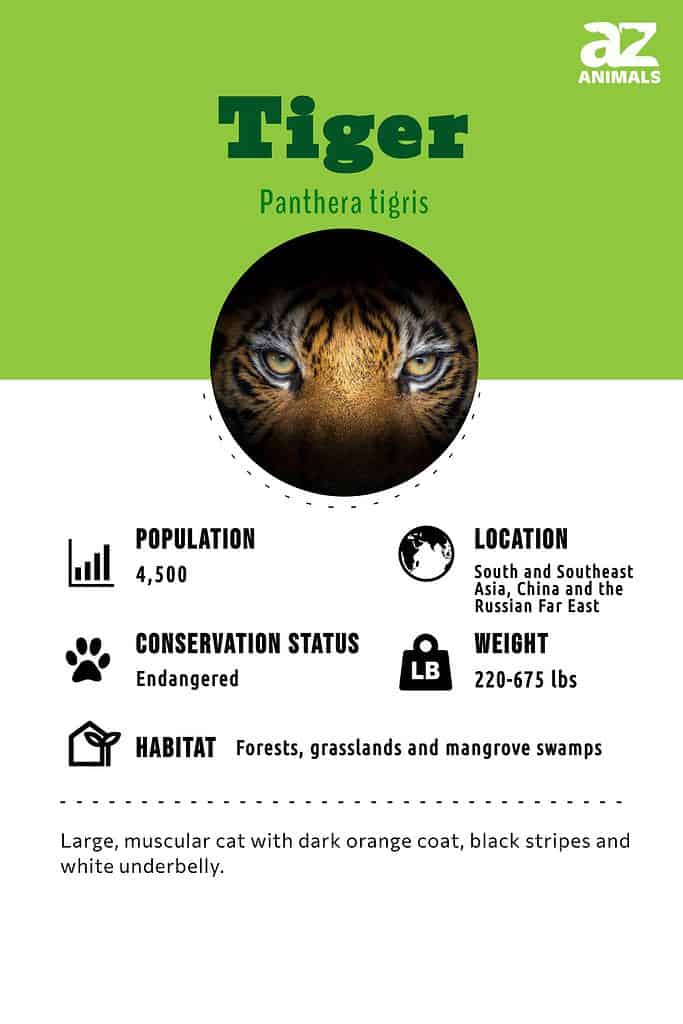
5 Incredible Tiger Facts!

  • Tigers are good swimmers and love the water.
  • They are hunted for their skin, fur, and other body parts.
  • They mark their territory with urine to keep other tigers out.
  • Their teeth measure about 4 inches long.
  • This creature’s long tail helps it to keep its balance.

Scientific Name

The scientific name of the tiger is Panthera tigris. The word Panthera means leopard and Tigris is Latin for tiger. They are sometimes called big cats. They belong to the Felidae family and the Mammalia class.

Nine subspecies include Sumatran, Siberian, Bengal, South China, Malayan, Indo-Chinese, Bali, Javan, and the Caspian tiger. Unfortunately, the Bali, Javan, and Caspian species are now under extinct classification.

Evolution
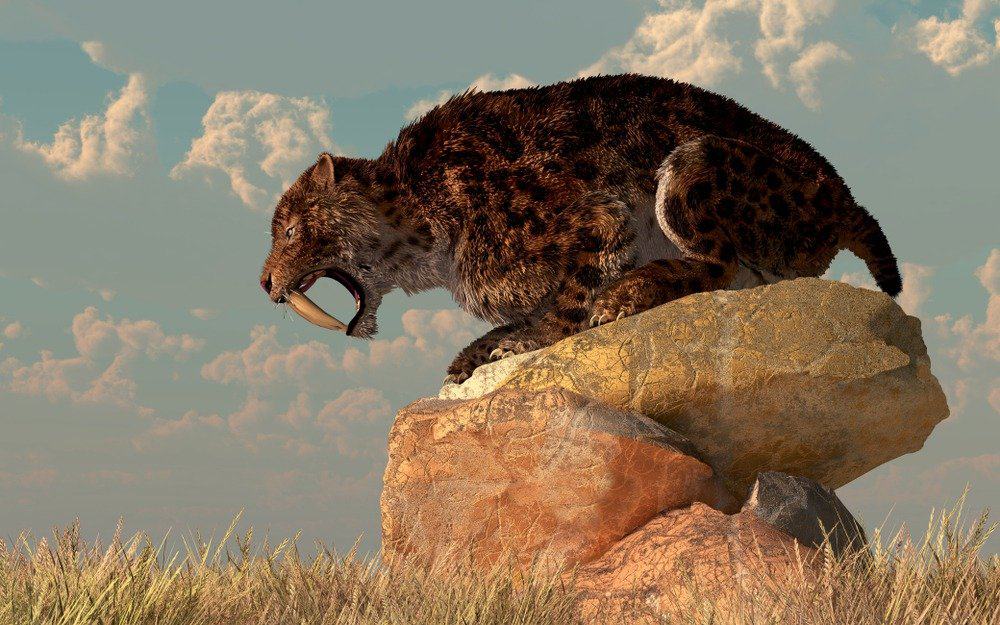
Saber-toothed tiger

Around 1.6 million years ago, the saber-tooth tiger, Smilodon, was found in fossil records discovered in the La Brea tar pits in California.

When thinking about the exotic animals of Africa – most would name the tiger among the big cats that hunt on the continent’s plains and savannahs. While the tiger did evolve from those majestic cats of Africa – the modern tiger has never lived there. As a matter of fact, tigers are less related to lions and leopards and more related to the endangered snow leopard.

The first mammals are believed to have lived 208 million years ago – after the extinction of dinosaurs. The first carnivores came from animals known as miacoids about 60 million years ago. These tree dwellers were about the size of a domestic cat and had developed sharp crushing teeth. Miacoids are the oldest relative to the modern-day tiger.

Carnivores split into two groups – Carniformia and Feliformia – around 40 million years ago. The Carniformia group was more bear-like and evolved into bears, dogs, weasels, raccoons, skunks, badgers, sea lions, walruses, and seals. Feliformia was more cat-like and evolved into cats, hyenas, and mongooses.

Proailurus, the oldest cat, appeared in France 30 million years ago. This aboreal creature weighed around 25 pounds and had eight more teeth than modern cats. 20 Million years ago, the direct ancestor of modern cats, Pseudaelurines, was found in the fossil record. Around 1.6 million years ago, the saber-tooth tiger, Smilodon, was found in fossil records discovered in the La Brea tar pits in California. These big cats became extinct around 10,000 years ago.

Appearance and Behavior
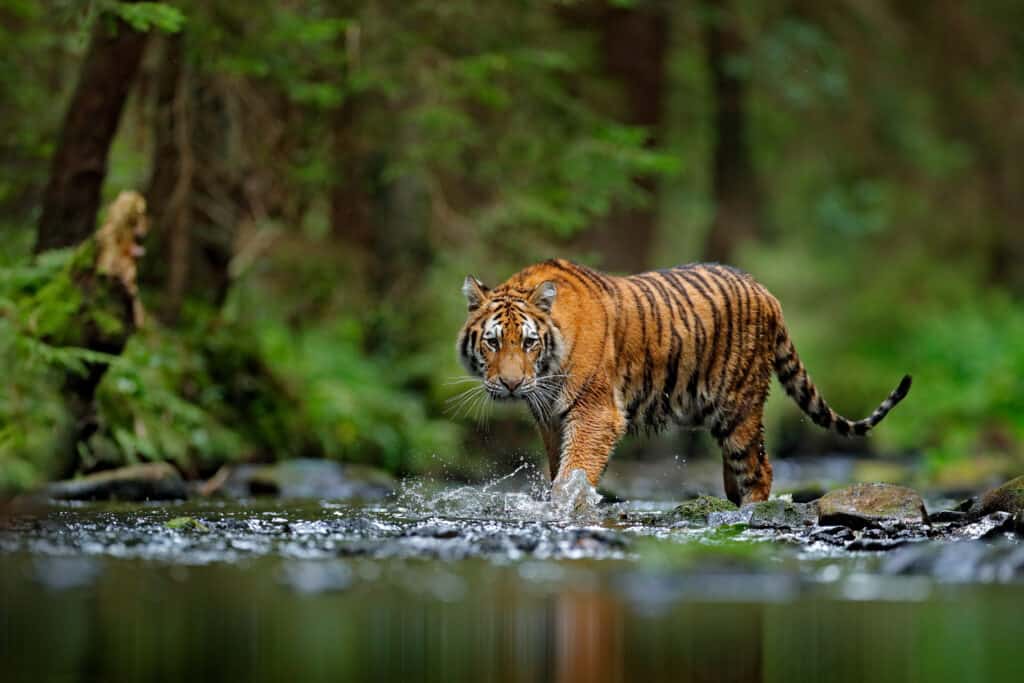
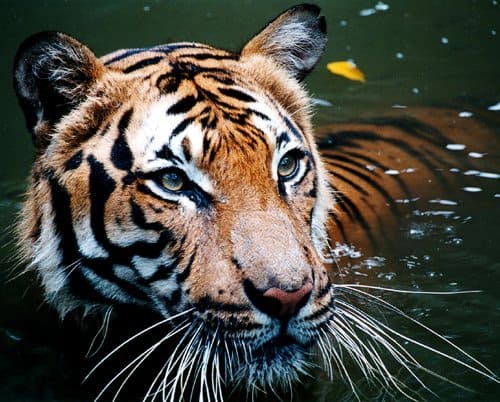
Tiger, Animals In The Wild, Forest, Water, Animal Head

A tiger’s pattern of stripes is as unique to the individual as fingerprints are to humans.

A tiger has a heavy coat of reddish-orange hair featuring a pattern of black stripes. Each has its own pattern of stripes kind of like a human’s fingerprints. It has a long tail as well as sharp teeth and claws. Its body measures 5 to 10.5 feet long and can weigh from 240 to 675 pounds, depending on the subspecies. For example, a 6-foot tiger is equal in length to a full-size bed. One weighs 500 pounds and is half the weight of a grand piano!

The largest tiger ever weighed more than 800 pounds while the largest subspecies of tiger is the Siberian, which has an average weight that reaches up to 675 pounds!

This cat’s striped tail measures about 3 feet long. This is equal to the length of three wooden rulers lined up end to end. It uses its tail to maintain balance when making quick turns as it runs after prey. It uses its 4-inch claws to grab onto prey. In addition, its paws allow it to walk quietly while stalking its next meal. Also, they have webbed feet making them excellent swimmers if they have to cross a river, stream, or other body of water in search of prey.
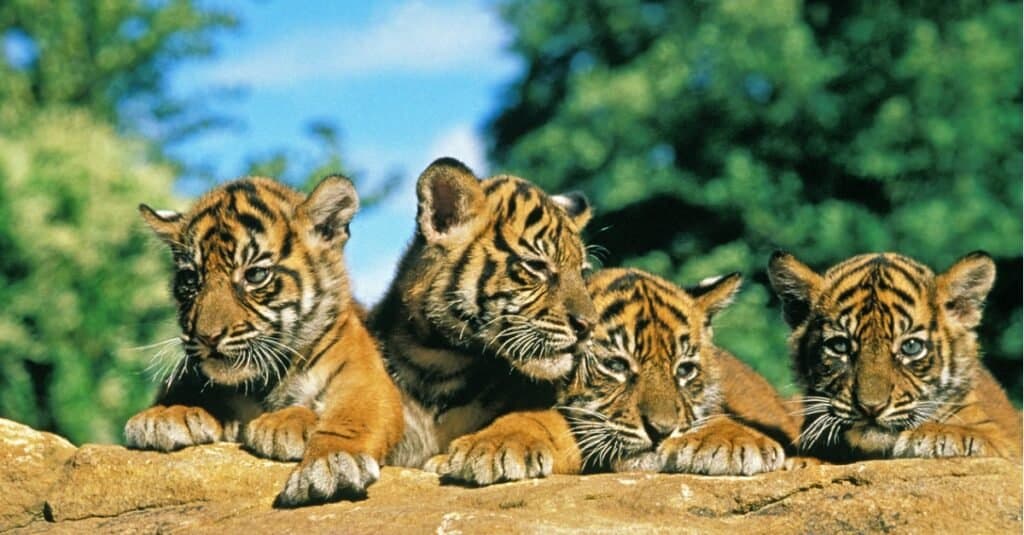
Tigers are solitary except when females are raising their cubs.

Adult tigers are animals with very few predators. Humans are the main predators of these cats. But they are also vulnerable to elephants and large buffalos due to the extraordinary strength and size of these mammals. These big cats’ speed, claws, and teeth are all defensive features.

These are solitary animals. The only exception is when females are raising their cubs. On the rare occasions these big cats are seen in a group, the group is called an ambush. These big cats try to stay out of sight of humans and other animals but can be aggressive if their territory is invaded.

Types of Tigers
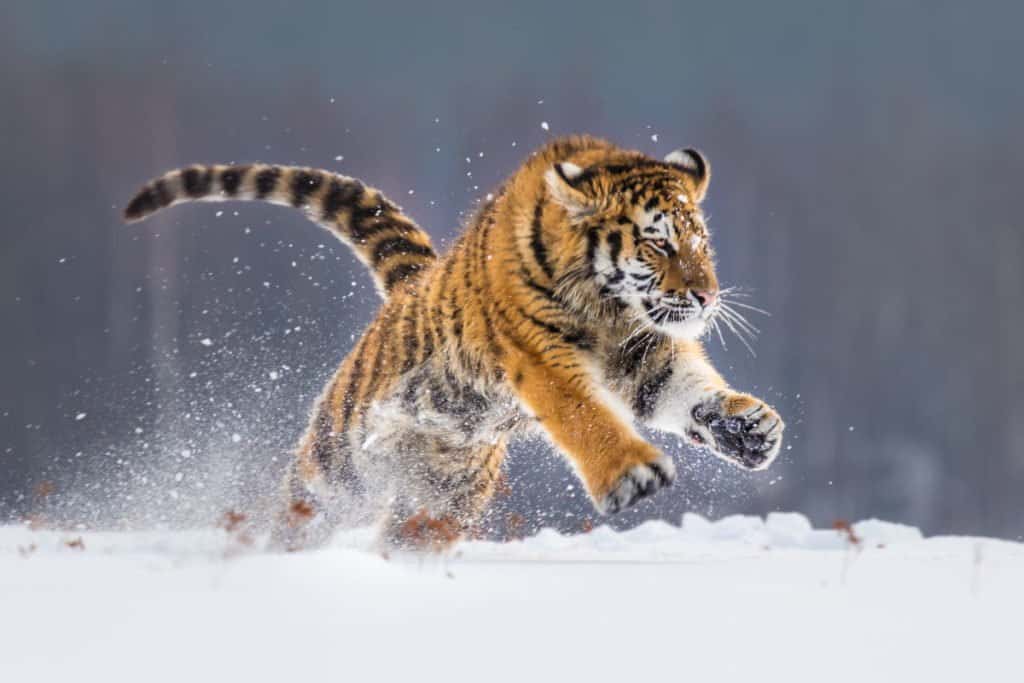
Largest cats - Siberian tiger

The Siberian tiger is the largest subspecies at 10.5 feet long and up to 675 pounds.

When considering the nine subspecies, the Siberian tiger is the largest of the group. It grows to be 10.5 feet long or longer. It’s also the heaviest, weighing in at 675 pounds. The SumSumatran Tigeratran tiger is known as the smallest classification of the species weighing around 260 pounds and growing to be about 8 feet long.

Though the nine subspecies appear to have the same coloration, there are some differences. For instance, the Sumatran is the one with the darkest fur with its stripes placed close together. Some species have a lot of stripes on their legs while others have very few.

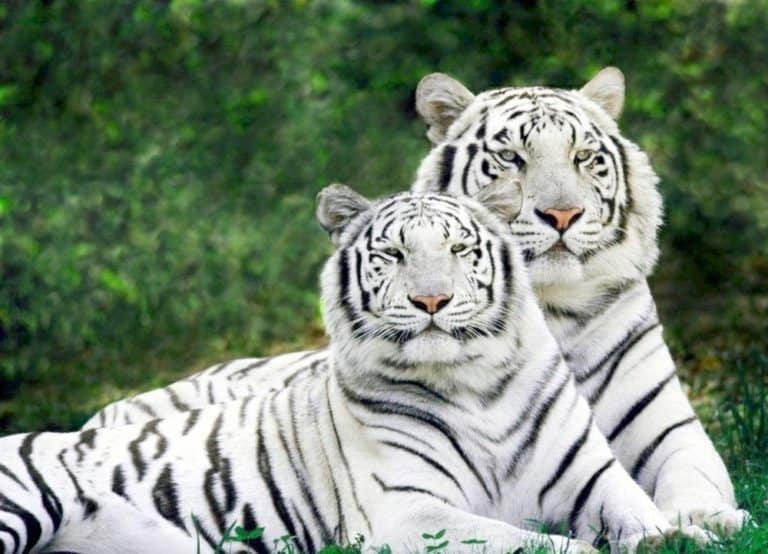
The Bengal Tiger is the most plentiful of all the subspecies. Most have the familiar reddish-orange coat with black stripes. Interestingly, some Bengals and Siberian tigers have a recessive gene that causes them to have coat site coats with black stripes. Cats with this white and black fur coat are not usually found in the wild.

South China Tigers are categorized as Critically Endangered. Their population is unknown. Unfortunately, the government declared them pests at one time and they were hunted causing their numbers to decrease drastically.

The Malayan tiger lives in a tropical climate. More specifically, they live in forests with broadleaf trees in Thailand. Their population has decreased, and they are considered Endangered.

The Indo-Chinese tiger lives in Cambodia, Thailand, and Vietnam. This subspecies has a coat that is darker than that of the Bengal tiger and they are smaller in size than Bengals. They live in mountainous habitats. Their population is unknown because they live in such remote places.

The Bali, Javan, and Caspian tigers are now extinct. This is due to poaching activity as well as loss of habitat.

Habitat
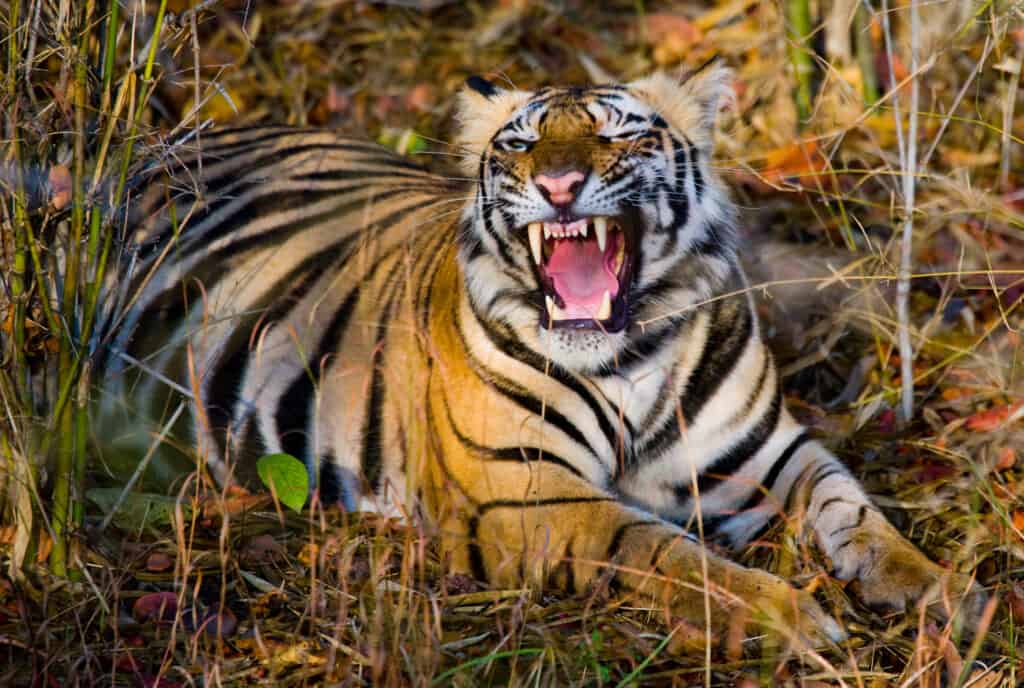
Wild Bengal Tiger lying on the grass and yawns.

Tigers live in different habitats including swamps, grasslands, and deciduous and mangrove forests.

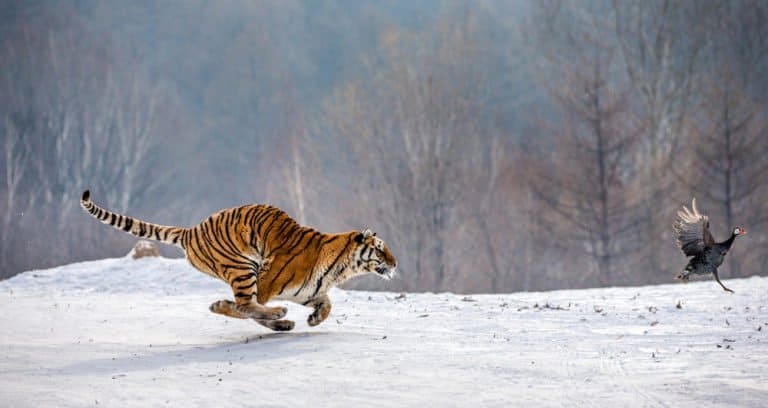
Tigers live in South and Southeast Asia as well as the eastern part of Russia and China. Some live in temperate climates while others live in tropical environments. Siberian tigers live in cold climates where it snows. Their heavy fur coat and an extra layer of fur on their paws protect them from cold temperatures. Also, they have an extra layer of fur around their neck that’s sometimes called a scarf. This insulates them from the cold even more.

Tigers live in different habitats including swamps, grasslands, and deciduous and mangrove forests. The type of habitat each of the subspecies lives in depends on its species.

Malayans live in tropical broadleaf forests while Indo-Chinese tigers live in hilly, mountainous areas. Bengals live in rainforests while the Sumatran live in lowland forests and around swamps.

Tigers sometimes migrate short distances in order to find a larger supply of prey. Also, they may migrate to an area with less snow and warmer temperatures in the cold weather months.

Diet
What Do Tigers Eat image
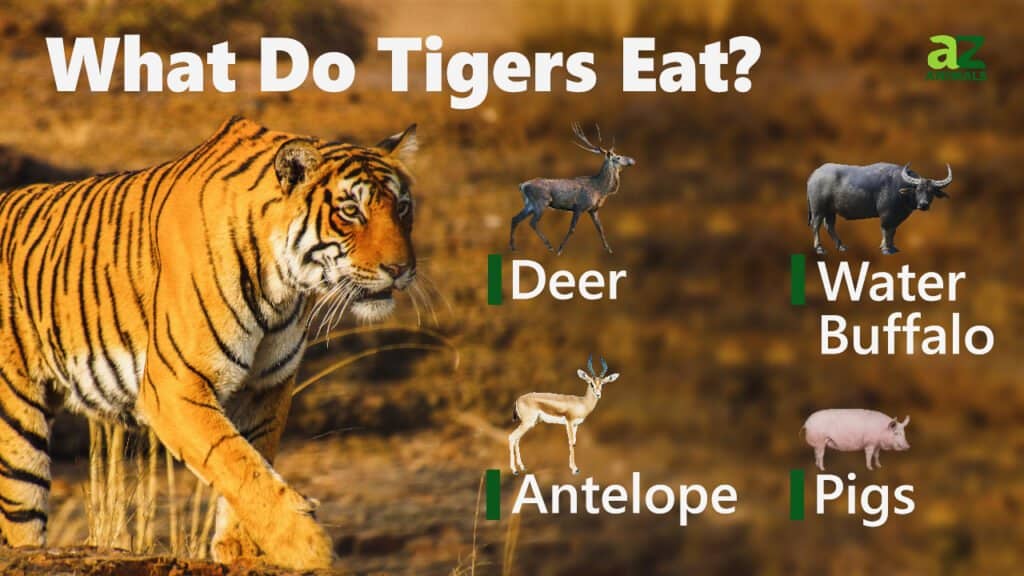
Tigers eat deer, water buffalo, antelope, and pigs.

What does a tiger eat? With powerful jaws, claws, and superb hunting abilities -tigers are carnivores who eat pretty much anything they want. Deer, antelope, buffalo, and pigs are some of the prey of tigers. Tigers have even been known to eat leopards and crocodiles!

Tigers use their stalking skills, speed, and quick movements to take down their prey. However, these big cats usually eat just once per week. They are capable of eating 75 pounds of meat in one evening. Seventy-five pounds is equal to four adult dachshunds. Tigers have a habit of killing prey, eating as much as they want, then covering the rest of it with leaves so they can come back later for a snack. For a complete list of the foods tigers eat, check out our “What Do Tigers Eat?” page.

Predators and Threats
Elephant vs Tiger

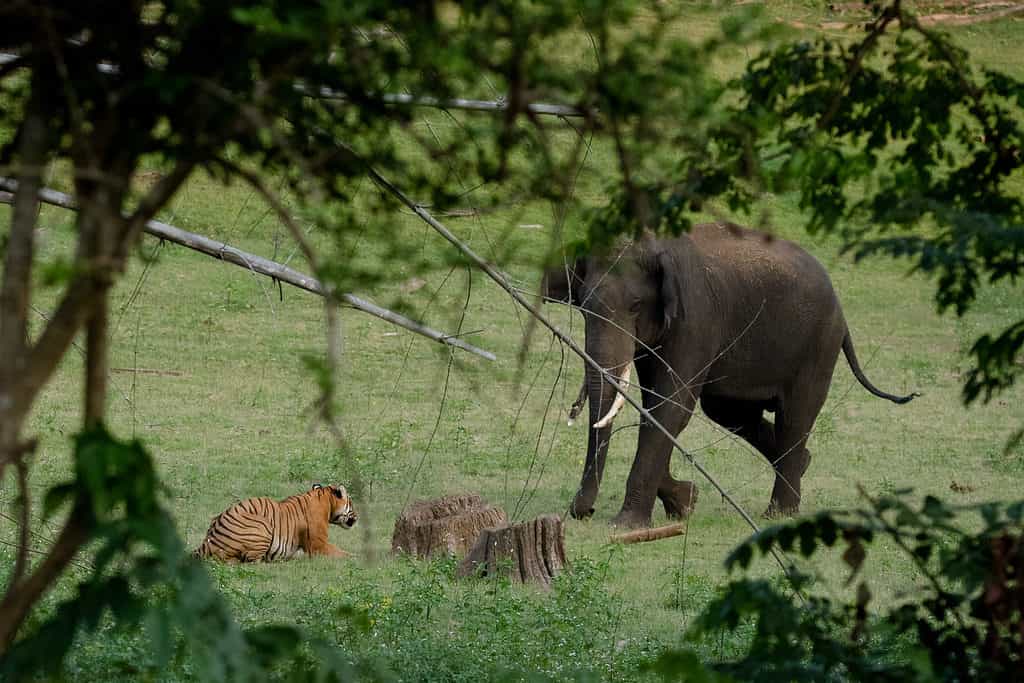
While humans are the main predators of tigers, they are also vulnerable to elephants and large buffalos.

Because of their size and strength, adult tigers don’t have many predators. Humans are predators of this animal. Elephants and bears can also pose a threat to them. Tiger cubs have a lot more predators than adults – including hyenas, crocodiles, and snakes.

Habitat loss through deforestation is a threat. Poaching is another major threat. They are hunted for their skin, fur, teeth, and other body parts. Also, many are captured and sold to individuals as exotic animals. This is illegal. These creatures do not receive the proper care when sold as exotic pets. In many cases, they are starved by their owners and not given the proper medical care, shelter, or exercise. Not surprisingly, tigers kept as exotic pets have been known to attack and injure or kill the people who purchased them.

Of course, a tiger living in a zoo environment receives the proper care from veterinarians and others who are trained to care for them in the best possible way.

The conservation status of the tiger is Endangered with a decreasing population. Fortunately, they are now protected by the Convention of International Trade in Endangered Species of Wild Fauna and Flora (CITES).

Reproduction, Babies, and Lifespan
Tiger cub

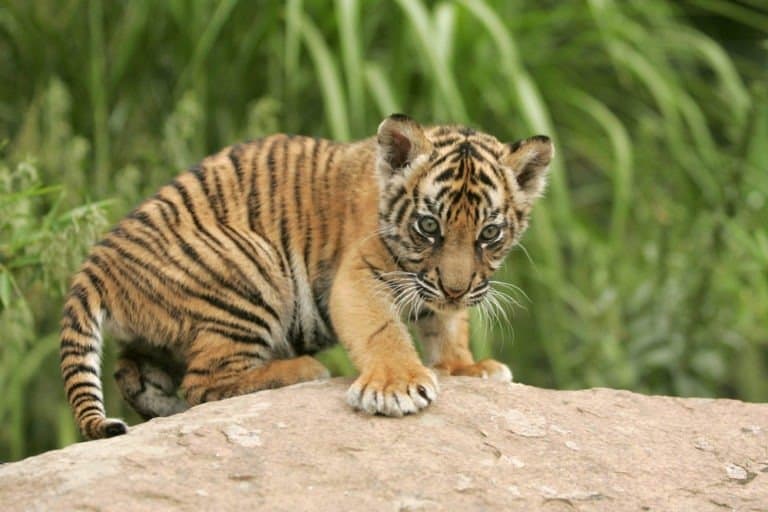
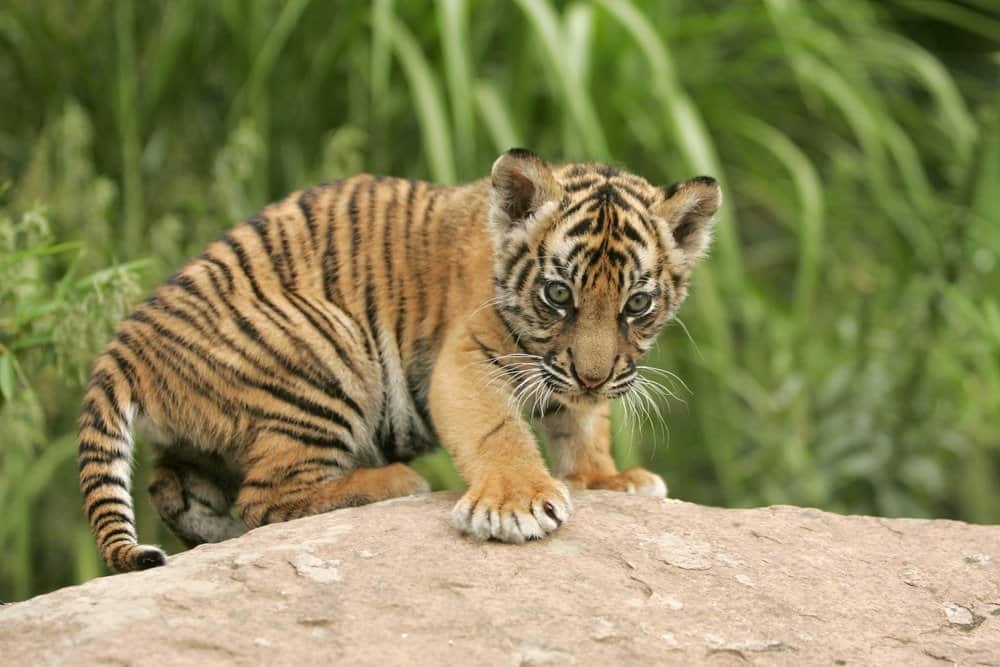
Tiger cubs weigh from 2 – 3 pounds at birth.

The breeding season of this creature usually falls between November and April. However, they can breed at any time of the year. A female that’s ready to mate marks her territory with a particular scent. This attracts males to the area. The males sometimes fight and otherwise compete for a female that is ready to mate. Tigers are not monogamous; they mate with different partners each breeding season.

The gestation period is around 100 days. A litter can number from 1 to 7 cubs, but usually, a female gives live birth to 2 to 4 cubs. Each tiger baby, or cub, weighs from 2 to 3 pounds at birth. Like other cats, tiger cubs are born blind. Their eyes open in 6 to 12 days. These newborns rely on their mothers for everything.

They are cared for by their mother and nursed for the first 6 weeks of life. The mothers are very protective of their cubs. Young cubs are vulnerable to a variety of predators and many fall victim to them before they are strong enough to defend themselves. So, if a mother feels her cubs are threatened in any way, she moves them to another den one baby at a time. Plus, she only leaves them for brief amounts of time to hunt for food. She licks each baby in an effort to clean its fur and stimulate its digestive system.

At 7 weeks old, the cubs are fed solid food by their mother. She brings food to the den and breaks it up for the cubs. The cubs spend a lot of time wrestling and chasing one another as a way to strengthen their muscles and learn stalking behaviors. At eight to 10 months, the cubs are ready to go out and hunt with their mother. They stay with her until they are around 2 years old.

Tigers suffer from some of the same threats/ailments as other types of cats. Feline leukemia, rabies and anemia are some examples.

They live from 10 to 15 years in the wild. In zoos, they can live up to 20 years or more. The world’s oldest tiger was a Sumatran named Djelita. She lived at Honolulu Zoo and reached the age of 25 years old.

Population
South China tiger drinking from a stream

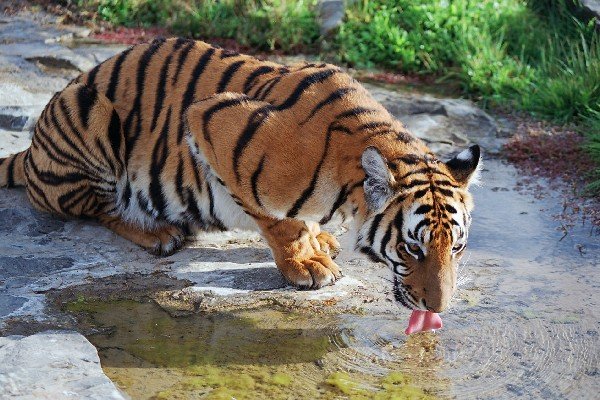
The South China Tiger population is unknown because of the remote, mountainous area where they live.

Bengals are the most plentiful of all the tiger species. Bengals living in India numbered between 2,500 and 3,750. As for the other subspecies, according to the IUCN Red List, there are 2,154 to 3,159 mature individuals in existence. The population of some tigers such as the South China tiger is unknown because of the remote, mountainous area where they live.

The official conservation status of the tiger is Endangered with a decreasing population.

In the Zoo
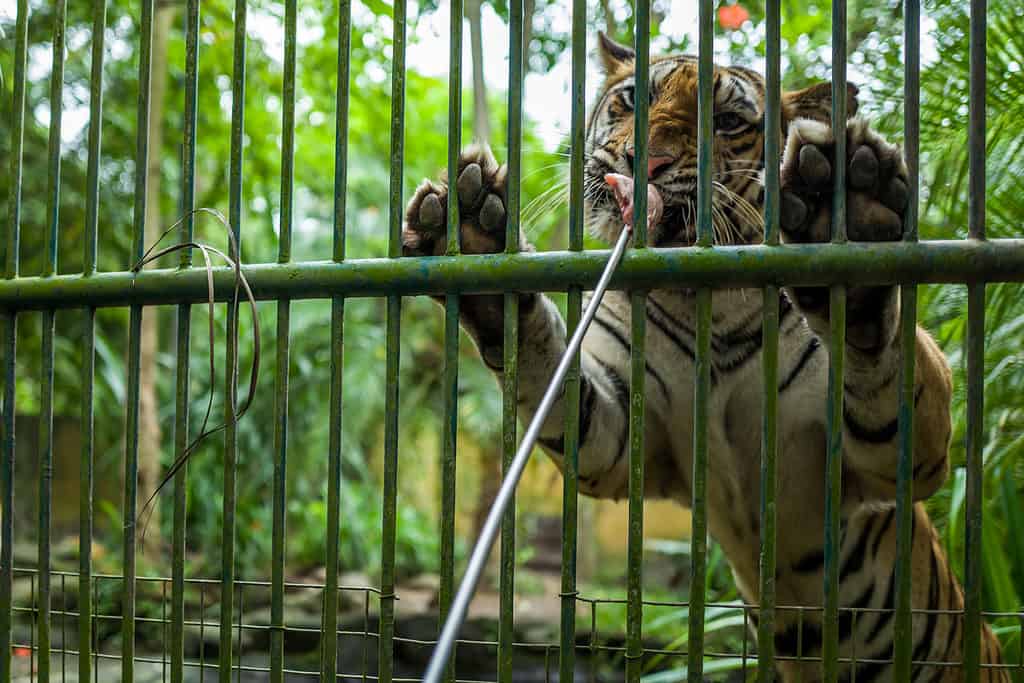
Tiger leans up against cage while being fed from the other side

Tiger leans up against the cage while being fed from the other side.

Watch This Fascinating Video About the Rarest Tiger on Earth!

More on Tigers

  • Extinct Types of Tigers
  • Why There Are No Tigers in Africa (And What Large Cats Do Thrive There)
View all 607 animals that start with T
How to say Tiger in ...
English
Tigar
Bulgarian
Тигър
Catalan
Tigre
Chinese
Croatian
tigar
Czech
tygr
Danish
tiger
Dutch
tijger
English
tiger
Esperanto
tigro
Estonian
tiiger
Finnish
tiikeri
French
tigre
Galician
tigre
German
Tiger
Hebrew
טיגריס
Hungarian
tigris
Indonesian
harimau
Italian
tigre
Japanese
トラ
Latin
tigris
English
tieger
Malay
harimau
Maltese
yigra
English
Tiger
Polish
tygrys
Portuguese
tigre
English
tigru
Slovenian
tiger
Spanish
tigre
English
maung lodaya
Swedish
tiger
Turkish
kaplan
Vietnamese
Hổ

Sources

  1. Sea World
  2. National Zoo
  3. Live Science https://www.livescience.com/29822-tiger-subspecies-images.html Jump to top
Lisha Pace

About the Author

Lisha Pace

After a career of working to provide opportunities for local communities to experience and create art, I am enjoying having time to write about two of my favorite things - nature and animals. Half of my life is spent outdoors, usually with my husband and sweet little fourteen year old dog. We love to take walks by the lake and take photos of the animals we meet including: otters, ospreys, Canadian geese, ducks and nesting bald eagles. I also enjoy reading, discovering books to add to my library, collecting and playing vinyl, and listening to my son's music.

Thank you for reading! Have some feedback for us?


Tiger FAQs (Frequently Asked Questions)

Tigers are carnivores eating deer, antelope, and boars as well as monkeys, snakes, and sloth bears.