


T
Species Profile

Tropicbird

Phaethontidae

Streamers of the tropical seas
Imogen Warren/Shutterstock.com

Tropicbird Distribution

Click a location to explore more animals from that region

This map shows coastal regions where Tropicbird are found.

Loading map...
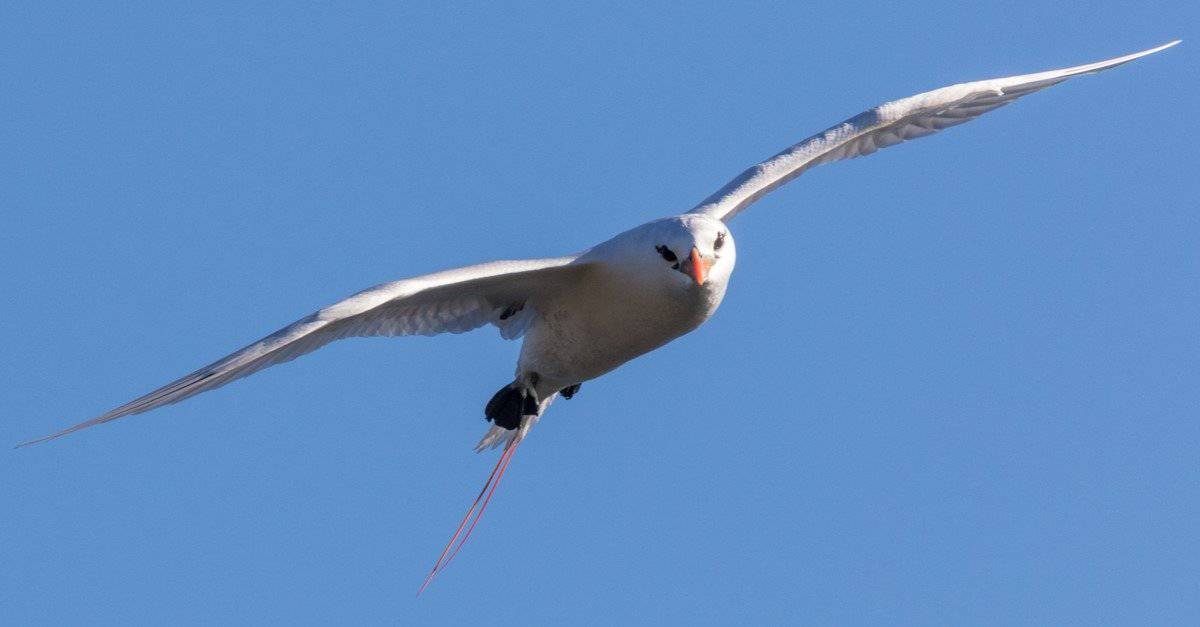
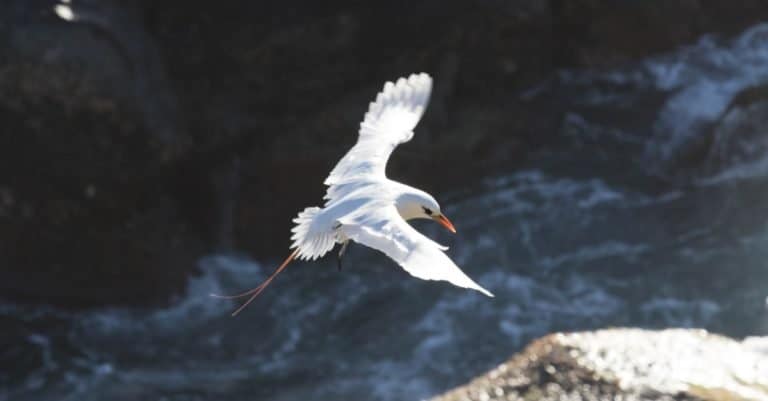
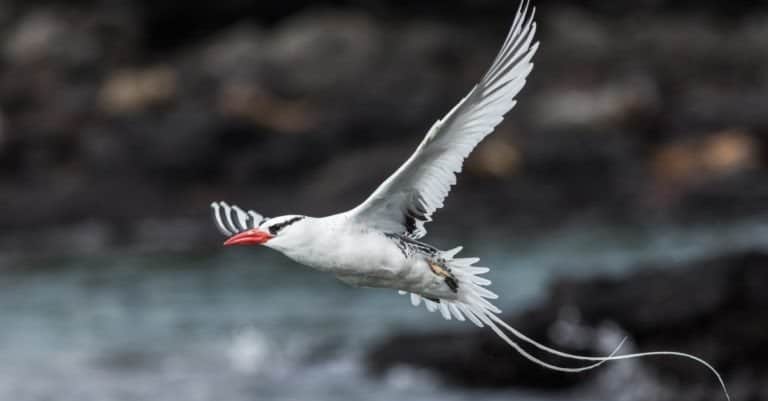
Tropicbird soaring in the air

At a Glance

Family Overview This page covers the Tropicbird family as a group. Stats below are general traits shared across the family.
Also Known As Bosun bird, Bo'sun, Boatswain bird, Sea-swallow
Diet Piscivore
Activity Diurnal+
Lifespan 15 years
Weight 0.78 lbs
Status Not Evaluated
Did You Know?

Adults span roughly 94-112 cm wingtip to wingtip; total length with streamers can reach about 90-105 cm.

Scientific Classification

Family Overview "Tropicbird" is not a single species but represents an entire family containing multiple species.

Tropicbirds are pelagic seabirds of tropical and subtropical oceans, famed for their elongated central tail feathers (“streamers”). They forage at sea for fish and squid, and nest on remote oceanic islands, often on cliffs or in crevices.

Kingdom
Animalia
Phylum
Chordata
Class
Aves
Order
Phaethontiformes
Family
Phaethontidae

Distinguishing Features

  • Very long central tail streamers
  • Mostly white plumage with black markings
  • Strong, direct flight over open ocean
  • Piscivorous and squid-eating seabird

Physical Measurements

Males and females differ in size

Length
2 ft 9 in (2 ft 4 in – 3 ft 5 in)
2 ft 11 in (2 ft 4 in – 3 ft 5 in)
Weight
1 lbs (1 lbs – 2 lbs)
Tail Length
1 ft 4 in (10 in – 1 ft 12 in)
1 ft 6 in (12 in – 1 ft 10 in)
Top Speed
50 mph
flying

Appearance

Primary Colors
Secondary Colors
Skin Type Feathered
Distinctive Features
  • Elongated central tail streamers, length varies strongly by species.
  • Total length roughly 70-105 cm, depending on streamer length.
  • Long, narrow wings adapted for dynamic soaring over open ocean.
  • Strong, pointed bill; color varies orange to bright red.
  • Mostly white plumage with species-specific black wing and face markings.
  • Feet set back and webbed; limited agility when walking on land.
  • Pelagic foraging on fish and squid, mainly surface-seizing and plunge-diving.
  • Breed on remote tropical islands, often cliffs, ledges, or crevices.
  • Typically one-egg clutch; extended chick-rearing tied to ocean conditions.
  • Juveniles show more barring/spotting and duller bills than adults.

Sexual Dimorphism

Sexual dimorphism is generally subtle. In several species, males average slightly longer tail streamers and may show marginally brighter soft-part coloration during courtship, but plumage pattern is largely similar in both sexes.

  • Tail streamers often slightly longer on average.
  • Courtship flight displays tend to be more frequent or conspicuous.
  • Tail streamers often slightly shorter on average.
  • Often slightly heavier-bodied in some breeding populations.

Did You Know?

Adults span roughly 94-112 cm wingtip to wingtip; total length with streamers can reach about 90-105 cm.

Body mass varies widely, about 0.32-0.82 kg, with red-tailed typically heavier than white-tailed.

Recorded lifespans extend roughly 10-30 years; many individuals survive 15-25 years in the wild.

Across the family they take small fish and squid, often snatching prey after plunge-dives or surface-dips.

They usually lay a single egg in a cliff ledge, crevice, or burrow; breeding timing varies by island.

Tail streamers differ: red-tailed shows red streamers, while white-tailed and red-billed have white streamers with bill-color contrasts.

Unique Adaptations

  • Supraorbital salt glands let them drink seawater and excrete excess salt through the nostrils.
  • Long, pointed wings support efficient gliding and fast commuting between tiny breeding islands and distant feeding grounds.
  • Elongated central tail feathers act as sexual signals; streamer length and color vary among the three species.
  • Dense, water-shedding plumage and frequent preening help maintain insulation and buoyancy during long pelagic trips.
  • Strong, slightly hooked bills and a wide gape help seize slippery fish and squid during split-second strikes.

Interesting Behaviors

  • Pairs perform aerial courtship with looping flights, calling, and streamer displays; intensity and timing vary among colonies.
  • Foraging is mostly offshore: they patrol wind lines and current edges, then plunge-dive or snatch prey at surface.
  • They often follow tuna or dolphins that drive fish upward; reliance on these associations differs by region and year.
  • Nesting adults are clumsy walkers; many choose crevices or ledges for protection, especially where predators are absent.
  • Chicks stay in the nest for weeks to months, building fat reserves; fledging age varies with food and island climate.

Cultural Significance

In Bermuda the white-tailed 'longtail' is a celebrated spring return and national symbol; across tropical islands tropicbirds feature on stamps, tourism branding, and seabird-monitoring programs reflecting ocean health.

Myths & Legends

The genus name Phaethon recalls Phaethon, Helios's son, whose fiery fall shaped Greek legends of the sun's chariot.

Bermuda's 'longtail' is welcomed in local tradition as a herald of spring, returning to nest on seaside cliffs.

Sailors long called them 'boatswain's birds'; maritime lore linked their piercing calls with ships nearing tropical islands and reefs.

Polynesian voyaging tradition says a tropicbird seen at sea signals nearby land, since these birds roost and nest on islands at night.

Conservation Status

NE Not Evaluated (family-level). Across Phaethontidae, the three extant species are currently assessed as Least Concern (LC), but several small, island-restricted breeding populations show localized declines and elevated extinction risk.

Has not yet been evaluated against the criteria.

Population Unknown

Protected Under

  • EU Birds Directive
  • Migratory Bird Treaty Act
  • National Wildlife Acts

You might be looking for:

Red-billed Tropicbird

34%

Phaethon aethereus

Large tropicbird with red bill and long white tail streamers; widely distributed across tropical oceans, often near islands and cliffs.

White-tailed Tropicbird

34%

Phaethon lepturus

Slender white tropicbird with very long white tail streamers; common across tropical Atlantic and Indo-Pacific islands.

Red-tailed Tropicbird

32%

Phaethon rubricauda

Mostly white bird with striking red tail streamers and red bill; breeds on islands in the Indian and Pacific oceans.

Life Cycle

Birth 1 chick
Lifespan 15 years

Lifespan

In the Wild
7–30 years
In Captivity
10–35 years

Reproduction

Mating System Monogamy
Social Structure Socially Monogamous
Breeding Season Year-round with regional peaks; often seasonal
Breeding Pattern Seasonal
Fertilization Internal Fertilization
Birth Type Internal_fertilization

Across tropicbirds, pairs typically form socially monogamous bonds at island nesting sites, with courtship displays and biparental incubation and chick care. Pair reunion between seasons varies by species and colony; extra-pair mating appears uncommon but may occur.

Behavior & Ecology

Social Colony Group: 30
Activity Diurnal, Crepuscular
Diet Piscivore small fish

Temperament

Wary
Nest-territorial
Aerially agile
Opportunistic
Site-faithful

Communication

shrill calls
raspy squawks
chattering notes
pair-contact calls
aerial courtship displays
tail-streamer posturing
bill pointing and head bobbing
threat displays at nest
chasing intruders

Habitat

Open Ocean Coastal Coral Reef Rocky Shore Cliff/Rocky Outcrop Beach
Biomes:
Terrain:
Coastal Island Rocky Sandy Volcanic Mountainous
Elevation: Up to 984 ft 3 in

Ecological Role

Mid-level marine predator linking pelagic food webs to island colonies

prey population control marine nutrient transport guano fertilization

Diet Details

Main Prey:
Small fish Flying fish Squid

Human Interaction

Domestication Status

Wild

No domestication history. Tropicbirds have been occasionally taken for food or tail feathers on some islands, but they were never selectively bred; modern interactions are mainly protection, research, and impact mitigation.

Danger Level

Low
  • painful pecking when handled
  • scratches from claws
  • zoonotic bacteria from feces
  • ectoparasites during nest work

As a Pet

Not Suitable as Pet

Legality: Generally illegal or permit-only; protected seabirds in many regions.

Care Level: Expert Only

Purchase Cost:
Lifetime Cost: $10,000 - $60,000

Economic Value

Uses:
Tourism Research Conservation
Products:
  • feathers

Relationships

Predators 8

Black rat
Black rat Rattus rattus
Norway rat
Norway rat Rattus norvegicus
Feral cat Felis silvestris catus
Brown/Black-naped tern Sternula spp. / Sterna spp.
Gulls
Gulls Larus spp.
Skuas and Jaegers Stercorarius spp.
Peregrine Falcon
Peregrine Falcon Falco peregrinus
Reef and pelagic sharks Carcharhinus spp.

Related Species 3

White-tailed Tropicbird Phaethon lepturus Shared Genus
Red-billed Tropicbird Phaethon aethereus Shared Genus
Red-tailed Tropicbird Phaethon rubricauda Shared Genus

Ecological Equivalents 5

Animals that fill a similar ecological role in their ecosystem

Boobies and gannets Sulidae Tropical pelagic plunge-divers that nest on remote islands and cliffs.
Frigatebirds
Frigatebirds Fregata spp. Warm-ocean seabirds that nest on islands; they overlap in foraging areas and engage in kleptoparasitism.
Terns Sterninae Surface-feeding tropical seabirds that often share island colonies and nearshore waters.
Noddies Anous spp. Tropical colony nesters occupying similar island habitats and feeding on small fish and squid.
Shearwaters and petrels Procellariidae Pelagic foragers that feed on fish and squid; they overlap in offshore feeding zones.

Types of Tropicbird

3

Explore 3 recognized types of tropicbird

White-tailed Tropicbird Phaethon lepturus
Red-billed Tropicbird Phaethon aethereus
Red-tailed Tropicbird Phaethon rubricauda

Tropicbirds are the common name given to one of three species of seafaring birds that are part of the Phaethontidae family.

The three living species are better known as the White-tailed tropicbird, the red-tailed tropicbird, and the red-billed tropicbird. The white-tailed variety is actually Bermuda’s national bird.

They live in mated pairs within small colonies of a few hundred to a few thousand birds. They can be found on islands, archipelagos, atolls, and other rocky formations in the Atlantic, Pacific, or Indian Oceans.

Tropicbirds prefer warmer climates with waters that are between 75- and 88-degrees Fahrenheit. They are common on the Hawaiian Islands, the Gulf of California, and certain areas of Brazil, Peru, and other central and South American countries. They have also made homes in Australia, Africa, Indonesia, Bermuda, and other island nations.

These birds have wingspans between 94 and 112 centimeters (cm) and can have tail feathers or streamers that are between 46 and 56 cm long.

4 Amazing Tropicbird Facts!

  • Looking for some interesting facts about Tropicbirds? Check out these four amazing facts about this bird!
  • Tropicbirds are Bermuda’s national bird and are a protected species there. They are also referred to as long tails on the island.
  • Females will look to procreate again ten months after successful fertilization or five months if previously unsuccessful.
  • They can perform complex maneuvers including flying backwards, making circles, and fast vertical ascents while courting a potential mate.
  • The Tropicbird has a 16-year lifespan.

Where to Find Tropicbirds

The different species of tropicbirds are found in mostly warm, tropical regions in the Pacific, Atlantic, and Indian Oceans. For instance, the white-tailed tropicbird is the national bird of the island of Bermuda. However, humans have also observed this species in the warm waters around Hawaii to the west and in Florida to the east.

The red-billed species typically lives on islands south of the equator, such as the Galapagos Islands, and has a smaller distribution range than the other two types of tropicbirds. They are often found off the coast of Brazil on the Fernando de Noronha and Abrolhos Archipelago. It has been as far east as Namibia, Pakistan, Sri Lanka, and other nations around the Indian Ocean.

They generally nest close to shore on tall craggy cliffs in mated pairs. When not nesting, the males and females primarily spend their time far out on the ocean looking for food.

Tropicbird Scientific Name

There are three living, or extant, Tropicbird species. They are all members of the Phaethontidae family and the genus Phaethon. The red-tailed tropicbird is known as Phaethon rubricauda. The red-billed tropicbird’s scientific name is Phaethon aethereus while the white-tailed variant is Phaethon lepturus.

Tropicbird Size and Appearance

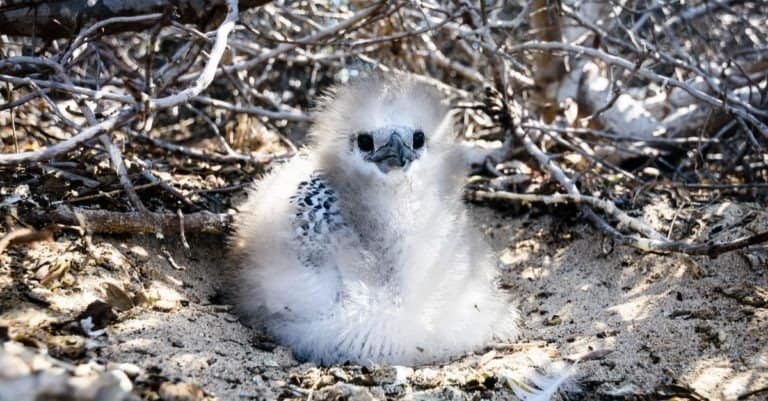
Tropicbird hatchlings typically have gray down when first born. As they mature, these gray feathers turn pure white. Depending upon which species it is, the adult tropicbird will have different black markings.

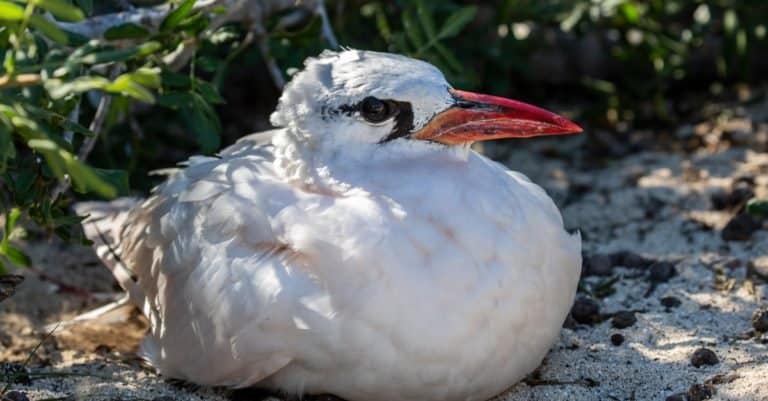
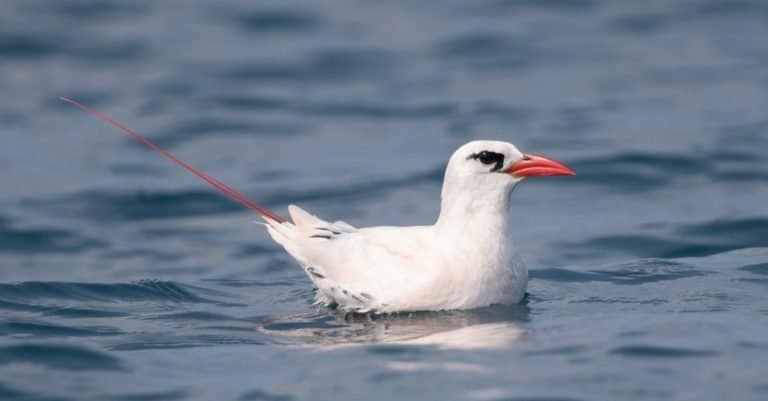
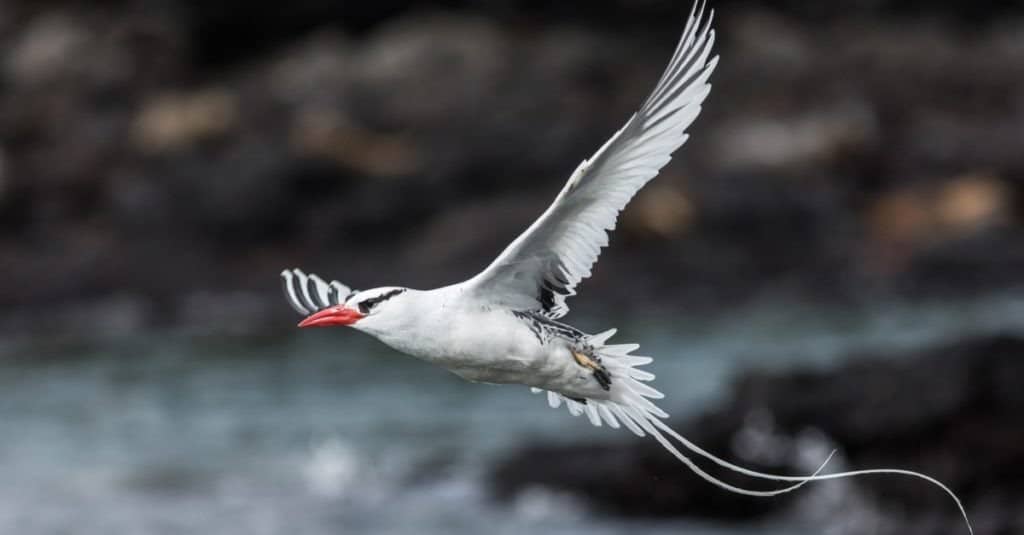
The main differences in appearance are aptly described by these birds’ common names. The red-tailed tropicbird has bright white feathers and a distinctive red tail. The red-billed species has a bright red beak to go along with its black facial markings and white body. The white-tailed tropicbird has black face markings, a white body and a white tail.

Tropicbirds have a wingspan between 94 and 112 centimeters. Their body is typically between 76 and 102 centimeters long.
Tropicbird Behavior

Tropicbirds normally fly solo while hunting on the ocean for food. However, they usually live in monogamous pairs while nesting on the shore. When hunting for food, Tropicbirds most commonly hover above the water and quickly dive down to catch pretty.

They have a very piercing and loud call that they let off during a flight display. They often emit multiple calls in a row to draw attention to themselves.

Tropicbird Nests

These birds make nests on rock ledges or within cracks on the ground. They often make simple scrape nests as opposed to more complex and larger cup or platform nests. The tropicbird uses its talons to dig a depression in the sand or rock face that is just deep enough to keep its eggs from rolling away.

Tropicbird Diet

Tropicbirds live on islands, atolls, cays, and other rocky formations in the middle of the Atlantic, Pacific, and Indian Oceans. As a result, their diet primarily consists of marine life. They prefer to catch flying fish as they jump out of the water but will also eat squid.

They can dive down up to 15 feet to snag crabs and other crustaceans from the ocean floor near shore. They will often fly miles out to sea to catch and bring back food for their nesting mates.

Tropicbird Predators and Threats

The tropicbird’s biggest threats and predators are dogs, cats, rats, and other creatures that invade their nests. These creatures generally attack the eggs or young chicks. Larger birds, such as sea eagles with their sharp talons, can and do also prey on the tropicbird.

Humans and their tendency to overfish are another major threat to the tropicbird population. As the numbers of fish, crustaceans, and squid decline around their island homes, tropicbird numbers have also seen a rapid decline. Starvation and lack of nutrition are a major concern for the continued survival of these birds.

Tropicbird Reproduction, Babies, and Lifespan

Tropicbirds engage in a complex flying ritual to attract a mate. They will fly in large loops and high speeds and have even been observed flying backwards as part of this effort. The length and volume of a bird’s tail feathers is the primary driver for finding an acceptable mate.

Once the birds find a mate, they generally remain in breeding pairs while nesting on an island. The female lays one egg either on a protected rocky cliff or in a ground crack. She will generally roost for 40 or 42 days until the egg hatches. During that time. The male will generally fly out to sea and bring back food for his mate.

Chicks are not only blind but also cannot move when they are first born. They typically remain in the nest under their parents’ protection for two to three months. Throughout that time both parents take turns feeding their offspring until it is old enough and large enough to learn to fly.

Tropicbird Population

These birds live in mated pairs when nesting on the islands that they call home. They prefer to live near coral reefs and to have easy access to the ocean for hunting and feeding purposes.

These birds will live in colonies of up to several hundred pairs. For example, 30 colonies in the Galapagos Islands have several thousand individual birds. However, two colonies around the coast of California and Mexico might have only 300 to 400 birds.

The exact population is difficult to estimate because of its dispersed living areas across the world. However, some estimates indicate that there are about 5,000 white-tailed tropicbirds and as few as 2,000 of the red-billed species around the world.

The red-tailed tropicbird has the largest population of the three species. Latest estimates indicate that there are at least 40,000 of these birds in the eastern Pacific Ocean. However, that number could be as high as 80,000 or more.

View all 606 animals that start with T

Sources

  1. Wikipedia / Accessed December 26, 2020
  2. Audubon / Accessed December 26, 2020
  3. Population Estimates, Conservation Concerns, and Management of Tropicbirds in the Western Atlantic / Accessed December 26, 2020
A-Z Animals Staff

About the Author

A-Z Animals Staff

AZ Animals is a growing team of animals experts, researchers, farmers, conservationists, writers, editors, and -- of course -- pet owners who have come together to help you better understand the animal kingdom and how we interact.
Connect:

Thank you for reading! Have some feedback for us?


Tropicbird FAQs (Frequently Asked Questions)

Tropicbirds are carnivores, meaning they eat other animals.