

The Uguisu (Horornis diphone), also known as the Japanese bush warbler, is a small songbird from Japan. It is famous for its beautiful call that signals the start of spring. Its plain brownish-green feathers contrast with its clear, melodic, and instantly recognizable song. The Uguisu has been a symbol of spring and renewal in Japan for centuries.
Classification and Evolution
The natural range of this rather miniature avian is in East Asia. The Uguisu can be found in China, Japan, Korea, Manchuria, the Philippines, and Taiwan. A relative of the nightingale, the bushtit, and other diminutive songbirds, it is also referred to as the Japanese nightingale owing to the beauty of its song. However, it is more commonly known as the Japanese bush warbler, a more appropriate name, since the avian does not sing at night. Its singing ability meant it was targeted as a pet of sorts, a considerable downside for the bird. In Japan, the bird’s presence and its singing are regarded as a sign of spring. The Uguisu can also be found in Hawaii, where it was introduced in the early 20th century and has since established populations on all the main islands.
Anatomy and Appearance
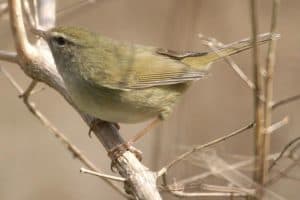
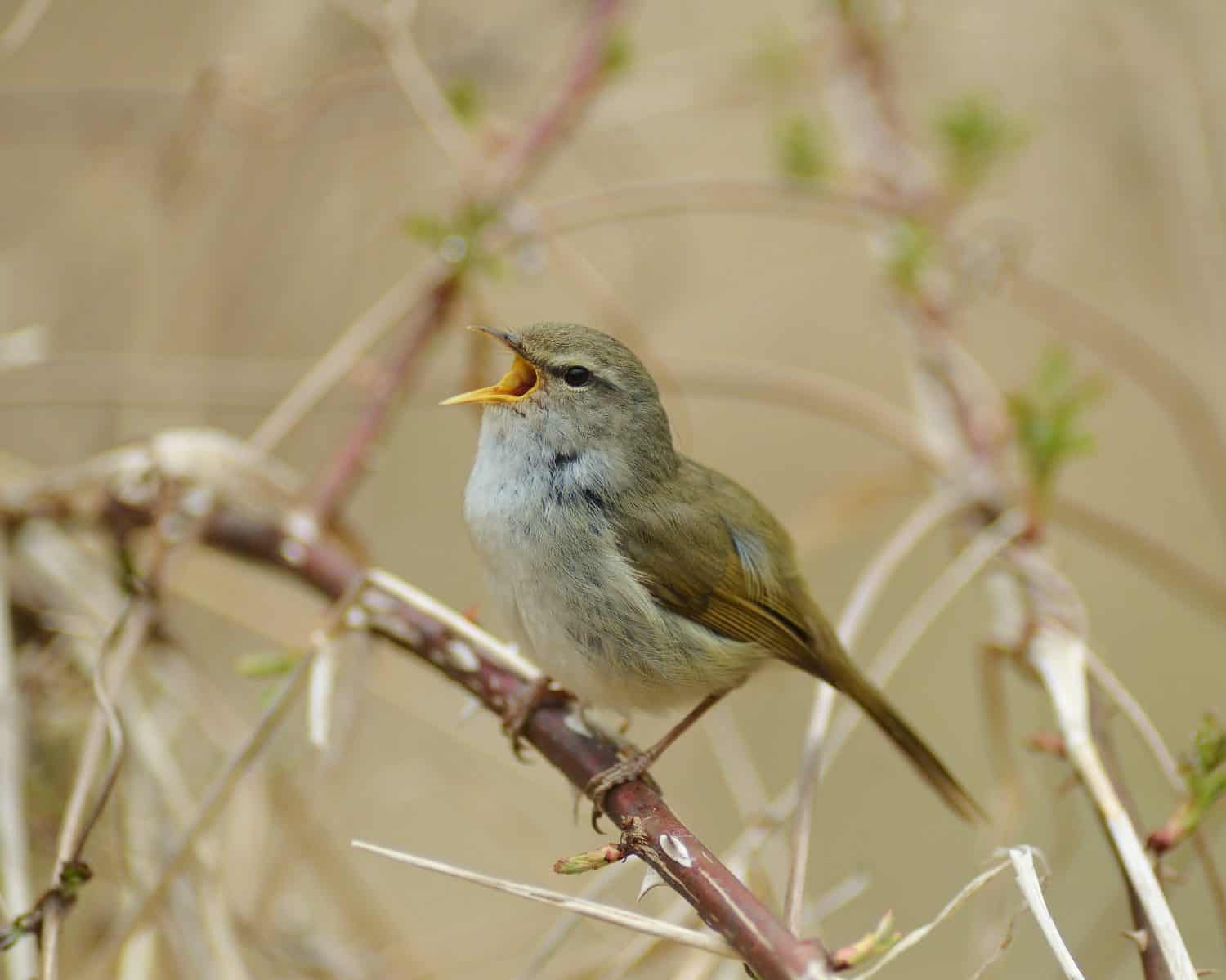
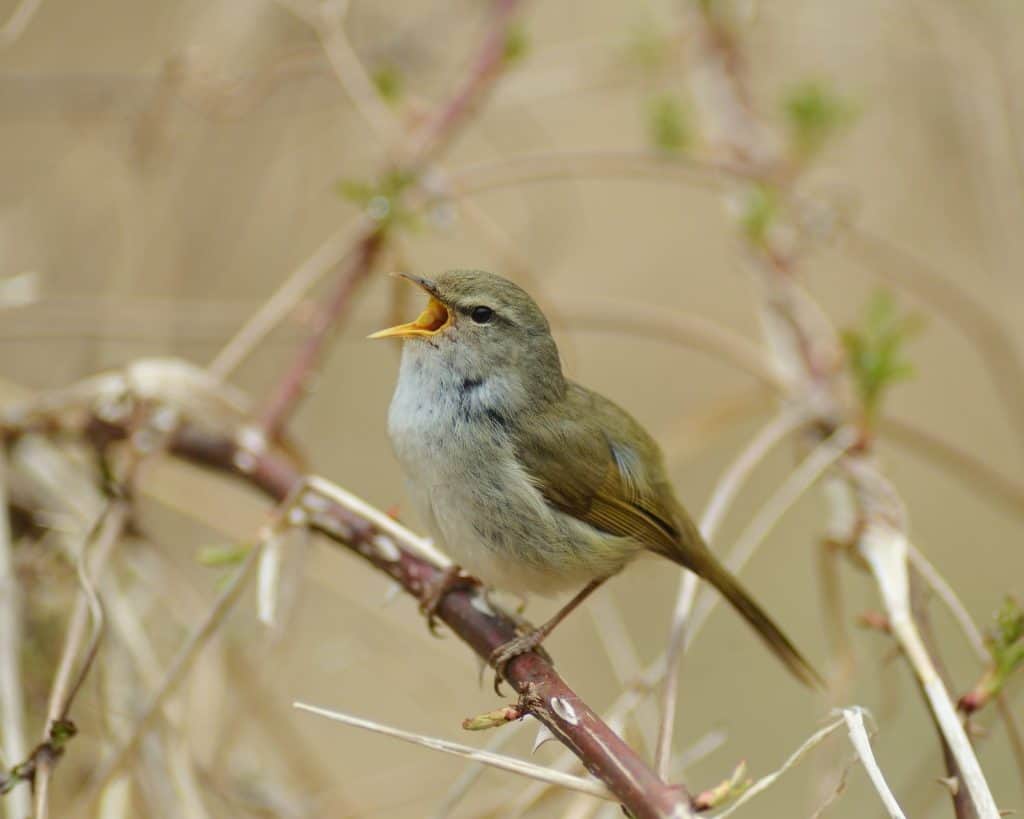
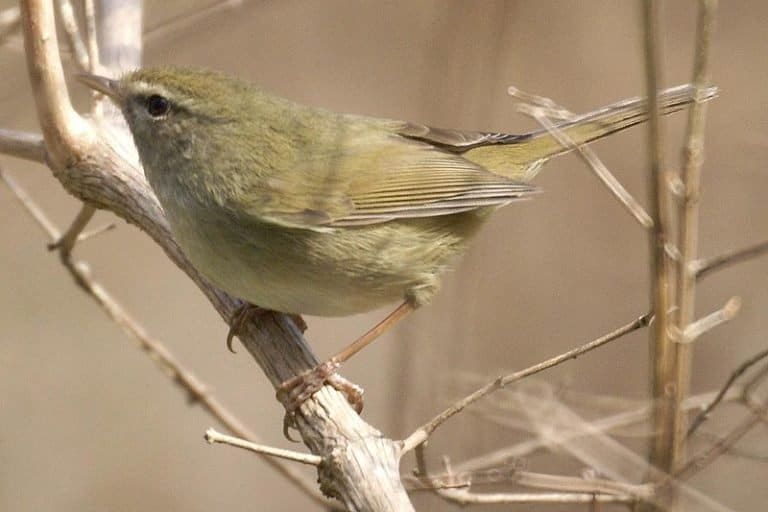
The Uguisu is rather small in size with small dark eyes, a slightly long dark beak, and drab plumage which may either be olive-green or pale brown, darkening at the points of the wings and tail. It can also be recognized by its thin legs ending in slender toes with claws at their tips to enable the bird to firmly grasp the branches it is perched on. There is also its tail, which is somewhat reminiscent of a long-tailed tit’s. It is not only rather lengthy but is also made of straight feathers.
Distribution and Habitat
The songbird can be found in East Asia. The Uguisu’s range tends to include China, Japan, Korea, the Philippines, and even Russia. It is also a seasonal visitor to Taiwan. The bird tends to favor dense foliage, which can be found in bamboo thickets and forests, where it can conceal itself from predators while snacking on nourishing fare.
The bird generally prefers mountain forests and lowland hills, and isn’t particularly choosy about altitude during warmer months. When winter, however, arrives, it moves to lower altitudes, where the weather is less severe.
Behavior and Lifestyle
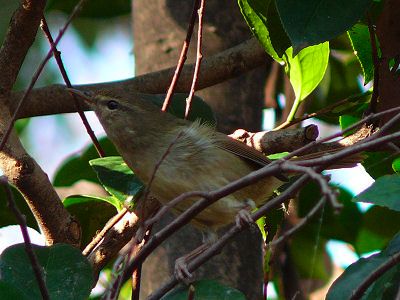
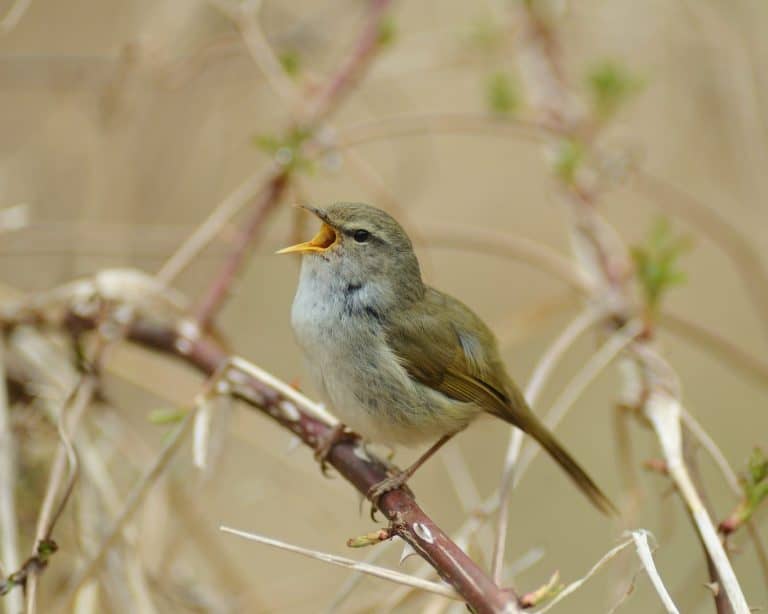
The Uguisu is solitary by nature and is also elusive.
©Cory / Creative Commons – Original
Uguisu are generally elusive and secretive by nature. They also prefer to conceal themselves in thick foliage in the daytime. They are also pretty solitary, and while they are quite adaptable in terms of elevation during the spring (being capable of living at low or high elevations), they prefer to live at lower elevations in winter. Depending on their location, they may also seek out warmer climes and migrate as the temperature drops. During colder months, they tend to be less active until spring comes around again. Since it is their breeding season, they can be heard singing in the hopes of attracting a potential mate.
Reproduction and Life Cycles
As far as birds go, Uguisu are not particularly long-lived. In general, they tend to have a lifespan ranging between 2 and 5 years in their natural habitat. Appearance-wise, both genders are pretty similar as opposed to certain species where males may have a brighter color of plumage compared to females. However, female Uguisu are smaller compared to their male counterparts. The latter uses their song in place of colorful plumage to attract a mate at the beginning of spring.
Afterward, the female Uguisu will lay a maximum of five small eggs in a bowl-like nest in thick foliage. The nest itself is made of leaves, twigs, or moss, and the bird will incubate those eggs until they hatch about three weeks later. The mother will care for the hatchlings herself for about a fortnight until they leave the nest.
Diet and Prey
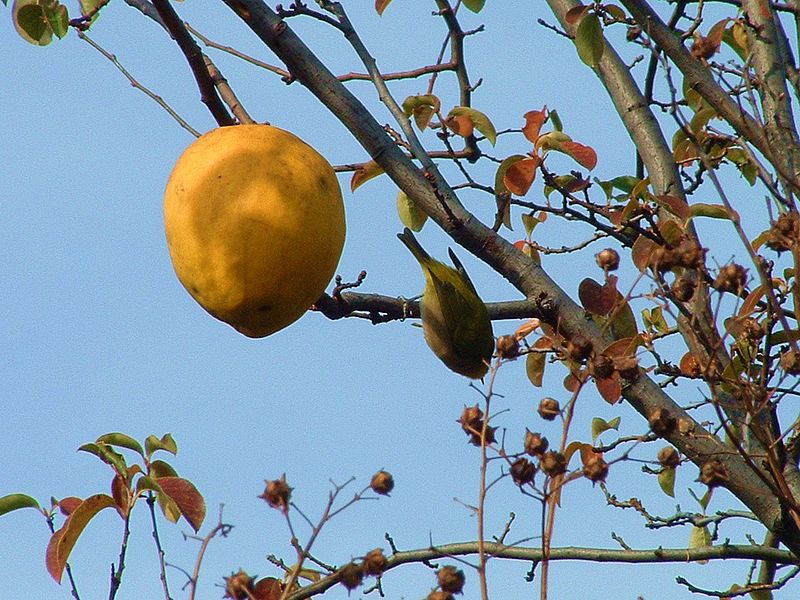
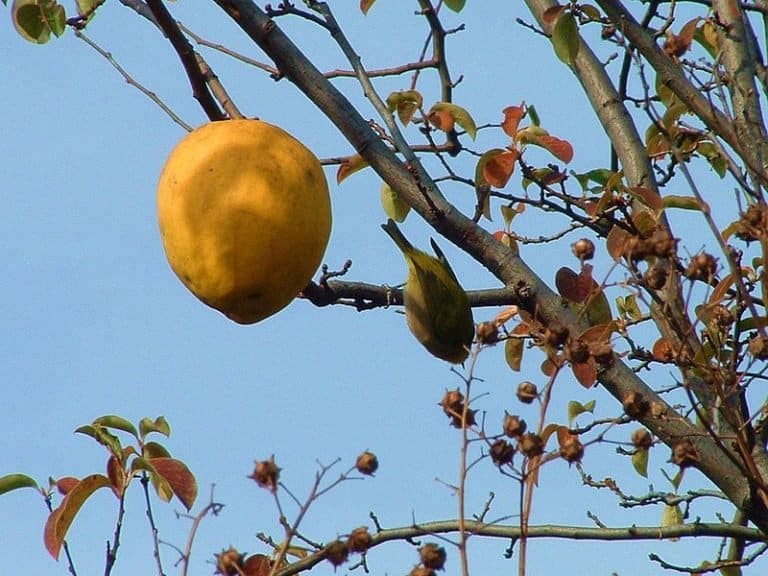
Uguisu are fond of fruit and insects.
©Alexander Mirochnik / Creative Commons – Original
Like several small birds, the Uguisu tends to be mainly insectivorous, although it will also nibble on plant matter, on occasion. As a result, it may be considered to be an omnivore. For the most part, beetles, moths, grasshoppers, and worms are some of its favorite foods. It also has something of a sweet tooth since it is also fond of berries and fruit, too.
Food is a key factor that influences the bird’s choice to migrate, since it becomes scarce during winter, and is more likely to be abundant at lower elevations.
Predators and Threats
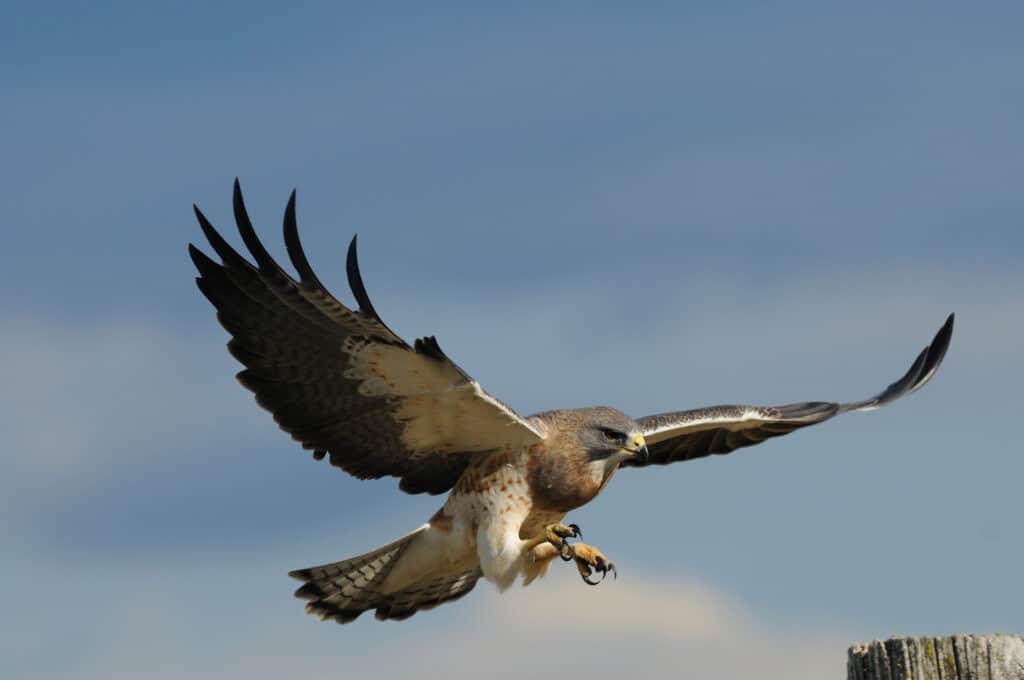
Birds of prey, such as hawks, may help themselves to a uguisu for dinner.
©Rob McKay/Shutterstock.com
There are several threats to the songbird’s safety. These include humans who are steadily encroaching on its natural habitat to build towns and cities. They also include its natural enemies out in the wild, including birds of prey, such as eagles, falcons, and hawks. Wild felines and canines also constitute a source of danger to the Uguisu, as do reptiles such as lizards and snakes.
That said, the bird itself does have a rather helpful feature, which enables it to avoid becoming food for larger carnivores while searching for tasty morsels under dense coverage. Thanks to its drab plumage, which enables it to blend in with its surroundings, it can be pretty difficult to spot by a hungry predator in search of a meal, feathery or otherwise.
Interesting Facts and Features
In addition to helping them find a mate, Uguisu also use their songs to declare their territory to their other relatives in the area. Because of their association with spring, they are known in Japan as the spring or Hanami birds. Other than their vocal ability, Uguisu are also treasured for another unlikely quality: their droppings, or their guano. As a matter of fact, these droppings were used by geishas and kabuki actors as a makeup remover and a skin care remedy. Uguisu droppings were also used as a fabric stain remover, particularly on silk, and to remove dyes from clothing.
Relationship with Humans
Logging and the clearing of land for cultivation are just a few factors affecting the habitat of the Japanese warbler. These threats aside, the Uguisu has played and continues to play a key role in Japanese culture and has been celebrated in poetry and works of art in the country on account of its beautiful singing. Unfortunately for the birds, they were also kept in cages as a result. At present, some of them are kept in facilities where they live free from the threat of predators and snack on organic seeds. There, they are farmed for their guano, which is sterilized and dried thoroughly before being packaged and sold for use in skincare.
Conservation Status and Life Today
The Uguisu’s presence in various countries and its ability to thrive at varying altitudes and habitats mean its natural range is rather extensive. As a result, it is classified on the IUCN Red List as Least Concern. However, in spite of its stable population in certain regions, concerns of deforestation affecting the species in other locations have also arisen.
Uguisu Pictures
View all of our Uguisu pictures in the gallery.

How to say Uguisu in ...
Sources
- David Burnie, Dorling Kindersley Animal, The Definitive Visual Guide To The World's Wildlife / Accessed May 5, 2011
- Tom Jackson, Lorenz Books The World Encyclopedia Of Animals / Accessed May 5, 2011
- David Burnie, Kingfisher The Kingfisher Animal Encyclopedia / Accessed May 5, 2011
- Richard Mackay, University of California Press The Atlas Of Endangered Species / Accessed May 5, 2011
- David Burnie, Dorling Kindersley Illustrated Encyclopedia Of Animals / Accessed May 5, 2011
- Dorling Kindersley Dorling Kindersley Encyclopedia Of Animals / Accessed May 5, 2011
- Christopher Perrins, Oxford University Press The Encyclopedia Of Birds / Accessed May 5, 2011
- Uguisu Facts / Accessed May 5, 2011
- Japanese Bush-Warblers / Accessed May 5, 2011
- Uguisu Distribution / Accessed May 5, 2011