U
Species Profile

Umbrellabird

Cephalopterus

Booming voices of the rainforest canopy
Wim Hoek/Shutterstock.com

Umbrellabird Distribution

Click a location to explore more animals from that region

Loading map...
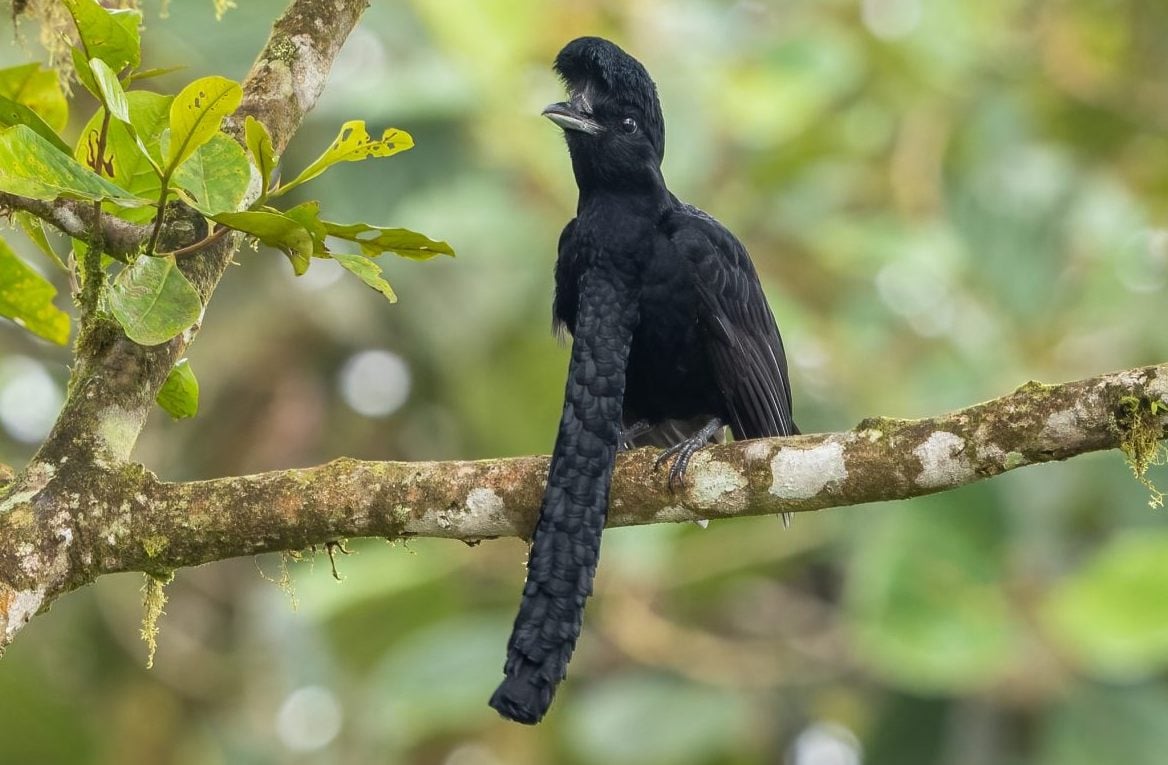
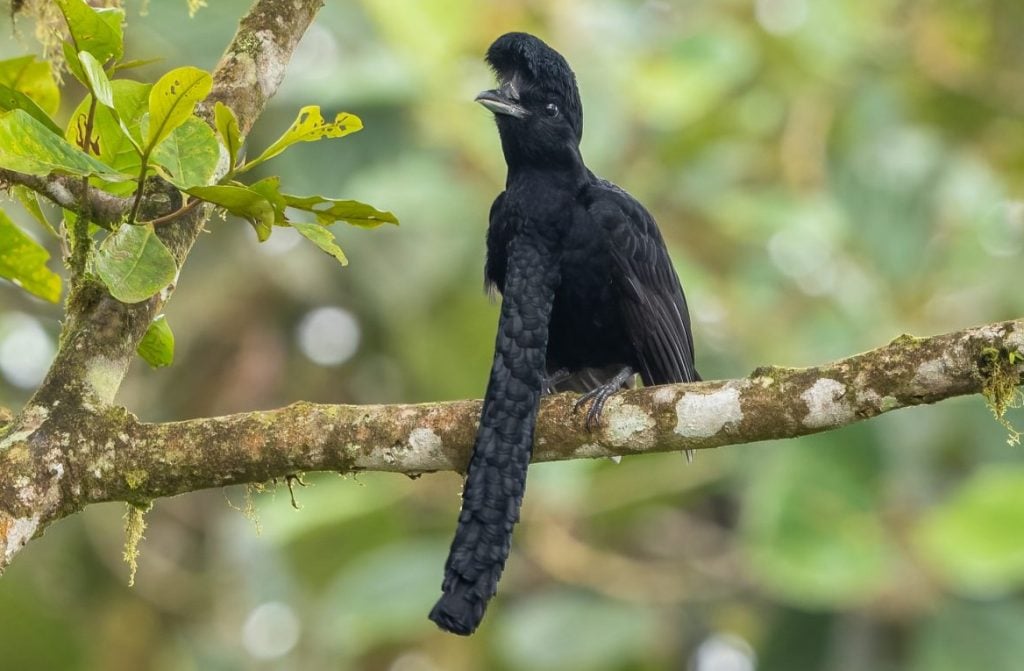
Long-wattled umbrellabird perched on a branch in the forest

At a Glance

Genus Overview This page covers the Umbrellabird genus as a group. Stats below are general traits shared across the genus.
Diet Omnivore
Activity Diurnal+
Lifespan 10 years
Weight 0.67 lbs
Status Vulnerable
Did You Know?

Across Cephalopterus, adults measure about 38-55 cm long and roughly 0.4-0.6 kg in mass.

Scientific Classification

Genus Overview "Umbrellabird" is not a single species but represents an entire genus containing multiple species.

Umbrellabirds are large, mostly black Neotropical cotingas (genus Cephalopterus) famous for males’ umbrella-like crest and inflatable throat wattle. They are primarily frugivorous forest birds with spectacular low-frequency booming courtship displays, often at traditional lek sites.

Kingdom
Animalia
Phylum
Chordata
Class
Aves
Order
Passeriformes
Family
Cotingidae
Genus
Cephalopterus

Distinguishing Features

  • Large black cotinga-like passerine
  • Prominent umbrella-shaped crest
  • Inflatable throat wattle in males
  • Deep booming courtship calls
  • Primarily fruit-eating forest canopy bird

Physical Measurements

Males and females differ in size

Length
1 ft 5 in (1 ft 2 in – 1 ft 8 in)
1 ft 5 in (1 ft 2 in – 1 ft 7 in)
Weight
1 lbs (1 lbs – 2 lbs)
1 lbs (1 lbs – 1 lbs)
Tail Length
6 in (5 in – 8 in)
Top Speed
28 mph
flying

Appearance

Primary Colors
Secondary Colors
Skin Type Feathers
Distinctive Features
  • Large passerines; ~41-55 cm total length across genus
  • Heavy-bodied silhouette with broad wings and thick neck
  • Male erectile, umbrella-like crest over forehead and bill
  • Inflatable throat wattle; size/shape varies strongly among species
  • Some species show extensive bare throat/neck skin
  • Stout bill adapted to swallowing large fruits
  • Mostly frugivorous; key seed dispersers in Neotropical forests
  • Booming, low-frequency calls; intensity and pitch vary by species
  • Courtship often at leks; structure varies from loose to traditional sites
  • Lifespan reported roughly ~10-20+ years; uncertain and variable by species
  • Primarily humid lowland to foothill forests; elevational range varies among species

Sexual Dimorphism

Males are larger and far more ornamented, with an erectile crest and an inflatable throat wattle used in booming lek displays. Females are smaller, darker-plainer, and lack or show reduced crest and wattle.

  • Prominent umbrella crest often obscuring much of the bill
  • Large inflatable throat wattle; length varies by species
  • More frequent display postures: puffing, wattle inflation, booming calls
  • Often occupies display perches at leks for extended periods
  • Crest minimal or absent; head profile smoother
  • Wattle absent or greatly reduced, not prominently inflatable
  • Overall more subdued, less bulky appearance
  • Typically avoids prolonged lek display perching

Did You Know?

Across Cephalopterus, adults measure about 38-55 cm long and roughly 0.4-0.6 kg in mass.

Male throat wattles vary by species, from short pendants to extremely long streamers reaching about 30-35 cm.

They're primarily fruit-eaters, swallowing large fruits whole and dispersing seeds far from parent trees.

Courtship includes very low-frequency booming notes that can carry through dense rainforest understory and canopy.

Most populations depend on intact forests; several species are threatened by habitat loss and hunting pressure.

Lifespan is poorly documented in the wild; captive individuals have been reported surviving into the teens, suggesting 10-20+ years potential.

Unique Adaptations

  • An expandable throat wattle acts like a visual signal amplifier, especially dramatic in long-wattled forms.
  • A dense, forward-drooping crest can be lifted into an "umbrella" shape, altering the bird's head silhouette.
  • Low-frequency vocal production helps signals travel farther in humid, cluttered forest habitats.
  • Wide gape and strong bill allow swallowing bulky fruits, enabling effective long-distance seed dispersal.
  • Dark, bulky plumage and still perching can make these large birds surprisingly hard to detect despite their size.

Interesting Behaviors

  • Males gather at traditional lek sites, where display intensity and lek size vary among species and regions.
  • During display, males raise the crest, inflate the wattle, and deliver slow, resonant booms between pauses.
  • Foraging is mostly solitary or in small groups, tracking seasonal fruiting trees across large forest areas.
  • Diet is fruit-heavy but can include insects or small animals opportunistically, varying with season and locality.
  • They often perch quietly for long periods, then make heavy, direct flights between fruiting trees and display areas.

Cultural Significance

Umbrellabirds are iconic rainforest "flagship" birds in the Neotropics, featured in natural history writing and ecotourism. Their leks and booming calls help motivate protection of large, fruit-rich forest landscapes.

Myths & Legends

The English name "umbrellabird" arose from early naturalists likening the male's raised crest to an open umbrella.

The genus name Cephalopterus comes from Greek roots meaning "head" and "wing/feather," referring to the striking crest.

In 19th-century European natural history collections, umbrellabird skins became emblems of distant, mysterious American rainforests.

You might be looking for:

Amazonian Umbrellabird

36%

Cephalopterus ornatus

Large black cotinga of the Amazon; males have a prominent umbrella-like crest and inflatable throat wattle used in booming displays.

Long-wattled Umbrellabird

34%

Cephalopterus penduliger

Chocó and Andean foothill species; males sport an exceptionally long pendulous throat wattle and deep resonant calls.

Bare-necked Umbrellabird

30%

Cephalopterus glabricollis

Central American species with a mostly bare throat/neck; inhabits humid forests and performs display booming at leks.

Life Cycle

Birth 1 chick
Lifespan 10 years

Lifespan

In the Wild
6–18 years
In Captivity
10–25 years

Reproduction

Mating System Polygyny
Social Structure Lek Breeding
Breeding Season Late dry to early wet season; varies
Breeding Pattern Transient
Fertilization Internal Fertilization
Birth Type Internal_fertilization

Across Cephalopterus, males gather at traditional lek display sites, booming and posturing to attract multiple females. Females select mates, then nest and provision young alone; pair bonds are brief or absent, with some display-site variation among species.

Behavior & Ecology

Social Congregation Group: 3
Activity Diurnal, Matutinal
Diet Omnivore palm fruits

Temperament

Shy
Wary
Cryptic
Territorial

Communication

low-frequency booms
deep grunts
short croaks
crest erection
wattle inflation
lek posturing
perch displays
pursuit flights

Habitat

Biomes:
Tropical Rainforest Wetland
Terrain:
Mountainous Hilly Valley Plains Riverine Coastal
Elevation: Up to 6561 ft 8 in

Ecological Role

Key canopy frugivores, occasional insect predators, across Neotropical wet forests.

seed dispersal forest regeneration insect population control

Diet Details

Other Foods:
Palm fruit Laurel fruits Fig Berries Aril

Human Interaction

Domestication Status

Wild

Cephalopterus umbrellabirds are not domesticated. Across the genus, humans mainly interact via habitat loss, limited hunting/capture, and ecotourism; large forest frugivores (~38-50 cm) with lek displays, living roughly ~10-20+ years in the wild.

Danger Level

Low
  • Painful pecks if handled
  • Scratches from feet/claws
  • Low zoonotic disease risk

As a Pet

Not Suitable as Pet

Legality: Generally illegal/restricted; protected wildlife trade controls apply.

Care Level: Expert Only

Purchase Cost:
Lifetime Cost: $20,000 - $60,000

Economic Value

Uses:
Tourism Research Conservation
Products:
  • ecotourism
  • education

Relationships

Predators 7

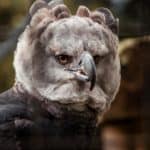
Harpy Eagle
Harpy Eagle Harpia harpyja
Crested Eagle Morphnus guianensis
Ornate Hawk-Eagle Spizaetus ornatus
Barred Forest-Falcon Micrastur ruficollis
Boa constrictor
Boa constrictor Boa constrictor
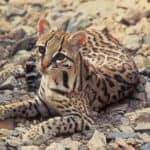
Ocelot
Ocelot Leopardus pardalis
Tayra Eira barbara

Related Species 6

Andean Cock-of-the-rock Rupicola peruvianus Shared Family
Guianan Cock-of-the-rock Rupicola rupicola Shared Family
Purple-throated Fruitcrow Querula purpurata Shared Family
Bare-necked Fruitcrow Gymnoderus foetidus Shared Family
Bellbirds Procnias Shared Family
Capuchinbird Perissocephalus tricolor Shared Family

Ecological Equivalents 5

Animals that fill a similar ecological role in their ecosystem

Toucan
Toucan Ramphastos spp. Large canopy frugivores; they swallow fruits whole and disperse large seeds.
Guans Penelope spp. Forest fruit-eaters that overlap in use of fruiting trees and in seed dispersal.
Pigeons
Pigeons Patagioenas spp. Primarily frugivorous; they track patchy fruit crops across forests.
Manakins Pipridae Lek-based courtship in forest habitats; despite size differences, they exhibit similar display ecology.
Piping-guans and chachalacas Cracidae Forest birds with loud vocalizations centered near display areas.

Types of Umbrellabird

3

Explore 3 recognized types of umbrellabird

Amazonian Umbrellabird Cephalopterus ornatus
Long-wattled Umbrellabird Cephalopterus penduliger
Bare-necked Umbrellabird Cephalopterus glabricollis

Quick Take

  • The Long-Wattled Umbrellabird must develop a 13-inch wattle to fulfill its specialized biological role.
  • Residing below 500 meters leaves the Amazonian Umbrellabird vulnerable to irreversible habitat fragmentation.
  • This Passerine defies typical migration patterns by moving vertically instead of traveling across the land.
  • Participating in a high-altitude Lek is the only way for the Umbrellabird to secure a mate.

Umbrellabirds have an umbrella-like crest on the top of their heads (for which they were named) and a tube-shaped inflatable pouch on their throats. They are the largest species of perching bird (Passerine) in South America, but populations are currently decreasing because of habitat loss.

A detailed infographic showcasing the anatomy, species types, and South American distribution of the Umbrellabird.
Part umbrella, part hippo, and 100% vital to the ecosystem. Witness the vertical survival story of South America’s most unusual perching bird. © A-Z Animals

Classification

The Umbrellabird is a large, tropical species of bird that is found inhabiting the rainforests of Central and South America. It is a cotinga, a member of the family Cotingidae, order Passeriformes. There are three different species of the genus Cephalopterus, all of which live in slightly different areas but are similar in appearance:

  • Amazonian (or Ornate) Umbrellabird (C. ornatus) — Amazon basin
  • Long-Wattled Umbrellabird (C. penduliger) — Ecuador and Colombia, west of the Andes
  • Bare-Necked Umbrellabird (C. glabricollis) — Panama and Costa Rica

Some scientists think that the Long-Wattled and Bare-Necked Umbrellabirds are subspecies of the Amazonian Umbrellabird.

Anatomy and Appearance
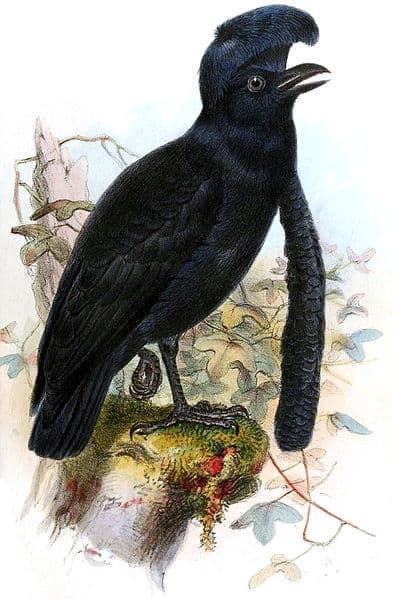
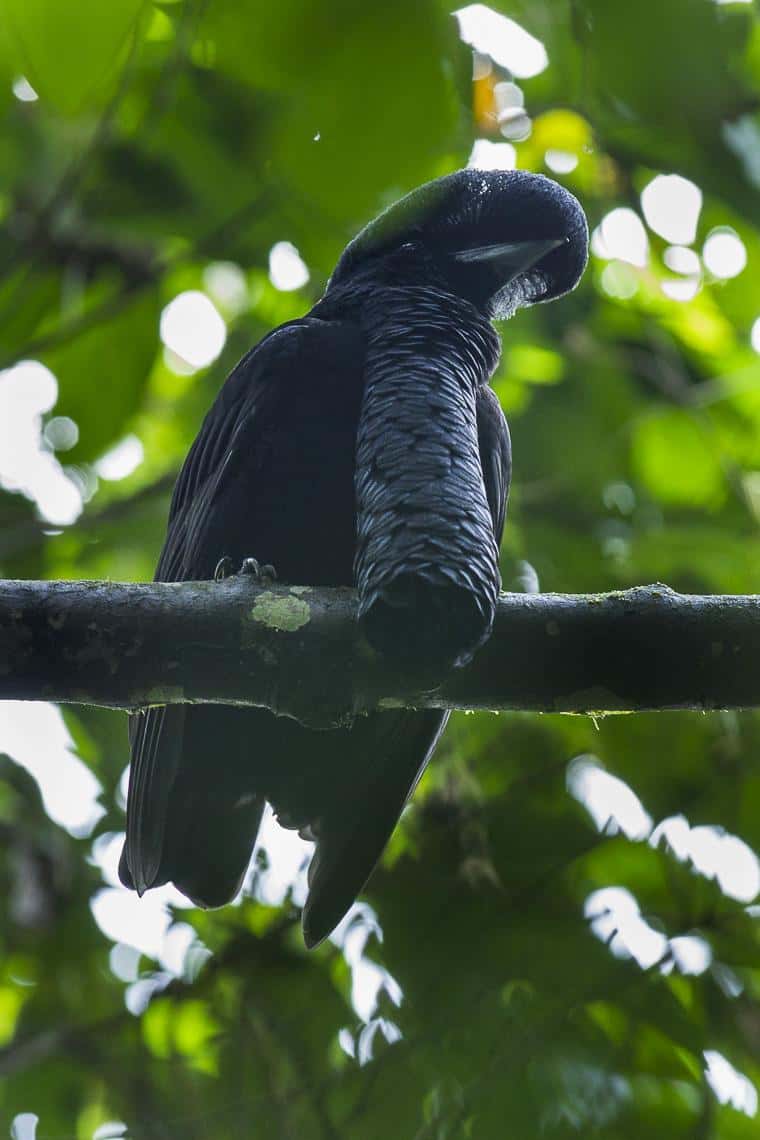
The Long-wattled Umbrellabird, Cephalopterus penduliger, has a wattle on its throat that can grow over 13 inches long.

The most distinctive feature of the Umbrellabird is the large crest on the top of its head. During mating, the males fan their crest out so that it nearly covers the whole of their head, and they then begin to make rumbling sounds to attract a female.

All three Umbrellabird species are similar in size, and their bodies are covered in mostly black feathers, but each subspecies has unique features. The Long-Wattled Umbrellabird has a wattle on its throat that can grow over 13 inches long; the males of the Amazonian Umbrellabird are thought to be the largest of all three species; the Bare-Necked Umbrellabird is easily distinguished by the reddish, featherless patch of skin on its throat and the small, red wattle.

Distribution and Habitat

The Umbrellabird is found throughout the sub-tropical belt of Central and South America, where they spend the majority of their time hopping between branches high up in the tree canopy. For most of the year, the Umbrellabird can be found inhabiting lowlands and mountain foothills, generally at altitudes less than 500 meters. During the breeding season, however, they migrate higher into the mountains where they gather in groups known as a “Lek” where they can find a mate. These breeding sites are usually in cloud forests that are between 800 and 2,000 meters above sea level. The Umbrellabird is known as an altitudinal migrant as it migrates up and down the mountains rather than across the land.

Behavior and Lifestyle
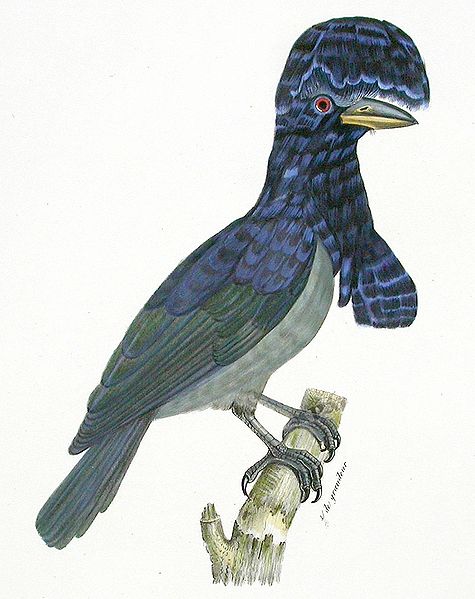
Cephalopterus ornatus, the Amazonian Umbrellabird, tends to hop from branch to branch, gripping with its clawed toes.

The Umbrellabird is generally a solitary animal that is known to cohabitate areas with other Umbrellabirds and similar species such as Woodpeckers. Its large size makes flying more difficult compared to other species, so it generally hops from branch to branch, gripping with its clawed toes. Although the Umbrellabird can fly short distances, it is relatively slow and clunky in the air. During the breeding season, however, these birds migrate to higher altitudes where they gather in small groups to choose a mate. Here, the male performs courtship displays for the female to watch before she picks a partner.

Reproduction and Life Cycles

Mating territories are occupied from March until June. Once paired up, the female constructs a relatively large nest from twigs, moss, and leaves inside a tree that is often far from the ground. This is thought to be to protect the nest from hungry predators that feed on the eggs of the Umbrellabird. The female then lays a single egg, which is incubated for only a month before it hatches, with the chick then being fed by its parents before it leaves the nest a couple of months later. Abandoned nests have been found alongside a current nest, indicating that females may even return to the same tree to lay their eggs every year. Umbrellabirds are thought to live for an average of 16 years in the wild.

Diet and Prey

Like many of the world’s tropical perching birds, the Umbrellabird is an omnivorous animal that feeds on what’s available in the tops of the trees. Fruits and small animals are the Umbrellabird’s primary sources of food. It eats a range of invertebrates such as insects and spiders, along with small frogs and birds. The Umbrellabird uses its strong toes to hold onto the branches while it picks fruits and berries with its curved beak. The quite long, black beak of the Umbrellabird is similar to that of a Raven and allows the Umbrellabird to snap up passing insects with ease. Since the Umbrellabird drops seeds from the fruit it eats across the forest, it plays a vital role in its native ecosystem.

Predators and Threats
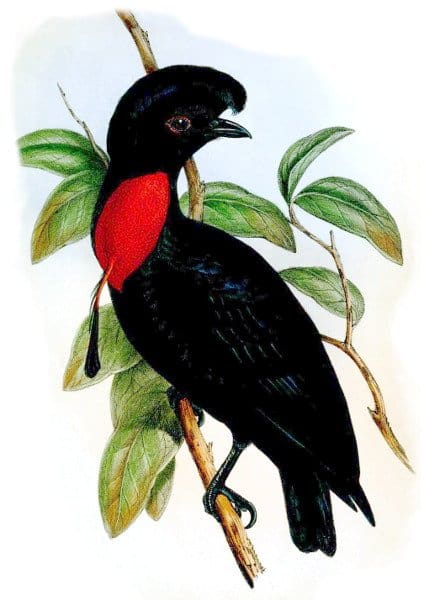
The Bare-necked Umbrellabird, Cephalopterus glabricollis, like other umbrellabirds, is threatened by habitat loss.

The Umbrellabird spends the majority of its time at the tops of trees, so ground-dwelling predators pose little threat to this unique bird. Arboreal animals, however, are a different story, often preying on the eggs and younger individuals that are a more manageable size. Monkeys and snakes are the primary predators of the Umbrellabird, along with large birds of prey such as hawks and eagles that can hunt from the air. The biggest threat to the Umbrellabird, however, is humans, who clear their native lowland forests, generally for agriculture.

Although all three species are being severely affected by habitat loss, the Bare-Necked Umbrellabird is considered the most threatened, being classified as Endangered, while the Long-Wattled Umbrellabird is Vulnerable.

Interesting Facts and Features

The distinctive throat pouch of the Umbrellabird inflates in males during the breeding season. The reason for this, it is believed, is to make their rumbling calls louder, making a booming sound that is said to sound like a hippo. The wattle is one of the characteristics that differ the most among the three species of Umbrellabird. The Long-Wattled Umbrellabird has a long black wattle (as its name suggests), while the Amazonian’s is shorter, and the Bare-Necked Umbrellabird’s is red in color and much smaller than the others.

The Umbrellabird’s existence was first recorded by Sir Alfred Wallace, a companion of Charles Darwin’s, in the 1800s while on an expedition to South America.

Relationship with Humans
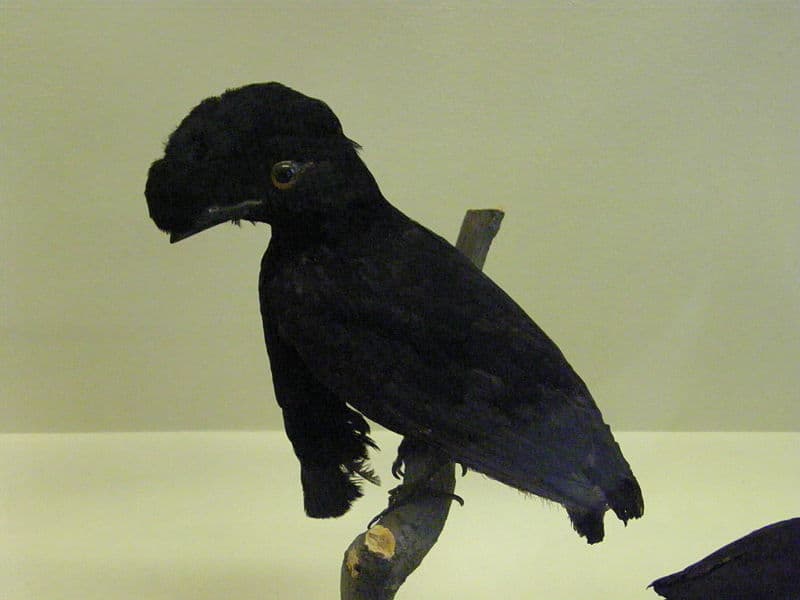
The Umbrellabird lives in the rainforest canopy and is rarely seen in open areas.

Because the Umbrellabird lives high in the rainforest canopy and is rarely seen in open areas, it can often be hard to spot during the non-breeding season when it is in the lowlands. Higher up in the mountain cloud forests, however, the breeding sites of the Umbrellabird have been known to be targeted by local hunters. It is the deforestation of the lowlands, where they spend most of their time, that has led to drastic declines in their population numbers. These areas are most commonly turned into pineapple and banana plantations that do not accommodate their arboreal lifestyle.

Conservation Status and Life Today

Today, the Long-Wattled Umbrellabird is listed as “Vulnerable“, while the Bare-Necked Umbrellabird is considered to be “Endangered.” However, the Amazonian Umbrellabird has been classified by the IUCN as Least Concern. All three species are under threat, nonetheless, mainly due to the loss of significant chunks of their natural habitats, with most of the remaining populations now found in protected areas.

View all 36 animals that start with U

Sources

  1. David Burnie, Dorling Kindersley (2011) Animal, The Definitive Visual Guide To The World's Wildlife / Accessed March 30, 2011
  2. Tom Jackson, Lorenz Books (2007) The World Encyclopedia Of Animals / Accessed March 30, 2011
  3. David Burnie, Kingfisher (2011) The Kingfisher Animal Encyclopedia / Accessed March 30, 2011
  4. Richard Mackay, University of California Press (2009) The Atlas Of Endangered Species / Accessed March 30, 2011
  5. David Burnie, Dorling Kindersley (2008) Illustrated Encyclopedia Of Animals / Accessed March 30, 2011
  6. Dorling Kindersley (2006) Dorling Kindersley Encyclopedia Of Animals / Accessed March 30, 2011
  7. Christopher Perrins, Oxford University Press (2009) The Encyclopedia Of Birds / Accessed March 30, 2011
  8. Neo Tropical Bird Club / Accessed March 30, 2011
  9. Avian Web / Accessed March 30, 2011
  10. Enchanted Learning / Accessed March 30, 2011
  11. Britannica / Accessed March 30, 2011
  12. The Alfred Russel Wallace Page / Accessed March 30, 2011
Thank you for reading! Have some feedback for us?


Umbrellabird FAQs (Frequently Asked Questions)

The umbrellabird is a large tropical bird found in the rainforests of Central and South America. It is named for the distinctive umbrella-shaped crest on top of its head.