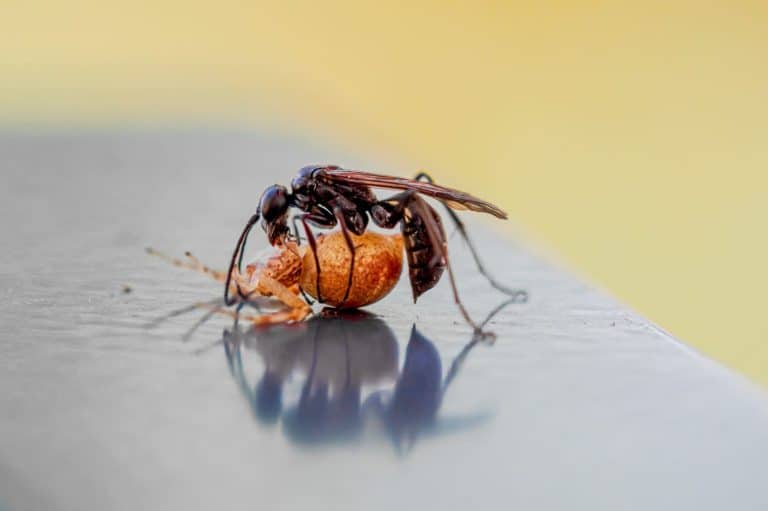
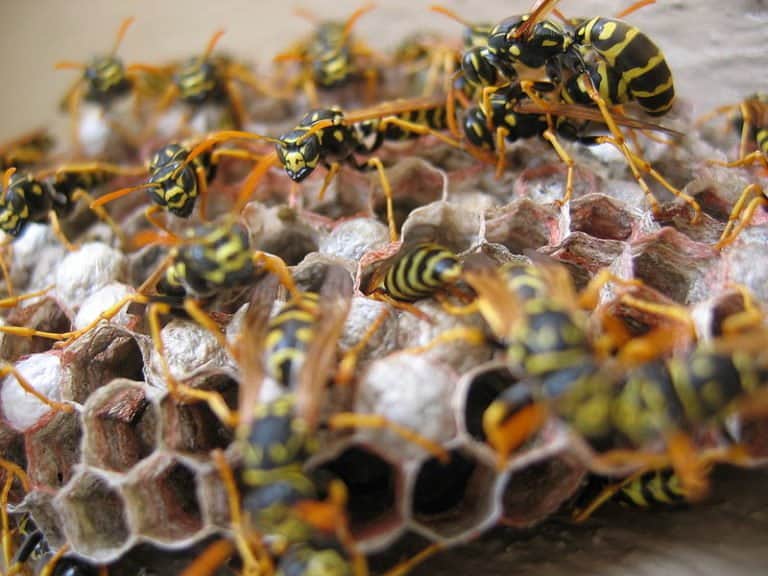
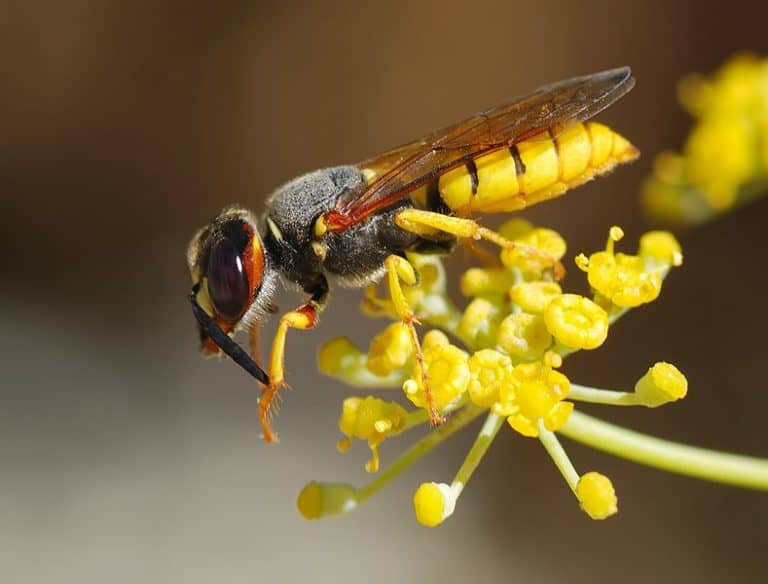
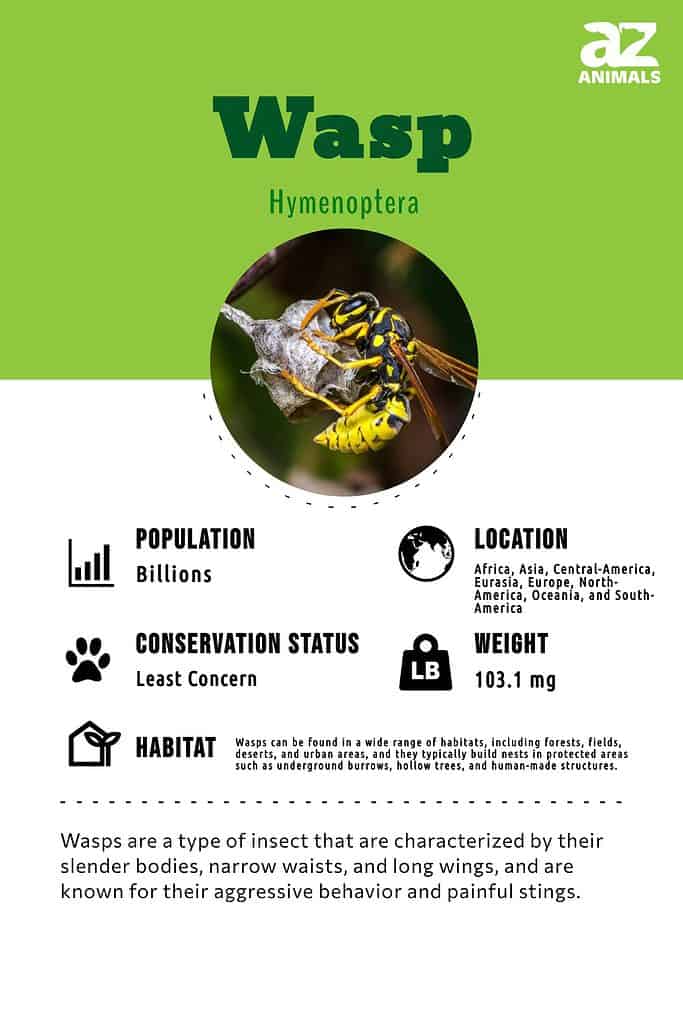
Most wasps build their nests from chewed-up wood or mud!
Wasps are some of the world’s most diverse creatures as this category of insects has more than 100,000 species worldwide. While most people think of wasps as aggressive insects that live in large colonies, the vast majority of wasps are peaceful, solitary creatures.
Although related to bees and ants, wasps are characterized by their slender, smooth bodies that have few hairs. They also have a narrow petiole or “waist” that attaches the abdomen to the thorax.
6 Incredible Wasp Facts
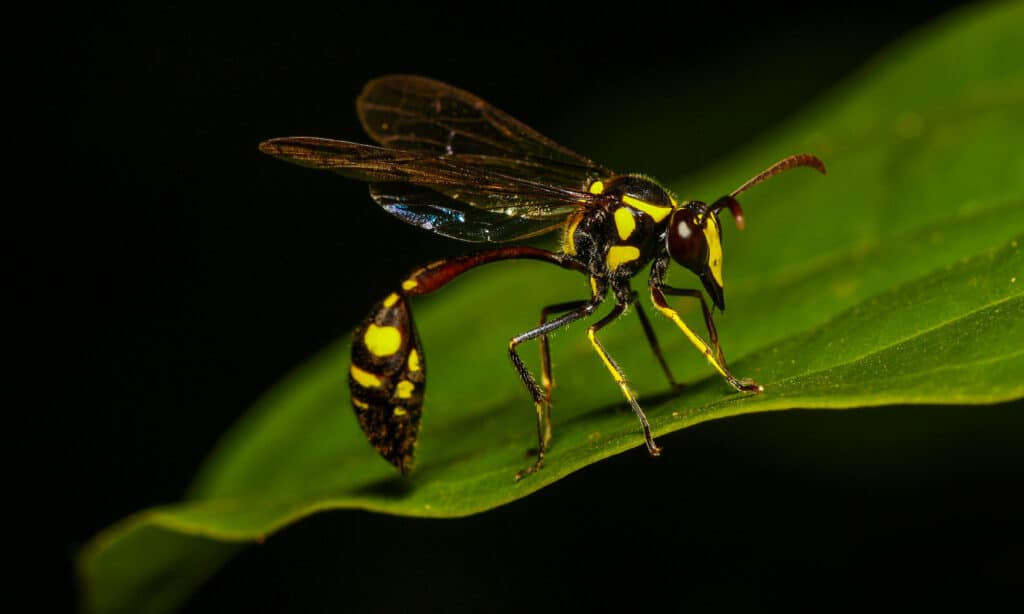
Wasps live all over the world, on every continent except Antarctica.
©Preecha Ngamsrisan/Shutterstock.com
- Wasps are classified into two types: social and solitary. Most wasps are solitary, meaning they prefer to live alone, while social wasps live in colonies of up to 10,000 individuals.
- Wasps live all over the world on every continent except Antarctica.
- Their venom contains a pheromone that makes other wasps more aggressive when they smell it.
- Wasps can repeatedly attack because their stinger is not barbed like those of bees.
- In later summer, young fertilized queens will burrow into an old log or inside other structures where they hibernate as all other wasps die off. In the spring, these queens start new colonies.
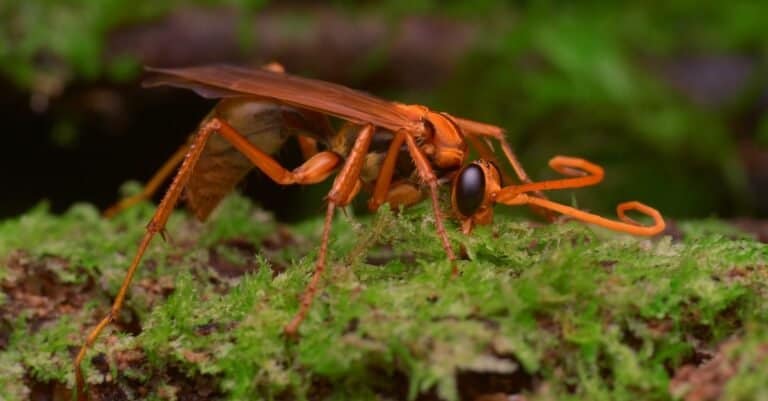
- The largest wasp in the world is the tarantula hawk, which can reach 2.7 inches in length. Tarantula hawks deliver a painful sting and have wingspans that can reach 4.5 inches.
Scientific Name
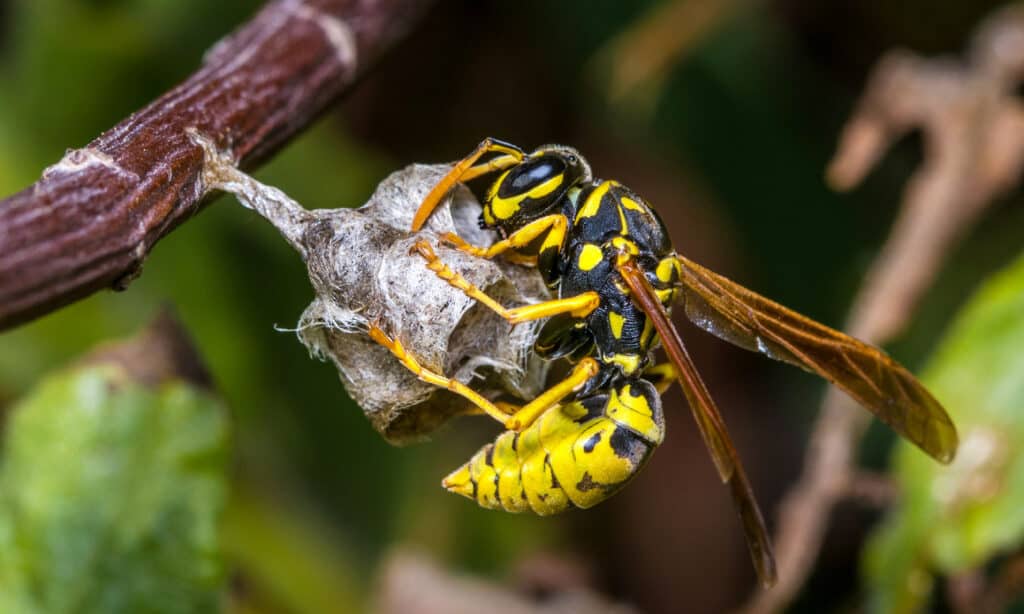
Wasps are insects that are members of the order Hymenoptera.
©JorgeOrtiz_1976/Shutterstock.com
Wasps are insects that are members of the order Hymenoptera and suborder Apocrita. Social wasps, the species that people are probably most familiar with, constitute about 1,000 species within the family Vespidae.
Yellowjackets, which include the eastern yellowjacket (Vespula maculifrons) the southern yellowjacket (Vespula squamosa), and the baldfaced hornet (Dolichovespula Immaculata) are part of the superfamily Vespoidea.
Species of wasps include hornets that nest above ground, as well as yellowjackets, a species that nests underground. Solitary wasps are also members of the superfamily Vespoidea but are also members of superfamilies Chrysidoidea and Apoidea.
Evolution and Origins
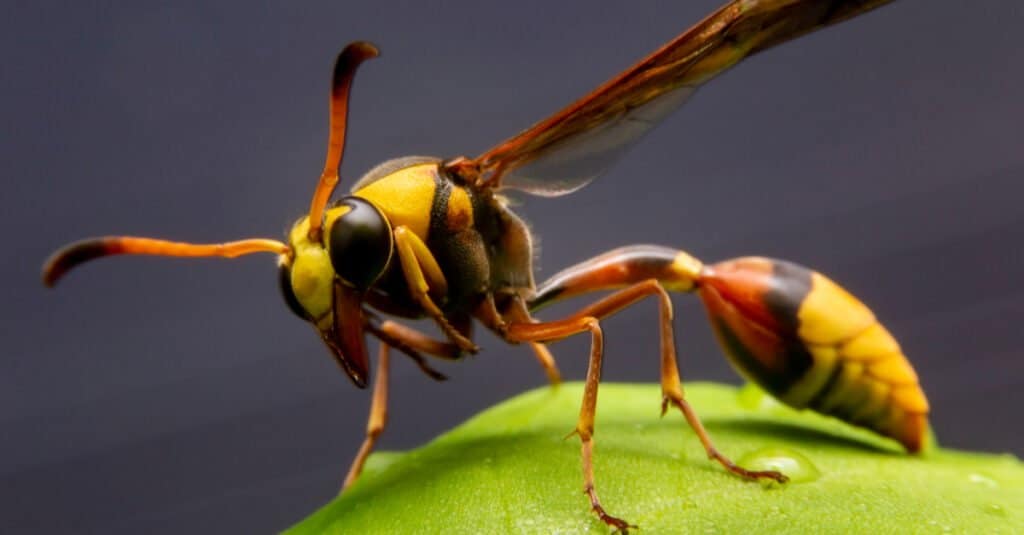
The evolution and origins of wasps can be traced back to the Jurassic period.
©Witsawat.S/Shutterstock.com
The evolution and origins of wasps can be traced back to the Jurassic period, around 150 million years ago, where they are believed to have evolved from a common ancestor with other Hymenoptera such as bees and ants.
Wasps have undergone a process of diversification, leading to the evolution of different subfamilies and genera, each with distinct characteristics and behaviors, such as hunting, scavenging, and social behavior.
The development of their venomous stingers, which are used for hunting and defense, is thought to have played a key role in their survival and success over time.
Different Types of Wasp
- Yellow jackets (Vespula and Dolichovespula spp.)
- Paper wasps (Polistes spp.)
- Hornets (Vespa spp.)
- Mud daubers (Sceliphron spp.)
- Cicada killers (Sphecius spp.)
- Tarantula hawks (Pepsis and Hemipepsis spp.)
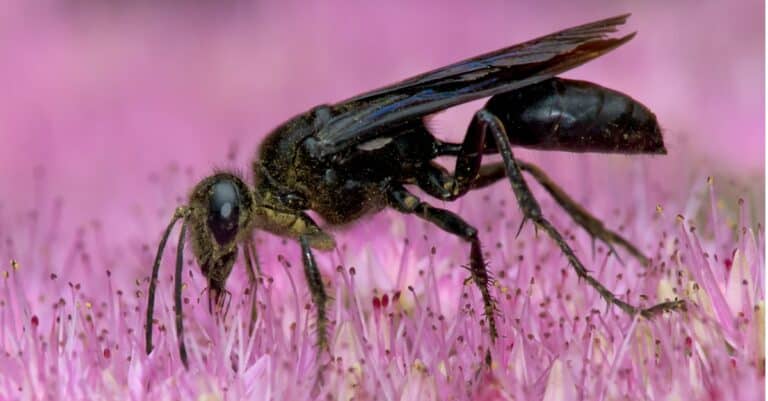
- Great black wasps (Sphex pensylvanicus)
- European hornet (Vespa crabro)
- Common wasp (Vespula vulgaris)
- German wasp (Vespula germanica)
- Asian giant hornet (Vespa mandarinia)
- Bald-faced hornet (Dolichovespula maculata)
- Black and yellow mud dauber (Sceliphron caementarium)
- Blue mud dauber (Chalybion californicum)
- Eastern cicada killer (Sphecius speciosus)
- European paper wasp (Polistes dominulus)
- Great golden digger wasp (Sphex ichneumoneus)
- Red wasp (Polistes carolina)
- Sand wasp (Bembix spp.)
- Velvet ant (Dasymutilla spp.)
- Western cicada killer (Sphecius grandis)
- Western paper wasp (Polistes fuscatus)
- Black and yellow argiope (Argiope aurantia)
- Black and red mud dauber (Sceliphron caementarium)
- Black and yellow garden spider (Argiope aurantia)
- Common Eastern bumble bee (Bombus impatiens)
- Eastern yellow jacket (Vespula maculifrons)
- European paper wasp (Polistes dominulus)
Appearance and Behavior
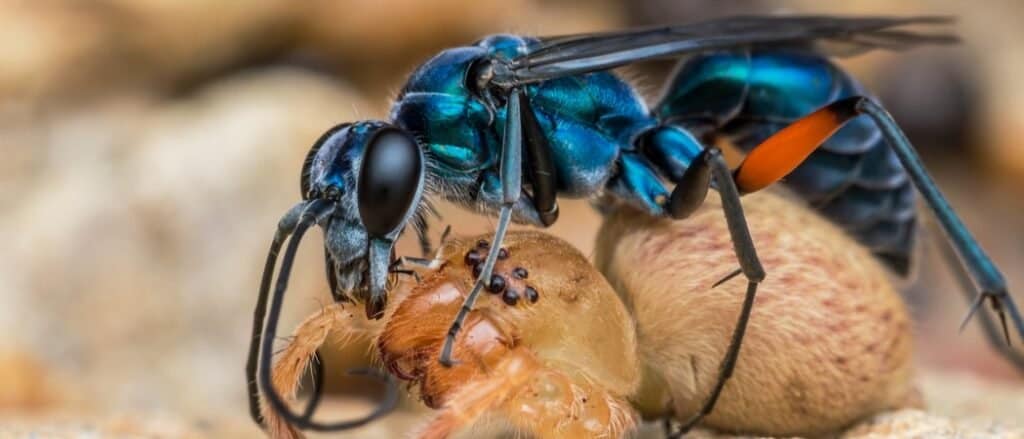
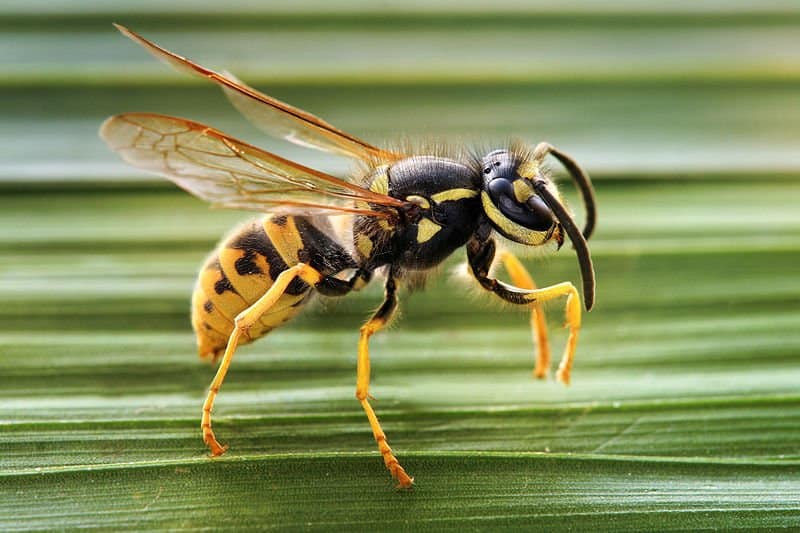
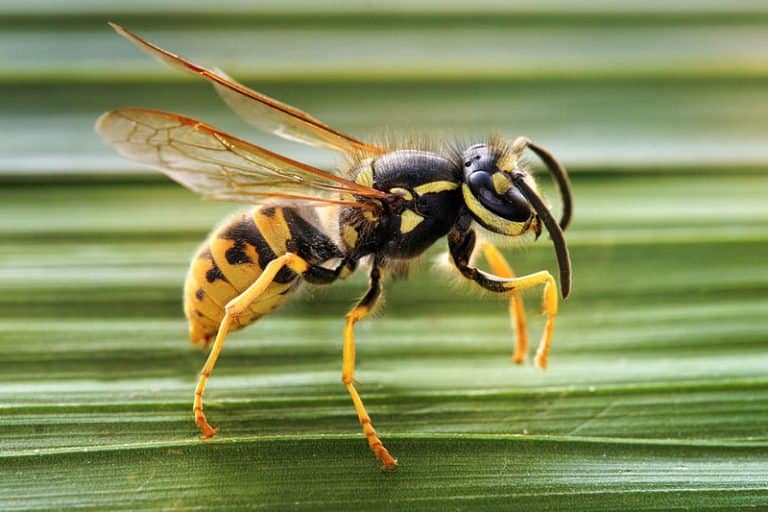
Many wasp species, particularly yellowjackets, have yellow and black markings, which is why many people commonly confuse them with bees.
©Ranjit_Mahara_Photography/Shutterstock.com
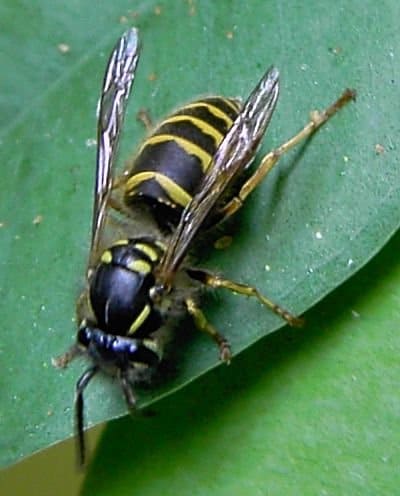
Many wasp species, particularly yellowjackets, have yellow and black markings, which is why many people commonly confuse them with bees. Although yellowjackets get their common name from their appearance, some subspecies have different colorations, encompassing almost every color.
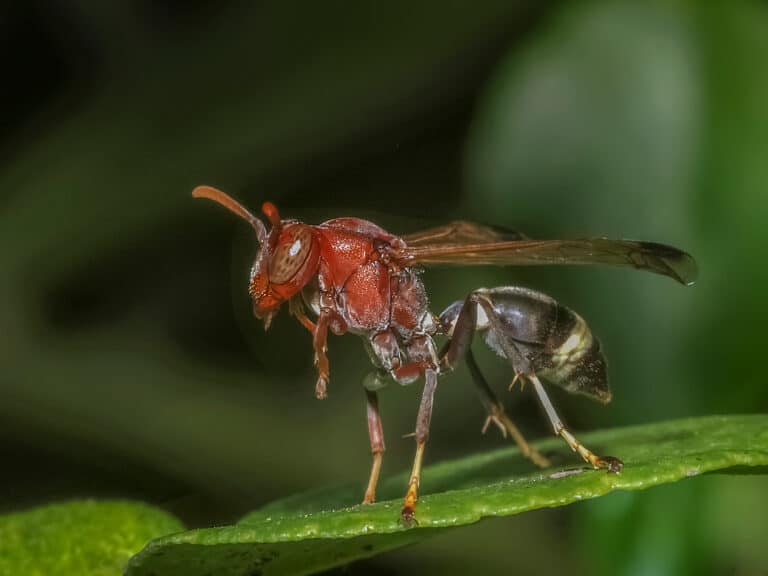
These insects can also be brown, metallic blue, and bright red, with the more brightly colored members part of the Vespidae stinging wasp family. Paper wasps, usually brown in color, are one of the more common species in North America and are similar to hornets and yellowjackets. They are semi-social creatures that live in small colonies but do not have a worker caste.
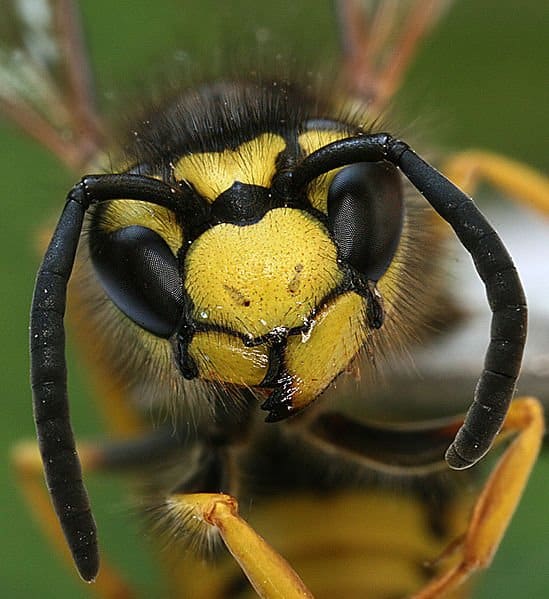
Their bodies have pointed lower abdomens and a petiole, a narrow waist that separates the abdomen from the thorax. In appearance, they are much thinner than bees. They also have biting mouthparts and antennae with 12 to 13 segments. Most species have wings. In stinging species, only females have a stinger, which is essentially a modified egg-laying structure that pierces and inserts venom into the victim.
In the Northern Hemisphere, these insects become most aggressive from August to October, as this is the time when their food supply changes, and young queens have left the colony to find new mates. It’s also the time when they are most likely to attack humans. Wasps also emit a pheromone when they are threatened, which is why you should never swat this insect after you have been stung, as this action will cause other wasps to attack.
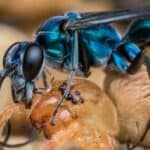
Species range in size from just over a half-inch to 1.8 inches long. Some of the largest members are solitary wasps such as cicada killers and the striking blue-and-orange tarantula hawks, both of which can grow up to 1.5 inches long.
The executioner wasp (Polistes carnifex) has the most painful and deadly sting of all wasp species in the world. Central and South America is home to this species, which is a type of yellow and brown paper wasp. However, the Schmidt Sting Pain Index also lists an attack by the warrior wasp as a Level 4 Pain, described as pure, intense, brilliant pain that can last for up to two hours. Most people recover after being stung by these insects, but those who are allergic to the venom can suffer significant side effects, even death.
Habitat
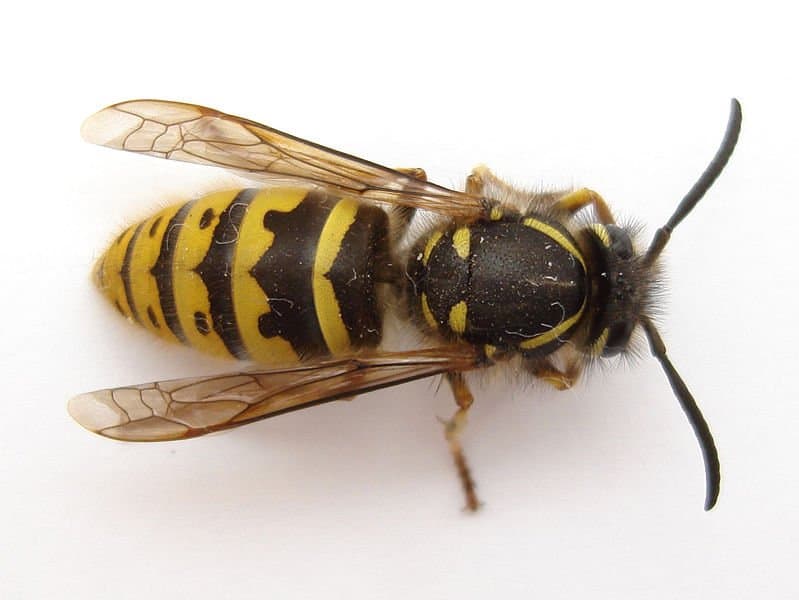
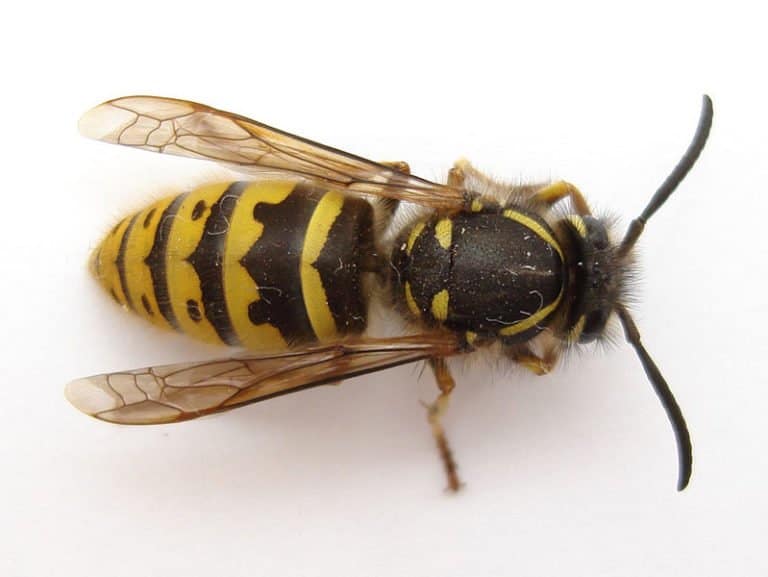
Wasp on a white background
©Trounce / Creative Commons – Original
All wasps build nests, and although their homes look similar to those constructed by bees, they are made of paper. They create their homes by chewing wood fibers to a pulp via their hard mandibles and then secreting the pulp into honeycomb shapes.
Other species such as potters or mason wasps, called mud daubers, use mud to build their homes, which look like long tubes. Favorite places to build homes include basements, sheds, and other dark, cool areas – where you are likely to have seen a wasp nest.
Thread-waisted wasps of the Apoidea superfamily have more diverse nesting habits, as you’ll find them in wood and pithy plant stems as well as mud homes. Spider wasps build their habitat in rotten wood or rock crevices.
Diet
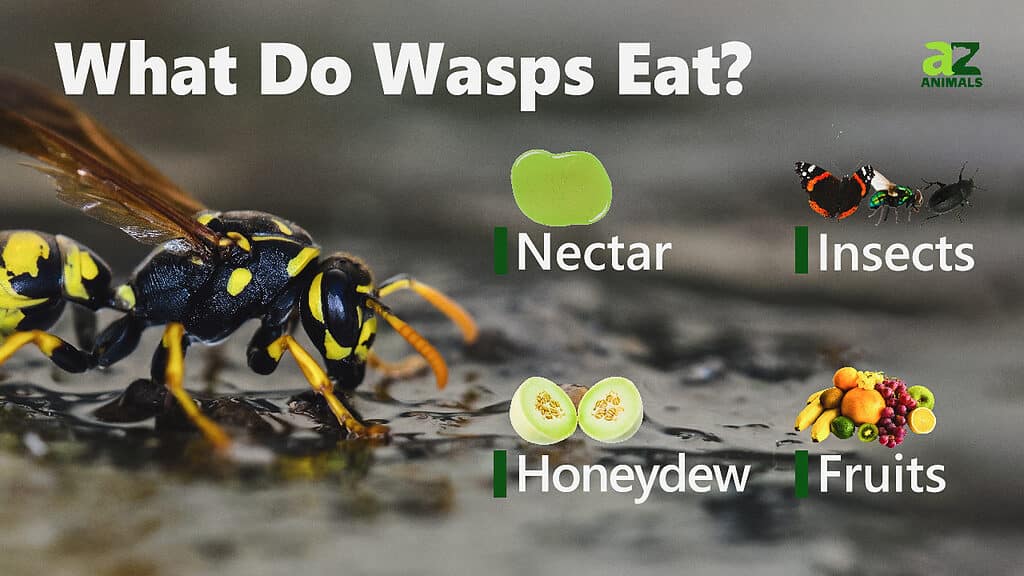
These insects are omnivores, meaning that they eat all kinds of food. Similar to bees, they prefer sweet foods such as nectar, honey, fruit, tree sap, and human food. Like bees, they often play a part in the pollination of plants in their search for nourishment.
However, they also eat almost every pest that harms crops, including grasshoppers, aphids, flies, caterpillars, and even bees as well as other garden pests, making them invaluable partners in the propagation of fruits and vegetables. They will often travel as far as a half kilometer from their nests when searching for food.
Predators and Threats
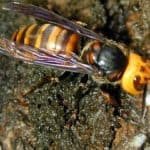
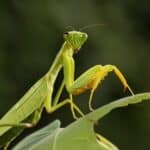
Wasps are preyed upon by many different types of animals throughout the world, including birds, reptiles, and amphibians. At least 24 bird species eat them, but they tend to hunt solitary species. Other insects that feed on them include praying mantises, dragonflies, robber flies, and even other wasps. Some mammals such as mice, rats, skunks, raccoons, weasels, wolverines, and badgers will also risk occasional wasp attacks to eat this insect.
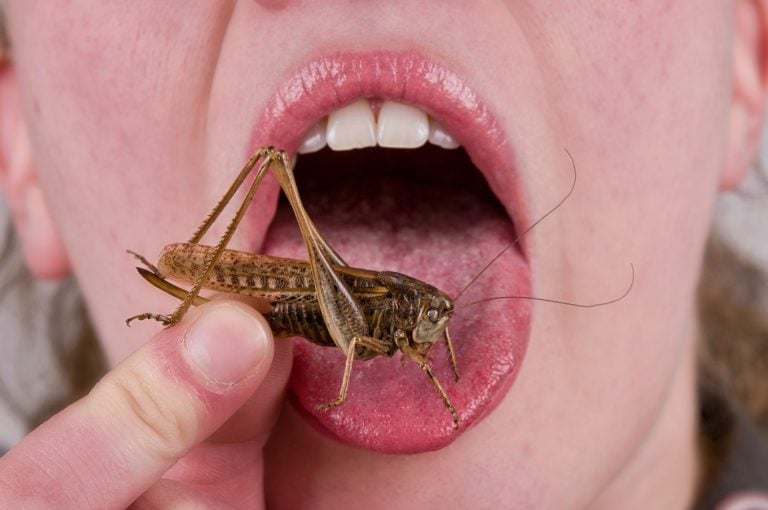
People in Japan and Laos eat larvae, which is considered a delicacy.
Reproduction, Babies, and Lifespan
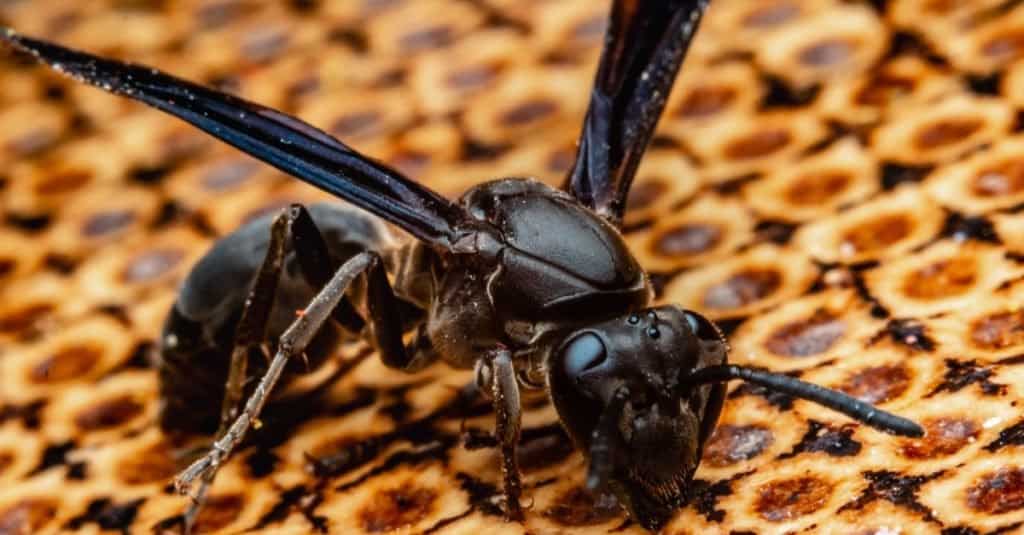
The life cycle varies slightly among each species, with a lifespan ranging from 12 to 22 days.
©JULIO CHINAZZO/Shutterstock.com
The life cycle varies slightly among each species, with a lifespan ranging from 12 to 22 days. Yellowjackets have a typical lifecycle that many other social wasps share. The lifecycle begins when a fertilized queen starts building her home, which is usually small at first. The first eggs hatch into female workers. Once these reach maturity, they continue building while the queen lays eggs and hatches additional workers.
Queens can lay eggs continually because they store sperm after mating with a male in the autumn. She uses the sperm repeatedly to grow her colony but usually runs out of stored sperm by the end of summer or early fall. The new males in the colony develop from the unfertilized eggs the queen lays at the end of summer.
Males leave to mate with new queens, after which they usually die. The worker females start dying in late summer and early fall too, leaving only the mated queens to survive the winter. Mated queens will then find a place to winter and remain dormant until the spring when they restart the cycle. Most queens only live one season.
Many, but not all, wasp societies have a caste system consisting of one or more queens, a few drones, and worker females. The colonies produced exist in one or more layers of paperlike cells made of chewed plant material mixed with saliva and regurgitated by the insect. In some species, the queens devote the rest of their lives to egg-laying and never emerge again.
Workers feed larvae a diet of masticated insects and other food, with caterpillars being a particular favorite. In autumn, workers construct larger cells for new queens, with larvae in these cells receiving higher amounts of food. Simultaneously, older queens begin to lay male eggs, with the drones mating with the new queens that will be the founders of the next year’s colonies. When the founder queens die, the workers begin to behave erratically until they all die off by the beginning of winter.
Solitary insects have a much different lifecycle. Generally, a lone female will mate and then prepare and provision one or more homes for her offspring, each containing cells for her young. The eggs hatch, with the larvae consuming the supplied food without leaving the cell. Following pupating, the new adult wasps emerge and seek mates. The males of most species have shorter lives and die after mating. The female goes on to continue the cycle.
Population
More than 110,000 of these insect species have been identified and scientists believe that another 100,000 await identification. A recent study discovered 186 new species in the rainforest of Costa Rica. Thus wasps are not in danger of becoming extinct anytime soon.
Common Types of Wasps
- Yellow Jackets – Yellow jackets are a common type of wasp in North America. Most yellow jackets have a banded yellow and black abdomen, although some are black and white or red and yellow. These insects are social, living in colonies of workers, drones, and queens.
- Cicada Killers – Cicada killers are a large species of wasp, growing up to 2 inches long, with a hairy black to the reddish thorax and a reddish brown abdomen with yellow stripes. These wasps are solitary insects and get their name from hunting cicadas.
- Hornets – Hornets are the largest of the social wasps, with some species reaching lengths of up to 2.2 inches long. These insects have stingers that are used to kill prey and protect their nests. A sting from a hornet will likely be more painful than that of a bee, and hornets can sting repeatedly without dying or losing their stingers.
- Paper Wasps – Paper wasps species vary in coloration, typically brown and yellow or red and brown, and have small waists and black wings. These wasps gather fibers from dead wood and plants to create paper-like nests. Unlike yellow jackets and hornets, these insects will only become aggressive if they (or their nests) are threatened.
- Mud Daubers – “Mud Dauber” is a common name that can be applied to wasps that build nests from mud. These slender wasps can reach lengths of about 1 inch and generally have black bodies with yellow markings. Mud dauber nests are cylindrical tubes that are commonly found in urban areas.
Wasp Pictures
View all of our Wasp pictures in the gallery.

Sources
- David Burnie, Dorling Kindersley (2011) Animal, The Definitive Visual Guide To The World's Wildlife / Accessed November 13, 2008
- Tom Jackson, Lorenz Books (2007) The World Encyclopedia Of Animals / Accessed November 13, 2008
- David Burnie, Kingfisher (2011) The Kingfisher Animal Encyclopedia / Accessed November 13, 2008
- Richard Mackay, University of California Press (2009) The Atlas Of Endangered Species / Accessed November 13, 2008
- David Burnie, Dorling Kindersley (2008) Illustrated Encyclopedia Of Animals / Accessed November 13, 2008
- Dorling Kindersley (2006) Dorling Kindersley Encyclopedia Of Animals / Accessed November 13, 2008