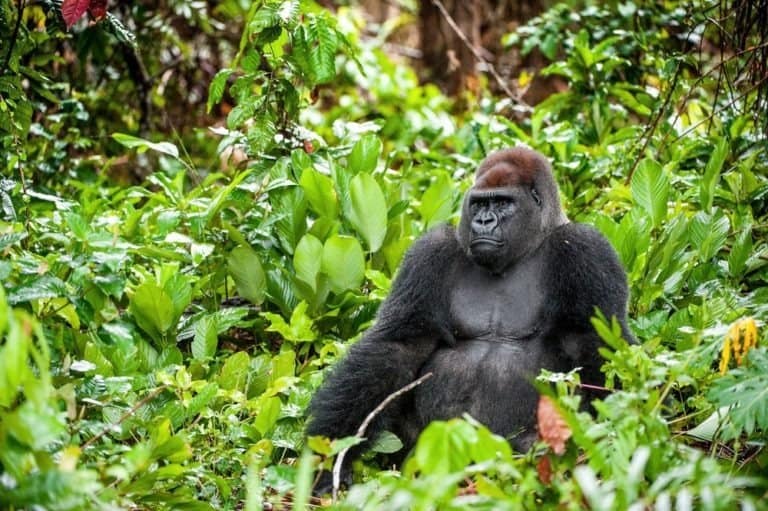







“The western lowland gorilla has been observed using basic tools in the wild in order to more effectively gather food“
The Western Lowland Gorilla is an intelligent animal sharing 98% of its DNA with that of humans. Perhaps the most famous Western Gorilla of all time is Koko, the gentle great ape who learned American sign language and taught the world that animals have thoughts and feelings too. Koko had a vocabulary of around 1,000 words – similar to that of a human toddler. She also shared a love of cats with her human friends and had several pet cats throughout her lifetime. Koko was believed to represent what language may have been five million years ago for people. That was the time that gorillas and humans separated in evolution – each following their own paths.
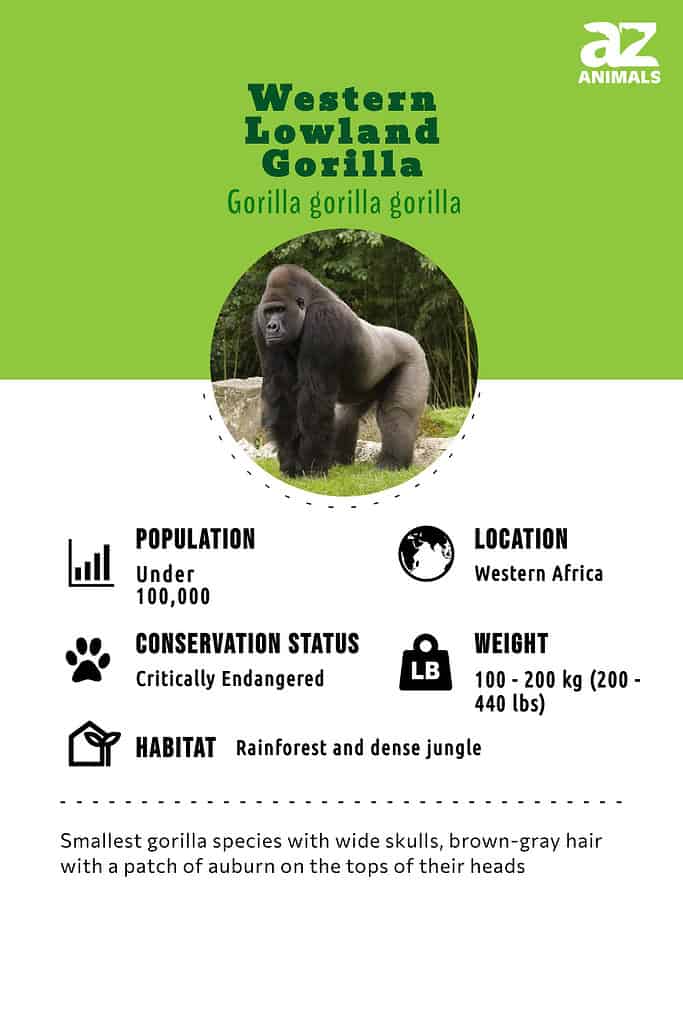
The scientific name of the Western Lowland Gorilla is Gorilla gorilla gorilla, and they are the smallest of the gorilla subspecies weighing anywhere from 220 to 400 pounds.
The Western Lowland Gorilla lives for an average of 50 years but has a high infant mortality rate. Females give birth to offspring every four years, coming into maturity at around 10 years of age. This means that while they may give birth to about 10 offspring in their lifetime, only two or three of those babies reach adulthood.
The critically endangered population of the Western Lowland Gorilla suffers from habitat loss and poaching. Due to differences in their immune system, the gorillas also die from illnesses that humans wouldn’t and are even more susceptible to illnesses that make humans gravely ill.
Incredible Western Lowland Gorilla Facts!
- We share around 98% of our DNA with gorillas. Despite our similarities, even the common human cold can have a detrimental impact on gorillas; they don’t have the necessary immunity to ward off something so simple. It’s amazing what a 2% difference makes.
- The Western Lowland Gorilla has the smallest family group of gorillas, with an average of 4 to 8 members. Other gorillas species may have up to 50 members in a group.
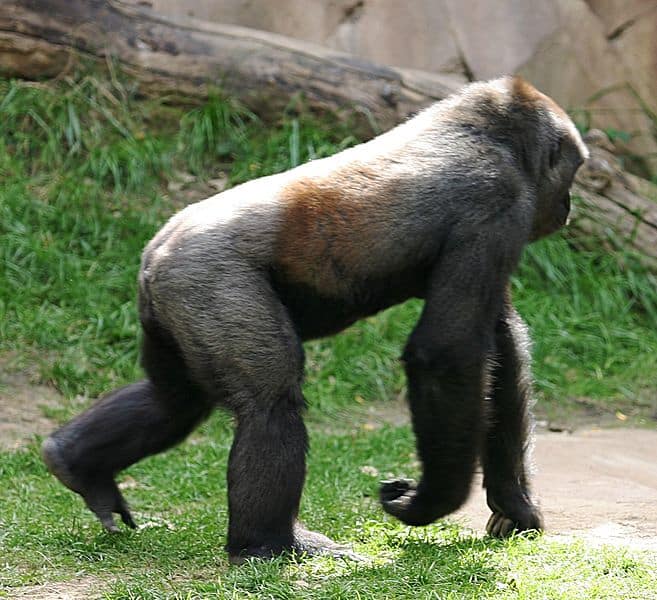
- Western Lowland Gorillas walk on all fours and use knuckles to carry the weight of their heads and torsos.
- Female Western Lowland Gorillas are able to give birth at 10 years old.
- The Western Lowland Gorilla is very intelligent and can even learn to use sign language to communicate with people and other gorillas.
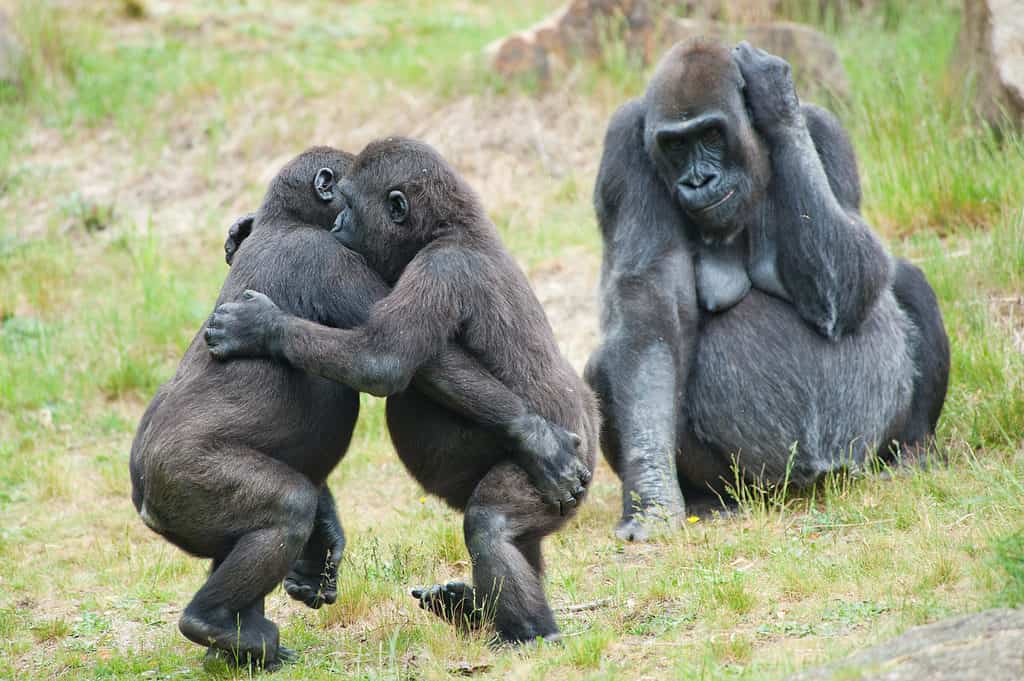
Western lowland gorillas live in the smallest groups of the four gorilla subspecies with only 4 – 8 members.
©Eric Gevaert/Shutterstock.com
Scientific Name
- Genus: Gorilla
- Species: Gorilla gorilla
- Scientific name: Gorilla gorilla gorilla
The etymology of the word gorilla derives from the word ‘gorillai’, a Greek Translation of Periplus of Hanno, written in Punic. It talks about a tribe of hair people. The Punic word for Gorilla that the Greeks borrowed is, in turn, a word borrowed from a language native to West Africa. The Mpongwe of Gabon call the gorilla ‘G’guyla’, and the Fang calls them ‘N’gil’.
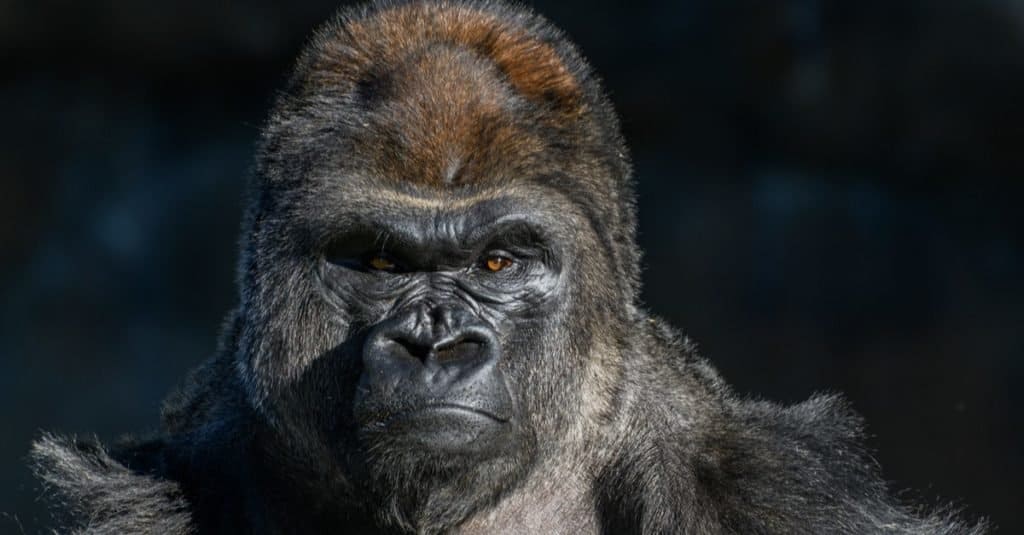
The Western Lowland gorilla is the nominate subspecies of the Western gorilla.
©Jeff W. Jarrett/Shutterstock.com
Species
The Western Lowland Gorilla is the nominate subspecies of the Western gorilla, and the smallest of the four gorilla species.
Western Gorilla (Gorilla gorilla)
- Western lowland gorilla (G. gorilla gorilla)
- Cross River gorilla (G. g. diehli)
Eastern Gorilla (Gorilla beringie)
- Mountain gorilla (G.beringei beringei)
- Eastern lowland gorilla (G. b. graueri)
Evolution
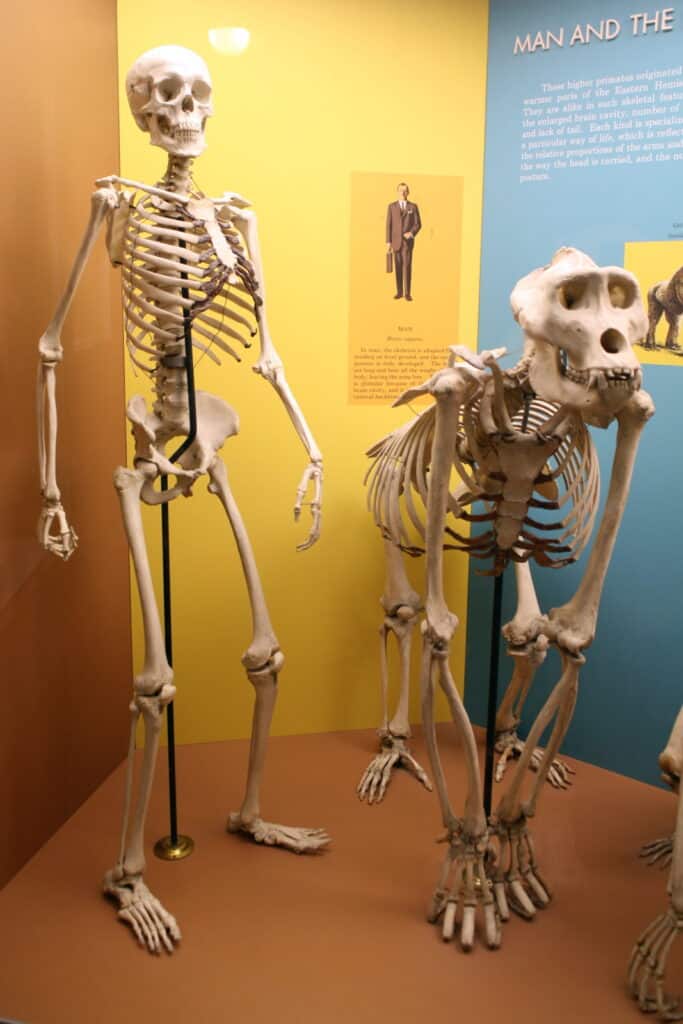
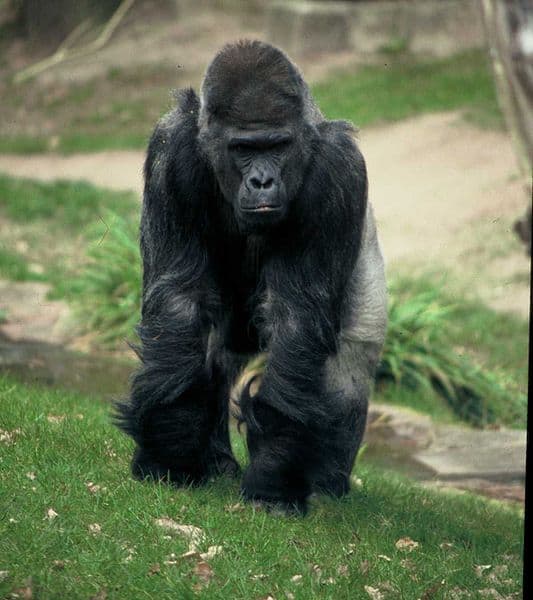
Gorillas are closely related to humans and share many traits.
©Cliff from Arlington, Virginia, USA, CC BY 2.0, via Wikimedia Commons – Original / License
Although not much is known about the evolution of gorillas, they are closely related to humans and chimpanzees. They all diverged from a common ancestor about 7 million years ago. Human gene sequences differ from gorilla sequences by only 1.6% on average.
Gorillas were previously thought to be a single species with three subspecies (Western lowland, eastern lowland, and mountain gorillas), but it is now agreed that there are two main species, the Western gorilla, (Gorilla gorilla) and the Eastern gorilla (Gorilla beringei), and they each have two subspecies. Western and Eastern gorillas split into two groups around 77,700 years ago.
Appearance
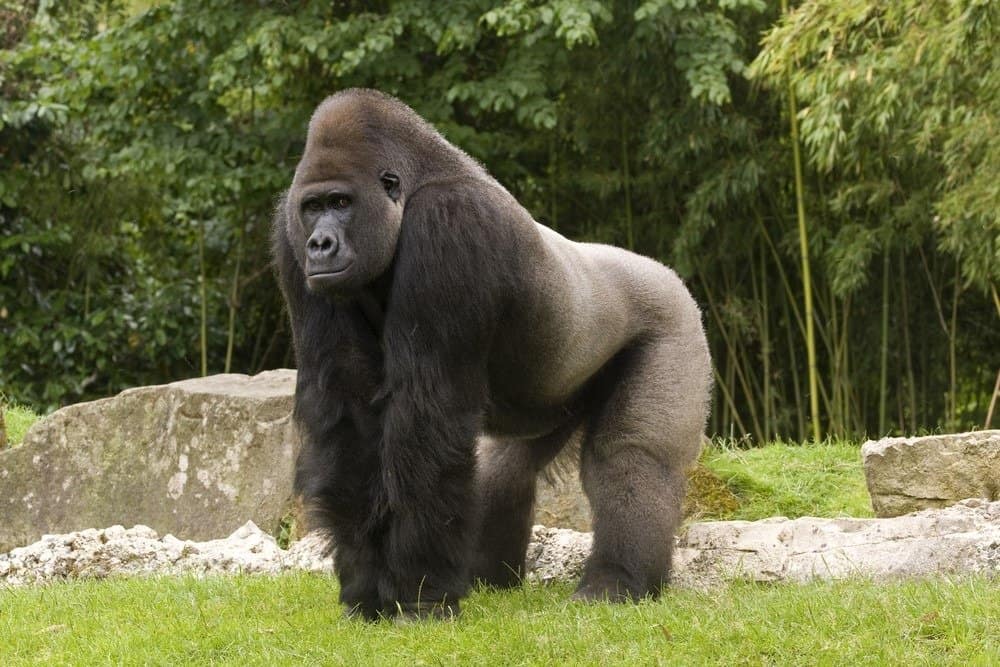
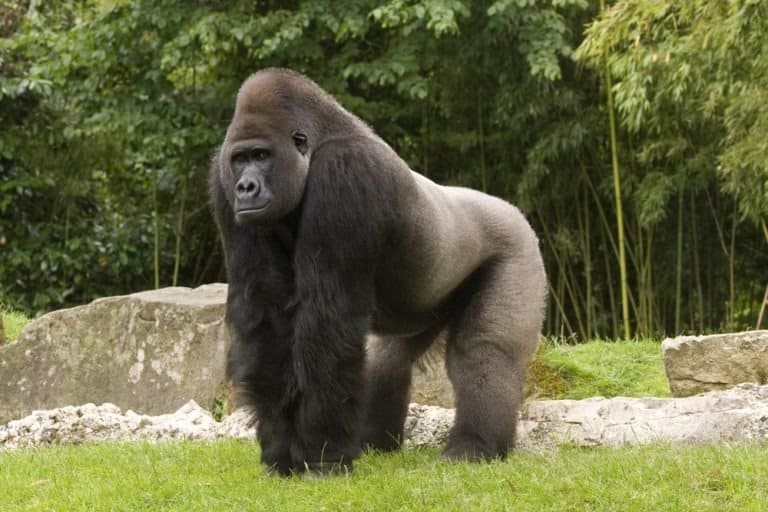
Compared to other gorilla subspecies, the Western Lowland Gorilla is smaller and weighs less. They weigh anywhere from 220 to 440 pounds, while their Eastern counterparts weigh 450 – 500 pounds.
The height of the Western Lowland Gorilla ranges from 4.7 to 5.5 feet, ranging from a child’s height or the average adult human height. Like other great apes, these gorillas have opposable thumbs, making using tools and other activities much easier.
They have wider skulls than other gorillas, and their brow ridges are more pronounced. It is also far easier to distinguish the females from males in Western Lowland Gorillas as the females are almost half the size of silverbacks.
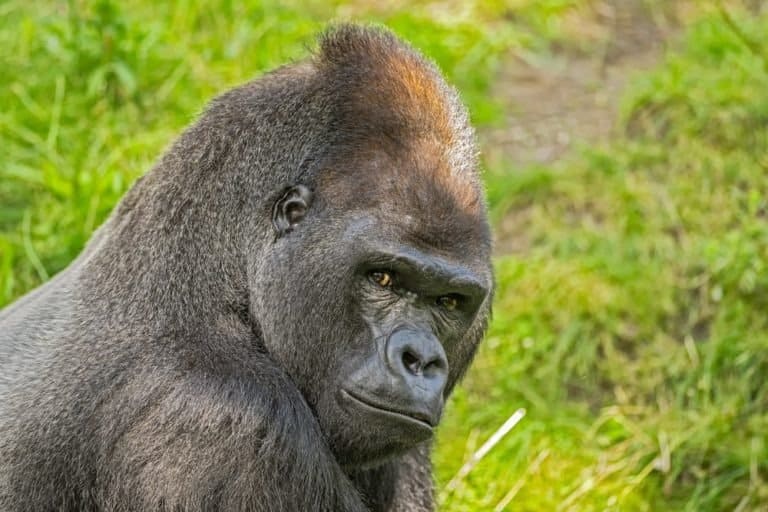
The Western Lowland Gorilla’s hair is a brown-gray color, with a little bit of red or auburn on top of its head. Male Western Lowland Gorillas have a patch of whitish hair that extends to their thighs, hence the name Silverback.
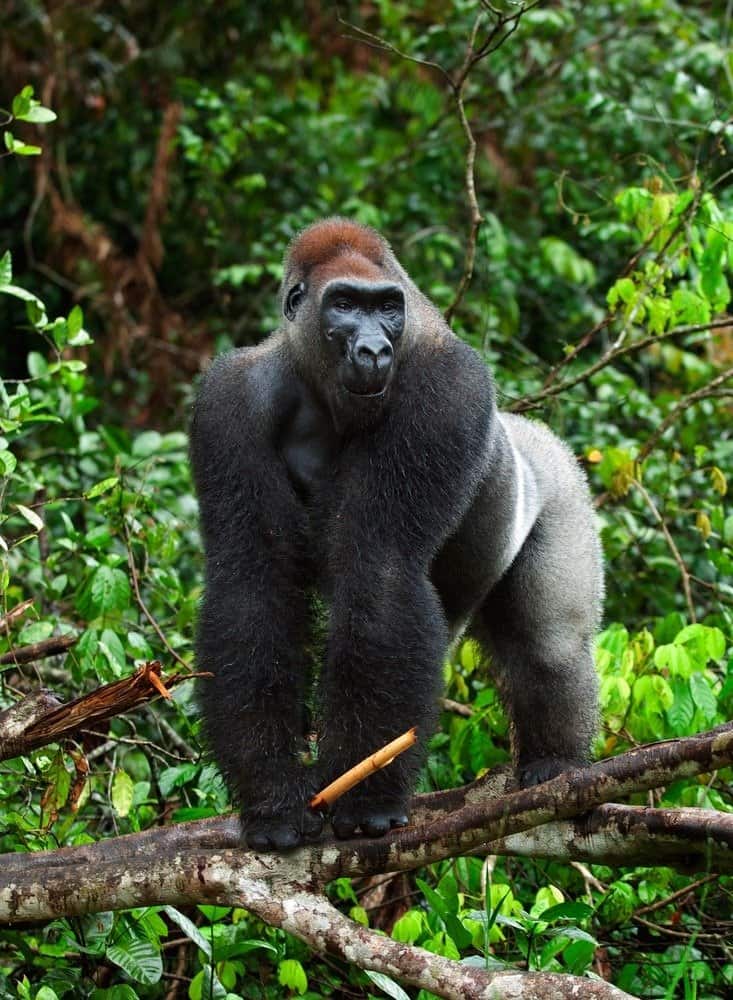
Western Lowland gorillas are smaller than their Eastern counterparts.
©Sergey Uryadnikov/Shutterstock.com
Behavior
The Western Lowland Gorilla is primarily a peaceful animal that prefers to avoid conflict. However, the dominant male will show signs of aggression to protect the group from outsiders. When offspring mature, they are ready to leave the group they were born into and find a mate.
This happens when the female is about eight years old and chooses the leader they want to join based on the range of their territory and the lead silverback’s size. When males mature, they either try to replace the silverback in an established group or spend a few years on their own until a few unrelated females join the male.
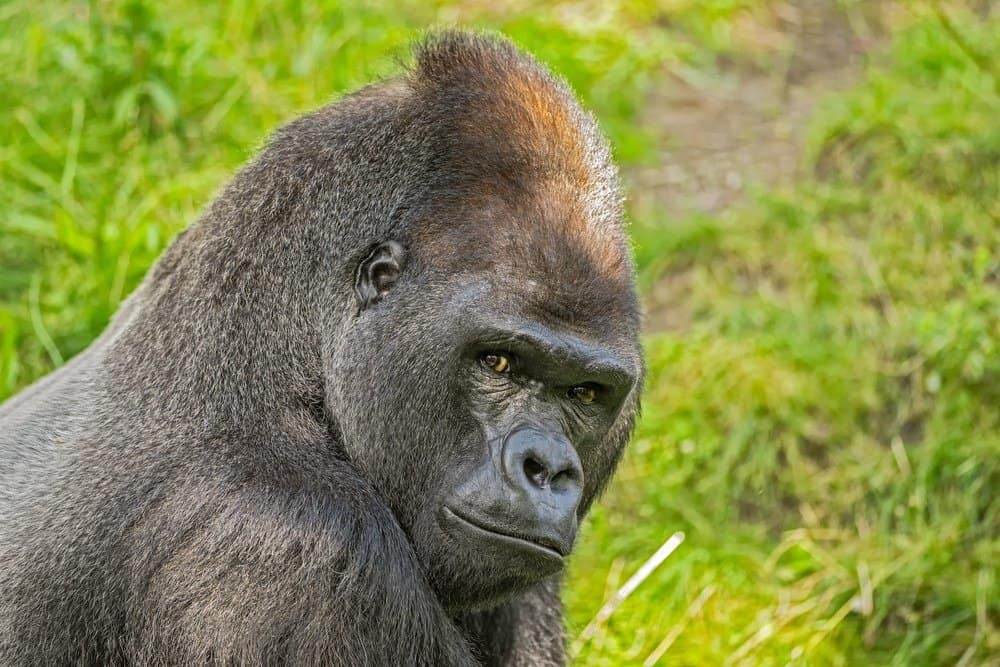
Alpha-male silverbacks are the absolute leaders of their group.
©Nick Fox/Shutterstock.com
A silverback male has breeding rights to all the females, but he also allows the other males who haven’t reached maturity to mate with the females as well. As the leader of the group, he chooses what time they eat, what time they wake up, what time they go to sleep, the area where they live, and takes care of any disputes the group members may have with each other.
These gorillas never attack unless they are provoked, but males do fight over females, and when there is a new leader in the group, they will kill unrelated infants. When there is an aggressor or a challenger, an adult male will stand on his legs, roar, and scream while slapping his chest. If the intruder doesn’t get the message or ignores it, this will result in the male may throw his head back several times and then charges on all fours toward the intruder.
Habitat
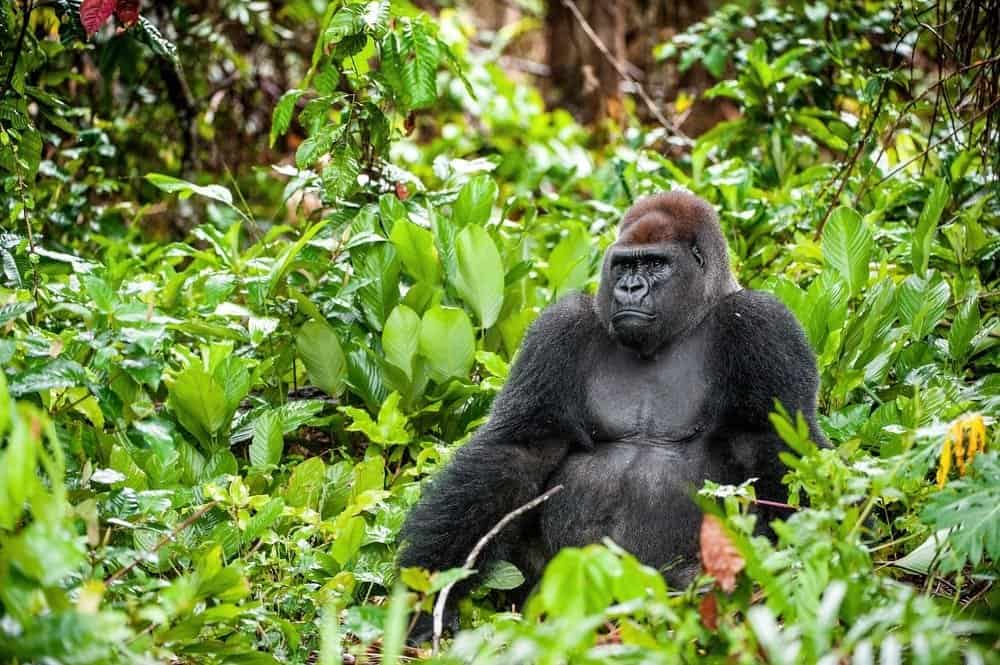
Western Lowland gorillas live in the tropical rainforests of Western Africa.
©Sergey Uryadnikov/Shutterstock.com
In the wild, the Western Lowland Gorilla lives in the tropical rainforests of western Africa. The range of these animals includes the countries of Cameroon, Gabon, Angola, Central African Republic, Democratic Republic of Congo, and Equatorial Guinea. The territory of the Western Lowland Gorilla spans more than 270,000 square miles.
Diet
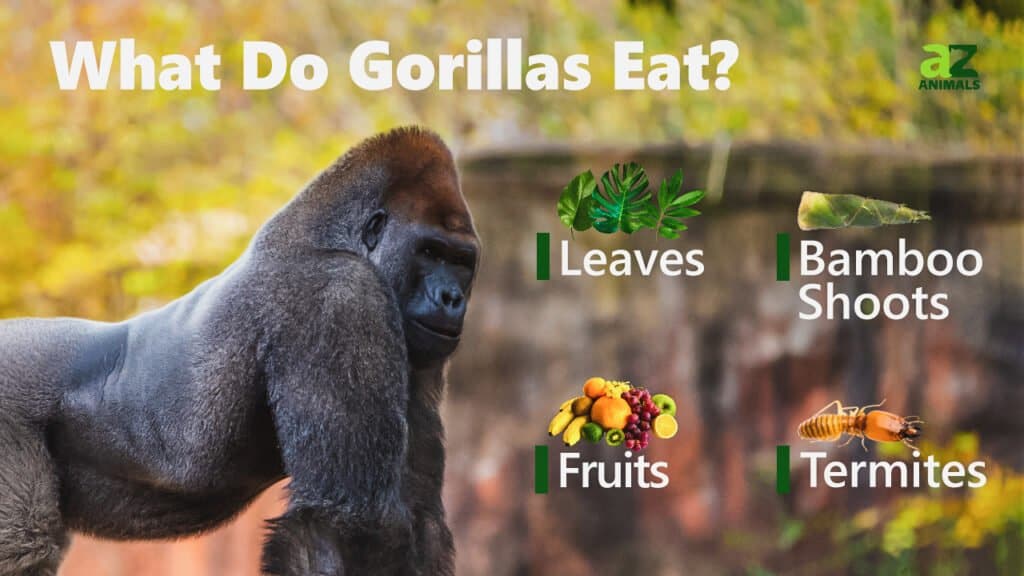
The Western Lowland Gorilla is largely an herbivorous animal with over 100 fruit species recorded in their diet, as well as shoots, leaves, and piths. When the fruit is scarce during the drier months, they also eat bark, nuts, pulp, wild cherry, roots, leaves, termites, lizards, and weaver ants. A fully grown adult male has the capacity to eat around 40 pounds of vegetation per day, which is around 10% of his body weight. For perspective, a 5-gallon bottle of water, a mid-size microwave, 4 10-pound bags of potatoes, and an average 3-year-old human child all weigh 40 pounds.
Predators and Threats
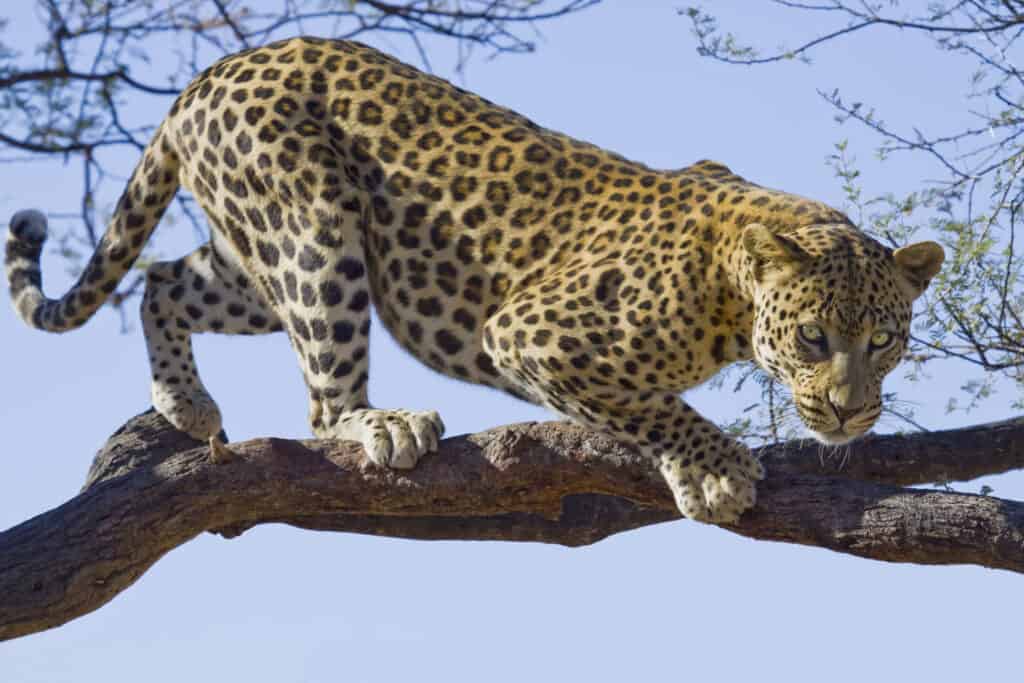
Leopards prey on Western Lowland Gorillas.
©iStock.com/lightstock
The critically endangered Western Lowland Gorilla has every few threats in the wild, other than leopards and crocodiles. The main threats to the gorillas come from humans through the forms of habitat loss, disease, and poaching.
With habitat loss, humans clear-cut the trees gorillas live among. Humans use trees for mining, developing human settlements, and logging. In turn, logging roads make it easy for poachers to drive into the gorilla’s habitat and kill the gorilla to make gourmet food as a high-priced delicacy for rich consumers. They also make ashtrays out of gorilla hands, and other body parts are made into trinkets as well.
Gorillas are vulnerable to diseases and illnesses that humans don’t have trouble getting. This is because they haven’t developed the immunities that humans have. As a result, the common cold that humans get at least once a year can kill a gorilla. This also means that visitors who are carriers of contagious illnesses, such as the coronavirus, cannot get too close to gorillas, or they must wear a mask and sterile gloves.
Reproduction, Babies, and Lifespan
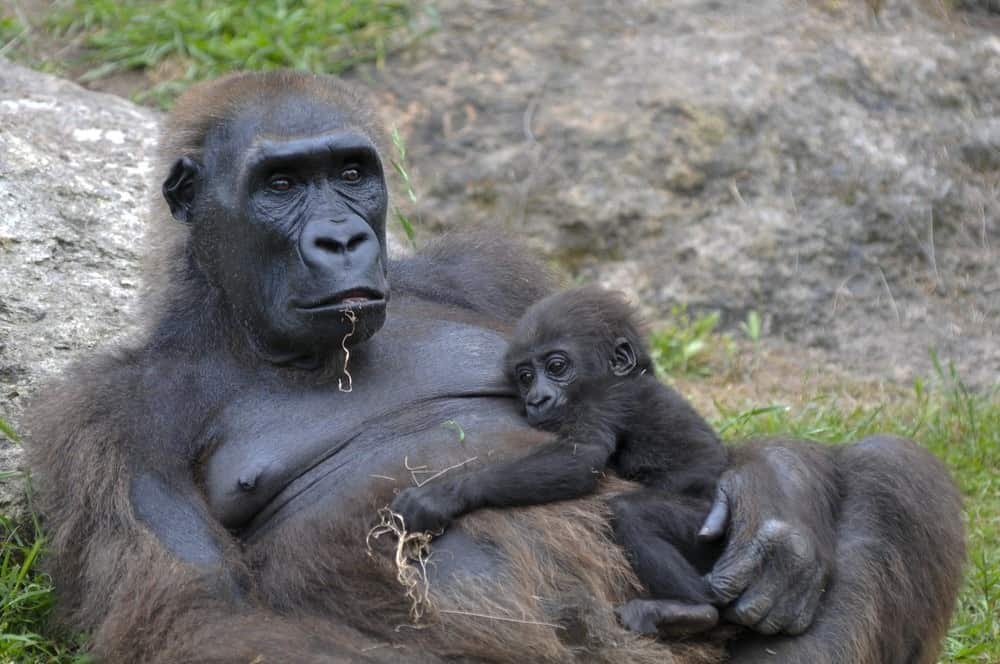
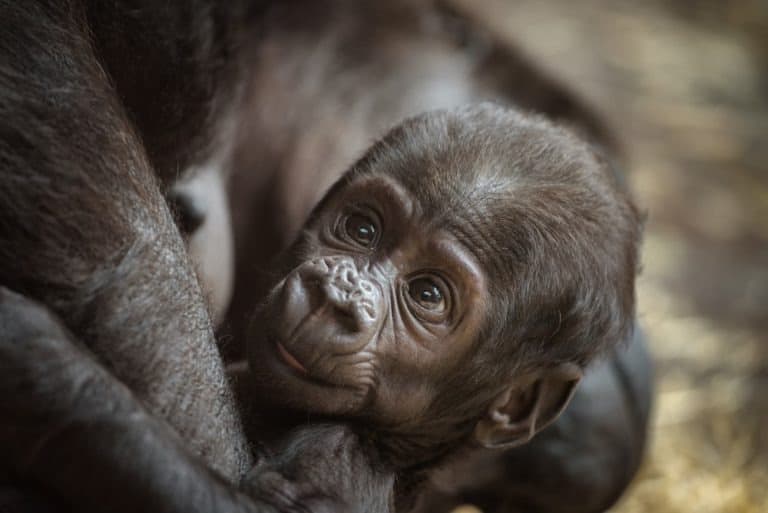
Baby gorillas weigh around four pounds at birth and require constant care from their mothers.
©Boris Diakovsky/Shutterstock.com
Unlike some animals in the wild, the Western Lowland Gorilla does not quickly reach the age when they begin to breed. Females don’t reach breeding age until they are 10 years old and males until 15 to 20 years old. The lifespan of these gorillas is 50 years or more, both in the wild and in captivity.
The gestation period for the Western Lowland Gorilla is similar to humans and lasts for nine months. Females typically give birth to a single offspring, with twins being the rarity. At birth, the baby gorilla weighs four pounds and can’t do much except cling to their mother. When they reach four months of age, they start to ride on their mother’s backs everywhere until they are three years old.
The infant mortality rate among the Western Lowland gorillas is high, with only two or three offspring surviving into adulthood. Typically, a female gorilla gives birth around every 4 years, becoming pregnant around the time her previous offspring no longer rides on her back. With a lifespan of 50 years and giving birth every four years, the female gives birth to around 10 babies in her lifetime, with only two or three surviving to adulthood.
Population
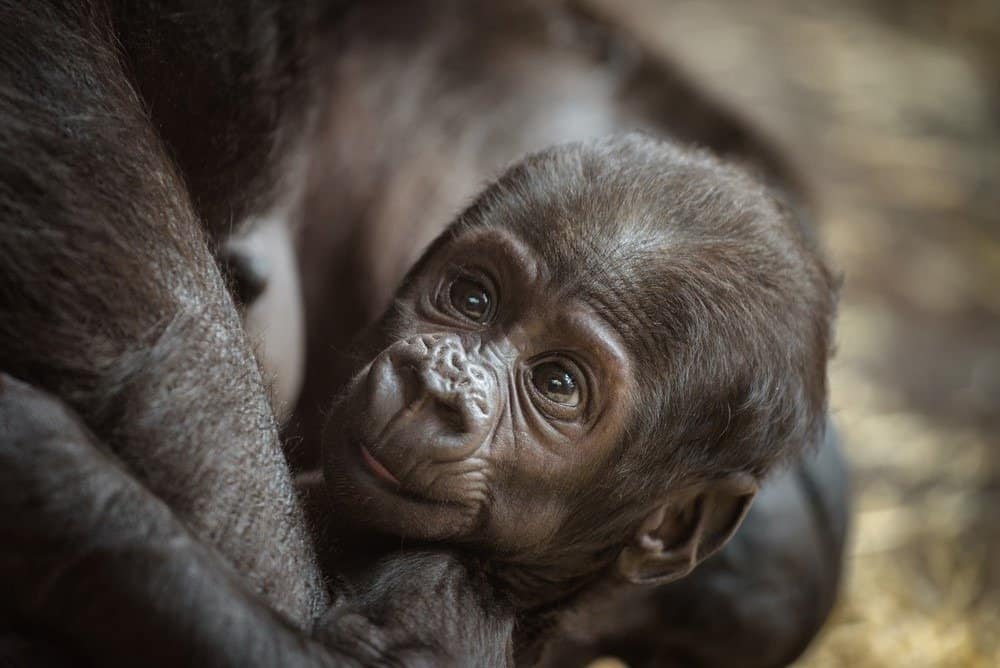
Only two out of 10 baby Western Lowland Gorillas survive to adulthood.
©Nick Fox/Shutterstock.com
The habitat of Western Lowland Gorillas makes it difficult for scientists to accurately determine how many of them are left in the wild. However, scientists believe that the total population is close to 100,000 individual gorillas. While it may seem like a relatively high number, the Western Lowland Gorilla is listed as critically endangered.
In Zoos

The Atlanta Zoo is a great place to experience gorillas and is also home to Ozzie, the oldest male Western Lowland gorilla in the world.
©Rob Hainer/Shutterstock.com
The Western Lowland Gorilla is actually one of two subspecies of gorilla found in Western Africa. The other subspecies of Western Gorilla is the Cross River gorilla, which is rare. Of all of the gorilla subspecies, the Western Lowland Gorilla is the most common gorilla subspecies found in zoos.
The Atlanta Zoo is home to one of the oldest living male Western Lowland Gorillas in the world. This gorilla’s name is Ozzie, and he was born around 1961, making him about 59 years old in the year 2020. Ozze has fathered 12 gorillas at the Atlanta Zoo and hates loud music, but loves oranges and cabbage.
The Smithsonian National Zoo has six Western Lowland Gorillas. Their names are Bakara, Mandara, Calaya, Kibibi, and Kojo. Baraka is a silverback and the largest member of the gorilla troop who weighs more than 400 pounds. He was born at the zoo in April of 1992.
Mandara raised Baraka as her own offspring shortly after his birth and had six babies of her own. Kojo, one of Mandara’s offspring along with Kibibi, is a young adult male and is one of the most playful gorillas there.
Western Lowland Gorilla Pictures
View all of our Western Lowland Gorilla pictures in the gallery.

Nick Fox/Shutterstock.com
Sources
- David Burnie, Dorling Kindersley (2011) Animal, The Definitive Visual Guide To The World's Wildlife / Accessed July 13, 2010
- Tom Jackson, Lorenz Books (2007) The World Encyclopedia Of Animals / Accessed July 13, 2010
- David Burnie, Kingfisher (2011) The Kingfisher Animal Encyclopedia / Accessed July 13, 2010
- Richard Mackay, University of California Press (2009) The Atlas Of Endangered Species / Accessed July 13, 2010
- David Burnie, Dorling Kindersley (2008) Illustrated Encyclopedia Of Animals / Accessed July 13, 2010
- Dorling Kindersley (2006) Dorling Kindersley Encyclopedia Of Animals / Accessed July 13, 2010
- David W. Macdonald, Oxford University Press (2010) The Encyclopedia Of Mammals / Accessed July 13, 2010
- World Wildlife Fund / Accessed October 20, 2020
- New England Primate Conservancy / Accessed October 20, 2020
- Saint Louis Zoo / Accessed October 20, 2020
- Smithsonian's National Zoo & Conservation Biology Institute / Accessed October 20, 2020
- National Geographic / Accessed October 20, 2020
- The Zoo. Belfast Zoological Gardens / Accessed October 20, 2020