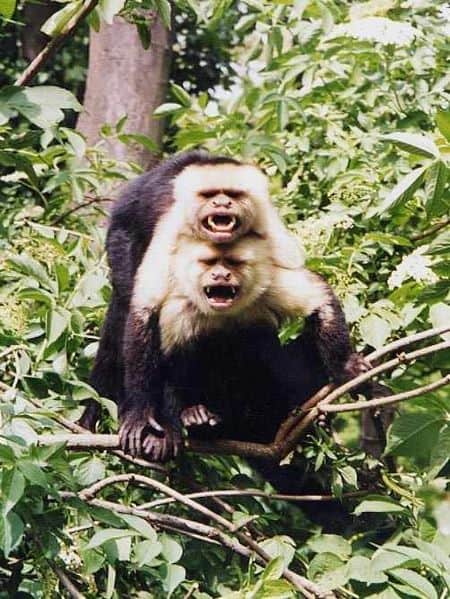



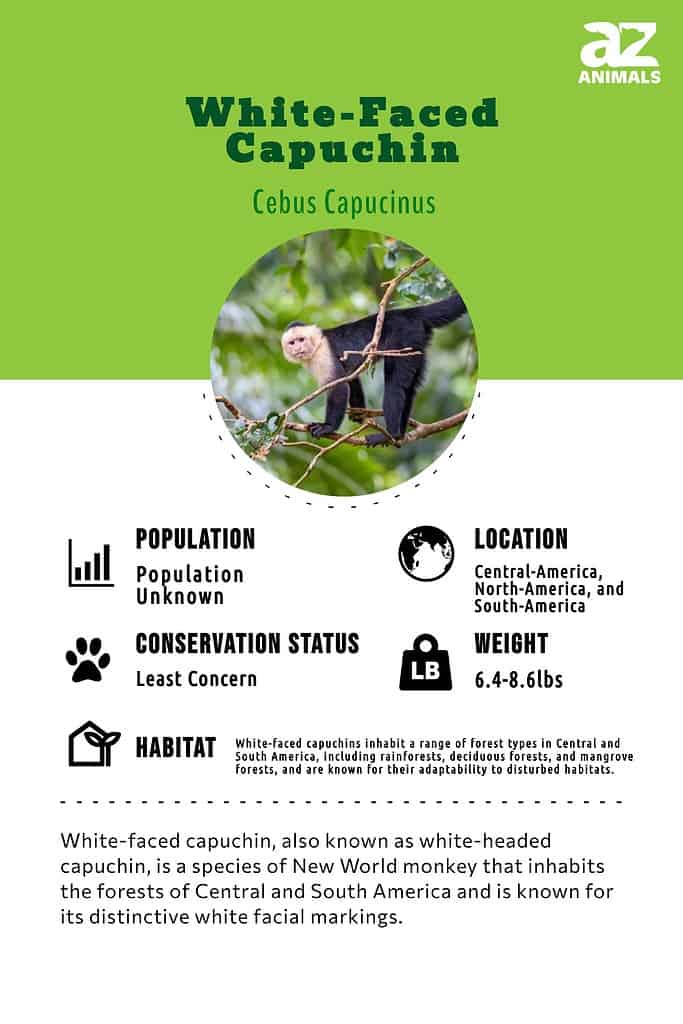
The white-faced capuchin monkey barks and coughs to alert other monkeys of a predator in the area.
White-faced capuchins live in social groups of 18 to 20 monkeys. They are omnivores and live to be around 30 years old in the wild.
These monkeys make their homes in tropical evergreen and dry deciduous forests where the canopies, or tops of the trees, grow very close together. They live in Central America, specifically Honduras, Costa Rica, Panama, and Nicaragua. They’re also found in South America, mainly in Colombia and Ecuador.
5 Incredible White-Faced Capuchin Facts!
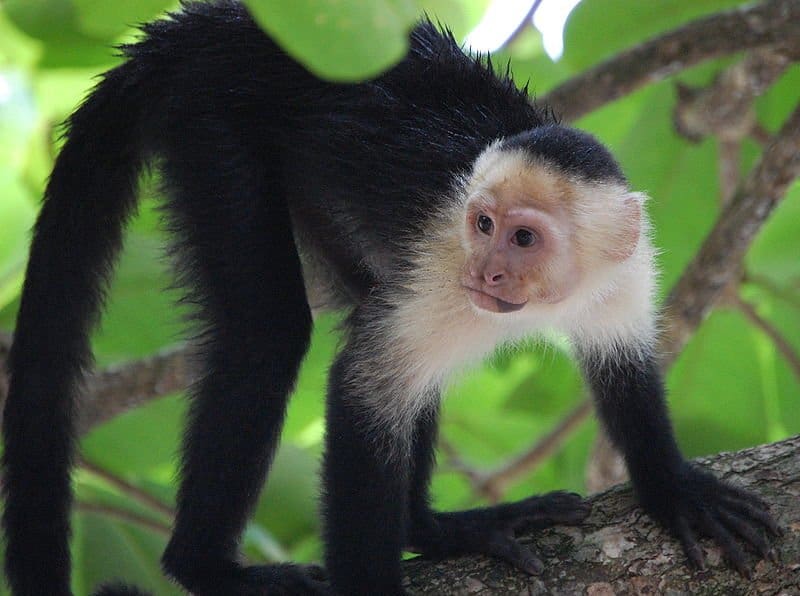
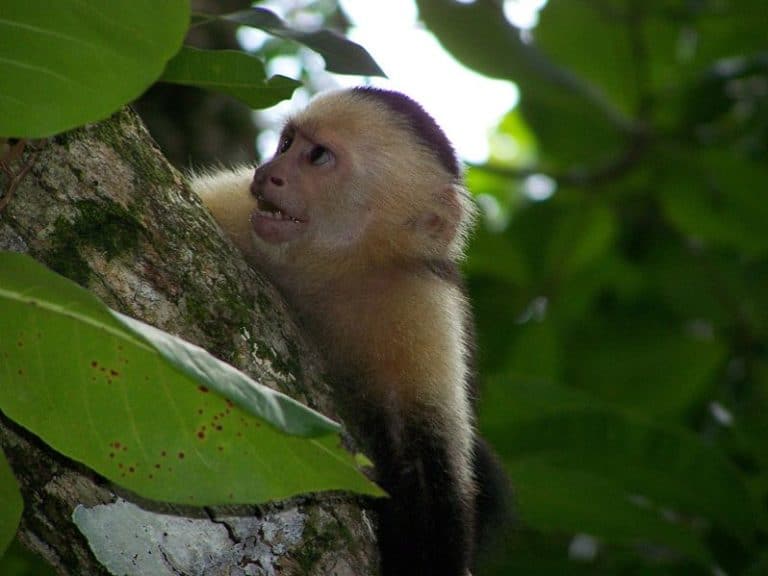
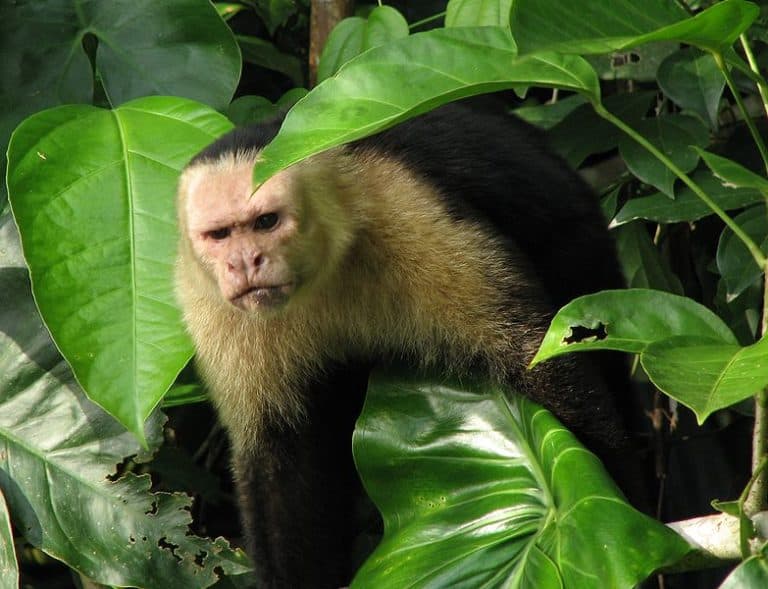
White-faced Capuchin monkey (Cebus capucinus) in Manuel Antonio National Park, Costa Rica.
©Steven G. Johnson / Creative Commons – Original
- White-faced capuchins communicate with one another using chirps, barks, and whistles.
- This type of monkey is diurnal which means it finds food during the day and sleeps at night.
- A white-faced capuchin uses its strong tail to balance and hang on to tree branches.
- White-faced capuchins in captivity can live to be 45 years old.
Scientific Name
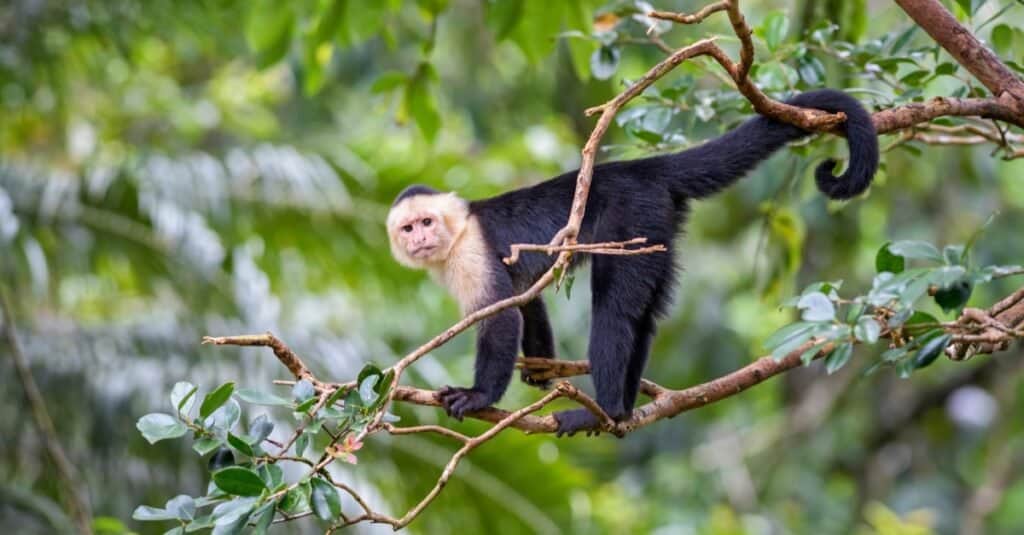
White-faced Capuchin – Cebus capucinus, beautiful brown white faces primate from Costa Rica forest.
©David Havel/Shutterstock.com
White-faced capuchins are also known as Panamanian white-headed capuchins and sometimes white-throated capuchins. Their scientific name is Cebus capucinus. These monkeys belong to the Cebidae family and are in the Mammalia class.
These capuchin monkeys got their name from the Capuchin friars in Italy. These friars wore a head covering, or cowl, that looked a lot like the black fur cap on the head of this capuchin monkey.
There are several types of capuchin monkeys including the Kaapori capuchin, wedge-capped capuchin, and the black-capped capuchin.
Here are a few different types of capuchin monkeys:
- Colombian white-faced
- Panamanian White-faced
- White-fronted capuchin
- Wedge-capped capuchin
- Kaapori capuchin
Evolution and Origins
The first capuchins (Cebus species) initially appeared in South America 16.3 million years ago, and like all monkeys, they share 97% of our DNA. Neotropical in nature, all capuchin species can be found mostly in northern and central South America.
Since it can survive in a wide range of forest types and utilize a wide range of food sources, the Panamanian white-faced capuchin can adapt to forest fragmentation better than other species. As a seed and pollen disperser, the Panamanian white-faced capuchin is vital to its ecosystems.
Colombian white-faced capuchins can be found in Central and South America in the wild. They live in the tropical woods of Nicaragua, Ecuador, Costa Rica, and Panama. The majority of the time that capuchin monkeys spend is in the 50-foot-high forest canopies.
Appearance and Behavior
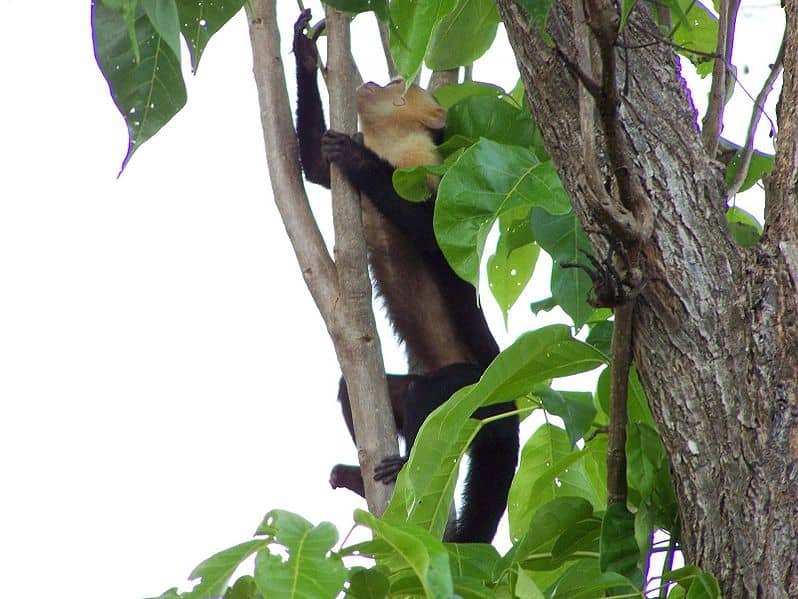
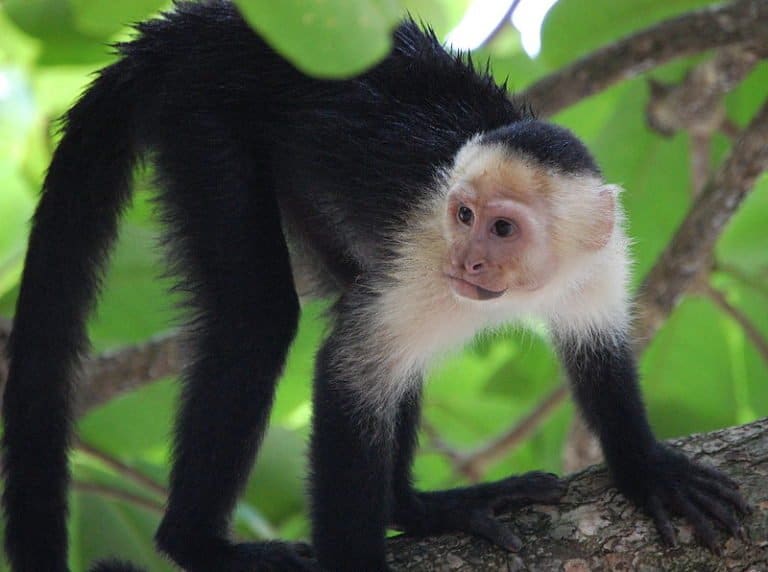
White-faced capuchin monkey in Manuel Antonio National Park in Costa Rica
©Michelle Reback / Creative Commons – Original
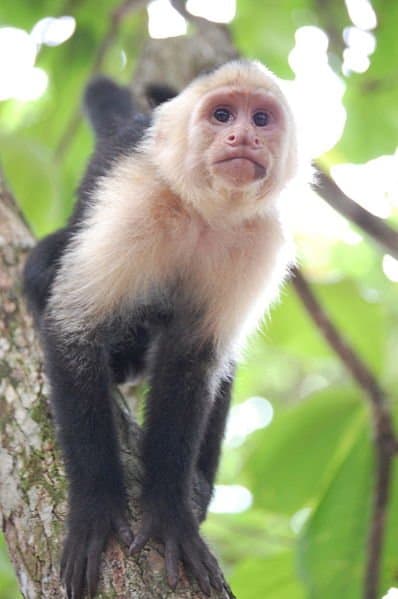
These monkeys have black fur on their back and legs and white fur on their chest and face. The white-faced capuchins are known for the cap of black fur on their head. Adult males can weigh up to eight pounds while females weigh about five pounds.
These monkeys grow to be from 15 to 17 inches in length, not including their tail which is about the same length as their body. For reference, an eight-pound capuchin weighs about the same as a gallon of milk. And a monkey that measures 17 inches long is a little bit longer than a bowling pin.
These monkeys have what’s known as a prehensile tail. This means that the monkey can grab tree branches and other objects using its tail. It’s almost like an extra hand! This tail helps them to hang on to tree limbs and branches as they move through the treetops. Staying up on high branches helps them to avoid predators.
Panamanian white-headed capuchins can move very quickly between the branches of the trees in their habitat. The fastest recorded speed of these monkeys is 34 mph.
White-faced capuchins use their voices as a way to stay safe from predators. They have a special chirping/barking sound they make to alert other monkeys in the area of a predator. This gives the monkeys a chance to go higher up in the trees or escape the area.
White-faced capuchins are very social and live in groups of 18 to 20. A group of white-faced capuchins can go by many names including a troop, a tribe, a cartload, and even a barrel. So now you know a barrel full of monkeys is not just a fun game! Most troops of white-faced capuchin monkeys are made up of females. They stay with the same group throughout their lives, while males migrate from troop to troop as they grow older.
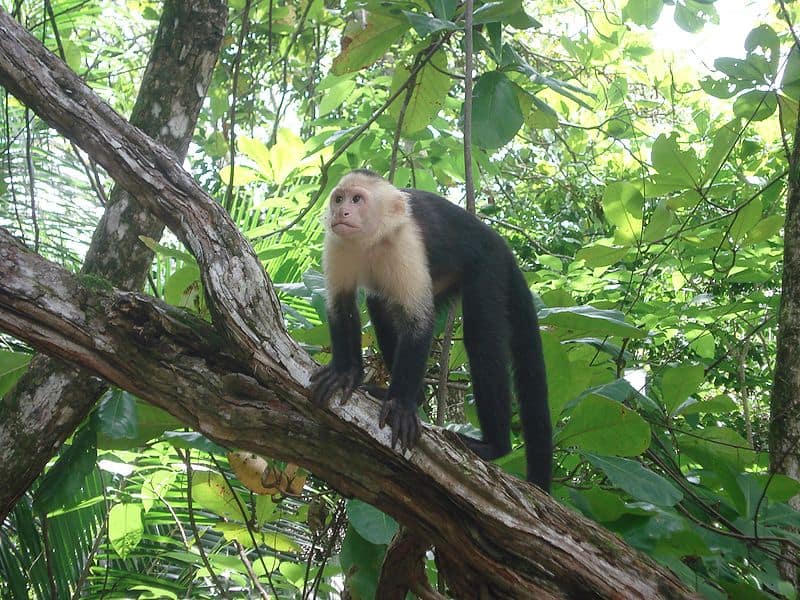
Habitat
White-faced capuchin monkeys live in Central and South America, specifically in the tropical forests of Ecuador, Panama, and Colombia. Troops of monkeys live high in the canopies of trees where they can find food, hide from predators, and communicate with others in their group.
They need a climate with a high level of humidity to survive. If you ever see a photo of a white-faced capuchin monkey sticking its tongue out; it’s not being rude. This monkey sticks its tongue out to allow moisture to evaporate helping them to stay cool during an especially dry season.
Diet
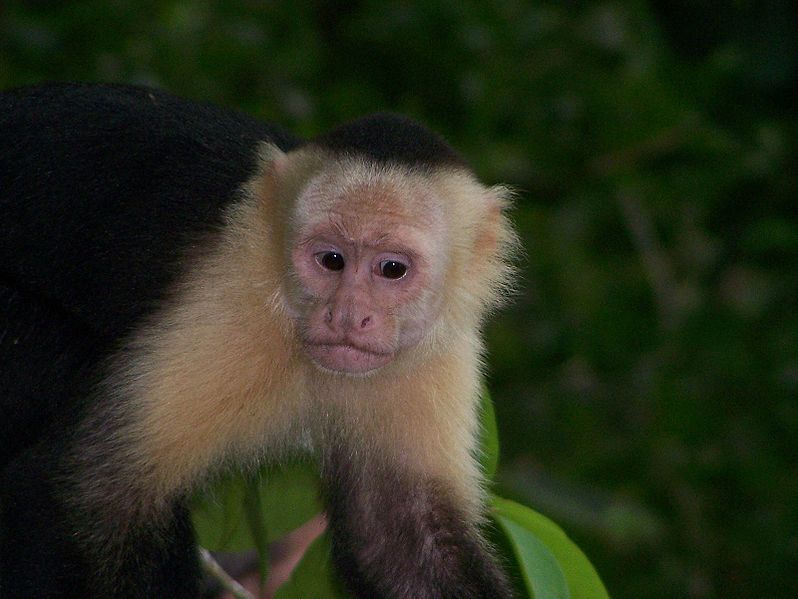
White-faced capuchin monkey in Manuel Antonio National Park in Costa Rica
©Michelle Reback / Creative Commons – Original
What does a Panamanian white-faced capuchin eat? These monkeys are omnivores, so they eat both meat and plants. They eat nuts and fruits such as figs and mangoes. Leaves, insects, lizards, and birds are also on the menu. In addition, they sometimes eat tree rats such as the Speckled spiny tree rat.
Scientists have observed that these white-headed monkeys are willing to try to eat a variety of foods – even an unfamiliar fruit or an insect they’ve never seen before. In short, these monkeys will try to eat anything they find in their habitat.
Predators and Threats
Like most smaller animals, the white-faced capuchin monkey has several predators. They are hunted by snakes, such as the tree boa constrictor and lancehead snake. Other predators include eagles, jaguars, caiman, and ocelots.
As you see, most of these animals have easy access to the trees where this monkey lives. An eagle may swoop down to attack a white-faced capuchin, or a jaguar may follow one up a tree to capture and eat it. A monkey may climb down from a tree to get a cool drink at a watering hole only to be captured by a caiman.
Though this monkey’s first defense against a predator is to run away, there are times when all of the members of a troop will gather together to try to fight off an intruding predator.
White-faced capuchin monkeys are also threatened by habitat loss through deforestation. Plus, they are sometimes hunted by humans who want to capture them to sell as exotic pets. However, the conservation status of this monkey is Least Concern. Though their population is generally stable, efforts are being made to increase it. Wildlife conservation groups and zoos breed white-faced capuchins to increase their number.
Reproduction, Babies, and Lifespan
Male and female white-faced capuchin monkeys have different partners every breeding season (January to April). When the females are ready to mate, they make specific chirping sounds for males to hear. A female white-faced capuchin is pregnant for about 160 days and has just one baby. She gives live birth to a baby that weighs just a few ounces and the mother capuchin cares for the baby.
A baby monkey is called an infant and can see from birth. An infant monkey nurses from its mother for two to four months and ides on its mother’s back for about the first six weeks of life. After it reaches four months old, the infant monkey learns how to find its own insects, fruit, nuts, and other food. It’s cared for and taught not only by its mother but by the other monkeys in the troop as well. It takes this monkey at least four years to become fully independent.
A white-faced capuchin in the wild must face predators, habitat loss, and poaching by humans. Its average lifespan is about 30 years. Alternatively, a white-faced capuchin kept at a zoo or wildlife preserve may live to be 45 to 50. The oldest white-faced capuchin on record reached 54 years of age.
As these monkeys grow older, they are more vulnerable to intestinal parasites that can cause terrible sickness or death.
Population
At last count in 2007, there are estimated to be around 54,000 white-faced capuchin monkeys in existence. Its conservation status is Least Concern.
However, the population of this animal is decreasing due to deforestation and other threats, so breeding programs are in place at various zoos and wildlife preserves to boost the population.
White-Faced Capuchin Pictures
View all of our White-Faced Capuchin pictures in the gallery.

Sources
- David Burnie, Dorling Kindersley (2011) Animal, The Definitive Visual Guide To The World's Wildlife / Accessed February 18, 2009
- Tom Jackson, Lorenz Books (2007) The World Encyclopedia Of Animals / Accessed February 18, 2009
- David Burnie, Kingfisher (2011) The Kingfisher Animal Encyclopedia / Accessed February 18, 2009
- Richard Mackay, University of California Press (2009) The Atlas Of Endangered Species / Accessed February 18, 2009
- David Burnie, Dorling Kindersley (2008) Illustrated Encyclopedia Of Animals / Accessed February 18, 2009
- Dorling Kindersley (2006) Dorling Kindersley Encyclopedia Of Animals / Accessed February 18, 2009
- David W. Macdonald, Oxford University Press (2010) The Encyclopedia Of Mammals / Accessed February 18, 2009