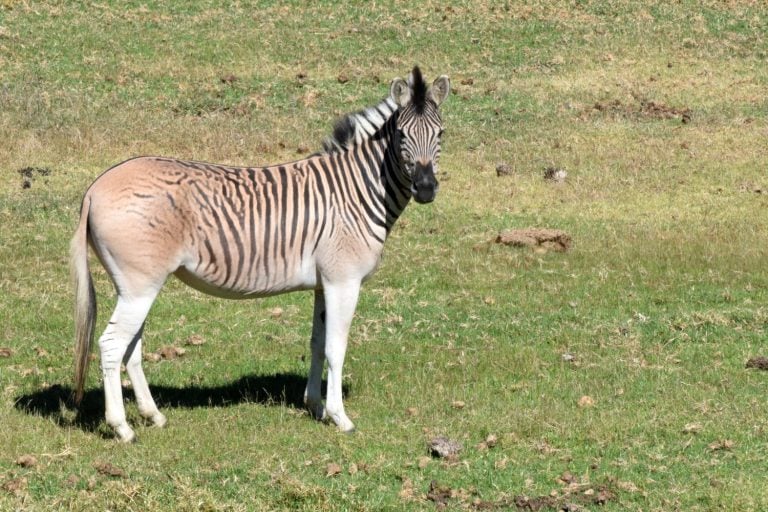
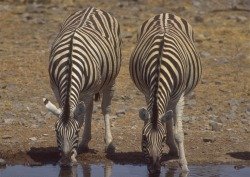
The zebra is perhaps the most visually dazzling member of the family Equidae, a group that includes horses, asses, zebras, and multiple other species. Zebras are famous for their black and white stripes. While some may think the stripes are a camouflage against predators, they actually repel flies! And these stripes–are zebras white with black stripes, or vice versa? The truth is, zebras have black skin, so the stripes that overlay their skin are white. Read on to learn more about the amazing zebra.
Classification and Scientific Name
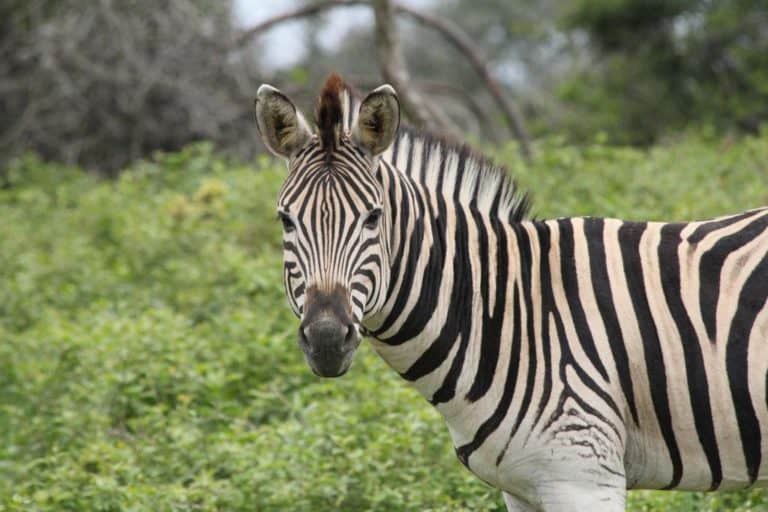
The Zebra is a large species of equine that is natively found roaming the grassy plains of sub-Saharan Africa. They are the largest and most distinctive wild horses with bodies that are patterned with white and black stripes, the exact placement of which is unique to each individual. Three different species of Zebra are found in Africa which are the Common Zebra (also known as the Plains Zebra and the Burchell’s Zebra), the Grevy’s Zebra (also known as the Imperial Zebra), and the Mountain Zebra. Zebras are incredibly sociable animals that can travel vast distances in search of fresh grass and water but are severely threatened throughout much of their natural range due to increasing levels of human activity. Today, both the Grevy’s Zebra and the Mountain Zebra are considered to be endangered species. Although the Common Zebra is more widespread and numerous, there have been sharp population declines in certain areas.
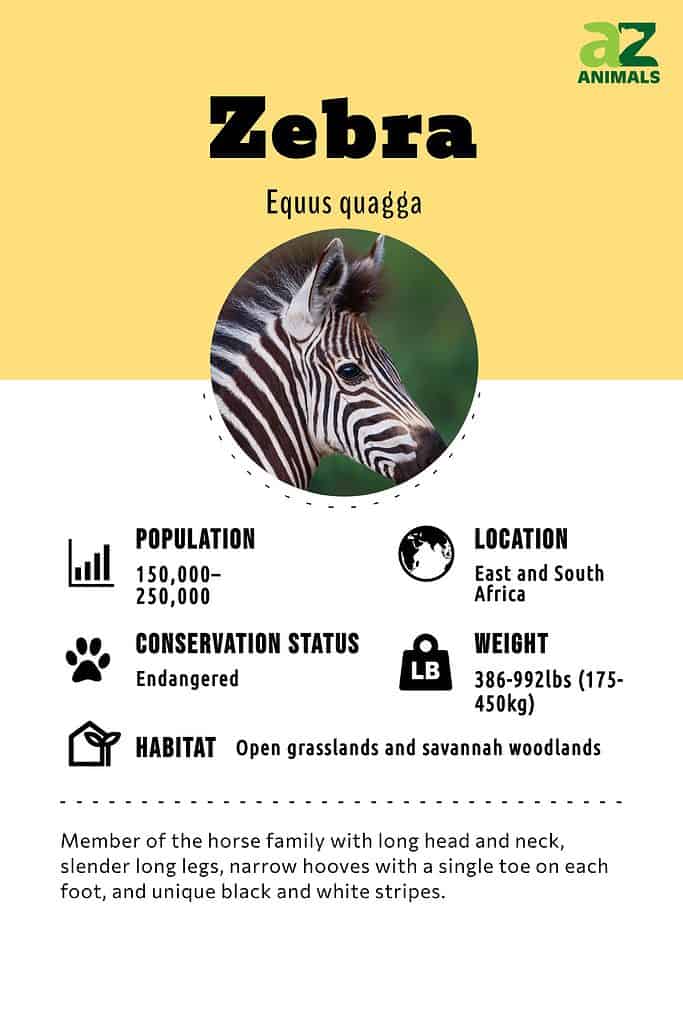
Zebras are members of the family Equidae, which includes multiple horse species. The most numerous zebra species is the Plains zebra, known as Equus quagga. The other two species include the Grévy’s zebra (Equus grevyi), and the mountain zebra (Equus zebra).
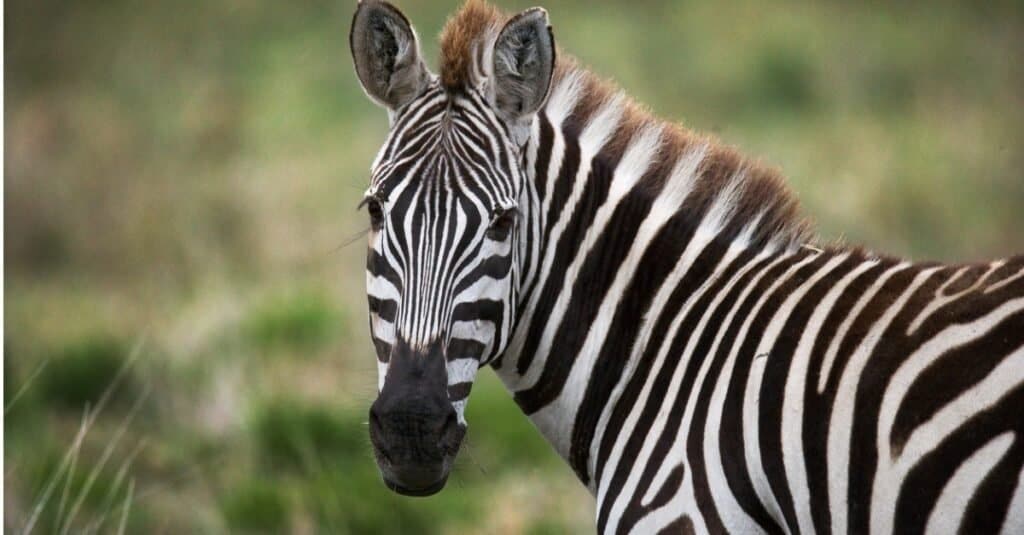
The most numerous zebra species is the Plains zebra, known as Equus quagga.
©GUDKOV ANDREY/Shutterstock.com
Evolution
Horses, asses, and zebras are believed to have shared a common ancestor named Eohippus, which roamed the earth 52 million years ago. This jungle animal, similar to a fox, had five toes and ate leaves and fruit. As this creature migrated to plains where there were fewer places for hiding, it developed speed by running on its middle toe, which became more prominent as it evolved.
As this animal took on other characteristics like grazing, faster speeds, and a larger size, other names were ascribed to it–Orohippus, Epihippus, Mesohippus, Miohippus, Kalabatipus, Parahippus and Merychippus. They lost their toes, grew longer legs, and their teeth adapted to grazing.
From these ancestors sprung Donohippus, which is the more direct ancestor of the modern horse. There were three modern types that evolved from the Donohippus–horses, wild horses, and donkeys/zebras/onagers.
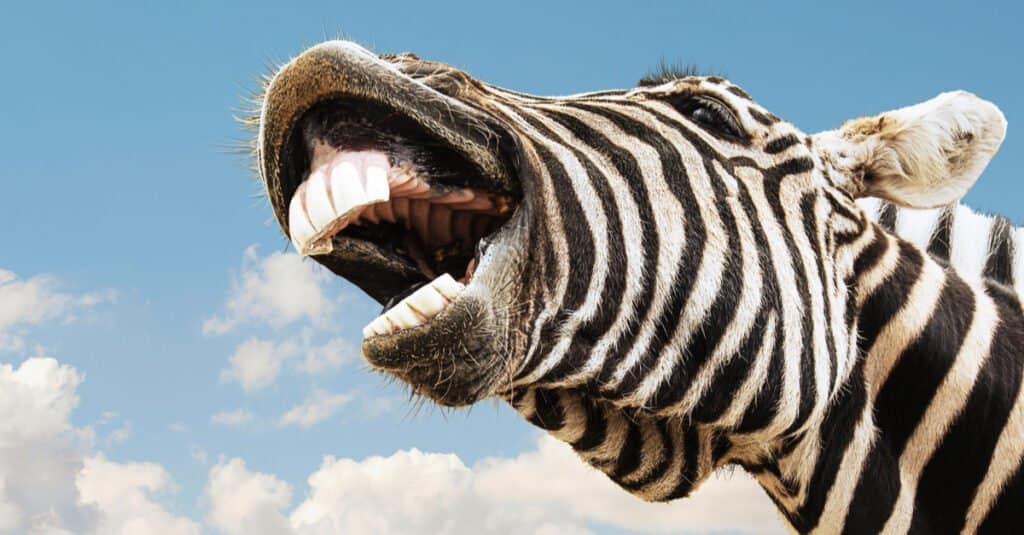
As the ancestors of zebras evolved, their teeth adapted to aid them in grazing.
©Mara008/Shutterstock.com
Types of Zebras
There are three species of zebras native to various parts of Africa listed below:
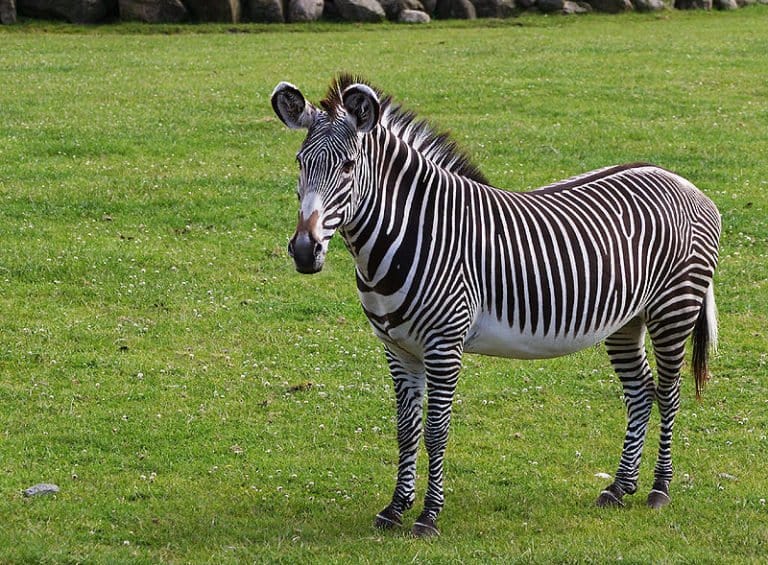
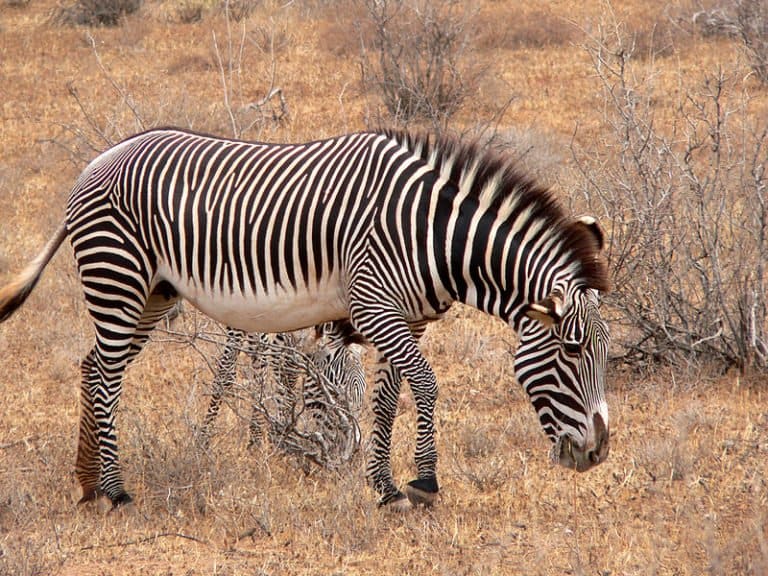
- Grévy’s Zebra – Grévy’s zebra (Equus grevyi) is the largest species of zebra. it’s named after Jules Grévy but is also called the imperial zebra. Classified as endangered, it inhabits semi-arid grasslands and scrub in parts of Kenya, Somalia and Ethiopia.
- Mountain Zebra – The mountain zebra (Equus zebra) prefers mountainous, woodland, or grassland habitats. There are two sub-species of mountain zebra–the Cape mountain zebra (South Africa) and Hartmann’s mountain zebra (southwestern Angola and Namibia). It’s listed as Vulnerable.
- Plains Zebra – The plains zebra (Equus quagga) is the most common group of zebras, native to East and South Africa, preferring open grasslands and savannah woodlands. It’s listed as Near Threatened. Burchell’s zebra (Equus quagga burchellii) is a subspecies of the plains zebra, named for the British explorer and naturalist William John Burchell and found in southern areas.
Anatomy and Appearance
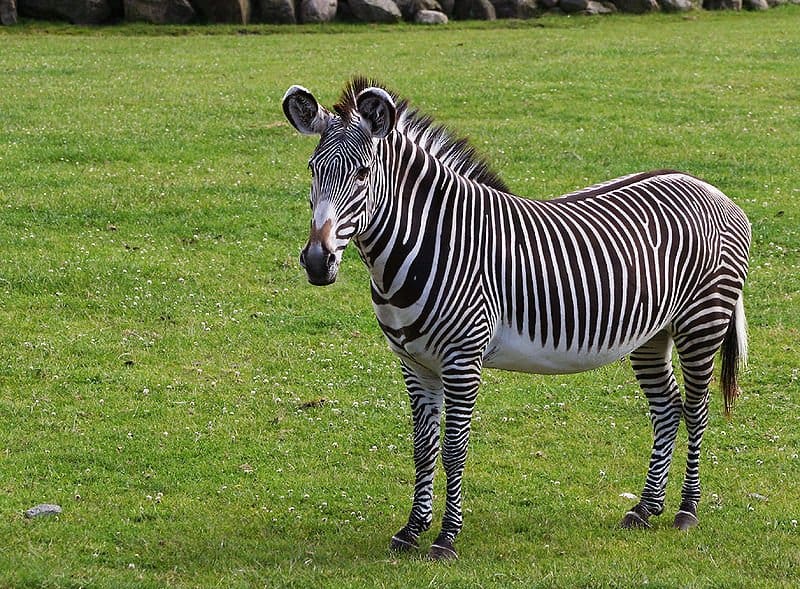
Zebras are heavy-bodied animals that are perfectly designed for speed with their long and slender legs and narrow hooves helping them to reach speeds of 40kph when running. In the same way as horses, they only have a single toe on each foot which they walk on the tip of and is protected by their tough hooves. Their black and white stripes are unique to each individual and help them to identify each other when in the herd. Zebras have long necks and heads that mean they can easily reach the grass on the ground and a mane that extends from their forehead and along their back to the tail. The pattern of their stripes varies between the species with Grevy’s and Mountain Zebras having narrower stripes and white undersides, while the Common Zebra has broad stripes that cover its entire body. The Grevy’s Zebra is not only the largest of the Zebra species but is also easily identifiable by its large, rounded ears.
Distribution and Habitat
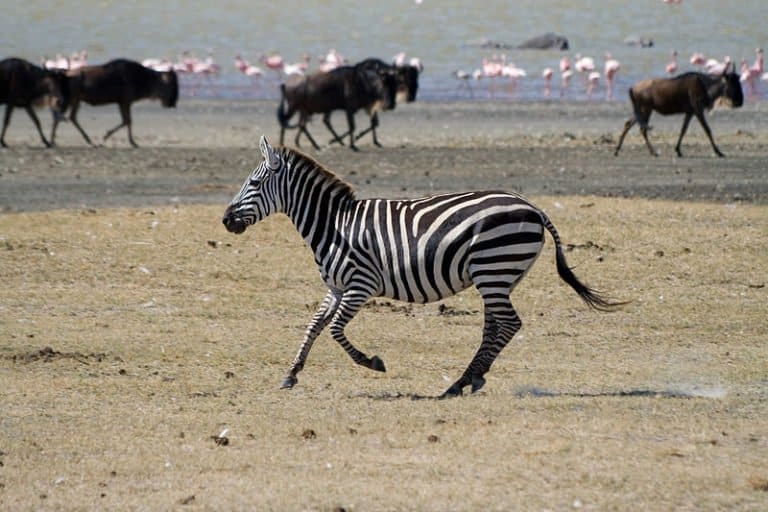
Zebras are animals that are found inhabiting the open grasslands and plains of East and Southern Africa where they spend most of their time grazing on the grasses. The Common Zebra is the most numerous and has the widest natural range throughout East Africa where they are found roaming the grassy plains. The Mountain Zebra can be found grazing on the mountain grasslands of South-West Africa, while the Grevy’s Zebra is confined to the arid grasslands and sub-desert steppe throughout Ethiopia, Somalia and in northern Kenya. Zebras have evolved to run incredibly fast so they can escape from dangerous predators and so rely heavily on the open plains for their survival. Although the Common Zebra has been least affected, all three species of the animal are at risk from population declines due to the loss of their natural habitats caused by increasing levels of human activity.
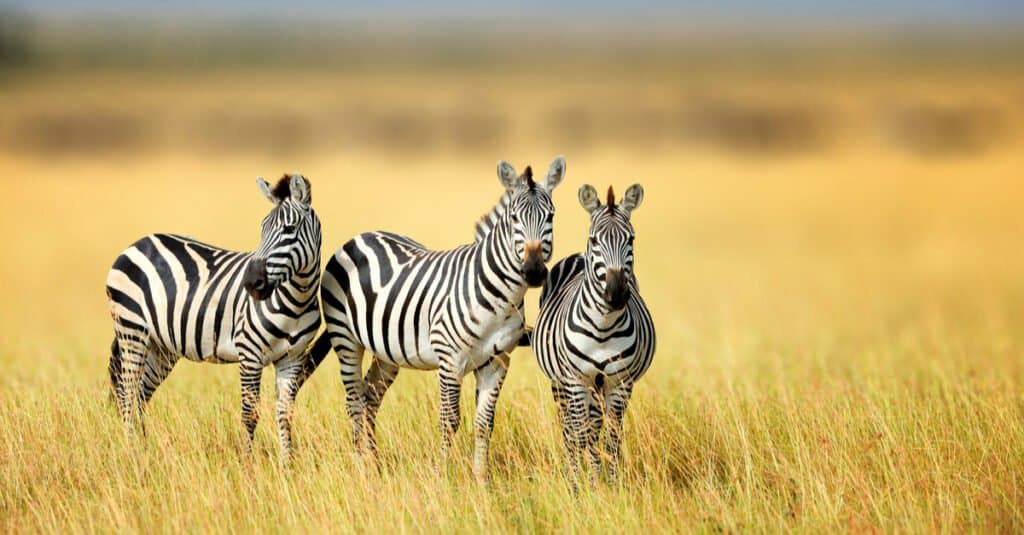
The Common Zebra has the widest natural range throughout East Africa, where it roams the grassy plains.
©Volodymyr Burdiak/Shutterstock.com
Behavior and Lifestyle
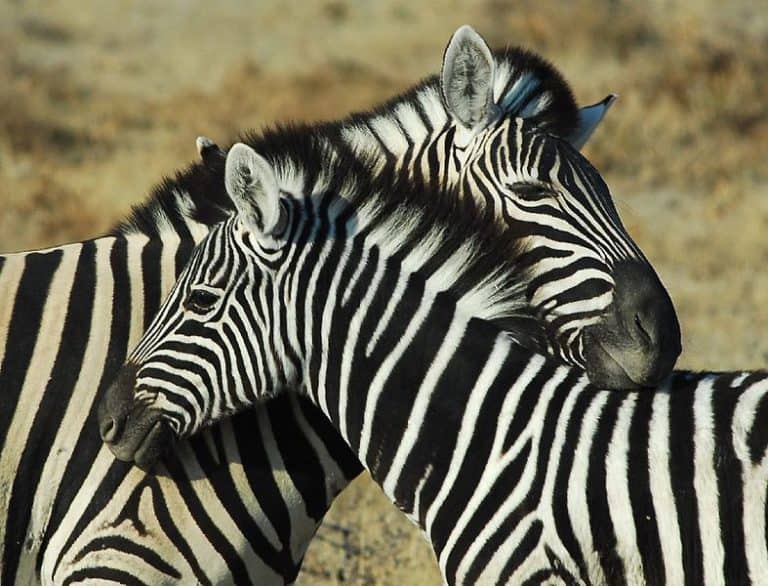
Zebras are highly sociable animals that roam the savanna in herds for protection from predators. The Grevy’s Zebra occupies herds more loosely than the other species with a stallion (male) patrolling enormous territories of up to 10 square kilometers, with mares (females) and their foals grazing freely and occasionally forming small groups that feed together. Both the Common Zebra and the Mountain Zebra inhabit their native regions in long-term herds that split into smaller family groups which are led by a dominant stallion and contain between one and six mares with their young. Their strong social bonds can make them very affectionate towards one another, often grooming each other using their teeth. During the mating season, males will fight fiercely for the right to breed with the females and do so by rearing up on their back legs whilst kicking and biting one another.
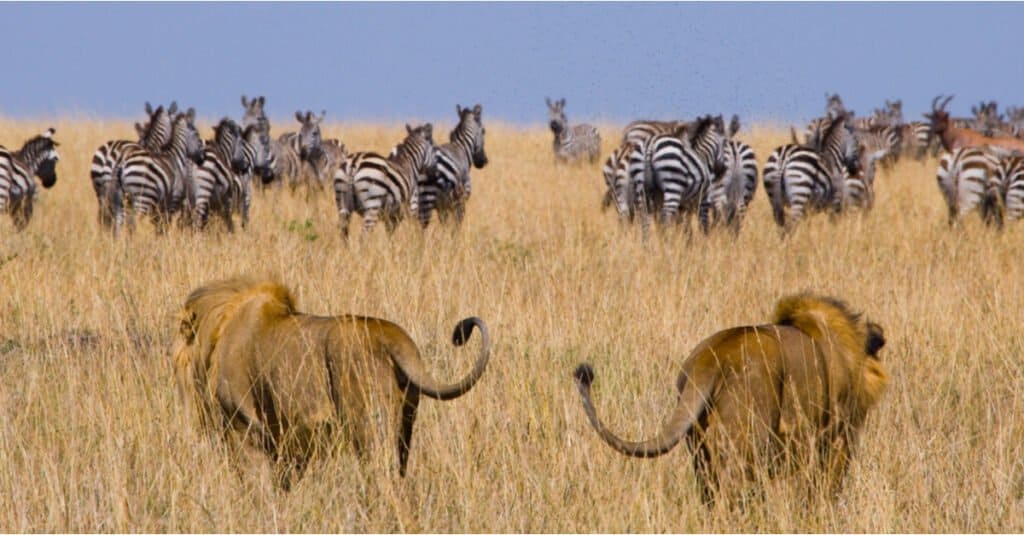
Zebras are highly sociable animals that roam the savanna in herds for protection from predators.
©GUDKOV ANDREY/Shutterstock.com
Reproduction and Life Cycles
The Zebra is a relatively slow-developing mammal with females not being able to first breed until they are at least a few years old. After a gestation period that can last for between 10 months and a year, the female gives birth to a single foal that is born with its stripes and mane and also has a little patch of hair in the middle of its tummy. Zebra foals can stand within minutes of birth, which is vital to ensure that they are able to run away to escape from predators. They are able to begin eating grass after a week and are weaned by the time they are 11 months old. Young Zebras remain with their mother until they are mature at around three years old. At that time, the males leave their natal herd to join an all-male bachelor group, while females stay with their mothers. These bachelor groups begin to challenge the dominant stallions to try and take over the harem during the mating season.
Diet and Prey
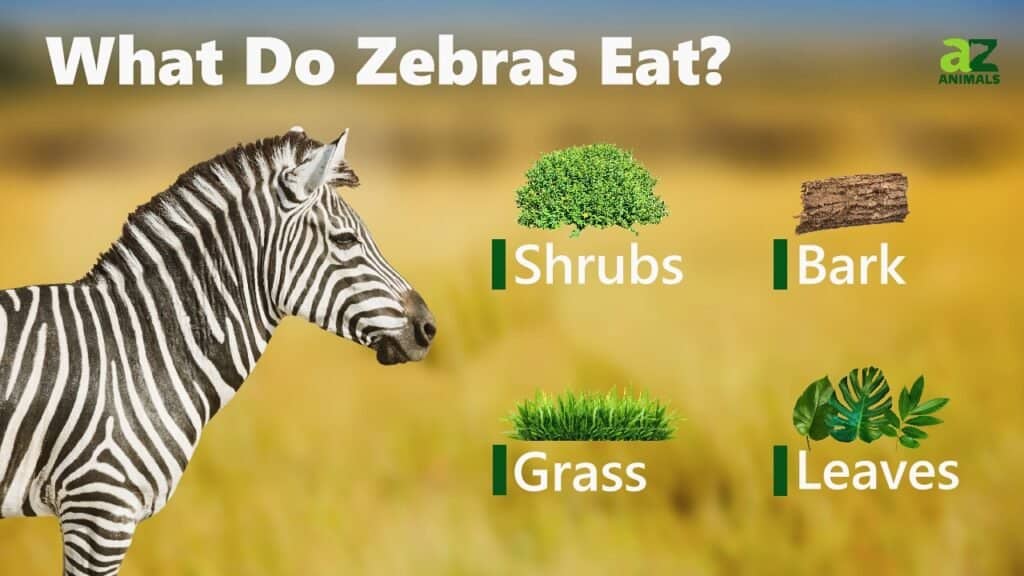
The Zebra is a herbivorous animal, meaning that it only eats plant matter in order to gain the nutrition that it needs to survive. The majority of the Zebra’s diet (in fact around 90%) is comprised of a wide variety of different grasses with other plant matter including leaves and buds making up the rest. They use their sharp front teeth to nibble on the tough ends of grasses before grinding them up using the flat molars along its cheeks. Because grass has little nutritional value, Zebras must spend between 60% and 80% of the day grazing. Common Zebras are often seen drinking at water holes daily. However, due to the fact that the Grevy’s Zebra and the Mountain Zebra inhabit drier, more arid regions, they often don’t drink for several days at a time. In the dry season, Zebras can travel vast distances in search of fresh grass and water holes that haven’t yet dried up, with the Grevy’s Zebra also known to dig into the ground of dried-up river beds to access the water underground. For a complete analysis of their diet, give our ‘What Do Zebras Eat?’ page a read!”
Predators and Threats
The Zebra is a large and powerful animal that despite being herbivorous can easily outrun many of its predators. Zebras are preyed upon by Lions, Leopards, Hyenas, and African Wild Dogs, along with numerous other large carnivores such as Crocodiles when they are crossing rivers or drinking. Although their first instinct is to run away, Zebras are sometimes known to attack the animal that is threatening it by kicking and biting. However, when danger is spotted, Zebras alert one another of the threat and by running away from their predator as a tight herd, they often either confuse or simply intimidate their attacker. The biggest threat though to Africa’s remaining Zebra populations is the increasing encroachment on their natural habitats by people, with the loss of their open plains to grazing for livestock and to clear land for agriculture.
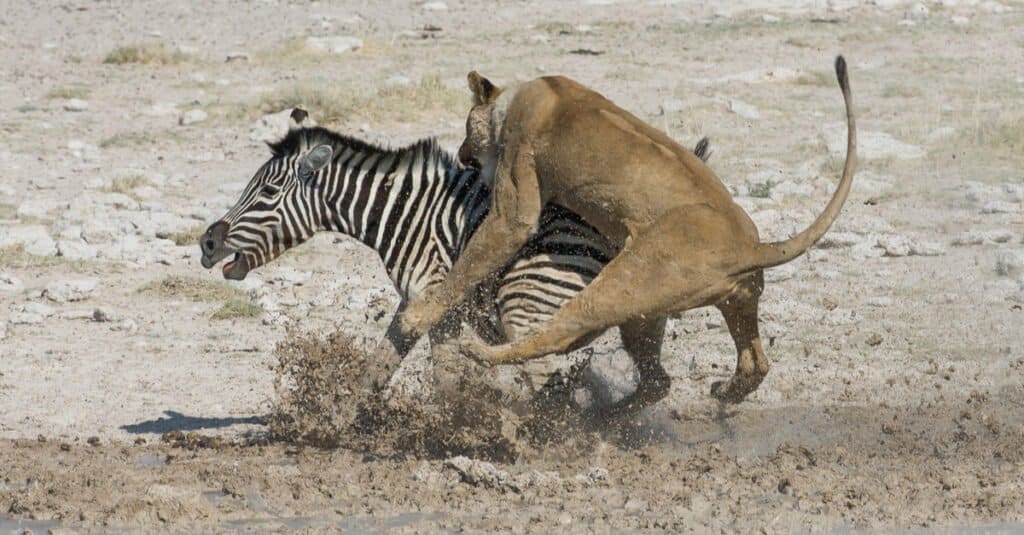
One of the zebra’s most dangerous predators is the lion.
©Rostislav Stach/Shutterstock.com
Interesting Facts and Features
The stripes of the Zebra remain a slight mystery to science even today as they were once thought to camouflage them into the natural light and shade of their surroundings to confuse predators, once running as a herd, it is extremely difficult to remain focused on a single animal. The formation of the stripes on the rear end of the Zebra differs greatly between the three species with Common Zebras having horizontal stripes on their haunches where those of the Grevy’s Zebra curve upwards. These patterns on their rear ends are thought to differ so greatly that members of the same herd can easily identify the individual at the front of the pack when running. As with other male horses, Zebra stallions are known to curl their top lips up which is thought to heighten their sense of smell. This so-called “horse laugh” is thought to prove vital for the male to be able to detect when a female is ready to mate.
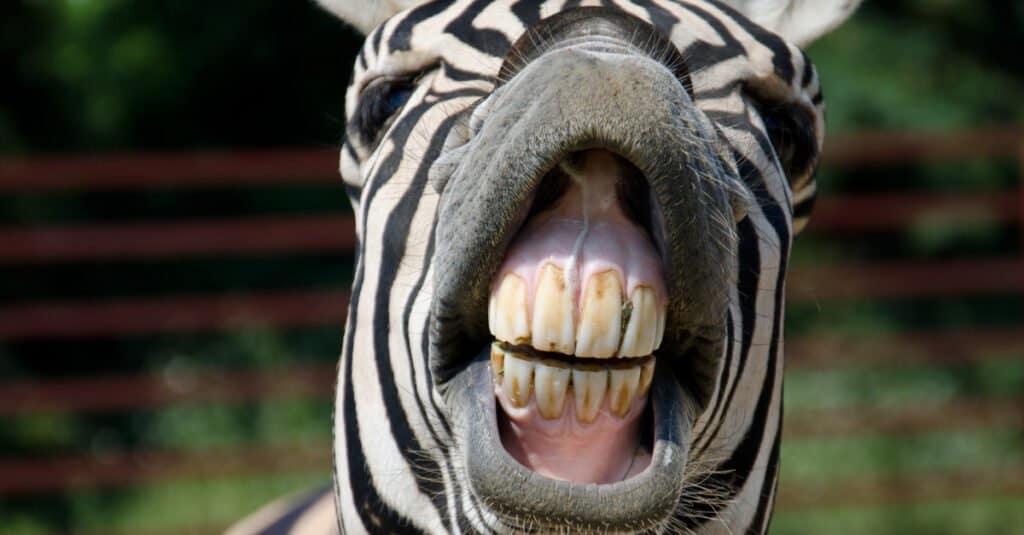
Zebra stallions curl their top lips upward to heighten their sense of smell.
©Galovtsik Gabor/Shutterstock.com
Relationship with Humans
Due to the free-roaming nature of Zebras and over vast distances, the increasing human presence throughout the world has meant that Zebras have been affected by the loss of their habitats throughout much of the natural range. However, one of the most intriguing things about Zebras to people is that because they are so closely related to other equines including Horses and Donkeys, Zebras have actually been able to breed with them. The mating of a zebra and donkey produces a hybrid foal known as a Zonkey, while a zebra mating with a horse produces Zorse. Although it is not thought that the two species would naturally be able to mate in the wild due to geographical differences, a number of both Zonkey and Zorse individuals now exist around the world. Zebras are thought to have natural protection against certain parasites which has led people to breed Horses and Donkeys with Zebras to produce an animal that has the character and size of a Horse or Donkey but with the power and resilience of a Zebra. As with other cross-breed offspring though, Zonkeys and Zorses are infertile and so are unable to reproduce themselves.
Conservation Status and Life Today
Today, the Grévy’s zebra is listed by the IUCN as Endangered and therefore faces extinction from its natural habitats in the future. The Mountain zebra is listed as Vulnerable. The Grevy’s Zebra and the Mountain Zebra are found in increasingly isolated regions and their numbers continue to fall throughout their natural ranges. The Common Zebra is an animal that is listed as being Near Threatened by extinction in the wild and although they are still widespread and numbers appear to be relatively stable, they like the other species, are threatened by habitat loss throughout much of their natural range, as well as being hunted for their meat and hides.
More on Zebras
- Zebra Poop: Everything You’ve Ever Wanted to Know
- Okapi vs Zebra: What Are Their Differences?
Zebra Pictures
View all of our Zebra pictures in the gallery.

How to say Zebra in ...
Sources
- David Burnie, Dorling Kindersley (2011) Animal, The Definitive Visual Guide To The World's Wildlife / Accessed December 5, 2008
- Tom Jackson, Lorenz Books (2007) The World Encyclopedia Of Animals / Accessed December 5, 2008
- David Burnie, Kingfisher (2011) The Kingfisher Animal Encyclopedia / Accessed December 5, 2008
- Richard Mackay, University of California Press (2009) The Atlas Of Endangered Species / Accessed December 5, 2008
- David Burnie, Dorling Kindersley (2008) Illustrated Encyclopedia Of Animals / Accessed December 5, 2008
- Dorling Kindersley (2006) Dorling Kindersley Encyclopedia Of Animals / Accessed December 5, 2008
- David W. Macdonald, Oxford University Press (2010) The Encyclopedia Of Mammals / Accessed December 5, 2008
- Common Zebra Information / Accessed December 5, 2008
- About Mountain Zebras / Accessed December 5, 2008
- Grevy'a Zebra Conservation / Accessed December 5, 2008