C
Species Profile

Click Beetle

Elateridae

Snap. Click. Flip. Survive.
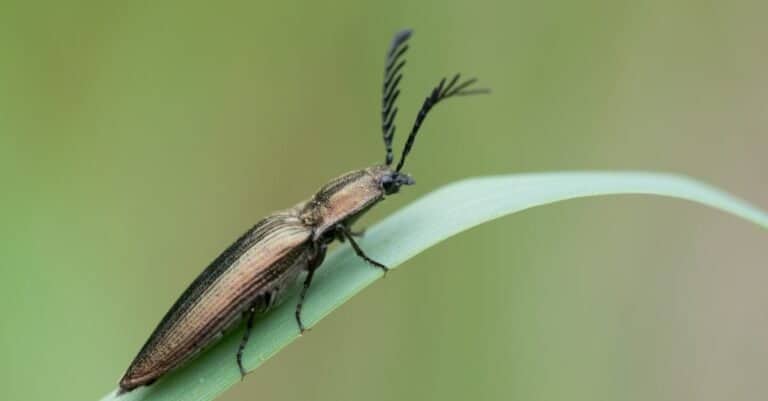
Karolsejnova/Shutterstock.com
Types of beetles - click beetle

At a Glance

Family Overview This page covers the Click Beetle family as a group. Stats below are general traits shared across the family.
Also Known As Skipjack, Spring beetle, Springing beetle, Snapping beetle, Wireworm
Diet Omnivore
Activity Nocturnal+
Lifespan 3 years
Weight 0.006 lbs
Status Not Evaluated
Did You Know?

Family-wide size range is broad: adults span roughly ~2-50 mm long (most are much smaller than the biggest tropical/temperate species).

Size Comparison

Human 5'8"
Click Beetle 0 in

Click Beetle stands at 0% of average human height.

Scientific Classification

Family Overview "Click Beetle" is not a single species but represents an entire family containing multiple species.

Click beetles (family Elateridae) are elongate beetles best known for a spring-loaded clicking mechanism (a prosternal spine snapping into a mesosternal groove) that produces an audible click and can flip the beetle into the air to escape predators or right itself.

Kingdom
Animalia
Phylum
Arthropoda
Class
Insecta
Order
Coleoptera
Family
Elateridae

Distinguishing Features

  • Elongate, parallel-sided beetle body form
  • Characteristic “click”/flip mechanism using a spine-and-groove on the underside of the thorax
  • Often able to right themselves by snapping into the air
  • Larvae (wireworms) typically slender, hard-bodied, and soil/wood-associated

Physical Measurements

Males and females differ in size

Height
0 in (0 in – 1 in)
Length
1 in (0 in – 2 in)
Weight
0 lbs (0 lbs – 0 lbs)
Top Speed
16 mph
Fly about 5–25 km/h

Appearance

Primary Colors
Skin Type Hard beetle exoskeleton with firm elytra; surface ranges from smooth and glossy to matte, finely pitted, or densely hairy or velvety. Thorax has a prosternal spine and mesosternal groove for clicking jumps.
Distinctive Features
  • Family-wide body plan: typically elongate, narrow, and somewhat parallel-sided (streamlined 'click beetle' profile), though overall robustness varies among lineages.
  • Thoracic clicking mechanism: a prosternal spine that snaps into a mesosternal groove, producing an audible click and enabling the beetle to flip into the air (commonly used to right itself and as an escape response).
  • Pronotum often with distinct posterior angles (sometimes sharply pointed), giving the 'shouldered' outline typical of many elaterids; degree of projection varies by species.
  • Head often partially recessed under the pronotum when viewed from above; eyes lateral; mouthparts adapted for varied adult diets (many feed little, others take nectar/pollen or plant material).
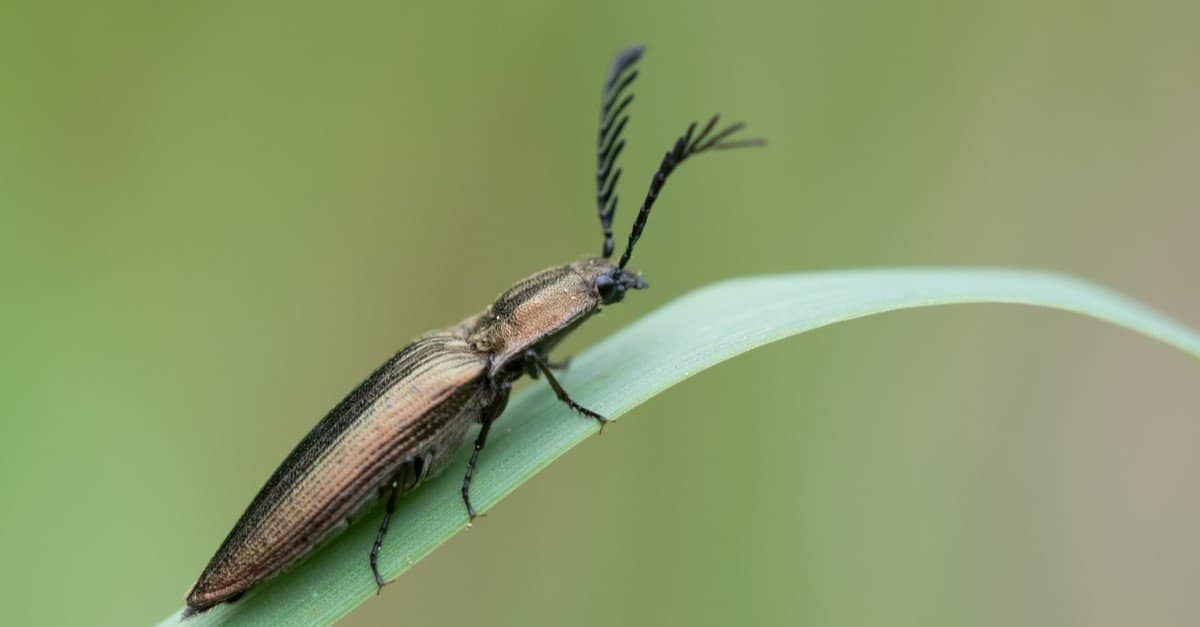
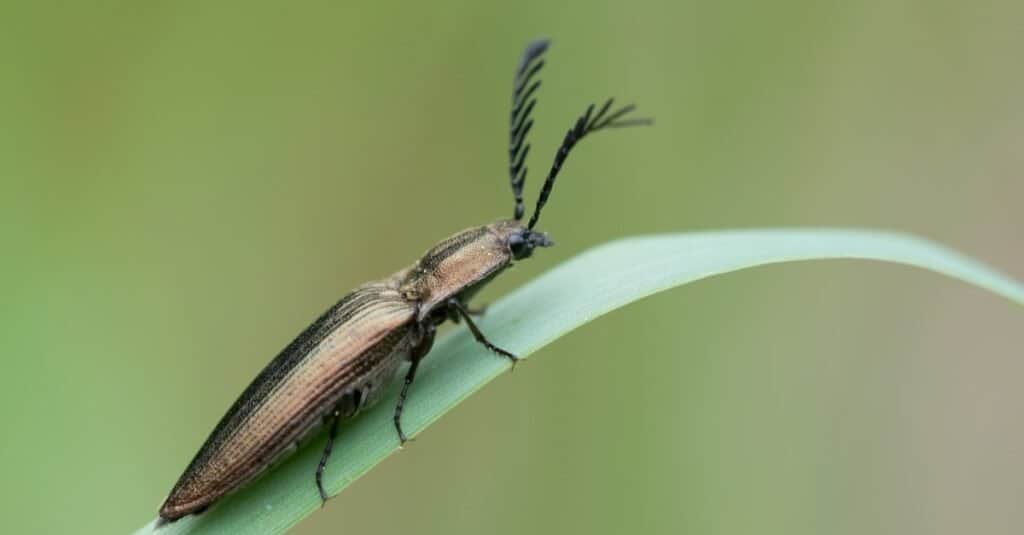
  • Antennae commonly serrate; in some taxa more strongly serrate to pectinate/flabellate (especially in males), aiding chemoreception.
  • Click beetle larvae, called wireworms, are slender, tough, wormlike with hard skins. They live in soil, leaf litter, rotting wood, or under bark. Some eat roots or seeds; others prey and can be crop pests.
  • Measurement range (adult size across the family): approximately ~0.2-6.5 cm in body length from the smallest to the largest members (many species fall in the mid-single-digit to low tens of millimeters).
  • Adult click beetles usually live weeks to a few months (often about 1–12+ weeks). Larvae develop months to several years (commonly 1–5 years). Whole cycle often 1–6+ years.
  • Elateridae adults often night- or twilight-active and come to lights; some day-active and may fly or stay still. Larvae live in soil, grassland, forest, wetlands, decaying wood; they are predators, scavengers, or root/seed feeders worldwide.
  • Bioluminescence occurs in some (not all) elaterids: certain lineages produce light (often greenish) from thoracic/abdominal organs; this is a notable but minority trait and should not be assumed for the entire family.

Sexual Dimorphism

Sexual dimorphism is variable across Elateridae: many species show subtle differences, while others are more distinct. The most common dimorphism involves antennae (males often more elongate/serrate/pectinate), with size/shape differences generally modest; some groups show clearer distinctions.

  • Antennae frequently longer and more strongly serrate/pectinate than in females, improving detection of female pheromones.
  • Often slightly narrower or more streamlined body form in some species (not universal).
  • In some luminous elaterids, light organ expression/intensity and placement can differ subtly by sex (varies by lineage).
  • Often slightly larger or broader abdomen associated with egg production (degree varies).
  • Antennae commonly shorter/less elaborated than males in species with antennal dimorphism.
  • In many species, external differences can be minimal, requiring close comparison or examination for reliable sexing.

Did You Know?

Family-wide size range is broad: adults span roughly ~2-50 mm long (most are much smaller than the biggest tropical/temperate species).

The loud click comes from a prosternal spine snapping into a mesosternal groove-a mechanical latch-and-spring system in the thorax.

Many species can launch themselves several body lengths into the air to right themselves or startle predators.

Larvae are called wireworms: tough, cylindrical, often amber-brown grubs that can live in soil, leaf litter, rotting wood, or under bark.

Across Elateridae, larval diets vary widely-some are predators of other soil invertebrates, others scavenge/consume decaying plant tissue, and some attack living roots and seeds.

A subset of click beetles (not the whole family) are bioluminescent-especially in tropical lineages such as "fire click beetles" (e.g., Pyrophorus), with glowing organs used in defense and signaling.

Overall lifespan varies by species and habitat: adults typically live weeks to a few months, while larvae commonly persist 1-5+ years before pupating. (Some wireworms can take several years to mature.)

Unique Adaptations

  • Thoracic clicking apparatus: a prosternal spine fits into a mesosternal groove, functioning like a latch that stores muscular energy and releases it as a rapid snap-producing sound plus a jump.
  • Elongate, streamlined body plan (typical of many elaterids) with tapered ends that helps them wedge into crevices under bark, stones, and soil clods-and makes the flip-and-land maneuver more effective.
  • Wireworm toughness: larvae have a hardened, wiry body wall that resists abrasion in soil and woody debris and helps deter some predators.
  • Soil/wood lifestyle flexibility: across the family, larvae are adapted for subterranean or subcortical life (reduced exposed surfaces, strong mandibles), supporting roles from predation to plant-feeding depending on lineage.
  • Bioluminescence in some lineages: certain click beetles possess light-producing organs (notably in tropical "fire click beetles"), an adaptation associated with defense and communication.

Interesting Behaviors

  • Righting behavior: when overturned, many elaterids arch the body, lock the thoracic mechanism, then release it to catapult upright-often repeating multiple times if the first flip fails.
  • Predator evasion by startle: the sudden audible click and unpredictable leap can disrupt attacks by birds, small mammals, reptiles, and predatory insects.
  • Nocturnality is common, but not universal: many adults are more active at dusk/night and are frequently attracted to artificial lights; others are day-active in open habitats.
  • Larval ecology is highly variable across the family: wireworms may hunt other larvae/worms in soil, bore in decaying wood, or feed on germinating seeds and roots-so the same "wireworm" label includes both beneficial predators and agricultural pests.
  • Habitat breadth is global and diverse: elaterids occur on every continent except Antarctica, from forests and grasslands to wetlands, deserts, and agricultural fields; larvae often track soil moisture and temperature gradients seasonally.
  • Adult feeding ranges from pollen/nectar/plant fluids to little or no feeding in some species; many adults focus on mating and dispersal while larvae do most growth.

Cultural Significance

Click beetles (Elateridae) are known two ways: as wireworms that damage seeds, roots, and crops, and as glowing “living lights” in the Caribbean and Americas that inspire names and stories. Their clicking jump helps teach kids about nature.

Myths & Legends

In parts of the West Indies, people caught glowing click beetles (Elateridae) and kept them briefly as living lanterns or wore them as glowing decorations, a practice noted in local custom and early nature writings.

Naming lore: the genus name Pyrophorus ("fire-bearer") reflects long-standing human fascination with the glowing 'fire click beetles,' which entered travelogues and popular stories as natural 'lamps' of the tropics.

Folkloric association by resemblance: in rural storytelling across the Americas, glowing beetles appear in songs and tales as tiny wandering lights of the night, symbols of courtship or guiding lights in the dark.

Elateridae's snapping jump gave rise to names like "click beetle" and "spring beetle," leading people to imagine the insect as a living spring or trickster that can pop free when trapped.

Conservation Status

NE Not Evaluated (family-level taxon; many individual species assessed across a wide range of categories)

Has not yet been evaluated against the criteria.

Population Unknown

You might be looking for:

Eastern eyed click beetle

22%

Alaus oculatus

Large North American click beetle with prominent eyespots on the pronotum.

Wireworm click beetles (common agricultural types)

18%

Agriotes spp.

Numerous species whose larvae (“wireworms”) are important crop pests in many regions.

Luminous click beetles

14%

Pyrophorus spp.

Neotropical click beetles with bioluminescent organs; some glow continuously.

Brown click beetles

10%

Athous spp.

Widespread genus in the Palearctic; many species are brown, elongate, and typical-looking click beetles.

Heath click beetle

8%

Selatosomus aeneus

A Palearctic species often associated with open habitats; metallic or bronzy tones.

Life Cycle

Birth 150 larvas
Lifespan 3 years

Lifespan

In the Wild
0.5–6 years
In Captivity
0.5–7 years

Reproduction

Mating System Polygynandry
Social Structure Solitary
Breeding Pattern Transient
Fertilization Internal Fertilization
Birth Type Internal_fertilization

Elateridae (click beetles) are solitary. Adults do not form pair bonds; mating is brief when males meet females ready to mate. They may mate with multiple partners. Smells (sex pheromones) and habitat cues bring them together. Eggs are fertilized inside and laid in soil or rotting wood.

Behavior & Ecology

Social Aggregation Group: 5
Activity Nocturnal, Crepuscular, Diurnal, Cathemeral
Diet Omnivore Highly variable across Elateridae: many larvae ("wireworms") commonly feed on germinating seeds and living roots; many adults commonly take pollen/nectar when available.
Seasonal Hibernates

Temperament

Non-aggressive; primary defense is evasive behavior rather than fighting
Strong startle/escape responses: the prosternal click can right the beetle or launch it to evade predators; many also feign death (thanatosis) after clicking
Generally wary and quick to drop from vegetation or seek cover when disturbed; adults may fly away, though flight propensity varies among species
Ecological roles span detritivores, predators, and plant-associated feeders depending on life stage and lineage; larvae often remain hidden and cryptic for long periods, contributing to a 'stealthy' temperament
High diversity within the family: some lineages are more arboreal, others soil-dwelling; some are strongly light-attracted while others are not; some species are bioluminescent (e.g., in certain tribes), influencing nighttime behaviors
Click beetles (Elateridae) vary in size from about 0.2 to 6 cm. Life cycles usually last one to several years (larvae often take years); adults live weeks to a few months.

Communication

Audible mechanical click produced by the prosternal spine mechanism; primarily associated with defense/righting, but can incidentally function as a disturbance signal in close proximity
Sex pheromones for long-range mate attraction and location Common across many beetles; strength/chemistry varies among lineages
Contact chemoreception via antennae and tarsi Recognition of mates, hosts, and microhabitats
Tactile signals during courtship and mating Antennal touching, mounting behaviors
Substrate-borne vibrations from movement and clicking; likely relevant at short range in cluttered habitats, though importance varies
Bioluminescent signaling in some elaterid groups Where present, used in nighttime context for mate attraction/recognition and possibly predator deterrence

Habitat

Biomes:
Tropical Rainforest Tropical Dry Forest Savanna Desert Hot Desert Cold Mediterranean Temperate Grassland Temperate Forest Temperate Rainforest Boreal Forest (Taiga) Tundra Alpine Wetland +7
Terrain:
Mountainous Hilly Plateau Plains Valley Coastal Island Riverine Volcanic Karst Rocky Sandy Muddy +7
Elevation: Up to 14763 ft 9 in

Ecological Role

Diverse soil-and-vegetation-associated consumers and occasional predators; includes both important herbivorous crop pests (wireworms) and beneficial predatory soil-dwellers, with adult flower-visiting common in many lineages.

soil food-web regulation (predation on some soil pests/other invertebrates in predatory species) herbivory impacts on plant communities and agriculture (root/seed feeding; sometimes major crop damage) nutrient cycling via consumption of decaying plant matter/fungi and bioturbation during larval movement pollination support in some habitats through adult pollen/nectar feeding (usually incidental rather than specialized) prey base for birds, mammals, reptiles, amphibians, and other insects

Diet Details

Main Prey:
Soft-bodied soil invertebrates Beetle larvae Fly larvae moth and butterfly larvae Insect eggs Aphids and other small, slow-moving insects Springtails and other soil arthropods +1
Other Foods:
Plant roots Seeds and grain kernels Underground stems and tubers Decaying plant material Pollen Nectar Plant sap Fungi and decaying organic matter +2

Human Interaction

Domestication Status

Wild

Click beetles (Elateridae) have no history of domestication. People meet them by chance—at lights, in gardens, or fields. Larvae called wireworms live in soil and eat seeds and roots, harming crops. Many species have long larval stages and short-lived adults. Adults click to flip over; some kinds glow.

Danger Level

Low
  • No venom and not known to transmit human diseases; adults may startle people due to loud clicking and sudden flipping.
  • Rare minor skin irritation/allergy from handling insects or contact with defensive secretions (not common).
  • Indirect harm via agriculture: wireworm larvae of multiple elaterid species can damage crops (e.g., cereals, potatoes, corn and other roots/seeds), leading to economic losses rather than direct human injury.

As a Pet

Not Suitable as Pet

Legality: Keeping common, locally found click beetles (Elateridae) short-term is often legal, but laws differ by country, state, or land ownership. Some species are protected, and moving live beetles can be banned for pest or biosecurity risk (wireworms).

Care Level: Moderate

Purchase Cost: Up to $25
Lifetime Cost: $10 - $150

Economic Value

Uses:
Agriculture (pest impact and management) Research and education Biodiversity monitoring / environmental assessment Public outreach / natural history interest (including bioluminescent species)
Products:
  • No standard commercial products; primary economic relevance is indirect (crop losses from wireworms; costs of monitoring and control).
  • Used as study organisms and teaching specimens; some are collected for displays/educational collections (often regulated).

Relationships

Predators 8

Robins and thrushes
Robins and thrushes Turdidae
European Starling
European Starling Sturnus vulgaris
Ground-foraging insectivorous bats Myotis
Common shrew Sorex araneus
Frog
Frog Ranidae
Ground beetles Carabidae
Wolf spider
Wolf spider Lycosidae
Parasitic wasps Ichneumonidae

Related Species 8

Wireworm click beetles Agriotes spp. Shared Family
brown click beetles Athous spp. Shared Family
Eyed click beetles Alaus Shared Family
Bioluminescent click beetles Pyrophorus Shared Family
Melanotus Melanotus Shared Family
Limonius Limonius Shared Family
Elater Elater Shared Family
Selatosomus Selatosomus Shared Family

Types of Click Beetle

12

Explore 12 recognized types of click beetle

Eastern eyed click beetle Alaus oculatus
Bioluminescent click beetle Pyrophorus noctilucus
Striped wireworm click beetle Agriotes lineatus
Red-legged click beetle Athous haemorrhoidalis
European wireworm click beetle Agriotes obscurus
Common eastern wireworm click beetle Melanotus communis
Pacific coast wireworm click beetle Limonius canus
California wireworm click beetle Limonius californicus
Red click beetle Elater ferrugineus
Bronze click beetle Selatosomus aeneus
Stag beetle mimic click beetle Chalcolepidius zonatus
Eyed click beetle (tropical American species) Alaus lusciosus

Click beetles are named for the clicking noise they make to escape predators.

Summary

Click beetles are insects in the family Elateridae. They’re characterized by their ability to snap a spine-like structure into a groove on their thorax. This makes a clicking sound that startles predators and helps them to get back up when they fall on their backs. The larvae of click beetles are known as wireworms. These long slender larvae are destructive pests that attack seeds, roots, and underground stems of various plants. 

Click Beetles Species, Types, and Scientific Name

The name click beetles apply to insects in the family Elateridae. They also have other common names, such as snapping beetles, spring beetles, elaters, and skipjacks. The insects in this family are characterized by their unusual click mechanism, which they use to avoid predation. 

Although there are a few other families of insects with similar mechanisms, members of the family Elateridae are considered the “true click beetles.” Examples of false click beetles include members of the family Eucnemidae and Cerophytidae. These are known as false click beetles and rare click beetles, respectively. 

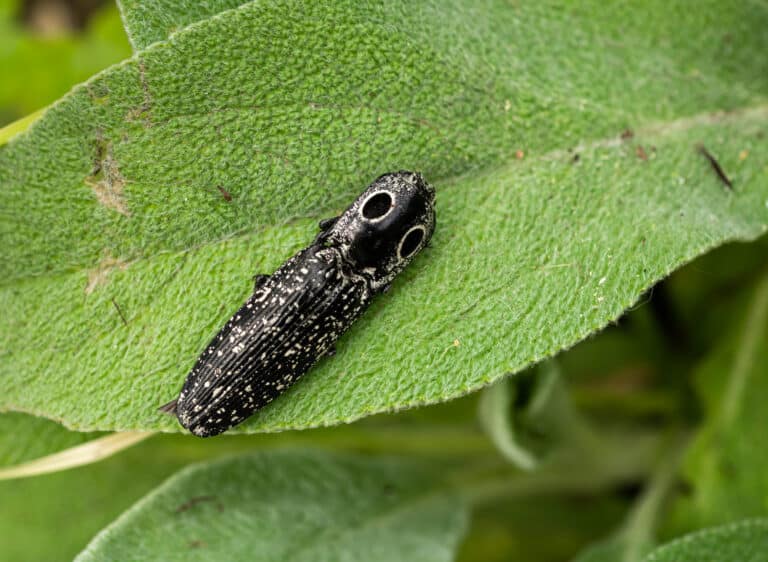
This cosmopolitan beetle family has up to 9300 known species found worldwide. Close to 1000 of these species are native to North America. The eyed click beetle (Alaus oculatus) is one of the most popular members of this family. Another popular group is the Pyrophorus (also known as fire beetles). They’re more popular for their impressive bioluminescent property. 

Appearance: How to Identify Click Beetles
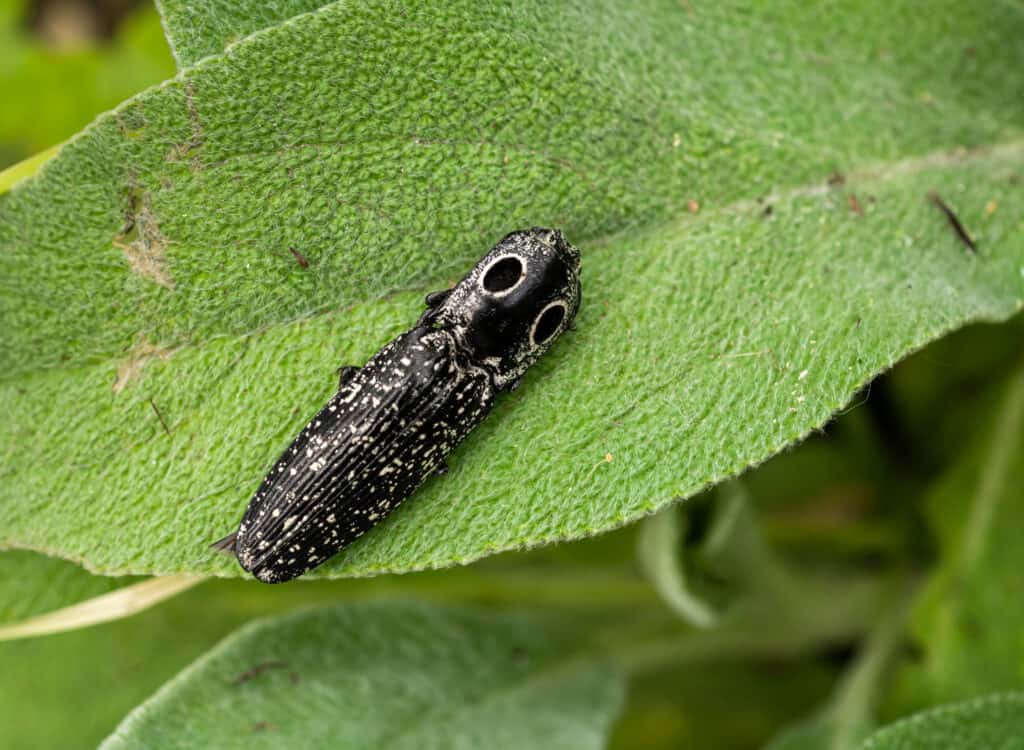
Eastern Eyed Click Beetl

The eyed click beetle (Alaus oculatus) is characterized by prominent oval eye spots on the pronotum.

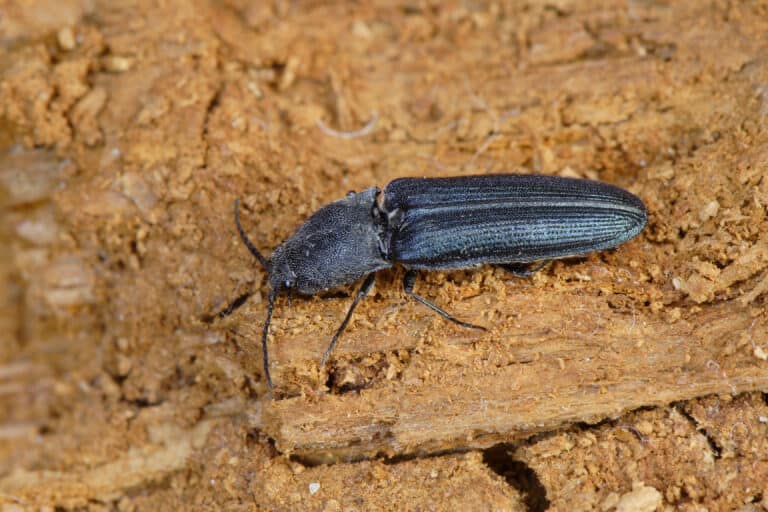
Snapping beetles vary in size and appearance. While some species in this family are large and colorful, others are dull-colored and are less than 2cm (0.78inches) long. Most click beetles have an elongated shape with parallel sides and a flattened body. They usually have backward projections on the side corners of their exoskeleton extending behind their head. 

Smaller species are typically around about 0.6cm (1/4 inches) long. However, larger ones like the Alaus oculatus can be up to 1 to 1.5 inches (2.5cm to 3.8cm) in length. Most species are brown or black. However, there are a few with bright colors. These are typically reddish and yellowish with patterns on their shell. 

The eyed click beetle (Alaus oculatus) is characterized by prominent oval eye spots on the pronotum. One unique characteristic of this group of insects is their ability to snap their prothorax and mesothorax segments to flip the air. They use this acrobatic move to right themselves, and it also produces a violent click sound that startles predators. 

The larvae of these beetles are called wireworms. These brownish, hard-bodied worms have a brownish color. They’re cylindrical and often measure between ½ to 2-½ inches (1.2cm 6.4cm) in length. Wireworms have 3 pairs of tiny true legs behind their heads, and their body ends with a flat, shield-like segment. 

Adult snapping beetles are typically nocturnal. They’re leaf feeders, but they’re hardly ever problematic pests. They may enter homes sometimes, but they’re not household pests. Wireworms mostly feed on dead organic matter. However, some species are serious agricultural pests. In addition, the larvae of a few species are active insectivorous predators. 

Habitat: Where to find Click Beetles

Click beetles are found worldwide in various habitats. They’re mostly outdoor insects living in fields, gardens, and bushes but rarely indoors. Adults spend most days hidden under barks or near plants. However, they’re more active at night and often fly toward light sources. Sometimes, in the mornings, you may see them resting on the side of buildings near a light source. The larvae hatch from eggs underground and can remain in the soil for up to 3 years. 

Diet: What Do Click Beetles Eat?

Adult click beetles are herbivorous. They feed on the leaves of various plants. They’re also attracted to sweet liquids such as nectar and other plant juices. The larvae (wireworms) eat different foods depending on the species. Most species feed on decaying plant matter in the soil, such as rotting wood. However, many species are agricultural pests, feeding on plant roots, sprouts, and seeds. Common crops they feed on include potato, strawberry, corn, and wheat. Some wireworms are also insectivorous. They prey on the larvae of other beetles, such as those of long-horned beetles and other insects that live in rotting wood.

What Eats Click Beetles? 

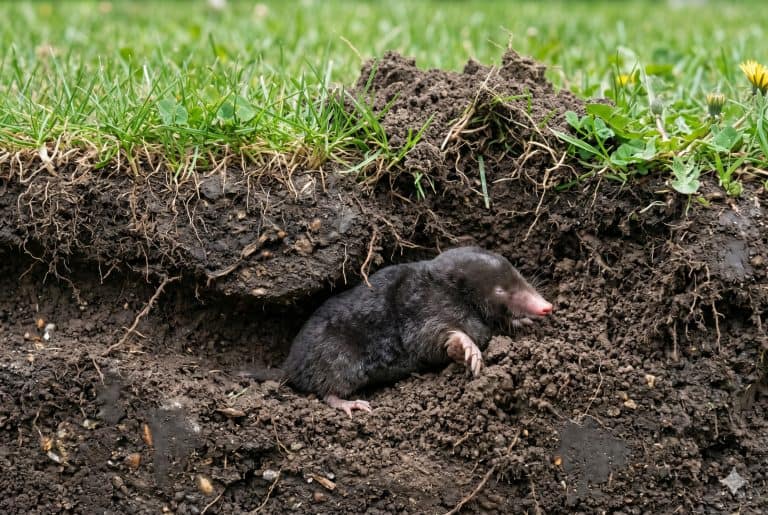
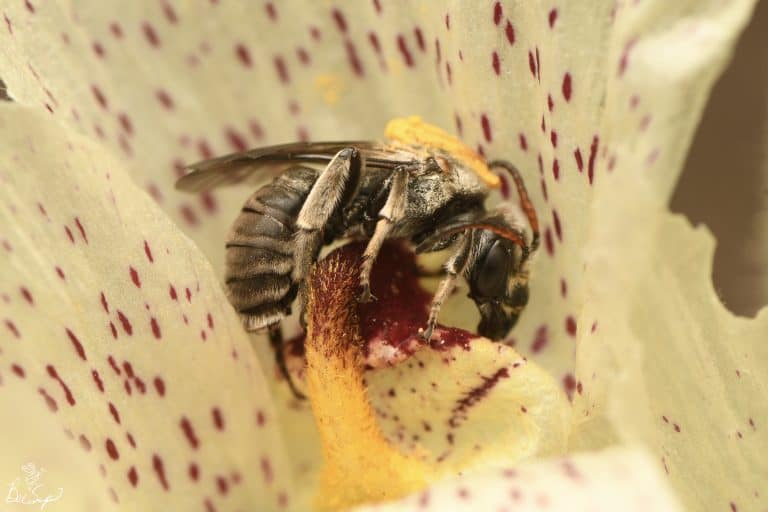
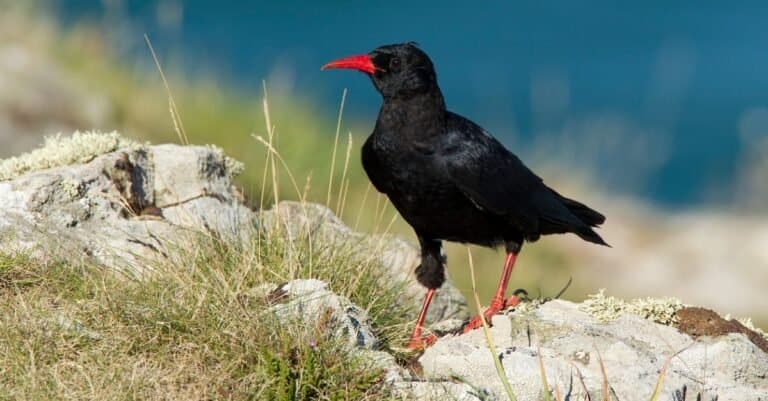
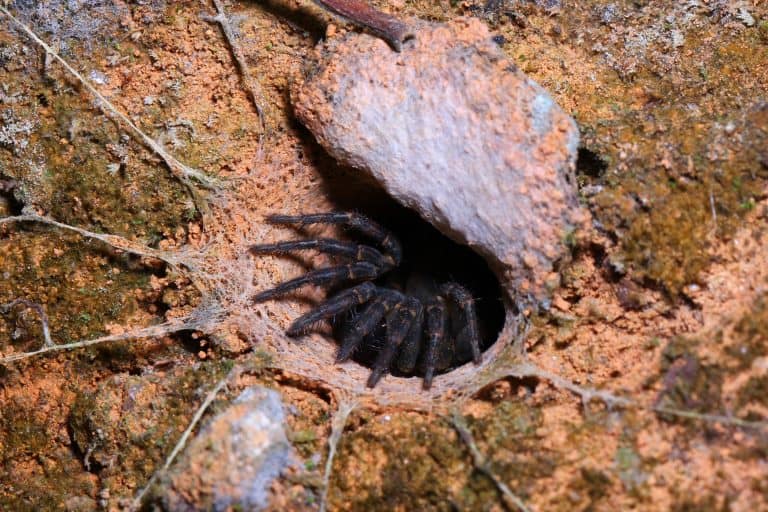
Rodents such as moles and shrews can prey on click beetles. Insectivorous birds can also pick them up and feed on them. Other insects, spiders, and mantises also prey on this beetle. Their clicking sound and acrobatic jump are adaptations that help them escape from predators. But this doesn’t always work, especially with larger predators. 

Prevention: How to Get Rid of Click Beetles

Adult snapping beetles hardly eat at all. Species that feed only eat very little, so farmers do not consider them serious agricultural pests. Unfortunately, we cannot say the same for their larvae. They attack various crops and tend to be very resistant to insecticides. They can also pass through the soil, spreading from one plant to the other within a short time. 

Methods of controlling wireworm infestations include clean cultivation and clean fallowing. You can also consider planting seed shallow and under warm conditions. This allows the seeds to germinate faster than the wireworm can damage it. There may be specific management practices for specific crops susceptible to these worms’ damage. 

Related Animals 

View all 392 animals that start with C

Sources

  1. Wikipedia / Accessed October 6, 2022
  2. Encyclopaedia Britannica / Accessed October 6, 2022
  3. Texas A&M Extension / Accessed October 6, 2022
  4. Missouri Department of Conservation / Accessed October 6, 2022
Abdulmumin Akinde

About the Author

Abdulmumin Akinde

Abdulmumin is a pharmacist and a top-rated content writer who can pretty much write on anything that can be researched on the internet. However, he particularly enjoys writing about animals, nature, and health. He loves animals, especially horses, and would love to have one someday.
Connect:

Thank you for reading! Have some feedback for us?


Click Beetle FAQs (Frequently Asked Questions)

Click beetles are named for the clicking noise they make to escape from predators. The beetle can snap a spine-like structure on their thorax into a groove beneath its pronotum. The clicking motion helps the beetle flip itself the right way and startles predators to allow them to escape an attack.