Quick Take
- Most 'purple' birds aren't actually purple, and the reason they appear that way is more fascinating than simple pigment. See iridescent violet plumage →
- One of these purple birds lives wild in Florida's wetlands, and most locals have no idea it exists. Florida's hidden wetland bird →
- A few of these species look completely black from a distance, and spotting the purple requires knowing exactly where and when to look. Spot the purple sheen →
- Some males on this list are dazzling jewel-toned purple; their female counterparts are so dull you'd never guess they're the same species. Males vs. dull females →
Purple is one of the rarest plumage colors in the bird world, but a few purple beauties do exist. Very few species are bright purple all over; most have patches of purple or appear iridescent in sunlight. Continue reading to discover 11 purple birds, including how to identify each species and where they live.
European Starling
Characteristics: The European starling (Sturnus vulgaris) is one of the most well-known purplish birds in the United States. Though these stocky birds with long beaks and short tails appear black, they actually feature a purple, blue, and green glossy sheen. The sheen is best seen in the summer sun.
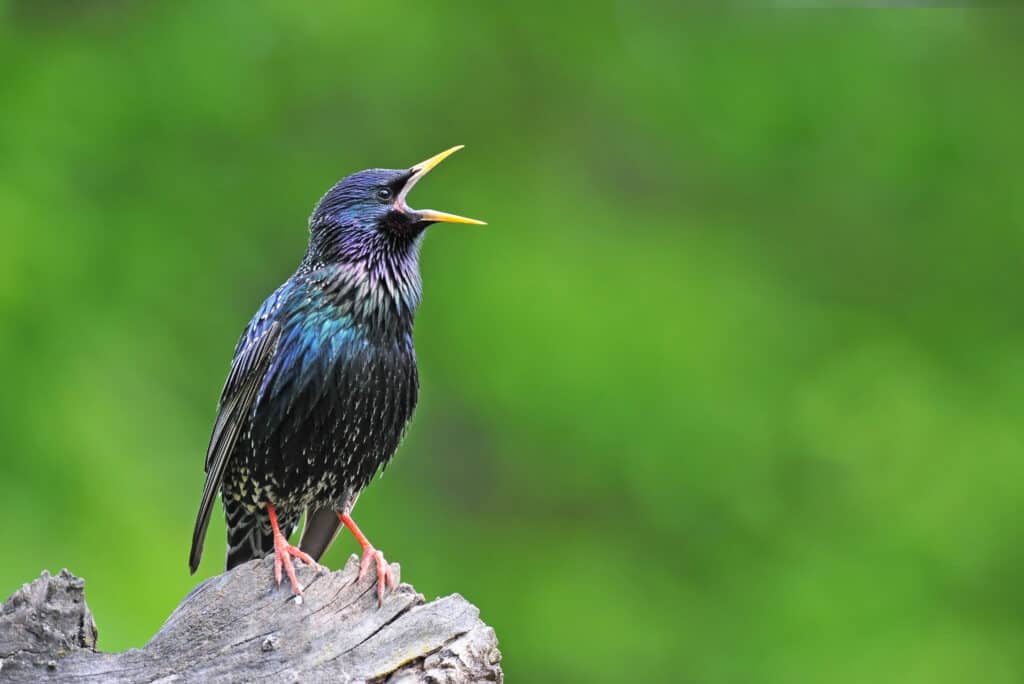
European starlings are excellent mimics and can imitate other birds, machinery, and human speech. They are native to Europe, Asia, and Africa.
©Soru Epotok/Shutterstock.com
Location/Habitat: European starlings are native to Europe and parts of Asia. However, they are also abundant throughout the United States and Canada as an introduced species. They are common in towns, cities, backyards, parks, and fields.
Purple Martin
Characteristics: Purple martins (Progne subis) are swallows with slightly hooked beaks, broad chests, forked tails, and long wings that taper to a point. Adult purple martins are shiny dark bluish-purple with black wings and black tails. However, they look black from a distance.
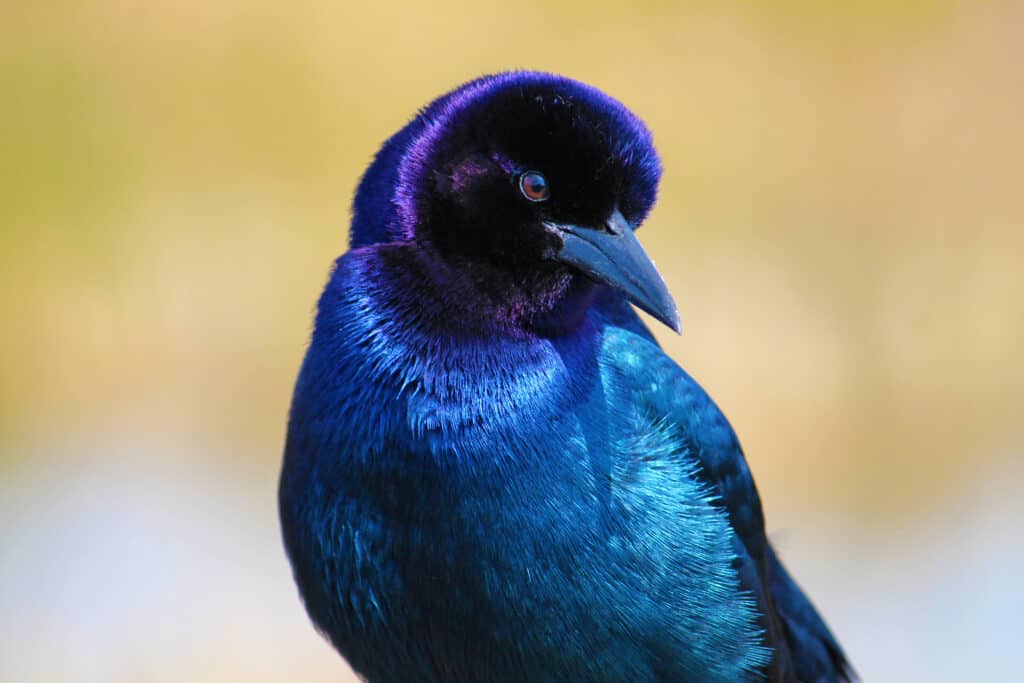
Purple martins have a wingspan of 15.3–16.1 inches and a length of 7.5–7.9 inches. Up close, they are iridescent purple and blue.
©iStock.com/KennShapiro
Location/Habitat: Purple martins are long-distance migrants that breed in the Eastern United States and Canada before wintering in South America. You can find them in open fields, wet meadows, parks, and towns.
Purple-Breasted Cotinga
Characteristics: The purple-breasted cotinga (Cotinga cotinga) is a medium-sized tropical bird with a plump body and a small head. These brightly colored birds are striking because of their turquoise-to-blue, purple, and black plumage. However, only the males are colorful. Females are brown with spotted breasts.

Purple-breasted cotingas live in the rainforest canopy of moist lowland forests. They are turquoise, blue, purple, and black.
Location/Habitat: Purple-breasted cotingas are found in seven South American countries: Brazil, Colombia, Venezuela, Guyana, French Guiana, and Suriname, with a limited distribution in Peru. These cotingas live in the rainforest canopy of moist lowland forests.
Violet-backed Starling
Characteristics: The violet-backed starling (Cinnyricinclus leucogaster) is a small starling with vibrant, iridescent plumage. Males are white below and bright violet above, while females are streaky brown with no bright coloring. Additionally, they feature black beaks, black legs, and yellow eyes.
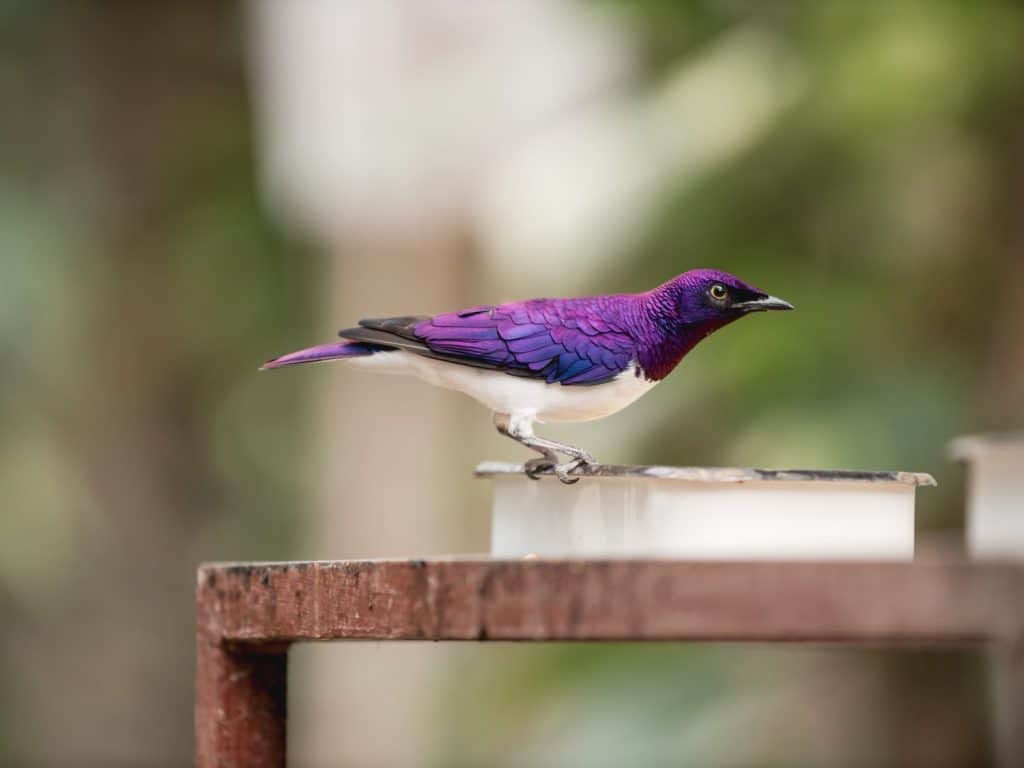
The metallic purple feathers of the male violet-backed starling are used to attract a female. These birds inhabit arid open woodlands and clearings.
©Konstantin Aksenov/Shutterstock.com
Location/Habitat: Violet-backed starlings live in Sub-Saharan Africa, where they are a relatively common bird. These birds inhabit arid open woodlands, clearings, and gallery forests.
Purple Honeycreeper
Characteristics: Purple honeycreepers (Cyanerpes caeruleus) belong to the tanager family. They are small, colorful birds found in the Neotropics. Their long, decurved beaks and vibrant coloring are their most distinctive features. Adult males are dark purple-blue with black wings and tails.

The purple honeycreeper has bright, purple feathers with black wings. Its long, decurved bill and vibrant coloring are its distinguishing features.
©iStock.com/Chelsea Sampson
Location/Habitat: The purple honeycreeper lives in the northern part of South America, inhabiting lowland forest canopies. You can also spot them in citrus and cocoa plantations.
Purple Grenadier
Characteristics: The purple grenadier (Granatina ianthinogaster) is a small seed-eating bird with unique coloring. Males have red heads, a blue patch around their eyes, and a purplish-blue body. Their tails are black, and their beaks are red. Females feature cinnamon-brown plumage and white barring.

The purple grenadier has a beautiful color combination of chestnut brown and muted violet. Their tails are black, and their beaks are red.
©iStock.com/neil bowman
Location/Habitat: The purple grenadier inhabits tropical shrublands in Eastern Africa, including Kenya, South Sudan, Somalia, Uganda, Ethiopia, and Tanzania.
Varied Bunting
Characteristics: Varied buntings (Passerina versicolor) are small songbirds with long tails and thick conical beaks. During the breeding season, adult males are a mix of deep purples and reds, with black facial markings and red eye rings. Outside of the breeding season, they feature dark brown plumage.

Varied buntings prefer dense cover in arid areas, like canyons or thorn forests. Males during the breeding season are deep purples and reds.
©iStock.com/Banu R
Location/Habitat: Varied buntings live in the Southwestern United States and Mexico. They are short-distance migrants that move to southern Mexico during winter. They prefer dense cover in arid areas, like canyons, thorn forests, and desert washes.
Costa’s Hummingbird
Characteristics: Costa’s hummingbirds (Calypte costae) are small, plump hummingbirds with short tails. They are notable for their gorget, which flares outward like a mustache on either side of the throat. Adult males are olive green and gray but have iridescent purple crowns and throats. Females have duller plumage, featuring green and white.
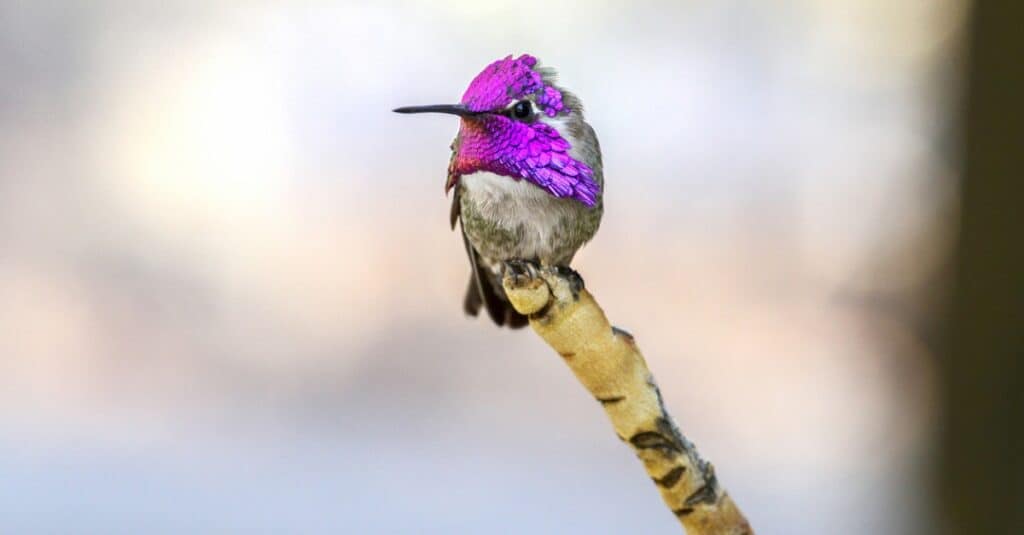
Unlike this male, the female Costa’s hummingbird doesn’t have purple feathers. Females have dull plumage, featuring green and white.
©iStock.com/Monica Lara
Location/Habitat: Costa’s hummingbird lives in the Southwestern United States and Northern Mexico, primarily in arid interior regions. Its habitats include desert scrub, coastal scrub, and deciduous forests.
Violet Sabrewing
Characteristics: The violet sabrewing (Campylopterus hemileucurus) is a large hummingbird with a long tail and a long, decurved bill. Males are a mixture of glossy, iridescent blue, purple, green, and black, with metallic violet napes. Females are bronze and metallic green.

Violet Sabrewings flying next to a beautiful red flower, sucking nectar in a Costa Rican tropical forest.
©Ondrej Prosicky/Shutterstock.com
Location/Habitat: Violet sabrewings are year-round residents of southern Mexico and Central America. They inhabit humid evergreen forests, banana plantations, and gardens.
Gray-headed Swamphen
Characteristics: The gray-headed swamphen (Porphyrio poliocephalus) is a large wading bird known as a rail; like other waders, they have long legs and toes. They also have thick necks, heavy beaks, and short tails. Their bodies are a mix of green and purple, with bright red frontal shields.

The gray-headed swamphen gets its common name swamphen from its affinity for swampy habitats.
©Pictures Punetha/Shutterstock.com
Location/Habitat: The gray-headed swamphen has a very small range in the United States, limited to the southern tip of Florida, where it lives year-round. These rails live in many of Florida’s wetlands, including marshes, sloughs, golf course ponds, and artificial wetlands. However, they tend to avoid saltwater wetlands.
Violet-Crowned Woodnymph
Characteristics: The violet-crowned woodnymph (Thalurania colombica) is a slender hummingbird with a long beak. Males are vibrant and metallic, with violet, bronze, and green plumage. Their throats are so shiny that they appear to glitter like sequins. Females are gray and bluish-green and are not as iridescent.

The violet-crowned woodnymph male is violet while the female is green.
©iStock.com/neil bowman
Location/Habitat: The violet-crowned woodnymph is found from Belize south to Peru, including the northern tip of South America. They live in the interior and edges of humid forests. You can also find them in cacao plantations and gardens. Violet-crowned woodnymphs belong to the Trochilidae family and are classified as emerald hummingbirds.